本讲义涵盖主题 1,数(Number)。剑桥数学有两个层次:核心(Core)和拓展(Extended)。标记 (Extended) 的部分只在拓展卷上考查;其他一切对两个层次都适用。
数
IGCSE 数学 · 第 1 主题
 30:48
30:48
Number
Two buses leave the same stop at nine o'clock. One runs every twelve minutes, the other every eighteen. When do they next leave together? Not at thirty…
英文讲解 · 内嵌中英文字幕
1.1
数的类型

大纲
| Subject content | Notes and examples |
|---|---|
| Identify and use: • natural numbers • integers (positive, zero and negative) • prime numbers • square numbers • cube numbers • common factors • common multiples • rational and irrational numbers • reciprocals. | Example tasks include: • convert between numbers and words, e.g. six billion is 6000000000 10007 is ten thousand and seven • express 72 as a product of its prime factors • find the highest common factor (HCF) of two numbers • find the lowest common multiple (LCM) of two numbers. |
来源:剑桥国际大纲
你必须知道不同种类数的词。考官为正确使用它们给分。
Counting numbers and integers
- 自然数(natural numbers)——计数的数 $1, 2, 3, 4, \dots$
- 整数(integers)——整的数,正的、负的或零:$\dots, -2, -1, 0, 1, 2, \dots$
Factors and multiples
- 一个数的因数(factor)整除它,不留余数(remainder)。$18$ 的因数是 $1, 2, 3, 6, 9, 18$。
- 一个数的倍数(multiple)是那个数乘以一个整数。$6$ 的倍数是 $6, 12, 18, 24, \dots$
- 两个数的一个公因数(common factor)是两者的一个因数。
- 两个数的一个公倍数(common multiple)是两者的一个倍数。
Prime, square and cube numbers
- 一个质数(prime number)恰好有两个因数:$1$ 和它自身。最先的质数是 $2, 3, 5, 7, 11, 13, \dots$ 注意 $1$ 不是质数。
- 一个平方数(square number)是一个整数乘以它自身:$1, 4, 9, 16, 25, \dots$
- 一个立方数(cube number)把一个整数用三次:$1, 8, 27, 64, \dots$
Rational, irrational and reciprocal
- 一个有理数(rational number)能被写成两个整数的一个分数(fraction)$\frac{a}{b}$。例子:$\frac{3}{4}$、$5$、$0.7$。
- 一个无理数(irrational number)不能这样写。例子:$\pi$ 和 $\sqrt{2}$。
- 一个数的倒数(reciprocal)是 $1$ 除以那个数。$4$ 的倒数是 $\frac{1}{4}$;$0.25$ 的倒数是 $4$;$\frac{2}{3}$ 的倒数是 $\frac{3}{2}$。
Prime factors, HCF and LCM
$1$ 以上的每个整数是质数,或能被写成质数的一个乘积(product)。要把一个数写成它的质因数(prime factors)的乘积,不断除以合适的最小质数。
Worked example. 把 $72$ 写成它的质因数的乘积。
$$72 = 2 \times 36 = 2 \times 2 \times 18 = 2 \times 2 \times 2 \times 9 = 2 \times 2 \times 2 \times 3 \times 3 = 2^{3} \times 3^{2}.$$

两个数的最大公因数(HCF)(highest common factor)是它们共享的最大因数。最小公倍数(LCM)(lowest common multiple)是它们共享的最小倍数。质因数给出一个快速的方法。
Worked example. 求 $72$ 和 $120$ 的 HCF 和 LCM。
先把每个写成质数的乘积:
$$72 = 2^{3} \times 3^{2}, \qquad 120 = 2^{3} \times 3 \times 5.$$
- HCF:取在两者中出现的每个质数的最低幂:$2^{3} \times 3 = 24$。
- LCM:取出现的每个质数的最高幂:$2^{3} \times 3^{2} \times 5 = 360$。
探索
Sets of numbers
Every counting number is also an integer, every integer a rational — see how the number sets nest, and how union and intersection combine them.
词汇表
训练
| 英文 | 中文 | 拼音 |
|---|---|---|
| natural number/ˈnætʃərəl ˈnʌmbə/ | 自然数 | zì rán shù |
| integer/ˈɪntɪdʒə/ | 整数 | zhěng shù |
| factor/ˈfæktə/ | 因数 | yīn shù |
| remainder/rɪˈmeɪndə/ | 余数 | yú shù |
| multiple/ˈmʌltɪpl/ | 倍数 | bèi shù |
| common factor/ˈkɒmən ˈfæktə/ | 公因数 | gōng yīn shù |
| common multiple/ˈkɒmən ˈmʌltɪpl/ | 公倍数 | gōng bèi shù |
| prime number/praɪm ˈnʌmbə/ | 质数 | zhì shù |
| square number/skweə ˈnʌmbə/ | 平方数 | píng fāng shù |
| cube number/kjuːb ˈnʌmbə/ | 立方数 | lì fāng shù |
| rational number/ˈræʃənl ˈnʌmbə/ | 有理数 | yǒu lǐ shù |
| fraction/ˈfrækʃn/ | 分数 | fēn shù |
| irrational number/ɪˈræʃənl ˈnʌmbə/ | 无理数 | wú lǐ shù |
| reciprocal/rɪˈsɪprəkl/ | 倒数 | dào shǔ |
| product/ˈprɒdʌkt/ | 乘积 | chéng jī |
| prime factor/praɪm ˈfæktə/ | 质因数 | zhì yīn shù |
| highest common factor/ˈhaɪɪst ˈkɒmən ˈfæktə/ | 最大公因数 | zuì dà gōng yīn shù |
| lowest common multiple/ˈləʊɪst ˈkɒmən ˈmʌltɪpl/ | 最小公倍数 | zuì xiǎo gōng bèi shù |
| set/set/ | 集合 | jí hé |
| ratio/ˈreɪʃɪəʊ/ | 比 | bǐ |
1.2
集合

大纲
| Subject content | Notes and examples |
|---|---|
| Understand and use set language, notation and Venn diagrams to describe sets. | Venn diagrams are limited to two sets. The following set notation will be used: • $n(A)$ Number of elements in set $A$ • $A'$ Complement of set $A$ • $\mathscr{E}$ Universal set • $A \cup B$ Union of $A$ and $B$ • $A \cap B$ Intersection of $A$ and $B$. Example definition of sets: $A = \{x : x \text{ is a natural number}\}$ $B = \{a, b, c, \dots\}$ $C = \{x : a \leqslant x \leqslant b\}$. |
| Subject content | Notes and examples |
|---|---|
| Understand and use set language, notation and Venn diagrams to describe sets and represent relationships between sets. | Venn diagrams are limited to two or three sets. The following set notation will be used: • $n(A)$ Number of elements in set $A$ • $\in$ "... is an element of ..." • $\notin$ "... is not an element of ..." • $A'$ Complement of set $A$ • $\varnothing$ The empty set • $\mathscr{E}$ Universal set • $A \subseteq B$ $A$ is a subset of $B$ • $A \nsubseteq B$ $A$ is not a subset of $B$ • $A \cup B$ Union of $A$ and $B$ • $A \cap B$ Intersection of $A$ and $B$. Example definition of sets: $A = \{x : x \text{ is a natural number}\}$ $B = \{(x, y) : y = mx + c\}$ $C = \{x : a \leqslant x \leqslant b\}$ $D = \{a, b, c, \dots\}$. |
来源:剑桥国际大纲
一个集合(set)是对象的一个搜集。集合里的每个对象是集合的一个元素(element)。你应当知道这个记号:
| 符号 | 含义 |
|---|---|
| $n(A)$ | 集合 $A$ 里的元素数量 |
| $x \in A$ | $x$ 是 $A$ 的一个元素 |
| $x \notin A$ | $x$ 不是 $A$ 的一个元素 |
| $\mathscr{E}$ | 全集(universal set)——正在谈论的一切 |
| $A'$ | $A$ 的补集(complement)——不在 $A$ 里的一切 |
| $\varnothing$ | 空集(empty set)——一个没有元素的集合 |
| $A \subseteq B$ | $A$ 是 $B$ 的一个子集(subset)——$A$ 的每个元素也在 $B$ 里 |
| $A \cup B$ | 并集(union)——在 $A$ 或 $B$ 或两者里的元素 |
| $A \cap B$ | 交集(intersection)——在 $A$ 和 $B$ 两者里的元素 |
一个维恩图(Venn diagram)把每个集合画成一个矩形(全集)里的一个圆。核心用两个集合;拓展可能用三个。
Worked example. $\mathscr{E} = \{1,2,3,4,5,6,7,8,9,10\}$,$A = \{\text{even numbers}\}$,$B = \{\text{multiples of } 3\}$。
- $A = \{2,4,6,8,10\}$ 而 $B = \{3,6,9\}$。
- $A \cap B = \{6\}$ ——在两者里的唯一的数。
- $A \cup B = \{2,3,4,6,8,9,10\}$ ——在任一集合里的数。
- $n(A \cup B) = 7$。
你也可能看到一个集合被写成一个规则,例如 $C = \{x : 1 \leqslant x \leqslant 5\}$ 意思是"所有使得 $1 \leqslant x \leqslant 5$ 的值 $x$"。
探索
Venn diagrams
Tap the regions to see union, intersection and complement — the language of sets.
词汇表
训练
| 英文 | 中文 | 拼音 |
|---|---|---|
| element/ˈelɪmənt/ | 元素 | yuán sù |
| universal set/ˌjuːnɪˈvɜːsl set/ | 全集 | quán jí |
| complement/ˈkɒmplɪmənt/ | 补集 | bǔ jí |
| empty set/ˈempti set/ | 空集 | kōng jí |
| subset/ˈsʌbset/ | 子集 | zi jí |
| union/ˈjuːnɪən/ | 并集 | bìng jí |
| intersection/ˌɪntəˈsekʃn/ | 交集 | jiāo jí |
| Venn diagram/ven ˈdaɪəɡræm/ | 维恩图 | wéi ēn tú |
1.3
幂与根
大纲
| Subject content | Notes and examples |
|---|---|
| Calculate with the following: • squares • square roots • cubes • cube roots • other powers and roots of numbers. | Includes recall of squares and their corresponding roots from 1 to 15, and recall of cubes and their corresponding roots of 1, 2, 3, 4, 5 and 10, e.g.: • Write down the value of $\sqrt{169}$ . • Work out $5^2 \times \sqrt[3]{8}$ . |
| Subject content | Notes and examples |
|---|---|
| Calculate with the following: • squares • square roots • cubes • cube roots • other powers and roots of numbers. | Includes recall of squares and their corresponding roots from 1 to 15, and recall of cubes and their corresponding roots of 1, 2, 3, 4, 5 and 10, e.g.: • Write down the value of $\sqrt{169}$. • Work out $5^2 \times \sqrt[3]{8}$. |
来源:剑桥国际大纲
- 一个幂(power)(也叫一个指数(index),复数 indices)显示把一个数乘以它自身多少次:$2^{5} = 2 \times 2 \times 2 \times 2 \times 2 = 32$。
- 一个数的一个平方根(square root)在平方时给出那个数:$\sqrt{169} = 13$,因为 $13^{2} = 169$。
- 一个立方根(cube root)对立方以同样的方式起作用:$\sqrt[3]{8} = 2$,因为 $2^{3} = 8$。
你应当能够回忆从 $1^2$ 到 $15^2$ 的平方(和它们的根),以及 $1, 2, 3, 4, 5$ 和 $10$ 的立方。
Worked example. 算出 $5^{2} \times \sqrt[3]{8}$。
$$5^{2} \times \sqrt[3]{8} = 25 \times 2 = 50.$$
探索
Powers and roots lab
square = x^2
Change the base and see powers grow while roots undo powers.
词汇表
训练
| 英文 | 中文 | 拼音 |
|---|---|---|
| power/ˈpaʊə/ | 幂 | mì |
| index/ˈɪndeks/ | 指数 | zhǐ shù |
| square root/skweə ruːt/ | 平方根 | píng fāng gēn |
| cube root/kjuːb ruːt/ | 立方根 | lì fāng gēn |
1.7
指数 I

大纲
| Subject content | Notes and examples |
|---|---|
| 1 Understand and use indices (positive, zero and negative integers). | e.g. find the value of $7^{-2}$. |
| 2 Understand and use the rules of indices. | e.g. find the value of $2^{-3} \times 2^4$, $(2^3)^2$, $2^3 \div 2^4$. |
| Subject content | Notes and examples |
|---|---|
| 1 Understand and use indices (positive, zero, negative, and fractional). | Examples include: • $6^{\frac{1}{2}} = \sqrt{6}$ • $16^{\frac{1}{4}} = \sqrt[4]{16}$ • find the value of $7^{-2}$, $81^{\frac{1}{2}}$, $8^{-\frac{2}{3}}$. |
| 2 Understand and use the rules of indices. | e.g. find the value of $2^{-3} \times 2^4$, $(2^3)^2$, $2^3 \div 2^4$. |
来源:剑桥国际大纲
当你乘或除同底数(same base)的幂时,用这些规则:
$$a^{m} \times a^{n} = a^{m+n}, \qquad a^{m} \div a^{n} = a^{m-n}, \qquad (a^{m})^{n} = a^{mn}.$$
一些特殊的幂:
$$a^{0} = 1, \qquad a^{-n} = \frac{1}{a^{n}}, \qquad a^{\frac{1}{n}} = \sqrt[n]{a}, \qquad a^{\frac{m}{n}} = \left(\sqrt[n]{a}\right)^{m}.$$
(像 $a^{\frac{m}{n}}$ 这样的分数幂是拓展(Extended)。)
Worked examples.
- $2^{-3} \times 2^{4} = 2^{-3+4} = 2^{1} = 2.$
- $(2^{3})^{2} = 2^{6} = 64.$
- $2^{3} \div 2^{4} = 2^{3-4} = 2^{-1} = \dfrac{1}{2}.$
- $7^{-2} = \dfrac{1}{7^{2}} = \dfrac{1}{49}.$
- $81^{\frac{1}{2}} = \sqrt{81} = 9.$
- $8^{-\frac{2}{3}} = \dfrac{1}{8^{\frac{2}{3}}} = \dfrac{1}{\left(\sqrt[3]{8}\right)^{2}} = \dfrac{1}{2^{2}} = \dfrac{1}{4}.$
词汇表
训练
| 英文 | 中文 | 拼音 |
|---|---|---|
| base/beɪs/ | 底数 | dǐ shù |
1.8
标准形式(科学记数法)

大纲
| Subject content | Notes and examples |
|---|---|
| 1 Use the standard form $A \times 10^n$ where $n$ is a positive or negative integer and $1 \leqslant A < 10$. | |
| 2 Convert numbers into and out of standard form. | |
| 3 Calculate with values in standard form. | Core candidates are expected to calculate with standard form only on Paper 3. |
| Subject content | Notes and examples |
|---|---|
| 1 Use the standard form $A \times 10^n$ where $n$ is a positive or negative integer and $1 \leqslant A < 10$. | |
| 2 Convert numbers into and out of standard form. | |
| 3 Calculate with values in standard form. |
来源:剑桥国际大纲
科学记数法(standard form)把一个数写成 $A \times 10^{n}$,其中 $1 \leqslant A < 10$ 而 $n$ 是一个整数。它用于非常大或非常小的数。
要转换,数小数点移动多少位:
- $4\,500\,000 = 4.5 \times 10^{6}$ ——点向左移 $6$ 位,所以幂是正的。
- $0.00072 = 7.2 \times 10^{-4}$ ——点向右移 $4$ 位,所以幂是负的。
Worked example. 算出 $(3 \times 10^{5}) \times (2 \times 10^{-2})$。
乘前面的数并加幂:
$$3 \times 2 = 6, \qquad 10^{5} \times 10^{-2} = 10^{3}, \qquad \text{so the answer is } 6 \times 10^{3}.$$

探索
Standard form route
Follow a large or small number into a x 10^n form.
词汇表
训练
| 英文 | 中文 | 拼音 |
|---|---|---|
| standard form/ˈstændəd fɔːm/ | 科学记数法 | kē xué jì shù fǎ |
1.18
无理根式

大纲
| Subject content | Notes and examples |
|---|---|
| 1 Understand and use surds, including simplifying expressions. | Examples include: • $\sqrt{20} = 2\sqrt{5}$ • $\sqrt{200} - \sqrt{32} = 6\sqrt{2}$. |
| 2 Rationalise the denominator. | Examples include: • $\frac{10}{\sqrt{5}} = 2\sqrt{5}$ • $\frac{1}{-1 + \sqrt{3}} = \frac{1 + \sqrt{3}}{2}$. |
来源:剑桥国际大纲
一个根式(surd)是一个无理的根,例如 $\sqrt{5}$。把它留在精确形式而不是舍入。两条有用的规则:
$$\sqrt{a} \times \sqrt{b} = \sqrt{ab}, \qquad \sqrt{\frac{a}{b}} = \frac{\sqrt{a}}{\sqrt{b}}.$$
通过取出最大的平方因数来化简一个根式。
Worked example. 化简 $\sqrt{20}$ 和 $\sqrt{200} - \sqrt{32}$。
$$\sqrt{20} = \sqrt{4 \times 5} = \sqrt{4}\,\sqrt{5} = 2\sqrt{5}.$$
$$\sqrt{200} - \sqrt{32} = \sqrt{100 \times 2} - \sqrt{16 \times 2} = 10\sqrt{2} - 4\sqrt{2} = 6\sqrt{2}.$$
分母有理化(rationalise the denominator)意味着从一个分数的底部(分母(denominator))移除一个根式。把上部和底部乘以一个清除根式的值。
Worked example. 有理化 $\dfrac{10}{\sqrt{5}}$ 和 $\dfrac{1}{-1+\sqrt{3}}$。
$$\frac{10}{\sqrt{5}} = \frac{10}{\sqrt{5}} \times \frac{\sqrt{5}}{\sqrt{5}} = \frac{10\sqrt{5}}{5} = 2\sqrt{5}.$$
$$\frac{1}{-1+\sqrt{3}} = \frac{1}{\sqrt{3}-1} \times \frac{\sqrt{3}+1}{\sqrt{3}+1} = \frac{\sqrt{3}+1}{3-1} = \frac{1+\sqrt{3}}{2}.$$
探索
Surd simplification route
Break a surd into square factors and simplify it.
词汇表
训练
| 英文 | 中文 | 拼音 |
|---|---|---|
| surd/sɜːd/ | 根式 | gēn shì |
| rationalise the denominator/ˈræʃənəlaɪz ðə dɪˈnɒmɪneɪtə/ | 分母有理化 | fēn mǔ yǒu lǐ huà |
| denominator/dɪˈnɒmɪneɪtə/ | 分母 | fēn mǔ |
1.4
分数、小数与百分数

大纲
| Subject content | Notes and examples |
|---|---|
| 1 Use the language and notation of the following in appropriate contexts: • proper fractions • improper fractions • mixed numbers • decimals • percentages. | Candidates are expected to be able to write fractions in their simplest form. Candidates are not expected to use recurring decimal notation. |
| 2 Recognise equivalence and convert between these forms. | Candidates are not expected to demonstrate the conversion of a recurring decimal to a fraction and vice versa. |
| Subject content | Notes and examples |
|---|---|
| 1 Use the language and notation of the following in appropriate contexts: • proper fractions • improper fractions • mixed numbers • decimals • percentages. | Candidates are expected to be able to write fractions in their simplest form. Recurring decimal notation is required, e.g. • $0.1\dot{7} = 0.1777...$ • $0.1\dot{2}\dot{3} = 0.1232323...$ • $0.\dot{1}2\dot{3} = 0.123123...$ |
| 2 Recognise equivalence and convert between these forms. | Includes converting between recurring decimals and fractions and vice versa, e.g. write $0.1\dot{7}$ as a fraction. |
来源:剑桥国际大纲
一个分数有一个分子(numerator)(上部)和一个分母(denominator)(底部)。
- 真分数(proper fraction):分子小于分母,例如 $\frac{3}{4}$。
- 假分数(improper fraction):分子相同或更大,例如 $\frac{7}{4}$。
- 带分数(mixed number):一个整数加一个分数,例如 $1\frac{3}{4}$。
在假分数和带分数之间转换:$\frac{7}{4} = 1\frac{3}{4}$,因为 $7 \div 4 = 1$ 余 $3$。
一个小数(decimal)在一个点之后使用位值。一个百分比(percentage)意味着"每 $100$ 中",所以 $37\% = \frac{37}{100} = 0.37$。
Converting between forms
| 要转换 | 方法 | 例子 |
|---|---|---|
| 分数 → 小数 | 上部除以底部 | $\frac{3}{8} = 3 \div 8 = 0.375$ |
| 小数 → 百分比 | 乘以 $100$ | $0.07 = 7\%$ |
| 百分比 → 分数 | 放在 $100$ 之上、然后化简 | $7\% = \frac{7}{100}$ |
| 百分比 → 小数 | 除以 $100$ | $34\% = 0.34$ |
通过把上部和底部除以它们的 HCF 把一个分数写成它的最简形式(simplest form):$\frac{18}{24} = \frac{3}{4}$(两者都除以 $6$)。
Recurring decimals (Extended)
一个循环小数(recurring decimal)永远重复相同的数字。点标记重复的部分:$0.1\dot{7} = 0.1777\ldots$ 而 $0.\dot{1}2\dot{3} = 0.123123\ldots$
要把一个循环小数变成一个分数,乘以使重复的部分对齐,然后相减。
Worked example. 把 $0.1\dot{7}$ 写成一个分数。
令 $x = 0.1777\ldots$ 只有 $7$ 重复,所以用 $10x$ 和 $100x$:
$$100x = 17.777\ldots, \qquad 10x = 1.777\ldots$$
$$100x - 10x = 16, \qquad 90x = 16, \qquad x = \frac{16}{90} = \frac{8}{45}.$$

探索
Number form lab
Classify equivalent number forms and operations.
词汇表
训练
| 英文 | 中文 | 拼音 |
|---|---|---|
| numerator/ˈnjuːməreɪtə/ | 分子 | fèn zǐ |
| proper fraction/ˈprɒpə ˈfrækʃn/ | 真分数 | zhēn fēn shù |
| improper fraction/ɪmˈprɒpə ˈfrækʃn/ | 假分数 | jiǎ fēn shù |
| mixed number/mɪkst ˈnʌmbə/ | 带分数 | dài fēn shù |
| decimal/ˈdesɪml/ | 小数 | xiǎo shù |
| percentage/pəˈsentɪdʒ/ | 百分比 | bǎi fēn bǐ |
| simplest form/ˈsɪmpəlɪst fɔːm/ | 最简形式 | zuì jiǎn xíng shì |
| recurring decimal/rɪˈkɜːrɪŋ ˈdesɪml/ | 循环小数 | xún huán xiǎo shù |
1.6
四则运算

大纲
| Subject content | Notes and examples |
|---|---|
| Use the four operations for calculations with integers, fractions and decimals, including correct ordering of operations and use of brackets. | Includes: • negative numbers • improper fractions • mixed numbers • practical situations, e.g. temperature changes. |
来源:剑桥国际大纲
Order of operations
按这个顺序做——运算顺序(order of operations):先括号、然后指数(幂和根)、然后乘和除(从左到右)、然后加和减(从左到右)。
Worked example. 算出 $-6 \times -3 + 7 \times 2$。
先做乘法:$-6 \times -3 = 18$ 而 $7 \times 2 = 14$。然后加:$18 + 14 = 32$。
Negative numbers
- 加一个负数:$5 + (-3) = 5 - 3 = 2$。
- 减一个负数:$5 - (-3) = 5 + 3 = 8$。
- 乘或除:相同的符号给出一个正数;不同的符号给出一个负数。所以 $-6 \times -3 = 18$ 但 $-12 \div 4 = -3$。
温度从 $-5\,{}^{\circ}\text{C}$ 到 $3\,{}^{\circ}\text{C}$ 的一个变化是 $8\,{}^{\circ}\text{C}$ 的一次上升。
Calculating with fractions
- 乘: 乘上部、乘底部:$\frac{2}{3} \times \frac{4}{5} = \frac{8}{15}$。
- 除: 乘以第二个分数的倒数:$\frac{2}{3} \div \frac{4}{5} = \frac{2}{3} \times \frac{5}{4} = \frac{10}{12} = \frac{5}{6}$。
- 加或减: 用一个公分母(底部的 LCM)。
Worked example. 算出 $1\frac{7}{15} - \frac{4}{5}$,以最简形式给出答案。
把带分数变成一个假分数,然后用分母 $15$:
$$1\frac{7}{15} = \frac{22}{15}, \qquad \frac{4}{5} = \frac{12}{15}, \qquad \frac{22}{15} - \frac{12}{15} = \frac{10}{15} = \frac{2}{3}.$$
词汇表
训练
| 英文 | 中文 | 拼音 |
|---|---|---|
| order of operations/ˈɔːdə ɒv ˌɒpəˈreɪʃnz/ | 运算顺序 | yùn suàn shùn xù |
1.5
排序
大纲
| Subject content | Notes and examples |
|---|---|
| Order quantities by magnitude and demonstrate familiarity with the symbols $=, \ne, >, <, \geqslant$ and $\leqslant$. |
| Subject content | Notes and examples |
|---|---|
| Order quantities by magnitude and demonstrate familiarity with the symbols $=, \neq, >, <, \geqslant$ and $\leqslant$. |
来源:剑桥国际大纲
用这些符号按大小(magnitude)(尺寸)比较数:
| 符号 | 含义 |
|---|---|
| $=$ | 等于 |
| $\neq$ | 不等于 |
| $>$ | 大于 |
| $<$ | 小于 |
| $\geqslant$ | 大于或等于 |
| $\leqslant$ | 小于或等于 |
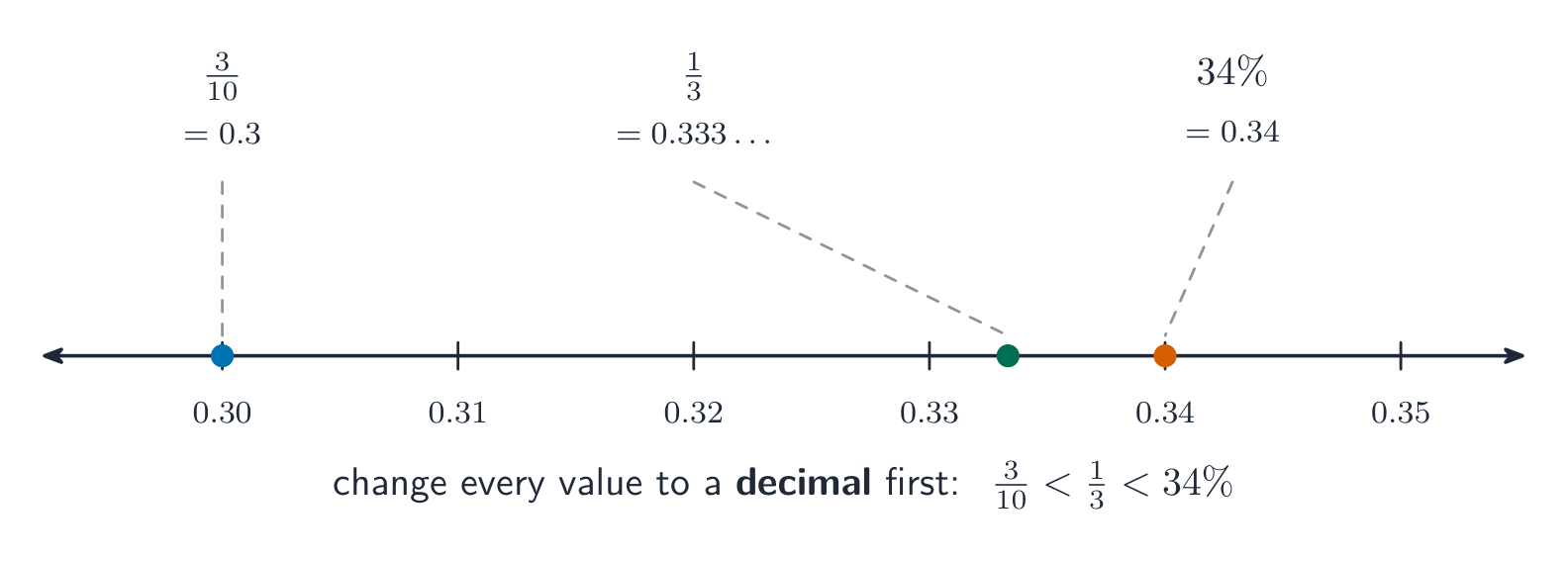
要把一个混合列表按顺序排列,先把每个值变成一个小数。
Worked example. 把 $34\%$、$\frac{1}{3}$ 和 $\frac{3}{10}$ 按顺序排列,最小的在先。
作为小数:$34\% = 0.34$,$\frac{1}{3} = 0.333\ldots$,$\frac{3}{10} = 0.3$。所以顺序是
$$\frac{3}{10} < \frac{1}{3} < 34\%.$$
词汇表
训练
| 英文 | 中文 | 拼音 |
|---|---|---|
| magnitude/ˈmæɡnɪtjuːd/ | 大小 | dà xiǎo |
1.13
百分数

大纲
| Subject content | Notes and examples |
|---|---|
| 1 Calculate a given percentage of a quantity. | |
| 2 Express one quantity as a percentage of another. | |
| 3 Calculate percentage increase or decrease. | |
| 4 Calculate with simple and compound interest. | Formulas are not given. Percentage calculations may include: • deposit • discount • profit and loss (as an amount or a percentage) • earnings • percentages over 100%. |
| Subject content | Notes and examples |
|---|---|
| 1 Calculate a given percentage of a quantity. | |
| 2 Express one quantity as a percentage of another. | |
| 3 Calculate percentage increase or decrease. | |
| 4 Calculate with simple and compound interest. | Problems may include repeated percentage change. Formulas are not given. |
| 5 Calculate using reverse percentages. | e.g. find the cost price given the selling price and the percentage profit. Percentage calculations may include: • deposit • discount • profit and loss (as an amount or a percentage) • earnings • percentages over 100%. |
来源:剑桥国际大纲
求一个数额的一个百分比。 $\$80$ 的 $15\% = 0.15 \times 80 = \$12$。
把一个数额写成另一个的一个百分比。 $25$ 中 $18$ 的分数是 $\frac{18}{25} \times 100\% = 72\%$。
百分比增加或减少用
$$\text{percentage change} = \frac{\text{change}}{\text{original amount}} \times 100\%.$$
Worked example. 一个价格从 $\$40$ 上升到 $\$50$。求百分比增加。
变化是 $\$10$,所以 $\frac{10}{40} \times 100\% = 25\%$ 增加。
一个快速的方式是一个乘数(multiplier)。要增加 $15\%$,乘以 $1.15$;要减少 $15\%$,乘以 $0.85$。
Simple and compound interest
利息(interest)是为借款或为储蓄而付的钱。本金(principal)是起始数额。
- 单利(simple interest)每年付相同的数额,只在本金上算出:
$$I = \frac{P \times r \times t}{100},$$其中 $P$ 是本金、$r$ 是每年的利率(作为一个百分比)而 $t$ 是年数。
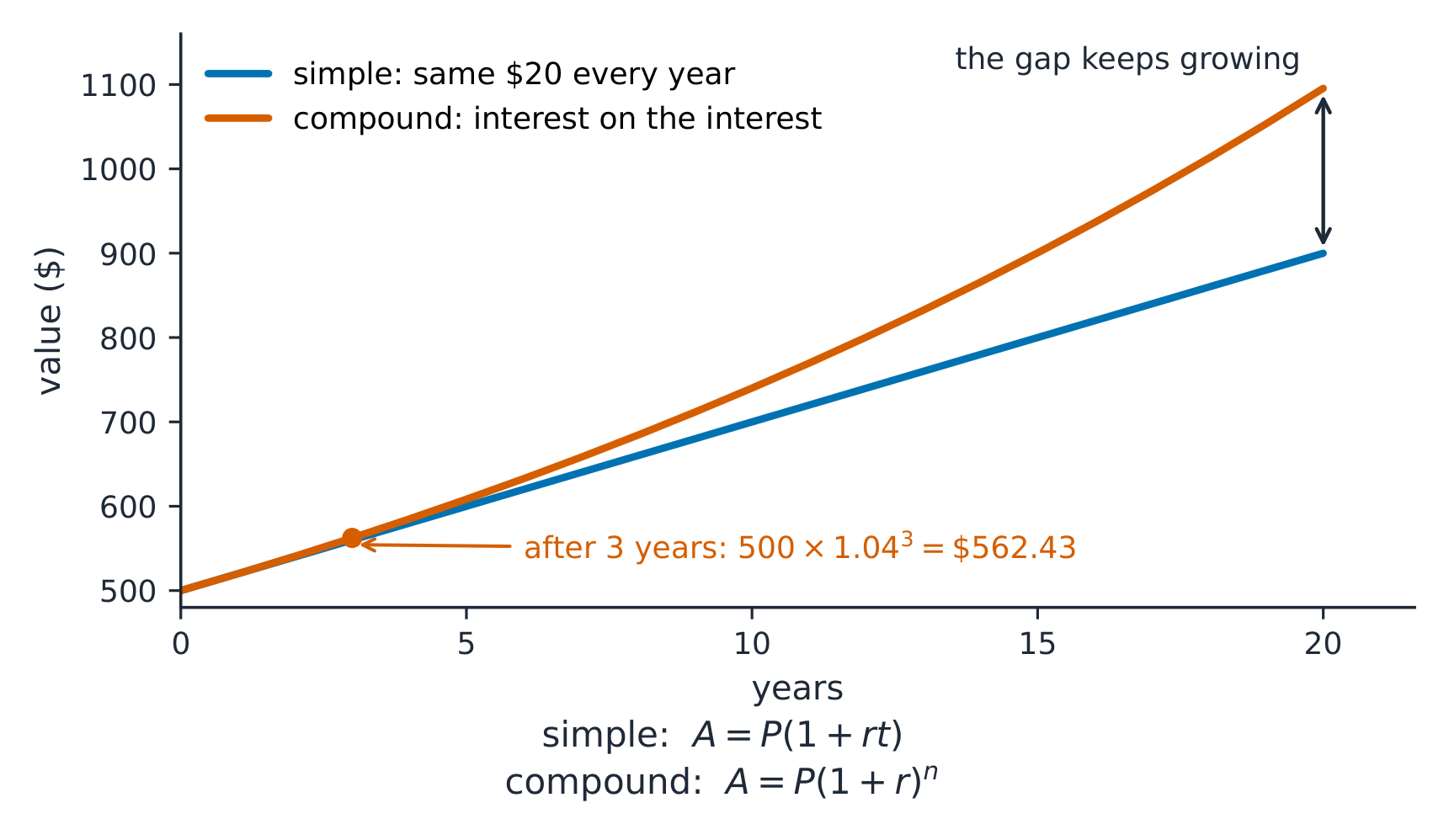
- 复利(compound interest)加上每年的利息,所以下一年在一个更大的总额上赚利息:
$$\text{final value} = P\left(1 + \frac{r}{100}\right)^{t}.$$
Worked example. 求以 $4\%$ 复利储蓄 $3$ 年的 $\$500$ 的值。
$$500 \times 1.04^{3} = 500 \times 1.124864 = \$562.43 \ (\text{to the nearest cent}).$$
Reverse percentages (Extended)
一个逆百分比(reverse percentage)问题给出一次变化之后的数额,并问原来的。要解它,除以乘数——不要只是把百分比减掉。
Worked example. 一件外套在一次 $20\%$ 增加后值 $\$60$。求原来的价格。
$\$60$ 是原来的 $120\%$,所以原来的价格是 $60 \div 1.2 = \$50$。
探索
Percentage change lab
new value = old value x multiplier
Change the multiplier and see the final value change.
词汇表
训练
| 英文 | 中文 | 拼音 |
|---|---|---|
| multiplier/ˌmʌltɪˈplaɪə/ | 乘数 | chéng shù |
| interest/ˈɪntrest/ | 利息 | lì xī |
| principal/ˈprɪnsɪpl/ | 本金 | běn jīn |
| simple interest/ˈsɪmpl ˈɪntrest/ | 单利 | dān lì |
| compound interest/ˈkɒmpaʊnd ˈɪntrest/ | 复利 | fù lì |
| reverse percentage/rɪˈvɜːs pəˈsentɪdʒ/ | 逆百分比 | nì bǎi fēn bǐ |
1.17
指数增长与衰减
大纲
| Subject content | Notes and examples |
|---|---|
| Use exponential growth and decay. | e.g. depreciation, population change. Knowledge of e is not required. |
来源:剑桥国际大纲
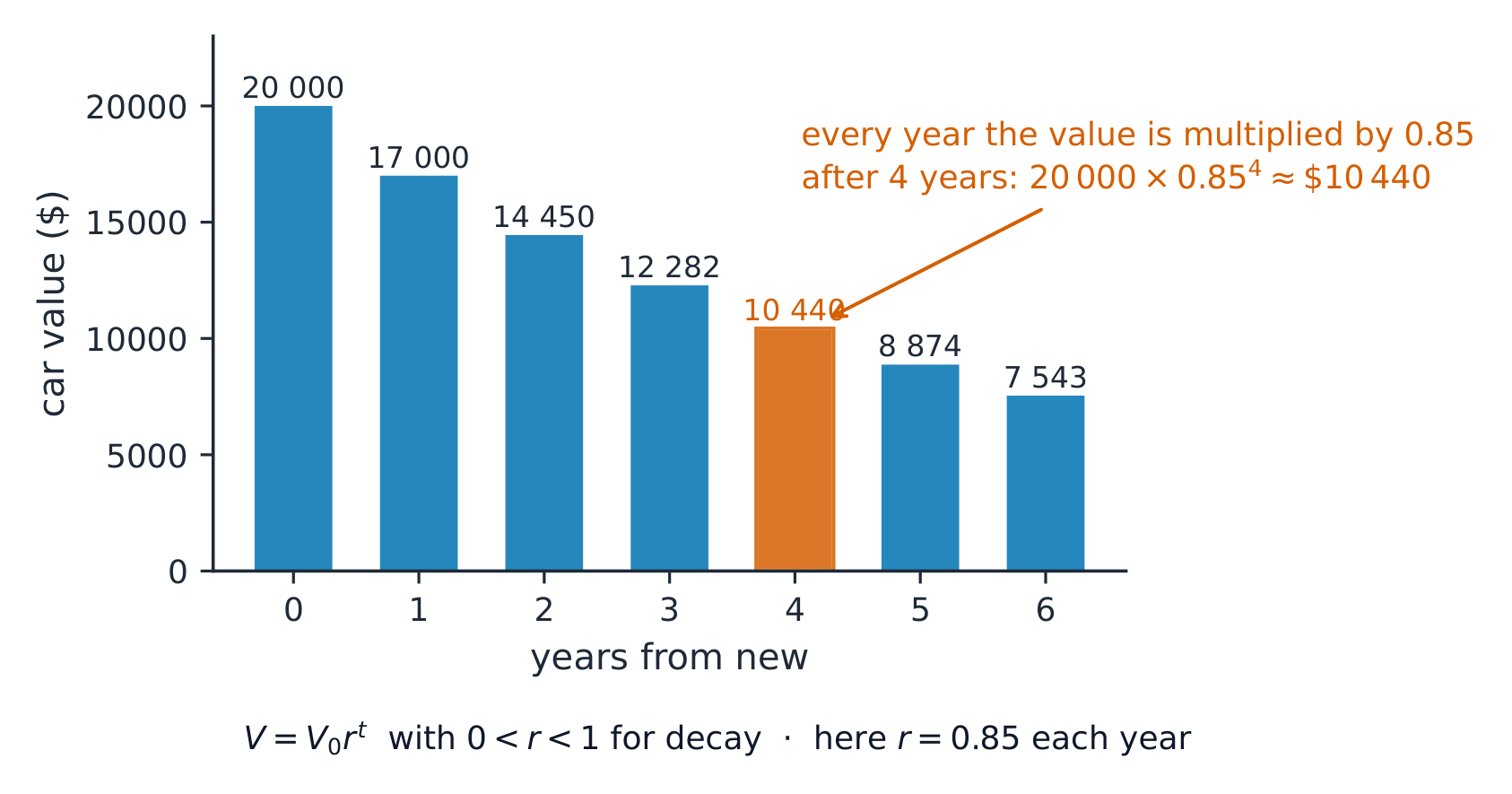
当一个量在每个时间段里以相同的百分比变化时,它显示指数增长(exponential growth)(它变得更大)或指数衰减(exponential decay)(它变得更小)。用复利公式。折旧(depreciation),其中像一辆车这样的东西每年丧失价值,是衰减。
Worked example. 一辆值 $\$20\,000$ 的车每年丧失它价值的 $15\%$。求它 $4$ 年后的值。
乘数是 $0.85$,所以
$$20\,000 \times 0.85^{4} = 20\,000 \times 0.522\ldots = \$10\,440 \ (\text{to the nearest dollar}).$$
探索
Compound interest
Money grows by (1 + r) every year, so compound interest curves above simple interest. Drag the rate and the number of years.
探索
Exponential growth & decay
y = a·bˣ
Change the base b: b > 1 grows, 0 < b < 1 decays — useful for interest and populations.
词汇表
训练
| 英文 | 中文 | 拼音 |
|---|---|---|
| exponential growth/ˌekspəˈnenʃl ɡrəʊθ/ | 指数增长 | zhǐ shù zēng zhǎng |
| exponential decay/ˌekspəˈnenʃl dɪˈkeɪ/ | 指数衰减 | zhǐ shù shuāi jiǎn |
| depreciation/dɪˌpriːʃɪˈeɪʃn/ | 折旧 | zhé jiù |
1.11
比与比例

大纲
| Subject content | Notes and examples |
|---|---|
| Understand and use ratio and proportion to: | |
| • give ratios in their simplest form | e.g. 20:30:40 in its simplest form is 2:3:4. |
| • divide a quantity in a given ratio | |
| • use proportional reasoning and ratios in context. | e.g. adapt recipes; use map scales; determine best value. |
来源:剑桥国际大纲
一个比(ratio)比较量,像 $a:b$ 这样写。像一个分数一样通过除以 HCF 化简它:$20:30:40 = 2:3:4$。
按一个比划分。 按比 $3:5$ 分享 $\$48$。
总份数是 $3 + 5 = 8$。一份是 $48 \div 8 = \$6$。所以各份是 $3 \times 6 = \$18$ 和 $5 \times 6 = \$30$。
比例(proportion)意味着两个比相等。把它用于食谱、地图比例尺(scales)和寻找最佳价值。
Worked example. $3$ 支笔值 $\$1.80$。求 $7$ 支笔的成本。
一支笔值 $1.80 \div 3 = \$0.60$。所以 $7$ 支笔值 $7 \times 0.60 = \$4.20$。
探索
Direct proportion
y = ax
Direct proportion is a straight line through the origin — double x and you double y.
词汇表
训练
| 英文 | 中文 | 拼音 |
|---|---|---|
| proportion/prəˈpɔːʃn/ | 比例 | bǐ lì |
| scale/skeɪl/ | 比例尺 | bǐ lì chǐ |
1.12
比率

大纲
| Subject content | Notes and examples |
|---|---|
| 1 Use common measures of rate. | e.g. calculate with: • hourly rates of pay • exchange rates between currencies • flow rates • fuel consumption. |
| 2 Apply other measures of rate. | e.g. calculate with: • pressure • density • population density. Required formulas will be given in the question. |
| 3 Solve problems involving average speed. | Knowledge of speed/distance/time formula is required. e.g. A cyclist travels 45 km in 3 hours 45 minutes. What is their average speed? Notation used will be, e.g. m/s (metres per second), $\text{g/cm}^3$ (grams per cubic centimetre). |
| Subject content | Notes and examples |
|---|---|
| 1 Use common measures of rate. | e.g. calculate with: • hourly rates of pay • exchange rates between currencies • flow rates • fuel consumption. |
| 2 Apply other measures of rate. | e.g. calculate with: • pressure • density • population density. Required formulas will be given in the question. |
| 3 Solve problems involving average speed. | Knowledge of speed/distance/time formula is required. e.g. A cyclist travels 45 km in 3 hours 45 minutes. What is their average speed? Notation used will be, e.g. m/s (metres per second), g/cm$^{3}$ (grams per cubic centimetre). |
来源:剑桥国际大纲
一个比率(rate)比较两个以不同单位衡量的量,例如每千克的价格,或每小时的距离。
平均速度(average speed)用
$$\text{average speed} = \frac{\text{total distance}}{\text{total time}}.$$
Worked example. 一个骑车者在 $3$ 小时 $45$ 分钟里行驶 $45\text{ km}$。求平均速度。
先把时间变成小时:$3$ h $45$ min $= 3.75$ h。然后
$$\text{average speed} = \frac{45}{3.75} = 12\text{ km/h}.$$
其他比率以同样的方式起作用。密度(density)从质量(mass)和体积(volume)求出:
$$\text{density} = \frac{\text{mass}}{\text{volume}}.$$
其他例子是流量、燃料消耗和人口密度(population density)。若一个比率需要一个特殊公式(例如压强(pressure)),问题会把它给你。
词汇表
训练
| 英文 | 中文 | 拼音 |
|---|---|---|
| rate/reɪt/ | 比率 | bǐ lǜ |
| average speed/ˈævrɪdʒ spiːd/ | 平均速度 | píng jūn sù dù |
| density/ˈdensɪti/ | 密度 | mì dù |
| mass/mæs/ | 质量 | zhì liàng |
| volume/ˈvɒljuːm/ | 体积 | tǐ jī |
| population density/ˌpɒpjʊˈleɪʃn ˈdensɪti/ | 人口密度 | rén kǒu mì dù |
| pressure/ˈpreʃə/ | 压强 | yā qiáng |
1.9
估算
大纲
| Subject content | Notes and examples |
|---|---|
| 1 Round values to a specified degree of accuracy. | Includes decimal places and significant figures. |
| 2 Make estimates for calculations involving numbers, quantities and measurements. | e.g. write 5764 correct to the nearest thousand. e.g. by writing each number correct to 1 significant figure, estimate the value of $$\frac{41.3}{9.79 \times 0.765}$$ . |
| 3 Round answers to a reasonable degree of accuracy in the context of a given problem. |
| Subject content | Notes and examples |
|---|---|
| 1 Round values to a specified degree of accuracy. | Includes decimal places and significant figures. e.g. write 5764 correct to the nearest thousand. |
| 2 Make estimates for calculations involving numbers, quantities and measurements. | e.g. by writing each number correct to 1 significant figure, estimate the value of $$\frac{41.3}{9.79 \times 0.765}$$ . |
| 3 Round answers to a reasonable degree of accuracy in the context of a given problem. |
来源:剑桥国际大纲
Rounding
- 小数位(d.p.)(decimal places):在点之后数的数字。$3.14159$ 到 $2$ d.p. 是 $3.14$。
- 有效数字(s.f.)(significant figures):从第一个非零数字数起的数字。$5764$ 到 $1$ s.f. 是 $6000$;$0.004067$ 到 $2$ s.f. 是 $0.0041$。
规则:看下一个数字。若它是 $5$ 或更多,向上舍入;若它更少,向下舍入。
Estimation
要估算(estimate)一个答案,把每个数舍入到 $1$ s.f.,然后计算。
Worked example. 估算 $\dfrac{41.3}{9.79 \times 0.765}$。
$$\frac{41.3}{9.79 \times 0.765} \approx \frac{40}{10 \times 0.8} = \frac{40}{8} = 5.$$
探索
Rounding and bounds lab
Classify numbers by the decision needed for accuracy.
词汇表
训练
| 英文 | 中文 | 拼音 |
|---|---|---|
| decimal place/ˈdesɪml pleɪs/ | 小数位 | xiǎo shù wèi |
| significant figure/sɪɡˈnɪfɪkənt ˈfɪɡə/ | 有效数字 | yǒu xiào shù zì |
| estimate/ˈestɪmət/ | 估算 | gū suàn |
1.10
精度范围

大纲
| Subject content | Notes and examples |
|---|---|
| Give upper and lower bounds for data rounded to a specified accuracy. | e.g. write down the upper bound of a length measured correct to the nearest metre. Candidates are not expected to find the bounds of the results of calculations which have used data rounded to a specified accuracy. |
| Subject content | Notes and examples |
|---|---|
| 1 Give upper and lower bounds for data rounded to a specified accuracy. | e.g. write down the upper bound of a length measured correct to the nearest metre. |
| 2 Find upper and lower bounds of the results of calculations which have used data rounded to a specified accuracy. | Example calculations include: • calculate the upper bound of the perimeter or the area of a rectangle given dimensions measured to the nearest centimetre • find the lower bound of the speed given rounded values of distance and time. |
来源:剑桥国际大纲
一个舍入的值真的可能是任何舍入到它的东西。最小可能的值是下界(lower bound);最大的是上界(upper bound)。对于一个舍入到最近单位的值,界限位于每一侧半个单位处。
Worked example. 一个高度 $h$ 是 $635\text{ m}$,准确到最近的米。给出界限。
$$634.5 \leqslant h < 635.5.$$
所以下界是 $634.5\text{ m}$ 而上界是 $635.5\text{ m}$。
Bounds in calculations (Extended)
组合界限以得到你想要的界限。
Worked example. 一个矩形是 $8\text{ cm}$ 乘 $5\text{ cm}$,每条边到最近的 cm。求最大可能的面积(area)。
用两条边的上界:$8.5 \times 5.5 = 46.75\text{ cm}^{2}$。(最小面积用下界:$7.5 \times 4.5 = 33.75\text{ cm}^{2}$。)
对于一个相除的量,例如 $\text{speed} = \dfrac{\text{distance}}{\text{time}}$,最大速度来自最大距离除以最小时间。
词汇表
训练
| 英文 | 中文 | 拼音 |
|---|---|---|
| lower bound/ˈləʊə baʊnd/ | 下界 | xià jiè |
| upper bound/ˈʌpə baʊnd/ | 上界 | shàng jiè |
| area/ˈeərɪə/ | 面积 | miàn jī |
1.15
时间
大纲
| Subject content | Notes and examples |
|---|---|
| 1 Calculate with time: seconds (s), minutes (min), hours (h), days, weeks, months, years, including the relationship between units. | 1 year = 365 days. |
| 2 Calculate times in terms of the 24-hour and 12-hour clock. | In the 24-hour clock, for example, 3.15 a.m. will be denoted by 03 15 and 3.15 p.m. by 15 15. |
| 3 Read clocks and timetables. | Includes problems involving time zones, local times and time differences. |
| Subject content | Notes and examples |
|---|---|
| 1 Calculate with time: seconds (s), minutes (min), hours (h), days, weeks, months, years, including the relationship between units. | 1 year = 365 days. |
| 2 Calculate times in terms of the 24-hour and 12-hour clock. | In the 24-hour clock, for example, 3.15 a.m. will be denoted by 0315 and 3.15 p.m. by 1515. |
| 3 Read clocks and timetables. | Includes problems involving time zones, local times and time differences. |
来源:剑桥国际大纲
- $60$ 秒 $= 1$ 分钟,$60$ 分钟 $= 1$ 小时,$24$ 小时 $= 1$ 天,而 $1$ 年 $= 365$ 天。
- 24 小时制把一个时间写成四个数字:下午 $3.15$ 是 $15\,15$。
Worked example. 一部电影在 $19\,35$ 开始并持续 $70$ 分钟。求它结束的时间。
$70$ min $= 1$ h $10$ min。加 $1$ 小时给出 $20\,35$;加 $10$ 分钟给出 $20\,45$。
对于时刻表和时区(time zone)问题,加上或减去各地之间的时差。
探索
Time, money and calculator lab
Choose the operation that matches a real measurement problem.
词汇表
训练
| 英文 | 中文 | 拼音 |
|---|---|---|
| time zone/taɪm zəʊn/ | 时区 | shí qū |
1.16
货币
大纲
| Subject content | Notes and examples |
|---|---|
| 1 Calculate with money. | |
| 2 Convert from one currency to another. |
来源:剑桥国际大纲
把钱作为普通小数处理,但给出到 $2$ d.p. 的答案(所以 $\$4.8$ 写成 $\$4.80$)。
货币换算。 把汇率(exchange rate)用作一个乘数。
Worked example. 汇率是 $\$1 = €0.92$。把 $\$150$ 换算成欧元,并把 $€138$ 换算回美元。
$$150 \times 0.92 = €138, \qquad 138 \div 0.92 = \$150.$$
词汇表
训练
| 英文 | 中文 | 拼音 |
|---|---|---|
| exchange rate/eksˈtʃeɪndʒ reɪt/ | 汇率 | huì lǜ |
1.14
使用计算器
大纲
| Subject content | Notes and examples |
|---|---|
| 1 Use a calculator efficiently. | e.g. know not to round values within a calculation and to only round the final answer. |
| 2 Enter values appropriately on a calculator. | e.g. enter 2 hours 30 minutes as 2.5 hours or 2° 30’ 0’’. |
| 3 Interpret the calculator display appropriately. | e.g. in money 4.8 means $4.80; in time 3.25 means 3 hours 15 minutes. |
| Subject content | Notes and examples |
|---|---|
| 1 Use a calculator efficiently. | e.g. know not to round values within a calculation and to only round the final answer. |
| 2 Enter values appropriately on a calculator. | e.g. enter 2 hours 30 minutes as 2.5 hours or 2° 30' 0''. |
| 3 Interpret the calculator display appropriately. | e.g. in money 4.8 means $4.80; in time 3.25 means 3 hours 15 minutes. |
来源:剑桥国际大纲
- 不要在一个计算的中途舍入。保留完整的值,只舍入最终答案。
- 把时间输入为一小时的一个小数:$2$ 小时 $30$ 分钟是 $2.5$ 小时,不是 $2.30$。
- 在上下文里读显示:在钱里,$4.8$ 意味着 $\$4.80$;在时间里,$3.25$ 小时意味着 $3$ 小时 $15$ 分钟。
1.14
考试技巧
- 按顺序遵循 BIDMAS(括号、指数、除/乘、加/减),并记住一个负数乘一个负数是正的。
- 在科学记数法里前面的数在 1 和 10 之间;一个小的数(像 $0.0004$)有一个负的 10 的幂。
- 一个百分比变化在原来的数额上算出。对于一个逆百分比,除以乘数(例如 $\div 1.2$ 撤销一个 $20\%$ 的上升)。
- 不要在中途舍入——保留完整的值,只在最后舍入,到问题要求的准确度(小数位或有效数字)。
- 对于准确度的界限,一个舍入到最近整数的值能是每一侧最多 $0.5$(所以 $8$ 意味着 $7.5 \le x < 8.5$)。
本主题的互动课程
逐步学习,并即时检测练习。