跳到主要内容

近代物理

AP 物理 2 · 第 15 主题

训练
讲义 词汇表
15.1

量子理论与波粒二象性

大纲
Learning ObjectiveEssential Knowledge

15.1.A
Describe the properties and behavior of an object that exhibits both particle-like and wave-like behavior.

  • 15.1.A.1 Quantum theory was developed to explain observations of matter and energy that could not be explained using classical mechanics. These phenomena include, but are not limited to, atomic spectra, blackbody radiation, and the photoelectric effect.
    • 15.1.A.1.i Quantum theory is necessary to describe the properties of matter at atomic and subatomic scales.
    • 15.1.A.1.ii In quantum theory, fundamental particles can exhibit both particle-like and wave-like behavior.
  • 15.1.A.2 Light can be modeled both as a wave and as discrete particles, called photons.
    • 15.1.A.2.i A photon is a massless, electrically neutral particle with energy proportional to the photon's frequency.
      • Relevant equations:
      • $E = hf$
      • $\lambda = \dfrac{c}{f}$
    • 15.1.A.2.ii Photons travel in straight lines unless they interact with matter.
  • 15.1.A.3 The speed of a photon depends on the medium through which the photon travels.
    • 15.1.A.3.i The speed of all photons in free space is equal to the speed of light, $c = 3.00 \times 10^{8}$ m/s.
    • 15.1.A.3.ii In general, the speed of photons through a given medium is inversely proportional to the index of refraction of that medium.
  • 15.1.A.4 Particles can demonstrate wave properties, as shown by variations of Young's double-slit experiment.
    • 15.1.A.4.i A wave model of matter is quantified by the de Broglie wavelength, which increases as the momentum of a particle decreases.
      • Relevant equation:
      • $\lambda = \dfrac{h}{p}$
    • 15.1.A.4.ii Quantum theory is necessary to describe systems where the de Broglie wavelength is comparable to the size of the system.
  • 15.1.A.5 Values of energy and momentum have discrete, or quantized, values for bound systems described by quantum theory.

来源:美国大学理事会 AP 课程与考试说明

在微小的尺度上,能量以叫量子(quanta)的离散包出现。光由光子(photons)携带,每个的能量由它的频率设定:

$$E=hf,$$
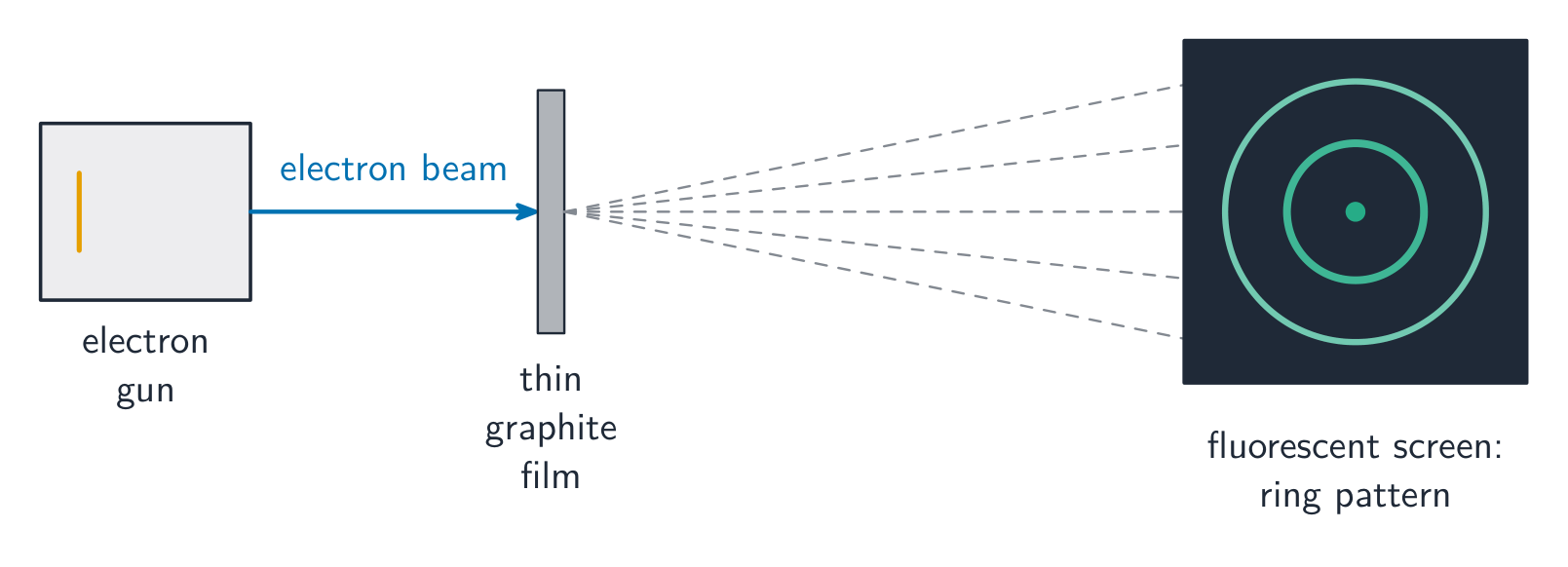
其中 $h$ 是普朗克常数。波粒二象性(wave–particle duality):光和物质各显示波行为(干涉、衍射)和粒子行为(光子、电子作为局域的击中)。一个粒子也有一个物质波长 $\lambda=\dfrac{h}{p}$,而且粒子真的会产生干涉 - 用电子做的杨氏双缝实验(double-slit experiment)的一个变体,会累积出和光一样的条纹图样。

电子形成一个衍射模式,显示粒子有一个波性质

Worked example. 求频率 $5.0\times10^{14}\ \text{Hz}$ 的橙光的一个光子的能量($h=6.63\times10^{-34}\ \text{J s}$):$E=hf=6.63\times10^{-34}\times5.0\times10^{14}=3.3\times10^{-19}\ \text{J}$,它约是 $2.1\ \text{eV}$(除以 $1.6\times10^{-19}$)。可见光光子携带几个电子伏特——正好触发视觉和光合作用的化学。

词汇表 训练
英文 中文 拼音
quanta 量子 liàng zǐ
photons 光子 guāng zi
Wave–particle duality 波粒二象性 bō lì èr xiàng xìng
double-slit experiment 双缝实验 shuāng fèng shí yàn
15.2

玻尔原子模型

大纲
Learning ObjectiveEssential Knowledge

15.2.A
Describe the properties of an atom.

  • 15.2.A.1 Atoms have internal structure.
    • 15.2.A.1.i Atoms consist of a small, positively charged nucleus surrounded by one or more negatively charged electrons.
    • 15.2.A.1.ii The nucleus of an atom is made up of protons and neutrons.
    • 15.2.A.1.iii The number of neutrons and protons in an atom can be represented using nuclear notation.
    • 15.2.A.1.iv An ion is an atom with a nonzero net electric charge.
  • 15.2.A.2 Each atomic element has a unique number of protons.
    • 15.2.A.2.i The number and arrangements of electrons affects how atoms interact.
    • 15.2.A.2.ii The total number of neutrons and protons identifies the isotope of an element.
    • 15.2.A.2.iii The mass of an atom is dominated by the total mass of the protons and neutrons in its nucleus.
  • 15.2.A.3 The Bohr model of the atom is based on classical physics and was the historical representation of the atom that led to the description of the hydrogen atom in terms of discrete energy states.
    • 15.2.A.3.i In the Bohr model of the atom, electrons are modeled as moving around the nucleus in circular orbits determined by the electron's charge and mass, as well as the electric force between the electron and the nucleus.
      • Relevant equations:
      • $F_e = k\dfrac{q_1 q_2}{r^2}$
      • $F_{\text{net}} = m\dfrac{v^2}{r}$
    • 15.2.A.3.ii The standing wave model of electrons accounts for the existence of specific allowed energy states of an electron in an atom, because the electron orbit's circumference must be an integer multiple of the electron's de Broglie wavelength.

Boundary statement: The analysis and description of electron structure is limited to energy levels and will not include such advanced descriptions as orbitals, orbital shapes, or probability functions.

来源:美国大学理事会 AP 课程与考试说明

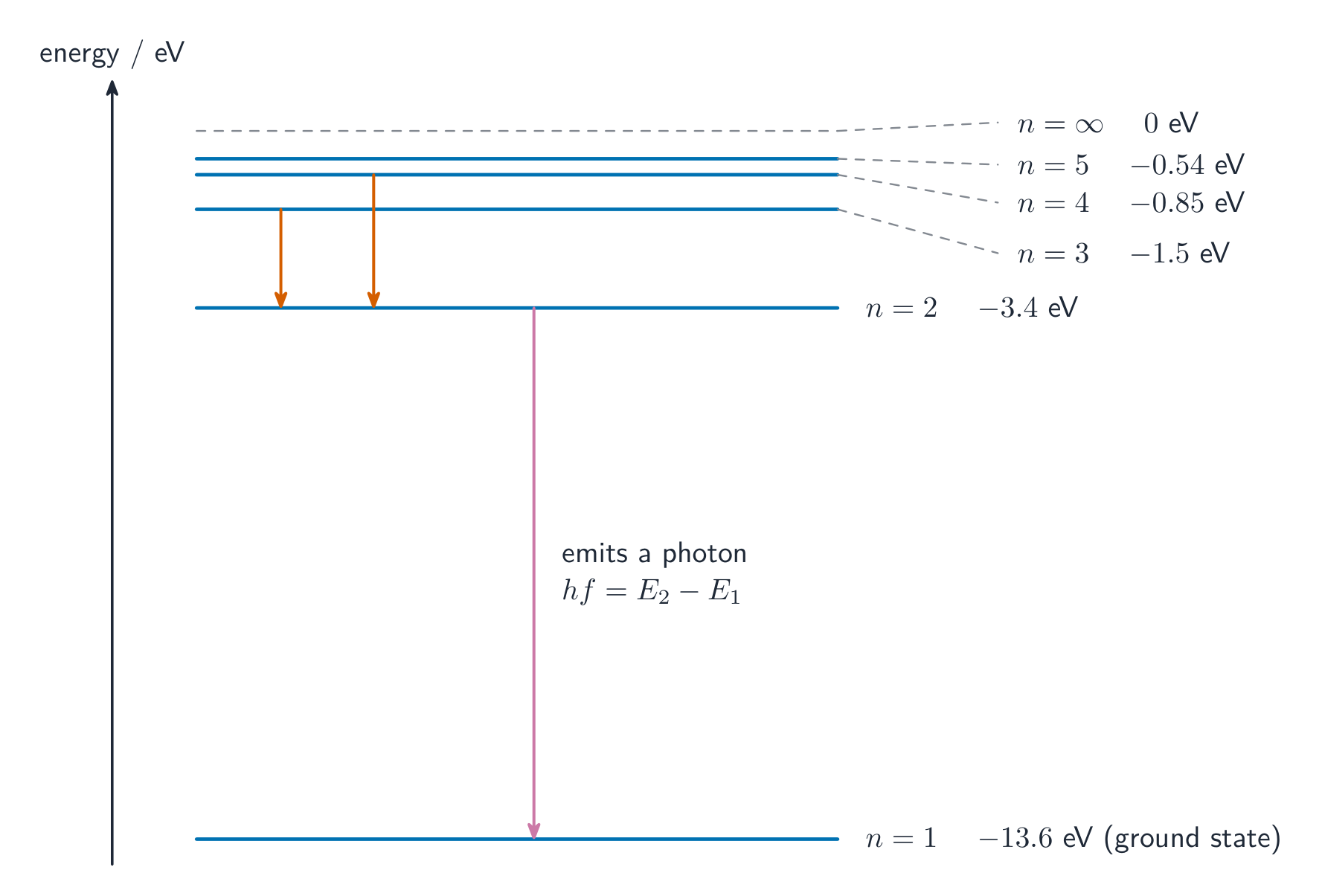
玻尔模型(Bohr model)把电子描绘成只在某些允许的能级(energy levels)绕原子核轨道运行。一个电子只能通过吸收或发射一个能量恰好匹配间隙的光子在能级之间跳跃:

$$E_{\text{photon}}=|E_{\text{final}}-E_{\text{initial}}|.$$
因为能级是离散的,只有特定的光子能量被允许。

词汇表 训练
英文 中文 拼音
Bohr model 玻尔模型 bō ěr mó xíng
energy levels 能级 néng jí
15.3

发射光谱与吸收光谱

大纲
Learning ObjectiveEssential Knowledge

15.3.A
Describe the emission or absorption of photons by atoms.

  • 15.3.A.1 Energy transfer occurs when photons are absorbed or emitted by an atom, which is modeled as a system consisting of a nucleus and an electron.
  • 15.3.A.2 Energy can only be absorbed or emitted by an atom if the amount of energy being absorbed or emitted corresponds to the energy difference between two atomic energy states.
    • 15.3.A.2.i An atom in a given energy state may absorb a photon of the appropriate energy and transition to a higher energy state.
    • 15.3.A.2.ii An atom in an excited energy state may emit a photon of the appropriate energy to spontaneously move to a lower energy state.
    • 15.3.A.2.iii Because an atom is modeled as a system consisting of an electron and a nucleus, a change in the energy state of an atom corresponds to a change in the interaction energy between the electron and the nucleus.
  • 15.3.A.3 Transitions between two energy states of an atom correspond to the absorption or emission of a photon of a single frequency and, therefore, a single wavelength.
  • 15.3.A.4 Atoms of each element have a unique set of allowed energy levels and thereby a unique set of absorption and emission frequencies. The unique set of frequencies determines the element's spectrum.
    • 15.3.A.4.i An emission spectrum can be used to determine the elements in a source of light.
    • 15.3.A.4.ii An absorption spectrum can be used to determine the elements composing a substance by observing what light the substance has absorbed.
    • 15.3.A.4.iii Energy level diagrams are commonly used to visually represent the energy states of an atom.
  • 15.3.A.5 Binding energy is the energy required to remove an electron from an atom, causing the atom to become ionized. An atom in the lowest energy level (ground state) will require the greatest amount of energy to remove the electron from the atom.

Boundary statement: In AP Physics 2, only energy level diagrams of single-electron atoms will be considered.

来源:美国大学理事会 AP 课程与考试说明

  • 一个发射光谱(emission spectrum)是当电子落到较低能级时发出的明线的集合——每条线一个特定的波长。
  • 一个吸收光谱(absorption spectrum)是那些相同波长从一个连续源被吸收的暗线的集合。
氢的离散能级产生一个线光谱
氢的离散能级产生一个线光谱

线的模式是元素的一个指纹,因为每个元素有它自己的能级。

探索

See an element's line spectrum

Electrons jump between fixed energy levels, emitting or absorbing photons of exact wavelengths — a line spectrum that fingerprints the element.

词汇表 训练
英文 中文 拼音
emission spectrum 发射光谱 fā shè guāng pǔ
absorption spectrum 吸收光谱 xī shōu guāng pǔ
15.4

黑体辐射

大纲
Learning ObjectiveEssential Knowledge

15.4.A
Describe the electromagnetic radiation emitted by an object due to its temperature.

  • 15.4.A.1 Matter will spontaneously convert some of its internal thermal energy into electromagnetic energy.
  • 15.4.A.2 A blackbody is an idealized model of matter that absorbs all radiation that falls on the body. If the body is in equilibrium at a constant temperature, then it must in turn emit energy.
  • 15.4.A.3 A blackbody will emit a continuous spectrum that only depends on the body's temperature. The radiation emitted by a blackbody is often modeled by plotting intensity per unit wavelength as a function of wavelength.
    • 15.4.A.3.i The distribution of the intensity of a blackbody's spectrum as a function of temperature cannot be modeled using only classical physics concepts. A blackbody's spectrum is described by Planck's law, which assumes that the energy of light is quantized.
    • 15.4.A.3.ii The peak wavelength emitted by a blackbody (the wavelength at which the blackbody emits the greatest amount of radiation per unit wavelength) decreases with increasing temperature, as described by Wien's law.
      • Relevant equation:
      • $\lambda_{\max} = \dfrac{b}{T}$
    • 15.4.A.3.iii The rate at which energy is emitted (power) by a blackbody is proportional to the surface area of the body and to the temperature of the body raised to the fourth power, as described by the Stefan-Boltzmann law.
      • Relevant equation:
      • $P = A\sigma T^4$

来源:美国大学理事会 AP 课程与考试说明

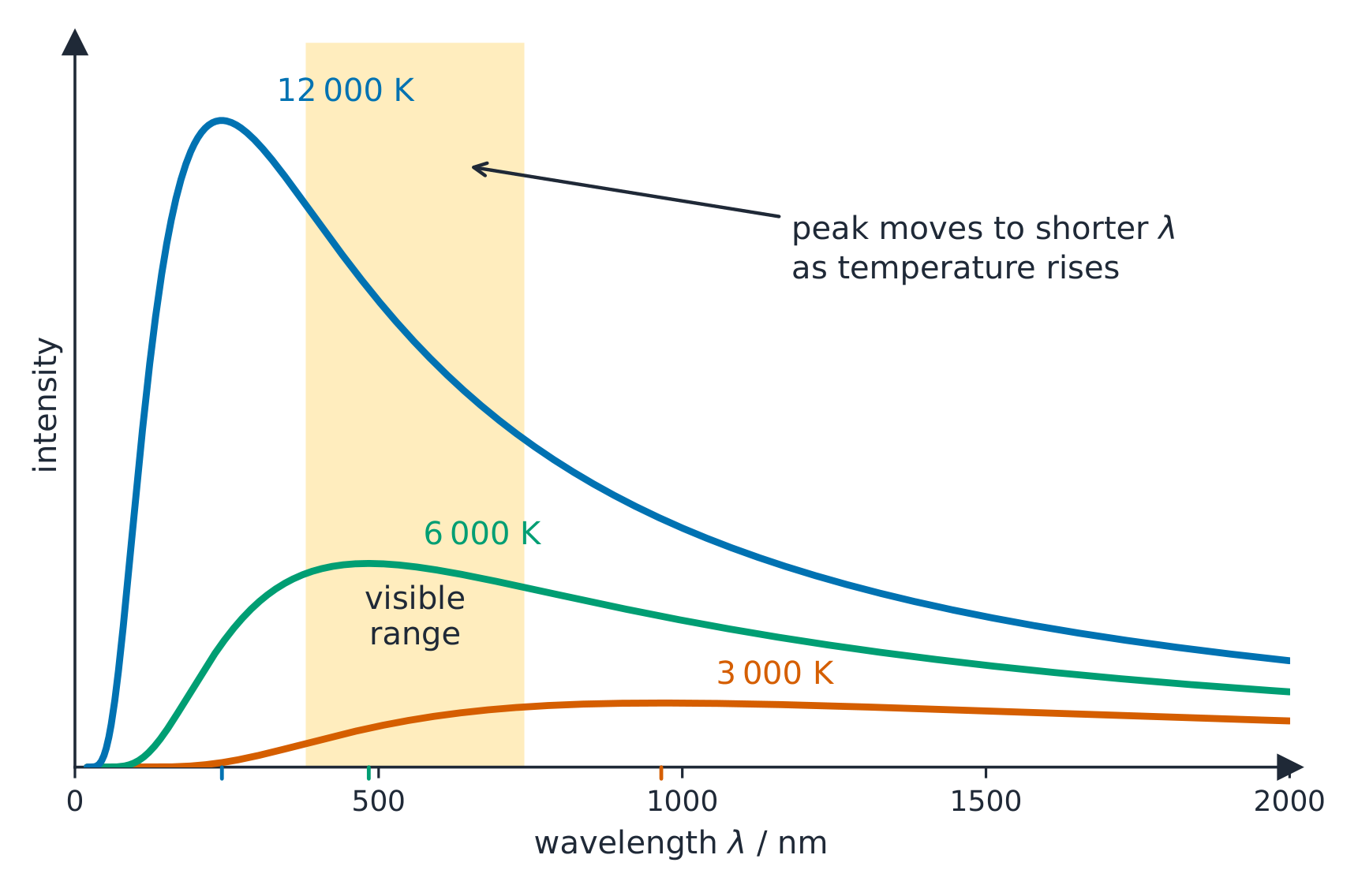
一个黑体(blackbody)发射一个只取决于它温度的连续光谱。更热的物体发光更亮并在更短的波长达到峰值(红热到白热到蓝热)。解释这个光谱需要量子化的能量——量子理论的一个奠基问题。

一个更热的黑体辐射更多,而它的峰值移向更短的波长
词汇表 训练
英文 中文 拼音
blackbody 黑体 hēi tǐ
15.5

光电效应

大纲
Learning ObjectiveEssential Knowledge

15.5.A
Describe an interaction between photons and matter using the photoelectric effect.

  • 15.5.A.1 The photoelectric effect is the emission of electrons when electromagnetic radiation is incident upon a photoactive material.
  • 15.5.A.2 The emission of electrons via the photoelectric effect requires a minimum frequency of incident light, called the threshold frequency.
    • 15.5.A.2.i Light that is incident on a material and is at the threshold frequency or higher will induce electron emission, regardless of the number of photons that strike the material.
    • 15.5.A.2.ii The energy of the emitted electrons is not dependent on the number of photons that are incident upon the material, which provides evidence that light is a collection of discrete, quantized energy packets called photons.
  • 15.5.A.3 The maximum kinetic energy of an emitted electron is related to the frequency of the incident light and the work function of the material, $\phi$.
    • 15.5.A.3.i The work function of a material is the minimum energy required to emit an electron from atoms in the material.
    • 15.5.A.3.ii The maximum kinetic energy of an emitted electron is given by the equation $K_{\max} = hf - \phi$.
    • 15.5.A.3.iii In a typical experimental setup to demonstrate the photoelectric effect and determine the work function of a metal, two metal plates are placed in a vacuum chamber and connected to a variable source of potential difference. One of the plates is illuminated by monochromatic light that causes electrons to be ejected and the potential difference between the plates is adjusted until no current is measured in the circuit.

Boundary statement: Where applicable, work functions for materials will be provided on the exam; students are not expected to know values of work functions or variables of a material that influence the magnitude of its work function.

来源:美国大学理事会 AP 课程与考试说明

光电效应

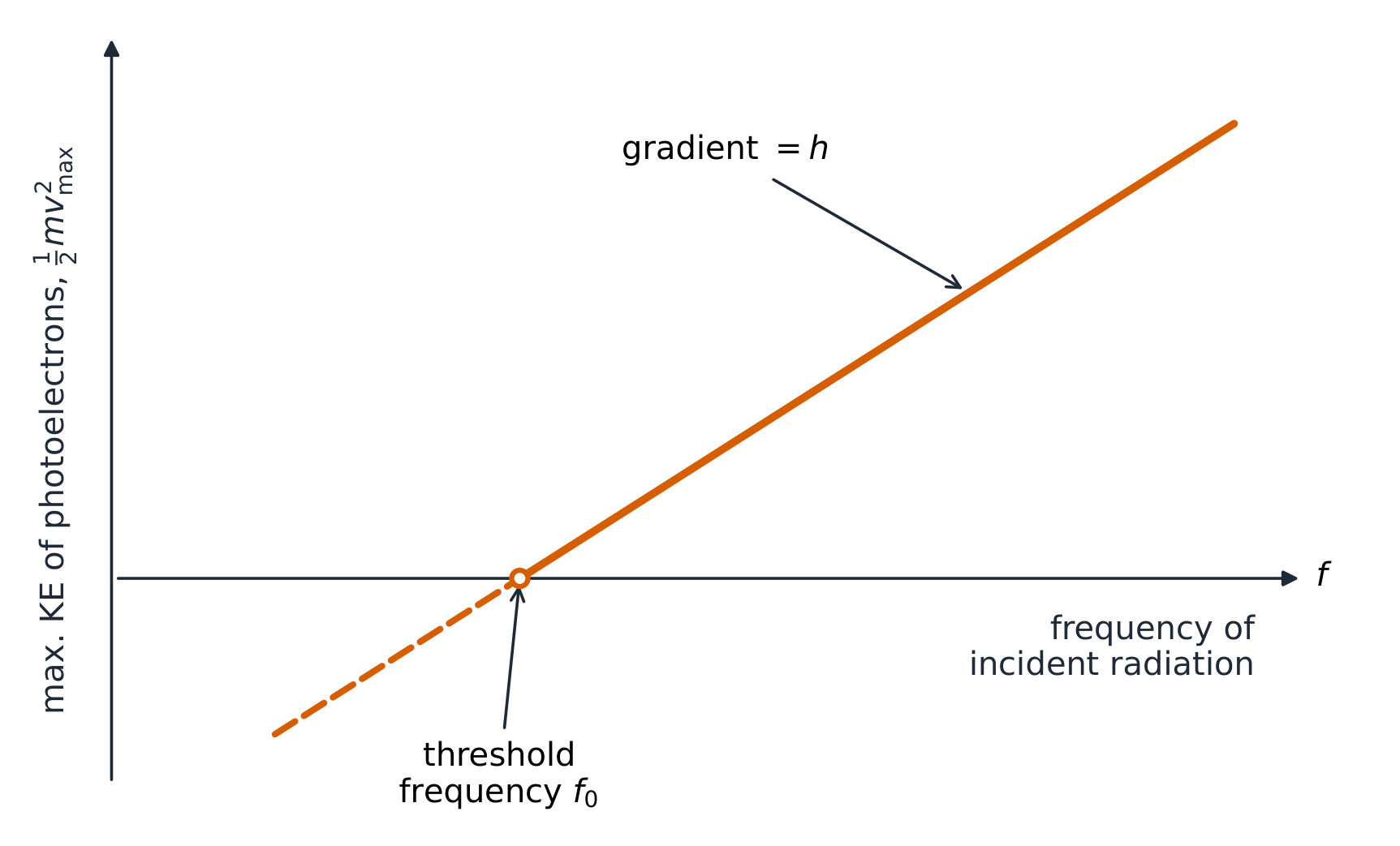
把光照在一个金属上能弹出电子——光电效应(photoelectric effect)。关键事实(只有光子图像解释):电子只有在光子的频率超过一个阈值时才出来,无论一个更暗、更低频率的光多亮。能量守恒给出

$$K_{\max}=hf-\phi,$$
其中 $\phi$ 是金属的逸出功(work function)(释放一个电子的能量)。

光电子的最大动能随频率线性上升
光电子的最大动能随频率线性上升

Worked example. 频率 $8.0\times10^{14}\ \text{Hz}$ 的光落在一个逸出功 $\phi=3.0\times10^{-19}\ \text{J}$ 的金属上。最有能量的电子以以下出来

$$K_{\max}=hf-\phi=(6.63\times10^{-34}\times8.0\times10^{14})-3.0\times10^{-19}=5.3\times10^{-19}-3.0\times10^{-19}=2.3\times10^{-19}\ \text{J}.$$
低于阈值频率 $\phi/h$,$K_{\max}$ 会是负的——意味着完全没有电子逃逸,无论光多亮。

词汇表 训练
英文 中文 拼音
photoelectric effect 光电效应 guāng diàn xiào yìng
work function 逸出功 yì chū gōng
15.6

康普顿散射

大纲
Learning ObjectiveEssential Knowledge

15.6.A
Describe the interaction between photons and matter using Compton scattering.

  • 15.6.A.1 In Compton scattering, a photon interacts with a free electron. The Compton effect is when a photon that emerges from the interaction has a lower energy and longer wavelength than the incoming photon. The magnitude of the change is related to the direction of the photon after the collision.
  • 15.6.A.2 Compton scattering provides evidence that light is a collection of discrete, quantized energy packets called photons.
    • 15.6.A.2.i Compton scattering can be explained by treating a photon as a particle and applying conservation of energy and conservation of momentum to the collision between the photon and electron.
    • 15.6.A.2.ii The transfer of a photon's energy to an electron results in the energy, momentum, frequency, and wavelength of the photon changing.
      • Relevant equations:
      • $E = hf$
      • $\lambda = \dfrac{h}{p}$
  • 15.6.A.3 The change in wavelength experienced by a photon after colliding with an electron is related to how much the photon's direction changes.
    • Relevant equation:
    • $\Delta\lambda = \dfrac{h}{m_e c}(1 - \cos\theta)$

Boundary statement: AP Physics 2 includes full quantitative and qualitative treatments of conservation of momentum in two dimensions.

来源:美国大学理事会 AP 课程与考试说明

康普顿散射(Compton scattering)里,一个光子像两个粒子那样与一个电子碰撞,转移一些能量和动量。散射的光子以更少能量(更长波长)出来。这是光子携带动量并表现为粒子的直接证据。

词汇表 训练
英文 中文 拼音
Compton scattering 康普顿散射 kāng pǔ dùn sǎn shè
15.7

裂变、聚变与核衰变

大纲
Learning ObjectiveEssential Knowledge

15.7.A
Describe the physical properties that constrain the behavior of interacting nuclei, subatomic particles, and nucleons.

  • 15.7.A.1 The strong force is exerted at nuclear scales and dominates the interactions of nucleons (protons or neutrons).
  • 15.7.A.2 Possible nuclear reactions are constrained by the law of conservation of nucleon number.
  • 15.7.A.3 The behavior of the constituent particles of a nuclear reaction is constrained by laws of conservation of energy, energy-mass equivalence, and conservation of momentum.
  • 15.7.A.4 For all nuclear reactions, mass and energy may be exchanged due to mass-energy equivalence.
    • Relevant equation:
    • $E = mc^2$
  • 15.7.A.5 Energy may be released in nuclear processes in the form of kinetic energy of the products or as photons.
  • 15.7.A.6 Nuclear fusion is the process by which two or more smaller nuclei combine to form a larger nucleus, as well as subatomic particles.
  • 15.7.A.7 Nuclear fission is the process by which the nucleus of an atom splits into two or more smaller nuclei, as well as subatomic particles.
  • 15.7.A.8 Nuclear fission may occur spontaneously or may require an energy input, depending on the binding energy of the nucleus.

15.7.B
Describe the radioactive decay of a given sample of material consisting of a finite number of nuclei.

  • 15.7.B.1 Radioactive decay is the spontaneous transformation of a nucleus into one or more different nuclei.
    • 15.7.B.1.i The time at which an individual nucleus undergoes radioactive decay is indeterminable, but decay rates can be described using probability
    • 15.7.B.1.ii The half-life, $t_{1/2}$, of a radioactive material is the time it takes for half of the initial number of radioactive nuclei to have spontaneously decayed.
    • 15.7.B.1.iii The decay constant $\lambda$ can be related to the half-life of a radioactive material with the equation $\lambda = \dfrac{\ln 2}{t_{1/2}}$.
  • 15.7.B.2 A material's decay constant may be used to predict the number of nuclei remaining in a sample after a period of time, or the age of a material if the initial amount of material is known.
    • Relevant equation:
    • $N = N_0 e^{-\lambda t}$
    • Derived equation:
    • $\ln\left(\dfrac{N}{N_0}\right) = -\lambda t$
  • 15.7.B.3 Different unstable elements and isotopes may have vastly different half-lives, ranging from fractions of a second to billions of years.

来源:美国大学理事会 AP 课程与考试说明

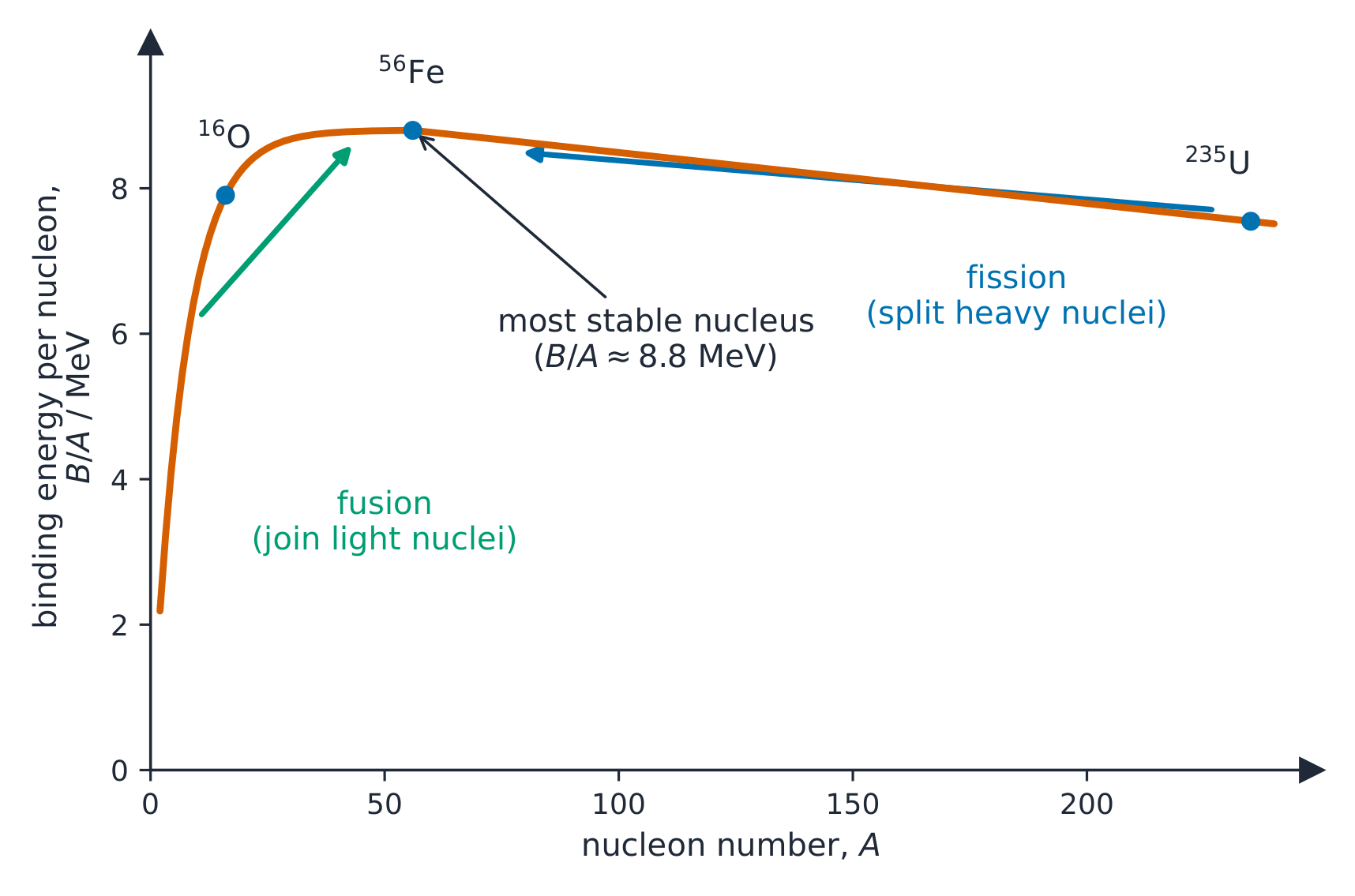
原子核(nucleus)储存巨大的能量。裂变(fission)把一个重原子核分裂成更轻的,释放能量(核反应堆、炸弹)。聚变(fusion)把轻原子核连接成一个更重的(太阳的能量)。两者都释放能量,因为产物有略更少的质量,由 $E=mc^2$ 转换。

每核子结合能在铁附近达到峰值,所以聚变和裂变都能释放能量

Worked example. 即使一个微小的质量也转换成一个巨大的能量。若一个核反应损失 $1.0\times10^{-3}\ \text{kg}$ 的质量,它释放 $E=mc^2=1.0\times10^{-3}\times(3.0\times10^{8})^2=9.0\times10^{13}\ \text{J}$ ——大致是 $20\,000$ 吨 TNT 的能量。
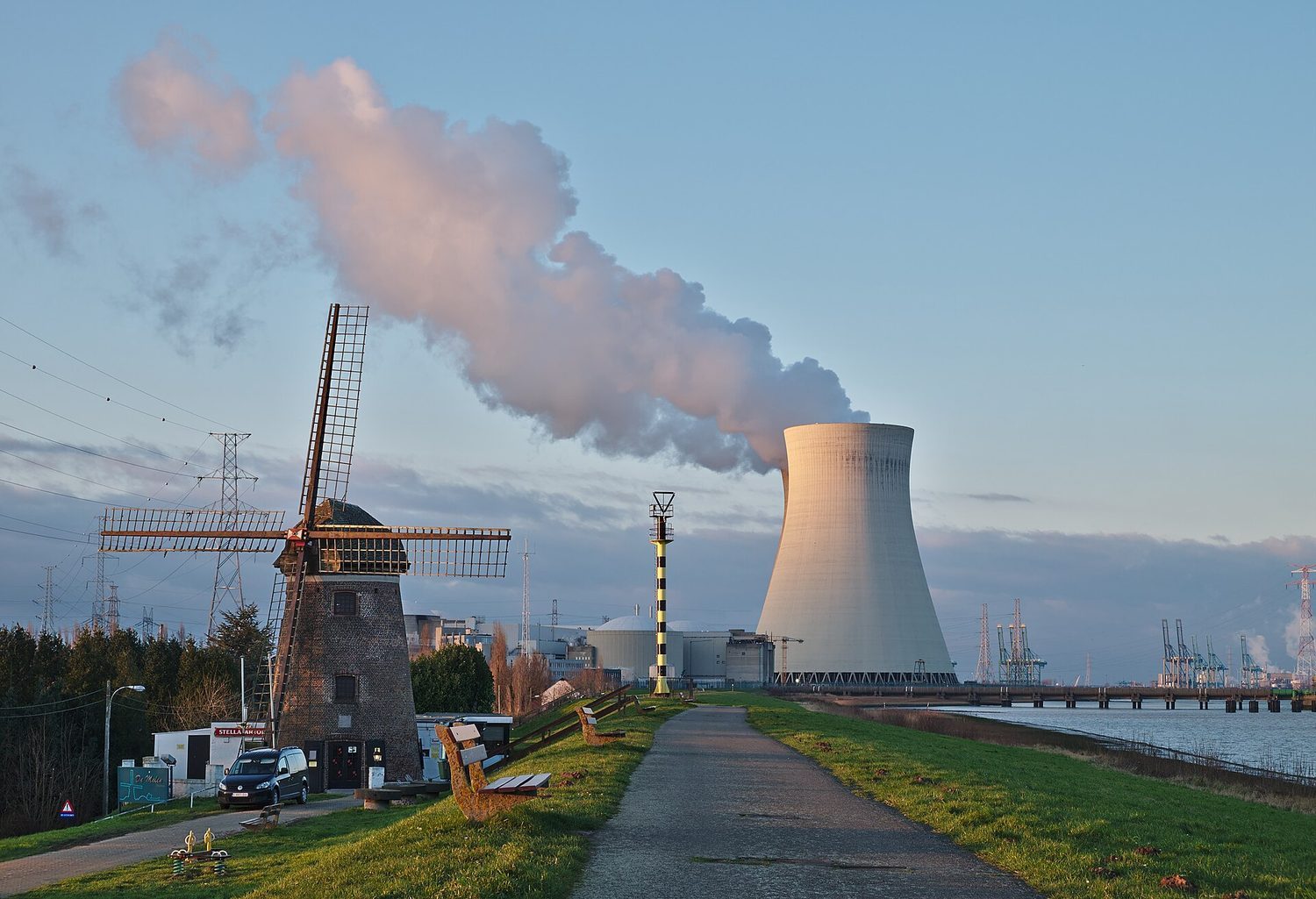
A nuclear power station: fission of heavy nuclei releases the energy that drives the plant
探索

Balance a nuclear decay equation

In alpha, beta and gamma decay, nucleon and charge numbers must balance. Pick a mode and see how the parent turns into the daughter nuclide.

词汇表 训练
英文 中文 拼音
nucleus 原子核 yuán zǐ hé
Fission 裂变 liè biàn
Fusion 聚变 jù biàn
15.8

放射性衰变的类型

大纲
Learning ObjectiveEssential Knowledge

15.8.A
Describe the processes by which individual nuclei decay.

  • 15.8.A.1 Some processes by which nuclei decay emit subatomic particles with unique properties.
    • 15.8.A.1.i An alpha particle, or helium nucleus, consists of two neutrons and two protons and is symbolized by $\alpha$ or $\text{He}^{2+}$. (In Physics 2, only He-4 nuclei will be considered.)
    • 15.8.A.1.ii Neutrinos and antineutrinos are subatomic particles that have no electrical charge, have negligible mass, and are symbolized by $\nu$ and $\bar{\nu}$, respectively.
    • 15.8.A.1.iii Neutrinos and antineutrinos only interact with matter via the weak force and the gravitational force, which results in very little interaction with normal matter.
    • 15.8.A.1.iv Positrons, or antielectrons, are subatomic particles that have an electric charge opposite that of an electron, have the same mass as an electron, and are symbolized by $e^+$ or $\beta^+$.
  • 15.8.A.2 Nuclei can undergo radioactive decay via alpha decay, beta-minus decay ($\beta^-$), beta-plus decay ($\beta^+$), and gamma decay ($\gamma$).
    • 15.8.A.2.i In all nuclear decays, nucleon number (the number of neutrons and protons), lepton number (the number of electrons and neutrinos), and charge are conserved.
    • 15.8.A.2.ii Alpha decay occurs when a nucleus ejects an alpha particle.
    • 15.8.A.2.iii Beta-minus decay occurs when a neutron changes to a proton by emitting an electron and antineutrino.
    • 15.8.A.2.iv Beta-plus decay occurs when a proton changes to a neutron by emitting a positron and neutrino.
    • 15.8.A.2.v Gamma decay occurs after a nucleus has undergone alpha or beta decay and the excited nucleus decays to a lower energy state by emitting a photon.
  • 15.8.A.3 The type of decay exhibited by a given nucleus is determined by the isotope of the element.

Boundary statement: AP Physics 2 does not expect students to memorize the processes by which specific isotopes decay or the half-lives of specific isotopes. Neutron emission and electron capture are not included in the AP Physics 2 curriculum framework. Additionally, types of neutrinos, the characteristics that distinguish neutrinos and antineutrinos, and an explanation or application of the weak force are not within the scope of this course.

来源:美国大学理事会 AP 课程与考试说明

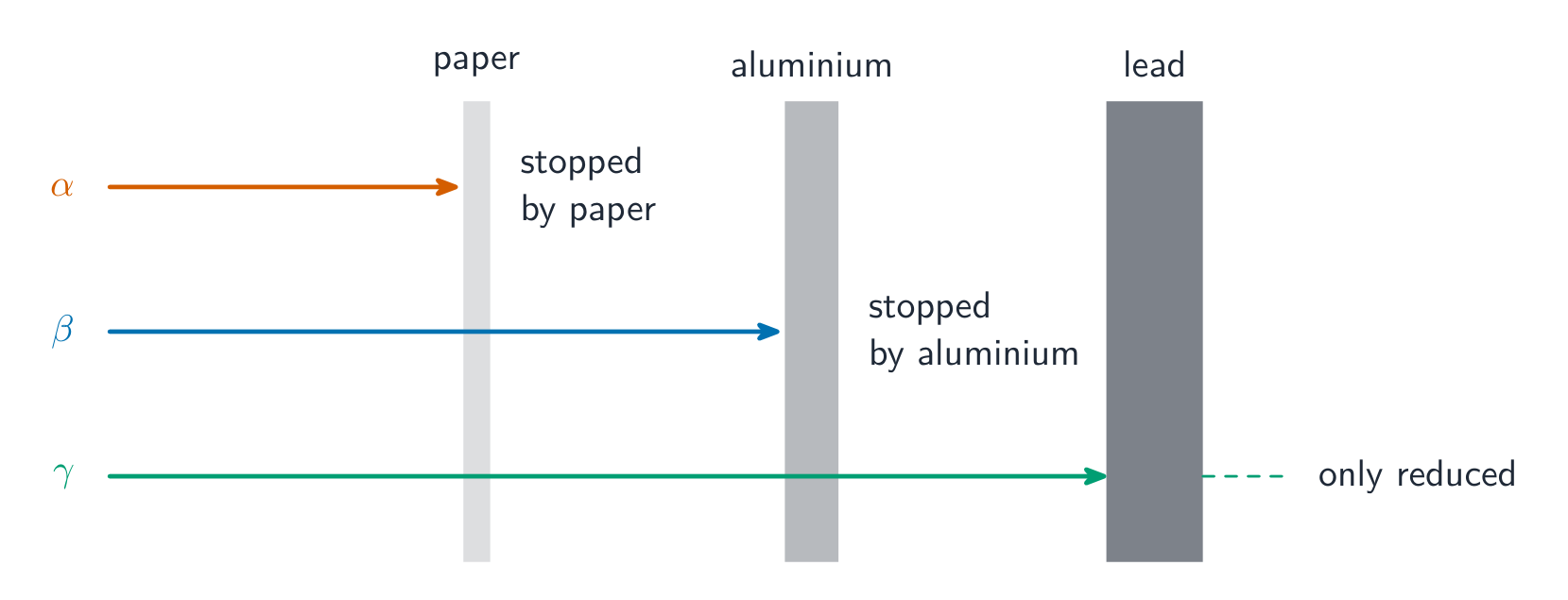
放射性衰变与半衰期

不稳定的原子核经历放射性衰变(radioactive decay),发射:

阿尔法、贝塔和伽马辐射的穿透力
阿尔法、贝塔和伽马辐射的穿透力
  • 阿尔法衰变(alpha decay)($\alpha$):一个氦核——质量数下降 4。
  • 贝塔衰变(beta decay)($\beta$)有两种。在贝塔负($\beta^-$)里一个中子变成一个质子,放出一个电子和一个反中微子(antineutrino):$n\rightarrow p+e^-+\bar{\nu}$。在贝塔正($\beta^+$)里一个质子变成一个中子,放出一个正电子(positron)和一个中微子(neutrino):$p\rightarrow n+e^++\nu$
  • 伽马衰变(gamma decay)($\gamma$):一个高能光子——原子核脱掉多余的能量。

中微子和反中微子(符号 $\nu$$\bar{\nu}$)是微小的、无电荷的、几乎无质量的粒子,它们带走能量并使贝塔衰变保持平衡。衰变是随机的,但一个样本每个半衰期(half-life)减半:每个半衰期后,剩下原子核的一半已经衰变。每个衰变方程守恒三个量:核子数(质量数)、电荷轻子数(lepton number)——一个电子或中微子记为 $+1$ 轻子,一个正电子或反中微子记为 $-1$,两边的总数必须相等。

Worked example. 一个放射性样本有一个 $8.0$ 天的半衰期。$24$ 天后剩多少分数?那是 $24/8.0=3$ 个半衰期,所以剩下的分数是 $\left(\tfrac12\right)^3=\tfrac18$ ——约 $12.5\%$。在铀-238($^{238}_{\ 92}\text{U}$)的一次阿尔法衰变里,子体有质量数 $238-4=234$ 和原子序数 $92-2=90$:钍-234。

探索

Watch a sample decay

Radioactive nuclei decay randomly with a fixed half-life: each half-life halves the number remaining. Step forward and watch the sample shrink.

词汇表 训练
英文 中文 拼音
radioactive decay 放射性衰变 fàng shè xìng shuāi biàn
Alpha decay 阿尔法衰变 ā ěr fǎ shuāi biàn
Beta decay 贝塔衰变 bèi tǎ shuāi biàn
antineutrino 反中微子 fǎn zhōng wēi zi
positron 正电子 zhèng diàn zi
neutrino 中微子 zhōng wēi zi
Gamma decay 伽马衰变 gā mǎ shuāi biàn
half-life 半衰期 bàn shuāi qī
lepton number 轻子数 qīng zi shù
练习卷
15.8

考试技巧

  • 光子能量是 $E=hf$;低于阈值频率没有电子被发射无论光多亮(光电效应)。
  • 对最快的光电子用 $K_{\max}=hf-\phi$($\phi$ = 逸出功)。
  • 电子通过吸收/发射一个能量等于能级间隙的光子在离散能级之间跳跃——线光谱的来源。
  • 在裂变和聚变里,损失的小质量通过 $E=mc^2$ 变成能量。
  • 通过守恒质量数、电荷和轻子数配平衰变方程(在 $\beta^-$ 里写反中微子,在 $\beta^+$ 里写中微子),并每个半衰期($n$ 个半衰期后 $(\tfrac12)^n$)把样本减半。

本主题的互动课程

逐步学习,并即时检测练习。

AP 物理 2历年真题

AP 物理 2的更多主题

登录或创建账号

IGCSE, A-Level & AP