| Learning Objective | Essential Knowledge |
|---|---|
8.1.A |
|
流体
AP 物理 1 · 第 8 主题
 8:06
8:06
Fluids
A steel nail dropped into water goes straight to the bottom. Now look at this ship. It is built from the same steel, tens of thousands of tonnes of it, and it…
英文讲解 · 内嵌中英文字幕
8.1
内部结构与密度
大纲
来源:美国大学理事会 AP 课程与考试说明
固体、液体和气体之间的差别来自它们的粒子多强地相互作用。一个流体(fluid)(液体或气体)没有固定的形状——它流动,因为它的粒子彼此经过。密度(density)是每单位体积的质量:
$$\rho=\frac{m}{V}.$$
它取决于物质和它的状态。一个物体沉没或漂浮取决于它的密度如何与周围流体的比较——密度较小的漂浮、密度较大的沉没。一个理想流体(ideal fluid)是不可压缩(incompressible)的(恒定密度,无论压强)且没有黏度(viscosity)(内摩擦)—— AP 始终使用的模型。
探索
Float or sink by density
An object floats if it is less dense than the fluid. Change the density and watch it ride higher or sink, displacing its own weight of fluid.
词汇表
训练
| 英文 | 中文 | 拼音 |
|---|---|---|
| fluid/ˈfluːɪd/ | 流体 | liú tǐ |
| Density/ˈdensɪti/ | 密度 | mì dù |
| ideal fluid/aɪˈdɪəl ˈfluːɪd/ | 理想流体 | lǐ xiǎng liú tǐ |
| incompressible/ˌɪnkəmˈpresəbl/ | 不可压缩 | bù kě yā suō |
| viscosity/vɪˈskɒsɪti/ | 黏度 | nián dù |
8.2
压强
大纲
| Learning Objective | Essential Knowledge |
|---|---|
8.2.A |
|
8.2.B |
|
来源:美国大学理事会 AP 课程与考试说明
压强(pressure)是每单位面积的垂直力,一个以帕斯卡(Pa)测量的标量(scalar):
$$P=\frac{F_\perp}{A}.$$
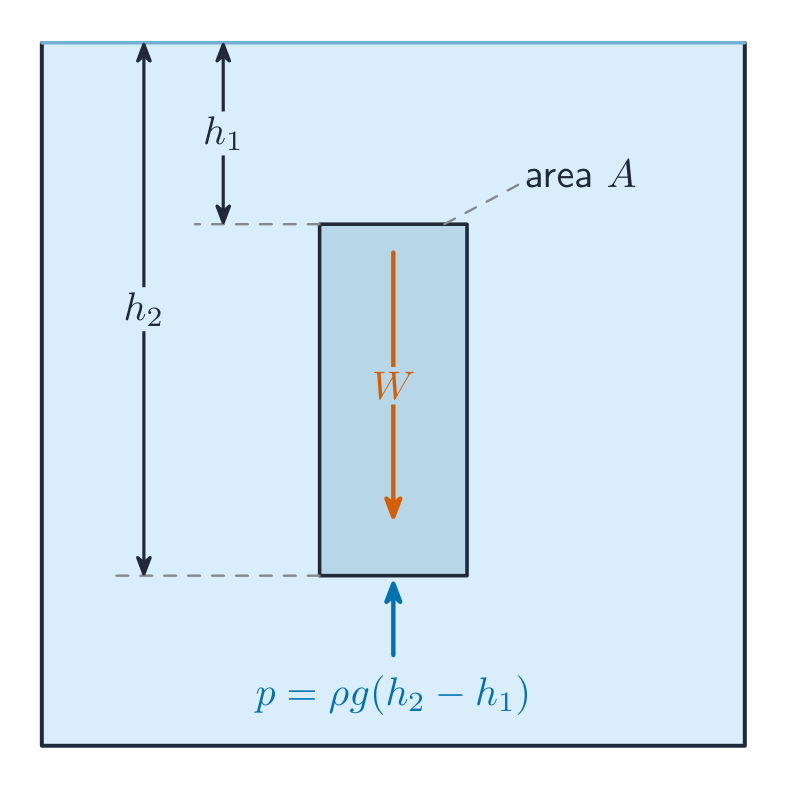
在一个静止的流体里,压强随深度(depth)增加,因为上面流体的重量:
$$P=P_0+\rho g h,$$
其中 $P_0$ 是表面的压强而 $h$ 是深度。压强在一点在所有方向上相等地作用并垂直于任何表面推。
区分 AP 问的两种压强:表压(gauge pressure)是流体柱添加的额外压强,$P_{\text{gauge}}=\rho g h$,而绝对压强(absolute pressure)是总量,$P=P_0+P_{\text{gauge}}$(以 $P_0$ 通常是大气压)。一个读"$200\ \text{kPa}$"的轮胎压力表是表压;里面的空气实际约在 $300\ \text{kPa}$ 绝对压强。
Worked example. 求水($\rho=1000\ \text{kg/m}^3$,表面压强 $P_0=1.0\times10^{5}\ \text{Pa}$)表面之下 $10\ \text{m}$ 的一个潜水者上的总压强:
$$P=P_0+\rho g h=1.0\times10^{5}+1000\times9.8\times10=1.98\times10^{5}\ \text{Pa}.$$
每 $10\ \text{m}$ 的水添加大约一个额外大气压的压强。注意压强不取决于容器的形状或宽度,只取决于深度。
词汇表
训练
| 英文 | 中文 | 拼音 |
|---|---|---|
| Pressure/ˈpreʃə/ | 压强 | yā qiáng |
| scalar/ˈskeɪlə/ | 标量 | biāo liàng |
| depth/depθ/ | 深度 | shēn dù |
| gauge pressure/ɡeɪdʒ ˈpreʃə/ | 表压 | biǎo yā |
| absolute pressure/ˈæbsəluːt ˈpreʃə/ | 绝对压强 | jué duì yā qiáng |
8.3
流体与牛顿定律
大纲
| Learning Objective | Essential Knowledge |
|---|---|
8.3.A |
|
8.3.B |
|
来源:美国大学理事会 AP 课程与考试说明
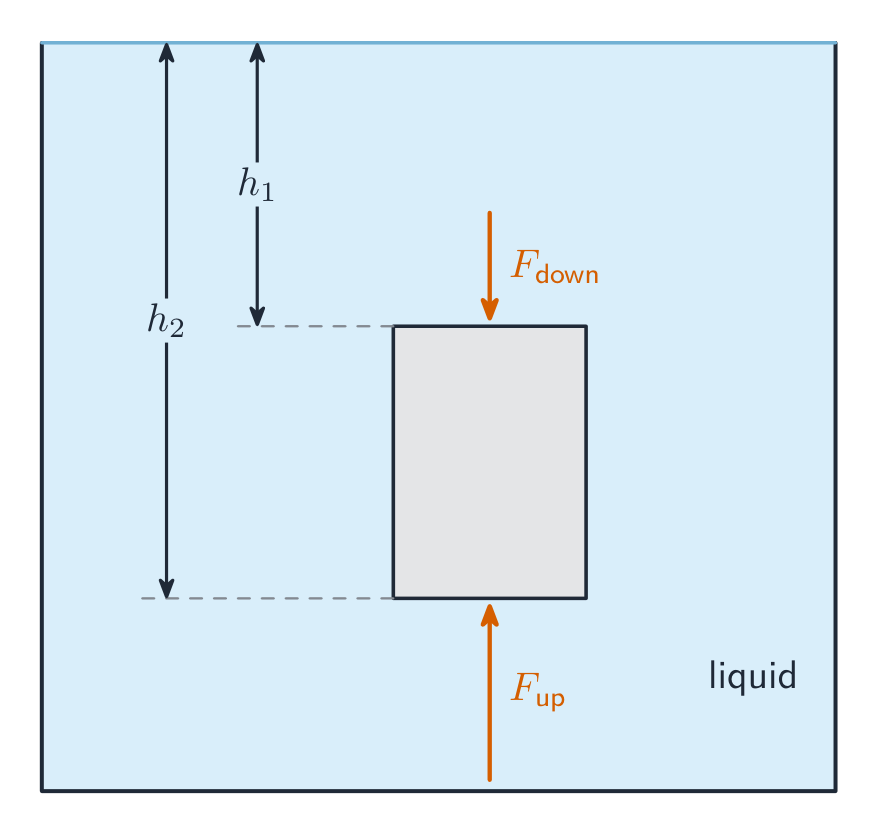
一个流体里的物体感受一个向上的浮力(buoyant force),等于它排开的流体的重量——阿基米德原理(Archimedes' principle):
$$F_b=\rho_{\text{fluid}}\,g\,V_{\text{displaced}}.$$
把这个与牛顿定律结合:物体在浮力平衡重量时漂浮、在重量获胜时沉没,而在浮力获胜时上升。一个漂浮的物体恰好排开它自己重量的流体。
Worked example. 一个密度 $600\ \text{kg/m}^3$ 的木块在水($1000\ \text{kg/m}^3$)里漂浮。多少分数在表面之下?对于漂浮,浮力等于重量,所以 $\rho_{\text{fluid}}\,g\,V_{\text{sub}}=\rho_{\text{object}}\,g\,V$:
$$\frac{V_{\text{sub}}}{V}=\frac{\rho_{\text{object}}}{\rho_{\text{fluid}}}=\frac{600}{1000}=0.60.$$
所以 $60\%$ 坐在水之下——大多数冰山(密度 $\approx 900$)藏在水下的同一原因。
词汇表
训练
| 英文 | 中文 | 拼音 |
|---|---|---|
| buoyant force/ˈbɔɪənt fɔːs/ | 浮力 | fú lì |
| Archimedes' principle/ˌɑːkɪˈmiːdiːz ˈprɪnsɪpl/ | 阿基米德原理 | ā jī mǐ dé yuán lǐ |
8.4
流体与守恒定律
大纲
| Learning Objective | Essential Knowledge |
|---|---|
8.4.A |
|
来源:美国大学理事会 AP 课程与考试说明
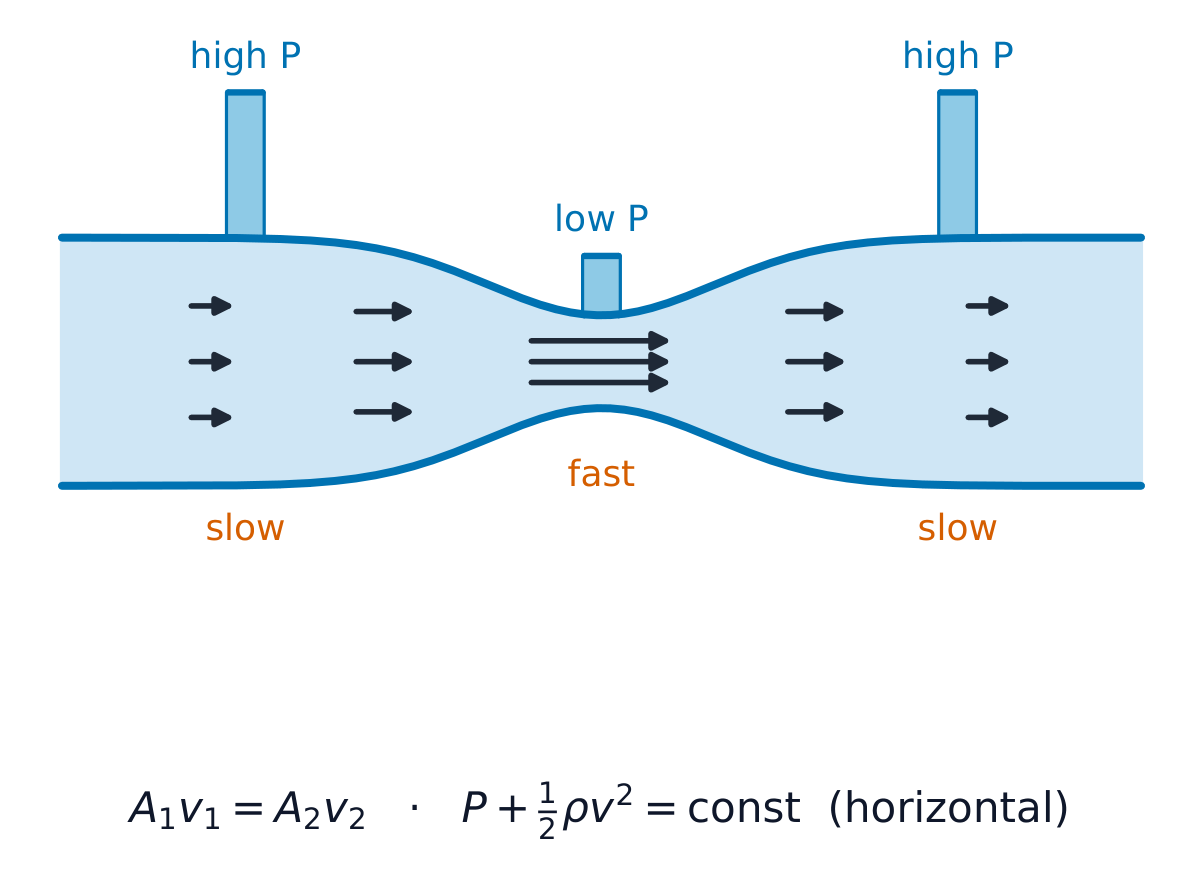
对于一个稳定流动的理想流体,两个守恒思想适用:
- 连续性(continuity)(质量守恒):体积流量恒定,所以 $A_1 v_1 = A_2 v_2$。一个更窄的管子迫使更快的流动。
- 伯努利方程(Bernoulli's equation)(每体积能量守恒):沿一条流线,
$$P+\tfrac{1}{2}\rho v^2+\rho g y = \text{constant}.$$
它们一起解释为什么流体在一个管子变窄或流动最快的地方加速而它的压强下降。
Worked example. 水以 $2.0\ \text{m/s}$ 流过一个横截面 $0.010\ \text{m}^2$ 的管子,然后进入一个 $0.0040\ \text{m}^2$ 的更窄部分。由连续性那里的速率是
$$v_2=\frac{A_1 v_1}{A_2}=\frac{0.010\times2.0}{0.0040}=5.0\ \text{m/s}.$$
由伯努利方程这更快的流处于更低的压强——抬起一个飞机机翼并把两艘经过的船拉到一起的效应。
Exam skill. 按什么变化选择正确的定律。若管子改变宽度,从连续性($A_1v_1=A_2v_2$)开始得到速率;若你然后需要一个压强,把那些速率喂进伯努利。只有当管子也改变水平时才注意高度项 $\rho g y$。
词汇表
训练
| 英文 | 中文 | 拼音 |
|---|---|---|
| Continuity/kɒntɪˈnjuːɪti/ | 连续性 | lián xù xìng |
| Bernoulli's equation/ˈbɜːnaʊliz ɪˈkweɪʒn/ | 伯努利方程 | bó nǔ lì fāng chéng |
8.4
考试技巧
- 压强随深度是 $P=P_0+\rho g h$ ——它只取决于深度,不取决于容器的形状或宽度。
- 浮力 = 排开的流体的重量($\rho_{\text{fluid}}\,gV_{\text{disp}}$);一个漂浮的物体排开它自己的重量,所以被淹没的分数是 $\rho_{\text{object}}/\rho_{\text{fluid}}$。
- 比较密度以预测漂浮 vs 沉没;一个漂浮的物体处于平衡(浮力 = 重量),不是失重。
- 用连续性 $A_1v_1=A_2v_2$:一个更窄的管子意味着更快的流动。
- 伯努利:一个流体流动更快的地方它的压强更低(机翼升力、喷雾)。
本主题的互动课程
逐步学习,并即时检测练习。