跳到主要内容

力矩与转动动力学

AP 物理 1 · 第 5 主题

训练
讲义 词汇表
5.1

转动运动学

大纲
Learning ObjectiveEssential Knowledge

5.1.A
Describe the rotation of a system with respect to time using angular displacement, angular velocity, and angular acceleration.

  • 5.1.A.1 Angular displacement is the measurement of the angle, in radians, through which a point on a rigid system rotates about a specified axis.
    • Equation: $\Delta\theta = \theta - \theta_0$
    • 5.1.A.1.i A rigid system is one that holds its shape but in which different points on the system move in different directions during rotation. A rigid system cannot be modeled as an object.
    • 5.1.A.1.ii One direction of angular displacement about an axis of rotation—clockwise or counterclockwise—is typically indicated as mathematically positive, with the other direction becoming mathematically negative.
    • 5.1.A.1.iii If the rotation of a system about an axis may be well described using the motion of the system's center of mass, the system may be treated as a single object. For example, the rotation of Earth about its axis may be considered negligible when considering the revolution of Earth about the center of mass of the Earth–Sun system.
  • 5.1.A.2 Average angular velocity is the average rate at which angular position changes with respect to time.
    • Equation: $\omega_{\text{avg}} = \dfrac{\Delta\theta}{\Delta t}$
  • 5.1.A.3 Average angular acceleration is the average rate at which the angular velocity changes with respect to time.
    • Equation: $\alpha_{\text{avg}} = \dfrac{\Delta\omega}{\Delta t}$
  • 5.1.A.4 Angular displacement, angular velocity, and angular acceleration around one axis are analogous to linear displacement, velocity, and acceleration in one dimension and demonstrate the same mathematical relationships.
    • 5.1.A.4.i For constant angular acceleration, the mathematical relationships between angular displacement, angular velocity, and angular acceleration can be described with the following equations:
      • Equation: $\omega = \omega_0 + \alpha t$
      • Equation: $\theta = \theta_0 + \omega_0 t + \dfrac{1}{2}\alpha t^2$
      • Equation: $\omega^2 = \omega_0^2 + 2\alpha(\theta - \theta_0)$
    • 5.1.A.4.ii Graphs of angular displacement, angular velocity, and angular acceleration as functions of time can be used to find the relationships between those quantities.

Boundary statement: Descriptions of the directions of rotation for a point or object are limited to clockwise and counterclockwise with respect to a given axis of rotation.

来源:美国大学理事会 AP 课程与考试说明

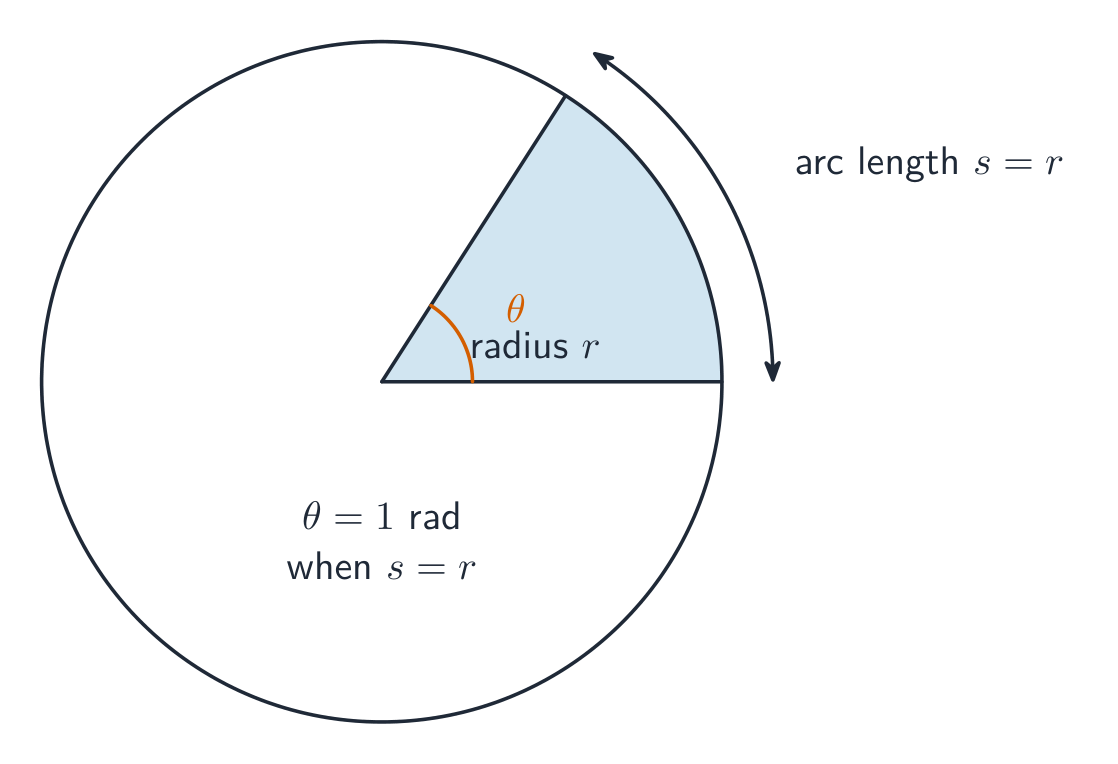
旋转由映照线性量的角量描述:

一弧度是弧长等于半径的角
一弧度是弧长等于半径的角
  • 角位移(angular displacement)$\theta$(以弧度(radians)),
  • 角速度(angular velocity)$\omega=\dfrac{\Delta\theta}{\Delta t}$,
  • 角加速度(angular acceleration)$\alpha=\dfrac{\Delta\omega}{\Delta t}$

对于恒定 $\alpha$,旋转运动学方程有与线性的相同形式,$\theta,\omega,\alpha$ 替换 $x,v,a$:$\omega=\omega_0+\alpha t$$\theta=\omega_0 t+\tfrac12\alpha t^2$,和 $\omega^2=\omega_0^2+2\alpha\theta$

Worked example. 一个轮子从静止开始并在 $6.0\ \text{s}$ 里均匀加速到 $30\ \text{rad/s}$。求它的角加速度和转过的总角度:

$$\alpha=\frac{\Delta\omega}{\Delta t}=\frac{30}{6.0}=5.0\ \text{rad/s}^2,\qquad \theta=\tfrac12\alpha t^2=\tfrac12\times5.0\times6.0^2=90\ \text{rad}.$$

词汇表 训练
英文 中文 拼音
angular displacement 角位移 jiǎo wèi yí
radians 弧度 hú dù
angular velocity 角速度 jiǎo sù dù
angular acceleration 角加速度 jiǎo jiā sù dù
5.2

连接线运动与转动

大纲
Learning ObjectiveEssential Knowledge

5.2.A
Describe the linear motion of a point on a rotating rigid system that corresponds to the rotational motion of that point, and vice versa.

  • 5.2.A.1 For a point at a distance $r$ from a fixed axis of rotation, the linear distance $s$ traveled by the point as the system rotates through an angle $\Delta\theta$ is given by the equation $\Delta s = r\Delta\theta$.
  • 5.2.A.2 Derived relationships of linear velocity and of the tangential component of acceleration to their respective angular quantities are given by the following equations:
    • Equation: $s = r\theta$
    • Equation: $v = r\omega$
    • Equation: $a_T = r\alpha$
  • 5.2.A.3 For a rigid system, all points within that system have the same angular velocity and angular acceleration.

Boundary statement: Descriptions of the directions of rotation for a point or object are limited to clockwise and counterclockwise with respect to a given axis of rotation.

来源:美国大学理事会 AP 课程与考试说明

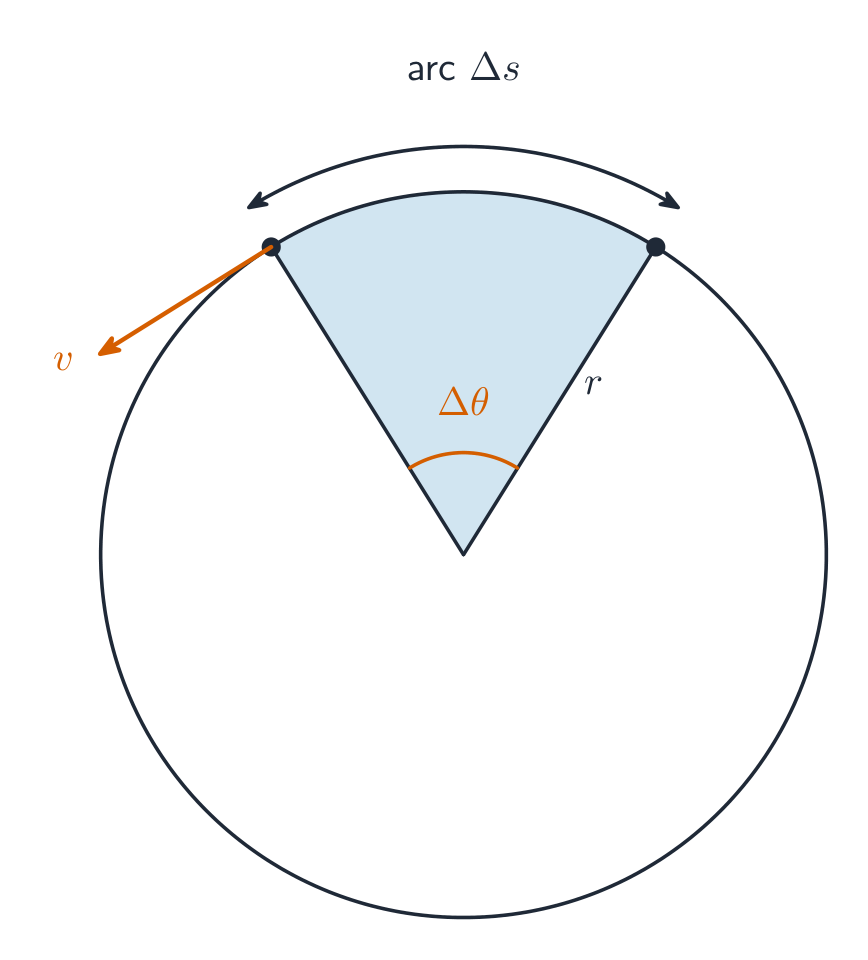
一个离轴半径 $r$ 的点有与角量绑定的线性量:

$$s=r\theta,\qquad v=r\omega,\qquad a_t=r\alpha.$$
离轴更远的点移动更快。这个联系让你能在"轮子旋转多快"和"它轮缘上一个点移动多快"之间切换。

随着半径转过一个角,一个点以速率 v 沿一条弧移动

Worked example. 一个半径 $0.35\ \text{m}$ 的自行车轮以 $12\ \text{rad/s}$ 旋转。轮缘上一个点(因而自行车)以 $v=r\omega=0.35\times12=4.2\ \text{m/s}$ 移动。一个到轴一半的点以那速率的一半移动。

5.3

力矩
大纲
Learning ObjectiveEssential Knowledge

5.3.A
Identify the torques exerted on a rigid system.

  • 5.3.A.1 Torque results only from the force component perpendicular to the position vector from the axis of rotation to the point of application of the force.
  • 5.3.A.2 The lever arm is the perpendicular distance from the axis of rotation to the line of action of the exerted force.

5.3.B
Describe the torques exerted on a rigid system.

  • 5.3.B.1 Torques can be described using force diagrams.
    • 5.3.B.1.i Force diagrams are similar to free-body diagrams and are used to analyze the torques exerted on a rigid system.
    • 5.3.B.1.ii Similar to free-body diagrams, force diagrams represent the relative magnitude and direction of the forces exerted on a rigid system. Force diagrams also depict the location at which those forces are exerted relative to the axis of rotation.
  • 5.3.B.2 The magnitude of the torque exerted on a rigid system by a force is described by the following equation, where $\theta$ is the angle between the force vector and the position vector from the axis of rotation to the point of application of the force.
    • Equation: $\tau = rF_{\perp} = rF\sin\theta$

Boundary statement: While AP Physics 1 expects students to mathematically manipulate the magnitude of torque using vector conventions, the direction of torque is beyond the scope of the course.

来源:美国大学理事会 AP 课程与考试说明

力矩的原理

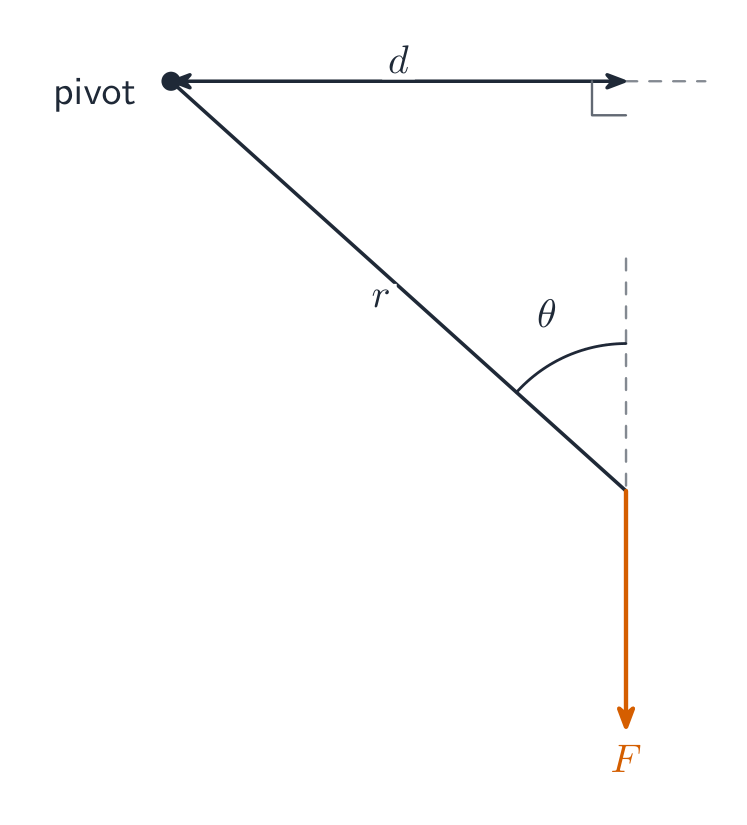
力矩(torque)是一个力的旋转效应——它多有效地使一个物体绕一个轴转:

$$\tau=r F\sin\theta = F\cdot r_\perp,$$
其中 $r_\perp$力臂(moment arm)(从轴到力作用线的垂直距离)。一个施加在更远处、或更垂直的力产生更多力矩。力矩有一个符号(顺时针 vs 逆时针)。

一个力的力矩取决于从支点的垂直距离
一个力的力矩取决于从支点的垂直距离

Worked example. 你在一把 $0.30\ \text{m}$ 扳手的末端以 $20\ \text{N}$ 推。垂直于扳手力矩是 $\tau=rF=0.30\times20=6.0\ \text{N m}$。若你相反以与扳手 $60^{\circ}$ 推,只有垂直部分计入:$\tau=rF\sin 60^{\circ}=0.30\times20\times0.87=5.2\ \text{N m}$ ——这就是为什么你以一个直角推以获得最多的转动效应。

探索

Balance torques on a beam

Torque is force times perpendicular distance, $\tau=Fd$. The beam is in rotational equilibrium when the torques on each side are equal.

词汇表 训练
英文 中文 拼音
Torque 力矩 lì jǔ
moment arm 力臂 lì bì
练习卷
5.4

转动惯量

大纲
Learning ObjectiveEssential Knowledge

5.4.A
Describe the rotational inertia of a rigid system relative to a given axis of rotation.

  • 5.4.A.1 Rotational inertia measures a rigid system's resistance to changes in rotation and is related to the mass of the system and the distribution of that mass relative to the axis of rotation.
  • 5.4.A.2 The rotational inertia of an object rotating a perpendicular distance $r$ from an axis is described by the equation
    • Equation: $I = mr^2$
  • 5.4.A.3 The total rotational inertia of a collection of objects about an axis is the sum of the rotational inertias of each object about that axis:
    • Equation: $I_{\text{tot}} = \sum I_i = \sum m_i r_i^2$

5.4.B
Describe the rotational inertia of a rigid system rotating about an axis that does not pass through the system's center of mass.

  • 5.4.B.1 A rigid system's rotational inertia in a given plane is at a minimum when the rotational axis passes through the system's center of mass.
  • 5.4.B.2 The parallel axis theorem uses the following equation to relate the rotational inertia of a rigid system about any axis that is parallel to an axis through its center of mass:
    • Equation: $I' = I_{\text{cm}} + Md^2$

Boundary statement: AP Physics 1 only expects students to calculate the rotational inertia for systems of five or fewer objects arranged in a two-dimensional configuration.

Boundary statement: Students do not need to know the rotational inertia of extended rigid systems, as these will be provided within the exam. Students should have a qualitative understanding of the factors that affect rotational inertia; for example, how rotational inertia is greater when mass is farther from the axis of rotation, which is why a hoop has more rotational inertia than a solid disk of the same mass and radius.

来源:美国大学理事会 AP 课程与考试说明

转动惯量(rotational inertia)(moment of inertia)$I$ 测量改变一个物体的旋转有多难——质量的旋转版本。它取决于质量和那质量离轴多远:质量散布得更远给出一个更大的 $I$。对于一个点质量,$I=mr^2$;对于延展的物体,提供标准公式(一个环是 $mR^2$、一个实心圆盘 $\tfrac12 mR^2$)。这就是为什么一个花样滑冰者在她收臂时旋转更快——她减小 $I$

词汇表 训练
英文 中文 拼音
Rotational inertia 转动惯量 zhuǎn dòng guàn liàng
5.5

转动平衡与转动形式的牛顿第一定律

大纲
Learning ObjectiveEssential Knowledge

5.5.A
Describe the conditions under which a system's angular velocity remains constant.

  • 5.5.A.1 A system may exhibit rotational equilibrium (constant angular velocity) without being in translational equilibrium, and vice versa.
    • 5.5.A.1.i Free-body and force diagrams describe the nature of the forces and torques exerted on an object or rigid system.
    • 5.5.A.1.ii Rotational equilibrium is a configuration of torques such that the net torque exerted on the system is zero.
      • Equation: $\sum \tau_i = 0$
    • 5.5.A.1.iii The rotational analog of Newton's first law is that a system will have a constant angular velocity only if the net torque exerted on the system is zero.
  • 5.5.A.2 A rotational corollary to Newton's second law states that if the torques exerted on a rigid system are not balanced, the system's angular velocity must be changing.

Boundary statement: AP Physics 1 does not expect students to simultaneously analyze rotation in multiple planes.

来源:美国大学理事会 AP 课程与考试说明

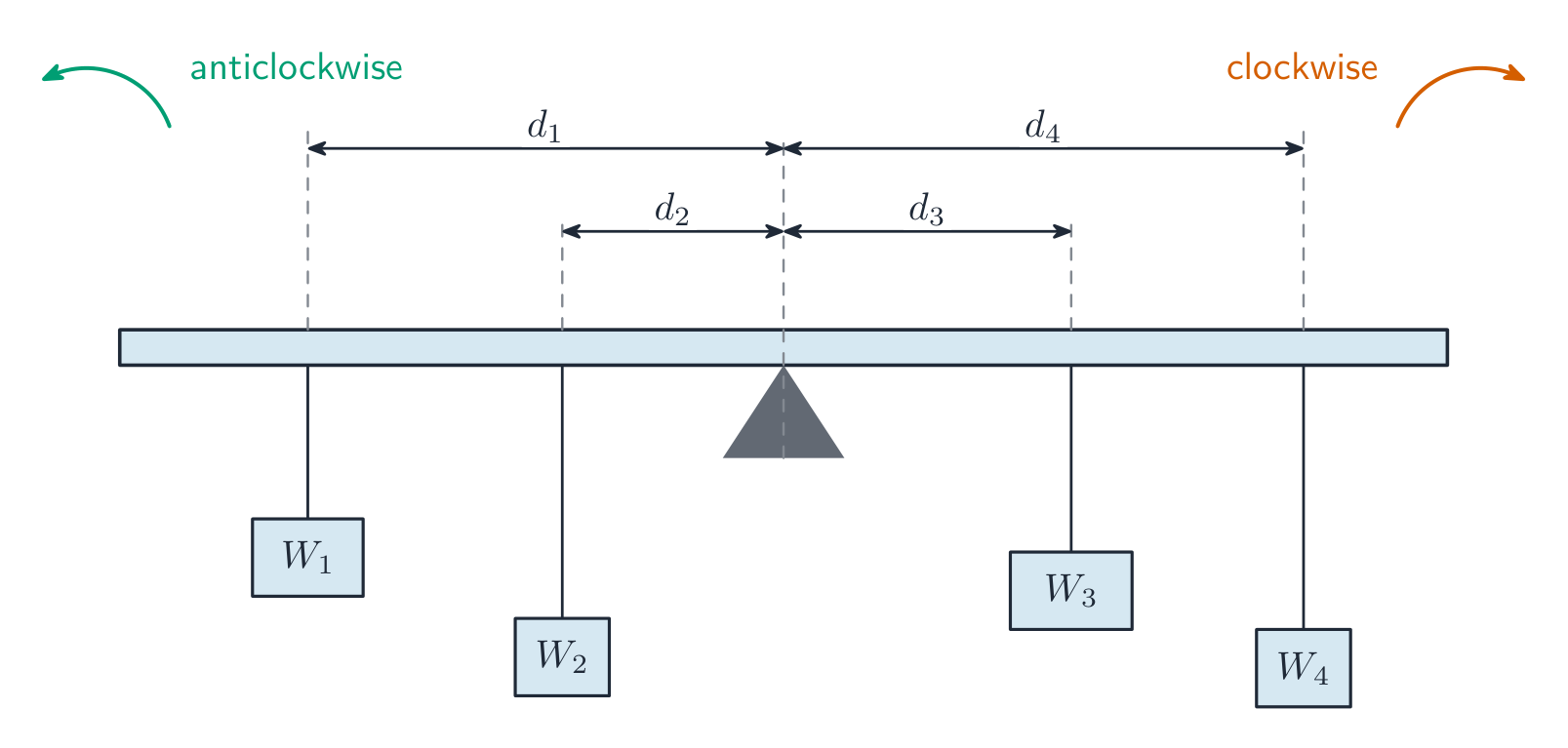
一个物体处于转动平衡(rotational equilibrium),当合力矩是零时,所以它的角速度保持恒定。对于一个平衡(静态)的物体,合力合力矩都是零。把轴选在一个未知力的位置从力矩方程移除它——梁和梯子问题的一个有用诀窍。

在平衡时绕支点的顺时针和逆时针力矩相等
在平衡时绕支点的顺时针和逆时针力矩相等

Worked example. 一个 $30\ \text{kg}$ 的孩子坐在离一个跷跷板支点 $2.0\ \text{m}$ 处。一个 $40\ \text{kg}$ 的孩子必须坐在另一侧哪里来平衡它?把顺时针力矩设为等于逆时针力矩($g$ 约去):

$$30\times2.0=40\times d\;\Rightarrow\;d=\frac{60}{40}=1.5\ \text{m}.$$
更重的孩子坐得更接近支点——更少距离、相同力矩。

探索

Find the balance point

For rotational equilibrium the total clockwise torque equals the total anticlockwise torque. Move the forces and distances until the beam balances.

词汇表 训练
英文 中文 拼音
rotational equilibrium 转动平衡 zhuǎn dòng píng héng
5.6

转动形式的牛顿第二定律

大纲
Learning ObjectiveEssential Knowledge

5.6.A
Describe the conditions under which a system's angular velocity changes.

  • 5.6.A.1 Angular velocity changes when the net torque exerted on the object or system is not equal to zero.
  • 5.6.A.2 The rate at which the angular velocity of a rigid system changes is directly proportional to the net torque exerted on the rigid system and is in the same direction. The angular acceleration of the rigid system is inversely proportional to the rotational inertia of the rigid system.
    • Equation: $\alpha_{\text{sys}} = \dfrac{\sum \tau}{I_{\text{sys}}} = \dfrac{\tau_{\text{net}}}{I_{\text{sys}}}$
  • 5.6.A.3 To fully describe a rotating rigid system, linear and rotational analyses may need to be performed independently.

来源:美国大学理事会 AP 课程与考试说明

合力矩产生角加速度,与 $F=ma$ 直接类比:

$$\sum\tau = I\alpha.$$
所以一个更大的合力矩,或一个更小的转动惯量,给出一个更大的角加速度。像平动问题一样解旋转问题,$\tau\leftrightarrow F$$I\leftrightarrow m$,和 $\alpha\leftrightarrow a$

Worked example. 一个 $12\ \text{N m}$ 的合力矩作用在一个转动惯量 $I=3.0\ \text{kg m}^2$ 的轮子上。它的角加速度是 $\alpha=\tau/I=12/3.0=4.0\ \text{rad/s}^2$ —— $a=F/m$ 的确切旋转孪生。

5.6

考试技巧

  • 力矩 $\tau=Fr_\perp$ 使用从支点的垂直距离;一个通过支点的力给出零力矩。
  • 对于平衡,设顺时针力矩 = 逆时针力矩;把支点选在一个未知力处从方程移除它。
  • 使用旋转类比:$\tau\leftrightarrow F$$I\leftrightarrow m$$\alpha\leftrightarrow a$,所以 $\sum\tau=I\alpha$ 映照 $\sum F=ma$
  • 转动惯量取决于质量离轴多远,不只是它的量——一个环比一个相等质量的圆盘更抵抗旋转。
  • 把角转换成弧度并用 $v=r\omega$$a_t=r\alpha$ 把线性连接到角。

本主题的互动课程

逐步学习,并即时检测练习。

AP 物理 1历年真题

AP 物理 1的更多主题

登录或创建账号

IGCSE, A-Level & AP