| Learning Objective | Essential Knowledge |
|---|---|
3.1.A |
|
功、能与功率
AP 物理 1 · 第 3 主题
 8:07
8:07
Work, Energy, and Power
Look up at the first hill of a roller coaster. A chain drags the train to the top, then lets go. There is no engine on the train — nothing pushes it again for…
英文讲解 · 内嵌中英文字幕
3.1
平动动能
大纲
来源:美国大学理事会 AP 课程与考试说明
能量(energy)是做功的能力,以焦耳(joules)(J)测量。一个移动的物体有动能(kinetic energy):
$$K=\tfrac{1}{2}mv^2.$$
它取决于速率的平方,所以把速率加倍使动能变为四倍。动能是一个标量而从不为负。
Worked example. 一辆 $1500\ \text{kg}$ 的车以 $20\ \text{m/s}$ 行驶。它的动能是 $K=\tfrac12\times1500\times20^2=3.0\times10^{5}\ \text{J}=300\ \text{kJ}$。若它加速到 $40\ \text{m/s}$(两倍),动能变成 $4\times$ 大,$1200\ \text{kJ}$ ——这就是为什么停车距离随速率增长得如此快。
词汇表
训练
| 英文 | 中文 | 拼音 |
|---|---|---|
| Energy/ˈenədʒi/ | 能量 | néng liàng |
| joules/dʒuːlz/ | 焦耳 | jiāo ěr |
| kinetic energy/kɪˈnetɪk ˈenədʒi/ | 动能 | dòng néng |
| Work/wɜːk/ | 功 | gōng |
3.2
功
大纲
| Learning Objective | Essential Knowledge |
|---|---|
3.2.A |
Boundary statement: AP Physics 1 only expects students to analyze the transfer of mechanical energy (as defined in Unit 3, Topic 4: Conservation of Energy), although students should be aware that mechanical energy may be dissipated in the form of thermal energy or sound. In AP Physics 2, students will also study how thermal energy can be transferred between systems through heating or cooling. |
来源:美国大学理事会 AP 课程与考试说明
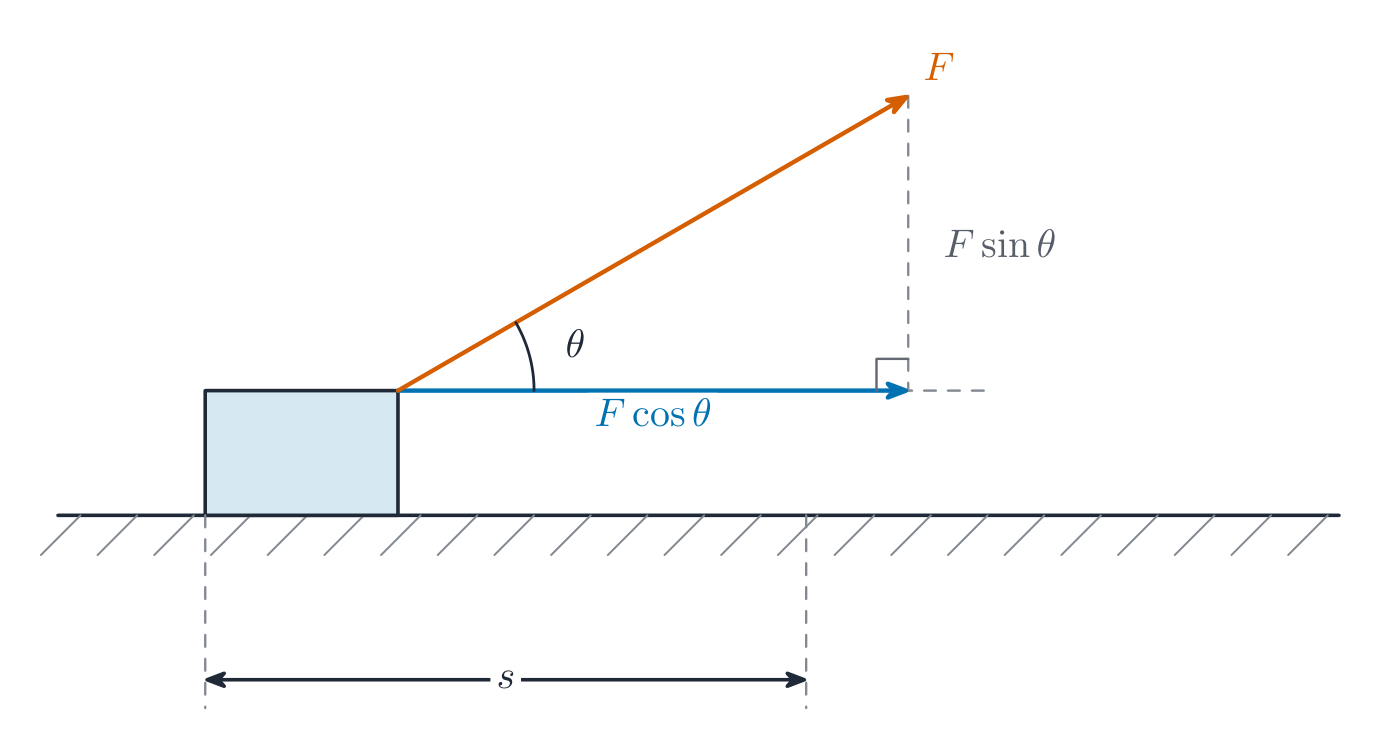
功(work)是一个力作用在一个位移上转移的能量:
$$W=F\,d\cos\theta,$$
其中 $\theta$ 是力和位移之间的角。功在力有一个沿运动的分量时是正的(添加能量)、在它反对运动时是负的(移除能量),而在力垂直时是零。在一个力-位置图上,功是曲线下的面积。动能定理(work–energy theorem)陈述合功等于动能的变化:$W_{\text{net}}=\Delta K$。
Worked example. 一个 $2.0\ \text{kg}$ 的木块在一个无摩擦地板上以 $3.0\ \text{m/s}$ 移动,被一个 $5.0\ \text{N}$ 的力沿运动方向推 $4.0\ \text{m}$。求它的最终速率。合功是 $W=Fd=5.0\times4.0=20\ \text{J}$,而由动能定理 $W=\tfrac12 m(v^2-v_0^2)$:
$$20=\tfrac12\times2.0\times(v^2-3.0^2)\;\Rightarrow\;v^2=29\;\Rightarrow\;v=5.4\ \text{m/s}.$$
词汇表
训练
| 英文 | 中文 | 拼音 |
|---|---|---|
| work–energy theorem/wɜːk ˈenədʒi ˈθɪərəm/ | 动能定理 | dòng néng dìng lǐ |
3.3
势能
大纲
| Learning Objective | Essential Knowledge |
|---|---|
3.3.A |
|
来源:美国大学理事会 AP 课程与考试说明
势能(potential energy)是取决于位置或构型的储存的能量:
- 表面附近的重力势能(gravitational potential energy):$U_g=mgh$(一个参考水平之上的高度 $h$)。
- 一个弹簧里的弹性势能(elastic potential energy):$U_s=\tfrac{1}{2}kx^2$。
势能只对保守力(conservative forces)(重力、弹簧)定义,对它们储存的能量取决于位置,不是路径。只有势能的变化重要,所以你可以把零水平放在任何方便的地方。
$U_g=mgh$ 的形式只在 $g$ 大致恒定的表面附近成立。一般形式,对相距 $r$ 的两个球形质量,是
$$U_g=-\frac{G m_1 m_2}{r}.$$
它是负的,并被定义为在无穷远处为零,所以引力势能随质量分开而向零上升。$mgh$ 只是它在表面附近的近似。(这是你处理卫星和逃逸速度所需的形式。)
探索
Store elastic potential energy in a spring
Stretching a spring stores elastic potential energy $\tfrac12 kx^2$ — the area under the force-extension line. Release it and that energy becomes kinetic.
词汇表
训练
| 英文 | 中文 | 拼音 |
|---|---|---|
| Potential energy/pəˈtenʃl ˈenədʒi/ | 势能 | shì néng |
| Gravitational potential energy/ˌɡrævɪˈteɪʃənl pəˈtenʃl ˈenədʒi/ | 重力势能 | zhòng lì shì néng |
| Elastic potential energy/ɪˈlæstɪk pəˈtenʃl ˈenədʒi/ | 弹性势能 | tán xìng shì néng |
| conservative forces/kənˈsɜːvətɪv ˈfɔːsɪz/ | 保守力 | bǎo shǒu lì |
3.4
能量守恒
大纲
| Learning Objective | Essential Knowledge |
|---|---|
3.4.A |
|
3.4.B |
|
3.4.C |
Boundary statement: AP Physics 1 expects students to know that mechanical energy can be dissipated as thermal energy or sound by nonconservative forces. |
来源:美国大学理事会 AP 课程与考试说明
机械能(total mechanical energy)是 $E=K+U$。当只有保守力做功时,机械能守恒(conserved):
$$K_1+U_1=K_2+U_2.$$
当摩擦或其他非保守力作用时,它们把机械能转移到热能(thermal energy);那么一般的陈述是总能量(包括热能)守恒。能量条形图是追踪能量去哪里的一个好方式。
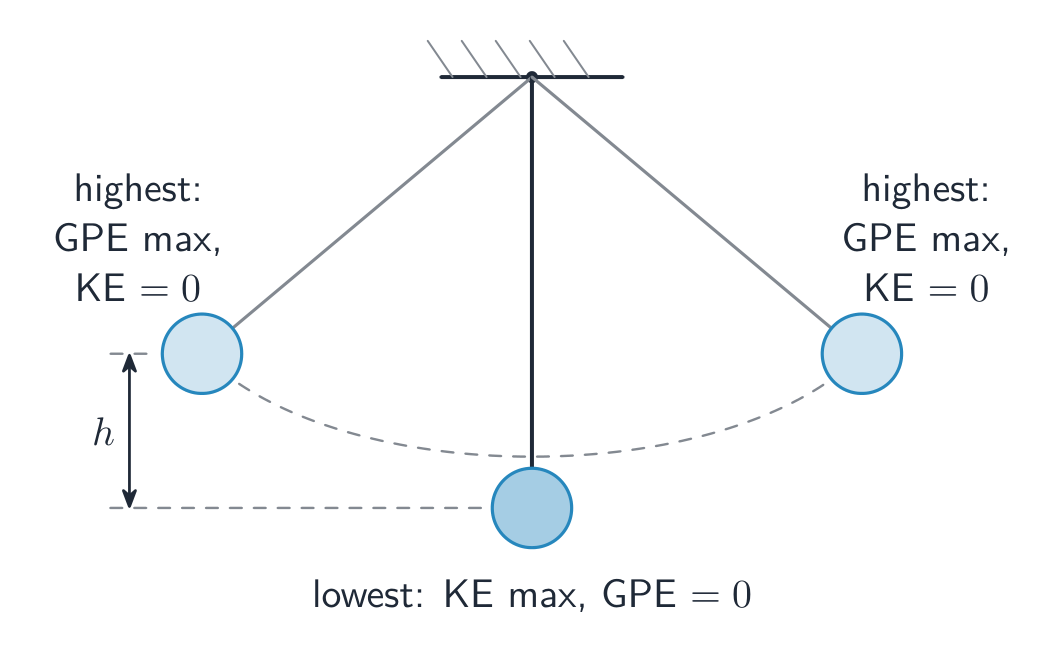
Worked example. 一个球从一个 $5.0\ \text{m}$ 高的无摩擦坡道顶部从静止释放。求它在底部的速率。所有的重力势能变成动能:
$$mgh=\tfrac12 mv^2\;\Rightarrow\;v=\sqrt{2gh}=\sqrt{2\times9.8\times5.0}=9.9\ \text{m/s}.$$
质量约去,所以每个物体达到相同的速率——恰好是自由落体的结果,现在从能量得到。若相反 $30\ \text{J}$ 损失给摩擦,你会减去它:$mgh-30=\tfrac12 mv^2$。
探索
Watch energy convert as an object falls
With no friction, mechanical energy is conserved: as an object falls, gravitational potential energy turns into kinetic energy while the total stays fixed.
词汇表
训练
| 英文 | 中文 | 拼音 |
|---|---|---|
| total mechanical energy/ˈtəʊtl mɪˈkænɪkl ˈenədʒi/ | 机械能 | jī xiè néng |
| conserved/kənˈsɜːvd/ | 守恒 | shǒu héng |
| thermal energy/ˈθɜːml ˈenədʒi/ | 热能 | rè néng |
3.5
功率
大纲
| Learning Objective | Essential Knowledge |
|---|---|
3.5.A |
|
来源:美国大学理事会 AP 课程与考试说明
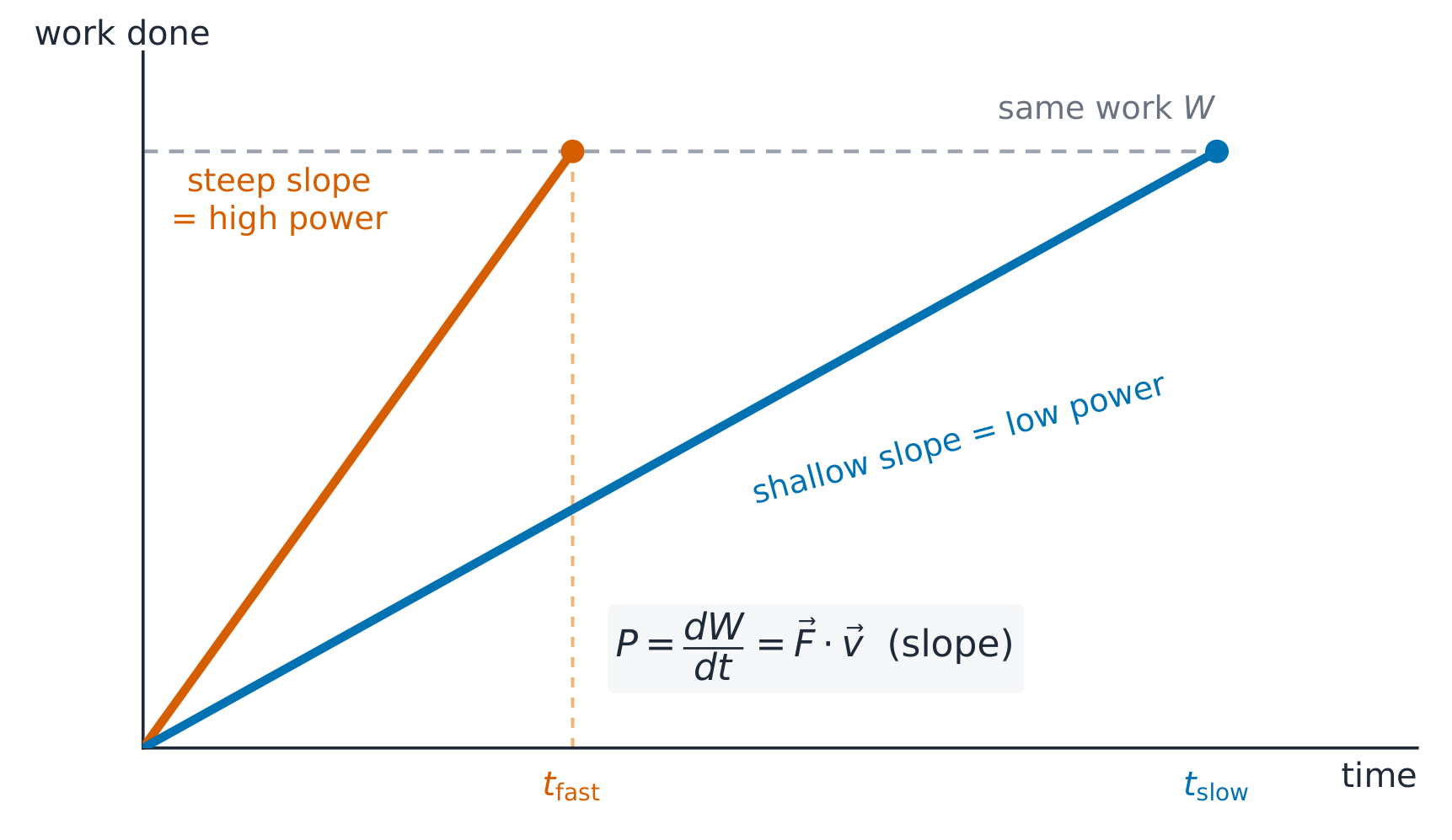
功率(power)是做功或转移能量的速率,以瓦特(watts)(W)测量:
$$P=\frac{W}{\Delta t}=\frac{\Delta E}{\Delta t},\qquad\text{and instantaneously}\qquad P=Fv.$$
所以同样的工作更快地完成需要更多功率。在一个能量-时间图上,功率是斜率。
Worked example. 一个马达以稳定的 $2.0\ \text{m/s}$ 提升一个 $50\ \text{kg}$ 的负载。因为它以恒定速率移动,提升力等于重量,所以
$$P=Fv=mgv=50\times9.8\times2.0=980\ \text{W}.$$
真实的机器浪费一些能量,所以我们引用效率(efficiency)——有用的输出功率除以总输入功率。若这个马达抽取 $1400\ \text{W}$ 的电功率来传递 $980\ \text{W}$ 的有用提升,它的效率是 $980/1400=0.70$,或 $70\%$;另外的 $30\%$ 变成热和声音。
词汇表
训练
| 英文 | 中文 | 拼音 |
|---|---|---|
| Power/ˈpaʊə/ | 功率 | gōng lǜ |
| watts/wɒts/ | 瓦特 | wǎ tè |
| efficiency/ɪˈfɪʃənsi/ | 效率 | xiào lǜ |
3.5
考试技巧
- 用 $W=Fd\cos\theta$:功在力垂直于运动时是零,而在它反对时是负的。
- 每当路径复杂时,伸手去拿动能定理($W_{\text{net}}=\Delta K$)或能量守恒($K_1+U_1=K_2+U_2$)而不是力。
- 当摩擦作用时,机械能不守恒——减去损失给热的能量。
- 记住 $K\propto v^2$:把速率加倍使动能(和停车距离)变为四倍。
- 对稳定速率的功率用 $P=Fv$;在恒定速度合力是零但功率不是。
本主题的互动课程
逐步学习,并即时检测练习。