| Learning Objective | Essential Knowledge |
|---|---|
1.1.A |
|
1.1.B |
|
运动学
AP 物理 1 · 第 1 主题
 9:04
9:04
Kinematics
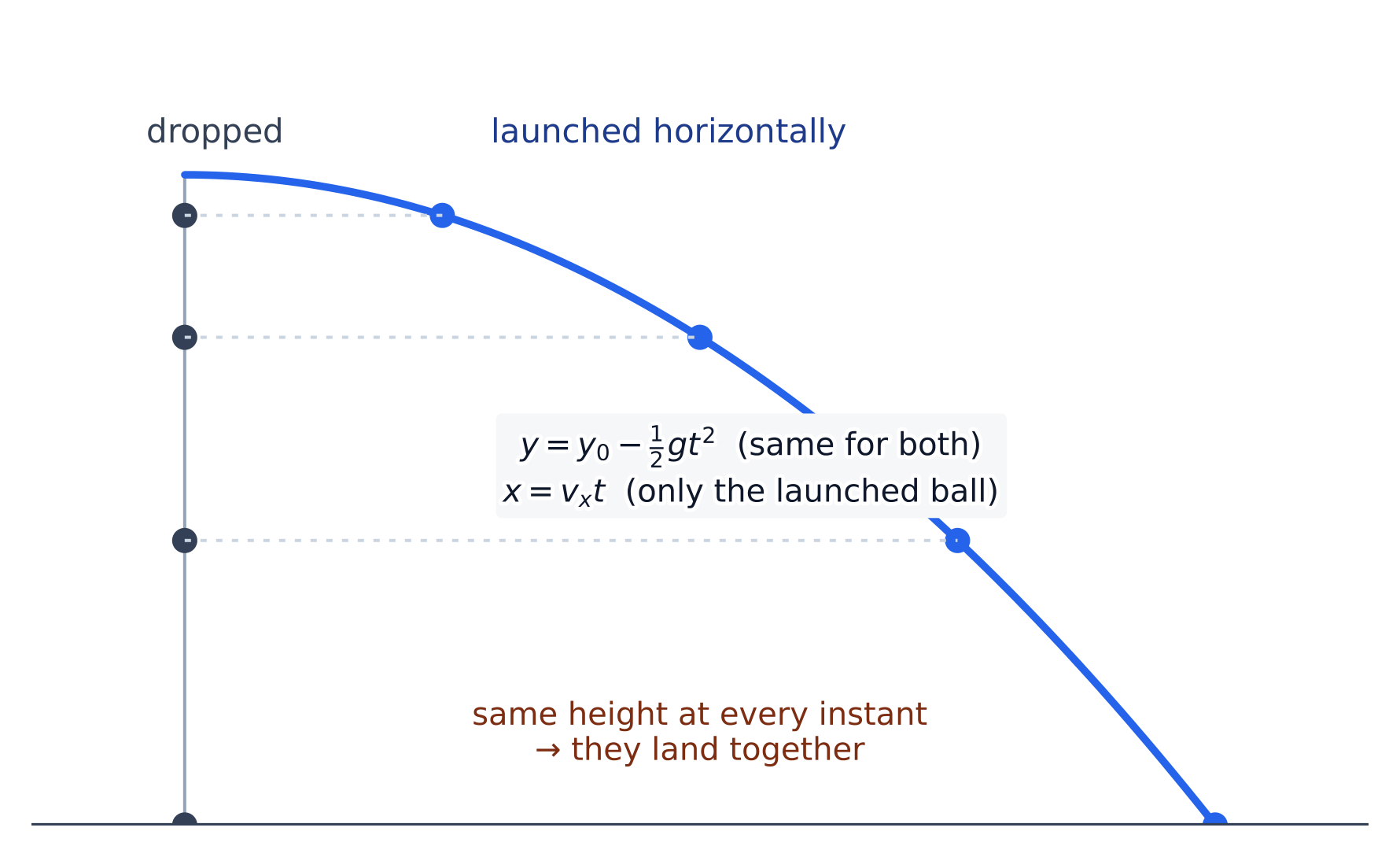
Two balls leave a table at the same moment. One is simply dropped. The other is fired sideways, hard. Which one hits the floor first? <slow>They land…
英文讲解 · 内嵌中英文字幕
1.1
一维标量与矢量
大纲
来源:美国大学理事会 AP 课程与考试说明
运动学(kinematics)描述物体如何移动,而不问为什么。首先,两种量:
- 一个标量(scalar)只有大小(大小(magnitude)):距离(distance)、速率、时间、质量。
- 一个矢量(vector)有大小和方向:位移、速度、加速度、力。
这个区别重要。距离(distance)是行进的总路径长度——一个只增长的标量。位移(displacement)是位置的直线变化,带一个方向。向东走 $3\ \text{m}$ 然后向西走回 $1\ \text{m}$:距离是 $4\ \text{m}$,但位移只是向东 $2\ \text{m}$。
在一维里,方向只是沿一个选定坐标轴的一个符号(+ 或 −)。先选择正方向至关重要——每个矢量的符号都取决于它。一个 $-5\ \text{m/s}$ 的速度不意味着"慢";它意味着负方向 $5\ \text{m/s}$。
词汇表
训练
| 英文 | 中文 | 拼音 |
|---|---|---|
| Kinematics/ˌkɪnɪˈmætɪks/ | 运动学 | yùn dòng xué |
| scalar/ˈskeɪlə/ | 标量 | biāo liàng |
| magnitude/ˈmæɡnɪtjuːd/ | 大小 | dà xiǎo |
| vector/ˈvektə/ | 矢量 | shǐ liàng |
| Displacement/dɪˈspleɪsmənt/ | 位移 | wèi yí |
| distance/ˈdɪstəns/ | 距离 | jù lí |
1.2
位移、速度与加速度
大纲
| Learning Objective | Essential Knowledge |
|---|---|
1.2.A |
|
1.2.B |
|
1.2.B |
|
来源:美国大学理事会 AP 课程与考试说明
三个相连的矢量描述沿一条线的运动:
- 位移(displacement)$\Delta x$ 是位置的变化——从起点到终点的一个矢量(不是总路径长度,那是距离)。
- 速度(velocity)是位置的变化率,$v=\dfrac{\Delta x}{\Delta t}$。它的符号给出方向;它的大小是速率(speed)。
- 加速度(acceleration)是速度的变化率,$a=\dfrac{\Delta v}{\Delta t}$。
小心把平均速度(average velocity)(总位移除以总时间)与瞬时速度(instantaneous velocity)(一个瞬间的速度,那个点位置-时间图的斜率)分开。它们只在速度恒定时才相等。
一个物体在 $v$ 和 $a$ 有相同符号时加速,而在它们有相反符号时减速(减速(deceleration))。注意一个负的加速度不总是意味着减速——一个越落越快的球有负的速度和负的加速度。
对于恒定加速度,四个运动学方程(常叫 SUVAT)适用:
$$v=v_0+at,\qquad \Delta x=v_0 t+\tfrac{1}{2}at^2,\qquad v^2=v_0^2+2a\,\Delta x,\qquad \Delta x=\tfrac{1}{2}(v_0+v)\,t.$$
挑选包含你知道的三个量加你想要的那个的方程,所以只剩下一个未知数。它们只在 $a$ 恒定时适用。
Worked example. 一辆车从静止开始并以 $2.0\ \text{m/s}^2$ 均匀加速 $6.0\ \text{s}$。求它的最终速度和它行进的距离。
列出你知道的:$v_0=0$,$a=2.0\ \text{m/s}^2$,$t=6.0\ \text{s}$。
$$v=v_0+at=0+2.0\times 6.0=12\ \text{m/s},$$
$$\Delta x=v_0 t+\tfrac12 at^2=0+\tfrac12\times 2.0\times 6.0^2=36\ \text{m}.$$
Worked example (free fall). 一个球以 $15\ \text{m/s}$ 直向上抛。取 $g=9.8\ \text{m/s}^2$ 和向上为正,它上升多高,以及它在返回抛掷者的手之前在空中多久?
在最高点速度暂时为零,而 $a=-g=-9.8\ \text{m/s}^2$ 始终(这是自由落体(free fall),忽略空气阻力(air resistance)):
$$v^2=v_0^2+2a\,\Delta x \;\Rightarrow\; 0=15^2+2(-9.8)\Delta x \;\Rightarrow\; \Delta x=\frac{225}{19.6}=11.5\ \text{m}.$$
到顶部的时间:$0=15-9.8\,t \Rightarrow t=1.53\ \text{s}$。按对称落下取相同的时间,所以总共是 $3.1\ \text{s}$。
词汇表
训练
| 英文 | 中文 | 拼音 |
|---|---|---|
| Velocity/vəˈlɒsɪti/ | 速度 | sù dù |
| speed/spiːd/ | 速率 | sù lǜ |
| Acceleration/əkˌseləˈreɪʃn/ | 加速度 | jiā sù dù |
| average velocity/ˈævrɪdʒ vəˈlɒsɪti/ | 平均速度 | píng jūn sù dù |
| instantaneous velocity/ˌɪnstənˈteɪnɪəs vəˈlɒsɪti/ | 瞬时速度 | shùn shí sù dù |
| deceleration/dɪˌseləˈreɪʃn/ | 减速 | jiǎn sù |
| free fall/friː fɔːl/ | 自由落体 | zì yóu luò tǐ |
| air resistance/eə rɪˈzɪstəns/ | 空气阻力 | kōng qì zǔ lì |
1.3
运动的表示
大纲
| Learning Objective | Essential Knowledge |
|---|---|
1.3.A |
Boundary statement: AP Physics 1 does not expect students to quantitatively analyze nonuniform acceleration. However, students will be expected to be able to qualitatively analyze, sketch appropriate graphs of, and discuss situations in which acceleration is nonuniform. Boundary statement: For all situations in which a numerical quantity is required for $g$, the value $g \approx 10 \ m/s^2$ will be used. However, students will not be penalized for correctly using the more precise commonly accepted values of $g = 9.81 \ \text{m/s}^2$ or $g = 9.8 \ \text{m/s}^2$. |
来源:美国大学理事会 AP 课程与考试说明
同一个运动作为一个描述、一个图、一张表,或一个方程出现,而你应当在它们之间移动:
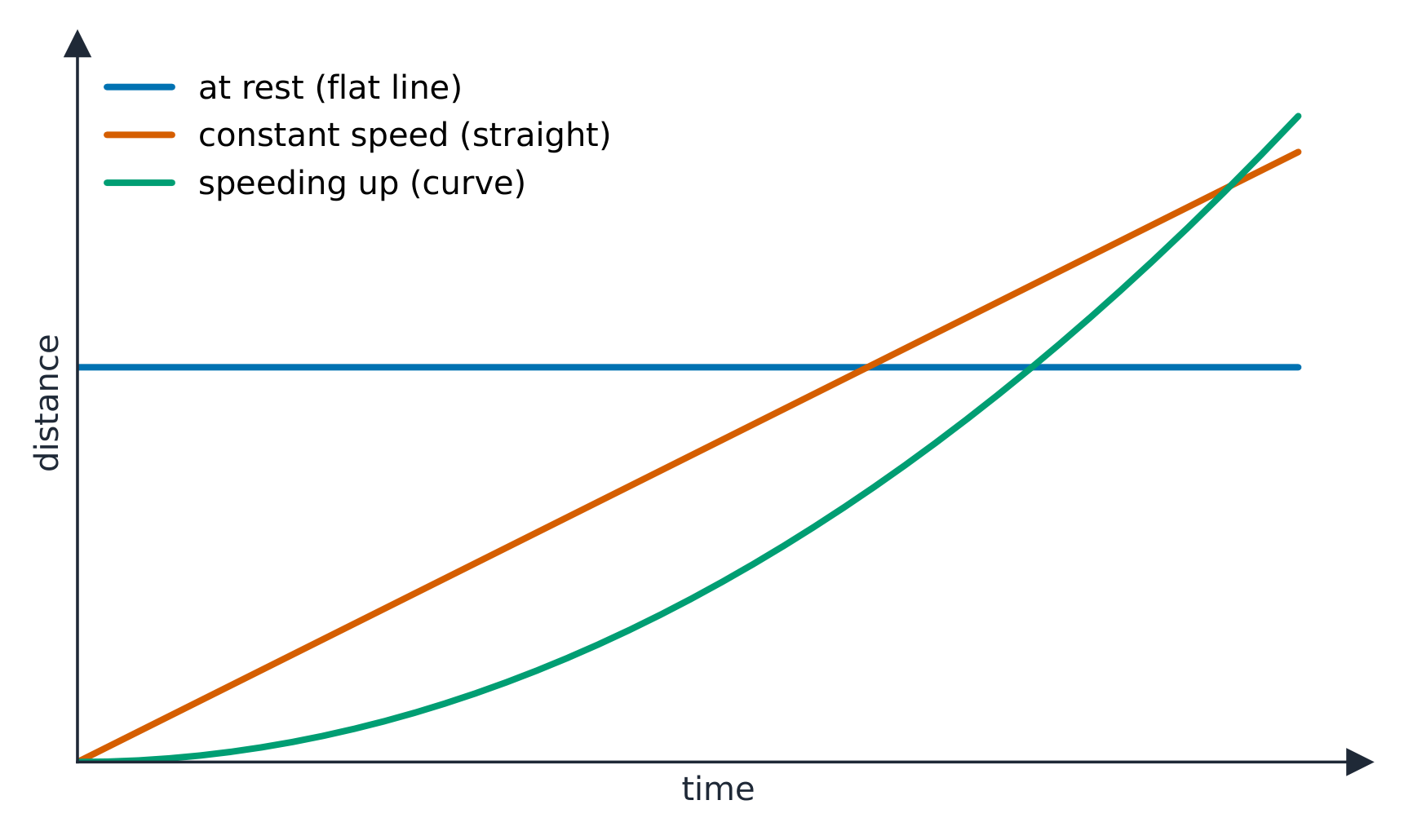
- 在一个位置-时间图上,斜率是速度(更陡 = 更快;一条曲线 = 变化的速度)。
- 在一个速度-时间图上,斜率是加速度,而线下的面积是位移。
从图读斜率和面积是一项核心考试技能。要从一个速度-时间图得到位移,把面积分成三角形和矩形并把它们相加;时间轴下方的面积算作负位移(相反方向的运动)。
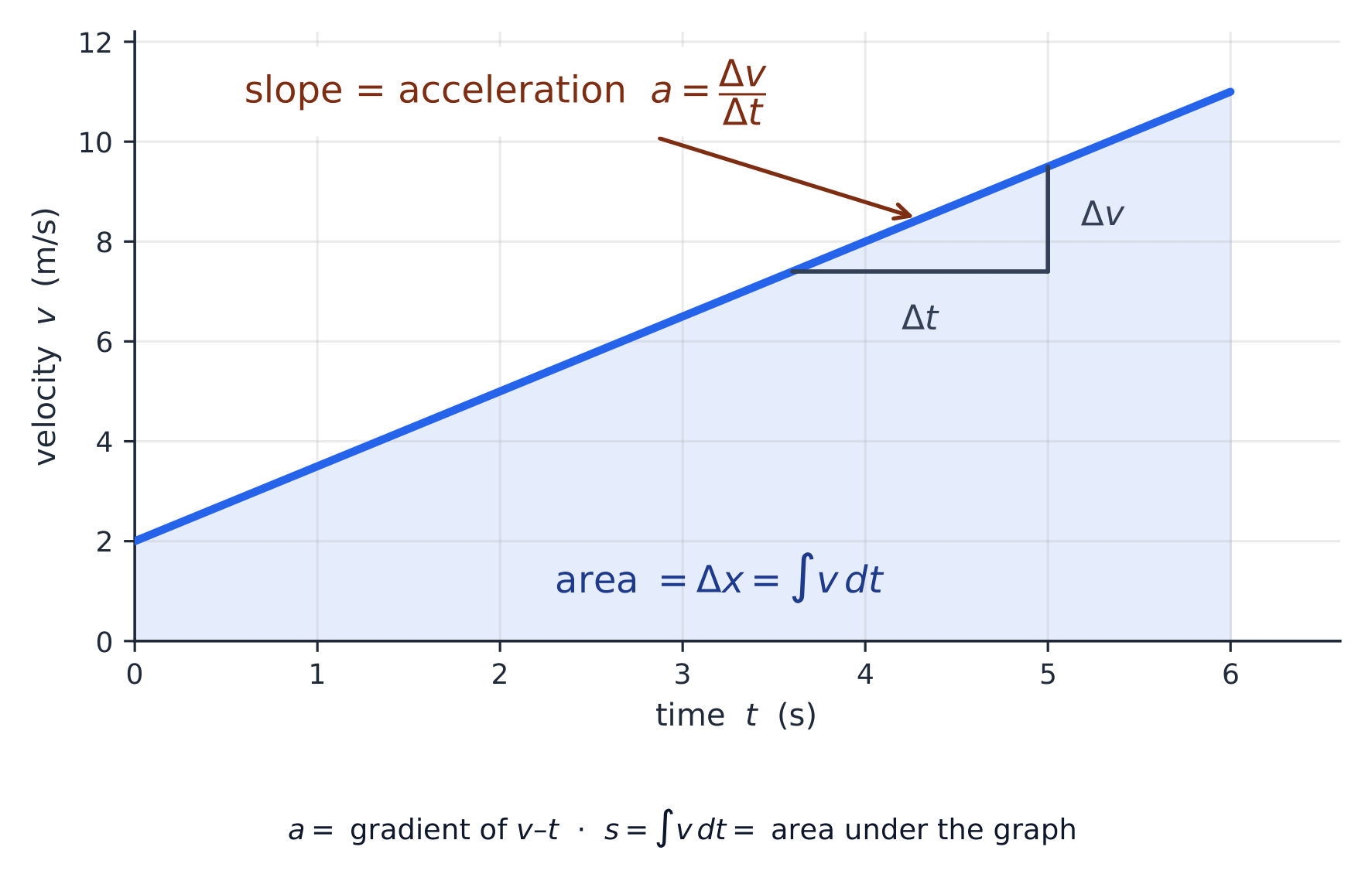
Worked example. 一个骑车者从静止在 $4.0\ \text{s}$ 里均匀加速到 $8.0\ \text{m/s}$,然后保持 $8.0\ \text{m/s}$ 达 $6.0\ \text{s}$。从速度-时间图求总距离。
面积是一个三角形后接一个矩形:
$$\Delta x=\underbrace{\tfrac12\times 4.0\times 8.0}_{\text{triangle}}+\underbrace{6.0\times 8.0}_{\text{rectangle}}=16+48=64\ \text{m}.$$
探索
Explore the velocity–time graph
Change the start velocity $u$ and the acceleration $a$. The gradient (slope) of the line is the acceleration; the area between the line and the time axis is the displacement.
1.4
参考系与相对运动
大纲
| Learning Objective | Essential Knowledge |
|---|---|
1.4.A |
|
1.4.B |
Boundary statement: Unless otherwise stated, the frame of reference of any problem may be assumed to be inertial. Boundary statement: Adding or subtracting vectors to find relative velocities is restricted to motion along one dimension for AP Physics 1. |
来源:美国大学理事会 AP 课程与考试说明
所有运动都相对于一个参考系(reference frame)测量。在不同的参考系里测量的速度不同,而你通过矢量加法组合它们。A 相对于 C 的速度是
$$\vec{v}_{A/C}=\vec{v}_{A/B}+\vec{v}_{B/C}.$$
一个在移动的火车上行走的人相对于火车有一个速度而相对于地面有另一个——这是相对运动(relative motion)。一个有用的捷径:A 相对于 B 的速度是 $\vec{v}_{A/B}=\vec{v}_A-\vec{v}_B$(减去 B 的速度)。
一个不加速的参考系是一个惯性参考系(inertial reference frame):在其中一个自由物体(没有净力)服从牛顿第一定律,保持静止或以恒定速度运动。一个加速的参考系——一辆刹车的汽车——是非惯性的,在其中物体似乎在没有力作用的情况下加速。
Worked example. 一艘船直向横穿一条河并相对于水以 $3.0\ \text{m/s}$ 移动。水流沿河以 $4.0\ \text{m/s}$ 流动。求船相对于河岸的速率和方向。
这两个速度垂直,所以作为一个直角三角形把它们相加:
$$v=\sqrt{3.0^2+4.0^2}=5.0\ \text{m/s},\qquad \theta=\tan^{-1}\!\frac{4.0}{3.0}=53^{\circ}\ \text{downstream from straight across.}$$
词汇表
训练
| 英文 | 中文 | 拼音 |
|---|---|---|
| reference frame/ˈrefrəns freɪm/ | 参考系 | cān kǎo xì |
| relative motion/ˈrelətɪv ˈməʊʃn/ | 相对运动 | xiāng duì yùn dòng |
| inertial reference frame/ɪˈnɜːʃl ˈrefrəns freɪm/ | 惯性参考系 | guàn xìng cān kǎo xì |
1.5
二维矢量与运动
大纲
| Learning Objective | Essential Knowledge |
|---|---|
1.5.A |
|
1.5.B |
|
来源:美国大学理事会 AP 课程与考试说明
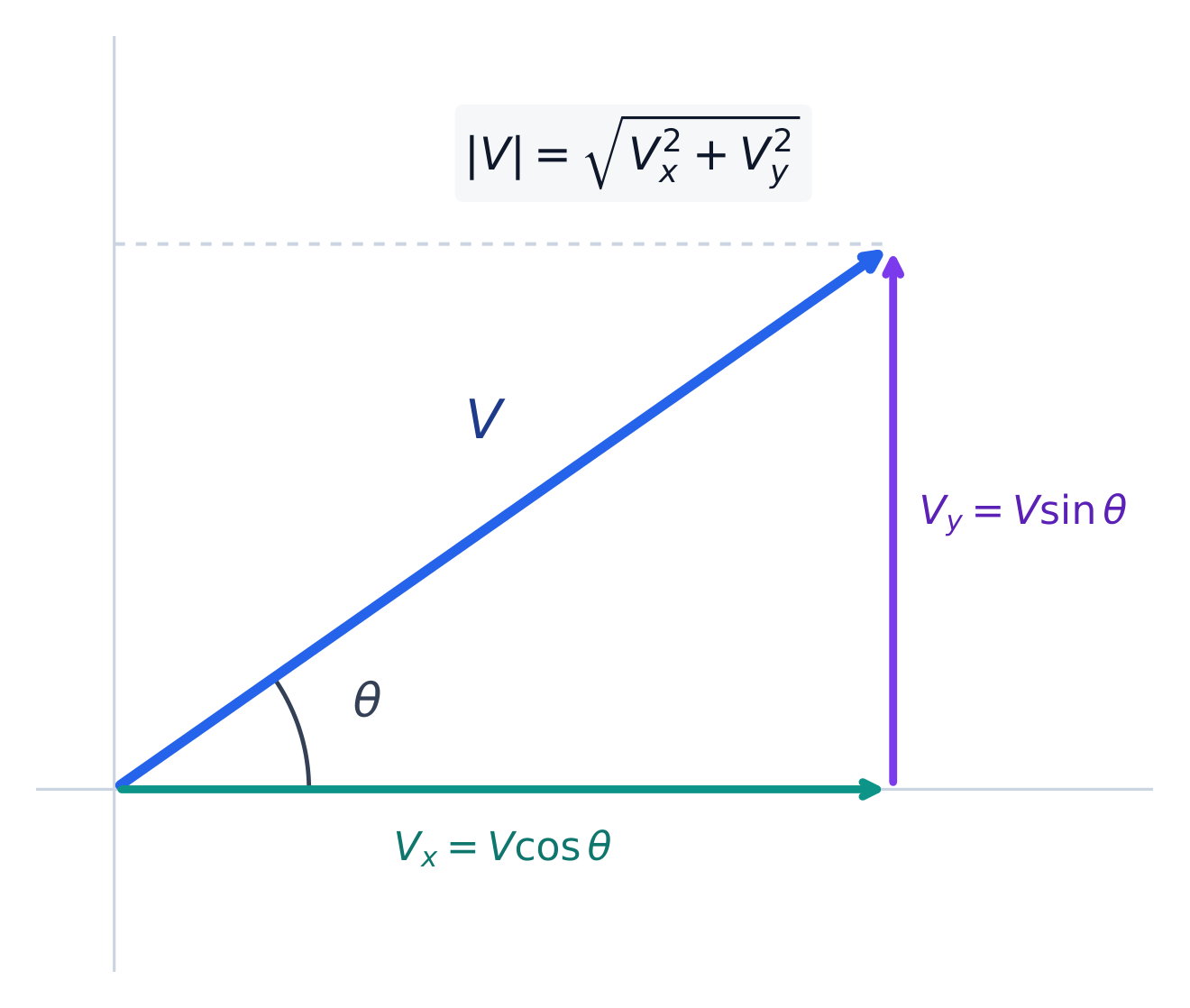
在二维里,把每个矢量分解成沿垂直坐标轴($x$ 和 $y$)的分量(components)、分别处理每个轴,然后重新组合。一个与水平成角 $\theta$ 的速度 $v$ 有分量 $v_x=v\cos\theta$ 和 $v_y=v\sin\theta$。
对于抛体运动(projectile motion)(一个只在重力下移动的物体):水平和竖直运动是独立的。水平地,速度恒定($a_x=0$);竖直地,加速度是 $-g$(向下)。这两个运动只共享时间。所以一个抛体的路径(它的轨迹(trajectory))是一条抛物线,而你把它作为由 $t$ 连接的两个一维问题来解。
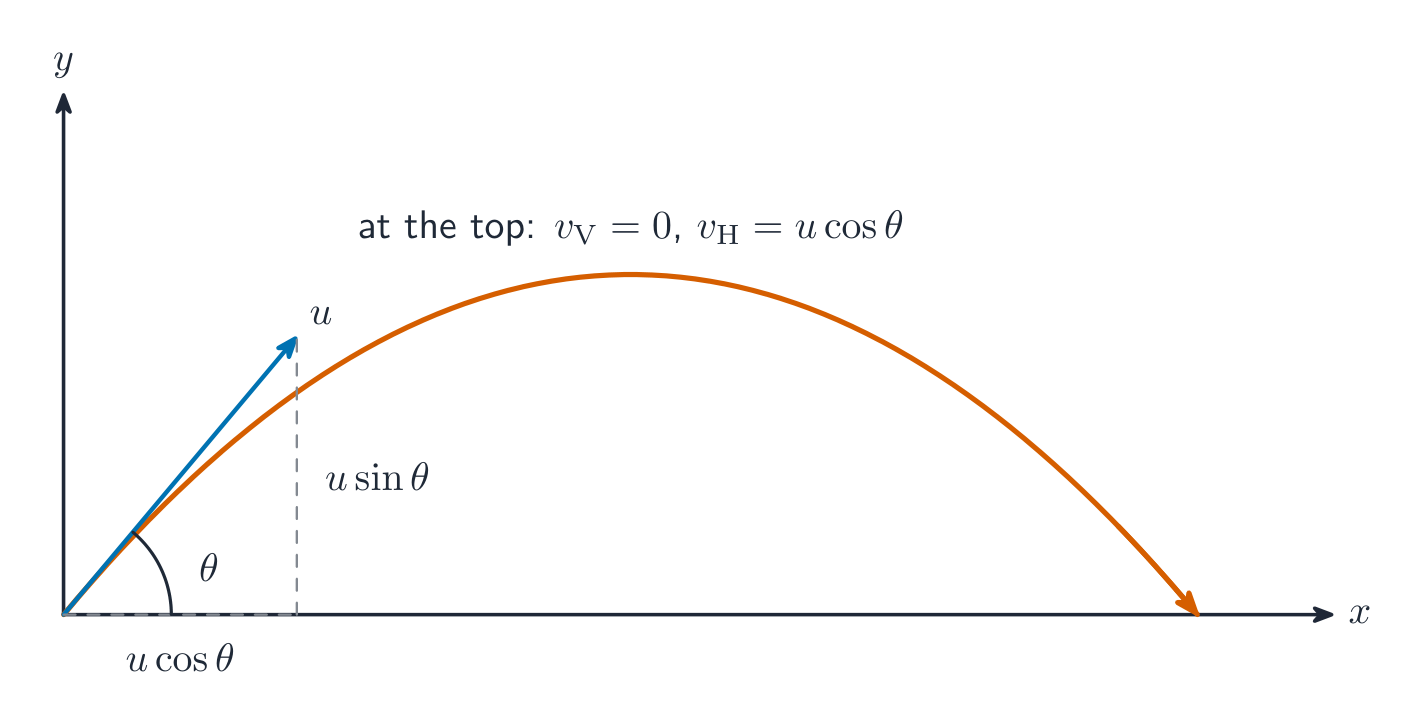
Worked example. 一个球以 $20\ \text{m/s}$、水平之上 $30^{\circ}$ 被踢。取 $g=9.8\ \text{m/s}^2$,求飞行时间、最大高度,和水平射程(range)(假设它在发射高度着陆)。
把发射速度分成分量:
$$v_{0x}=20\cos 30^{\circ}=17.3\ \text{m/s},\qquad v_{0y}=20\sin 30^{\circ}=10\ \text{m/s}.$$
竖直运动设定时间。在顶部 $v_y=0$,所以 $0=10-9.8\,t \Rightarrow t_{\text{up}}=1.02\ \text{s}$,而总飞行是 $2t_{\text{up}}=2.0\ \text{s}$。最大高度是
$$\Delta y=\frac{v_{0y}^2}{2g}=\frac{10^2}{19.6}=5.1\ \text{m}.$$
水平运动在整个飞行以恒定 $v_{0x}$ 运行,所以射程是
$$R=v_{0x}\times t_{\text{flight}}=17.3\times 2.0=35\ \text{m}.$$
一个常见的陷阱:在飞行的顶部竖直速度是零,但球不静止——它的水平速度 $v_{0x}$ 从不变化。顶部的速率等于 $v_{0x}=17.3\ \text{m/s}$。
探索
Explore projectile motion
Fire the ball, then change the angle and speed. The horizontal motion stays steady while gravity pulls it down — together they trace a parabola. Find the launch angle that gives the longest range, and try the Moon.
探索
Explore vectors and their components
Drag the vectors to change their $x$- and $y$-components. See how a single vector is built from independent horizontal and vertical parts, and how two vectors add tip-to-tail into a resultant.
词汇表
训练
| 英文 | 中文 | 拼音 |
|---|---|---|
| components/kəmˈpəʊnənts/ | 分量 | fèn liàng |
| projectile motion/prəˈdʒektaɪl ˈməʊʃn/ | 抛体运动 | pāo tǐ yùn dòng |
| trajectory/trəˈdʒektəri/ | 轨迹 | guǐ jì |
| range/reɪndʒ/ | 射程 | shè chéng |
1.5
考试技巧
- 通过列出你知道的三个量加你想要的那个来选择正确的运动学方程,所以只剩下一个未知数;SUVAT 方程只在加速度恒定时适用。
- 先固定一个正方向——每个位移、速度和加速度然后携带一个符号;一个负的速度意味着"向相反方向移动",不是"慢"。
- 把一个抛体当作只共享时间 $t$ 的两个独立的一维问题:水平地恒定速度、竖直地 $a=-g$。在顶部 $v_y=0$ 但 $v_x$ 不变。
- 在一个速度-时间图上斜率是加速度而面积是位移(坐标轴下方的面积是负的)。
- 把距离(标量,总路径)与位移(矢量,起点到终点)区分开,把速率与速度区分开。
本主题的互动课程
逐步学习,并即时检测练习。