| Learning Objective | Essential Knowledge |
|---|---|
7.1.A |
|
振动
AP 物理 1 · 第 7 主题
 7:48
7:48
Oscillations
Two identical springs, two identical masses. Pull one of them far down. Pull the other only a little. Let go of both at the same moment. Which one gets back…
英文讲解 · 内嵌中英文字幕
7.1
简谐运动(SHM)的定义
大纲
来源:美国大学理事会 AP 课程与考试说明
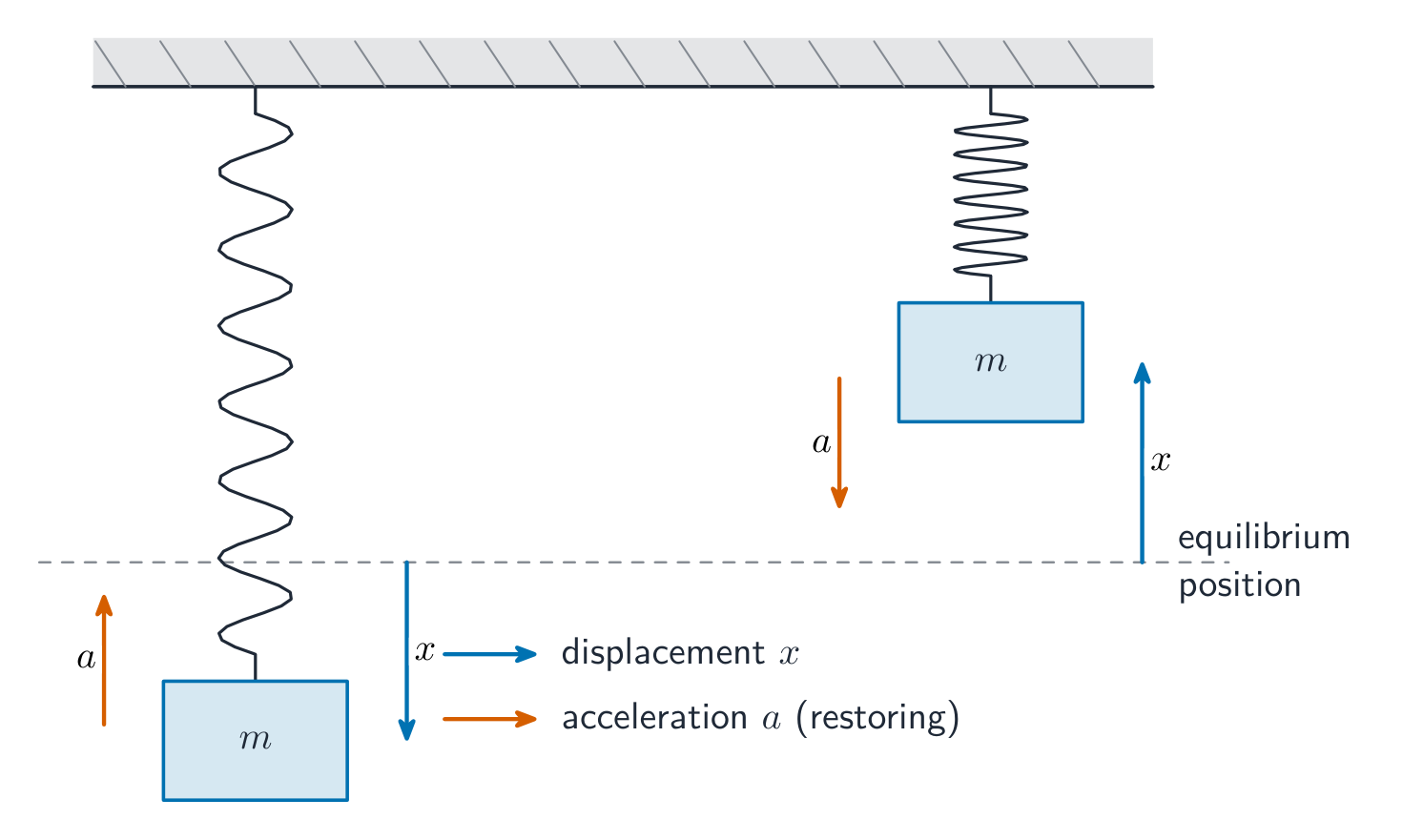
简谐运动(simple harmonic motion)(SHM)是由一个回复力(restoring force)造成的一个来回振动(oscillation),该回复力与从平衡的位移成比例并总是指回向它:$F=-kx$。一个弹簧上的质量和(对小角度)一个摆是标准的例子。因为力随位移增长,运动是平滑而重复的,在时间上描出一条正弦曲线。
SHM 的判据正是这个:加速度与位移成比例且方向相反,$a=-\dfrac{k}{m}x$。一个摆只对小摆动遵循它,那里 $\sin\theta\approx\theta$;大的摆动不完全是 SHM。
词汇表
训练
| 英文 | 中文 | 拼音 |
|---|---|---|
| Simple harmonic motion/ˈsɪmpl hɑːˈmɒnɪk ˈməʊʃn/ | 简谐运动 | jiǎn xié yùn dòng |
| oscillation/ˌɒsɪˈleɪʃn/ | 振动 | zhèn dòng |
| restoring force/rɪˈstɔːrɪŋ fɔːs/ | 回复力 | huí fù lì |
7.2
简谐运动的频率与周期
大纲
| Learning Objective | Essential Knowledge |
|---|---|
7.2.A |
|
来源:美国大学理事会 AP 课程与考试说明
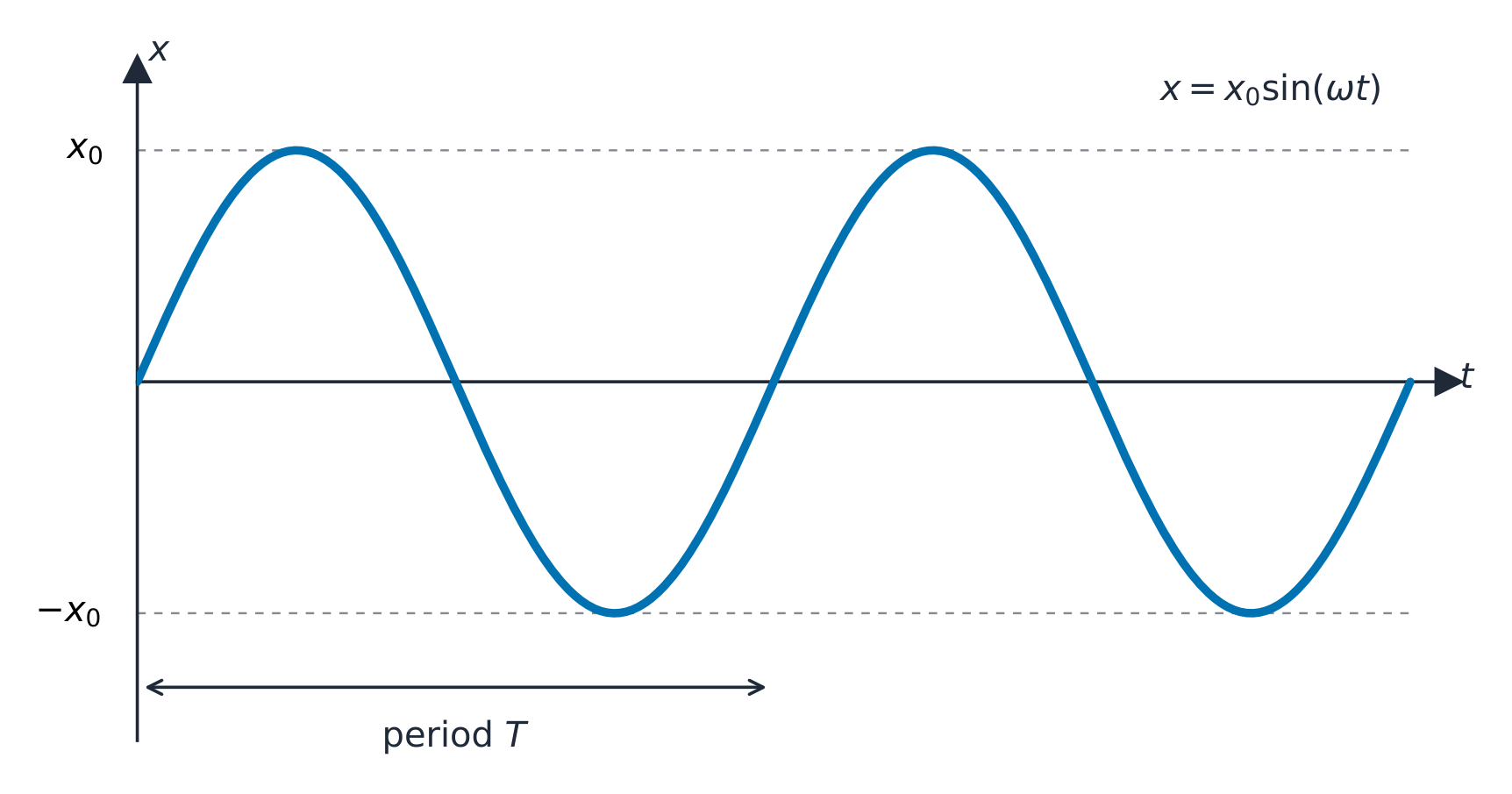
- 周期(period)$T$ 是一个完整循环的时间。
- 频率(frequency)$f=\dfrac{1}{T}$ 是每秒的循环数(赫兹)。
对于 SHM 这些只取决于系统,不取决于振幅:
$$T_{\text{spring}}=2\pi\sqrt{\frac{m}{k}},\qquad T_{\text{pendulum}}=2\pi\sqrt{\frac{L}{g}}.$$
所以一个更硬的弹簧或更小的质量振动更快;一个更长的摆摆动更慢。
Worked example. 一个 $0.25\ \text{kg}$ 的质量挂在一个刚度 $k=100\ \text{N/m}$ 的弹簧上。它的周期是
$$T=2\pi\sqrt{\frac{m}{k}}=2\pi\sqrt{\frac{0.25}{100}}=0.31\ \text{s},\qquad f=\frac{1}{T}=3.2\ \text{Hz}.$$
Worked example. 一个摆钟以恰好 $2.0\ \text{s}$ 的周期滴答。它多长?重新排列 $T=2\pi\sqrt{L/g}$,
$$L=g\left(\frac{T}{2\pi}\right)^2=9.8\times\left(\frac{2.0}{2\pi}\right)^2=0.99\ \text{m}.$$
注意振幅从未进入——一个宽的或窄的摆动保持相同的时间,这就是使摆成为好钟的东西。
探索
Time a pendulum's swing
A pendulum's period depends on its length and gravity, not its mass or (small) amplitude: $T=2\pi\sqrt{L/g}$. Lengthen it and each swing takes longer.
词汇表
训练
| 英文 | 中文 | 拼音 |
|---|---|---|
| period/ˈpɪərɪəd/ | 周期 | zhōu qī |
| frequency/ˈfriːkwənsi/ | 频率 | pín lǜ |
7.3
简谐运动的表示与分析
大纲
| Learning Objective | Essential Knowledge |
|---|---|
7.3.A |
|
来源:美国大学理事会 AP 课程与考试说明
位移正弦地变化:$x(t)=A\cos(\omega t)$(或正弦),其中 $A$ 是振幅(amplitude)(最大位移)而 $\omega=2\pi f$ 是角频率(angular frequency)。读运动:
- 在极端($x=\pm A$):位移和回复力最大,所以加速度最大,但速度是零。
- 在平衡(equilibrium)($x=0$):力和加速度是零,但速率最大。
速度和加速度也是正弦的,与位移在相位(phase)上偏移——速度比位移领先四分之一循环,而加速度与位移恰好相反。
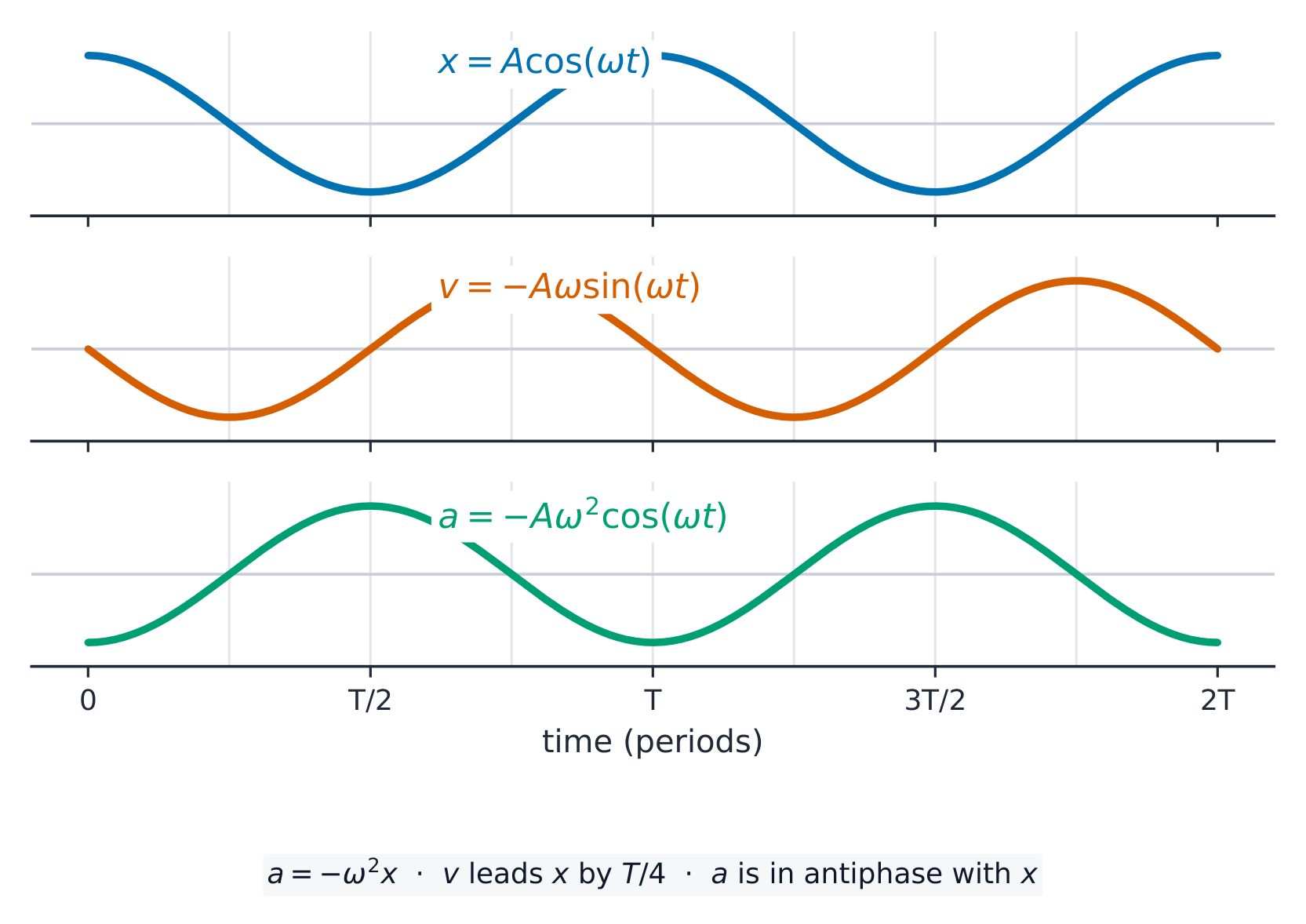
把图当作一个故事读:$x$ 最大的地方(转折点),$v$ 刚落到零而 $a$ 处于它最负的,把质量拖回;四分之一循环后质量以顶速冲过中间,加速度为零。
词汇表
训练
| 英文 | 中文 | 拼音 |
|---|---|---|
| amplitude/ˈæmplɪtjuːd/ | 振幅 | zhèn fú |
| angular frequency/ˈæŋɡjʊlə ˈfriːkwənsi/ | 角频率 | jiǎo pín lǜ |
| phase/feɪz/ | 相位 | xiàng wèi |
| equilibrium/ˌiːkwɪˈlɪbrɪəm/ | 平衡 | píng héng |
7.4
简谐振子的能量
大纲
| Learning Objective | Essential Knowledge |
|---|---|
7.4.A |
|
来源:美国大学理事会 AP 课程与考试说明
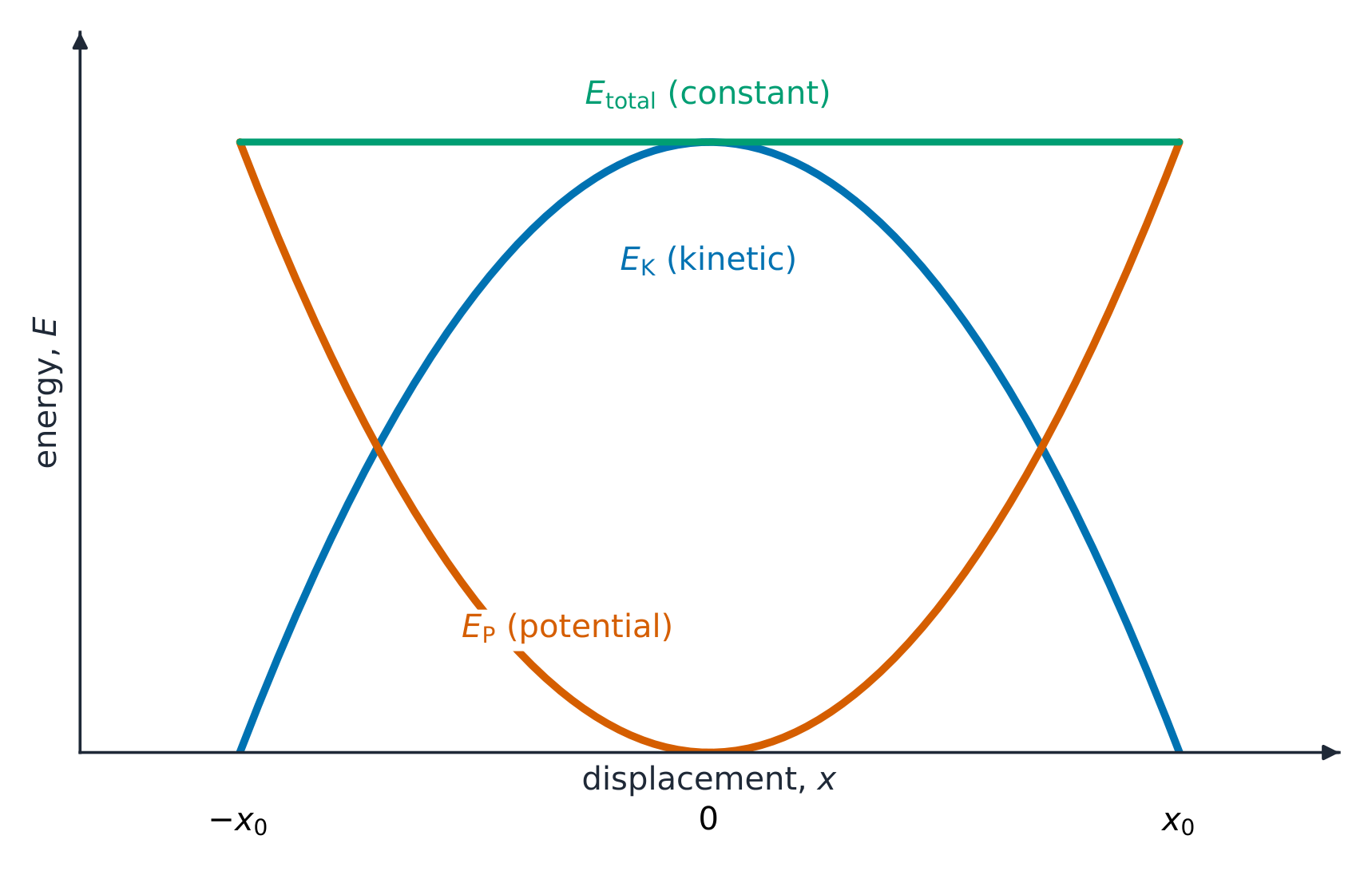
能量在动能和势能之间晃动,而总量保持恒定(没有摩擦):
$$E=\tfrac{1}{2}kA^2 = \tfrac{1}{2}kx^2+\tfrac{1}{2}mv^2.$$
在极端它是全势能;在平衡它是全动能(最大速率)。因为 $E\propto A^2$,把振幅加倍使能量变为四倍。
Worked example. 一个刚度 $k=200\ \text{N/m}$ 的弹簧上的 $0.50\ \text{kg}$ 质量以振幅 $A=0.10\ \text{m}$ 振动。求它的最大速率。所有的能量在平衡点是动能,所以 $\tfrac12 kA^2=\tfrac12 mv_{\max}^2$:
$$v_{\max}=A\sqrt{\frac{k}{m}}=0.10\times\sqrt{\frac{200}{0.50}}=0.10\times20=2.0\ \text{m/s}.$$
当你只需要最大速率时,能量方法比追踪正弦函数更快。
探索
Trade kinetic and potential energy in SHM
In simple harmonic motion, energy sloshes between kinetic (fastest at the centre) and potential (greatest at the extremes) while the total stays constant.
7.4
考试技巧
- 判据 SHM:加速度必须与位移成比例并指回向中间($a=-\tfrac{k}{m}x$)。
- 周期不取决于振幅——用 $T=2\pi\sqrt{m/k}$(弹簧)或 $T=2\pi\sqrt{L/g}$(摆,小角度)。
- 速率在中间最大(全动能)而在极端为零(全势能);加速度在极端最大。
- 用能量($\tfrac12 kA^2 = \tfrac12 kx^2 + \tfrac12 mv^2$)快速求最大速率:$v_{\max}=A\sqrt{k/m}$。
- 总能量 $\propto A^2$,所以把振幅加倍使能量变为四倍。
本主题的互动课程
逐步学习,并即时检测练习。