| English | 释义 | 拼音 |
|---|---|---|
| power/ˈpaʊə/ | 功率 | gōng lǜ |
| watt/wɒt/ | 瓦特 | wǎ tè |
Two cranes, same load — which one wins the race?
- Two cranes lift an identical crate to the same rooftop. Both do exactly the same work.
- But one finishes in ten seconds and the other in a full minute.
- The fast crane is more powerful — it does the work at a higher rate.
- Power 功率 is not how much work, but how fast it is done.
Power is a rate
- Power is the rate of doing work or transferring energy. Average power is $P_{avg}=W/\Delta t$.
- It is measured in watts 瓦特 ($1\ \text{W} = 1\ \tfrac{\text{J}}{\text{s}}$).
- Same work in less time means more power; same time with more work means more power too.
- A $100\ \text{W}$ bulb turns $100$ joules of electrical energy into light and heat each second.
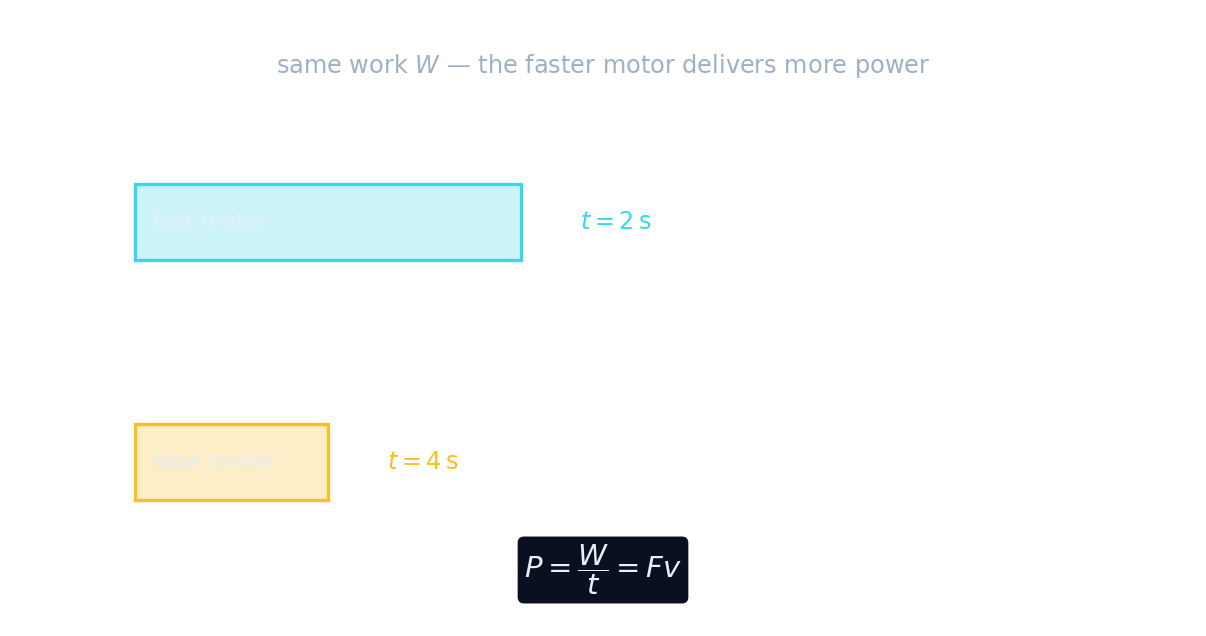
Faster work, more power
Relate how quickly motion builds up to the rate at which energy is delivered.
A motor does $600\ \text{J}$ of work in $3\ \text{s}$. What is its power, in watts?
难度 2/5 · 今日首次完成可获 140 金币及少量额外奖励
$P = W/t = 600/3 = 200\ \text{W}$.
What is the SI unit of power?
难度 1/5 · 今日首次完成可获 100 金币及少量额外奖励
Power is measured in watts, where $1\ \text{W} = 1\ \tfrac{\text{J}}{\text{s}}$.
Power equals work divided by ____.
难度 1/5 · 今日首次完成可获 100 金币及少量额外奖励
$P = W/t$ — work per unit 时间.
One watt is equal to:
难度 1/5 · 今日首次完成可获 100 金币及少量额外奖励
$1\ \text{W} = 1\ \tfrac{\text{J}}{\text{s}}$ — one joule of energy transferred each second.
Power, force and speed
- Instantaneous power from a force is $P=\vec F\cdot\vec v=Fv\cos\theta$; for force parallel to velocity, $P=Fv$.
- Engine power is the rate of work by the driving force; net power is the rate of work by all forces and can be zero at constant speed.
- This links the "energy" view ($W/t$) to the "force" view ($Fv$) of power.
- Both give watts, and both describe the same rate of energy transfer.
A motor pushes with $50\ \text{N}$ at a steady $4\ \tfrac{\text{m}}{\text{s}}$. What power does it deliver, in watts?
难度 2/5 · 今日首次完成可获 140 金币及少量额外奖励
$P = Fv = 50 \times 4 = 200\ \text{W}$.
Power in everyday life
- A sprinter, a kettle, a phone charger — each is rated by its power in watts.
- Bigger power means faster energy delivery, not more total energy.
- Over time, energy used $= P \times t$ (this is what electricity bills charge for).
- A low-power device left on for hours can use more energy than a high-power one used briefly.
Two machines that transfer the same total energy always have the same power.
难度 1/5 · 今日首次完成可获 100 金币及少量额外奖励
Power is energy per second. The machine that does it faster has more power, even for the same total energy.
Power is not the same as energy. Two devices can transfer the same total energy, yet the one that does it faster has the higher power. Power is energy per second, not the energy itself.
A motor does $600\ \text{J}$ of work in $3\ \text{s}$.
- $P = \dfrac{W}{t} = \dfrac{600}{3} = 200\ \text{W}$.
If it instead pushes with $50\ \text{N}$ at $4\ \tfrac{\text{m}}{\text{s}}$: $P = Fv = 50 \times 4 = 200\ \text{W}$ — the same power.
Power is the rate of doing work or transferring energy: $P_{avg} = \dfrac{W}{\Delta t}$ and $P=Fv$ for a parallel force, measured in watts ($1\ \text{W} = 1\ \tfrac{\text{J}}{\text{s}}$). It measures how fast energy moves, not how much — energy used is $P \times t$.
Write from the data: find the power
- A motor does 450 J of work in 9 s.
- Find the power.
A motor does 450 J of work in 9 s. What is its power, in watts?
Average power is work per elapsed time: $P_{avg}=W/\Delta t=(450\ \text{J})/(9\ \text{s})=50\ \text{W}$. The motor transfers 50 joules of energy per second on average.
A motor does 450 J of work in 9 s. What is its power, in watts?
难度 1/5 · 今日首次完成可获 100 金币及少量额外奖励
Average power is work per elapsed time: $P_{avg}=W/\Delta t=(450\ \text{J})/(9\ \text{s})=50\ \text{W}$. The motor transfers 50 joules of energy per second on average.