| Learning Objective | Essential Knowledge |
|---|---|
1.1.A |
|
1.1.B |
|
AP 物理 1
学习建议
AP 物理 1 是基于代数的力学:运动学、力、功、能与功率、动量、力矩与转动、振动、流体。不需要微积分——这反而让它在概念上更难,而不是更容易。你要对情境作推理,而不是套公式。
自由作答部分决定分数。它要求你论证、比较两种情境,并用文字解释结果。只有正确数值、没有推理,几乎得不到分。
先点明原理。“因为动量守恒,且水平方向没有外力……”正是评分细则想看的那句话。每道题都画受力分析图,哪怕看起来没必要——这是本课程回报最高的习惯。
下面的笔记按 CED 逐单元展开,从运动学到简谐运动,每节配例题。历年自由作答题(FRQ)及评分标准在资料库中;实验设计题建议单独练——它每年都考,给分看实验步骤是否清楚,而不是套公式。
-
1
运动学
1.1
一维标量与矢量
大纲
来源:美国大学理事会 AP 课程与考试说明
运动学(kinematics)描述物体如何移动,而不问为什么。首先,两种量:
- 一个标量(scalar)只有大小(大小(magnitude)):距离(distance)、速率、时间、质量。
- 一个矢量(vector)有大小和方向:位移、速度、加速度、力。
这个区别重要。距离(distance)是行进的总路径长度——一个只增长的标量。位移(displacement)是位置的直线变化,带一个方向。向东走 $3\ \text{m}$ 然后向西走回 $1\ \text{m}$:距离是 $4\ \text{m}$,但位移只是向东 $2\ \text{m}$。
在一维里,方向只是沿一个选定坐标轴的一个符号(+ 或 −)。先选择正方向至关重要——每个矢量的符号都取决于它。一个 $-5\ \text{m/s}$ 的速度不意味着"慢";它意味着负方向 $5\ \text{m/s}$。
词汇表 训练英文 中文 拼音 Kinematics/ˌkɪnɪˈmætɪks/ 运动学 yùn dòng xué scalar/ˈskeɪlə/ 标量 biāo liàng magnitude/ˈmæɡnɪtjuːd/ 大小 dà xiǎo vector/ˈvektə/ 矢量 shǐ liàng Displacement/dɪˈspleɪsmənt/ 位移 wèi yí distance/ˈdɪstəns/ 距离 jù lí 1.2
位移、速度与加速度
大纲
Learning Objective Essential Knowledge 1.2.A
Describe a change in an object's position.- 1.2.A.1 When using the object model, the size, shape, and internal configuration are ignored. The object may be treated as a single point with extensive properties such as mass and charge.
- 1.2.A.2 Displacement is the change in an object's position.
- Equation: $\Delta x = x - x_0$
1.2.B
Describe the average velocity and acceleration of an object.- 1.2.B.1 Averages of velocity and acceleration are calculated considering the initial and final states of an object over an interval of time.
- 1.2.B.2 Average velocity is the displacement of an object divided by the interval of time in which that displacement occurs.
- Equation: $\vec{v}_{avg} = \dfrac{\Delta \vec{x}}{\Delta t}$
- 1.2.B.3 Average acceleration is the change in velocity divided by the interval of time in which that change in velocity occurs.
- Equation: $\vec{a}_{avg} = \dfrac{\Delta \vec{v}}{\Delta t}$
1.2.B
Describe the velocity and acceleration of an object.- 1.2.B.4 An object is accelerating if the magnitude and/or direction of the object's velocity are changing.
- 1.2.B.5 Calculating average velocity or average acceleration over a very small time interval yields a value that is very close to the instantaneous velocity or instantaneous acceleration.
来源:美国大学理事会 AP 课程与考试说明
抛体运动:两个独立方向 三个相连的矢量描述沿一条线的运动:
- 位移(displacement)$\Delta x$ 是位置的变化——从起点到终点的一个矢量(不是总路径长度,那是距离)。
- 速度(velocity)是位置的变化率,$v=\dfrac{\Delta x}{\Delta t}$。它的符号给出方向;它的大小是速率(speed)。
- 加速度(acceleration)是速度的变化率,$a=\dfrac{\Delta v}{\Delta t}$。
小心把平均速度(average velocity)(总位移除以总时间)与瞬时速度(instantaneous velocity)(一个瞬间的速度,那个点位置-时间图的斜率)分开。它们只在速度恒定时才相等。
一个物体在 $v$ 和 $a$ 有相同符号时加速,而在它们有相反符号时减速(减速(deceleration))。注意一个负的加速度不总是意味着减速——一个越落越快的球有负的速度和负的加速度。
对于恒定加速度,四个运动学方程(常叫 SUVAT)适用:
$$v=v_0+at,\qquad \Delta x=v_0 t+\tfrac{1}{2}at^2,\qquad v^2=v_0^2+2a\,\Delta x,\qquad \Delta x=\tfrac{1}{2}(v_0+v)\,t.$$挑选包含你知道的三个量加你想要的那个的方程,所以只剩下一个未知数。它们只在 $a$ 恒定时适用。Worked example. 一辆车从静止开始并以 $2.0\ \text{m/s}^2$ 均匀加速 $6.0\ \text{s}$。求它的最终速度和它行进的距离。
列出你知道的:$v_0=0$,$a=2.0\ \text{m/s}^2$,$t=6.0\ \text{s}$。
$$v=v_0+at=0+2.0\times 6.0=12\ \text{m/s},$$$$\Delta x=v_0 t+\tfrac12 at^2=0+\tfrac12\times 2.0\times 6.0^2=36\ \text{m}.$$Worked example (free fall). 一个球以 $15\ \text{m/s}$ 直向上抛。取 $g=9.8\ \text{m/s}^2$ 和向上为正,它上升多高,以及它在返回抛掷者的手之前在空中多久?
在最高点速度暂时为零,而 $a=-g=-9.8\ \text{m/s}^2$ 始终(这是自由落体(free fall),忽略空气阻力(air resistance)):
$$v^2=v_0^2+2a\,\Delta x \;\Rightarrow\; 0=15^2+2(-9.8)\Delta x \;\Rightarrow\; \Delta x=\frac{225}{19.6}=11.5\ \text{m}.$$到顶部的时间:$0=15-9.8\,t \Rightarrow t=1.53\ \text{s}$。按对称落下取相同的时间,所以总共是 $3.1\ \text{s}$。词汇表 训练英文 中文 拼音 Velocity/vəˈlɒsɪti/ 速度 sù dù speed/spiːd/ 速率 sù lǜ Acceleration/əkˌseləˈreɪʃn/ 加速度 jiā sù dù average velocity/ˈævrɪdʒ vəˈlɒsɪti/ 平均速度 píng jūn sù dù instantaneous velocity/ˌɪnstənˈteɪnɪəs vəˈlɒsɪti/ 瞬时速度 shùn shí sù dù deceleration/dɪˌseləˈreɪʃn/ 减速 jiǎn sù free fall/friː fɔːl/ 自由落体 zì yóu luò tǐ air resistance/eə rɪˈzɪstəns/ 空气阻力 kōng qì zǔ lì 1.3
运动的表示
大纲
Learning Objective Essential Knowledge 1.3.A
Describe the position, velocity, and acceleration of an object using representations of that object's motion.- 1.3.A.1 Motion can be represented by motion diagrams, figures, graphs, equations, and narrative descriptions.
- 1.3.A.2 For constant acceleration, three kinematic equations can be used to describe instantaneous linear motion in one dimension:
- Equation: $v_x = v_{x0} + a_x t$
- Equation: $x = x_0 + v_{x0}t + \dfrac{1}{2}a_x t^2$
- Equation: $v_x^2 = v_{x0}^2 + 2a_x(x - x_0)$
- Note: The equations above are written to indicate motion in the x-direction, but these equations can be used in any single dimension as appropriate.
- 1.3.A.3 Near the surface of Earth, the vertical acceleration caused by the force of gravity is downward, constant, and has a measured value approximately equal to $a_g = g \approx 10 \ m/s^2$.
- 1.3.A.4 Graphs of position, velocity, and acceleration as functions of time can be used to find the relationships between those quantities.
- 1.3.A.4.i An object's instantaneous velocity is the rate of change of the object's position, which is equal to the slope of a line tangent to a point on a graph of the object's position as a function of time.
- 1.3.A.4.ii An object's instantaneous acceleration is the rate of change of the object's velocity, which is equal to the slope of a line tangent to a point on a graph of the object's velocity as a function of time.
- 1.3.A.4.iii The displacement of an object during a time interval is equal to the area under the curve of a graph of the object's velocity as a function of time (i.e., the area bounded by the function and the horizontal axis for the appropriate interval).
- 1.3.A.4.iv The change in velocity of an object during a time interval is equal to the area under the curve of a graph of the acceleration of the object as a function of time.
Boundary statement: AP Physics 1 does not expect students to quantitatively analyze nonuniform acceleration. However, students will be expected to be able to qualitatively analyze, sketch appropriate graphs of, and discuss situations in which acceleration is nonuniform.
Boundary statement: For all situations in which a numerical quantity is required for $g$, the value $g \approx 10 \ m/s^2$ will be used. However, students will not be penalized for correctly using the more precise commonly accepted values of $g = 9.81 \ \text{m/s}^2$ or $g = 9.8 \ \text{m/s}^2$.
来源:美国大学理事会 AP 课程与考试说明
同一个运动作为一个描述、一个图、一张表,或一个方程出现,而你应当在它们之间移动:
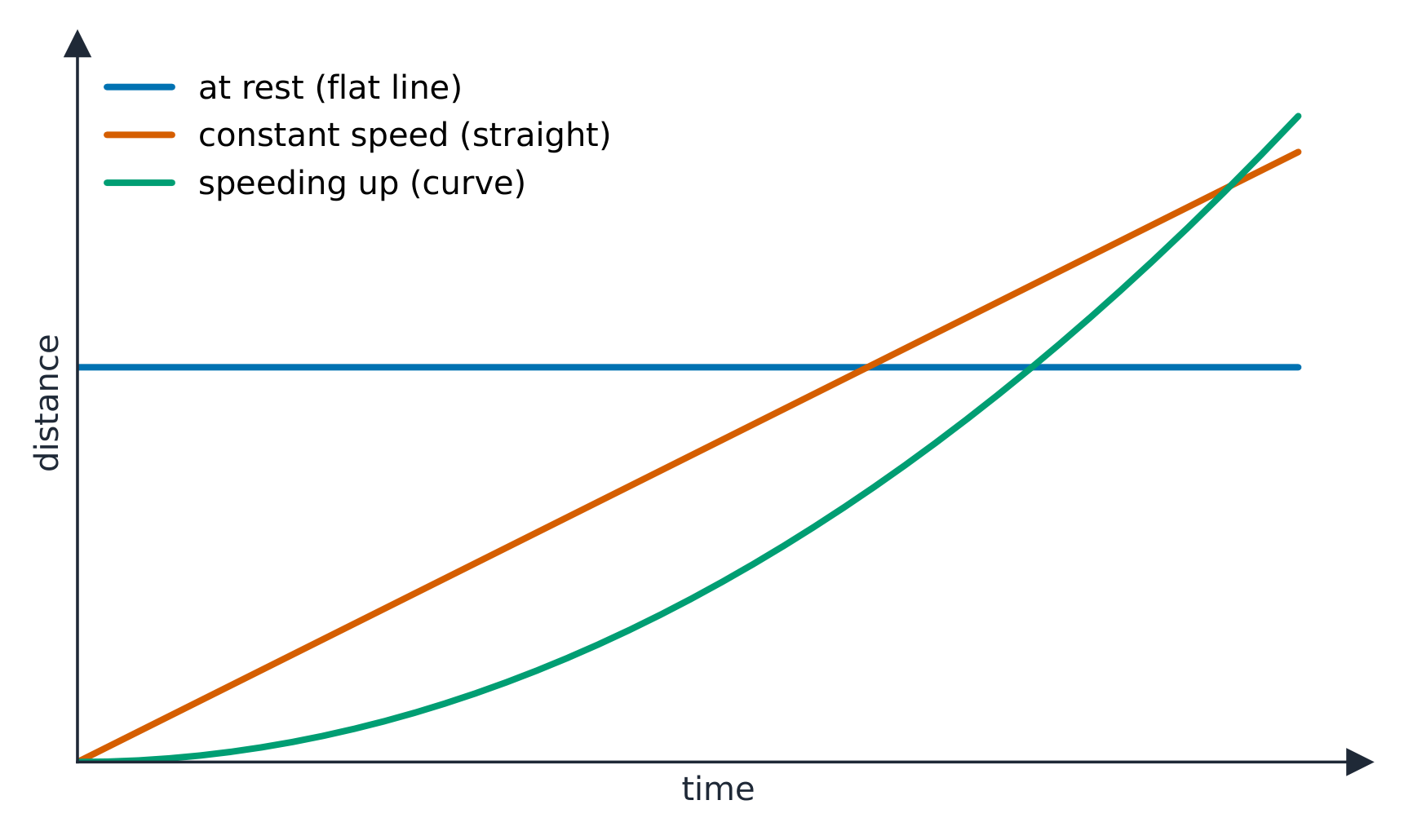
读一个距离-时间图:平坦意味着静止,一个直的斜率意味着恒定速率 - 在一个位置-时间图上,斜率是速度(更陡 = 更快;一条曲线 = 变化的速度)。
- 在一个速度-时间图上,斜率是加速度,而线下的面积是位移。
从图读斜率和面积是一项核心考试技能。要从一个速度-时间图得到位移,把面积分成三角形和矩形并把它们相加;时间轴下方的面积算作负位移(相反方向的运动)。
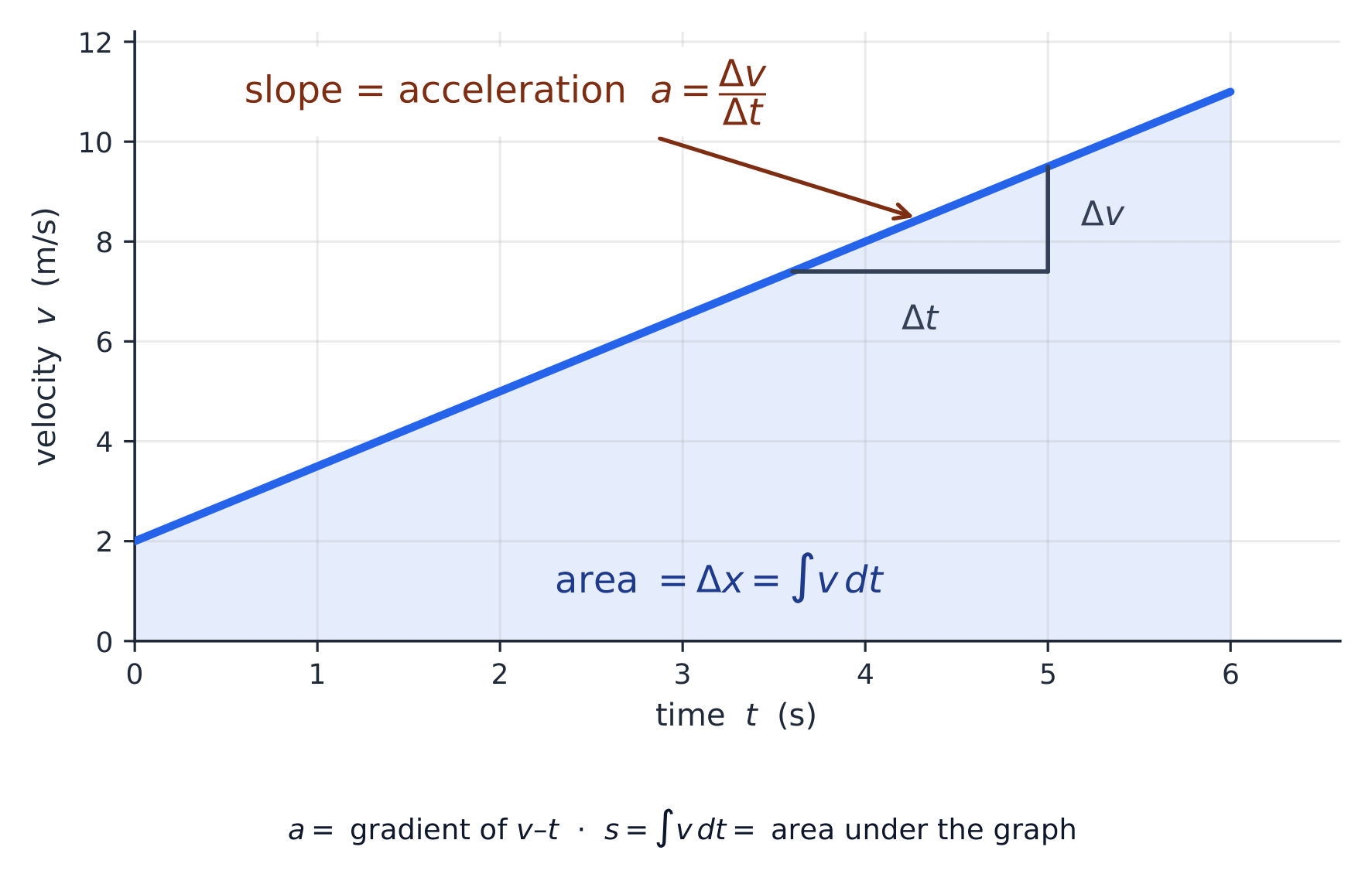
在一个速度-时间图上斜率是加速度而阴影面积是位移 Worked example. 一个骑车者从静止在 $4.0\ \text{s}$ 里均匀加速到 $8.0\ \text{m/s}$,然后保持 $8.0\ \text{m/s}$ 达 $6.0\ \text{s}$。从速度-时间图求总距离。
面积是一个三角形后接一个矩形:
$$\Delta x=\underbrace{\tfrac12\times 4.0\times 8.0}_{\text{triangle}}+\underbrace{6.0\times 8.0}_{\text{rectangle}}=16+48=64\ \text{m}.$$探索Explore the velocity–time graph
Change the start velocity $u$ and the acceleration $a$. The gradient (slope) of the line is the acceleration; the area between the line and the time axis is the displacement.
1.4
参考系与相对运动
大纲
Learning Objective Essential Knowledge 1.4.A
Describe the reference frame of a given observer.- 1.4.A.1 The choice of reference frame will determine the direction and magnitude of quantities measured by an observer in that reference frame.
1.4.B
Describe the motion of objects as measured by observers in different inertial reference frames.- 1.4.B.1 Measurements from a given reference frame may be converted to measurements from another reference frame.
- 1.4.B.2 The observed velocity of an object results from the combination of the object's velocity and the velocity of the observer's reference frame.
- 1.4.B.2.i Combining the motion of an object and the motion of an observer in a given reference frame involves the addition or subtraction of vectors.
- 1.4.B.2.ii The acceleration of any object is the same as measured from all inertial reference frames.
Boundary statement: Unless otherwise stated, the frame of reference of any problem may be assumed to be inertial.
Boundary statement: Adding or subtracting vectors to find relative velocities is restricted to motion along one dimension for AP Physics 1.
来源:美国大学理事会 AP 课程与考试说明
所有运动都相对于一个参考系(reference frame)测量。在不同的参考系里测量的速度不同,而你通过矢量加法组合它们。A 相对于 C 的速度是
$$\vec{v}_{A/C}=\vec{v}_{A/B}+\vec{v}_{B/C}.$$一个在移动的火车上行走的人相对于火车有一个速度而相对于地面有另一个——这是相对运动(relative motion)。一个有用的捷径:A 相对于 B 的速度是 $\vec{v}_{A/B}=\vec{v}_A-\vec{v}_B$(减去 B 的速度)。一个不加速的参考系是一个惯性参考系(inertial reference frame):在其中一个自由物体(没有净力)服从牛顿第一定律,保持静止或以恒定速度运动。一个加速的参考系——一辆刹车的汽车——是非惯性的,在其中物体似乎在没有力作用的情况下加速。
Worked example. 一艘船直向横穿一条河并相对于水以 $3.0\ \text{m/s}$ 移动。水流沿河以 $4.0\ \text{m/s}$ 流动。求船相对于河岸的速率和方向。
这两个速度垂直,所以作为一个直角三角形把它们相加:
$$v=\sqrt{3.0^2+4.0^2}=5.0\ \text{m/s},\qquad \theta=\tan^{-1}\!\frac{4.0}{3.0}=53^{\circ}\ \text{downstream from straight across.}$$词汇表 训练英文 中文 拼音 reference frame/ˈrefrəns freɪm/ 参考系 cān kǎo xì relative motion/ˈrelətɪv ˈməʊʃn/ 相对运动 xiāng duì yùn dòng inertial reference frame/ɪˈnɜːʃl ˈrefrəns freɪm/ 惯性参考系 guàn xìng cān kǎo xì 1.5
二维矢量与运动
大纲
Learning Objective Essential Knowledge 1.5.A
Describe the perpendicular components of a vector.- 1.5.A.1 Vectors can be mathematically modeled as the resultant of two perpendicular components.
- 1.5.A.2 Vectors can be resolved into components using a chosen coordinate system.
- 1.5.A.3 Vectors can be resolved into perpendicular components using trigonometric functions and relationships.
- Equation: $\sin \theta = \dfrac{a}{c}$
- Equation: $\cos \theta = \dfrac{b}{c}$
- Equation: $\tan \theta = \dfrac{a}{b}$
- Equation: $a^2 + b^2 = c^2$
1.5.B
Describe the motion of an object moving in two dimensions.- 1.5.B.1 Motion in two dimensions can be analyzed using one-dimensional kinematic relationships if the motion is separated into components.
- 1.5.B.2 Projectile motion is a special case of two-dimensional motion that has zero acceleration in one dimension and constant, nonzero acceleration in the second dimension.
来源:美国大学理事会 AP 课程与考试说明
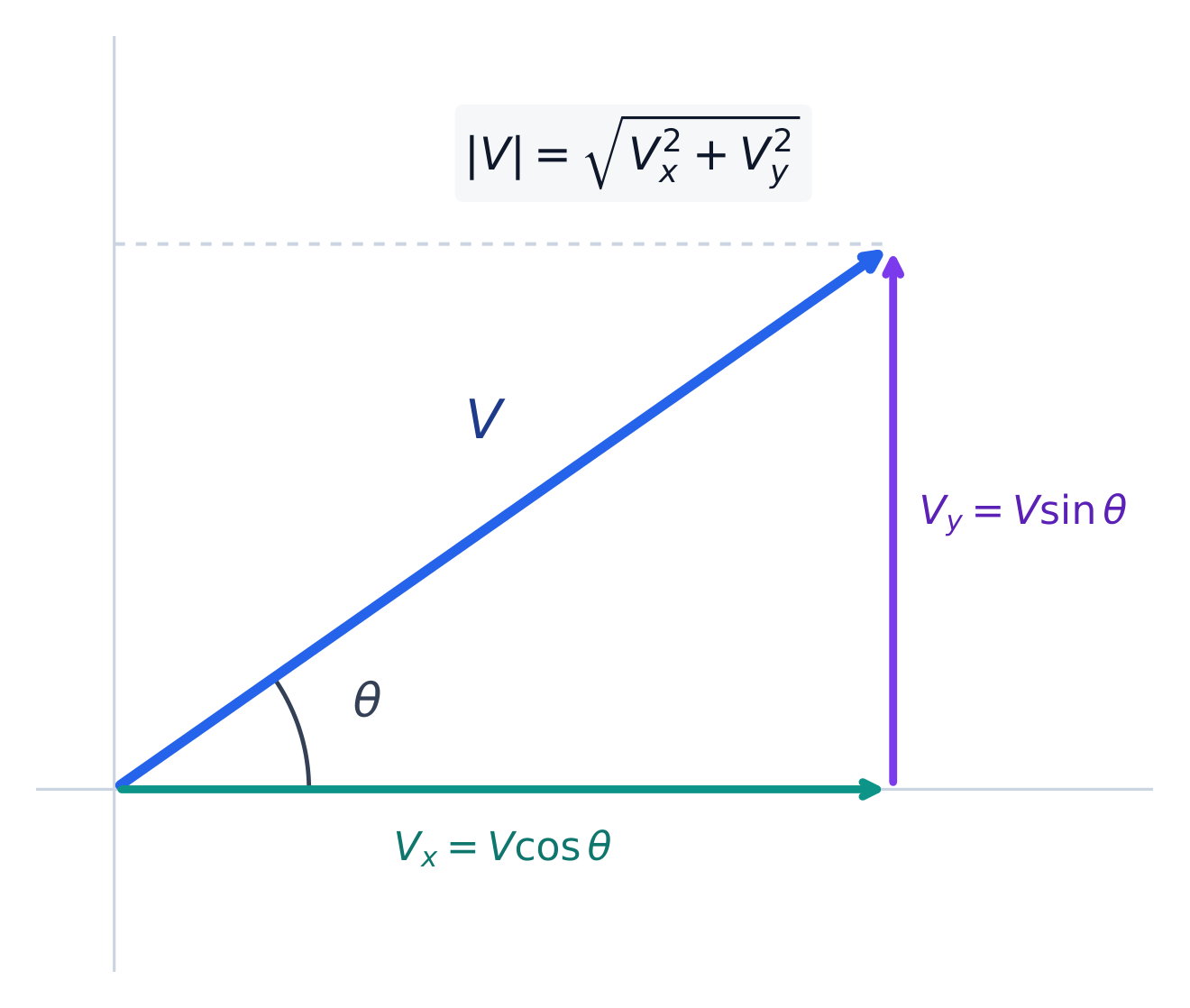
在二维里,把每个矢量分解成沿垂直坐标轴($x$ 和 $y$)的分量(components)、分别处理每个轴,然后重新组合。一个与水平成角 $\theta$ 的速度 $v$ 有分量 $v_x=v\cos\theta$ 和 $v_y=v\sin\theta$。
一个速度矢量分解成它的水平和竖直分量 对于抛体运动(projectile motion)(一个只在重力下移动的物体):水平和竖直运动是独立的。水平地,速度恒定($a_x=0$);竖直地,加速度是 $-g$(向下)。这两个运动只共享时间。所以一个抛体的路径(它的轨迹(trajectory))是一条抛物线,而你把它作为由 $t$ 连接的两个一维问题来解。
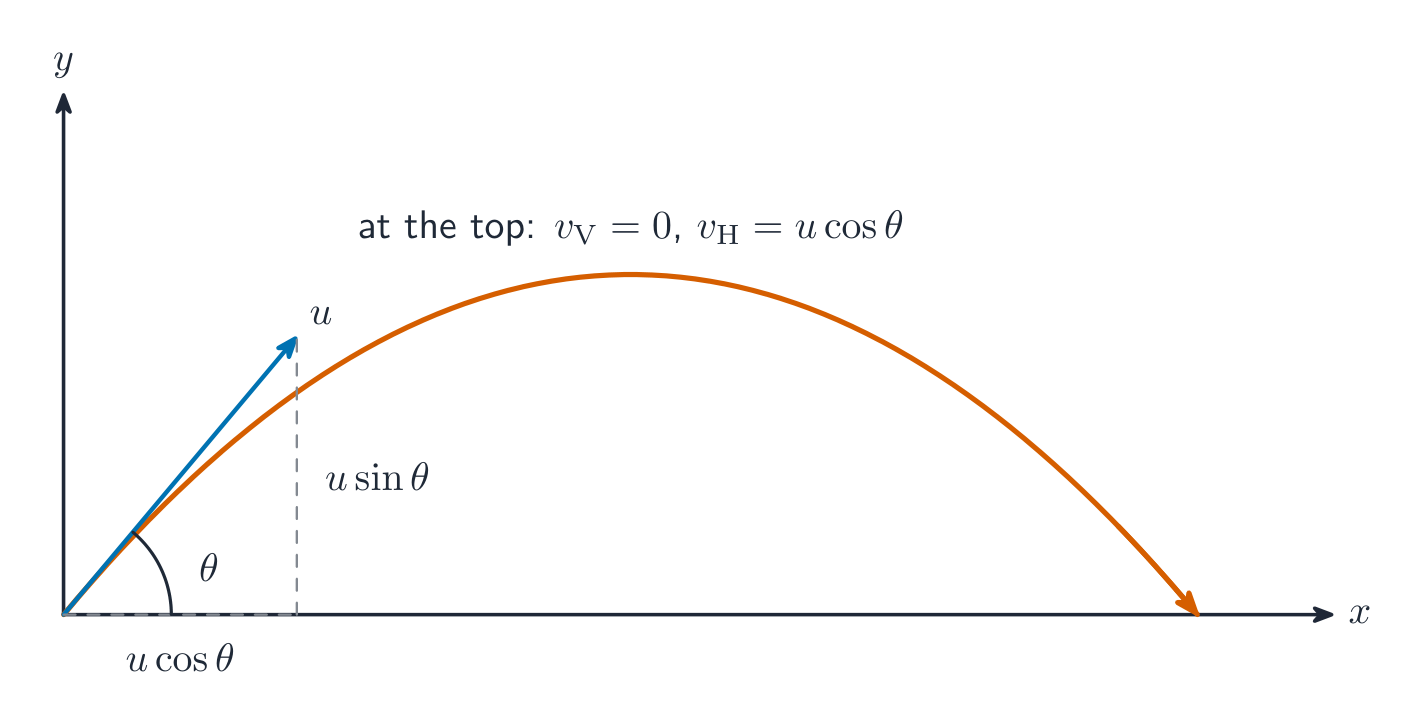
一个以一个角度发射的抛体:水平和竖直运动是独立的 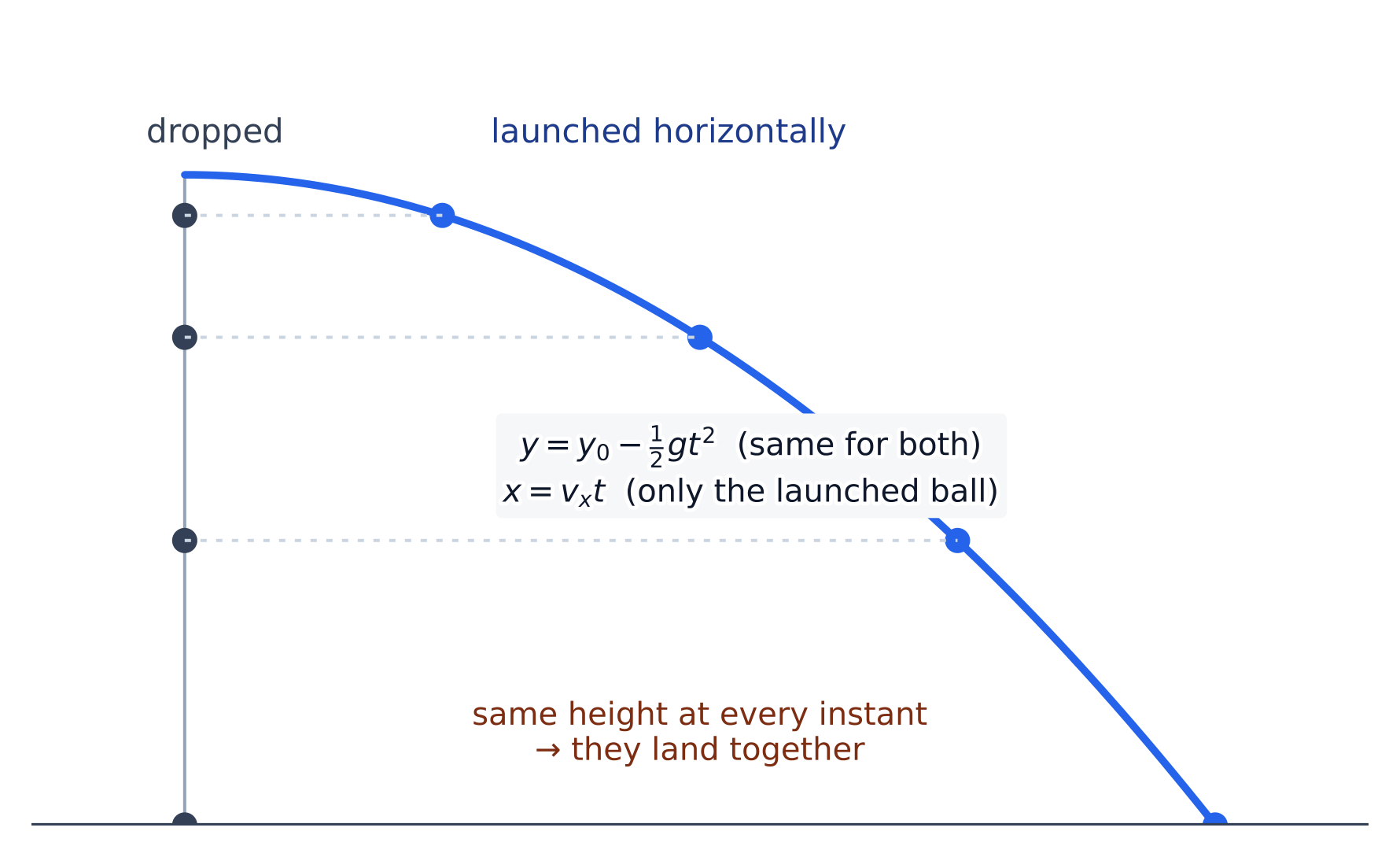
一个落下的球和一个水平发射的球一起落下——竖直运动是相同的 Worked example. 一个球以 $20\ \text{m/s}$、水平之上 $30^{\circ}$ 被踢。取 $g=9.8\ \text{m/s}^2$,求飞行时间、最大高度,和水平射程(range)(假设它在发射高度着陆)。
把发射速度分成分量:
$$v_{0x}=20\cos 30^{\circ}=17.3\ \text{m/s},\qquad v_{0y}=20\sin 30^{\circ}=10\ \text{m/s}.$$竖直运动设定时间。在顶部 $v_y=0$,所以 $0=10-9.8\,t \Rightarrow t_{\text{up}}=1.02\ \text{s}$,而总飞行是 $2t_{\text{up}}=2.0\ \text{s}$。最大高度是$$\Delta y=\frac{v_{0y}^2}{2g}=\frac{10^2}{19.6}=5.1\ \text{m}.$$水平运动在整个飞行以恒定 $v_{0x}$ 运行,所以射程是$$R=v_{0x}\times t_{\text{flight}}=17.3\times 2.0=35\ \text{m}.$$一个常见的陷阱:在飞行的顶部竖直速度是零,但球不静止——它的水平速度 $v_{0x}$ 从不变化。顶部的速率等于 $v_{0x}=17.3\ \text{m/s}$。
探索Explore projectile motion
Fire the ball, then change the angle and speed. The horizontal motion stays steady while gravity pulls it down — together they trace a parabola. Find the launch angle that gives the longest range, and try the Moon.
探索Explore vectors and their components
Drag the vectors to change their $x$- and $y$-components. See how a single vector is built from independent horizontal and vertical parts, and how two vectors add tip-to-tail into a resultant.
词汇表 训练英文 中文 拼音 components/kəmˈpəʊnənts/ 分量 fèn liàng projectile motion/prəˈdʒektaɪl ˈməʊʃn/ 抛体运动 pāo tǐ yùn dòng trajectory/trəˈdʒektəri/ 轨迹 guǐ jì range/reɪndʒ/ 射程 shè chéng 1.5
考试技巧
- 通过列出你知道的三个量加你想要的那个来选择正确的运动学方程,所以只剩下一个未知数;SUVAT 方程只在加速度恒定时适用。
- 先固定一个正方向——每个位移、速度和加速度然后携带一个符号;一个负的速度意味着"向相反方向移动",不是"慢"。
- 把一个抛体当作只共享时间 $t$ 的两个独立的一维问题:水平地恒定速度、竖直地 $a=-g$。在顶部 $v_y=0$ 但 $v_x$ 不变。
- 在一个速度-时间图上斜率是加速度而面积是位移(坐标轴下方的面积是负的)。
- 把距离(标量,总路径)与位移(矢量,起点到终点)区分开,把速率与速度区分开。
-
2
力与平动动力学
2.1
系统与质心
大纲
Learning Objective Essential Knowledge 2.1.A
Describe the properties and interactions of a system.- 2.1.A.1 System properties are determined by the interactions between objects within the system.
- 2.1.A.2 If the properties or interactions of the constituent objects within a system are not important in modeling the behavior of the macroscopic system, the system can itself be treated as a single object.
- 2.1.A.3 Systems may allow interactions between constituent parts of the system and the environment, which may result in the transfer of energy or mass.
- 2.1.A.4 Individual objects within a chosen system may behave differently from each other as well as from the system as a whole.
- 2.1.A.5 The internal structure of a system affects the analysis of that system.
- 2.1.A.6 As variables external to a system are changed, the system's substructure may change.
2.1.B
Describe the location of a system's center of mass with respect to the system's constituent parts.- 2.1.B.1 For systems with symmetrical mass distributions, the center of mass is located on lines of symmetry.
- 2.1.B.2 The location of a system's center of mass along a given axis can be calculated using the equation
- Equation: $\vec{x}_{cm} = \dfrac{\sum m_i \vec{x}_i}{\sum m_i}$
- 2.1.B.3 A system can be modeled as a singular object that is located at the system's center of mass.
Boundary statement: AP Physics 1 only expects students to calculate the center of mass for systems of five or fewer particles arranged in a two-dimensional configuration or for systems that are highly symmetrical.
来源:美国大学理事会 AP 课程与考试说明
一个系统(system)是你选择分析的物体或物体组。一个系统能被当作它质心(center of mass)处的一个单一的点——它质量的平均位置。外力改变质心的运动;内力(系统各部分之间)不改变。
这就是为什么一把跨桌旋转的扳手的质心仍然沿一条直线移动:旋转是内部的,而只有(接近零的)外力对质心重要。对于一条线上位置 $x_1,x_2$ 处的两个质量 $m_1,m_2$,质心坐在 $x_{\text{cm}}=\dfrac{m_1x_1+m_2x_2}{m_1+m_2}$ ——总是更接近更重的质量。
词汇表 训练英文 中文 拼音 system/ˈsɪstəm/ 系统 xì tǒng center of mass/ˈsentə ɒv mæs/ 质心 zhì xīn 2.2
力与受力图
大纲
Learning Objective Essential Knowledge 2.2.A
Describe a force as an interaction between two objects or systems.- 2.2.A.1 Forces are vector quantities that describe the interactions between objects or systems.
- 2.2.A.1.i A force exerted on an object or system is always due to the interaction of that object with another object or system.
- 2.2.A.1.ii An object or system cannot exert a net force on itself.
- 2.2.A.2 Contact forces describe the interaction of an object or system touching another object or system and are macroscopic effects of interatomic electric forces.
2.2.B
Describe the forces exerted on an object or system using a free-body diagram.- 2.2.B.1 Free-body diagrams are useful tools for visualizing forces being exerted on a single object or system and for determining the equations that represent a physical situation.
- 2.2.B.2 The free-body diagram of an object or system shows each of the forces exerted on the object by the environment.
- 2.2.B.3 Forces exerted on an object or system are represented as vectors originating from the representation of the center of mass, such as a dot. A system is treated as though all of its mass is located at the center of mass.
- 2.2.B.4 A coordinate system with one axis parallel to the direction of acceleration of the object or system simplifies the translation from free-body diagram to algebraic representation. For example, in a free-body diagram of an object on an inclined plane, it is useful to set one axis parallel to the surface of the incline.
Boundary statement: AP Physics 1 only expects students to depict the forces exerted on objects, not the force components on free-body diagrams. On the AP Physics exams, individual forces represented on a free-body diagram must be drawn as individual straight arrows, originating on the dot and pointing in the direction of the force. Individual forces that are in the same direction must be drawn side by side, not overlapping.
来源:美国大学理事会 AP 课程与考试说明
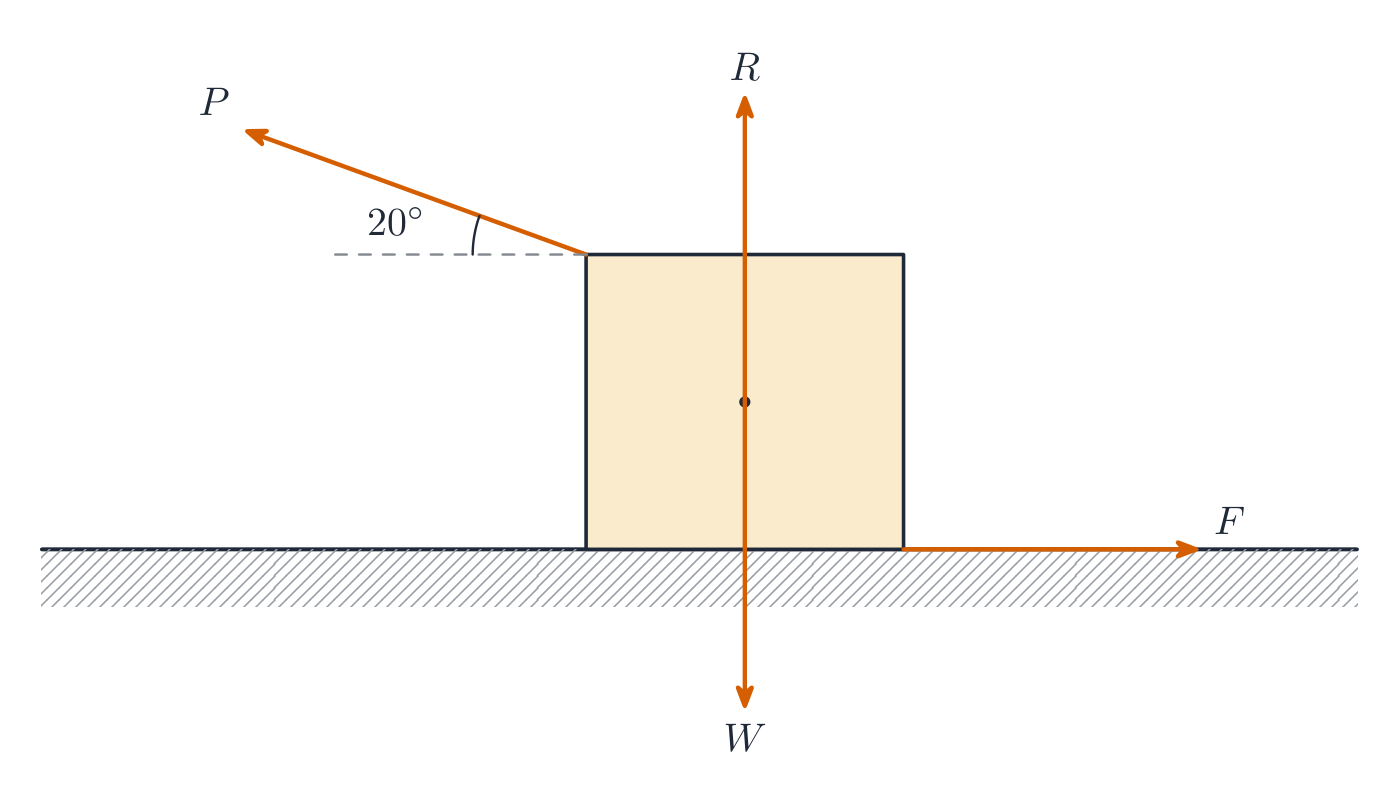
一个力(force)是一个推或拉——一个矢量,以牛顿(N)测量。一个受力图(free-body diagram)把一个物体显示为一个点,带每个作用在它上的力的箭头(重力(weight)、法向、张力(tension)、摩擦、施加),每个被标注并指向正确的方向。在任何动力学问题之前画它;它是大多数分数被赢得或失去的地方。
一个受力图显示作用在一个物体上的每个力 两条规则保持受力图诚实:只画作用在选定物体上的力(不是它对其他东西施加的力),并只画真实的、物理的力(一根绳子、一个表面、重力、一只手)——绝不画一个"$ma$"箭头,它是力的结果,不是一个力本身。
探索Balance the forces on a free-body diagram
A free-body diagram shows every force on one object as an arrow. The object accelerates only if the forces don't cancel — the net force sets $a=F/m$.
词汇表 训练英文 中文 拼音 force/fɔːs/ 力 lì free-body diagram/friː ˈbɒdi ˈdaɪəɡræm/ 受力图 shòu lì tú weight/weɪt/ 重力 zhòng lì tension/ˈtenʃn/ 张力 zhāng lì 2.3
牛顿第三定律
大纲
Learning Objective Essential Knowledge 2.3.A
Describe the interaction of two objects using Newton's third law and a representation of paired forces exerted on each object.- 2.3.A.1 Newton's third law describes the interaction of two objects in terms of the paired forces that each exerts on the other.
- Equation: $\vec{F}_{\text{A on B}} = -\vec{F}_{\text{B on A}}$
- 2.3.A.2 Interactions between objects within a system (internal forces) do not influence the motion of a system's center of mass.
- 2.3.A.3 Tension is the macroscopic net result of forces that segments of a string, cable, chain, or similar system exert on each other in response to an external force.
- 2.3.A.3.i An ideal string has negligible mass and does not stretch when under tension.
- 2.3.A.3.ii The tension in an ideal string is the same at all points within the string.
- 2.3.A.3.iii In a string with nonnegligible mass, tension may not be the same at all points within the string.
- 2.3.A.3.iv An ideal pulley is a pulley that has negligible mass and rotates about an axle through its center of mass with negligible friction.
Boundary statement: AP Physics 1 only expects students to describe tension qualitatively in a string, cable, chain, or similar system with mass. For example, students might note that the tension in a hanging chain is greater toward the top of the chain.
Boundary statement: The interaction between objects or systems at a distance is limited to gravitational forces in AP Physics 1. In AP Physics 2, gravitational, electric, and magnetic forces may be considered.
来源:美国大学理事会 AP 课程与考试说明
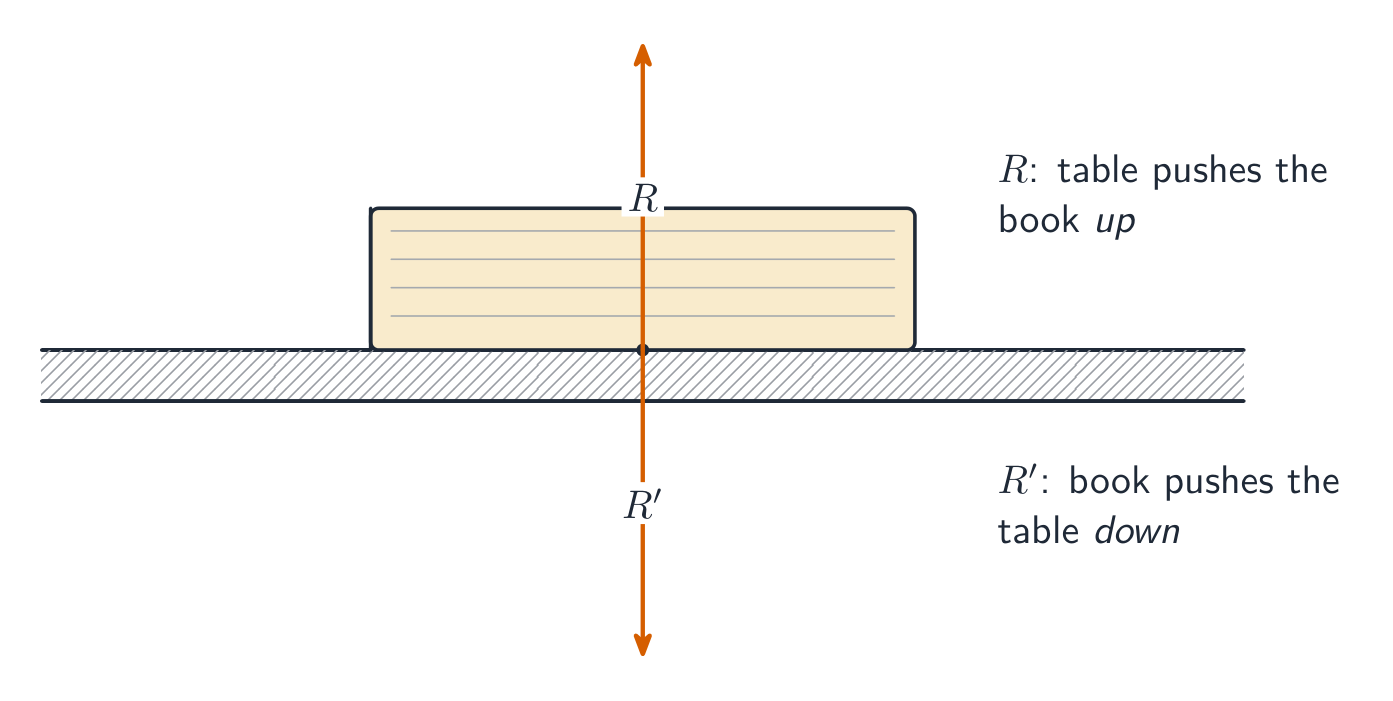
牛顿第三定律(Newton's third law):若物体 A 推物体 B,那么 B 以一个大小相等、方向相反的力推回 A。这两个力作用在不同的物体上,所以它们从不互相抵消。通过"A 对 B / B 对 A"的措辞辨别第三定律对。
一个牛顿第三定律对:两个不同物体上大小相等、方向相反的力 一个经典的陷阱:一本书的重力和来自桌子的法向力不是一个第三定律对——它们作用在同一个物体(书)上。书的重力的伙伴是书对地球施加的拉力;桌子的推力的伙伴是书对桌子的推力。
词汇表 训练英文 中文 拼音 Newton's third law/ˈnjuːtnz θɜːd lɔː/ 牛顿第三定律 niú dùn dì sān dìng lǜ 2.4
牛顿第一定律
大纲
Learning Objective Essential Knowledge 2.4.A
Describe the conditions under which a system's velocity remains constant.- 2.4.A.1 The net force on a system is the vector sum of all forces exerted on the system.
- 2.4.A.2 Translational equilibrium is a configuration of forces such that the net force exerted on a system is zero.
- Derived equation: $\sum_i \vec{F}_i = 0$
- 2.4.A.3 Newton's first law states that if the net force exerted on a system is zero, the velocity of that system will remain constant.
- 2.4.A.4 Forces may be balanced in one dimension but unbalanced in another. The system's velocity will change only in the direction of the unbalanced force.
- 2.4.A.5 An inertial reference frame is one from which an observer would verify Newton's first law of motion.
来源:美国大学理事会 AP 课程与考试说明
牛顿第一定律(Newton's first law)(惯性(inertia)定律):一个物体的速度保持恒定,除非一个合力(net force)作用在它上。所以零合力意味着恒定速度(包括静止)——物体处于平衡(translational equilibrium)。惯性是抵抗运动变化的倾向,由质量测量。
Worked example. 一辆 $1200\ \text{kg}$ 的车在一条水平路上以稳定的 $25\ \text{m/s}$ 巡航。它上的合力是什么?因为速度恒定,加速度是零,所以由第一定律合力是零——向前的驱动力恰好平衡阻力和摩擦。"稳定速率"总是意味着平衡的力。
词汇表 训练英文 中文 拼音 Newton's first law/ˈnjuːtnz fɜːst lɔː/ 牛顿第一定律 niú dùn dì yí dìng lǜ inertia/ɪˈnɜːʃə/ 惯性 guàn xìng net force/net fɔːs/ 合力 hé lì translational equilibrium/trænˈsleɪʃənl ˌiːkwɪˈlɪbrɪəm/ 平衡 píng héng 2.5
牛顿第二定律
大纲
Learning Objective Essential Knowledge 2.5.A
Describe the conditions under which a system's velocity changes.- 2.5.A.1 Unbalanced forces are a configuration of forces such that the net force exerted on a system is not equal to zero.
- 2.5.A.2 Newton's second law of motion states that the acceleration of a system's center of mass has a magnitude proportional to the magnitude of the net force exerted on the system and is in the same direction as that net force.
- Equation: $\vec{a}_{\text{sys}} = \dfrac{\sum \vec{F}}{m_{\text{sys}}} = \dfrac{\vec{F}_{\text{net}}}{m_{\text{sys}}}$
- 2.5.A.3 The velocity of a system's center of mass will only change if a nonzero net external force is exerted on that system.
来源:美国大学理事会 AP 课程与考试说明
牛顿第二定律(Newton's second law)把合力与加速度关联:
$$\vec{a}=\frac{\sum \vec{F}}{m},\qquad\text{i.e.}\qquad \sum\vec{F}=m\vec{a}.$$一次一个轴地应用它:加起每个轴上的力分量并把这个和设为那个轴的 $ma$。加速度指向与合力相同的方向。Worked example. 一个 $4.0\ \text{kg}$ 的箱子被一个 $18\ \text{N}$ 的水平力沿地板拉。箱子上的摩擦是 $6.0\ \text{N}$。求它的加速度。沿运动方向合力是 $18-6.0=12\ \text{N}$,所以
$$a=\frac{\sum F}{m}=\frac{12}{4.0}=3.0\ \text{m/s}^2.$$Worked example (incline 斜面). 一个质量 $m$ 的木块沿一个倾斜角 $\theta$ 的无摩擦坡道滑下。求它的加速度。把重力分解成沿坡道和垂直于坡道的分量;只有沿坡道部分,$mg\sin\theta$,驱动运动,所以
$$a=\frac{mg\sin\theta}{m}=g\sin\theta.$$坡道越陡,$\sin\theta$ 越大而它加速越快;在 $\theta=90^{\circ}$ 它是自由落体。词汇表 训练英文 中文 拼音 Newton's second law/ˈnjuːtnz ˈsekənd lɔː/ 牛顿第二定律 niú dùn dì èr dìng lǜ incline/ɪnˈklaɪn/ 斜面 xié miàn 2.6
万有引力
大纲
Learning Objective Essential Knowledge 2.6.A
Describe the gravitational interaction between two objects or systems with mass.- 2.6.A.1 Newton's law of universal gravitation describes the gravitational force between two objects or systems as directly proportional to each of their masses and inversely proportional to the square of the distance between the systems' centers of mass.
- Equation: $\left|\vec{F}_g\right| = G\dfrac{m_1 m_2}{r^2}$
- 2.6.A.1.i The gravitational force is attractive.
- 2.6.A.1.ii The gravitational force is always exerted along the line connecting the centers of mass of the two interacting systems.
- 2.6.A.1.iii The gravitational force on a system can be considered to be exerted on the system's center of mass.
- 2.6.A.2 A field models the effects of a noncontact force exerted on an object at various positions in space.
- 2.6.A.2.i The magnitude of the gravitational field created by a system of mass $M$ at a point in space is equal to the ratio of the gravitational force exerted by the system on a test object of mass $m$ to the mass of the test object.
- Equation: $\left|\vec{g}\right| = \dfrac{\left|\vec{F}_g\right|}{m} = G\dfrac{M}{r^2}$
- 2.6.A.2.ii If the gravitational force is the only force exerted on an object, the observed acceleration of the object (in m/s$^2$) is numerically equal to the magnitude of the gravitational field strength (in N/kg) at that location.
- 2.6.A.2.i The magnitude of the gravitational field created by a system of mass $M$ at a point in space is equal to the ratio of the gravitational force exerted by the system on a test object of mass $m$ to the mass of the test object.
- 2.6.A.3 The gravitational force exerted by an astronomical body on a relatively small nearby object is called weight.
- Equation: $\text{Weight} = F_g = mg$
2.6.B
Describe situations in which the gravitational force can be considered constant.- 2.6.B.1 If the gravitational force between two systems' centers of mass has a negligible change as the relative position of the two systems changes, the gravitational force can be considered constant at all points between the initial and final positions of the systems.
- 2.6.B.2 Near the surface of Earth, the strength of the gravitational field is $g \approx 10 \text{ N/kg}$
2.6.C
Describe the conditions under which the magnitude of a system's apparent weight is different from the magnitude of the gravitational force exerted on that system.- 2.6.C.1 The magnitude of the apparent weight of a system is the magnitude of the normal force exerted on the system.
- 2.6.C.2 If the system is accelerating, the apparent weight of the system is not equal to the magnitude of the gravitational force exerted on the system.
- 2.6.C.3 A system appears weightless when there are no forces exerted on the system or when the force of gravity is the only force exerted on the system.
- 2.6.C.4 The equivalence principle states that an observer in a noninertial reference frame is unable to distinguish between an object's apparent weight and the gravitational force exerted on the object by a gravitational field.
2.6.D
Describe inertial and gravitational mass.- 2.6.D.1 Objects have inertial mass, or inertia, a property that determines how much an object's motion resists changes when interacting with another object.
- 2.6.D.2 Gravitational mass is related to the force of attraction between two systems with mass.
- 2.6.D.3 Inertial mass and gravitational mass have been experimentally verified to be equivalent.
来源:美国大学理事会 AP 课程与考试说明
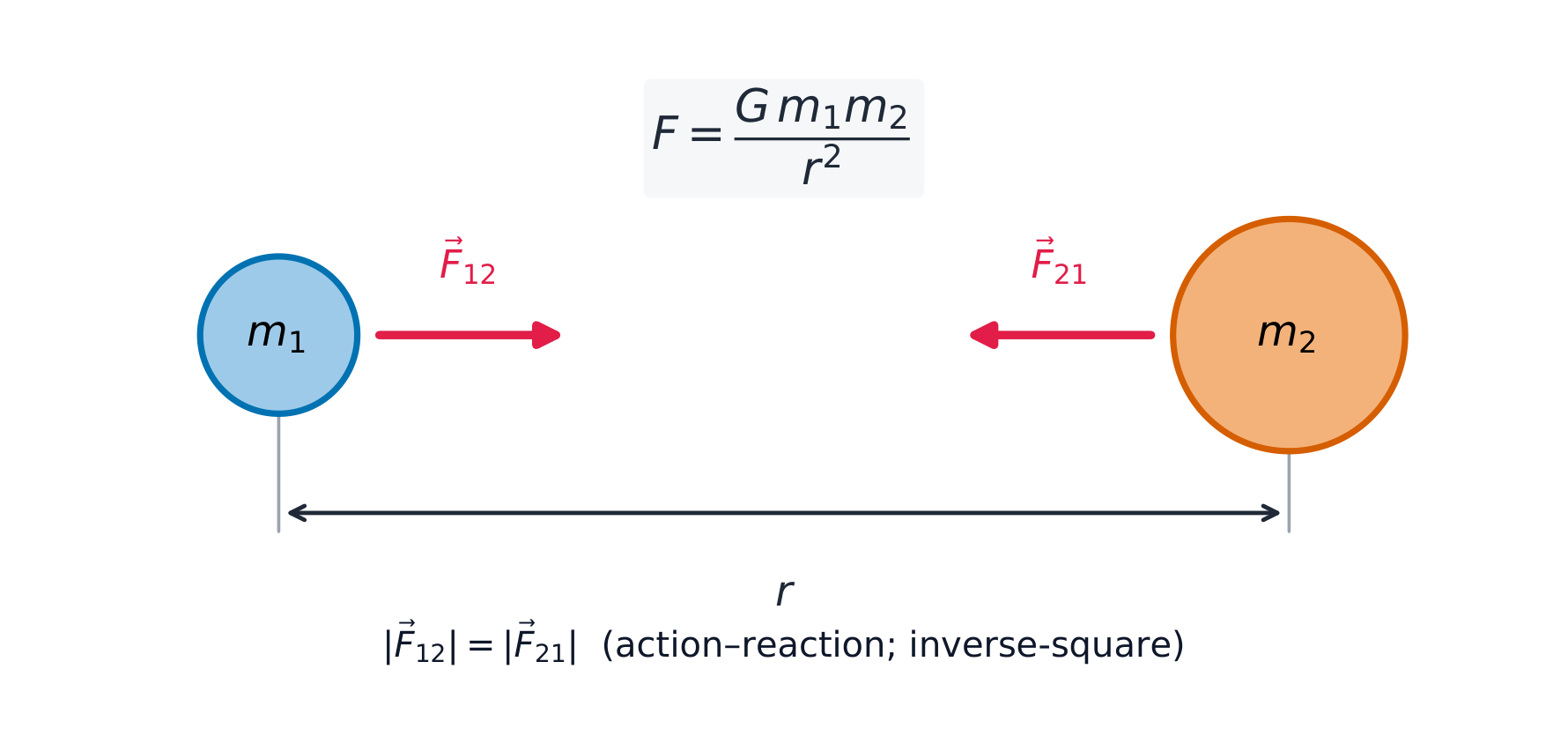
轨道运动(开普勒第二定律) 在一个行星表面附近,万有引力(gravitational force)(重力)是 $F_g=mg$,向下,其中 $g$ 是重力场强度(gravitational field strength)。更一般地,万有引力定律(Newton's law of gravitation)给出任意两个质量之间的吸引:
$$F_g=\frac{G m_1 m_2}{r^2},$$沿连接它们的线,随着距离 $r$ 增长而更弱(一个平方反比定律)。把间距加倍使力变为四分之一。两个质量沿连接它们的线以大小相等、方向相反、平方反比的力互相吸引 Worked example. 一个 $2.0\ \text{kg}$ 的物体在地球上重 $19.6\ \text{N}$($g=9.8\ \text{m/s}^2$)。在月球上 $g_{\text{Moon}}=1.6\ \text{m/s}^2$。它的质量不变($2.0\ \text{kg}$),但它的重量变成 $F_g=mg=2.0\times1.6=3.2\ \text{N}$。质量测量惯性;重量是一个取决于你在哪里的力。
质量其实扮演两个不同的角色。惯性质量(inertial mass)决定一个物体多强地抵抗加速($F=ma$);引力质量(gravitational mass)决定它多强地吸引其他质量($F=Gm_1m_2/r^2$)。实验证实这两者相等——这正是为什么每个物体,无论轻重,都以相同的 $g$ 下落。
词汇表 训练英文 中文 拼音 gravitational field strength/ˌɡrævɪˈteɪʃənl fiːld streŋθ/ 重力场强度 zhòng lì chǎng qiáng dù Newton's law of gravitation/ˈnjuːtnz lɔː ɒv ˌɡrævɪˈteɪʃn/ 万有引力定律 wàn yǒu yǐn lì dìng lǜ Inertial mass/ɪˈnɜːʃl mæs/ 惯性质量 guàn xìng zhì liàng gravitational mass/ˌɡrævɪˈteɪʃənl mæs/ 引力质量 yǐn lì zhì liàng 2.7
动摩擦与静摩擦
大纲
Learning Objective Essential Knowledge 2.7.A
Describe kinetic friction between two surfaces- 2.7.A.1 Kinetic friction occurs when two surfaces in contact move relative to each other.
- 2.7.A.1.i The kinetic friction force is exerted in a direction opposite to the motion of each surface relative to the other surface.
- 2.7.A.1.ii The force of friction between two surfaces does not depend on the size of the surface area of contact.
- 2.7.A.2 The magnitude of the kinetic friction force exerted on an object is the product of the normal force the surface exerts on the object and the coefficient of kinetic friction.
- Equation: $\left|\vec{F}_{f,k}\right| = \left|\mu_k \vec{F}_n\right|$
- 2.7.A.2.i The coefficient of kinetic friction depends on the material properties of the surfaces that are in contact.
- 2.7.A.2.ii Normal force is the perpendicular component of the force exerted on an object by the surface with which it is in contact; it is directed away from the surface.
2.7.B
Describe static friction between two surfaces.- 2.7.B.1 Static friction may occur between the contacting surfaces of two objects that are not moving relative to each other.
- 2.7.B.2 Static friction adopts the value and direction required to prevent an object from slipping or sliding on a surface.
- Equation: $\left|\vec{F}_{f,s}\right| \leq \left|\mu_s \vec{F}_n\right|$
- 2.7.B.2.i Slipping and sliding refer to situations in which two surfaces are moving relative to each other.
- 2.7.B.2.ii There exists a maximum value for which static friction will prevent an object from slipping on a given surface.
- Equation: $F_{f,s,\max} = \mu_s F_n$
- 2.7.B.3 The coefficient of static friction is typically greater than the coefficient of kinetic friction for a given pair of surfaces.
来源:美国大学理事会 AP 课程与考试说明
摩擦力(friction)沿一个表面作用,反对相对滑动(或滑动的倾向):
- 动摩擦(kinetic friction)(滑动时):$f_k=\mu_k N$。
- 静摩擦(static friction)(还未滑动时):$f_s\le \mu_s N$ ——它调整到一个最大值以防止运动。
这里 $N$ 是法向力(normal force)(表面推力,垂直于表面)而 $\mu$ 是摩擦系数(coefficient of friction)。
Worked example. 一个 $5.0\ \text{kg}$ 的板条箱坐在一个水平地板上,$\mu_s=0.40$。一个 $15\ \text{N}$ 的水平推力会移动它吗?在一个水平地板上 $N=mg=5.0\times9.8=49\ \text{N}$,所以最大的静摩擦是 $f_{s,\max}=\mu_s N=0.40\times49=19.6\ \text{N}$。$15\ \text{N}$ 的推力小于 $19.6\ \text{N}$,所以摩擦上升以匹配它而板条箱保持静止。
探索Slide a block down a slope with friction
Friction opposes motion up to a maximum $\mu N$. Tilt the slope until gravity's pull along it beats static friction and the block starts to slide.
词汇表 训练英文 中文 拼音 Friction/ˈfrɪkʃn/ 摩擦力 mó cā lì Kinetic friction/kɪˈnetɪk ˈfrɪkʃn/ 动摩擦 dòng mó cā Static friction/ˈstætɪk ˈfrɪkʃn/ 静摩擦 jìng mó cā normal force/ˈnɔːml fɔːs/ 法向力 fǎ xiàng lì coefficient of friction/ˌkəʊɪˈfɪʃənt ɒv ˈfrɪkʃn/ 摩擦系数 mó cā xì shù 2.8
弹簧力
大纲
Learning Objective Essential Knowledge 2.8.A
Describe the force exerted on an object by an ideal spring- 2.8.A.1 An ideal spring has negligible mass and exerts a force that is proportional to the change in its length as measured from its relaxed length.
- 2.8.A.2 The magnitude of the force exerted by an ideal spring on an object is given by Hooke's law:
- Equation: $\vec{F}_s = -k\Delta\vec{x}$
- 2.8.A.3 The force exerted on an object by a spring is always directed toward the equilibrium position of the object–spring system.
来源:美国大学理事会 AP 课程与考试说明
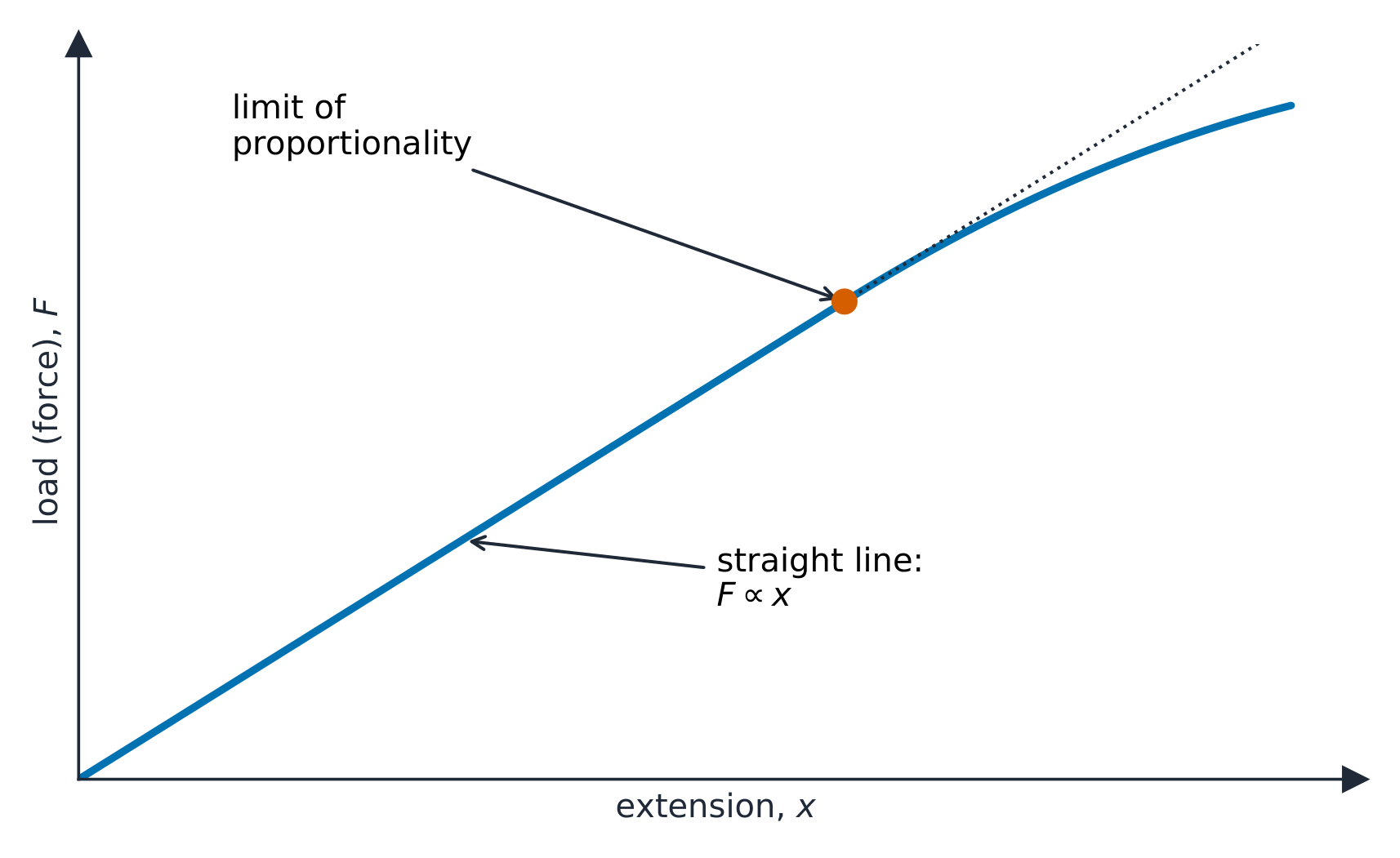
胡克定律与弹性极限 一个理想弹簧施加一个与它的拉伸或压缩成比例的回复力(restoring force)——胡克定律(Hooke's law):
$$F_s=-kx,$$其中 $k$ 是弹簧常数(spring constant)(刚度)而 $x$ 是从弹簧自然长度的位移。负号意味着力指回向平衡。胡克定律:伸长与负载成比例,直到比例极限 Worked example. 一个 $k=200\ \text{N/m}$ 的弹簧竖直悬挂而一个 $0.50\ \text{kg}$ 的质量被挂在它上。它在静止时拉伸多远?在静止时弹簧力平衡重量,$kx=mg$,所以
$$x=\frac{mg}{k}=\frac{0.50\times9.8}{200}=0.025\ \text{m}=2.5\ \text{cm}.$$探索Stretch a spring (Hooke's law)
A spring's force is proportional to its extension, $F=kx$ (Hooke's law). Pull harder and the extension grows in step — until the spring's limit.
词汇表 训练英文 中文 拼音 restoring force/rɪˈstɔːrɪŋ fɔːs/ 回复力 huí fù lì Hooke's law/hʊks lɔː/ 胡克定律 hú kè dìng lǜ spring constant/sprɪŋ ˈkɒnstənt/ 弹簧常数 tán huáng cháng shù 2.9
圆周运动
大纲
Learning Objective Essential Knowledge 2.9.A
Describe the motion of an object traveling in a circular path.- 2.9.A.1 Centripetal acceleration is the component of an object's acceleration directed toward the center of the object's circular path.
- 2.9.A.1.i The magnitude of centripetal acceleration for an object moving in a circular path is the ratio of the object's tangential speed squared to the radius of the circular path.
- Equation: $a_c = \dfrac{v^2}{r}$
- 2.9.A.1.ii Centripetal acceleration is directed toward the center of an object's circular path.
- 2.9.A.1.i The magnitude of centripetal acceleration for an object moving in a circular path is the ratio of the object's tangential speed squared to the radius of the circular path.
- 2.9.A.2 Centripetal acceleration can result from a single force, more than one force, or components of forces exerted on an object in circular motion.
- 2.9.A.2.i At the top of a vertical, circular loop, an object requires a minimum speed to maintain circular motion. At this point, and with this minimum speed, the gravitational force is the only force that causes the centripetal acceleration.
- Equation: $v = \sqrt{gr}$
- 2.9.A.2.ii Components of the static friction force and the normal force can contribute to the net force producing centripetal acceleration of an object traveling in a circle on a banked surface.
- 2.9.A.2.iii A component of tension contributes to the net force producing centripetal acceleration experienced by a conical pendulum.
- 2.9.A.2.i At the top of a vertical, circular loop, an object requires a minimum speed to maintain circular motion. At this point, and with this minimum speed, the gravitational force is the only force that causes the centripetal acceleration.
- 2.9.A.3 Tangential acceleration is the rate at which an object's speed changes and is directed tangent to the object's circular path.
- 2.9.A.4 The net acceleration of an object moving in a circle is the vector sum of the centripetal acceleration and tangential acceleration.
- 2.9.A.5 The revolution of an object traveling in a circular path at a constant speed (uniform circular motion) can be described using period and frequency.
- 2.9.A.5.i The time to complete one full circular path, one full rotation, or a full cycle of oscillatory motion is defined as period, $T$.
- 2.9.A.5.ii The rate at which an object is completing revolutions is defined as frequency, $f$.
- Equation: $T = \dfrac{1}{f}$
- 2.9.A.5.iii For an object traveling at a constant speed in a circular path, the period is given by the derived equation
- Equation: $T = \dfrac{2\pi r}{v}$
2.9.B
Describe circular orbits using Kepler's third law.- 2.9.B.1 For a satellite in circular orbit around a central body, the satellite's centripetal acceleration is caused only by gravitational attraction. The period and radius of the circular orbit are related to the mass of the central body.
- Equation: $T^2 = \dfrac{4\pi^2}{GM} R^3$
Boundary statement: AP Physics 1 only expects students to quantitatively analyze banked curves in which no friction is required to maintain uniform circular motion. Analysis of situations in which friction is required on a banked curve is limited to qualitative descriptions.
Boundary statement: AP Physics 1 does not expect students to know Kepler's first or second laws of planetary motion.
来源:美国大学理事会 AP 课程与考试说明
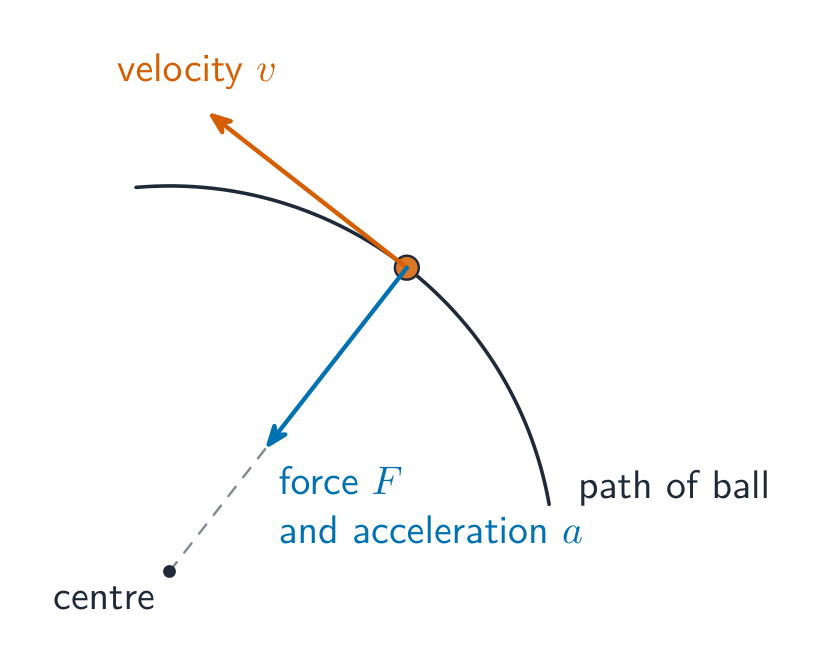
匀速圆周运动 一个以恒定速率在一个圆里移动的物体仍然加速,因为它的速度方向不断变化。这个向心加速度(centripetal acceleration)指向中心:
$$a_c=\frac{v^2}{r}.$$它由一个合向内(向心)力(net inward (centripetal) force)$F_c=\dfrac{mv^2}{r}$ 产生——由任何指向内的真实力(张力、重力、摩擦、法向)供应。转一整圈所需的时间是周期(period)$T$,而每秒转的圈数是频率(frequency)$f$;它们互为倒数,$f = 1/T$,同样的定义描述任何转动或振动。没有单独的向外的力;"离心"只是一个表观效应。速度沿切线指向;向心力和加速度指向中心 Worked example. 一个 $0.30\ \text{kg}$ 的球在一根绳上以 $4.0\ \text{m/s}$ 在一个半径 $0.80\ \text{m}$ 的水平圆里被甩。求绳里的张力。张力供应整个向心力:
$$T=\frac{mv^2}{r}=\frac{0.30\times4.0^2}{0.80}=6.0\ \text{N}.$$若绳最多能承受 $6.0\ \text{N}$,这是球在那个半径能走的最快——转得再快绳就断了。词汇表 训练英文 中文 拼音 centripetal acceleration/senˈtrɪpɪtl əkˌseləˈreɪʃn/ 向心加速度 xiàng xīn jiā sù dù net inward (centripetal) force/net ˈɪnwəd fɔːs/ 向心力 xiàng xīn lì period/ˈpɪərɪəd/ 周期 zhōu qī frequency/ˈfriːkwənsi/ 频率 pín lǜ 2.9
考试技巧
- 总是先画一个受力图:只有作用在选定物体上的真实力(重力、法向、张力、摩擦、施加)——绝不画一个"$ma$"箭头。
- 一次一个轴地应用 $\sum F = ma$;在一个斜面上把重力分解成 $mg\sin\theta$(沿)和 $mg\cos\theta$(垂直)。
- 一个牛顿第三定律对作用在两个不同的物体上——一本书的重力和桌子的法向力不是一个对(两者都作用在书上)。
- 静摩擦调整到 $\mu_s N$(用它来测试运动是否开始);一旦滑动,用动摩擦 $f_k=\mu_k N$。
- 圆周运动需要一个由一个真实力供应的合向内(向心)力 $mv^2/r$ ——没有向外的"离心"力。
-
3
功、能与功率
3.1
平动动能
大纲
Learning Objective Essential Knowledge 3.1.A
Describe the translational kinetic energy of an object in terms of the object's mass and velocity.- 3.1.A.1 An object's translational kinetic energy is given by the equation
- Equation: $K = \dfrac{1}{2}mv^2$
- 3.1.A.2 Translational kinetic energy is a scalar quantity.
- 3.1.A.3 Different observers may measure different values of the translational kinetic energy of an object, depending on the observer's frame of reference.
来源:美国大学理事会 AP 课程与考试说明
能量(energy)是做功的能力,以焦耳(joules)(J)测量。一个移动的物体有动能(kinetic energy):
$$K=\tfrac{1}{2}mv^2.$$它取决于速率的平方,所以把速率加倍使动能变为四倍。动能是一个标量而从不为负。Worked example. 一辆 $1500\ \text{kg}$ 的车以 $20\ \text{m/s}$ 行驶。它的动能是 $K=\tfrac12\times1500\times20^2=3.0\times10^{5}\ \text{J}=300\ \text{kJ}$。若它加速到 $40\ \text{m/s}$(两倍),动能变成 $4\times$ 大,$1200\ \text{kJ}$ ——这就是为什么停车距离随速率增长得如此快。
词汇表 训练英文 中文 拼音 Energy/ˈenədʒi/ 能量 néng liàng joules/dʒuːlz/ 焦耳 jiāo ěr kinetic energy/kɪˈnetɪk ˈenədʒi/ 动能 dòng néng Work/wɜːk/ 功 gōng 3.2
功
大纲
Learning Objective Essential Knowledge 3.2.A
Describe the work done on an object or system by a given force or collection of forces.- 3.2.A.1 Work is the amount of energy transferred into or out of a system by a force exerted on that system over a distance.
- 3.2.A.1.i The work done by a conservative force exerted on a system is path-independent and only depends on the initial and final configurations of that system.
- 3.2.A.1.ii The work done by a conservative force on a system—or the change in the potential energy of the system—will be zero if the system returns to its initial configuration.
- 3.2.A.1.iii Potential energies are associated only with conservative forces.
- 3.2.A.1.iv The work done by a nonconservative force is path-dependent.
- 3.2.A.1.v Examples of nonconservative forces are friction and air resistance.
- 3.2.A.2 Work is a scalar quantity that may be positive, negative, or zero.
- 3.2.A.3 The amount of work done on a system by a constant force is related to the components of that force and the displacement of the point at which that force is exerted.
- 3.2.A.3.i Only the component of the force exerted on a system that is parallel to the displacement of the point of application of the force will change the system's total energy.
- Equation: $W = F_{\parallel}d = Fd\cos\theta$
- 3.2.A.3.ii The component of the force exerted on a system perpendicular to the direction of the displacement of the system's center of mass can change the direction of the system's motion without changing the system's kinetic energy.
- 3.2.A.3.i Only the component of the force exerted on a system that is parallel to the displacement of the point of application of the force will change the system's total energy.
- 3.2.A.4 The work-energy theorem states that the change in an object's kinetic energy is equal to the sum of the work (net work) being done by all forces exerted on the object.
- Equation: $\Delta K = \sum_{i} W_i = \sum_{i} F_{\parallel,i}\,d$
- 3.2.A.4.i An external force may change the configuration of a system. The component of the external force parallel to the displacement times the displacement of the point of application of the force gives the change in kinetic energy of the system.
- 3.2.A.4.ii If the system's center of mass and the point of application of the force move the same distance when a force is exerted on a system, then the system may be modeled as an object, and only the system's kinetic energy can change.
- 3.2.A.4.iii The energy dissipated by friction is typically equated to the force of friction times the length of the path over which the force is exerted
- Equation: $\Delta E_{\text{mech}} = F_f\,d\cos\theta$
- 3.2.A.5 Work is equal to the area under the curve of a graph of $F_{\parallel}$ as a function of displacement.
Boundary statement: AP Physics 1 only expects students to analyze the transfer of mechanical energy (as defined in Unit 3, Topic 4: Conservation of Energy), although students should be aware that mechanical energy may be dissipated in the form of thermal energy or sound. In AP Physics 2, students will also study how thermal energy can be transferred between systems through heating or cooling.
来源:美国大学理事会 AP 课程与考试说明
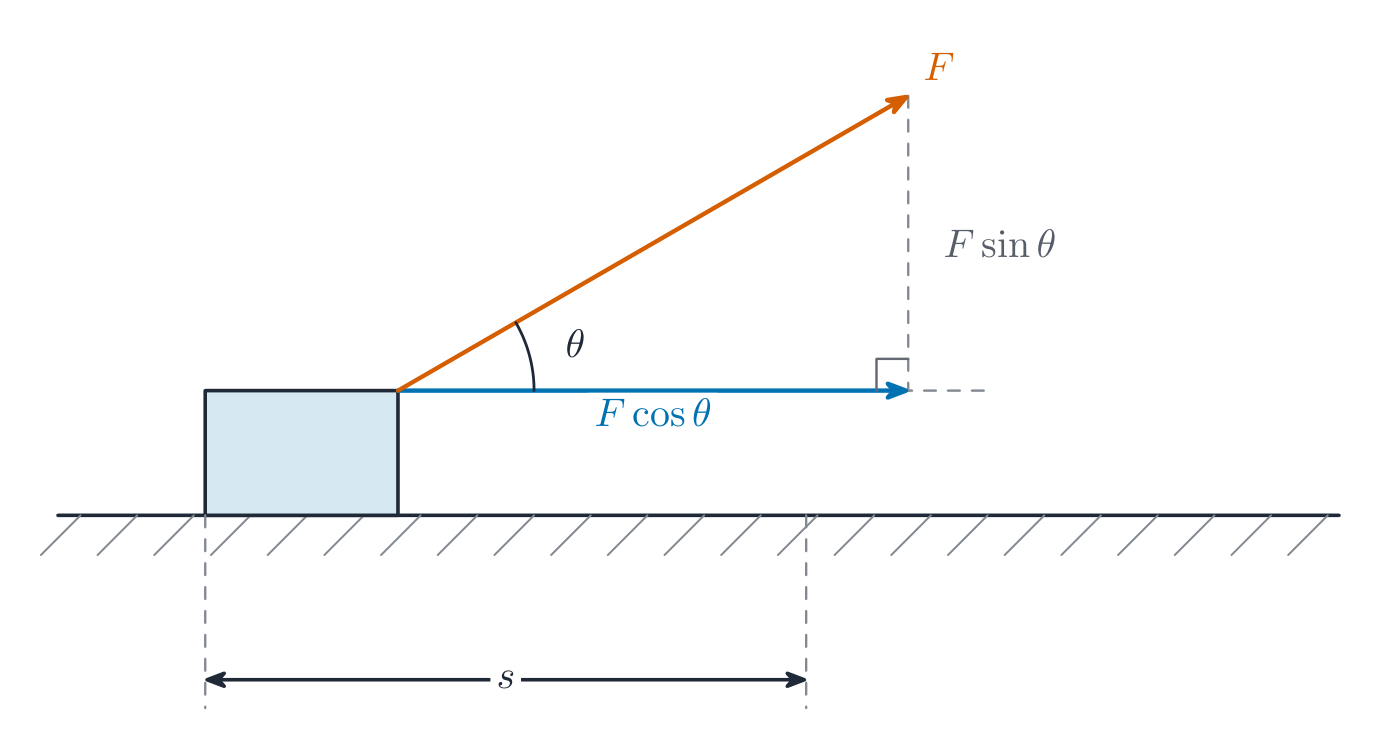
功(work)是一个力作用在一个位移上转移的能量:
$$W=F\,d\cos\theta,$$其中 $\theta$ 是力和位移之间的角。功在力有一个沿运动的分量时是正的(添加能量)、在它反对运动时是负的(移除能量),而在力垂直时是零。在一个力-位置图上,功是曲线下的面积。动能定理(work–energy theorem)陈述合功等于动能的变化:$W_{\text{net}}=\Delta K$。只有沿位移的力分量做功 Worked example. 一个 $2.0\ \text{kg}$ 的木块在一个无摩擦地板上以 $3.0\ \text{m/s}$ 移动,被一个 $5.0\ \text{N}$ 的力沿运动方向推 $4.0\ \text{m}$。求它的最终速率。合功是 $W=Fd=5.0\times4.0=20\ \text{J}$,而由动能定理 $W=\tfrac12 m(v^2-v_0^2)$:
$$20=\tfrac12\times2.0\times(v^2-3.0^2)\;\Rightarrow\;v^2=29\;\Rightarrow\;v=5.4\ \text{m/s}.$$词汇表 训练英文 中文 拼音 work–energy theorem/wɜːk ˈenədʒi ˈθɪərəm/ 动能定理 dòng néng dìng lǐ 3.3
势能
大纲
Learning Objective Essential Knowledge 3.3.A
Describe the potential energy of a system.- 3.3.A.1 A system composed of two or more objects has potential energy if the objects within that system only interact with each other through conservative forces.
- 3.3.A.2 Potential energy is a scalar quantity associated with the position of objects within a system.
- 3.3.A.3 The definition of zero potential energy for a given system is a decision made by the observer considering the situation to simplify or otherwise assist in analysis.
- 3.3.A.4 The potential energy of common physical systems can be described using the physical properties of that system.
- 3.3.A.4.i The elastic potential energy of an ideal spring is given by the following equation, where $\Delta x$ is the distance the spring has been stretched or compressed from its equilibrium length.
- Equation: $U_s = \dfrac{1}{2}k(\Delta x)^2$
- 3.3.A.4.ii The general form for the gravitational potential energy of a system consisting of two approximately spherical distributions of mass (e.g., moons, planets or stars) is given by the equation
- Equation: $U_g = -G\dfrac{m_1 m_2}{r}$
- 3.3.A.4.iii Because the gravitational field near the surface of a planet is nearly constant, the change in gravitational potential energy in a system consisting of an object with mass $m$ and a planet with gravitational field of magnitude $g$ when the object is near the surface of the planet may be approximated by the equation
- Equation: $\Delta U_g = mg\Delta y$
- 3.3.A.4.i The elastic potential energy of an ideal spring is given by the following equation, where $\Delta x$ is the distance the spring has been stretched or compressed from its equilibrium length.
- 3.3.A.5 The total potential energy of a system containing more than two objects is the sum of the potential energy of each pair of objects within the system.
来源:美国大学理事会 AP 课程与考试说明
势能(potential energy)是取决于位置或构型的储存的能量:
- 表面附近的重力势能(gravitational potential energy):$U_g=mgh$(一个参考水平之上的高度 $h$)。
- 一个弹簧里的弹性势能(elastic potential energy):$U_s=\tfrac{1}{2}kx^2$。
势能只对保守力(conservative forces)(重力、弹簧)定义,对它们储存的能量取决于位置,不是路径。只有势能的变化重要,所以你可以把零水平放在任何方便的地方。
$U_g=mgh$ 的形式只在 $g$ 大致恒定的表面附近成立。一般形式,对相距 $r$ 的两个球形质量,是
$$U_g=-\frac{G m_1 m_2}{r}.$$它是负的,并被定义为在无穷远处为零,所以引力势能随质量分开而向零上升。$mgh$ 只是它在表面附近的近似。(这是你处理卫星和逃逸速度所需的形式。)探索Store elastic potential energy in a spring
Stretching a spring stores elastic potential energy $\tfrac12 kx^2$ — the area under the force-extension line. Release it and that energy becomes kinetic.
词汇表 训练英文 中文 拼音 Potential energy/pəˈtenʃl ˈenədʒi/ 势能 shì néng Gravitational potential energy/ˌɡrævɪˈteɪʃənl pəˈtenʃl ˈenədʒi/ 重力势能 zhòng lì shì néng Elastic potential energy/ɪˈlæstɪk pəˈtenʃl ˈenədʒi/ 弹性势能 tán xìng shì néng conservative forces/kənˈsɜːvətɪv ˈfɔːsɪz/ 保守力 bǎo shǒu lì 3.4
能量守恒
大纲
Learning Objective Essential Knowledge 3.4.A
Describe the energies present in a system.- 3.4.A.1 A system composed of only a single object can only have kinetic energy.
- 3.4.A.2 A system that contains objects that interact via conservative forces or that can change its shape reversibly may have both kinetic and potential energies.
3.4.B
Describe the behavior of a system using conservation of mechanical energy principles.- 3.4.B.1 Mechanical energy is the sum of a system's kinetic and potential energies.
- 3.4.B.2 Any change to a type of energy within a system must be balanced by an equivalent change of other types of energies within the system or by a transfer of energy between the system and its surroundings.
- 3.4.B.3 A system may be selected so that the total energy of that system is constant.
- 3.4.B.4 If the total energy of a system changes, that change will be equivalent to the energy transferred into or out of the system.
3.4.C
Describe how the selection of a system determines whether the energy of that system changes.- 3.4.C.1 Energy is conserved in all interactions.
- 3.4.C.2 If the work done on a selected system is zero and there are no nonconservative interactions within the system, the total mechanical energy of the system is constant.
- 3.4.C.3 If the work done on a selected system is nonzero, energy is transferred between the system and the environment.
Boundary statement: AP Physics 1 expects students to know that mechanical energy can be dissipated as thermal energy or sound by nonconservative forces.
来源:美国大学理事会 AP 课程与考试说明
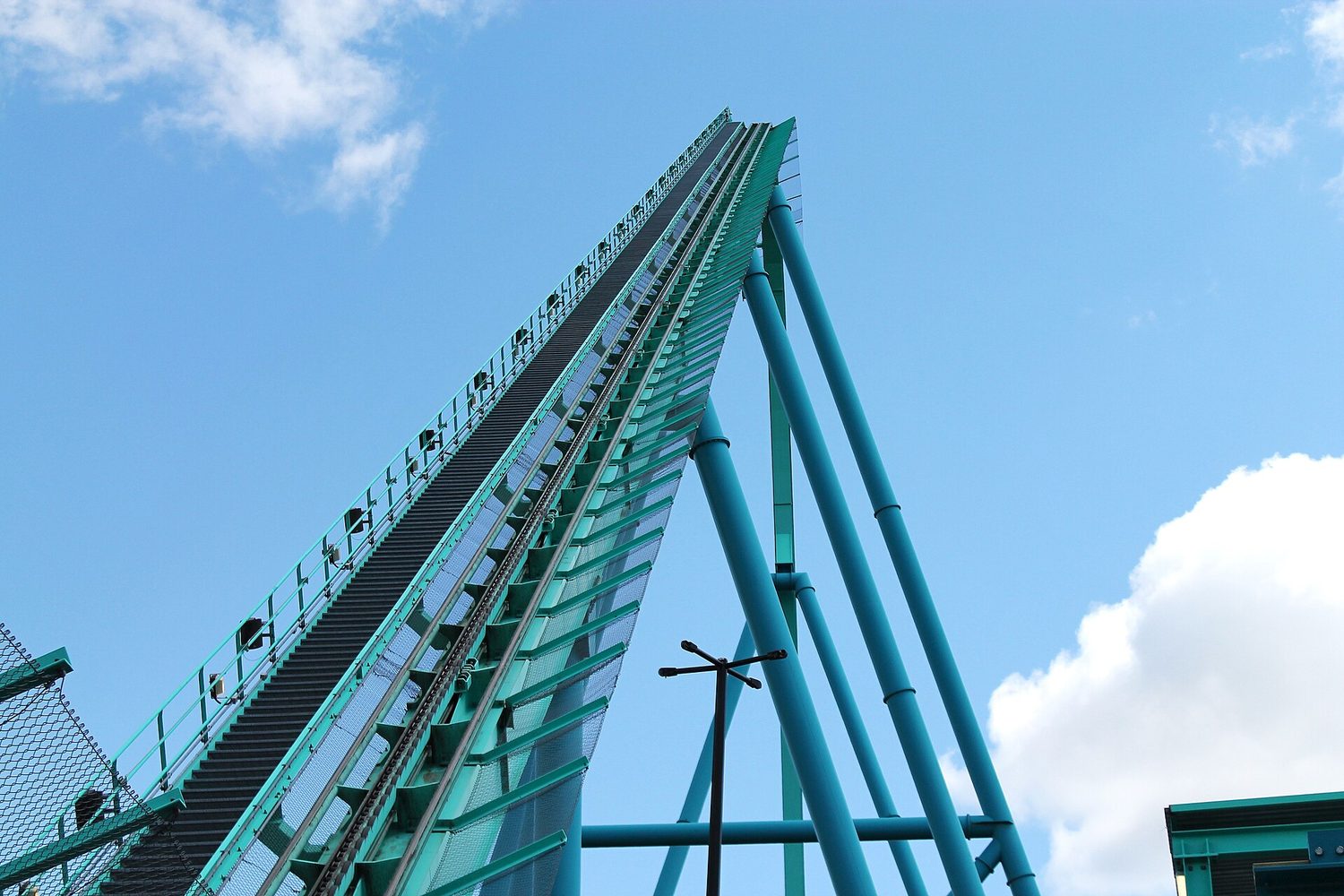
能量守恒:动能↔势能 过山车来回转换能量:它在最高点时势能最大,在最低点时速度最快(动能最大) 机械能(total mechanical energy)是 $E=K+U$。当只有保守力做功时,机械能守恒(conserved):
$$K_1+U_1=K_2+U_2.$$当摩擦或其他非保守力作用时,它们把机械能转移到热能(thermal energy);那么一般的陈述是总能量(包括热能)守恒。能量条形图是追踪能量去哪里的一个好方式。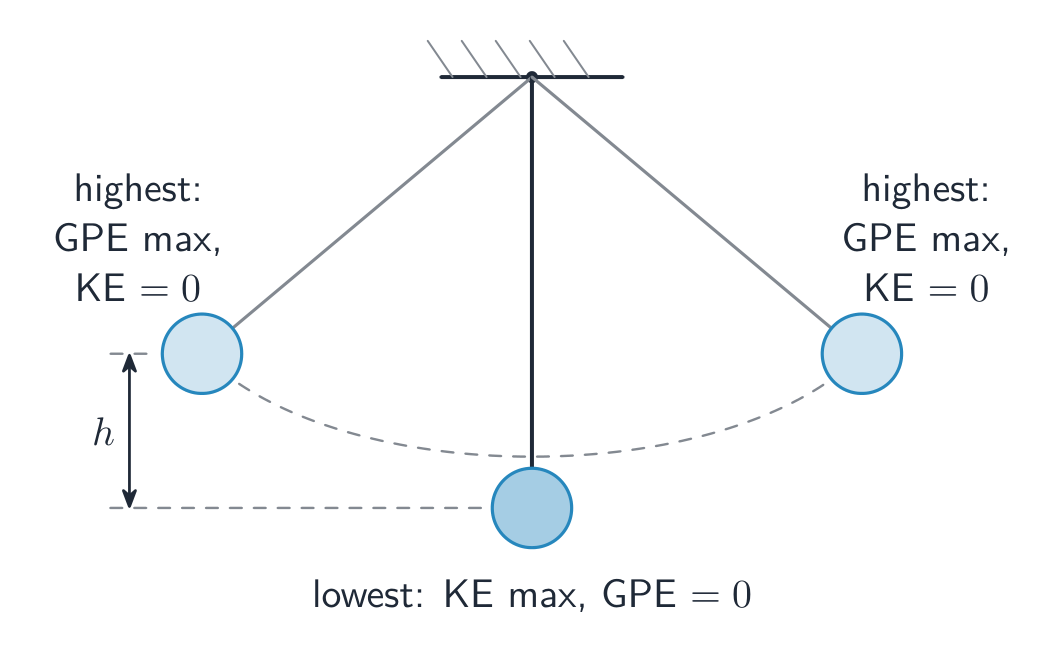
一个摆动的摆把重力势能换成动能并换回 Worked example. 一个球从一个 $5.0\ \text{m}$ 高的无摩擦坡道顶部从静止释放。求它在底部的速率。所有的重力势能变成动能:
$$mgh=\tfrac12 mv^2\;\Rightarrow\;v=\sqrt{2gh}=\sqrt{2\times9.8\times5.0}=9.9\ \text{m/s}.$$质量约去,所以每个物体达到相同的速率——恰好是自由落体的结果,现在从能量得到。若相反 $30\ \text{J}$ 损失给摩擦,你会减去它:$mgh-30=\tfrac12 mv^2$。探索Watch energy convert as an object falls
With no friction, mechanical energy is conserved: as an object falls, gravitational potential energy turns into kinetic energy while the total stays fixed.
词汇表 训练英文 中文 拼音 total mechanical energy/ˈtəʊtl mɪˈkænɪkl ˈenədʒi/ 机械能 jī xiè néng conserved/kənˈsɜːvd/ 守恒 shǒu héng thermal energy/ˈθɜːml ˈenədʒi/ 热能 rè néng 3.5
功率
大纲
Learning Objective Essential Knowledge 3.5.A
Describe the transfer of energy into, out of, or within a system in terms of power.- 3.5.A.1 Power is the rate at which energy changes with respect to time, either by transfer into or out of a system or by conversion from one type to another within a system.
- 3.5.A.2 Average power is the amount of energy being transferred or converted, divided by the time it took for that transfer or conversion to occur.
- Equation: $P_{\text{avg}} = \dfrac{\Delta E}{\Delta t}$
- 3.5.A.3 Because work is the change in energy of an object or system due to a force, average power is the total work done, divided by the time during which that work was done.
- Equation: $P_{\text{avg}} = \dfrac{W}{\Delta t}$
- 3.5.A.4 The instantaneous power delivered to an object by the component of a constant force parallel to the object's velocity can be described with the derived equation.
- Equation: $P_{\text{inst}} = F_{\parallel}v = Fv\cos\theta$
来源:美国大学理事会 AP 课程与考试说明
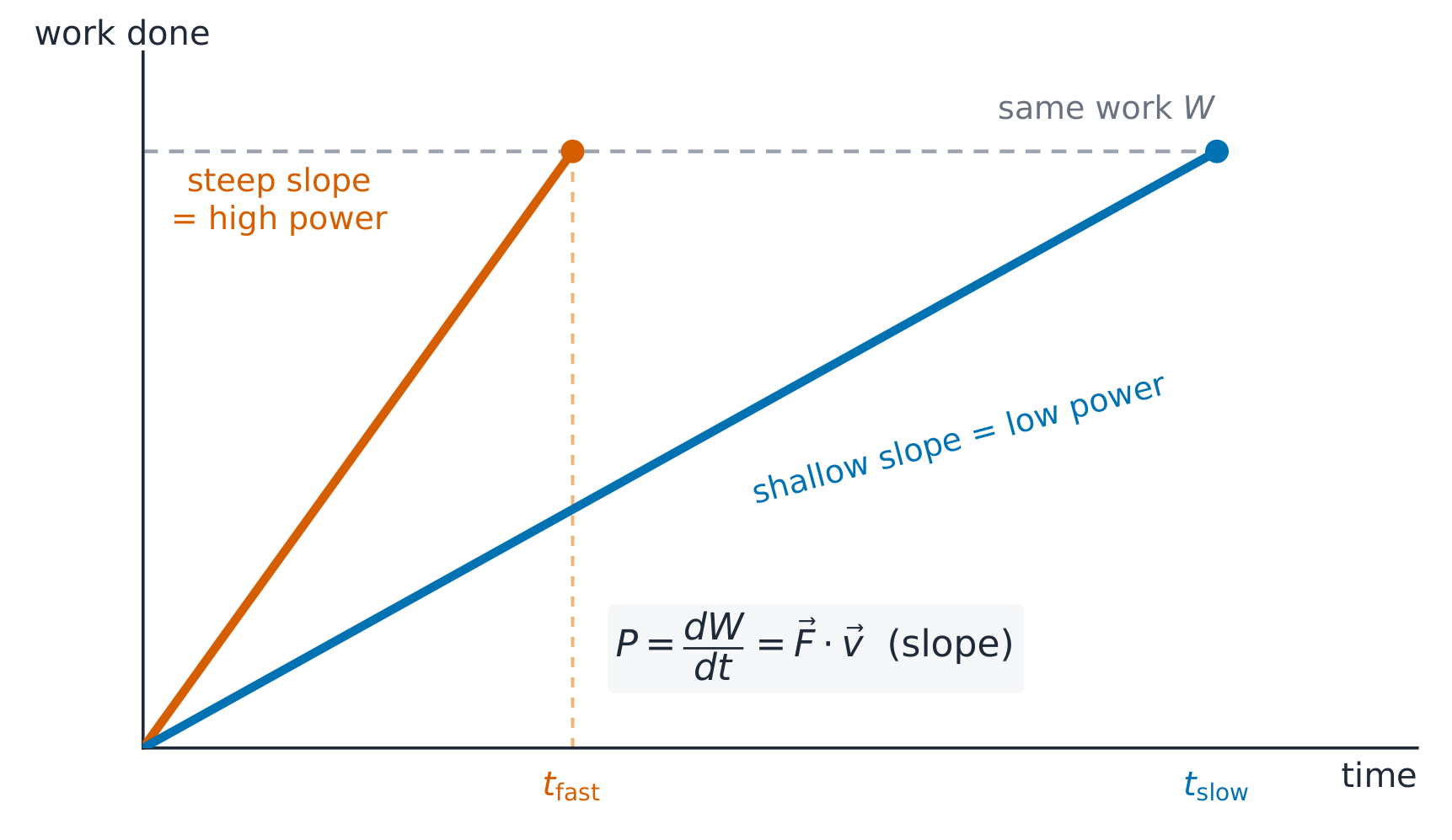
功率(power)是做功或转移能量的速率,以瓦特(watts)(W)测量:
$$P=\frac{W}{\Delta t}=\frac{\Delta E}{\Delta t},\qquad\text{and instantaneously}\qquad P=Fv.$$所以同样的工作更快地完成需要更多功率。在一个能量-时间图上,功率是斜率。功率是功-时间图的斜率:同样的功在更少时间里意味着更多功率 Worked example. 一个马达以稳定的 $2.0\ \text{m/s}$ 提升一个 $50\ \text{kg}$ 的负载。因为它以恒定速率移动,提升力等于重量,所以
$$P=Fv=mgv=50\times9.8\times2.0=980\ \text{W}.$$真实的机器浪费一些能量,所以我们引用效率(efficiency)——有用的输出功率除以总输入功率。若这个马达抽取 $1400\ \text{W}$ 的电功率来传递 $980\ \text{W}$ 的有用提升,它的效率是 $980/1400=0.70$,或 $70\%$;另外的 $30\%$ 变成热和声音。
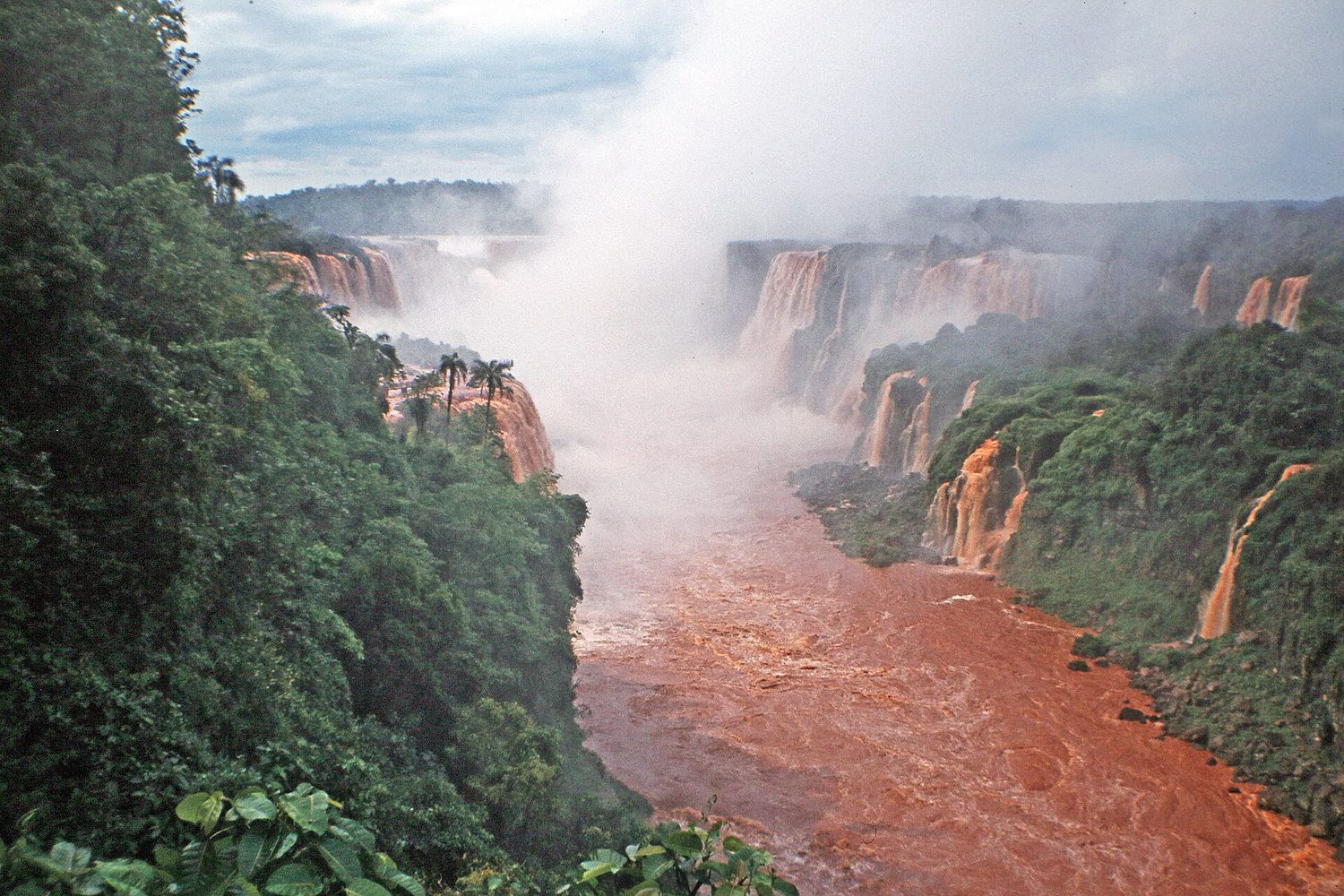
A waterfall: power is how quickly energy is transferred — the same drop in less time is more power 词汇表 训练英文 中文 拼音 Power/ˈpaʊə/ 功率 gōng lǜ watts/wɒts/ 瓦特 wǎ tè efficiency/ɪˈfɪʃənsi/ 效率 xiào lǜ 3.5
考试技巧
- 用 $W=Fd\cos\theta$:功在力垂直于运动时是零,而在它反对时是负的。
- 每当路径复杂时,伸手去拿动能定理($W_{\text{net}}=\Delta K$)或能量守恒($K_1+U_1=K_2+U_2$)而不是力。
- 当摩擦作用时,机械能不守恒——减去损失给热的能量。
- 记住 $K\propto v^2$:把速率加倍使动能(和停车距离)变为四倍。
- 对稳定速率的功率用 $P=Fv$;在恒定速度合力是零但功率不是。
- 3.1.A.1 An object's translational kinetic energy is given by the equation
-
4
线动量
4.1
线动量
大纲
Learning Objective Essential Knowledge 4.1.A
Describe the linear momentum of an object or system.- 4.1.A.1 Linear momentum is defined by the equation $\vec{p} = m\vec{v}$.
- Equation: $\vec{p} = m\vec{v}$
- 4.1.A.2 Momentum is a vector quantity and has the same direction as the velocity.
- 4.1.A.3 Momentum can be used to analyze collisions and explosions.
- 4.1.A.3.i A collision is a model for an interaction where the forces exerted between the involved objects in the system are much larger than the net external force exerted on those objects during the interaction.
- 4.1.A.3.ii As only the initial and final states of a collision are analyzed, the object model may be used to analyze collisions.
- 4.1.A.3.iii An explosion is a model for an interaction in which forces internal to the system move objects within that system apart.
Boundary statement: Unless otherwise stated, the general term "momentum" will refer specifically to linear momentum.
来源:美国大学理事会 AP 课程与考试说明
动量(linear momentum)是质量乘速度——一个指向与速度相同方向的矢量:
$$\vec{p}=m\vec{v}.$$它测量"停止一个移动物体有多难"。一辆重的慢卡车和一个轻的快球能有相同的动量。它的单位是 $\text{kg m/s}$,与 $\text{N s}$ 相同。词汇表 训练英文 中文 拼音 Linear momentum/ˈlɪnɪə məʊˈmentəm/ 动量 dòng liàng 4.2
动量变化与冲量
大纲
Learning Objective Essential Knowledge 4.2.A
Describe the impulse delivered to an object or system.- 4.2.A.1 The rate of change of momentum is equal to the net external force exerted on an object or system.
- Equation: $\vec{F}_{\text{net}} = \dfrac{\Delta \vec{p}}{\Delta t}$
- 4.2.A.2 Impulse is defined as the product of the average force exerted on a system and the time interval during which that force is exerted on the system.
- Equation: $\vec{J} = \vec{F}_{\text{avg}} \Delta t$
- 4.2.A.3 Impulse is a vector quantity and has the same direction as the net force exerted on the system.
- 4.2.A.4 The impulse delivered to a system by a net external force is equal to the area under the curve of a graph of the net external force exerted on the system as a function of time.
- 4.2.A.5 The net external force exerted on a system is equal to the slope of a graph of the momentum of the system as a function of time.
4.2.B
Describe the relationship between the impulse exerted on an object or a system and the change in momentum of the object or system.- 4.2.B.1 Change in momentum is the difference between a system's final momentum and its initial momentum.
- Equation: $\Delta \vec{p} = \vec{p} - \vec{p}_0$
- 4.2.B.2 The impulse–momentum theorem relates the impulse exerted on a system and the system's change in momentum.
- Equation: $\vec{J} = \vec{F}_{\text{avg}} \Delta t = \Delta \vec{p}$
- 4.2.B.3 Newton's second law of motion is a direct result of the impulse–momentum theorem applied to systems with constant mass.
- Equation: $\vec{F}_{\text{net}} = \dfrac{\Delta \vec{p}}{\Delta t} = m\dfrac{\Delta \vec{v}}{\Delta t} = m\vec{a}$
Boundary statement: AP Physics 1 does not require students to quantitatively analyze systems in which the mass of the system changes with respect to time.
来源:美国大学理事会 AP 课程与考试说明
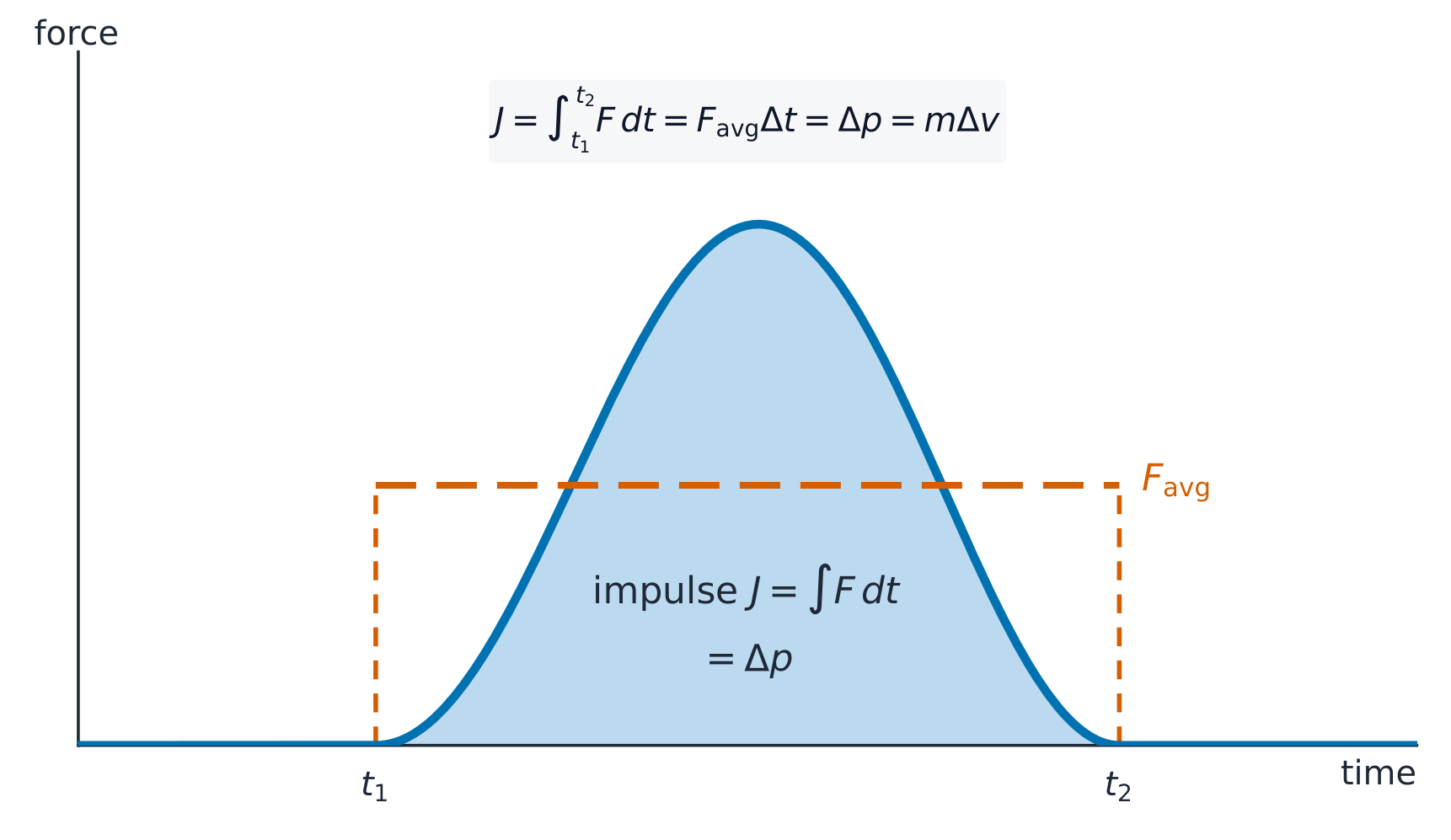
一个合力随时间作用改变动量。传递的冲量(impulse)是
$$\vec{J}=\vec{F}\,\Delta t=\Delta\vec{p}.$$这是冲量-动量定理(impulse–momentum theorem):冲量等于动量的变化。在一个力-时间图上,冲量是曲线下的面积。它解释为什么气囊和随挥有帮助——把同样的动量变化分散到一个更长的时间减少力。冲量是力-时间曲线下的面积,等于平均力乘接触时间 Worked example. 一个 $0.15\ \text{kg}$ 的球以 $20\ \text{m/s}$ 撞墙并以 $15\ \text{m/s}$ 直接弹回。接触持续 $0.020\ \text{s}$。求球上的平均力。取反弹方向为正,所以 $u=-20\ \text{m/s}$ 而 $v=+15\ \text{m/s}$:
$$\Delta p=m(v-u)=0.15\big(15-(-20)\big)=5.25\ \text{kg m/s},\qquad F=\frac{\Delta p}{\Delta t}=\frac{5.25}{0.020}=260\ \text{N}.$$符号工作重要:忘记速度反转是这里最常见的错误。词汇表 训练英文 中文 拼音 impulse/ˈɪmpʌls/ 冲量 chōng liàng 4.3
线动量守恒
大纲
Learning Objective Essential Knowledge 4.3.A
Describe the behavior of a system using conservation of linear momentum.- 4.3.A.1 A collection of objects with individual momenta can be described as one system with one center-of-mass velocity.
- 4.3.A.1.i For a collection of objects, the velocity of a system's center of mass can be calculated using the equation $\vec{v}_{\text{cm}} = \dfrac{\sum \vec{p}_i}{\sum m_i} = \dfrac{\sum m_i \vec{v}_i}{\sum m_i}$.
- 4.3.A.1.ii The velocity of a system's center of mass is constant in the absence of a net external force.
- 4.3.A.2 The total momentum of a system is the sum of the momenta of the system's constituent parts.
- 4.3.A.3 In the absence of net external forces, any change to the momentum of an object within a system must be balanced by an equivalent and opposite change of momentum elsewhere within the system. Any change to the momentum of a system is due to a transfer of momentum between the system and its surroundings.
- 4.3.A.3.i The impulse exerted by one object on a second object is equal and opposite to the impulse exerted by the second object on the first. This is a direct result of Newton's third law.
- 4.3.A.3.ii A system may be selected so that the total momentum of that system is constant.
- 4.3.A.3.iii If the total momentum of a system changes, that change will be equivalent to the impulse exerted on the system.
- Equation: $\vec{J} = \Delta \vec{p}$
- 4.3.A.4 Correct application of conservation of momentum can be used to determine the velocity of a system immediately before and immediately after collisions or explosions.
Boundary statement: AP Physics 1 includes a quantitative and qualitative treatment of conservation of momentum in one dimension and a semiquantitative treatment of conservation of momentum in two dimensions. Exam questions involving solution of simultaneous equations are not included in AP Physics 1, but the AP Physics 1 Exam may include questions that assess whether students can set up the equations properly and reason about how changing a given mass, speed, or angle would affect other quantities. AP Physics 2 includes a full treatment of conservation of momentum in two dimensions for problems that include one unknown final velocity.
4.3.B
Describe how the selection of a system determines whether the momentum of that system changes.- 4.3.B.1 Momentum is conserved in all interactions.
- 4.3.B.2 If the net external force on the selected system is zero, the total momentum of the system is constant.
- 4.3.B.3 If the net external force on the selected system is nonzero, momentum is transferred between the system and the environment.
来源:美国大学理事会 AP 课程与考试说明
若一个系统上的合外力是零,它的总动量守恒(conserved):
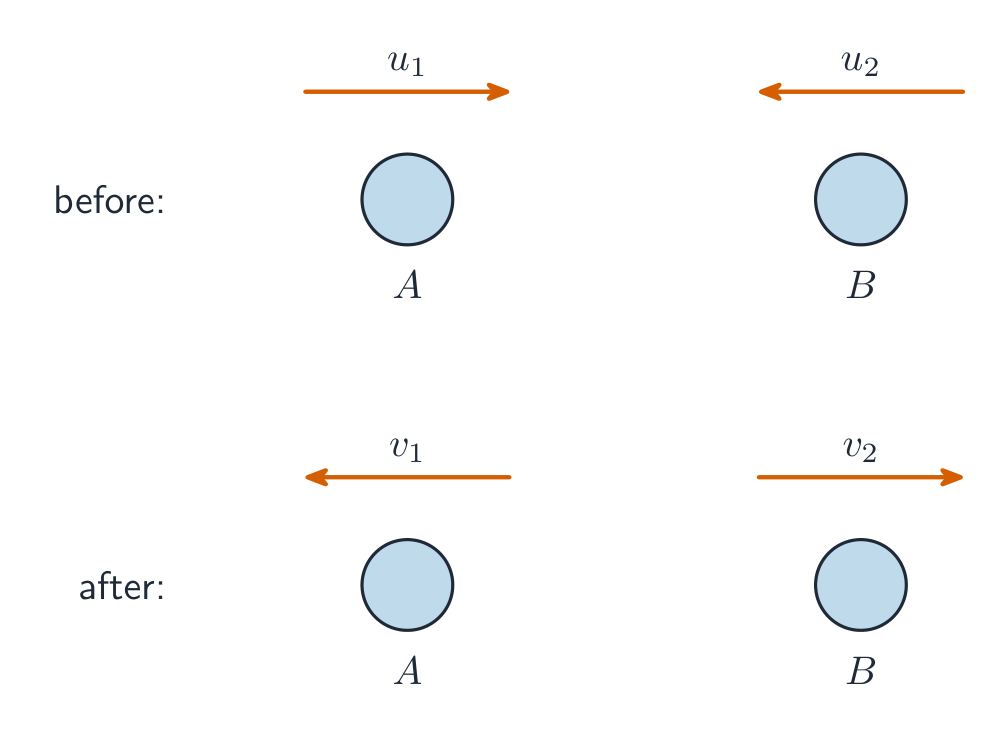
$$\sum \vec{p}_{\text{before}}=\sum \vec{p}_{\text{after}}.$$内力(像两个碰撞的小车之间的推力)成第三定律对而抵消,所以它们不能改变总动量。这是碰撞(collisions)和爆炸的关键工具——在 $x$ 和 $y$ 方向分别应用它。一个正面碰撞:之前的总动量等于之后的总动量 Worked example (recoil 反冲). 一个 $60\ \text{kg}$ 的滑冰者,最初在无摩擦冰上静止,以 $8.0\ \text{m/s}$ 抛一个 $2.0\ \text{kg}$ 的球。求她的反冲速率。总动量从零开始并保持零:
$$0=(60)v+(2.0)(8.0)\;\Rightarrow\;v=-\frac{16}{60}=-0.27\ \text{m/s},$$所以她以 $0.27\ \text{m/s}$ 向球相反的方向移动——火箭和枪背后的原理。一整个物体集合能用单一的质心速度(center-of-mass velocity)描述:
$$\vec{v}_{\text{cm}}=\frac{\sum m_i\vec{v}_i}{\sum m_i}=\frac{\vec{p}_{\text{total}}}{M_{\text{total}}}.$$因为在没有净外力作用时总动量守恒,$\vec{v}_{\text{cm}}$ 于是保持恒定——一张 $v_{\text{cm}}$ 对时间的图是平的,除非有外部力作用。一次内部碰撞或爆炸从不改变它,无论碎片飞得多猛烈。探索Collide two carts and conserve momentum
In any collision the total momentum $\sum mv$ before equals the total after. Set the masses and speeds and check the momentum bookkeeping.
词汇表 训练英文 中文 拼音 conserved/kənˈsɜːvd/ 守恒 shǒu héng collisions/kəˈlɪʒnz/ 碰撞 pèng zhuàng center-of-mass velocity/ˈsentə ɒv mæs vəˈlɒsɪti/ 质心速度 zhì xīn sù dù recoil/rɪˈkɔɪl/ 反冲 fǎn chōng 4.4
弹性碰撞与非弹性碰撞
大纲
Learning Objective Essential Knowledge 4.4.A
Describe whether an interaction between objects is elastic or inelastic.- 4.4.A.1 An elastic collision between objects is one in which the initial kinetic energy of the system is equal to the final kinetic energy of the system.
- 4.4.A.2 In an elastic collision, the final kinetic energies of each of the objects within the system may be different from their initial kinetic energies.
- 4.4.A.3 An inelastic collision between objects is one in which the total kinetic energy of the system decreases.
- 4.4.A.4 In an inelastic collision, some of the initial kinetic energy is not restored to kinetic energy but is transformed by nonconservative forces into other forms of energy.
- 4.4.A.5 In a perfectly inelastic collision, the objects stick together and move with the same velocity after the collision.
来源:美国大学理事会 AP 课程与考试说明
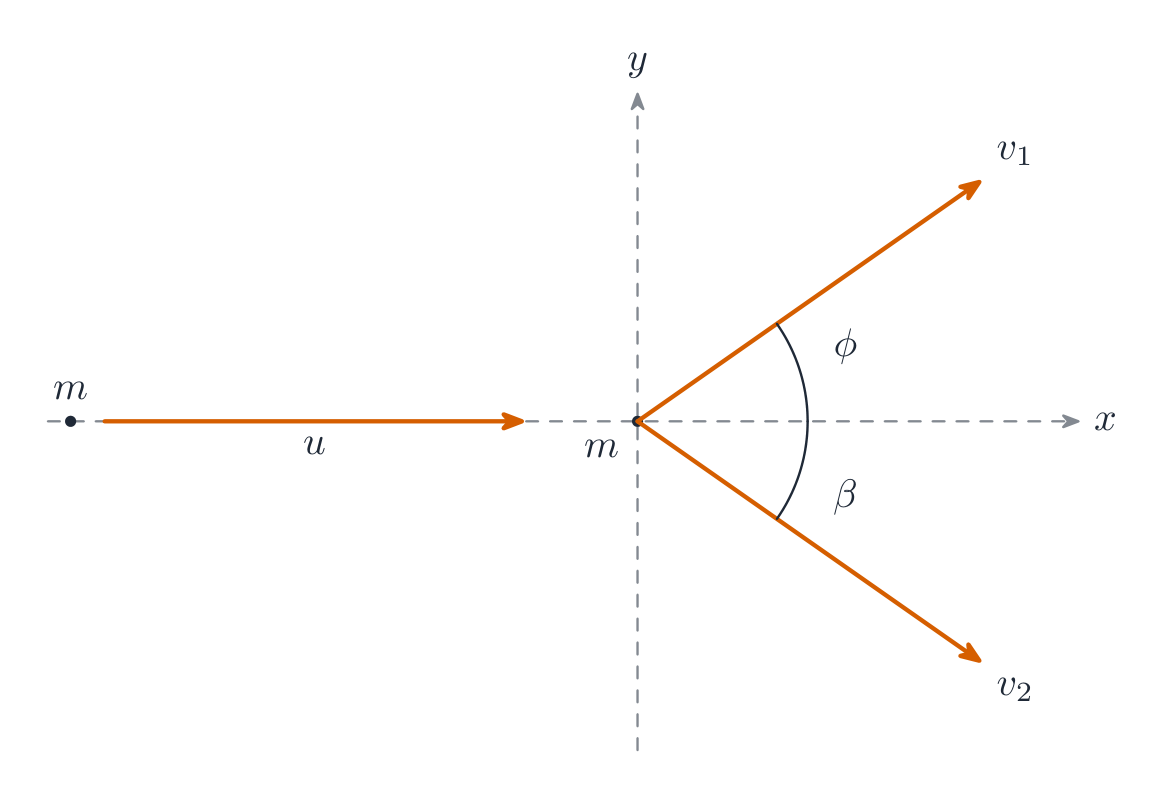
碰撞中的动量守恒 动量在每个碰撞里守恒(没有外力)。动能不守恒:
一个掠射碰撞,沿两个垂直坐标轴分解 - 在一个弹性碰撞(elastic collision)里,动能也守恒(物体干净地弹开)。
- 在一个非弹性碰撞(inelastic collision)里,一些动能变成热或形变。在一个完全非弹性碰撞里物体粘在一起并之后以一个共同速度移动。
策略:总是写动量守恒;只在碰撞被陈述为弹性时加能量守恒。一个值得记住的弹性事实:在相等质量之间的一个一维弹性碰撞里,这两个物体简单地交换速度(一个移动的球撞一个相同的静止的停死,而目标以进入的速率飞走)。
Worked example. 一辆 $1000\ \text{kg}$ 以 $20\ \text{m/s}$ 移动的车撞进一辆静止的 $1500\ \text{kg}$ 的车而它们锁在一起。求它们的共同速率,和损失的动能。动量守恒给出
$$1000\times20=(1000+1500)\,v\;\Rightarrow\;v=\frac{20000}{2500}=8.0\ \text{m/s}.$$之前的动能是 $\tfrac12(1000)(20^2)=2.0\times10^{5}\ \text{J}$;之后是 $\tfrac12(2500)(8.0^2)=8.0\times10^{4}\ \text{J}$。所以 $1.2\times10^{5}\ \text{J}$(约 $60\%$)损失给撞皱和热——动量仍然守恒,但动能不守恒。探索Compare elastic and inelastic collisions
Momentum is always conserved, but kinetic energy is only conserved in an elastic collision. In an inelastic one the carts stick and some energy becomes heat.
词汇表 训练英文 中文 拼音 elastic collision/ɪˈlæstɪk kəˈlɪʒn/ 弹性碰撞 tán xìng pèng zhuàng inelastic collision/ɪnɪˈlæstɪk kəˈlɪʒn/ 非弹性碰撞 fēi tán xìng pèng zhuàng 4.4
考试技巧
- 动量是一个矢量——在相加之前分配 $+$/$-$ 符号;一个反弹的球反转它的速度,给出一个大的 $\Delta p$。
- 动量在每个碰撞里守恒(没有外力);动能只在碰撞被陈述为弹性时守恒。
- 在一个完全非弹性碰撞里物体粘住并以一个共同速度移动。
- 冲量 $=F\,\Delta t=\Delta p$ = 一个力-时间图下的面积;把一个碰撞分散到一个更长的时间减少力(气囊、弯膝)。
- 对反冲/爆炸,把之前和之后的总动量设为相等(之前常常是零)。
- 4.1.A.1 Linear momentum is defined by the equation $\vec{p} = m\vec{v}$.
-
5
力矩与转动动力学
5.1
转动运动学
大纲
Learning Objective Essential Knowledge 5.1.A
Describe the rotation of a system with respect to time using angular displacement, angular velocity, and angular acceleration.- 5.1.A.1 Angular displacement is the measurement of the angle, in radians, through which a point on a rigid system rotates about a specified axis.
- Equation: $\Delta\theta = \theta - \theta_0$
- 5.1.A.1.i A rigid system is one that holds its shape but in which different points on the system move in different directions during rotation. A rigid system cannot be modeled as an object.
- 5.1.A.1.ii One direction of angular displacement about an axis of rotation—clockwise or counterclockwise—is typically indicated as mathematically positive, with the other direction becoming mathematically negative.
- 5.1.A.1.iii If the rotation of a system about an axis may be well described using the motion of the system's center of mass, the system may be treated as a single object. For example, the rotation of Earth about its axis may be considered negligible when considering the revolution of Earth about the center of mass of the Earth–Sun system.
- 5.1.A.2 Average angular velocity is the average rate at which angular position changes with respect to time.
- Equation: $\omega_{\text{avg}} = \dfrac{\Delta\theta}{\Delta t}$
- 5.1.A.3 Average angular acceleration is the average rate at which the angular velocity changes with respect to time.
- Equation: $\alpha_{\text{avg}} = \dfrac{\Delta\omega}{\Delta t}$
- 5.1.A.4 Angular displacement, angular velocity, and angular acceleration around one axis are analogous to linear displacement, velocity, and acceleration in one dimension and demonstrate the same mathematical relationships.
- 5.1.A.4.i For constant angular acceleration, the mathematical relationships between angular displacement, angular velocity, and angular acceleration can be described with the following equations:
- Equation: $\omega = \omega_0 + \alpha t$
- Equation: $\theta = \theta_0 + \omega_0 t + \dfrac{1}{2}\alpha t^2$
- Equation: $\omega^2 = \omega_0^2 + 2\alpha(\theta - \theta_0)$
- 5.1.A.4.ii Graphs of angular displacement, angular velocity, and angular acceleration as functions of time can be used to find the relationships between those quantities.
- 5.1.A.4.i For constant angular acceleration, the mathematical relationships between angular displacement, angular velocity, and angular acceleration can be described with the following equations:
Boundary statement: Descriptions of the directions of rotation for a point or object are limited to clockwise and counterclockwise with respect to a given axis of rotation.
来源:美国大学理事会 AP 课程与考试说明
旋转由映照线性量的角量描述:
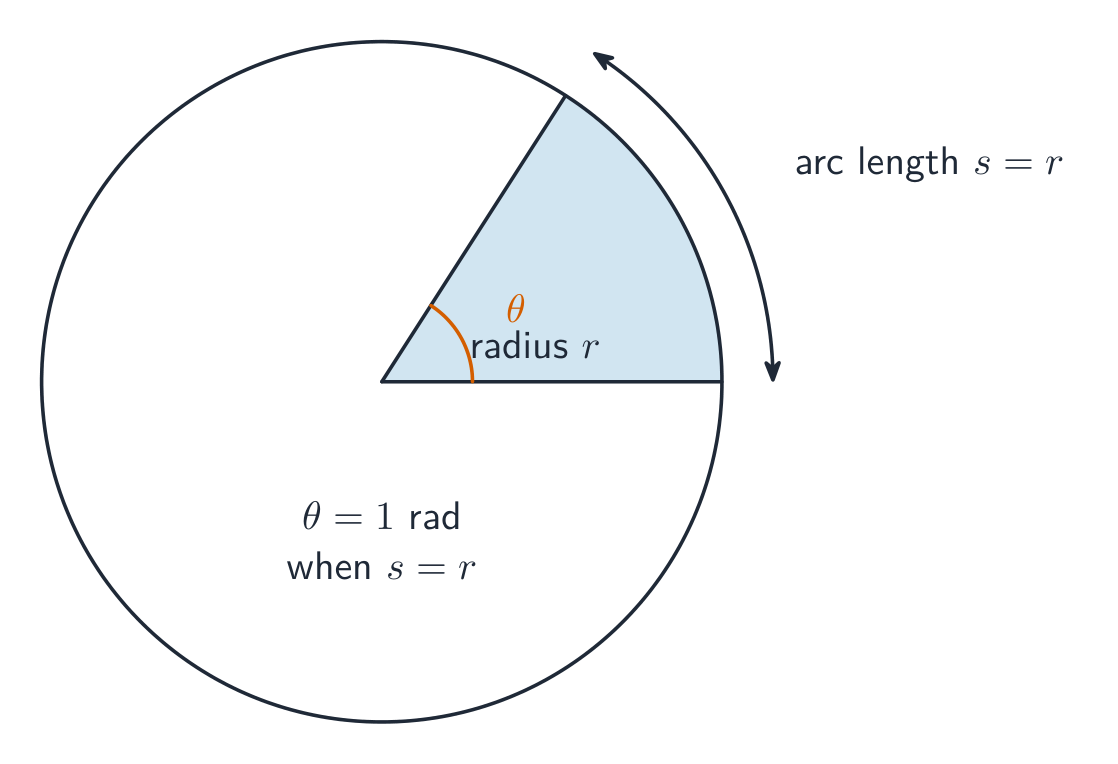
一弧度是弧长等于半径的角 - 角位移(angular displacement)$\theta$(以弧度(radians)),
- 角速度(angular velocity)$\omega=\dfrac{\Delta\theta}{\Delta t}$,
- 角加速度(angular acceleration)$\alpha=\dfrac{\Delta\omega}{\Delta t}$。
对于恒定 $\alpha$,旋转运动学方程有与线性的相同形式,$\theta,\omega,\alpha$ 替换 $x,v,a$:$\omega=\omega_0+\alpha t$、$\theta=\omega_0 t+\tfrac12\alpha t^2$,和 $\omega^2=\omega_0^2+2\alpha\theta$。
Worked example. 一个轮子从静止开始并在 $6.0\ \text{s}$ 里均匀加速到 $30\ \text{rad/s}$。求它的角加速度和转过的总角度:
$$\alpha=\frac{\Delta\omega}{\Delta t}=\frac{30}{6.0}=5.0\ \text{rad/s}^2,\qquad \theta=\tfrac12\alpha t^2=\tfrac12\times5.0\times6.0^2=90\ \text{rad}.$$词汇表 训练英文 中文 拼音 angular displacement/ˈæŋɡjʊlə dɪˈspleɪsmənt/ 角位移 jiǎo wèi yí radians/ˈreɪdɪənz/ 弧度 hú dù angular velocity/ˈæŋɡjʊlə vəˈlɒsɪti/ 角速度 jiǎo sù dù angular acceleration/ˈæŋɡjʊlə əkˌseləˈreɪʃn/ 角加速度 jiǎo jiā sù dù 5.2
连接线运动与转动
大纲
Learning Objective Essential Knowledge 5.2.A
Describe the linear motion of a point on a rotating rigid system that corresponds to the rotational motion of that point, and vice versa.- 5.2.A.1 For a point at a distance $r$ from a fixed axis of rotation, the linear distance $s$ traveled by the point as the system rotates through an angle $\Delta\theta$ is given by the equation $\Delta s = r\Delta\theta$.
- 5.2.A.2 Derived relationships of linear velocity and of the tangential component of acceleration to their respective angular quantities are given by the following equations:
- Equation: $s = r\theta$
- Equation: $v = r\omega$
- Equation: $a_T = r\alpha$
- 5.2.A.3 For a rigid system, all points within that system have the same angular velocity and angular acceleration.
Boundary statement: Descriptions of the directions of rotation for a point or object are limited to clockwise and counterclockwise with respect to a given axis of rotation.
来源:美国大学理事会 AP 课程与考试说明
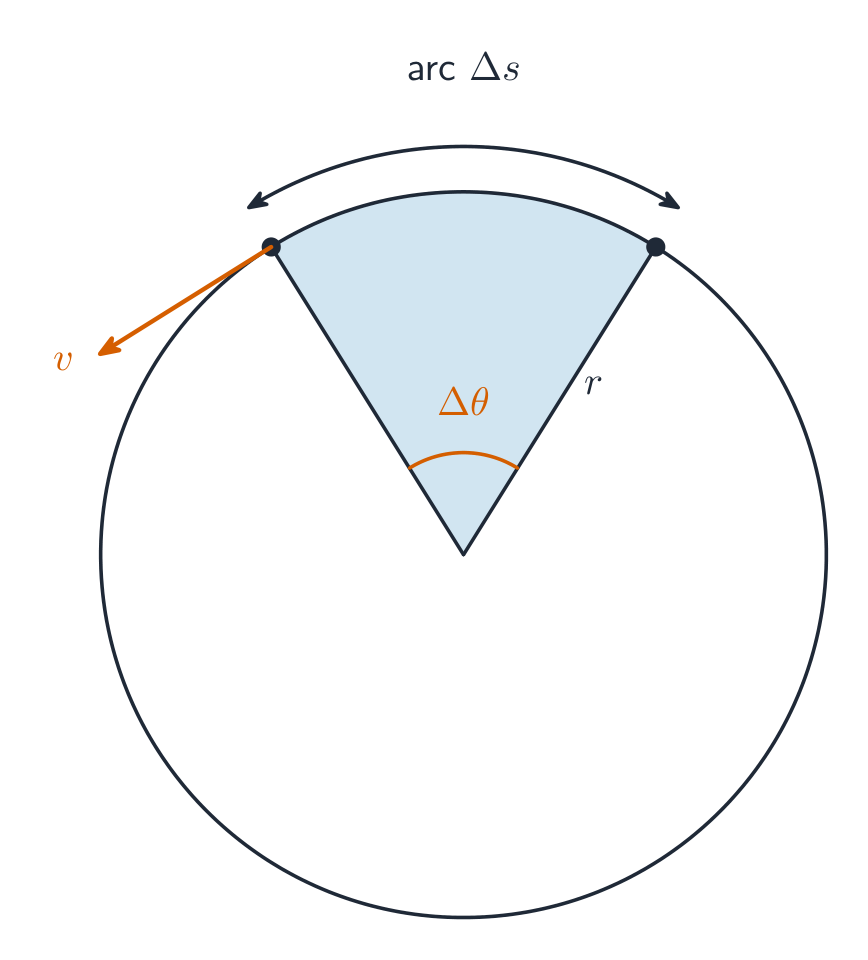
一个离轴半径 $r$ 的点有与角量绑定的线性量:
$$s=r\theta,\qquad v=r\omega,\qquad a_t=r\alpha.$$离轴更远的点移动更快。这个联系让你能在"轮子旋转多快"和"它轮缘上一个点移动多快"之间切换。随着半径转过一个角,一个点以速率 v 沿一条弧移动 Worked example. 一个半径 $0.35\ \text{m}$ 的自行车轮以 $12\ \text{rad/s}$ 旋转。轮缘上一个点(因而自行车)以 $v=r\omega=0.35\times12=4.2\ \text{m/s}$ 移动。一个到轴一半的点以那速率的一半移动。
5.3
力矩
大纲
Learning Objective Essential Knowledge 5.3.A
Identify the torques exerted on a rigid system.- 5.3.A.1 Torque results only from the force component perpendicular to the position vector from the axis of rotation to the point of application of the force.
- 5.3.A.2 The lever arm is the perpendicular distance from the axis of rotation to the line of action of the exerted force.
5.3.B
Describe the torques exerted on a rigid system.- 5.3.B.1 Torques can be described using force diagrams.
- 5.3.B.1.i Force diagrams are similar to free-body diagrams and are used to analyze the torques exerted on a rigid system.
- 5.3.B.1.ii Similar to free-body diagrams, force diagrams represent the relative magnitude and direction of the forces exerted on a rigid system. Force diagrams also depict the location at which those forces are exerted relative to the axis of rotation.
- 5.3.B.2 The magnitude of the torque exerted on a rigid system by a force is described by the following equation, where $\theta$ is the angle between the force vector and the position vector from the axis of rotation to the point of application of the force.
- Equation: $\tau = rF_{\perp} = rF\sin\theta$
Boundary statement: While AP Physics 1 expects students to mathematically manipulate the magnitude of torque using vector conventions, the direction of torque is beyond the scope of the course.
来源:美国大学理事会 AP 课程与考试说明
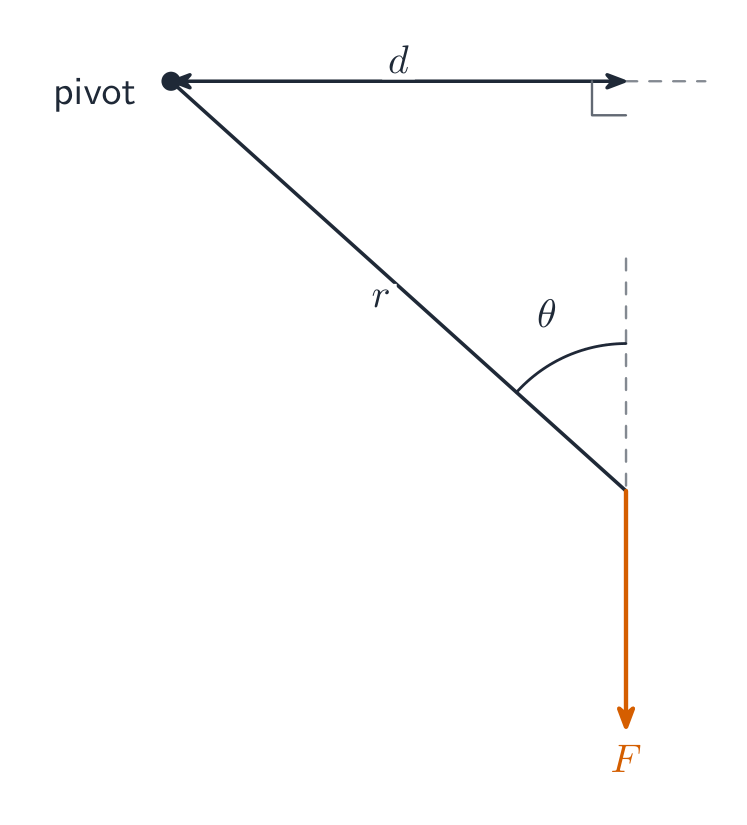
力矩的原理 力矩(torque)是一个力的旋转效应——它多有效地使一个物体绕一个轴转:
$$\tau=r F\sin\theta = F\cdot r_\perp,$$其中 $r_\perp$ 是力臂(moment arm)(从轴到力作用线的垂直距离)。一个施加在更远处、或更垂直的力产生更多力矩。力矩有一个符号(顺时针 vs 逆时针)。一个力的力矩取决于从支点的垂直距离 Worked example. 你在一把 $0.30\ \text{m}$ 扳手的末端以 $20\ \text{N}$ 推。垂直于扳手力矩是 $\tau=rF=0.30\times20=6.0\ \text{N m}$。若你相反以与扳手 $60^{\circ}$ 推,只有垂直部分计入:$\tau=rF\sin 60^{\circ}=0.30\times20\times0.87=5.2\ \text{N m}$ ——这就是为什么你以一个直角推以获得最多的转动效应。
探索Balance torques on a beam
Torque is force times perpendicular distance, $\tau=Fd$. The beam is in rotational equilibrium when the torques on each side are equal.
词汇表 训练英文 中文 拼音 Torque/tɔːk/ 力矩 lì jǔ moment arm/ˈməʊmənt ɑːm/ 力臂 lì bì 5.4
转动惯量
大纲
Learning Objective Essential Knowledge 5.4.A
Describe the rotational inertia of a rigid system relative to a given axis of rotation.- 5.4.A.1 Rotational inertia measures a rigid system's resistance to changes in rotation and is related to the mass of the system and the distribution of that mass relative to the axis of rotation.
- 5.4.A.2 The rotational inertia of an object rotating a perpendicular distance $r$ from an axis is described by the equation
- Equation: $I = mr^2$
- 5.4.A.3 The total rotational inertia of a collection of objects about an axis is the sum of the rotational inertias of each object about that axis:
- Equation: $I_{\text{tot}} = \sum I_i = \sum m_i r_i^2$
5.4.B
Describe the rotational inertia of a rigid system rotating about an axis that does not pass through the system's center of mass.- 5.4.B.1 A rigid system's rotational inertia in a given plane is at a minimum when the rotational axis passes through the system's center of mass.
- 5.4.B.2 The parallel axis theorem uses the following equation to relate the rotational inertia of a rigid system about any axis that is parallel to an axis through its center of mass:
- Equation: $I' = I_{\text{cm}} + Md^2$
Boundary statement: AP Physics 1 only expects students to calculate the rotational inertia for systems of five or fewer objects arranged in a two-dimensional configuration.
Boundary statement: Students do not need to know the rotational inertia of extended rigid systems, as these will be provided within the exam. Students should have a qualitative understanding of the factors that affect rotational inertia; for example, how rotational inertia is greater when mass is farther from the axis of rotation, which is why a hoop has more rotational inertia than a solid disk of the same mass and radius.
来源:美国大学理事会 AP 课程与考试说明
转动惯量(rotational inertia)(moment of inertia)$I$ 测量改变一个物体的旋转有多难——质量的旋转版本。它取决于质量和那质量离轴多远:质量散布得更远给出一个更大的 $I$。对于一个点质量,$I=mr^2$;对于延展的物体,提供标准公式(一个环是 $mR^2$、一个实心圆盘 $\tfrac12 mR^2$)。这就是为什么一个花样滑冰者在她收臂时旋转更快——她减小 $I$。
词汇表 训练英文 中文 拼音 Rotational inertia/rəʊˈteɪʃənl ɪˈnɜːʃə/ 转动惯量 zhuǎn dòng guàn liàng 5.5
转动平衡与转动形式的牛顿第一定律
大纲
Learning Objective Essential Knowledge 5.5.A
Describe the conditions under which a system's angular velocity remains constant.- 5.5.A.1 A system may exhibit rotational equilibrium (constant angular velocity) without being in translational equilibrium, and vice versa.
- 5.5.A.1.i Free-body and force diagrams describe the nature of the forces and torques exerted on an object or rigid system.
- 5.5.A.1.ii Rotational equilibrium is a configuration of torques such that the net torque exerted on the system is zero.
- Equation: $\sum \tau_i = 0$
- 5.5.A.1.iii The rotational analog of Newton's first law is that a system will have a constant angular velocity only if the net torque exerted on the system is zero.
- 5.5.A.2 A rotational corollary to Newton's second law states that if the torques exerted on a rigid system are not balanced, the system's angular velocity must be changing.
Boundary statement: AP Physics 1 does not expect students to simultaneously analyze rotation in multiple planes.
来源:美国大学理事会 AP 课程与考试说明
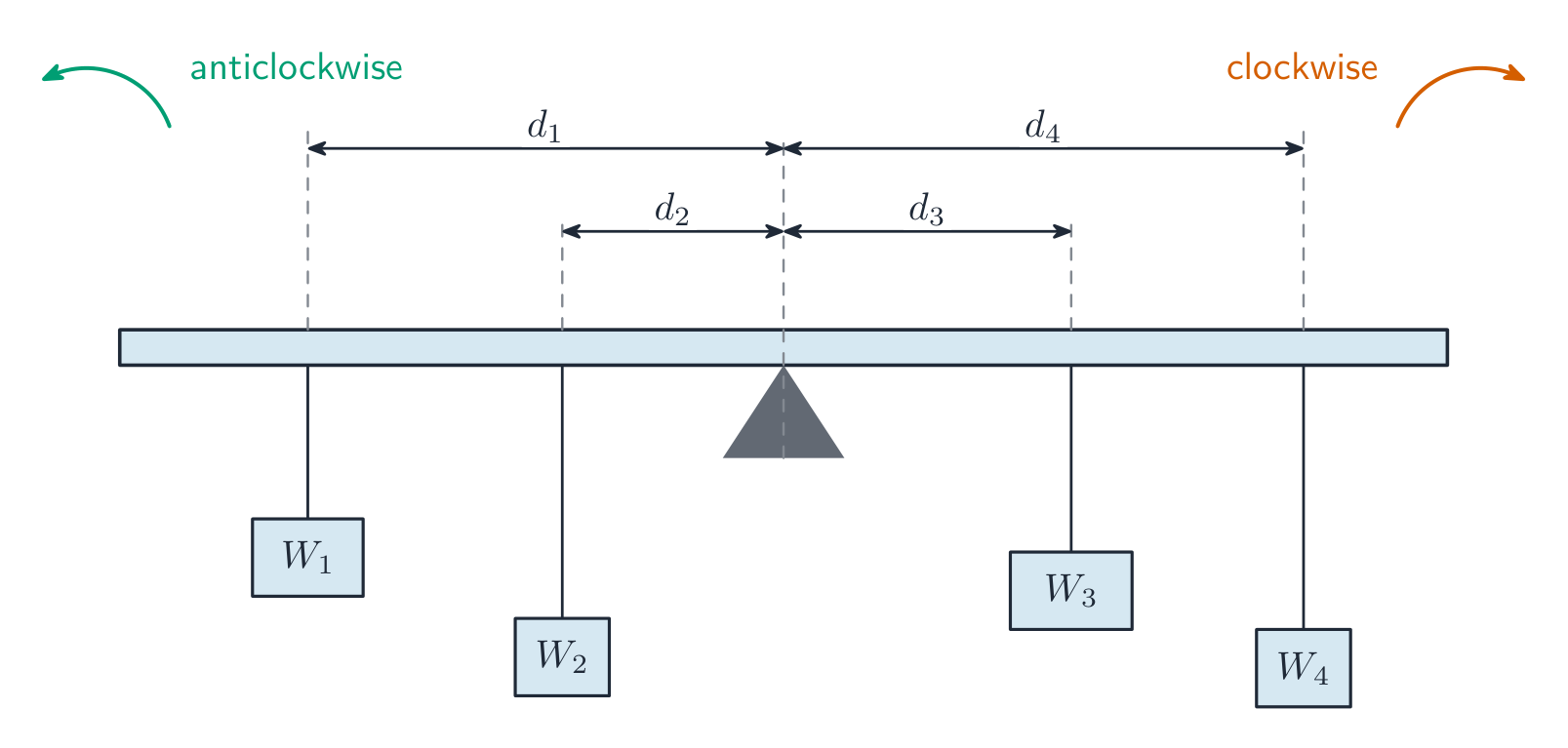
一个物体处于转动平衡(rotational equilibrium),当合力矩是零时,所以它的角速度保持恒定。对于一个平衡(静态)的物体,合力和合力矩都是零。把轴选在一个未知力的位置从力矩方程移除它——梁和梯子问题的一个有用诀窍。
在平衡时绕支点的顺时针和逆时针力矩相等 Worked example. 一个 $30\ \text{kg}$ 的孩子坐在离一个跷跷板支点 $2.0\ \text{m}$ 处。一个 $40\ \text{kg}$ 的孩子必须坐在另一侧哪里来平衡它?把顺时针力矩设为等于逆时针力矩($g$ 约去):
$$30\times2.0=40\times d\;\Rightarrow\;d=\frac{60}{40}=1.5\ \text{m}.$$更重的孩子坐得更接近支点——更少距离、相同力矩。探索Find the balance point
For rotational equilibrium the total clockwise torque equals the total anticlockwise torque. Move the forces and distances until the beam balances.
词汇表 训练英文 中文 拼音 rotational equilibrium/rəʊˈteɪʃənl ˌiːkwɪˈlɪbrɪəm/ 转动平衡 zhuǎn dòng píng héng 5.6
转动形式的牛顿第二定律
大纲
Learning Objective Essential Knowledge 5.6.A
Describe the conditions under which a system's angular velocity changes.- 5.6.A.1 Angular velocity changes when the net torque exerted on the object or system is not equal to zero.
- 5.6.A.2 The rate at which the angular velocity of a rigid system changes is directly proportional to the net torque exerted on the rigid system and is in the same direction. The angular acceleration of the rigid system is inversely proportional to the rotational inertia of the rigid system.
- Equation: $\alpha_{\text{sys}} = \dfrac{\sum \tau}{I_{\text{sys}}} = \dfrac{\tau_{\text{net}}}{I_{\text{sys}}}$
- 5.6.A.3 To fully describe a rotating rigid system, linear and rotational analyses may need to be performed independently.
来源:美国大学理事会 AP 课程与考试说明
合力矩产生角加速度,与 $F=ma$ 直接类比:
$$\sum\tau = I\alpha.$$所以一个更大的合力矩,或一个更小的转动惯量,给出一个更大的角加速度。像平动问题一样解旋转问题,$\tau\leftrightarrow F$、$I\leftrightarrow m$,和 $\alpha\leftrightarrow a$。Worked example. 一个 $12\ \text{N m}$ 的合力矩作用在一个转动惯量 $I=3.0\ \text{kg m}^2$ 的轮子上。它的角加速度是 $\alpha=\tau/I=12/3.0=4.0\ \text{rad/s}^2$ —— $a=F/m$ 的确切旋转孪生。
5.6
考试技巧
- 力矩 $\tau=Fr_\perp$ 使用从支点的垂直距离;一个通过支点的力给出零力矩。
- 对于平衡,设顺时针力矩 = 逆时针力矩;把支点选在一个未知力处从方程移除它。
- 使用旋转类比:$\tau\leftrightarrow F$、$I\leftrightarrow m$、$\alpha\leftrightarrow a$,所以 $\sum\tau=I\alpha$ 映照 $\sum F=ma$。
- 转动惯量取决于质量离轴多远,不只是它的量——一个环比一个相等质量的圆盘更抵抗旋转。
- 把角转换成弧度并用 $v=r\omega$、$a_t=r\alpha$ 把线性连接到角。
- 5.1.A.1 Angular displacement is the measurement of the angle, in radians, through which a point on a rigid system rotates about a specified axis.
-
6
转动系统的能量与动量
6.1
转动动能
大纲
Learning Objective Essential Knowledge 6.1.A
Describe the rotational kinetic energy of a rigid system in terms of the rotational inertia and angular velocity of that rigid system.- 6.1.A.1 The rotational kinetic energy of an object or rigid system is related to the rotational inertia and angular velocity of the rigid system and is given by the equation $K = \frac{1}{2} I \omega^2$.
- 6.1.A.1.i The rotational inertia of an object about a fixed axis can be used to show that the rotational kinetic energy of that object is equivalent to its translational kinetic energy, which is its total kinetic energy.
- 6.1.A.1.ii The total kinetic energy of a rigid system is the sum of its rotational kinetic energy due to its rotation about its center of mass and the translational kinetic energy due to the linear motion of its center of mass.
- 6.1.A.2 A rigid system can have rotational kinetic energy while its center of mass is at rest due to the individual points within the rigid system having linear speed and, therefore, kinetic energy.
- 6.1.A.3 Rotational kinetic energy is a scalar quantity.
来源:美国大学理事会 AP 课程与考试说明
一个旋转的物体有转动动能(rotational kinetic energy),$\tfrac12 mv^2$ 的旋转孪生:
$$K_{\text{rot}}=\tfrac{1}{2}I\omega^2.$$一个既移动又旋转的物体(像一个滚动的球)有两种平动和转动动能,而它的总量是 $K=\tfrac12 mv^2+\tfrac12 I\omega^2$。词汇表 训练英文 中文 拼音 rotational kinetic energy/rəʊˈteɪʃənl kɪˈnetɪk ˈenədʒi/ 转动动能 zhuǎn dòng dòng néng 6.2
力矩与功
大纲
Learning Objective Essential Knowledge 6.2.A
Describe the work done on a rigid system by a given torque or collection of torques.- 6.2.A.1 A torque can transfer energy into or out of an object or rigid system if the torque is exerted over an angular displacement.
- 6.2.A.2 The amount of work done on a rigid system by a torque is related to the magnitude of that torque and the angular displacement through which the rigid system rotates during the interval in which that torque is exerted.
- Equation: $W = \tau \Delta\theta$
- 6.2.A.3 Work done on a rigid system by a given torque can be found from the area under the curve of a graph of torque as a function of angular position.
来源:美国大学理事会 AP 课程与考试说明
一个力矩作用过一个角位移做功,改变转动动能:
$$W=\tau\,\Delta\theta,\qquad P=\tau\omega.$$这是 $W=Fd$ 和 $P=Fv$ 的旋转形式,而它把动能定理扩展到旋转。Worked example. 一个马达在一个飞轮转过 $10\ \text{rad}$ 时对它施加一个稳定的 $8.0\ \text{N m}$ 力矩。做的功是 $W=\tau\,\Delta\theta=8.0\times10=80\ \text{J}$,而若飞轮从静止开始这全都变成转动动能。
探索Balance torques on a seesaw
Torque is force times perpendicular distance, $\tau = Fd$. The beam balances when the torques on each side are equal — move the forces and distances to find the balance point.
6.3
角动量与角冲量
大纲
Learning Objective Essential Knowledge 6.3.A
Describe the angular momentum of an object or rigid system.- 6.3.A.1 The magnitude of the angular momentum of a rigid system about a specific axis can be described with the equation $L = I\omega$.
- 6.3.A.2 The magnitude of the angular momentum of an object about a given point is $L = rmv \sin\theta$.
- 6.3.A.2.i The selection of the axis about which an object is considered to rotate influences the determination of the angular momentum of that object.
- 6.3.A.2.ii The measured angular momentum of an object traveling in a straight line depends on the distance between the reference point and the object, the mass of the object, the speed of the object, and the angle between the radial distance and the velocity of the object.
6.3.B
Describe the angular impulse delivered to an object or rigid system by a torque.- 6.3.B.1 Angular impulse is defined as the product of the torque exerted on an object or rigid system and the time interval during which the torque is exerted.
- Equation: $\text{angular impulse} = \tau \Delta t$
- 6.3.B.2 Angular impulse has the same direction as the torque exerted on the object or system.
- 6.3.B.3 The angular impulse delivered to an object or rigid system by a torque can be found from the area under the curve of a graph of the torque as a function of time.
6.3.C
Relate the change in angular momentum of an object or rigid system to the angular impulse given to that object or rigid system.- 6.3.C.1 The magnitude of the change in angular momentum can be described by comparing the magnitudes of the final and initial angular momenta of the object or rigid system: $\Delta L = L - L_0$
- 6.3.C.2 A rotational form of the impulse–momentum theorem relates the angular impulse delivered to an object or rigid system and the change in angular momentum of that object or rigid system.
- 6.3.C.2.i The angular impulse exerted on an object or rigid system is equal to the change in angular momentum of that object or rigid system.
- Equation: $\Delta L = \tau \Delta t$
- 6.3.C.2.ii The rotational form of the impulse–momentum theorem is a direct result of the rotational form of Newton's second law of motion for cases in which rotational inertia is constant: $\tau_{\text{net}} = \dfrac{\Delta L}{\Delta t} = I \dfrac{\Delta\omega}{\Delta t} = I\alpha$
- 6.3.C.2.i The angular impulse exerted on an object or rigid system is equal to the change in angular momentum of that object or rigid system.
- 6.3.C.3 The net torque exerted on an object is equal to the slope of the graph of the angular momentum of an object as a function of time.
- 6.3.C.4 The angular impulse delivered to an object is equal to the area under the curve of a graph of the net external torque exerted on an object as a function of time.
Boundary statement: While AP Physics 1 expects that students can mathematically manipulate the magnitude of angular momentum using one-dimensional vector conventions, the direction of angular momentum and angular impulse is beyond the scope of the course.
来源:美国大学理事会 AP 课程与考试说明
角动量(angular momentum)是线性动量的旋转版本:
$$L=I\omega.$$一个合力矩随时间作用传递一个改变它的角冲量(angular impulse):$\tau\,\Delta t=\Delta L$ ——旋转冲量-动量定理。词汇表 训练英文 中文 拼音 Angular momentum/ˈæŋɡjʊlə məʊˈmentəm/ 角动量 jiǎo dòng liàng angular impulse/ˈæŋɡjʊlə ˈɪmpʌls/ 角冲量 jiǎo chōng liàng 6.4
角动量守恒
大纲
Learning Objective Essential Knowledge 6.4.A
Describe the behavior of a system using conservation of angular momentum.- 6.4.A.1 The total angular momentum of a system about a rotational axis is the sum of the angular momenta of the system's constituent parts about that axis.
- 6.4.A.2 Any change to a system's angular momentum must be due to an interaction between the system and its surroundings.
- 6.4.A.2.i The angular impulse exerted by one object or system on a second object or system is equal and opposite to the angular impulse exerted by the second object or system on the first. This is a direct result of Newton's third law.
- 6.4.A.2.ii A system may be selected so that the total angular momentum of that system is constant.
- 6.4.A.2.iii The angular speed of a nonrigid system may change without the angular momentum of the system changing if the system changes shape by moving mass closer to or further from the rotational axis.
- 6.4.A.2.iv If the total angular momentum of a system changes, that change will be equivalent to the angular impulse exerted on the system.
6.4.B
Describe how the selection of a system determines whether the angular momentum of that system changes.- 6.4.B.1 Angular momentum is conserved in all interactions.
- 6.4.B.2 If the net external torque exerted on a selected object or rigid system is zero, the total angular momentum of that system is constant.
- 6.4.B.3 If the net external torque exerted on a selected object or rigid system is nonzero, angular momentum is transferred between the system and the environment.
来源:美国大学理事会 AP 课程与考试说明
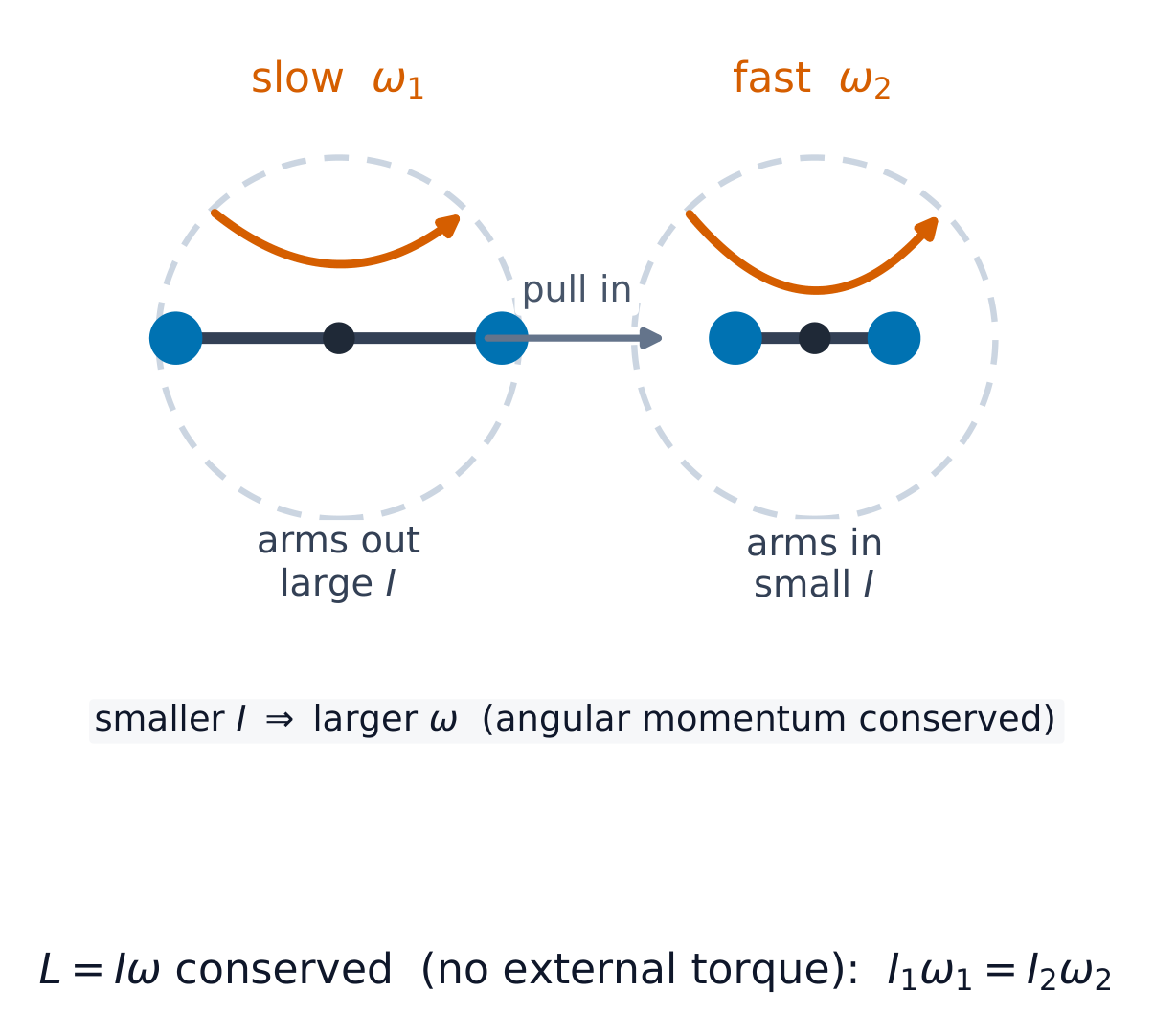
若一个系统上的合外力矩是零,它的总角动量守恒(conserved):
$$I_1\omega_1=I_2\omega_2.$$所以若 $I$ 减小,$\omega$ 增大以保持 $L$ 恒定——这就是为什么一个旋转的滑冰者在收臂时加速。它也适用于旋转系统的碰撞和爆炸。Worked example. 一个滑冰者以 $2.0\ \text{rev/s}$ 旋转,转动惯量 $I_1=4.0\ \text{kg m}^2$。她收臂,把她的转动惯量降到 $I_2=1.6\ \text{kg m}^2$。没有外力矩,角动量守恒:
$$\omega_2=\frac{I_1}{I_2}\,\omega_1=\frac{4.0}{1.6}\times2.0=5.0\ \text{rev/s}.$$她的动能实际上上升——额外的能量来自她的肌肉逆着向外的拉力收臂所做的功。向内拉质量降低 I,所以 ω 上升以守恒 L = Iω 词汇表 训练英文 中文 拼音 conserved/kənˈsɜːvd/ 守恒 shǒu héng 6.5
滚动
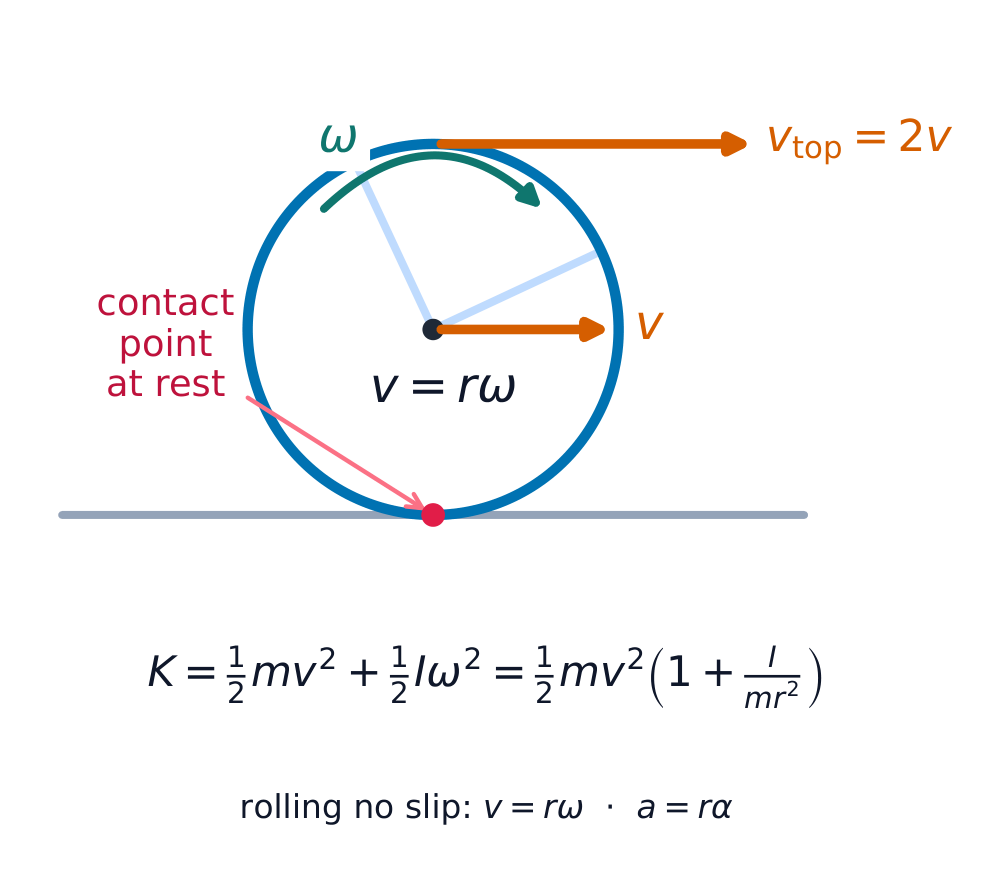
大纲
Learning Objective Essential Knowledge 6.5.A
Describe the kinetic energy of a system that has translational and rotational motion.- 6.5.A.1 The total kinetic energy of a system is the sum of the system's translational and rotational kinetic energies.
- Equation: $K_{\text{tot}} = K_{\text{trans}} + K_{\text{rot}}$
6.5.B
Describe the motion of a system that is rolling without slipping.- 6.5.B.1 While rolling without slipping, the translational motion of a system's center of mass is related to the rotational motion of the system itself with the equations:
- Equation: $\Delta x_{\text{cm}} = r\Delta\theta$
- Equation: $v_{\text{cm}} = r\omega$
- Equation: $a_{\text{cm}} = r\alpha$
- 6.5.B.2 For ideal cases, rolling without slipping implies that the frictional force does not dissipate any energy from the rolling system.
6.5.C
Describe the motion of a system that is rolling while slipping.- 6.5.C.1 When slipping, the motion of a system's center of mass and the system's rotational motion cannot be directly related.
- 6.5.C.2 When a rotating system is slipping relative to another surface, the point of application of the force of kinetic friction exerted on the system moves with respect to the surface, so the force of kinetic friction will dissipate energy from the system.
Boundary statement: Rolling friction is beyond the scope of AP Physics 1.
Boundary statement: The precise mathematical relationships between linear and angular quantities while a rigid body is rolling while slipping are beyond the scope of AP Physics 1 and 2, and students will not be expected to model those relationships quantitatively. However, students are expected to qualitatively explain the changes to linear and angular quantities while a rigid body is rolling while slipping.
来源:美国大学理事会 AP 课程与考试说明
纯滚动(rolling without slipping)把平动和转动运动联系起来:接触点暂时静止,所以
$$v=r\omega \qquad\text{and}\qquad a=r\alpha.$$一个滚动物体的能量在平动和转动之间分割,所以在一个斜面上它比一个无摩擦滑动的物体加速更慢——一些能量进入旋转。Worked example. 对于一个纯滚动的实心圆盘($I=\tfrac12 mR^2$),它的动能的多少分数是转动的?用 $v=R\omega$,转动部分是 $\tfrac12 I\omega^2=\tfrac12(\tfrac12 mR^2)\omega^2=\tfrac14 mv^2$,而平动部分是 $\tfrac12 mv^2$。所以总量是 $\tfrac34 mv^2$ 而转动份额是 $\tfrac{1/4}{3/4}=\tfrac13$。一个环,它的质量更远,把它一半的能量储存在旋转里并从一个坡道滚下更慢。
在纯滚动里接触点静止,所以 v = rω 词汇表 训练英文 中文 拼音 Rolling without slipping/ˈrəʊlɪŋ wɪˈðaʊt ˈslɪpɪŋ/ 纯滚动 chún gǔn dòng 6.6
环绕卫星的运动
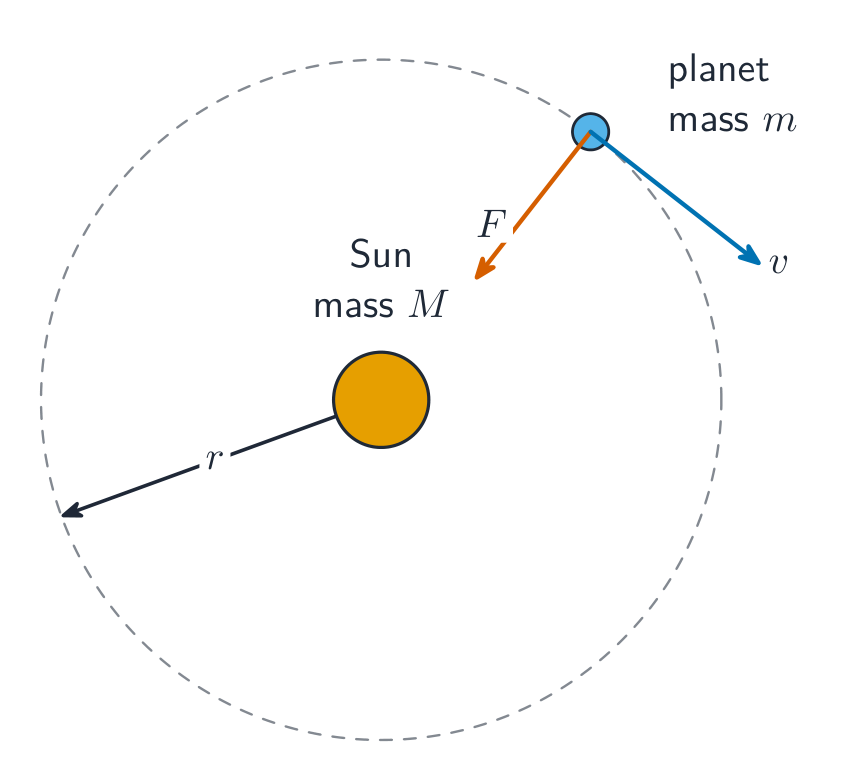
大纲
Learning Objective Essential Knowledge 6.6.A
Describe the motions of a system consisting of two objects interacting only via gravitational forces.- 6.6.A.1 In a system consisting only of a massive central object and an orbiting satellite with mass that is negligible in comparison to the central object's mass, the motion of the central object itself is negligible.
- 6.6.A.2 The motion of satellites in orbits is constrained by conservation laws.
- 6.6.A.2.i In circular orbits, the system's total mechanical energy, the system's gravitational potential energy, and the satellite's angular momentum and kinetic energy are constant.
- 6.6.A.2.ii In elliptical orbits, the system's total mechanical energy and the satellite's angular momentum are constant, but the system's gravitational potential energy and the satellite's kinetic energy can each change.
- 6.6.A.2.iii The gravitational potential energy of a system consisting of a satellite and a massive central object is defined to be zero when the satellite is an infinite distance from the central object.
- Equation: $U_g = -G\dfrac{m_1 m_2}{r}$
- 6.6.A.3 The escape velocity of a satellite is the satellite's velocity such that the mechanical energy of the satellite–central-object system is equal to zero.
- 6.6.A.3.i When the only force exerted on a satellite is gravity from a central object, a satellite that reaches escape velocity will move away from the central body until its speed reaches zero at an infinite distance from the central body.
- 6.6.A.3.ii The escape velocity of a satellite from a central body of mass $M$ can be derived using conservation of energy laws.
- Equation (derived): $v_{\text{esc}} = \sqrt{\dfrac{2GM}{r}}$
来源:美国大学理事会 AP 课程与考试说明
轨道运动(开普勒第二定律) 一个在轨道里的卫星(satellite)处于自由落体:重力提供把它的路径弯曲成一个轨道所需的确切向心力。把重力设为等于向心要求,
$$\frac{GMm}{r^2}=\frac{mv^2}{r}\ \Rightarrow\ v=\sqrt{\frac{GM}{r}}.$$所以一个更大的轨道意味着一个更慢的速率。对于一个圆形轨道,角动量和机械能都恒定;对于一个椭圆轨道,角动量守恒(绕行星没有力矩)而速率变化——最接近时最快。重力提供保持一个卫星在轨道里的向心力 Worked example. 求一个刚好在地球之上的低轨道里的卫星的速率,半径 $r=6.4\times10^{6}\ \text{m}$,$GM=4.0\times10^{14}\ \text{m}^3/\text{s}^2$:
$$v=\sqrt{\frac{GM}{r}}=\sqrt{\frac{4.0\times10^{14}}{6.4\times10^{6}}}=\sqrt{6.25\times10^{7}}\approx 7.9\times10^{3}\ \text{m/s},$$约 $7.9\ \text{km/s}$ ——并注意卫星的质量约去,所以所有低轨道共享这个速率。逃逸速度(escape velocity)是恰好让一个物体永远离开的发射速率:它的总机械能恰好为零,所以它只在无穷远处减速到零。令 $\tfrac12 mv^2 - \dfrac{GMm}{r}=0$(用一般引力势能 $U_g=-GMm/r$)并解出 $v$,
$$v_{\text{esc}}=\sqrt{\frac{2GM}{r}}.$$它是相同半径处圆轨道速率的 $\sqrt2$ 倍,而且(像轨道速率一样)不取决于逃逸物体的质量。探索Compare orbits at different radii
A satellite is in free fall, its gravity supplying the centripetal force. A larger orbit means a slower speed and a longer period — Kepler's third law.
词汇表 训练英文 中文 拼音 satellite/ˈsætəlaɪt/ 卫星 wèi xīng Escape velocity/eˈskeɪp vəˈlɒsɪti/ 逃逸速度 táo yì sù dù 6.6
考试技巧
- 当没有外力矩作用时守恒角动量 $L=I\omega$:一个更小的 $I$(收臂)给出一个更大的 $\omega$。
- 一个滚动物体把它的能量在 $\tfrac12 mv^2$ 和 $\tfrac12 I\omega^2$ 之间分割,由 $v=r\omega$ 联系——所以它从一个坡道加速比一个滑动的更慢。
- 对于一个圆形轨道把重力设为等于向心要求:$v=\sqrt{GM/r}$,所以一个更大的轨道更慢而卫星的质量约去。
- 收臂提高旋转和动能——额外的能量来自向内拉所做的功;$L$ 不变。
- 注意哪个旋转量守恒:$L$(没有力矩)与能量(没有摩擦)是不同的条件。
- 6.1.A.1 The rotational kinetic energy of an object or rigid system is related to the rotational inertia and angular velocity of the rigid system and is given by the equation $K = \frac{1}{2} I \omega^2$.
-
7
振动
7.1
简谐运动(SHM)的定义
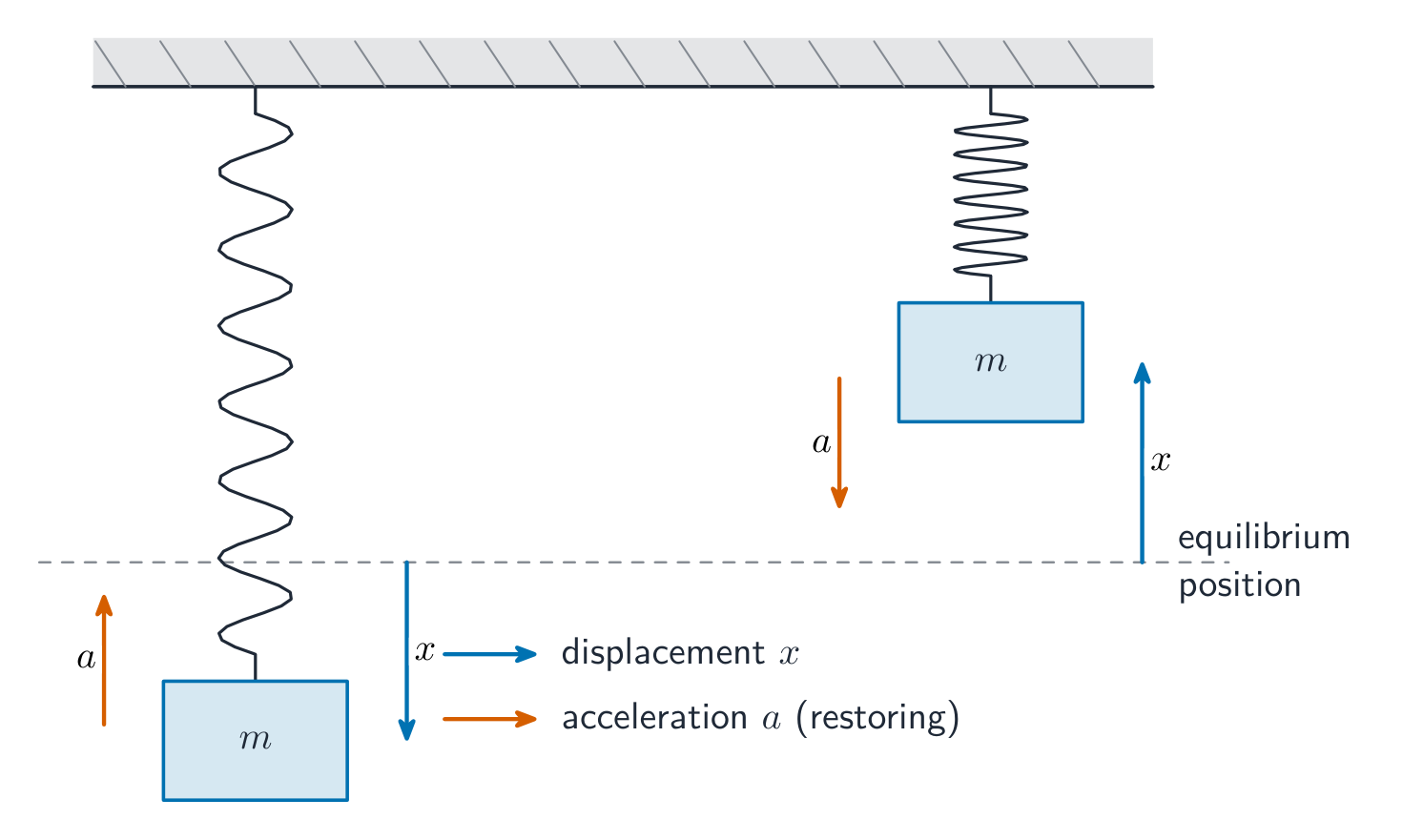
大纲
Learning Objective Essential Knowledge 7.1.A
Describe simple harmonic motion.- 7.1.A.1 Simple harmonic motion is a special case of periodic motion.
- 7.1.A.2 SHM results when the magnitude of the restoring force exerted on an object is proportional to that object's displacement from its equilibrium position.
- Equation: $ma_x = -k\Delta x$
- 7.1.A.2.i A restoring force is a force that is exerted in a direction opposite to the object's displacement from an equilibrium position.
- 7.1.A.2.ii An equilibrium position is a location at which the net force exerted on an object or system is zero.
- 7.1.A.2.iii The motion of a pendulum with a small angular displacement can be modeled as simple harmonic motion because the restoring torque is proportional to the angular displacement.
来源:美国大学理事会 AP 课程与考试说明
简谐运动 简谐运动(simple harmonic motion)(SHM)是由一个回复力(restoring force)造成的一个来回振动(oscillation),该回复力与从平衡的位移成比例并总是指回向它:$F=-kx$。一个弹簧上的质量和(对小角度)一个摆是标准的例子。因为力随位移增长,运动是平滑而重复的,在时间上描出一条正弦曲线。
在 SHM 里加速度总是指回向平衡,与位移相反 SHM 的判据正是这个:加速度与位移成比例且方向相反,$a=-\dfrac{k}{m}x$。一个摆只对小摆动遵循它,那里 $\sin\theta\approx\theta$;大的摆动不完全是 SHM。
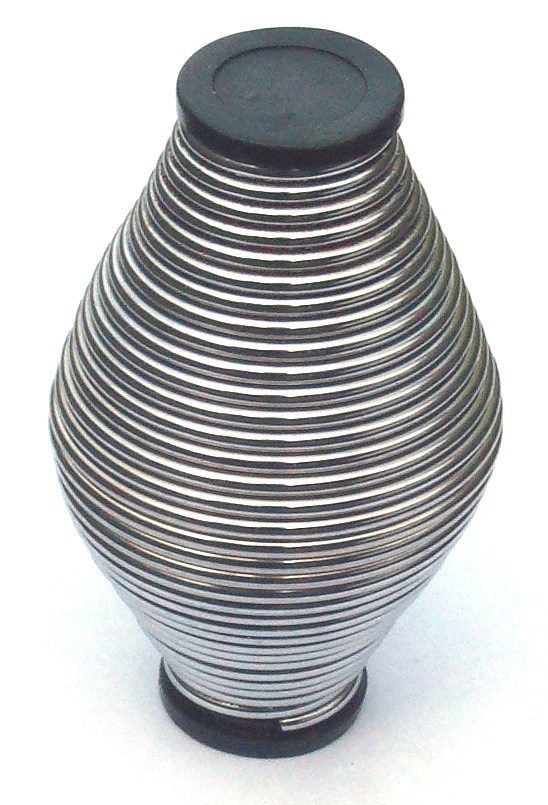
A spring under load: Hooke's law F = −kx is the restoring force that produces SHM 词汇表 训练英文 中文 拼音 Simple harmonic motion/ˈsɪmpl hɑːˈmɒnɪk ˈməʊʃn/ 简谐运动 jiǎn xié yùn dòng oscillation/ˌɒsɪˈleɪʃn/ 振动 zhèn dòng restoring force/rɪˈstɔːrɪŋ fɔːs/ 回复力 huí fù lì 7.2
简谐运动的频率与周期
大纲
Learning Objective Essential Knowledge 7.2.A
Describe the frequency and period of an object exhibiting SHM.- 7.2.A.1 The period of SHM is related to the frequency $f$ of the object's motion by the following equation:
- Equation: $T = \dfrac{1}{f}$
- 7.2.A.1.i The period of an object–ideal-spring oscillator is given by the equation $T_s = 2\pi\sqrt{\dfrac{m}{k}}$.
- 7.2.A.1.ii The period of a simple pendulum displaced by a small angle is given by the equation $T_p = 2\pi\sqrt{\dfrac{\ell}{g}}$.
来源:美国大学理事会 AP 课程与考试说明
- 周期(period)$T$ 是一个完整循环的时间。
- 频率(frequency)$f=\dfrac{1}{T}$ 是每秒的循环数(赫兹)。
对于 SHM 这些只取决于系统,不取决于振幅:
$$T_{\text{spring}}=2\pi\sqrt{\frac{m}{k}},\qquad T_{\text{pendulum}}=2\pi\sqrt{\frac{L}{g}}.$$所以一个更硬的弹簧或更小的质量振动更快;一个更长的摆摆动更慢。Worked example. 一个 $0.25\ \text{kg}$ 的质量挂在一个刚度 $k=100\ \text{N/m}$ 的弹簧上。它的周期是
$$T=2\pi\sqrt{\frac{m}{k}}=2\pi\sqrt{\frac{0.25}{100}}=0.31\ \text{s},\qquad f=\frac{1}{T}=3.2\ \text{Hz}.$$Worked example. 一个摆钟以恰好 $2.0\ \text{s}$ 的周期滴答。它多长?重新排列 $T=2\pi\sqrt{L/g}$,
$$L=g\left(\frac{T}{2\pi}\right)^2=9.8\times\left(\frac{2.0}{2\pi}\right)^2=0.99\ \text{m}.$$注意振幅从未进入——一个宽的或窄的摆动保持相同的时间,这就是使摆成为好钟的东西。探索Time a pendulum's swing
A pendulum's period depends on its length and gravity, not its mass or (small) amplitude: $T=2\pi\sqrt{L/g}$. Lengthen it and each swing takes longer.
词汇表 训练英文 中文 拼音 period/ˈpɪərɪəd/ 周期 zhōu qī frequency/ˈfriːkwənsi/ 频率 pín lǜ 7.3
简谐运动的表示与分析
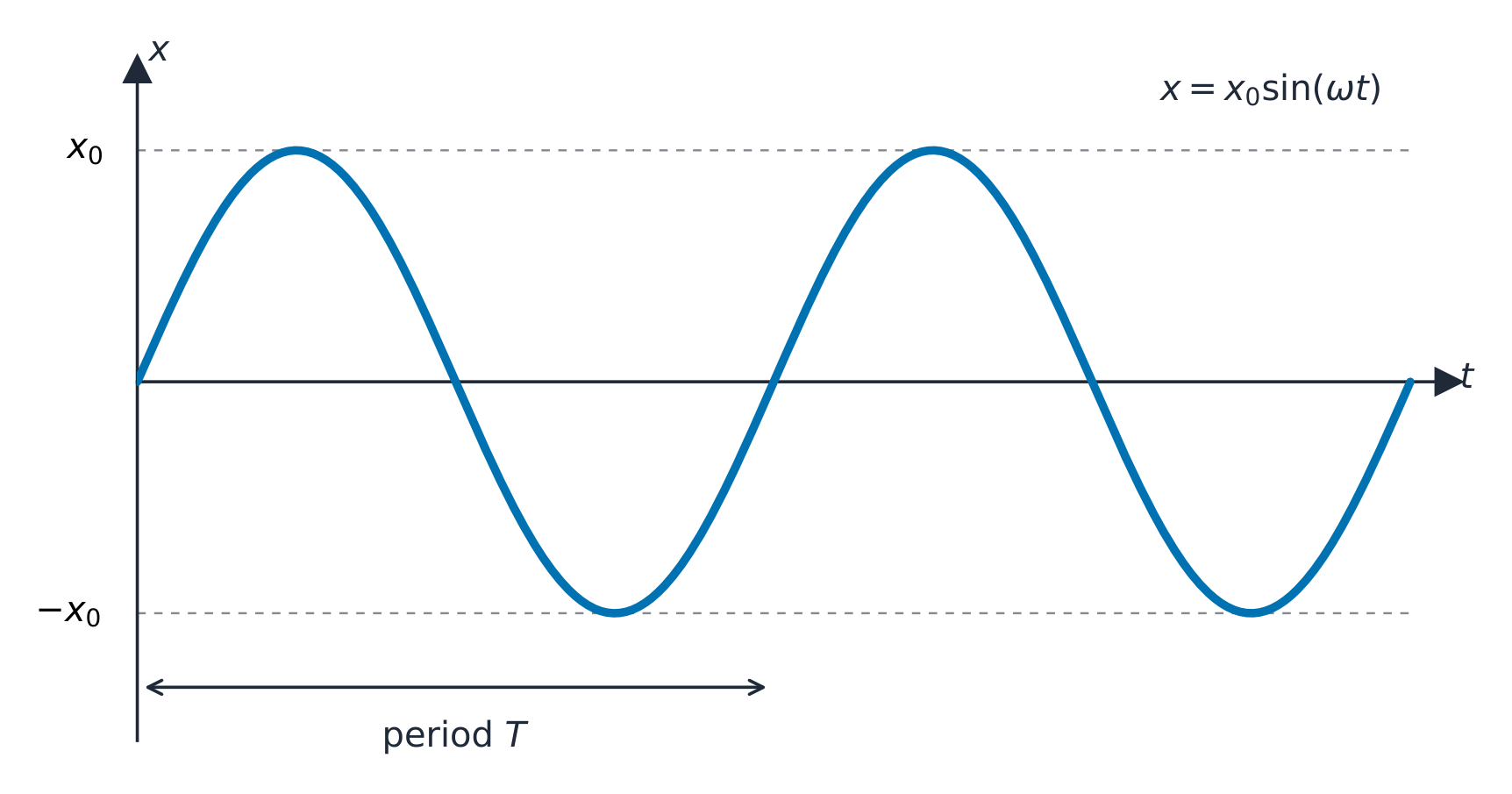
大纲
Learning Objective Essential Knowledge 7.3.A
Describe the displacement, velocity, and acceleration of an object exhibiting SHM.- 7.3.A.1 For an object exhibiting SHM, the displacement of that object measured from its equilibrium position can be represented by the equations $x = A\cos(2\pi ft)$ or $x = A\sin(2\pi ft)$.
- 7.3.A.1.i Minima, maxima, and zeros of displacement, velocity, and acceleration are features of harmonic motion.
- 7.3.A.1.ii Recognizing the positions or times at which the displacement, velocity, and acceleration for SHM have extrema or zeros can help in qualitatively describing the behavior of the motion.
- 7.3.A.2 Changing the amplitude of a system exhibiting SHM will not change the period of that system.
- 7.3.A.3 Properties of SHM can be determined and analyzed using graphical representations.
来源:美国大学理事会 AP 课程与考试说明
位移正弦地变化:$x(t)=A\cos(\omega t)$(或正弦),其中 $A$ 是振幅(amplitude)(最大位移)而 $\omega=2\pi f$ 是角频率(angular frequency)。读运动:
位移在简谐运动里随时间正弦地变化 - 在极端($x=\pm A$):位移和回复力最大,所以加速度最大,但速度是零。
- 在平衡(equilibrium)($x=0$):力和加速度是零,但速率最大。
速度和加速度也是正弦的,与位移在相位(phase)上偏移——速度比位移领先四分之一循环,而加速度与位移恰好相反。
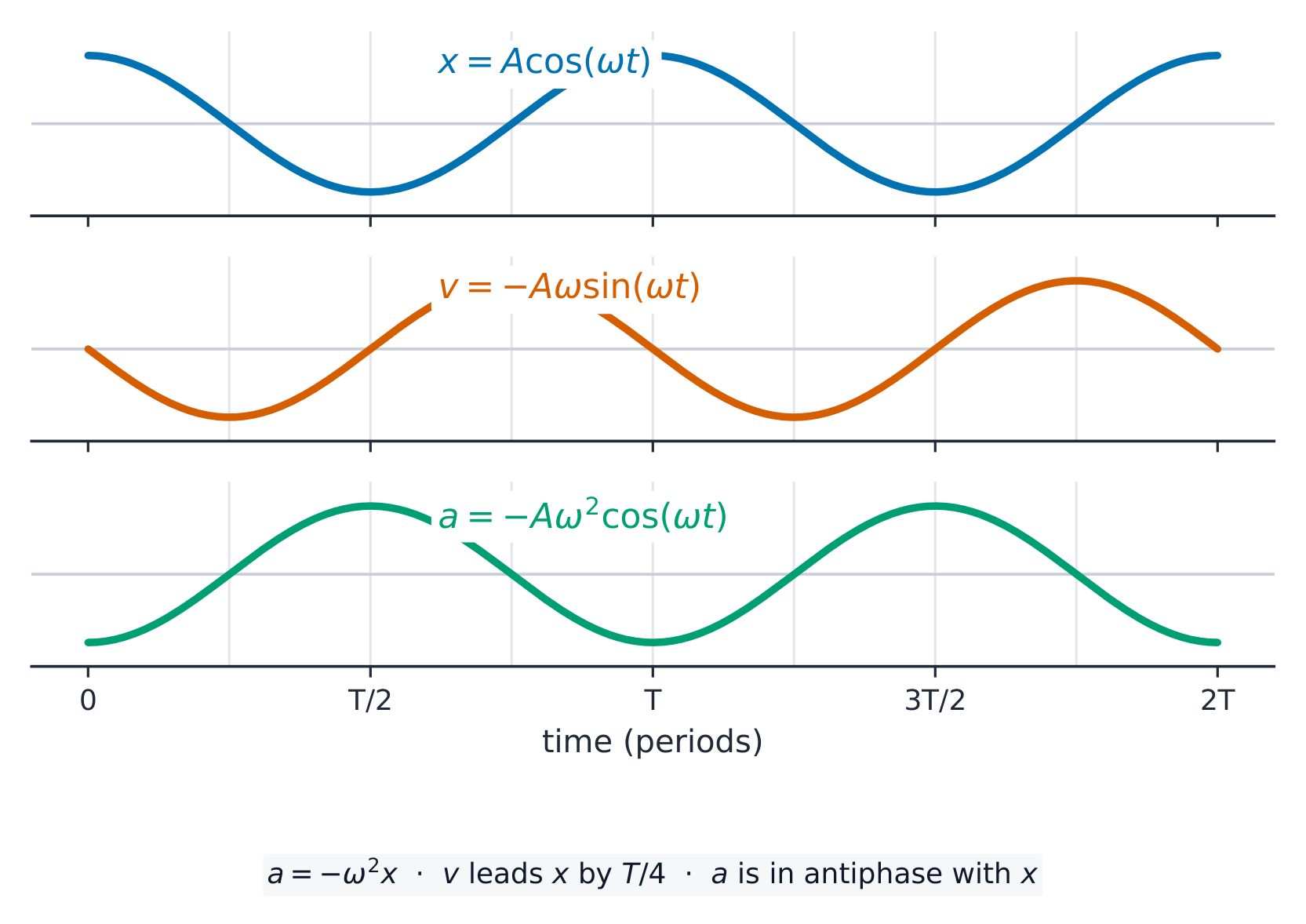
SHM 里的位移、速度和加速度,每个相隔四分之一循环 把图当作一个故事读:$x$ 最大的地方(转折点),$v$ 刚落到零而 $a$ 处于它最负的,把质量拖回;四分之一循环后质量以顶速冲过中间,加速度为零。
词汇表 训练英文 中文 拼音 amplitude/ˈæmplɪtjuːd/ 振幅 zhèn fú angular frequency/ˈæŋɡjʊlə ˈfriːkwənsi/ 角频率 jiǎo pín lǜ phase/feɪz/ 相位 xiàng wèi equilibrium/ˌiːkwɪˈlɪbrɪəm/ 平衡 píng héng 7.4
简谐振子的能量
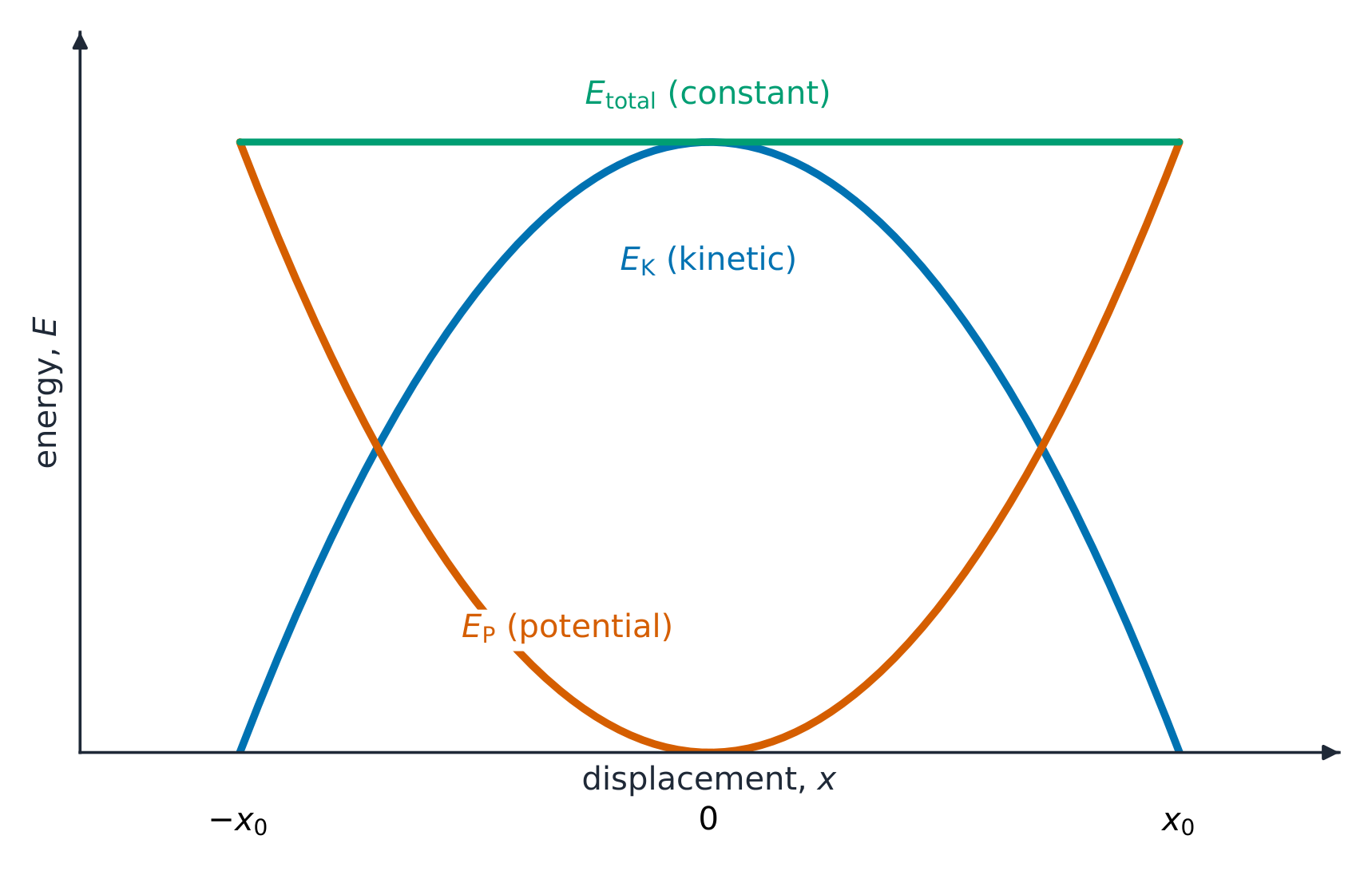
大纲
Learning Objective Essential Knowledge 7.4.A
Describe the mechanical energy of a system exhibiting SHM.- 7.4.A.1 The total energy of a system exhibiting SHM is the sum of the system's kinetic and potential energies.
- Equation: $E_{\text{total}} = U + K$
- 7.4.A.2 Conservation of energy indicates that the total energy of a system exhibiting SHM is constant.
- 7.4.A.3 The kinetic energy of a system exhibiting SHM is at a maximum when the system's potential energy is at a minimum.
- 7.4.A.4 The potential energy of a system exhibiting SHM is at a maximum when the system's kinetic energy is at a minimum.
- 7.4.A.4.i The minimum kinetic energy of a system exhibiting SHM is zero.
- 7.4.A.4.ii Changing the amplitude of a system exhibiting SHM will change the maximum potential energy of the system and, therefore, the total energy of the system.
- Relevant equation for a spring–object system: $E_{\text{total}} = \dfrac{1}{2}kA^2$
来源:美国大学理事会 AP 课程与考试说明
能量守恒:动能↔势能 能量在动能和势能之间晃动,而总量保持恒定(没有摩擦):
$$E=\tfrac{1}{2}kA^2 = \tfrac{1}{2}kx^2+\tfrac{1}{2}mv^2.$$在极端它是全势能;在平衡它是全动能(最大速率)。因为 $E\propto A^2$,把振幅加倍使能量变为四倍。动能和势能在一个循环上交换而总能量保持恒定 Worked example. 一个刚度 $k=200\ \text{N/m}$ 的弹簧上的 $0.50\ \text{kg}$ 质量以振幅 $A=0.10\ \text{m}$ 振动。求它的最大速率。所有的能量在平衡点是动能,所以 $\tfrac12 kA^2=\tfrac12 mv_{\max}^2$:
$$v_{\max}=A\sqrt{\frac{k}{m}}=0.10\times\sqrt{\frac{200}{0.50}}=0.10\times20=2.0\ \text{m/s}.$$当你只需要最大速率时,能量方法比追踪正弦函数更快。探索Trade kinetic and potential energy in SHM
In simple harmonic motion, energy sloshes between kinetic (fastest at the centre) and potential (greatest at the extremes) while the total stays constant.
7.4
考试技巧
- 判据 SHM:加速度必须与位移成比例并指回向中间($a=-\tfrac{k}{m}x$)。
- 周期不取决于振幅——用 $T=2\pi\sqrt{m/k}$(弹簧)或 $T=2\pi\sqrt{L/g}$(摆,小角度)。
- 速率在中间最大(全动能)而在极端为零(全势能);加速度在极端最大。
- 用能量($\tfrac12 kA^2 = \tfrac12 kx^2 + \tfrac12 mv^2$)快速求最大速率:$v_{\max}=A\sqrt{k/m}$。
- 总能量 $\propto A^2$,所以把振幅加倍使能量变为四倍。
-
8
流体
8.1
内部结构与密度
大纲
Learning Objective Essential Knowledge 8.1.A
Describe the properties of a fluid.- 8.1.A.1 Distinguishing properties of solids, liquids, and gases stem from the varying interactions between atoms and molecules.
- 8.1.A.2 A fluid is a substance that has no fixed shape.
- 8.1.A.3 Fluids can be characterized by their density. Density is defined as a ratio of mass to volume.
- Equation: $\rho = \dfrac{m}{V}$
- 8.1.A.4 An ideal fluid is incompressible and has no viscosity.
来源:美国大学理事会 AP 课程与考试说明
固体、液体和气体之间的差别来自它们的粒子多强地相互作用。一个流体(fluid)(液体或气体)没有固定的形状——它流动,因为它的粒子彼此经过。密度(density)是每单位体积的质量:
$$\rho=\frac{m}{V}.$$它取决于物质和它的状态。一个物体沉没或漂浮取决于它的密度如何与周围流体的比较——密度较小的漂浮、密度较大的沉没。一个理想流体(ideal fluid)是不可压缩(incompressible)的(恒定密度,无论压强)且没有黏度(viscosity)(内摩擦)—— AP 始终使用的模型。探索Float or sink by density
An object floats if it is less dense than the fluid. Change the density and watch it ride higher or sink, displacing its own weight of fluid.
词汇表 训练英文 中文 拼音 fluid/ˈfluːɪd/ 流体 liú tǐ Density/ˈdensɪti/ 密度 mì dù ideal fluid/aɪˈdɪəl ˈfluːɪd/ 理想流体 lǐ xiǎng liú tǐ incompressible/ˌɪnkəmˈpresəbl/ 不可压缩 bù kě yā suō viscosity/vɪˈskɒsɪti/ 黏度 nián dù 8.2
压强
大纲
Learning Objective Essential Knowledge 8.2.A
Describe the pressure exerted on a surface by a given force.- 8.2.A.1 Pressure is defined as the magnitude of the perpendicular force component exerted per unit area over a given surface area, as described by the equation
- Equation: $P = \dfrac{F_\perp}{A}$
- 8.2.A.2 Pressure is a scalar quantity.
- 8.2.A.3 The volume and density of a given amount of an incompressible fluid is constant regardless of the pressure exerted on that fluid.
8.2.B
Describe the pressure exerted by a fluid.- 8.2.B.1 The pressure exerted by a fluid is the result of the entirety of the interactions between the fluid's constituent particles and the surface with which those particles interact.
- 8.2.B.2 The absolute pressure of a fluid at a given point is equal to the sum of a reference pressure $P_0$, such as the atmospheric pressure $P_{\text{atm}}$, and the gauge pressure $P_{\text{gauge}}$.
- Equation: $P = P_0 + \rho g h$
- 8.2.B.3 The gauge pressure of a vertical column of fluid is described by the equation
- Equation: $P_{\text{gauge}} = \rho g h$
来源:美国大学理事会 AP 课程与考试说明
压强(pressure)是每单位面积的垂直力,一个以帕斯卡(Pa)测量的标量(scalar):
$$P=\frac{F_\perp}{A}.$$在一个静止的流体里,压强随深度(depth)增加,因为上面流体的重量:$$P=P_0+\rho g h,$$其中 $P_0$ 是表面的压强而 $h$ 是深度。压强在一点在所有方向上相等地作用并垂直于任何表面推。液压千斤顶:施加在小活塞上的压强毫不减弱地通过液体传到大活塞,所以一个小力就能顶起一辆车 区分 AP 问的两种压强:表压(gauge pressure)是流体柱添加的额外压强,$P_{\text{gauge}}=\rho g h$,而绝对压强(absolute pressure)是总量,$P=P_0+P_{\text{gauge}}$(以 $P_0$ 通常是大气压)。一个读"$200\ \text{kPa}$"的轮胎压力表是表压;里面的空气实际约在 $300\ \text{kPa}$ 绝对压强。
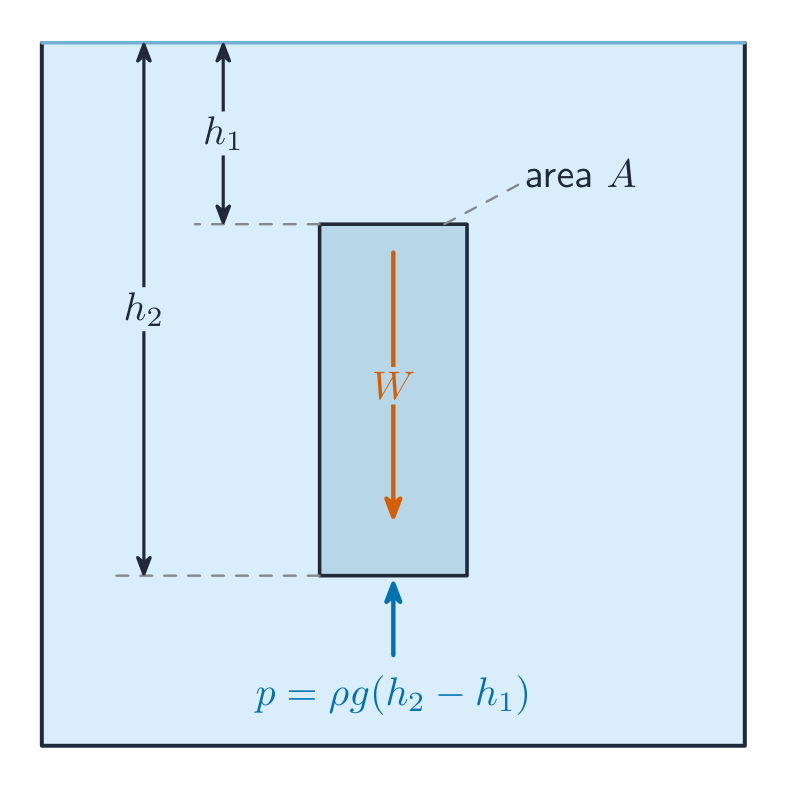
一个液柱的重量设定一个深度的额外压强 Worked example. 求水($\rho=1000\ \text{kg/m}^3$,表面压强 $P_0=1.0\times10^{5}\ \text{Pa}$)表面之下 $10\ \text{m}$ 的一个潜水者上的总压强:
$$P=P_0+\rho g h=1.0\times10^{5}+1000\times9.8\times10=1.98\times10^{5}\ \text{Pa}.$$每 $10\ \text{m}$ 的水添加大约一个额外大气压的压强。注意压强不取决于容器的形状或宽度,只取决于深度。词汇表 训练英文 中文 拼音 Pressure/ˈpreʃə/ 压强 yā qiáng scalar/ˈskeɪlə/ 标量 biāo liàng depth/depθ/ 深度 shēn dù gauge pressure/ɡeɪdʒ ˈpreʃə/ 表压 biǎo yā absolute pressure/ˈæbsəluːt ˈpreʃə/ 绝对压强 jué duì yā qiáng 8.3
流体与牛顿定律
大纲
Learning Objective Essential Knowledge 8.3.A
Describe the conditions under which a fluid's velocity changes.- 8.3.A.1 Newton's laws can be used to describe the motion of particles within a fluid.
- 8.3.A.2 The macroscopic behavior of a fluid is a result of the internal interactions between the fluid's constituent particles and external forces exerted on the fluid.
8.3.B
Describe the buoyant force exerted on an object interacting with a fluid.- 8.3.B.1 The buoyant force is a net upward force exerted on an object by a fluid.
- 8.3.B.2 The buoyant force exerted on an object by a fluid is a result of the collective forces exerted on the object by the particles making up the fluid.
- 8.3.B.3 The magnitude of the buoyant force exerted on an object by a fluid is equivalent to the weight of the fluid displaced by the object.
- Equation: $F_b = \rho V g$
来源:美国大学理事会 AP 课程与考试说明
浮力:漂浮还是下沉 一个流体里的物体感受一个向上的浮力(buoyant force),等于它排开的流体的重量——阿基米德原理(Archimedes' principle):
$$F_b=\rho_{\text{fluid}}\,g\,V_{\text{displaced}}.$$把这个与牛顿定律结合:物体在浮力平衡重量时漂浮、在重量获胜时沉没,而在浮力获胜时上升。一个漂浮的物体恰好排开它自己重量的流体。Worked example. 一个密度 $600\ \text{kg/m}^3$ 的木块在水($1000\ \text{kg/m}^3$)里漂浮。多少分数在表面之下?对于漂浮,浮力等于重量,所以 $\rho_{\text{fluid}}\,g\,V_{\text{sub}}=\rho_{\text{object}}\,g\,V$:
$$\frac{V_{\text{sub}}}{V}=\frac{\rho_{\text{object}}}{\rho_{\text{fluid}}}=\frac{600}{1000}=0.60.$$所以 $60\%$ 坐在水之下——大多数冰山(密度 $\approx 900$)藏在水下的同一原因。词汇表 训练英文 中文 拼音 buoyant force/ˈbɔɪənt fɔːs/ 浮力 fú lì Archimedes' principle/ˌɑːkɪˈmiːdiːz ˈprɪnsɪpl/ 阿基米德原理 ā jī mǐ dé yuán lǐ 8.4
流体与守恒定律
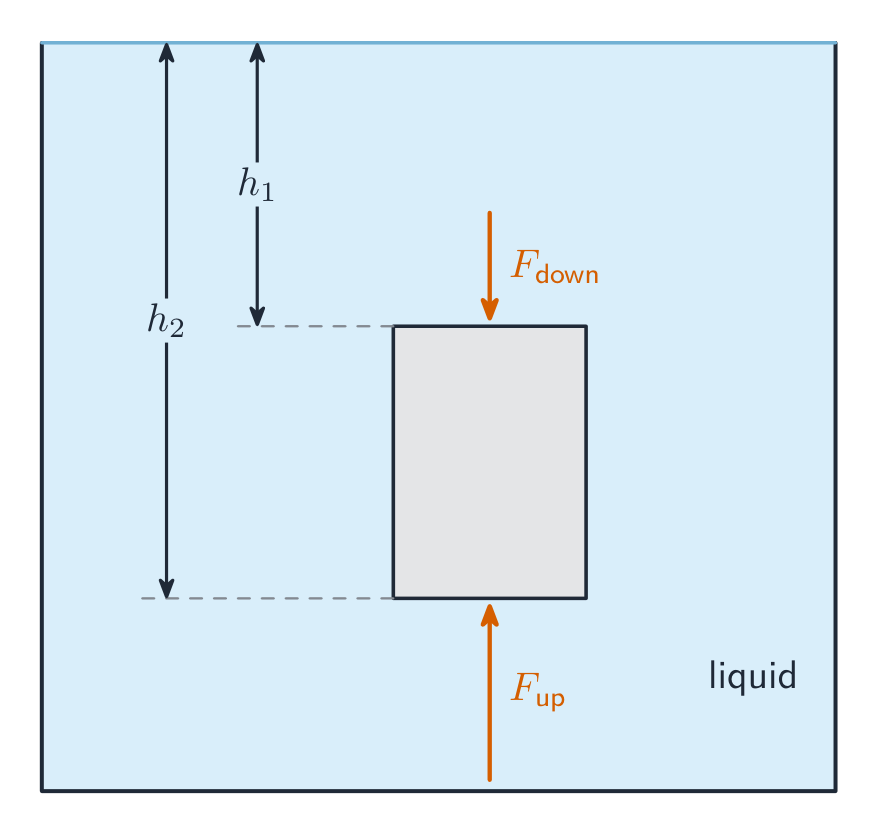
大纲
Learning Objective Essential Knowledge 8.4.A
Describe the flow of an incompressible fluid through a cross-sectional area by using mass conservation.- 8.4.A.1 A difference in pressure between two locations causes a fluid to flow.
- 8.4.A.1.i The rate at which matter enters a fluid-filled tube open at both ends must equal the rate at which matter exits the tube.
- 8.4.A.1.ii The rate at which matter flows into a location is proportional to the cross-sectional area of the flow and the speed at which the fluid flows.
- Derived equation: $\dfrac{V}{t} = A v$
- 8.4.A.2 The continuity equation for fluid flow describes conservation of mass flow rate in incompressible fluids.
- Equation: $A_1 v_1 = A_2 v_2$
来源:美国大学理事会 AP 课程与考试说明
对于一个稳定流动的理想流体,两个守恒思想适用:
浮力产生是因为一个物体底部的压强超过它顶部的 - 连续性(continuity)(质量守恒):体积流量恒定,所以 $A_1 v_1 = A_2 v_2$。一个更窄的管子迫使更快的流动。
- 伯努利方程(Bernoulli's equation)(每体积能量守恒):沿一条流线,
$$P+\tfrac{1}{2}\rho v^2+\rho g y = \text{constant}.$$
它们一起解释为什么流体在一个管子变窄或流动最快的地方加速而它的压强下降。
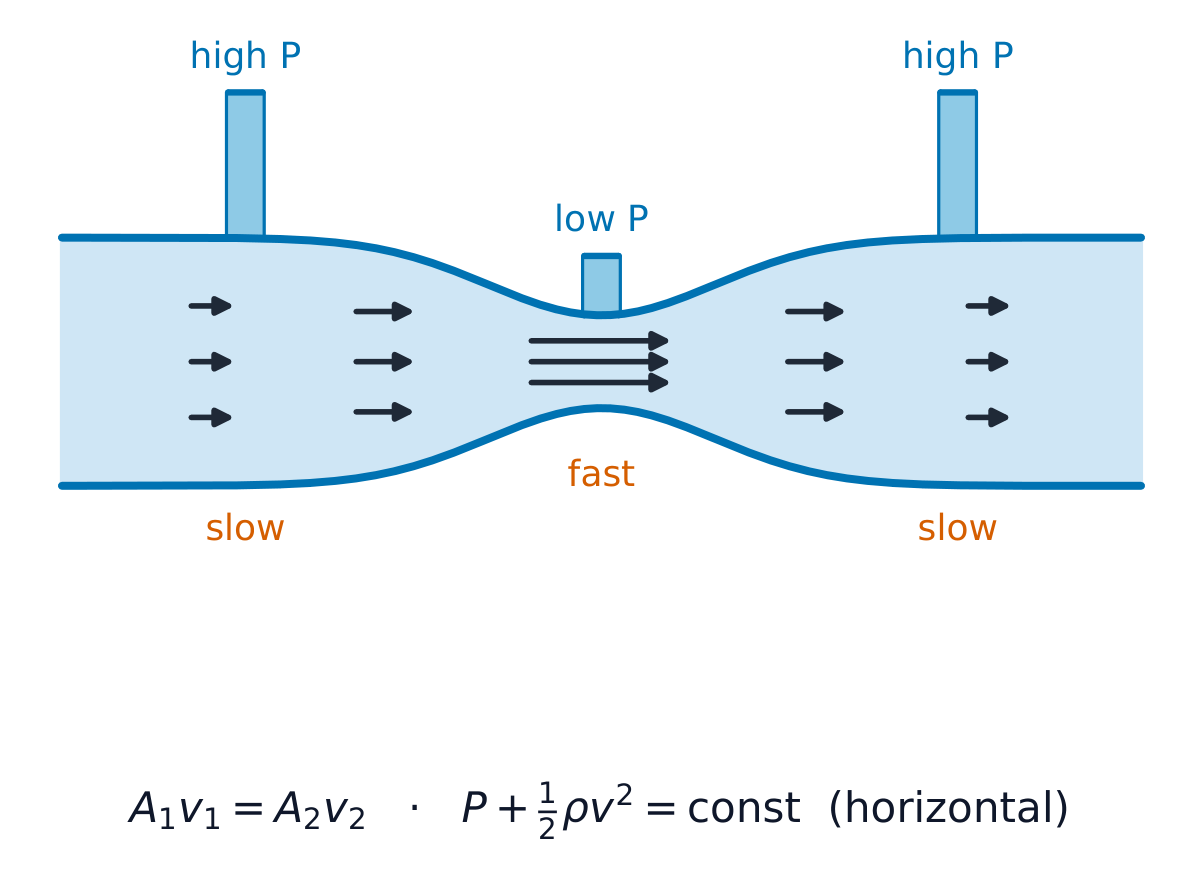
管子变窄的地方流体加速(连续性)而它的压强下降(伯努利) Worked example. 水以 $2.0\ \text{m/s}$ 流过一个横截面 $0.010\ \text{m}^2$ 的管子,然后进入一个 $0.0040\ \text{m}^2$ 的更窄部分。由连续性那里的速率是
$$v_2=\frac{A_1 v_1}{A_2}=\frac{0.010\times2.0}{0.0040}=5.0\ \text{m/s}.$$由伯努利方程这更快的流处于更低的压强——抬起一个飞机机翼并把两艘经过的船拉到一起的效应。Exam skill. 按什么变化选择正确的定律。若管子改变宽度,从连续性($A_1v_1=A_2v_2$)开始得到速率;若你然后需要一个压强,把那些速率喂进伯努利。只有当管子也改变水平时才注意高度项 $\rho g y$。
词汇表 训练英文 中文 拼音 Continuity/kɒntɪˈnjuːɪti/ 连续性 lián xù xìng Bernoulli's equation/ˈbɜːnaʊliz ɪˈkweɪʒn/ 伯努利方程 bó nǔ lì fāng chéng 8.4
考试技巧
- 压强随深度是 $P=P_0+\rho g h$ ——它只取决于深度,不取决于容器的形状或宽度。
- 浮力 = 排开的流体的重量($\rho_{\text{fluid}}\,gV_{\text{disp}}$);一个漂浮的物体排开它自己的重量,所以被淹没的分数是 $\rho_{\text{object}}/\rho_{\text{fluid}}$。
- 比较密度以预测漂浮 vs 沉没;一个漂浮的物体处于平衡(浮力 = 重量),不是失重。
- 用连续性 $A_1v_1=A_2v_2$:一个更窄的管子意味着更快的流动。
- 伯努利:一个流体流动更快的地方它的压强更低(机翼升力、喷雾)。