| Learning Objective | Essential Knowledge |
|---|---|
4.1.A |
Boundary statement: Unless otherwise stated, the general term "momentum" will refer specifically to linear momentum. |
线动量
AP 物理 1 · 第 4 主题
 7:49
7:49
Linear Momentum
Five steel balls hang in a row, just touching. Lift one, let it go, and one ball flies off the far end. Only one. Lift two, and exactly two fly off. Something…
英文讲解 · 内嵌中英文字幕
4.1
线动量
大纲
来源:美国大学理事会 AP 课程与考试说明
动量(linear momentum)是质量乘速度——一个指向与速度相同方向的矢量:
$$\vec{p}=m\vec{v}.$$
它测量"停止一个移动物体有多难"。一辆重的慢卡车和一个轻的快球能有相同的动量。它的单位是 $\text{kg m/s}$,与 $\text{N s}$ 相同。
词汇表
训练
| 英文 | 中文 | 拼音 |
|---|---|---|
| Linear momentum/ˈlɪnɪə məʊˈmentəm/ | 动量 | dòng liàng |
4.2
动量变化与冲量
大纲
| Learning Objective | Essential Knowledge |
|---|---|
4.2.A |
|
4.2.B |
Boundary statement: AP Physics 1 does not require students to quantitatively analyze systems in which the mass of the system changes with respect to time. |
来源:美国大学理事会 AP 课程与考试说明
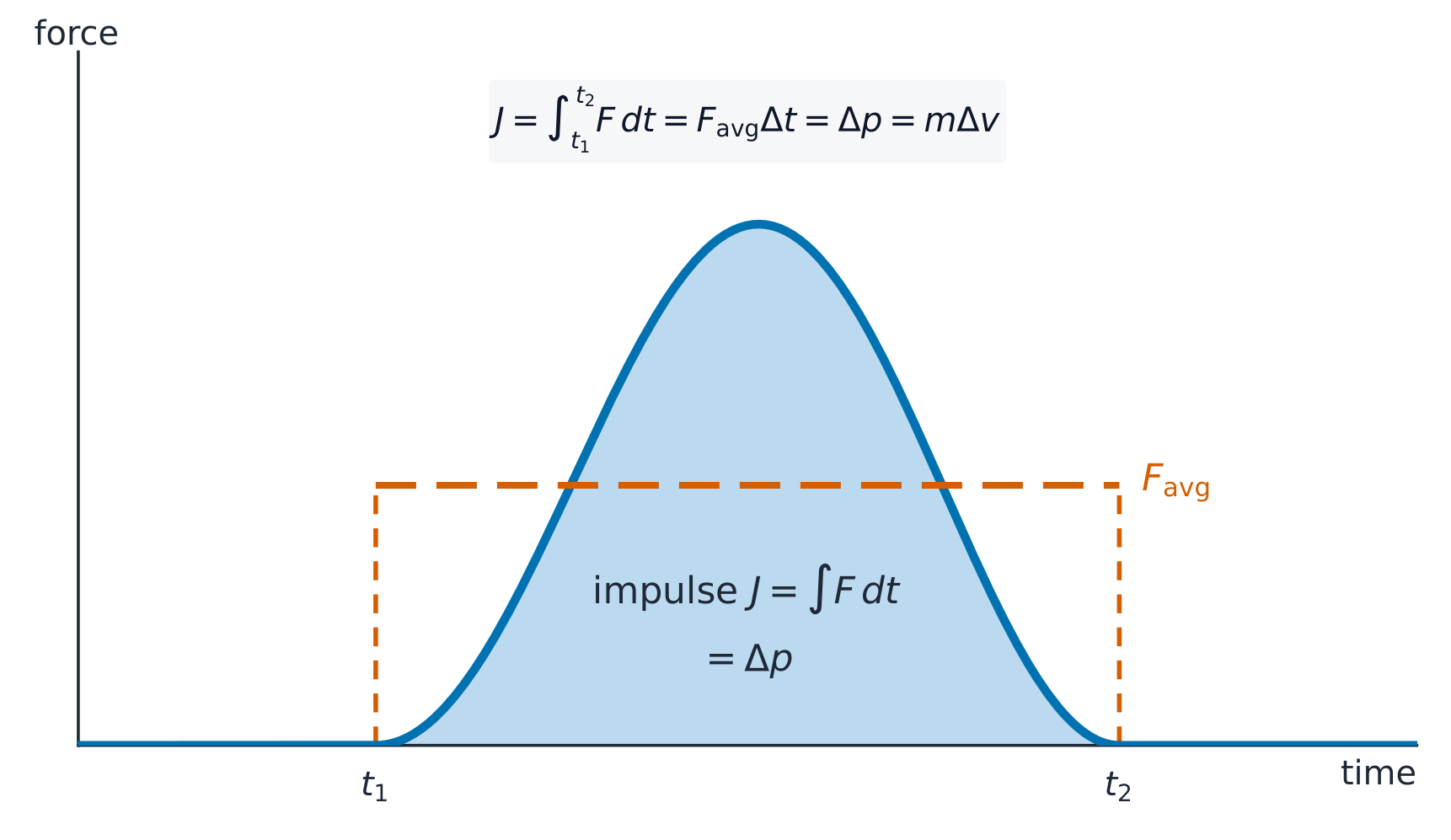
一个合力随时间作用改变动量。传递的冲量(impulse)是
$$\vec{J}=\vec{F}\,\Delta t=\Delta\vec{p}.$$
这是冲量-动量定理(impulse–momentum theorem):冲量等于动量的变化。在一个力-时间图上,冲量是曲线下的面积。它解释为什么气囊和随挥有帮助——把同样的动量变化分散到一个更长的时间减少力。
Worked example. 一个 $0.15\ \text{kg}$ 的球以 $20\ \text{m/s}$ 撞墙并以 $15\ \text{m/s}$ 直接弹回。接触持续 $0.020\ \text{s}$。求球上的平均力。取反弹方向为正,所以 $u=-20\ \text{m/s}$ 而 $v=+15\ \text{m/s}$:
$$\Delta p=m(v-u)=0.15\big(15-(-20)\big)=5.25\ \text{kg m/s},\qquad F=\frac{\Delta p}{\Delta t}=\frac{5.25}{0.020}=260\ \text{N}.$$
符号工作重要:忘记速度反转是这里最常见的错误。
词汇表
训练
| 英文 | 中文 | 拼音 |
|---|---|---|
| impulse/ˈɪmpʌls/ | 冲量 | chōng liàng |
4.3
线动量守恒
大纲
| Learning Objective | Essential Knowledge |
|---|---|
4.3.A |
Boundary statement: AP Physics 1 includes a quantitative and qualitative treatment of conservation of momentum in one dimension and a semiquantitative treatment of conservation of momentum in two dimensions. Exam questions involving solution of simultaneous equations are not included in AP Physics 1, but the AP Physics 1 Exam may include questions that assess whether students can set up the equations properly and reason about how changing a given mass, speed, or angle would affect other quantities. AP Physics 2 includes a full treatment of conservation of momentum in two dimensions for problems that include one unknown final velocity. |
4.3.B |
|
来源:美国大学理事会 AP 课程与考试说明
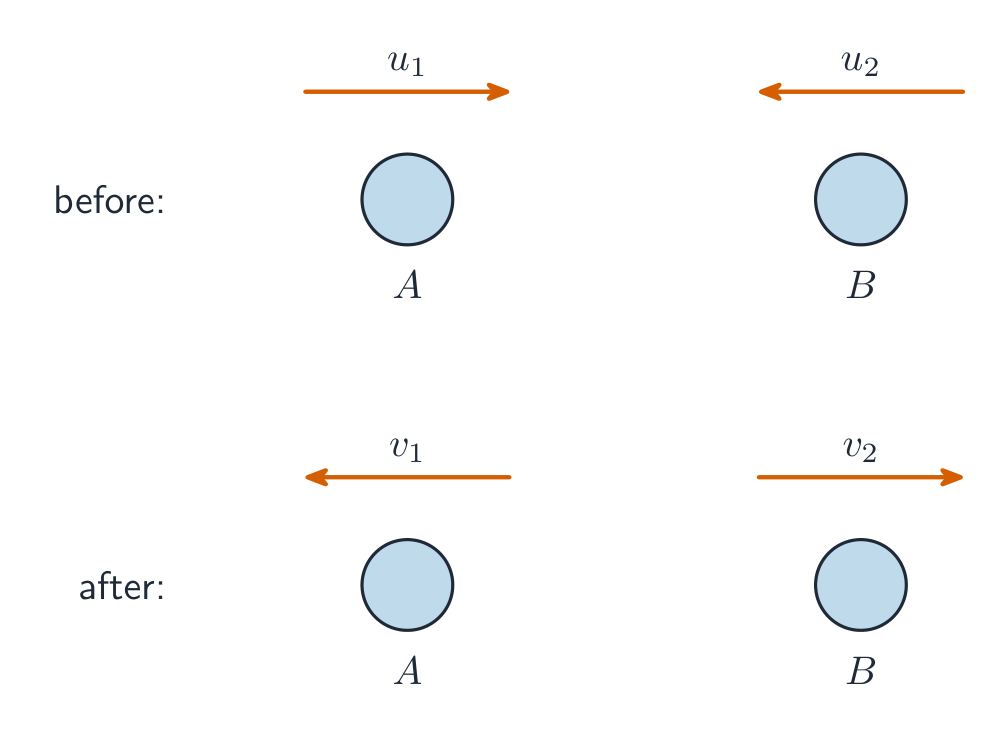
若一个系统上的合外力是零,它的总动量守恒(conserved):
$$\sum \vec{p}_{\text{before}}=\sum \vec{p}_{\text{after}}.$$
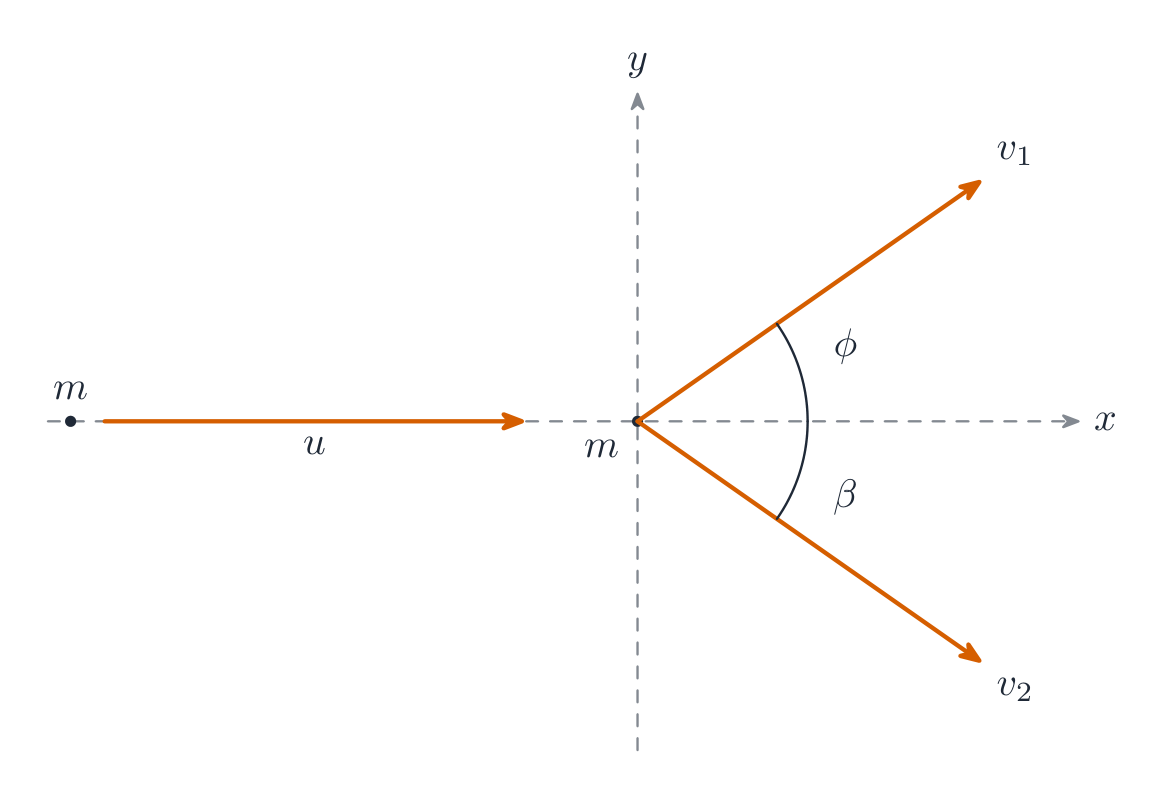
内力(像两个碰撞的小车之间的推力)成第三定律对而抵消,所以它们不能改变总动量。这是碰撞(collisions)和爆炸的关键工具——在 $x$ 和 $y$ 方向分别应用它。
Worked example (recoil 反冲). 一个 $60\ \text{kg}$ 的滑冰者,最初在无摩擦冰上静止,以 $8.0\ \text{m/s}$ 抛一个 $2.0\ \text{kg}$ 的球。求她的反冲速率。总动量从零开始并保持零:
$$0=(60)v+(2.0)(8.0)\;\Rightarrow\;v=-\frac{16}{60}=-0.27\ \text{m/s},$$
所以她以 $0.27\ \text{m/s}$ 向球相反的方向移动——火箭和枪背后的原理。
一整个物体集合能用单一的质心速度(center-of-mass velocity)描述:
$$\vec{v}_{\text{cm}}=\frac{\sum m_i\vec{v}_i}{\sum m_i}=\frac{\vec{p}_{\text{total}}}{M_{\text{total}}}.$$
因为在没有净外力作用时总动量守恒,$\vec{v}_{\text{cm}}$ 于是保持恒定——一张 $v_{\text{cm}}$ 对时间的图是平的,除非有外部力作用。一次内部碰撞或爆炸从不改变它,无论碎片飞得多猛烈。
探索
Collide two carts and conserve momentum
In any collision the total momentum $\sum mv$ before equals the total after. Set the masses and speeds and check the momentum bookkeeping.
词汇表
训练
| 英文 | 中文 | 拼音 |
|---|---|---|
| conserved/kənˈsɜːvd/ | 守恒 | shǒu héng |
| collisions/kəˈlɪʒnz/ | 碰撞 | pèng zhuàng |
| center-of-mass velocity/ˈsentə ɒv mæs vəˈlɒsɪti/ | 质心速度 | zhì xīn sù dù |
| recoil/rɪˈkɔɪl/ | 反冲 | fǎn chōng |
4.4
弹性碰撞与非弹性碰撞
大纲
| Learning Objective | Essential Knowledge |
|---|---|
4.4.A |
|
来源:美国大学理事会 AP 课程与考试说明
动量在每个碰撞里守恒(没有外力)。动能不守恒:
- 在一个弹性碰撞(elastic collision)里,动能也守恒(物体干净地弹开)。
- 在一个非弹性碰撞(inelastic collision)里,一些动能变成热或形变。在一个完全非弹性碰撞里物体粘在一起并之后以一个共同速度移动。
策略:总是写动量守恒;只在碰撞被陈述为弹性时加能量守恒。一个值得记住的弹性事实:在相等质量之间的一个一维弹性碰撞里,这两个物体简单地交换速度(一个移动的球撞一个相同的静止的停死,而目标以进入的速率飞走)。
Worked example. 一辆 $1000\ \text{kg}$ 以 $20\ \text{m/s}$ 移动的车撞进一辆静止的 $1500\ \text{kg}$ 的车而它们锁在一起。求它们的共同速率,和损失的动能。动量守恒给出
$$1000\times20=(1000+1500)\,v\;\Rightarrow\;v=\frac{20000}{2500}=8.0\ \text{m/s}.$$
之前的动能是 $\tfrac12(1000)(20^2)=2.0\times10^{5}\ \text{J}$;之后是 $\tfrac12(2500)(8.0^2)=8.0\times10^{4}\ \text{J}$。所以 $1.2\times10^{5}\ \text{J}$(约 $60\%$)损失给撞皱和热——动量仍然守恒,但动能不守恒。
探索
Compare elastic and inelastic collisions
Momentum is always conserved, but kinetic energy is only conserved in an elastic collision. In an inelastic one the carts stick and some energy becomes heat.
词汇表
训练
| 英文 | 中文 | 拼音 |
|---|---|---|
| elastic collision/ɪˈlæstɪk kəˈlɪʒn/ | 弹性碰撞 | tán xìng pèng zhuàng |
| inelastic collision/ɪnɪˈlæstɪk kəˈlɪʒn/ | 非弹性碰撞 | fēi tán xìng pèng zhuàng |
4.4
考试技巧
- 动量是一个矢量——在相加之前分配 $+$/$-$ 符号;一个反弹的球反转它的速度,给出一个大的 $\Delta p$。
- 动量在每个碰撞里守恒(没有外力);动能只在碰撞被陈述为弹性时守恒。
- 在一个完全非弹性碰撞里物体粘住并以一个共同速度移动。
- 冲量 $=F\,\Delta t=\Delta p$ = 一个力-时间图下的面积;把一个碰撞分散到一个更长的时间减少力(气囊、弯膝)。
- 对反冲/爆炸,把之前和之后的总动量设为相等(之前常常是零)。
本主题的互动课程
逐步学习,并即时检测练习。