| Learning Objective | Essential Knowledge |
|---|---|
6.1.A |
|
转动系统的能量与动量
AP 物理 1 · 第 6 主题
 7:54
7:54
Energy and Momentum of Rotating Systems
Watch a skater spinning with her arms stretched out. She pulls them in — and suddenly she spins much faster. Nobody pushed her. No motor started. So where did…
英文讲解 · 内嵌中英文字幕
6.1
转动动能
大纲
来源:美国大学理事会 AP 课程与考试说明
一个旋转的物体有转动动能(rotational kinetic energy),$\tfrac12 mv^2$ 的旋转孪生:
$$K_{\text{rot}}=\tfrac{1}{2}I\omega^2.$$
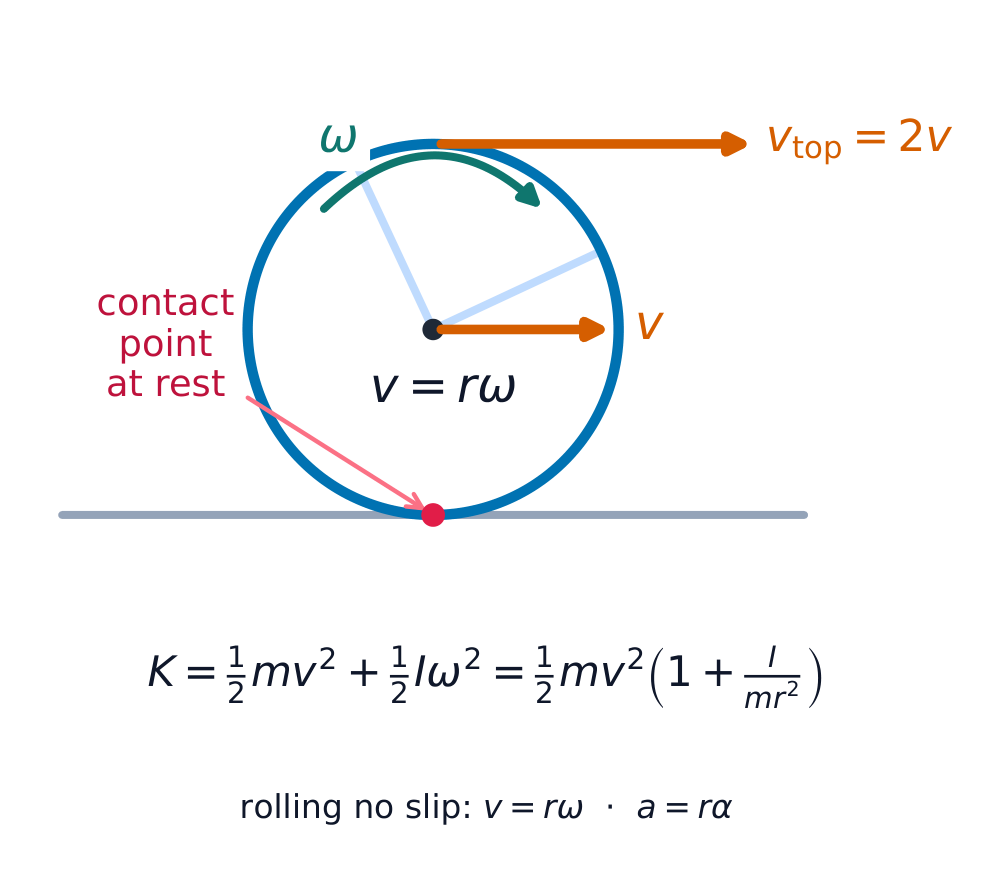
一个既移动又旋转的物体(像一个滚动的球)有两种平动和转动动能,而它的总量是 $K=\tfrac12 mv^2+\tfrac12 I\omega^2$。
词汇表
训练
| 英文 | 中文 | 拼音 |
|---|---|---|
| rotational kinetic energy/rəʊˈteɪʃənl kɪˈnetɪk ˈenədʒi/ | 转动动能 | zhuǎn dòng dòng néng |
6.2
力矩与功
大纲
| Learning Objective | Essential Knowledge |
|---|---|
6.2.A |
|
来源:美国大学理事会 AP 课程与考试说明
一个力矩作用过一个角位移做功,改变转动动能:
$$W=\tau\,\Delta\theta,\qquad P=\tau\omega.$$
这是 $W=Fd$ 和 $P=Fv$ 的旋转形式,而它把动能定理扩展到旋转。
Worked example. 一个马达在一个飞轮转过 $10\ \text{rad}$ 时对它施加一个稳定的 $8.0\ \text{N m}$ 力矩。做的功是 $W=\tau\,\Delta\theta=8.0\times10=80\ \text{J}$,而若飞轮从静止开始这全都变成转动动能。
探索
Balance torques on a seesaw
Torque is force times perpendicular distance, $\tau = Fd$. The beam balances when the torques on each side are equal — move the forces and distances to find the balance point.
6.3
角动量与角冲量
大纲
| Learning Objective | Essential Knowledge |
|---|---|
6.3.A |
|
6.3.B |
|
6.3.C |
Boundary statement: While AP Physics 1 expects that students can mathematically manipulate the magnitude of angular momentum using one-dimensional vector conventions, the direction of angular momentum and angular impulse is beyond the scope of the course. |
来源:美国大学理事会 AP 课程与考试说明
角动量(angular momentum)是线性动量的旋转版本:
$$L=I\omega.$$
一个合力矩随时间作用传递一个改变它的角冲量(angular impulse):$\tau\,\Delta t=\Delta L$ ——旋转冲量-动量定理。
词汇表
训练
| 英文 | 中文 | 拼音 |
|---|---|---|
| Angular momentum/ˈæŋɡjʊlə məʊˈmentəm/ | 角动量 | jiǎo dòng liàng |
| angular impulse/ˈæŋɡjʊlə ˈɪmpʌls/ | 角冲量 | jiǎo chōng liàng |
6.4
角动量守恒
大纲
| Learning Objective | Essential Knowledge |
|---|---|
6.4.A |
|
6.4.B |
|
来源:美国大学理事会 AP 课程与考试说明
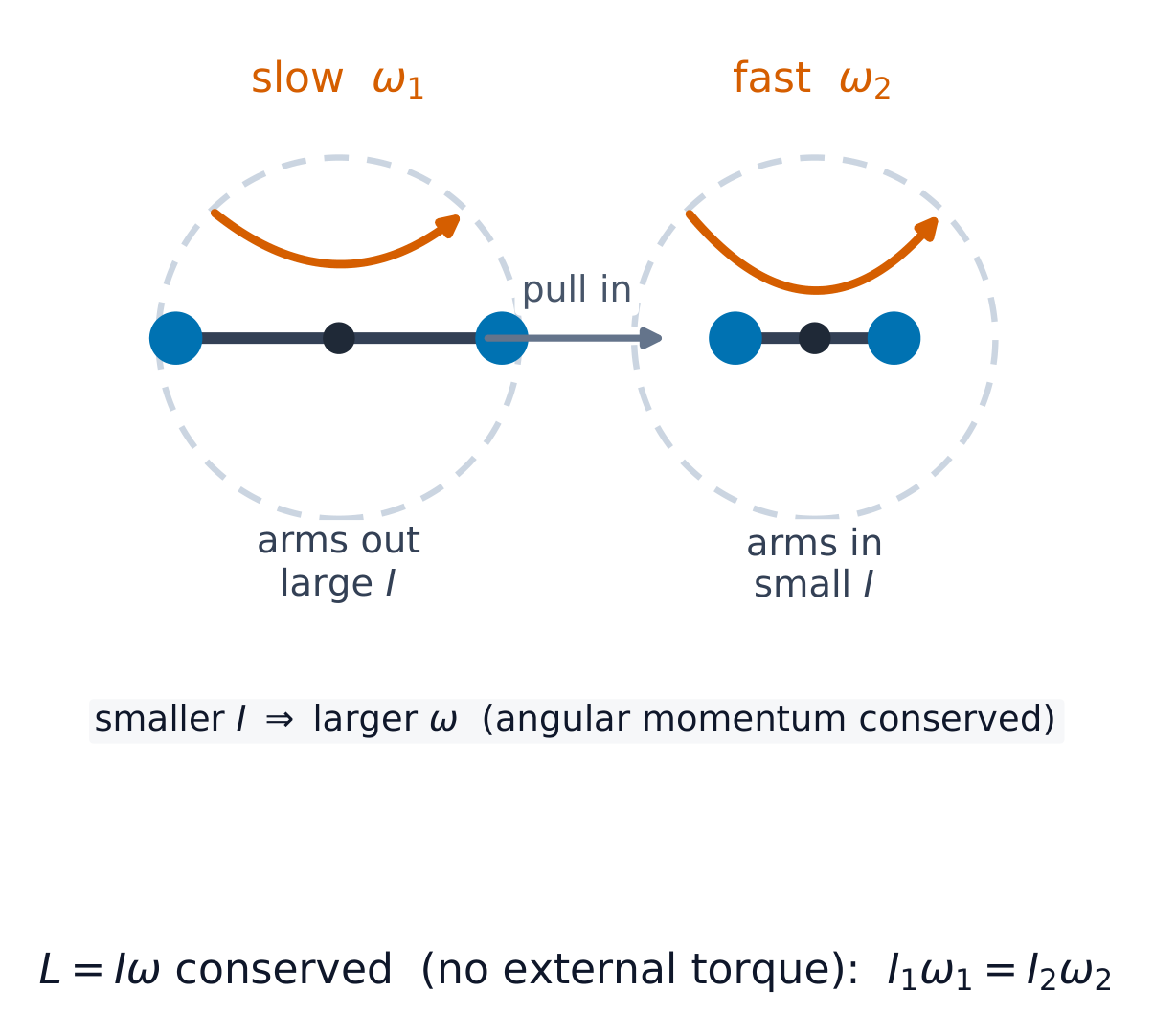
若一个系统上的合外力矩是零,它的总角动量守恒(conserved):
$$I_1\omega_1=I_2\omega_2.$$
所以若 $I$ 减小,$\omega$ 增大以保持 $L$ 恒定——这就是为什么一个旋转的滑冰者在收臂时加速。它也适用于旋转系统的碰撞和爆炸。
Worked example. 一个滑冰者以 $2.0\ \text{rev/s}$ 旋转,转动惯量 $I_1=4.0\ \text{kg m}^2$。她收臂,把她的转动惯量降到 $I_2=1.6\ \text{kg m}^2$。没有外力矩,角动量守恒:
$$\omega_2=\frac{I_1}{I_2}\,\omega_1=\frac{4.0}{1.6}\times2.0=5.0\ \text{rev/s}.$$
她的动能实际上上升——额外的能量来自她的肌肉逆着向外的拉力收臂所做的功。
词汇表
训练
| 英文 | 中文 | 拼音 |
|---|---|---|
| conserved/kənˈsɜːvd/ | 守恒 | shǒu héng |
6.5
滚动
大纲
| Learning Objective | Essential Knowledge |
|---|---|
6.5.A |
|
6.5.B |
|
6.5.C |
Boundary statement: Rolling friction is beyond the scope of AP Physics 1. Boundary statement: The precise mathematical relationships between linear and angular quantities while a rigid body is rolling while slipping are beyond the scope of AP Physics 1 and 2, and students will not be expected to model those relationships quantitatively. However, students are expected to qualitatively explain the changes to linear and angular quantities while a rigid body is rolling while slipping. |
来源:美国大学理事会 AP 课程与考试说明
纯滚动(rolling without slipping)把平动和转动运动联系起来:接触点暂时静止,所以
$$v=r\omega \qquad\text{and}\qquad a=r\alpha.$$
一个滚动物体的能量在平动和转动之间分割,所以在一个斜面上它比一个无摩擦滑动的物体加速更慢——一些能量进入旋转。
Worked example. 对于一个纯滚动的实心圆盘($I=\tfrac12 mR^2$),它的动能的多少分数是转动的?用 $v=R\omega$,转动部分是 $\tfrac12 I\omega^2=\tfrac12(\tfrac12 mR^2)\omega^2=\tfrac14 mv^2$,而平动部分是 $\tfrac12 mv^2$。所以总量是 $\tfrac34 mv^2$ 而转动份额是 $\tfrac{1/4}{3/4}=\tfrac13$。一个环,它的质量更远,把它一半的能量储存在旋转里并从一个坡道滚下更慢。
词汇表
训练
| 英文 | 中文 | 拼音 |
|---|---|---|
| Rolling without slipping/ˈrəʊlɪŋ wɪˈðaʊt ˈslɪpɪŋ/ | 纯滚动 | chún gǔn dòng |
6.6
环绕卫星的运动
大纲
| Learning Objective | Essential Knowledge |
|---|---|
6.6.A |
|
来源:美国大学理事会 AP 课程与考试说明
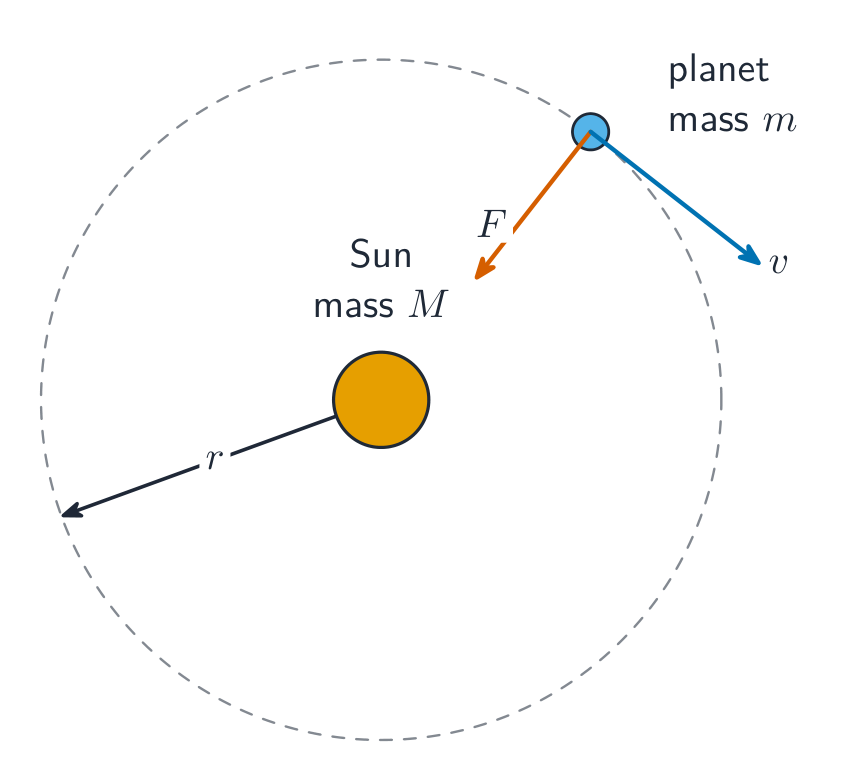
一个在轨道里的卫星(satellite)处于自由落体:重力提供把它的路径弯曲成一个轨道所需的确切向心力。把重力设为等于向心要求,
$$\frac{GMm}{r^2}=\frac{mv^2}{r}\ \Rightarrow\ v=\sqrt{\frac{GM}{r}}.$$
所以一个更大的轨道意味着一个更慢的速率。对于一个圆形轨道,角动量和机械能都恒定;对于一个椭圆轨道,角动量守恒(绕行星没有力矩)而速率变化——最接近时最快。
Worked example. 求一个刚好在地球之上的低轨道里的卫星的速率,半径 $r=6.4\times10^{6}\ \text{m}$,$GM=4.0\times10^{14}\ \text{m}^3/\text{s}^2$:
$$v=\sqrt{\frac{GM}{r}}=\sqrt{\frac{4.0\times10^{14}}{6.4\times10^{6}}}=\sqrt{6.25\times10^{7}}\approx 7.9\times10^{3}\ \text{m/s},$$
约 $7.9\ \text{km/s}$ ——并注意卫星的质量约去,所以所有低轨道共享这个速率。
逃逸速度(escape velocity)是恰好让一个物体永远离开的发射速率:它的总机械能恰好为零,所以它只在无穷远处减速到零。令 $\tfrac12 mv^2 - \dfrac{GMm}{r}=0$(用一般引力势能 $U_g=-GMm/r$)并解出 $v$,
$$v_{\text{esc}}=\sqrt{\frac{2GM}{r}}.$$
它是相同半径处圆轨道速率的 $\sqrt2$ 倍,而且(像轨道速率一样)不取决于逃逸物体的质量。
探索
Compare orbits at different radii
A satellite is in free fall, its gravity supplying the centripetal force. A larger orbit means a slower speed and a longer period — Kepler's third law.
词汇表
训练
| 英文 | 中文 | 拼音 |
|---|---|---|
| satellite/ˈsætəlaɪt/ | 卫星 | wèi xīng |
| Escape velocity/eˈskeɪp vəˈlɒsɪti/ | 逃逸速度 | táo yì sù dù |
6.6
考试技巧
- 当没有外力矩作用时守恒角动量 $L=I\omega$:一个更小的 $I$(收臂)给出一个更大的 $\omega$。
- 一个滚动物体把它的能量在 $\tfrac12 mv^2$ 和 $\tfrac12 I\omega^2$ 之间分割,由 $v=r\omega$ 联系——所以它从一个坡道加速比一个滑动的更慢。
- 对于一个圆形轨道把重力设为等于向心要求:$v=\sqrt{GM/r}$,所以一个更大的轨道更慢而卫星的质量约去。
- 收臂提高旋转和动能——额外的能量来自向内拉所做的功;$L$ 不变。
- 注意哪个旋转量守恒:$L$(没有力矩)与能量(没有摩擦)是不同的条件。
本主题的互动课程
逐步学习,并即时检测练习。