Angular Momentum and Angular Impulse
Introduced| English |
|---|
| angular momentum/ˈæŋɡjʊlə məʊˈmentəm/ |
Why a spinning top refuses to fall over
- A stationary top topples at once; spin it and it stands, defying gravity for a surprisingly long time.
- Spinning things resist changes to their rotation — they have angular momentum 角动量.
- It is the rotational cousin of ordinary (linear) momentum.
- To change it, you must apply a torque over time — an angular impulse.
Angular momentum
- Angular momentum is $L = I\omega$ — rotational inertia times angular velocity.
- It is the twin of $p = mv$, with $I$ for mass and $\omega$ for velocity.
- Its units are $\text{kg}\cdot\text{m}^2/\text{s}$, and it points along the spin axis.
- The faster the spin or the larger the $I$, the more angular momentum.
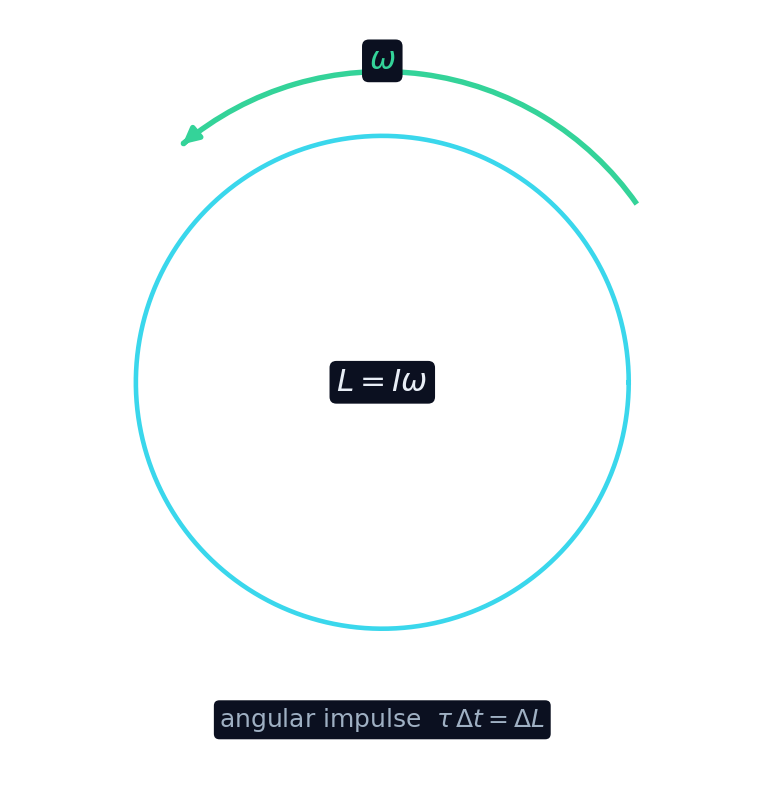
Spin carries angular momentum
Change the spin to feel how angular momentum L = Iω builds with faster rotation.
A disk with $I = 2\ \text{kg}\cdot\text{m}^2$ spins at $\omega = 5\ \tfrac{\text{rad}}{\text{s}}$. What is its angular momentum, in $\text{kg}\cdot\text{m}^2/\text{s}$?
$L = I\omega = 2 \times 5 = 10\ \text{kg}\cdot\text{m}^2/\text{s}$.
Angular momentum is the rotational twin of linear momentum $p = mv$. Which is its formula?
$L = I\omega$ — inertia times angular velocity, the twin of $mv$.
Angular impulse changes it
- An angular impulse is a torque acting over time: $\tau\,\Delta t$.
- It equals the change in angular momentum: $\tau\,\Delta t = \Delta L$.
- This is the rotational twin of $F\,\Delta t = \Delta p$.
- A long-lasting torque, or a large one, produces a big change in spin.
An angular impulse is a torque acting over ____.
Angular impulse $= \tau\,\Delta t$, and it equals the change in angular momentum.
A torque of $4\ \text{N·m}$ acts for $2\ \text{s}$. By how much does the angular momentum change, in $\text{kg}\cdot\text{m}^2/\text{s}$?
$\Delta L = \tau\,\Delta t = 4 \times 2 = 8\ \text{kg}\cdot\text{m}^2/\text{s}$.
Angular momentum resists tipping
- A large angular momentum makes an object "gyroscopically" stubborn — it holds its axis.
- This steadies spinning tops, bicycle wheels, footballs thrown with spin, and satellites.
- To turn the axis you must supply a torque; without one, the axis stays put.
- The bigger $L$ is, the harder the object is to knock off its spin.
Angular momentum $I\omega$ and rotational kinetic energy $\tfrac12 I\omega^2$ are the same quantity.
They differ: $L$ is linear in $\omega$, energy is quadratic. They are distinct quantities.
Select all effects that come from a large angular momentum.
Large $L$ makes spinning objects hold their axis. Falling speed is unrelated to angular momentum.
Angular momentum $L = I\omega$ is not the same as rotational kinetic energy $\tfrac12 I\omega^2$. One is linear in $\omega$, the other quadratic. In a collision or a skater's spin, angular momentum is the conserved quantity — energy may change.
A disk of $I = 2\ \text{kg}\cdot\text{m}^2$ spins at $\omega = 5\ \tfrac{\text{rad}}{\text{s}}$.
- $L = I\omega = 2 \times 5 = 10\ \text{kg}\cdot\text{m}^2/\text{s}$.
A torque of $4\ \text{N}\cdot\text{m}$ applied for $2\ \text{s}$ adds $\tau\Delta t = 8$, raising $L$ to $18\ \text{kg}\cdot\text{m}^2/\text{s}$.
Angular momentum is $L = I\omega$, the rotational twin of $p = mv$ (units $\text{kg}\cdot\text{m}^2/\text{s}$). An angular impulse $\tau\,\Delta t$ changes it: $\tau\,\Delta t = \Delta L$. A large $L$ makes a spinning object resist tipping.