| Learning Objective | Essential Knowledge |
|---|---|
2.1.A |
|
2.1.B |
Boundary statement: AP Physics 1 only expects students to calculate the center of mass for systems of five or fewer particles arranged in a two-dimensional configuration or for systems that are highly symmetrical. |
力与平动动力学
AP 物理 1 · 第 2 主题
 10:50
10:50
Force & Translational Dynamics
Three skydivers, far above the ground. Gravity is pulling every one of them down, hard. Yet they hang there, steady, side by side. So why has that pull stopped…
英文讲解 · 内嵌中英文字幕
2.1
系统与质心
大纲
来源:美国大学理事会 AP 课程与考试说明
一个系统(system)是你选择分析的物体或物体组。一个系统能被当作它质心(center of mass)处的一个单一的点——它质量的平均位置。外力改变质心的运动;内力(系统各部分之间)不改变。
这就是为什么一把跨桌旋转的扳手的质心仍然沿一条直线移动:旋转是内部的,而只有(接近零的)外力对质心重要。对于一条线上位置 $x_1,x_2$ 处的两个质量 $m_1,m_2$,质心坐在 $x_{\text{cm}}=\dfrac{m_1x_1+m_2x_2}{m_1+m_2}$ ——总是更接近更重的质量。
词汇表
训练
| 英文 | 中文 | 拼音 |
|---|---|---|
| system/ˈsɪstəm/ | 系统 | xì tǒng |
| center of mass/ˈsentə ɒv mæs/ | 质心 | zhì xīn |
2.2
力与受力图
大纲
| Learning Objective | Essential Knowledge |
|---|---|
2.2.A |
|
2.2.B |
Boundary statement: AP Physics 1 only expects students to depict the forces exerted on objects, not the force components on free-body diagrams. On the AP Physics exams, individual forces represented on a free-body diagram must be drawn as individual straight arrows, originating on the dot and pointing in the direction of the force. Individual forces that are in the same direction must be drawn side by side, not overlapping. |
来源:美国大学理事会 AP 课程与考试说明
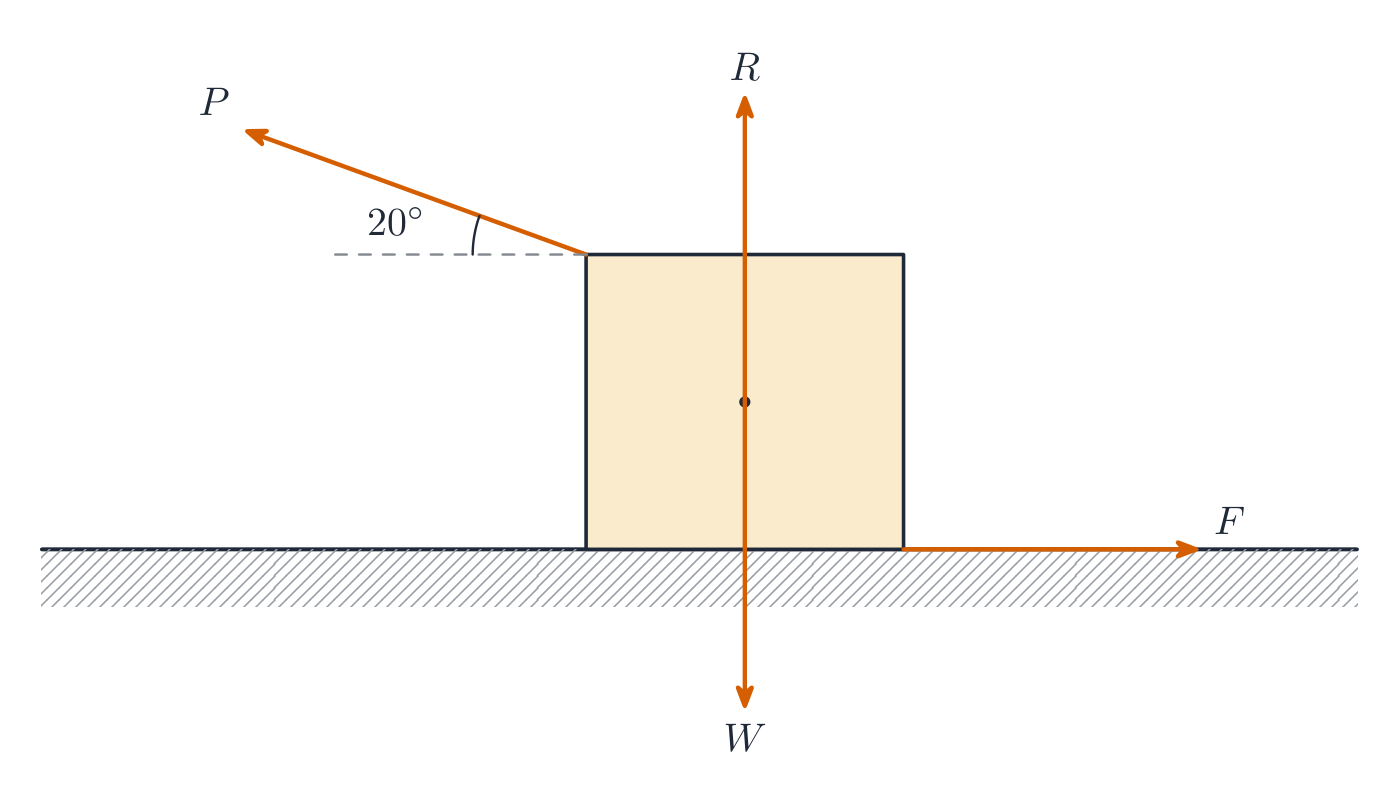
一个力(force)是一个推或拉——一个矢量,以牛顿(N)测量。一个受力图(free-body diagram)把一个物体显示为一个点,带每个作用在它上的力的箭头(重力(weight)、法向、张力(tension)、摩擦、施加),每个被标注并指向正确的方向。在任何动力学问题之前画它;它是大多数分数被赢得或失去的地方。
两条规则保持受力图诚实:只画作用在选定物体上的力(不是它对其他东西施加的力),并只画真实的、物理的力(一根绳子、一个表面、重力、一只手)——绝不画一个"$ma$"箭头,它是力的结果,不是一个力本身。
探索
Balance the forces on a free-body diagram
A free-body diagram shows every force on one object as an arrow. The object accelerates only if the forces don't cancel — the net force sets $a=F/m$.
词汇表
训练
| 英文 | 中文 | 拼音 |
|---|---|---|
| force/fɔːs/ | 力 | lì |
| free-body diagram/friː ˈbɒdi ˈdaɪəɡræm/ | 受力图 | shòu lì tú |
| weight/weɪt/ | 重力 | zhòng lì |
| tension/ˈtenʃn/ | 张力 | zhāng lì |
2.3
牛顿第三定律
大纲
| Learning Objective | Essential Knowledge |
|---|---|
2.3.A |
Boundary statement: AP Physics 1 only expects students to describe tension qualitatively in a string, cable, chain, or similar system with mass. For example, students might note that the tension in a hanging chain is greater toward the top of the chain. Boundary statement: The interaction between objects or systems at a distance is limited to gravitational forces in AP Physics 1. In AP Physics 2, gravitational, electric, and magnetic forces may be considered. |
来源:美国大学理事会 AP 课程与考试说明
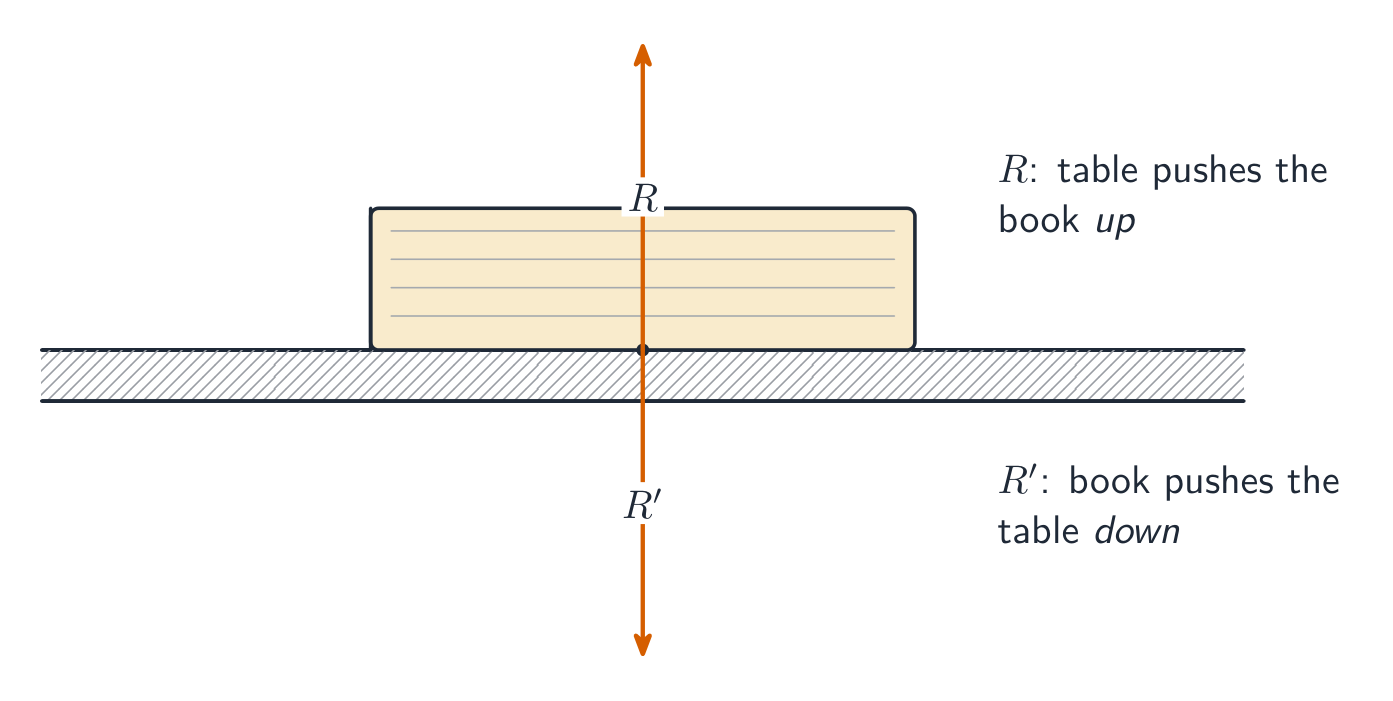
牛顿第三定律(Newton's third law):若物体 A 推物体 B,那么 B 以一个大小相等、方向相反的力推回 A。这两个力作用在不同的物体上,所以它们从不互相抵消。通过"A 对 B / B 对 A"的措辞辨别第三定律对。
一个经典的陷阱:一本书的重力和来自桌子的法向力不是一个第三定律对——它们作用在同一个物体(书)上。书的重力的伙伴是书对地球施加的拉力;桌子的推力的伙伴是书对桌子的推力。
词汇表
训练
| 英文 | 中文 | 拼音 |
|---|---|---|
| Newton's third law/ˈnjuːtnz θɜːd lɔː/ | 牛顿第三定律 | niú dùn dì sān dìng lǜ |
2.4
牛顿第一定律
大纲
| Learning Objective | Essential Knowledge |
|---|---|
2.4.A |
|
来源:美国大学理事会 AP 课程与考试说明
牛顿第一定律(Newton's first law)(惯性(inertia)定律):一个物体的速度保持恒定,除非一个合力(net force)作用在它上。所以零合力意味着恒定速度(包括静止)——物体处于平衡(translational equilibrium)。惯性是抵抗运动变化的倾向,由质量测量。
Worked example. 一辆 $1200\ \text{kg}$ 的车在一条水平路上以稳定的 $25\ \text{m/s}$ 巡航。它上的合力是什么?因为速度恒定,加速度是零,所以由第一定律合力是零——向前的驱动力恰好平衡阻力和摩擦。"稳定速率"总是意味着平衡的力。
词汇表
训练
| 英文 | 中文 | 拼音 |
|---|---|---|
| Newton's first law/ˈnjuːtnz fɜːst lɔː/ | 牛顿第一定律 | niú dùn dì yí dìng lǜ |
| inertia/ɪˈnɜːʃə/ | 惯性 | guàn xìng |
| net force/net fɔːs/ | 合力 | hé lì |
| translational equilibrium/trænˈsleɪʃənl ˌiːkwɪˈlɪbrɪəm/ | 平衡 | píng héng |
2.5
牛顿第二定律
大纲
| Learning Objective | Essential Knowledge |
|---|---|
2.5.A |
|
来源:美国大学理事会 AP 课程与考试说明
牛顿第二定律(Newton's second law)把合力与加速度关联:
$$\vec{a}=\frac{\sum \vec{F}}{m},\qquad\text{i.e.}\qquad \sum\vec{F}=m\vec{a}.$$
一次一个轴地应用它:加起每个轴上的力分量并把这个和设为那个轴的 $ma$。加速度指向与合力相同的方向。
Worked example. 一个 $4.0\ \text{kg}$ 的箱子被一个 $18\ \text{N}$ 的水平力沿地板拉。箱子上的摩擦是 $6.0\ \text{N}$。求它的加速度。沿运动方向合力是 $18-6.0=12\ \text{N}$,所以
$$a=\frac{\sum F}{m}=\frac{12}{4.0}=3.0\ \text{m/s}^2.$$
Worked example (incline 斜面). 一个质量 $m$ 的木块沿一个倾斜角 $\theta$ 的无摩擦坡道滑下。求它的加速度。把重力分解成沿坡道和垂直于坡道的分量;只有沿坡道部分,$mg\sin\theta$,驱动运动,所以
$$a=\frac{mg\sin\theta}{m}=g\sin\theta.$$
坡道越陡,$\sin\theta$ 越大而它加速越快;在 $\theta=90^{\circ}$ 它是自由落体。
词汇表
训练
| 英文 | 中文 | 拼音 |
|---|---|---|
| Newton's second law/ˈnjuːtnz ˈsekənd lɔː/ | 牛顿第二定律 | niú dùn dì èr dìng lǜ |
| incline/ɪnˈklaɪn/ | 斜面 | xié miàn |
2.6
万有引力
大纲
| Learning Objective | Essential Knowledge |
|---|---|
2.6.A |
|
2.6.B |
|
2.6.C |
|
2.6.D |
|
来源:美国大学理事会 AP 课程与考试说明
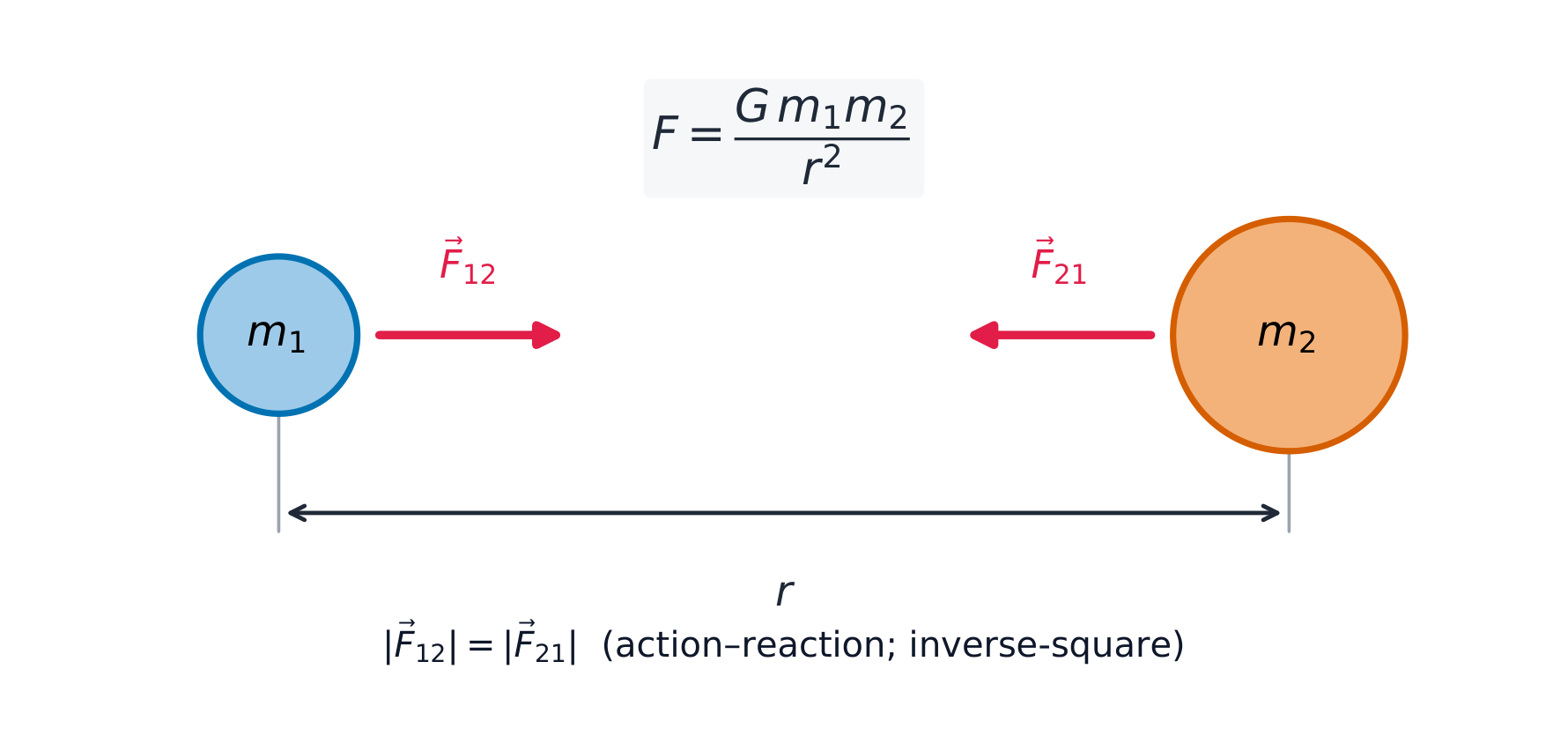
在一个行星表面附近,万有引力(gravitational force)(重力)是 $F_g=mg$,向下,其中 $g$ 是重力场强度(gravitational field strength)。更一般地,万有引力定律(Newton's law of gravitation)给出任意两个质量之间的吸引:
$$F_g=\frac{G m_1 m_2}{r^2},$$
沿连接它们的线,随着距离 $r$ 增长而更弱(一个平方反比定律)。把间距加倍使力变为四分之一。
Worked example. 一个 $2.0\ \text{kg}$ 的物体在地球上重 $19.6\ \text{N}$($g=9.8\ \text{m/s}^2$)。在月球上 $g_{\text{Moon}}=1.6\ \text{m/s}^2$。它的质量不变($2.0\ \text{kg}$),但它的重量变成 $F_g=mg=2.0\times1.6=3.2\ \text{N}$。质量测量惯性;重量是一个取决于你在哪里的力。
质量其实扮演两个不同的角色。惯性质量(inertial mass)决定一个物体多强地抵抗加速($F=ma$);引力质量(gravitational mass)决定它多强地吸引其他质量($F=Gm_1m_2/r^2$)。实验证实这两者相等——这正是为什么每个物体,无论轻重,都以相同的 $g$ 下落。
词汇表
训练
| 英文 | 中文 | 拼音 |
|---|---|---|
| gravitational field strength/ˌɡrævɪˈteɪʃənl fiːld streŋθ/ | 重力场强度 | zhòng lì chǎng qiáng dù |
| Newton's law of gravitation/ˈnjuːtnz lɔː ɒv ˌɡrævɪˈteɪʃn/ | 万有引力定律 | wàn yǒu yǐn lì dìng lǜ |
| Inertial mass/ɪˈnɜːʃl mæs/ | 惯性质量 | guàn xìng zhì liàng |
| gravitational mass/ˌɡrævɪˈteɪʃənl mæs/ | 引力质量 | yǐn lì zhì liàng |
2.7
动摩擦与静摩擦
大纲
| Learning Objective | Essential Knowledge |
|---|---|
2.7.A |
|
2.7.B |
|
来源:美国大学理事会 AP 课程与考试说明
摩擦力(friction)沿一个表面作用,反对相对滑动(或滑动的倾向):
- 动摩擦(kinetic friction)(滑动时):$f_k=\mu_k N$。
- 静摩擦(static friction)(还未滑动时):$f_s\le \mu_s N$ ——它调整到一个最大值以防止运动。
这里 $N$ 是法向力(normal force)(表面推力,垂直于表面)而 $\mu$ 是摩擦系数(coefficient of friction)。
Worked example. 一个 $5.0\ \text{kg}$ 的板条箱坐在一个水平地板上,$\mu_s=0.40$。一个 $15\ \text{N}$ 的水平推力会移动它吗?在一个水平地板上 $N=mg=5.0\times9.8=49\ \text{N}$,所以最大的静摩擦是 $f_{s,\max}=\mu_s N=0.40\times49=19.6\ \text{N}$。$15\ \text{N}$ 的推力小于 $19.6\ \text{N}$,所以摩擦上升以匹配它而板条箱保持静止。
探索
Slide a block down a slope with friction
Friction opposes motion up to a maximum $\mu N$. Tilt the slope until gravity's pull along it beats static friction and the block starts to slide.
词汇表
训练
| 英文 | 中文 | 拼音 |
|---|---|---|
| Friction/ˈfrɪkʃn/ | 摩擦力 | mó cā lì |
| Kinetic friction/kɪˈnetɪk ˈfrɪkʃn/ | 动摩擦 | dòng mó cā |
| Static friction/ˈstætɪk ˈfrɪkʃn/ | 静摩擦 | jìng mó cā |
| normal force/ˈnɔːml fɔːs/ | 法向力 | fǎ xiàng lì |
| coefficient of friction/ˌkəʊɪˈfɪʃənt ɒv ˈfrɪkʃn/ | 摩擦系数 | mó cā xì shù |
2.8
弹簧力
大纲
| Learning Objective | Essential Knowledge |
|---|---|
2.8.A |
|
来源:美国大学理事会 AP 课程与考试说明
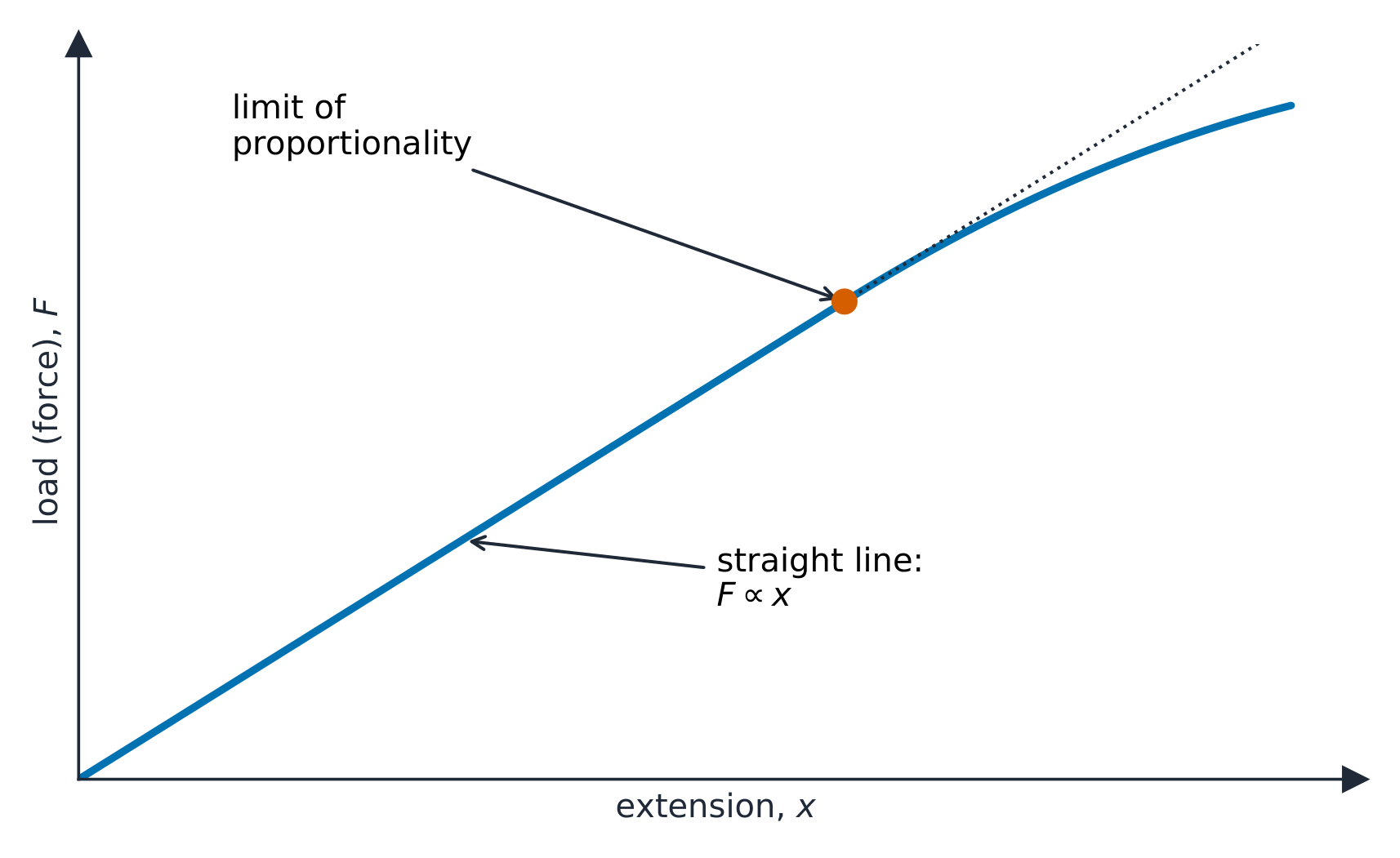
一个理想弹簧施加一个与它的拉伸或压缩成比例的回复力(restoring force)——胡克定律(Hooke's law):
$$F_s=-kx,$$
其中 $k$ 是弹簧常数(spring constant)(刚度)而 $x$ 是从弹簧自然长度的位移。负号意味着力指回向平衡。
Worked example. 一个 $k=200\ \text{N/m}$ 的弹簧竖直悬挂而一个 $0.50\ \text{kg}$ 的质量被挂在它上。它在静止时拉伸多远?在静止时弹簧力平衡重量,$kx=mg$,所以
$$x=\frac{mg}{k}=\frac{0.50\times9.8}{200}=0.025\ \text{m}=2.5\ \text{cm}.$$
探索
Stretch a spring (Hooke's law)
A spring's force is proportional to its extension, $F=kx$ (Hooke's law). Pull harder and the extension grows in step — until the spring's limit.
词汇表
训练
| 英文 | 中文 | 拼音 |
|---|---|---|
| restoring force/rɪˈstɔːrɪŋ fɔːs/ | 回复力 | huí fù lì |
| Hooke's law/hʊks lɔː/ | 胡克定律 | hú kè dìng lǜ |
| spring constant/sprɪŋ ˈkɒnstənt/ | 弹簧常数 | tán huáng cháng shù |
2.9
圆周运动
大纲
| Learning Objective | Essential Knowledge |
|---|---|
2.9.A |
|
2.9.B |
Boundary statement: AP Physics 1 only expects students to quantitatively analyze banked curves in which no friction is required to maintain uniform circular motion. Analysis of situations in which friction is required on a banked curve is limited to qualitative descriptions. Boundary statement: AP Physics 1 does not expect students to know Kepler's first or second laws of planetary motion. |
来源:美国大学理事会 AP 课程与考试说明
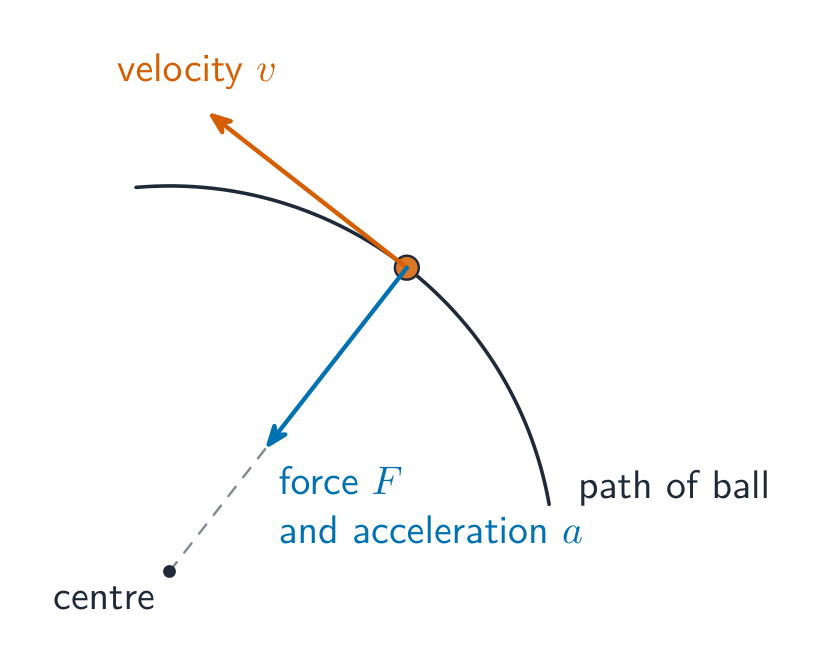
一个以恒定速率在一个圆里移动的物体仍然加速,因为它的速度方向不断变化。这个向心加速度(centripetal acceleration)指向中心:
$$a_c=\frac{v^2}{r}.$$
它由一个合向内(向心)力(net inward (centripetal) force)$F_c=\dfrac{mv^2}{r}$ 产生——由任何指向内的真实力(张力、重力、摩擦、法向)供应。转一整圈所需的时间是周期(period)$T$,而每秒转的圈数是频率(frequency)$f$;它们互为倒数,$f = 1/T$,同样的定义描述任何转动或振动。没有单独的向外的力;"离心"只是一个表观效应。
Worked example. 一个 $0.30\ \text{kg}$ 的球在一根绳上以 $4.0\ \text{m/s}$ 在一个半径 $0.80\ \text{m}$ 的水平圆里被甩。求绳里的张力。张力供应整个向心力:
$$T=\frac{mv^2}{r}=\frac{0.30\times4.0^2}{0.80}=6.0\ \text{N}.$$
若绳最多能承受 $6.0\ \text{N}$,这是球在那个半径能走的最快——转得再快绳就断了。
词汇表
训练
| 英文 | 中文 | 拼音 |
|---|---|---|
| centripetal acceleration/senˈtrɪpɪtl əkˌseləˈreɪʃn/ | 向心加速度 | xiàng xīn jiā sù dù |
| net inward (centripetal) force/net ˈɪnwəd fɔːs/ | 向心力 | xiàng xīn lì |
| period/ˈpɪərɪəd/ | 周期 | zhōu qī |
| frequency/ˈfriːkwənsi/ | 频率 | pín lǜ |
2.9
考试技巧
- 总是先画一个受力图:只有作用在选定物体上的真实力(重力、法向、张力、摩擦、施加)——绝不画一个"$ma$"箭头。
- 一次一个轴地应用 $\sum F = ma$;在一个斜面上把重力分解成 $mg\sin\theta$(沿)和 $mg\cos\theta$(垂直)。
- 一个牛顿第三定律对作用在两个不同的物体上——一本书的重力和桌子的法向力不是一个对(两者都作用在书上)。
- 静摩擦调整到 $\mu_s N$(用它来测试运动是否开始);一旦滑动,用动摩擦 $f_k=\mu_k N$。
- 圆周运动需要一个由一个真实力供应的合向内(向心)力 $mv^2/r$ ——没有向外的"离心"力。
本主题的互动课程
逐步学习,并即时检测练习。