| English | 释义 | 拼音 |
|---|---|---|
| centripetal/senˈtrɪpɪtl/ | 向心的 | xiàng xīn de |
Whirl a ball on a string — where does it go if it snaps?
- Spin a ball on a string in a circle at steady speed. Now imagine the string snaps.
- It does not fly outward — it shoots off along the tangent, in a straight line.
- So something must constantly pull it inward to bend its path into a circle.
- That inward pull is the key to all circular motion.
Constant speed, changing velocity
- In uniform circular motion the speed is constant but the velocity is not.
- Velocity is a vector, and its direction changes every instant around the circle.
- A changing velocity means there is an acceleration — even at constant speed.
- This acceleration points toward the centre, so we call it centripetal 向心的.
A ball on a horizontal frictionless table moves in a circle on a horizontal string. The string snaps. Which way does it then move?
难度 1/5 · 今日首次完成可获 100 金币及少量额外奖励
With no inward force, inertia carries the ball in a straight line — along the 相切 where the string broke.
An object in uniform circular motion has zero acceleration because its speed is constant.
难度 1/5 · 今日首次完成可获 100 金币及少量额外奖励
Its 方向 changes, so its velocity changes — there is a centripetal acceleration $v^2/r$ toward the centre.
Centripetal acceleration and force
- The centripetal acceleration has size $a_c = \dfrac{v^2}{r}$, directed to the centre.
- By Newton's second law, a net centripetal force $F_c = \dfrac{mv^2}{r}$ must point inward.
- Faster spin or a tighter circle both demand a larger inward force.
- This force is not new — it is provided by tension, gravity, friction, or a normal force.
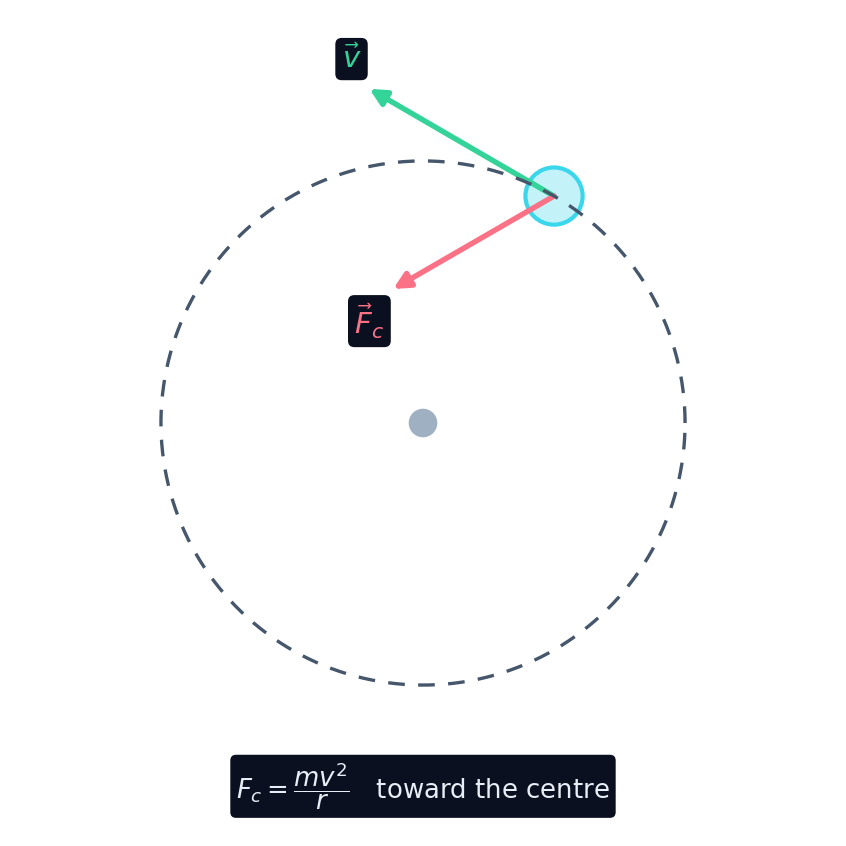
Around the circle
Sweep the angle and change the radius to see how position and direction change around a circle.
A $2\ \text{kg}$ ball moves at $4\ \tfrac{\text{m}}{\text{s}}$ in a circle of radius $8\ \text{m}$. What centripetal force is needed, in $\text{N}$?
难度 2/5 · 今日首次完成可获 140 金币及少量额外奖励
$F_c = \dfrac{mv^2}{r} = \dfrac{2 \times 16}{8} = 4\ \text{N}$, toward the centre.
In which direction does the net (centripetal) force point?
难度 1/5 · 今日首次完成可获 100 金币及少量额外奖励
The net force is centripetal — it points toward the centre, bending the path into a circle.
Centripetal acceleration has magnitude $v^2 / \_\_$ (fill in the missing symbol).
难度 1/5 · 今日首次完成可获 100 金币及少量额外奖励
$a_c = v^2/r$: bigger speed or smaller radius means a larger centripetal acceleration.
Select 所有 forces that can provide the centripetal force in real situations.
难度 2/5 · 今日首次完成可获 140 金币及少量额外奖励
Tension, gravity and friction can each supply the inward force. There is no real outward centrifugal force.
There is no outward "centrifugal" force
- The feeling of being flung outward in a turning car is your inertia, not a real force.
- Your body "wants" to go straight (tangent); the car door pushes you inward to turn you.
- In a ground-based inertial frame there is no additional outward centrifugal force; weight and support also act and can balance vertically.
- Call the inward net force centripetal; a rotating frame uses an outward centrifugal term to account for that frame's acceleration.
If the string breaks, the ball flies off along the tangent, not radially outward. And there is no real outward "centrifugal force" — the outward feeling is just inertia resisting the inward turn. The genuine net force is inward.
On a horizontal frictionless table, a $2\ \text{kg}$ ball attached to a horizontal string moves at $4\ \tfrac{\text{m}}{\text{s}}$ in a circle of radius $8\ \text{m}$.
- $F_c = \dfrac{mv^2}{r} = \dfrac{2 \times 4^2}{8} = \dfrac{32}{8} = 4\ \text{N}$, directed toward the centre.
Weight and the table's normal force balance vertically. The horizontal string tension supplies this $4\ \text{N}$ inward.
Uniform circular motion has constant speed but changing velocity, so there is a centripetal acceleration $a_c = v^2/r$ toward the centre. A net centripetal force $F_c = mv^2/r$ (from tension, gravity, friction...) points inward. There is no real outward "centrifugal" force — that is inertia.
Write from the data: find the centripetal force
- A 3 kg ball moves at 2 m/s in a circle of radius 2 m.
- Find the centripetal force.
A 3 kg ball on a horizontal frictionless table moves at constant speed 2 m/s in a circle of radius 2 m, held by a horizontal string. What inward force is required, and what happens if the string snaps?
The inward resultant is $F_c=mv^2/r=(3\ \text{kg})(2\ \tfrac{\text{m}}{\text{s}})^2/(2\ \text{m})=3(4)/2=6\ \text{N}$. It points toward the centre. If the horizontal string breaks on a frictionless table, no horizontal force remains and the ball continues along the tangent.
A 3 kg ball moves at constant speed 2 m/s in a circle of radius 2 m. What inward resultant force is required?
难度 1/5 · 今日首次完成可获 100 金币及少量额外奖励
The inward resultant is $F_c=mv^2/r=(3\ \text{kg})(2\ \tfrac{\text{m}}{\text{s}})^2/(2\ \text{m})=3(4)/2=6\ \text{N}$. It points toward the centre. If the horizontal string breaks on a frictionless table, no horizontal force remains and the ball continues along the tangent.