跳到主要内容

供给与需求

AP 微观经济学 · 第 2 主题

训练
讲义 词汇表
2.1

需求

大纲
Enduring UnderstandingLearning ObjectiveEssential Knowledge

MKT-3
Individuals and firms respond to incentives and face constraints.

MKT-3.A
a. Define (using graphs as appropriate) key terms and factors related to consumer decision making and the law of demand.
b. Explain (using graphs as appropriate) the relationship between price and quantity demanded and how buyers respond to incentives and constraints.

  • MKT-3.A.1 A well-defined system of property rights is necessary for the market system to function well.
  • MKT-3.A.2 Economic agents respond to incentives.
  • MKT-3.A.3 Individuals often respond to incentives, such as those presented by prices, but also face constraints, such as income, time, and legal and regulatory frameworks.
  • MKT-3.A.4 The law of demand suggests that a change in the own-price causes a change in quantity demanded in the opposite direction and a movement along a demand (marginal benefit) curve.
  • MKT-3.A.5 The conceptual relationship between price and quantity stated by the law of demand leads to downward-sloping demand curves explained by the income effect and substitution effect and/or by diminishing marginal utility.
  • MKT-3.A.6 The market demand curve (schedule) is derived from the summation of individual demand curves (schedules).

MKT-3.B
Explain (using graphs as appropriate) buyers' responses to changes in incentives and constraints.

  • MKT-3.B.1 Changes in the determinants of consumer demand can cause the demand curve to shift.

来源:美国大学理事会 AP 课程与考试说明

供求:需求右移使价与量上升

一个市场只有在产权(property rights)明确定义时才运作——所有者能使用、把他人排除在外并交易他们的资源;没有产权,价格无法协调交换。在那个框架内,两股力量是需求和供给。

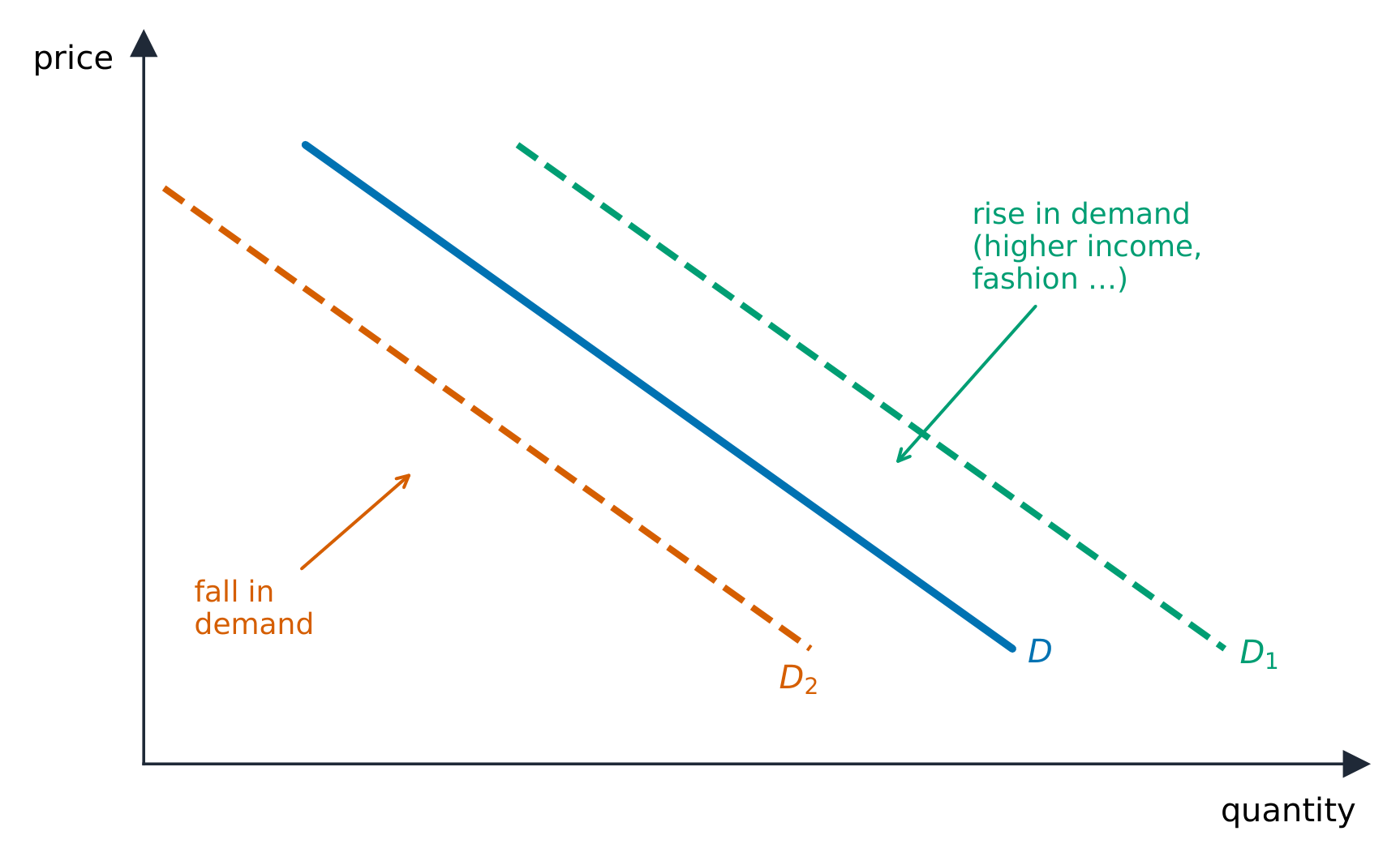
需求(demand)是一种物品的价格和买者愿意并能够购买的数量之间的关系。需求定律(law of demand)说价格和需求量朝相反方向移动,所以需求曲线向倾斜。两个原因:替代效应(substitution effect)(当一种物品变贵时,买者转向替代品)和收入效应(income effect)(一个更高的价格缩小实际购买力)。

需求曲线向下倾斜;收入、偏好和相关价格移动它

把一个需求量的变化(沿曲线的一个移动,只由物品自身价格造成)与一个需求的变化(整条曲线的一个移动)区分开。需求随决定因素(determinants)移动,记作 TRIBE:

  • Tastes/preferences(偏好),
  • Related goods(相关物品)——一个替代品(substitute)价格的上升提高需求;一个互补品(complement)价格的上升降低它,
  • Income(收入)——对一个正常商品(normal good)更多收入提高需求;对一个低档商品(inferior good)它降低它,
  • Buyers(买者)(消费者数量),
  • Expectations(预期)未来价格或收入。

市场需求曲线是每个个体买者需求曲线的水平相加(horizontal summation)——在每个价格上,把所有买者想要的数量加起来。这就是为什么更多的买者(上面的 B)把整条市场曲线向右移动。

探索

Shift demand and watch price and quantity

The demand curve slopes down: lower price, more wanted. A change in income, tastes or related-good prices shifts the whole curve, moving the equilibrium.

词汇表 训练
英文 中文 拼音
property rights 产权 chǎn quán
Demand 需求 xū qiú
law of demand 需求定律 xū qiú dìng lǜ
substitution effect 替代效应 tì dài xiào yìng
income effect 收入效应 shōu rù xiào yìng
determinants 决定因素 jué dìng yīn sù
substitute 替代品 tì dài pǐn
complement 互补品 hù bǔ pǐn
normal good 正常商品 zhèng cháng shāng pǐn
inferior good 低档商品 dī dàng shāng pǐn
horizontal summation 水平相加 shuǐ píng xiāng jiā
Supply 供给 gōng jǐ
2.2

供给

大纲
Enduring UnderstandingLearning ObjectiveEssential Knowledge

MKT-3
Individuals and firms respond to incentives and face constraints.

MKT-3.C
a. Define (using graphs as appropriate) the law of supply.
b. Explain (using graphs as appropriate) the relationship between price and quantity supplied.

  • MKT-3.C.1 A change in own-price causes a change in quantity supplied in the same direction and a movement along a supply curve.
  • MKT-3.C.2 The market supply curve (schedule) is derived from the summation of individual supply curves (schedules). The market supply curve is upward-sloping.

MKT-3.D
Explain (using graphs as appropriate) producers' (sellers') responses to changes in incentives and technology.

  • MKT-3.D.1 Changes in the determinants of supply can cause the supply curve to shift.

来源:美国大学理事会 AP 课程与考试说明

供给曲线的移动

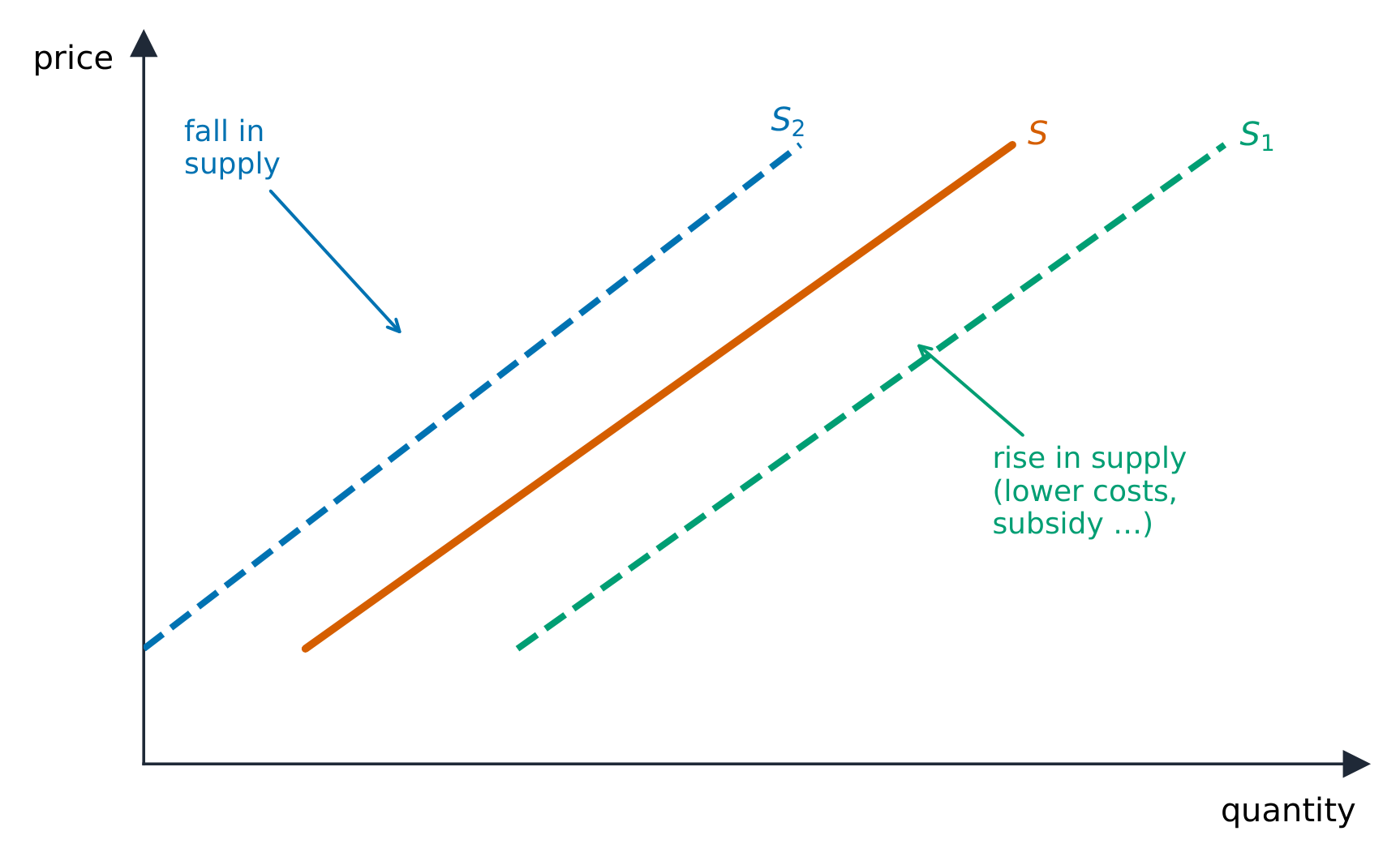
供给(supply)是价格和卖者会提供的数量之间的关系。供给定律(law of supply):价格和供给量朝相同方向移动,所以供给曲线向倾斜(更高的价格覆盖更高的边际成本并奖励更多产出)。

供给曲线向上倾斜;成本、技术、税和补贴移动它

再次把一个供给量的变化(沿曲线的移动,来自物品自身价格)与一个供给的变化(一个移动)分开。供给随投入价格技术、税收和补贴(subsidies)、一个企业能制造的其他物品的价格卖者数量,和预期移动。和需求一样,市场供给曲线是个体企业供给曲线的水平相加——在每个价格上,把所有企业提供的数量加起来——所以更多的卖者把市场供给向右移动。

考试技能: 在自由回答部分你必须画正确标注的供求图并在正确的方向移动正确的曲线——先决定事件是改变一个"自身价格"(沿曲线移动)还是一个决定因素(移动)。

词汇表 训练
英文 中文 拼音
law of supply 供给定律 gōng jǐ dìng lǜ
subsidies 补贴 bǔ tiē
2.3

需求价格弹性

大纲
Enduring UnderstandingLearning ObjectiveEssential Knowledge

MKT-3
Individuals and firms respond to incentives and face constraints.

MKT-3.E
a. Define measures of elasticity.
b. Explain (using graphs where appropriate) measures of elasticity and the impact of a given price change on total revenue or total expenditure.
c. Calculate (using data from a graph or a table as appropriate) measures of elasticity.

  • MKT-3.E.1 Economists use the concept of elasticity to measure the magnitude of percentage changes in quantity owing to any given changes in the own-price, income, and prices of related goods.
  • MKT-3.E.2 Price elasticity of demand is measured by the percentage change in quantity demanded divided by the percentage change in price or the responsiveness of the quantity demanded to changes in price. Elasticity varies along a linear demand curve, meaning slope is not elasticity.
  • MKT-3.E.3 Ranges of values of elasticity of demand are described as elastic or inelastic with the separating benchmark being a magnitude of 1, where the change in the price and the change in the quantity demanded are proportional.
    • a. When the magnitude of the value of elasticity is greater than 1, the demand is described as being elastic with respect to that price in the range of the given change.
    • b. When the magnitude of the value of elasticity is less than 1, the demand is described as being inelastic with respect to that price in the range of the given change.
    • c. When the magnitude of the value of elasticity is equal to 1, the demand is described as being unit elastic with respect to that price in the range of the given change.
  • MKT-3.E.4 The price elasticity of demand depends on certain factors such as the availability of substitutes.
  • MKT-3.E.5 The impact of a given price change on total revenue or total expenditure will depend on whether demand is elastic, inelastic, or unit elastic.

来源:美国大学理事会 AP 课程与考试说明

需求的价格弹性

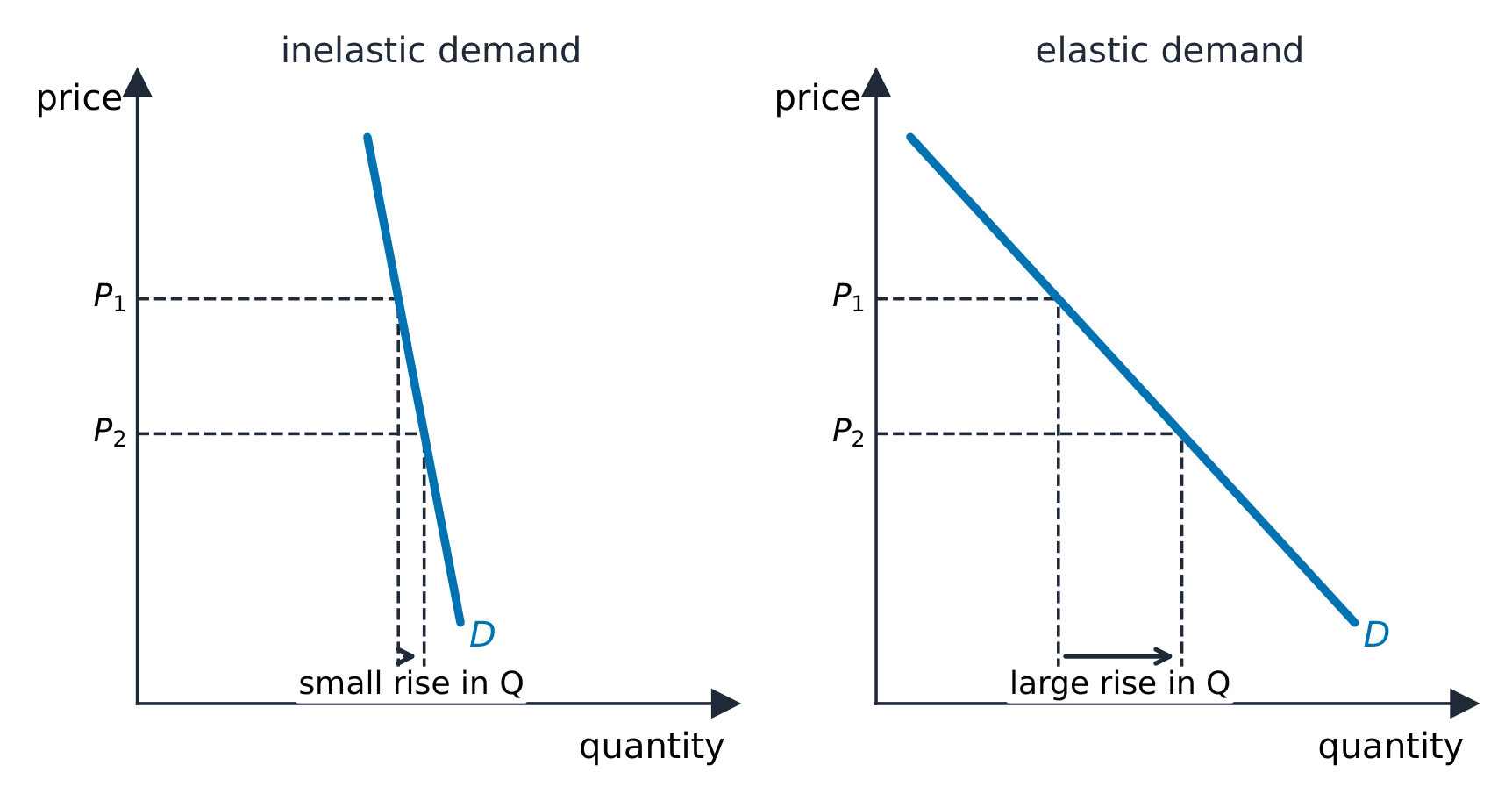
需求价格弹性(price elasticity of demand)测量需求量对一个价格变化多有响应:

$$E_d=\left|\frac{\%\ \Delta\ \text{quantity demanded}}{\%\ \Delta\ \text{price}}\right|.$$

缺乏弹性与富有弹性的需求:对一个价格变化的一个小与大的响应
  • $E_d>1$:富有弹性(elastic)(数量强烈响应);
  • $E_d<1$:缺乏弹性(inelastic)(数量几乎不响应);
  • $E_d=1$:单位弹性(unit elastic)。

当有更多替代品、物品是一个奢侈品、它占收入的一个大份额,或买者有更多时间去调整时,需求更富有弹性。弹性与总收入(total revenue)($P\times Q$)联系:若需求富有弹性,一次降价提高收入;若缺乏弹性,一次降价降低它。沿一条直线需求曲线,弹性随着你向下移动而下降(顶部富有弹性、底部缺乏弹性)。

Worked example. 一次从 $\$10$$\$12$ 的价格上升(一个 $+20\%$ 的变化)使需求量从 $100$ 削减到 $85$(一个 $-15\%$ 的变化)。那么 $E_d=\left|\dfrac{-15\%}{20\%}\right|=0.75<1$,所以需求缺乏弹性。因为它缺乏弹性,价格上升提高总收入:从 $\$10\times100=\$1000$$\$12\times85=\$1020$

探索

Stretch price and measure elasticity

Price elasticity of demand is how strongly quantity responds to price. A steep curve is inelastic (small response); a shallow one is elastic (large response).

词汇表 训练
英文 中文 拼音
Price elasticity of demand 需求价格弹性 xū qiú jià gé tán xìng
elastic 富有弹性 fù yǒu tán xìng
inelastic 缺乏弹性 quē fá tán xìng
total revenue 总收入 zǒng shōu rù
2.4

供给价格弹性

大纲
Enduring UnderstandingLearning ObjectiveEssential Knowledge

MKT-3
Individuals and firms respond to incentives and face constraints.

MKT-3.E
a. Define measures of elasticity.
b. Explain (using graphs where appropriate) measures of elasticity and the impact of a given price change on total revenue or total expenditure.
c. Calculate (using data from a graph or a table as appropriate) measures of elasticity.

  • MKT-3.E.6 Price elasticity of supply is measured by the percentage change in quantity supplied divided by the percentage change in price, or the responsiveness of the quantity supplied to changes in price.
  • MKT-3.E.7 Ranges of values of elasticity of supply are described as elastic or inelastic with the separating benchmark being a magnitude of 1, where the change in the price and the change in the quantity supplied are proportional.
    • a. When the magnitude of the value of elasticity is greater than 1, the supply is described as being elastic with respect to that price in the range of the given change.
    • b. When the magnitude of the value of elasticity is less than 1, the supply is described as being inelastic with respect to that price in the range of the given change.
    • c. When the magnitude of the value of elasticity is equal to 1, the supply is described as being unit elastic with respect to that price in the range of the given change.
  • MKT-3.E.8 The price elasticity of supply depends on certain factors such as the price of alternative inputs.

来源:美国大学理事会 AP 课程与考试说明

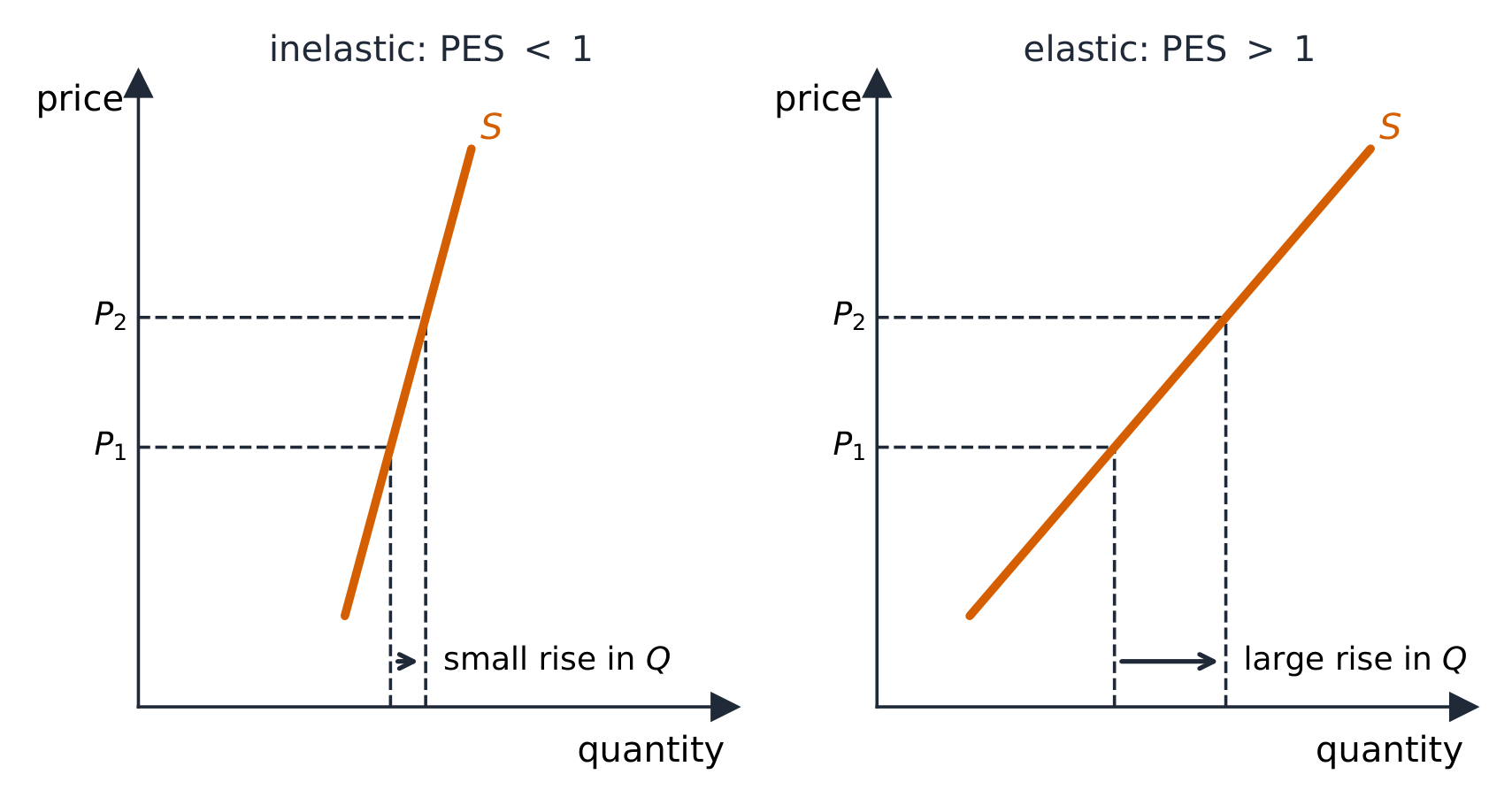
供给价格弹性(price elasticity of supply),$E_s=\dfrac{\%\ \Delta\ Q_s}{\%\ \Delta\ P}$,测量卖者多有响应。当企业能容易地调整产出时供给更富有弹性——闲置产能、可储存的物品,而最重要的是更多时间(供给在长期比短期更富有弹性)。

当 PES 低于 1 时同样的价格上升给出一个小的供给响应,高于 1 时一个大的
词汇表 训练
英文 中文 拼音
Price elasticity of supply 供给价格弹性 gōng jǐ jià gé tán xìng
2.5

其他弹性

大纲
Enduring UnderstandingLearning ObjectiveEssential Knowledge

MKT-3
Individuals and firms respond to incentives and face constraints.

MKT-3.E
a. Define measures of elasticity.
b. Explain (using graphs where appropriate) measures of elasticity and the impact of a given price change on total revenue or total expenditure.
c. Calculate (using data from a graph or a table as appropriate) measures of elasticity.

  • MKT-3.E.9 Elasticity can be measured for any determinant of demand or supply, not just the price.
  • MKT-3.E.10 Income elasticity of demand is measured by the percentage change in the quantity demanded divided by the percentage change in consumers' income. Economists use the income elasticity of demand to determine whether a good is normal or inferior.
  • MKT-3.E.11 Cross-price elasticity of demand is measured by the percentage change in the quantity demanded of one good divided by the percentage change in the price of another good. Economists use the cross-price elasticity of demand to determine whether goods are substitutes, complements, or not related.

来源:美国大学理事会 AP 课程与考试说明

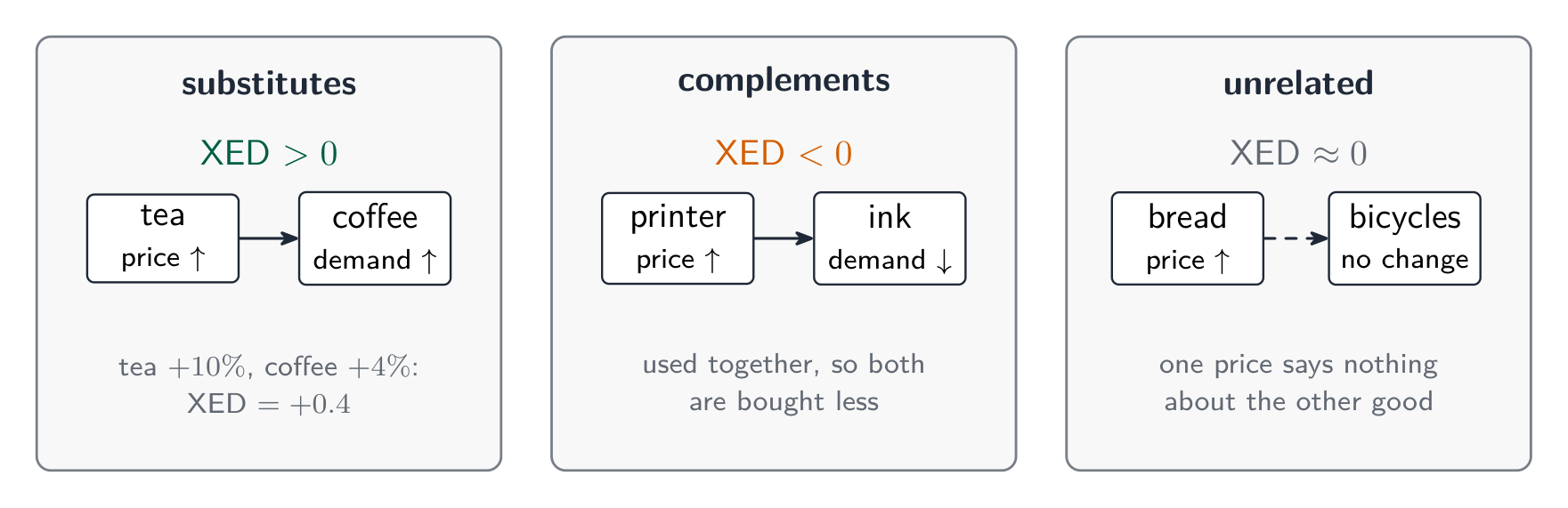
  • 交叉价格弹性(cross-price elasticity)$=\dfrac{\%\ \Delta\ Q_x}{\%\ \Delta\ P_y}$:对替代品,对互补品——符号告诉你这个关系。
  • 收入弹性(income elasticity)$=\dfrac{\%\ \Delta\ Q}{\%\ \Delta\ \text{income}}$:对正常商品(而对奢侈品 $>1$),对低档商品

Worked example. 当咖啡的价格上升 $10\%$ 时,茶的需求量上升 $6\%$:交叉价格弹性 $=\dfrac{+6\%}{+10\%}=+0.6$号确认咖啡和茶是替代品。若相反收入的一次 $5\%$ 上升使餐厅餐需求上升 $10\%$,收入弹性 $=\dfrac{10\%}{5\%}=+2$ ——一个正常商品,而一个奢侈品,因为它超过 $1$

交叉弹性:对替代品正,对互补品负
交叉弹性:对替代品正,对互补品负

考试技能: 你被期望计算一个弹性、给它分类,并读一个符号作为替代品/互补品或正常/低档的证据。

词汇表 训练
英文 中文 拼音
Cross-price elasticity 交叉价格弹性 jiāo chā jià gé tán xìng
Income elasticity 收入弹性 shōu rù tán xìng
2.6

市场均衡与消费者和生产者剩余

大纲
Enduring UnderstandingLearning ObjectiveEssential Knowledge

MKT-4
Although equilibria are stable, an economy can move from one equilibrium to another if market conditions change.

MKT-4.A
a. Define (using graphs as appropriate) market equilibrium, consumer surplus, and producer surplus.
b. Explain (using graphs as appropriate) how equilibrium price, quantity, consumer surplus, and producer surplus for a good or service are determined.
c. Calculate (using data from a graph or table as appropriate) areas of consumer surplus and producer surplus at equilibrium.

  • MKT-4.A.1 The supply-demand model is a tool for understanding what factors influence prices and quantities and why prices and quantities might differ across markets or change over time.
  • MKT-4.A.2 In a perfectly competitive market, equilibrium is achieved (and markets clear with no shortages or surpluses) when the price of a good or service brings the quantity supplied and quantity demanded into balance, in the sense that buyers wish to purchase the same quantity that sellers wish to provide.
  • MKT-4.A.3 Equilibrium price provides information to economic decision-makers to guide resource allocation.
  • MKT-4.A.4 Economists use consumer surplus and producer surplus to measure the benefits markets create to buyers and sellers and understand market efficiency.
  • MKT-4.A.5 Market equilibrium maximizes total economic surplus in the absence of market failures, meaning that perfectly competitive markets are efficient.

来源:美国大学理事会 AP 课程与考试说明

消费者与生产者剩余

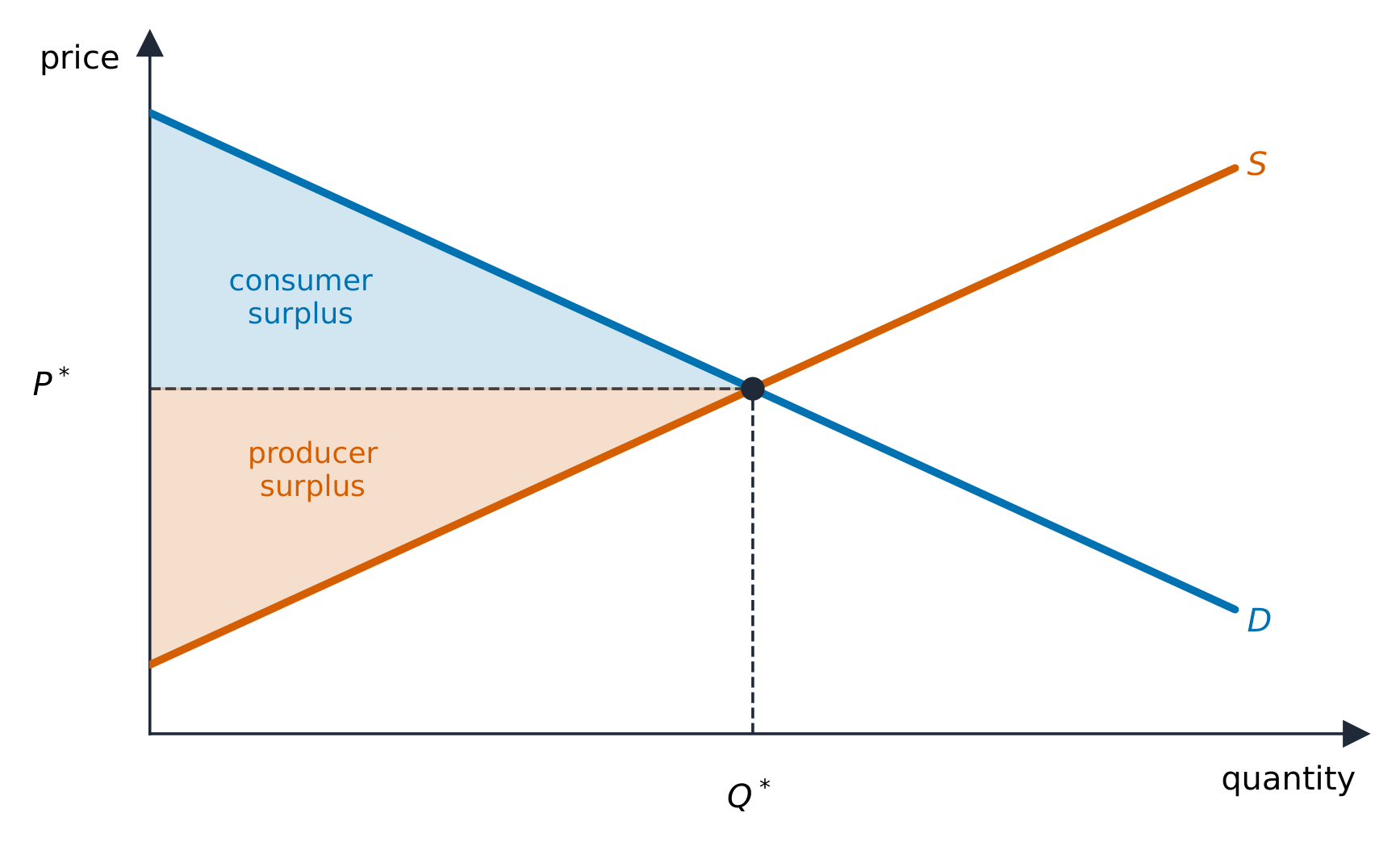
均衡(equilibrium)是供给遇到需求的地方:均衡价格使市场出清,所以需求量等于供给量而没有短缺或过剩。

市场均衡处的消费者剩余和生产者剩余
市场均衡处的消费者剩余和生产者剩余
  • 消费者剩余(consumer surplus)是需求曲线之下和价格之上的面积——买者会付的和他们实际付的之间的差距。
  • 生产者剩余(producer surplus)是供给曲线之上和价格之下的面积——价格和卖者最低可接受价格之间的差距。
  • 它们的和是总剩余(total surplus),而竞争均衡最大化它——这就是为什么自由市场被称为配置有效率(allocatively efficient)。
探索

See consumer and producer surplus

At equilibrium the market clears. The gap between what buyers would pay and the price is consumer surplus; the gap above sellers' costs is producer surplus.

词汇表 训练
英文 中文 拼音
Equilibrium 均衡 jūn héng
Consumer surplus 消费者剩余 xiāo fèi zhě shèng yú
Producer surplus 生产者剩余 shēng chǎn zhě shèng yú
total surplus 总剩余 zǒng shèng yú
allocatively efficient 配置有效率 pèi zhì yǒu xiào lǜ
surplus 过剩 guò shèng
2.7

市场非均衡与均衡变动

大纲
Enduring UnderstandingLearning ObjectiveEssential Knowledge

MKT-4
Although equilibria are stable, an economy can move from one equilibrium to another if market conditions change.

MKT-4.B
a. Define a surplus and shortage.
b. Explain (using graphs where appropriate) how changes in underlying conditions and shocks to a competitive market can alter price, quantity, consumer surplus, and producer surplus.
c. Calculate (using data from a graph or table as appropriate) changes in price, quantity, consumer surplus, and producer surplus in response to changes in market conditions or market disequilibrium.

  • MKT-4.B.1 Whenever markets experience imbalances—creating disequilibrium prices and quantities, surpluses, and shortages—market forces drive price and quantity toward equilibrium.
  • MKT-4.B.2 Factors that shift the market demand and market supply curves cause price, quantity, consumer surplus, producer surplus, and total economic surplus (within that market) to change. The impact of the change depends on the price elasticities of demand and supply.

来源:美国大学理事会 AP 课程与考试说明

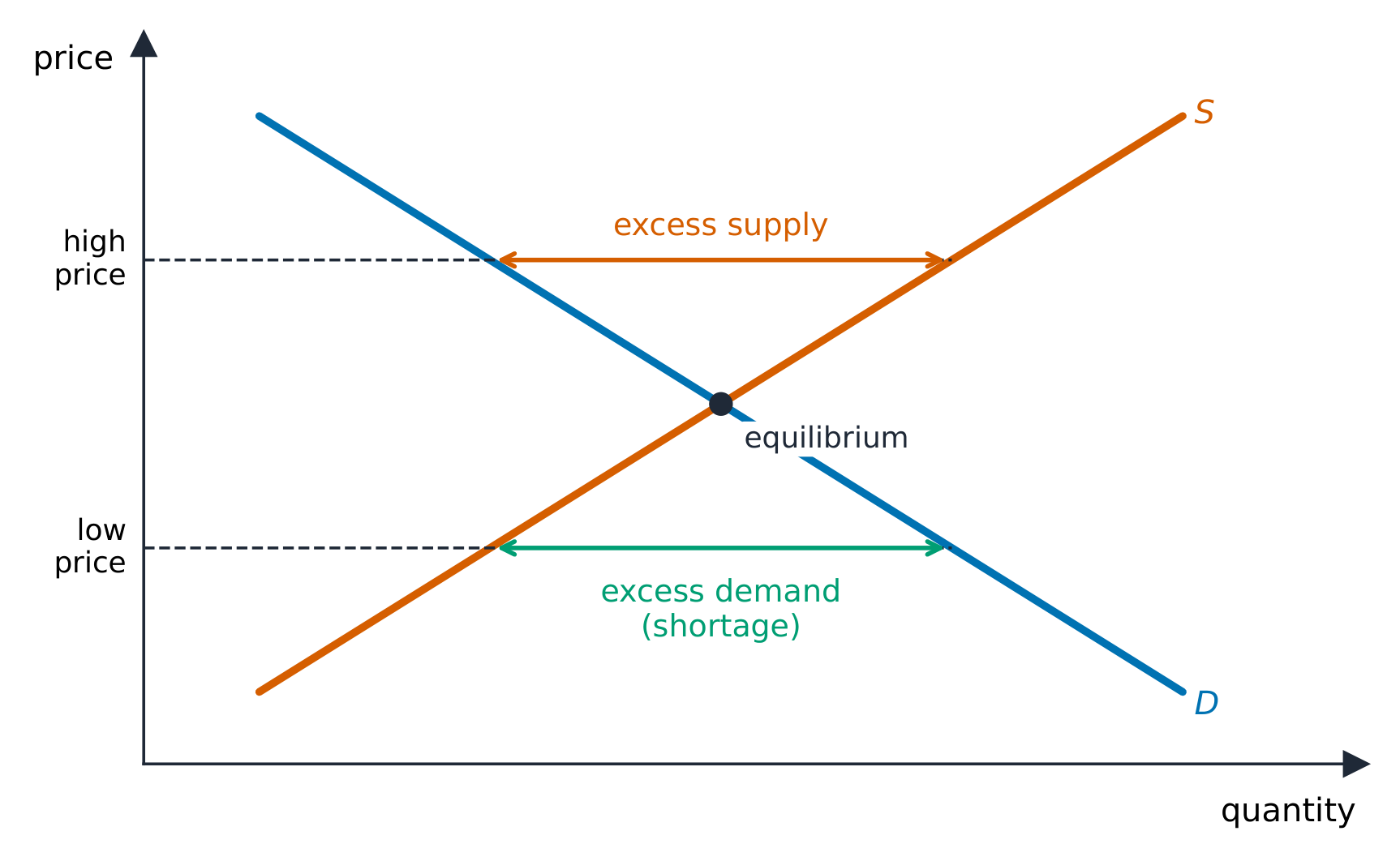
离开均衡市场自我纠正:均衡价格之上有一个过剩(surplus)(超额供给)把价格推低;它之下一个短缺(shortage)(超额需求)把价格推高。

均衡之上有超额供给;它之下,超额需求
均衡之上有超额供给;它之下,超额需求

当一个决定因素移动一条曲线时,均衡可预测地移动。一个单一移动给价格和数量两者一个确定的结果。当两条曲线都移动时,价格或数量之一是不确定的(indeterminate)(取决于这些移动的相对大小)——一个最爱的考试陷阱。通过画这些移动来算出它们。

词汇表 训练
英文 中文 拼音
shortage 短缺 duǎn quē
2.8

政府干预市场的影响

大纲
Enduring UnderstandingLearning ObjectiveEssential Knowledge

POL-1
Government policies influence consumer and producer behavior and therefore affect market outcomes.

POL-1.A
a. Define forms of government price and quantity intervention.
b. Explain (using graphs where appropriate) how government policies alter consumer and producer behaviors that influence incentives and therefore affect outcomes.
c. Calculate (using data from a graph or table where appropriate) changes in market outcomes resulting from government policies.

  • POL-1.A.1 Some government policies, such as price floors, price ceilings, and other forms of price and quantity regulation, affect incentives and outcomes in all market structures.
  • POL-1.A.2 Governments use taxes and subsidies to change incentives in ways that influence consumer and producer behavior, shifting the supply and demand curves accordingly.
  • POL-1.A.3 Taxes and subsidies affect government revenues or costs.
  • POL-1.A.4 Government intervention in a market producing the efficient quantity through taxes, subsidies, price controls, or quantity controls can only decrease allocative efficiency.
  • POL-1.A.5 Deadweight loss represents the losses to buyers and sellers as a result of government intervention in an efficient market.
  • POL-1.A.6 The incidence of taxes and subsidies imposed on goods traded in perfectly competitive markets depends on the elasticity of supply and demand.

来源:美国大学理事会 AP 课程与考试说明

价格上限导致短缺
税收与无谓损失

政府干预,通常减少总剩余:

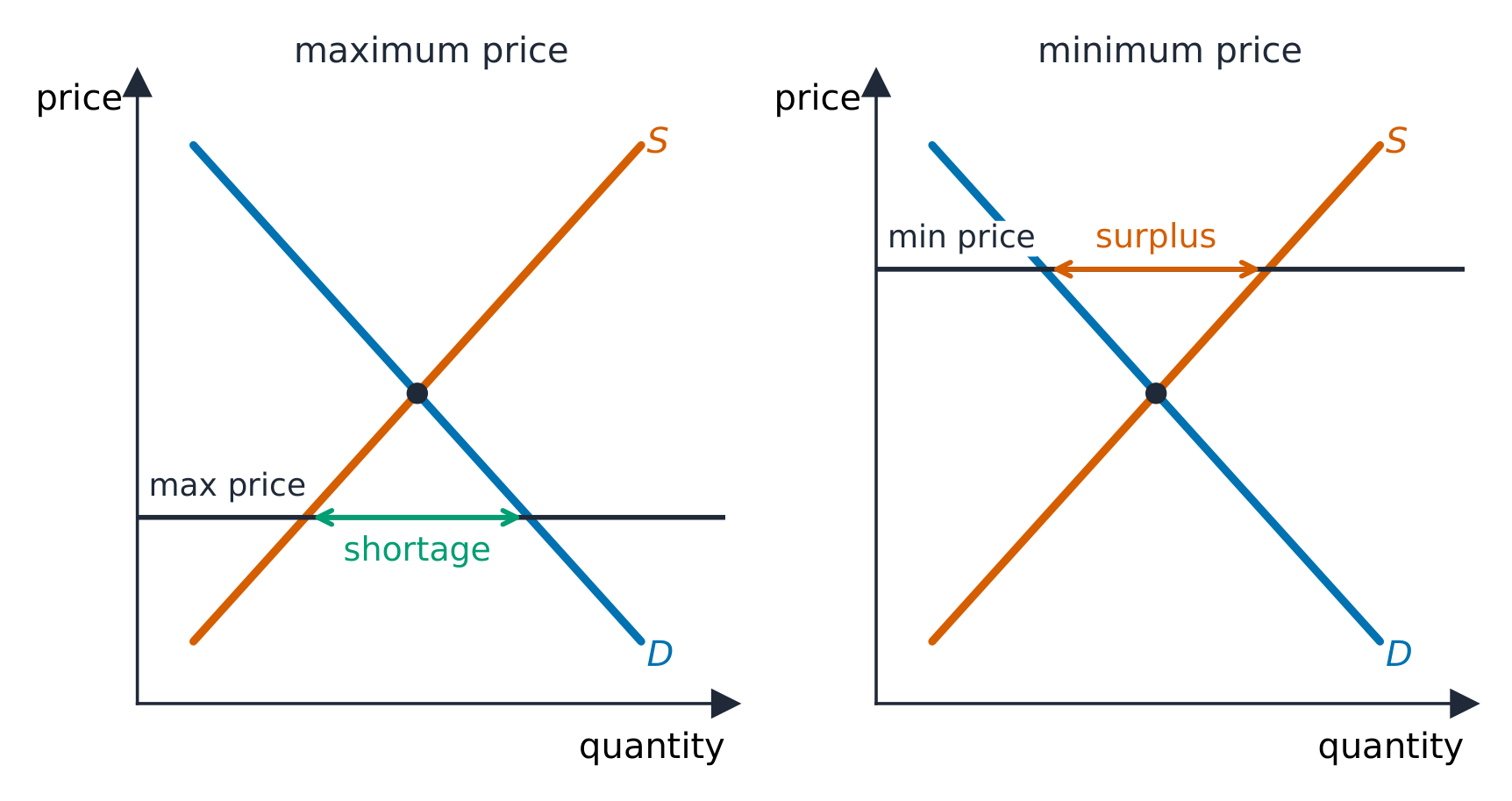
一个价格上限造成一个短缺;一个价格下限造成一个过剩
  • 一个在均衡之下的价格上限(price ceiling)(一个法定最大值,像租金管制)造成一个持续的短缺
  • 一个在均衡之上的价格下限(price floor)(一个法定最小值,像最低工资)造成一个持续的过剩
  • 一项消费税(excise tax)使供给向上移动这个税;负担(税收归宿(tax incidence))更重地落在更缺乏弹性的一侧。
  • 一项补贴使供给向下移动,提高数量。

这些每一个都造成无谓损失(deadweight loss)——不再发生的互利交易,显示为新数量处曲线之间的一个三角形。

考试技能: 在一个图上,能够给消费者剩余、生产者剩余、来自一个税的政府收入,和无谓损失涂阴影,并说谁承担这个税以及为什么。

探索

Add a tax or price control

A price ceiling below equilibrium causes shortages; a tax drives a wedge between what buyers pay and sellers get, shrinking the quantity traded.

词汇表 训练
英文 中文 拼音
price ceiling 价格上限 jià gé shàng xiàn
price floor 价格下限 jià gé xià xiàn
excise tax 消费税 xiāo fèi shuì
tax incidence 税收归宿 shuì shōu guī sù
deadweight loss 无谓损失 wú wèi sǔn shī
2.9

国际贸易与公共政策

大纲
Enduring UnderstandingLearning ObjectiveEssential Knowledge

POL-1
Government policies influence consumer and producer behavior and therefore affect market outcomes.

POL-1.B
a. Define tariffs and quotas.
b. Explain (using graphs where appropriate) how markets are affected by public policy related to international trade.
c. Calculate (using data from a graph or table as appropriate) changes in market outcomes resulting from public policy related to international trade.

  • POL-1.B.1 Equilibria in competitive markets may be altered by the decision to open an economy to trade with other countries; equilibrium price can be higher or lower than under autarky, and the gap between domestic supply and demand is filled by trade. Opening an economy to trade with other countries affects consumer surplus, producer surplus, and total economic surplus.
  • POL-1.B.2 Tariffs, which governments sometimes use to influence international trade, affect domestic price, quantity, government revenue, and consumer surplus and total economic surplus.
  • POL-1.B.3 Quotas can be used to alter quantities produced and therefore affect price, consumer surplus, and total economic surplus.
    • Exclusion statement: The graphing of quotas is beyond the scope of the course and the AP Exam, but understanding how quotas affect quantities produced is within the scope.

来源:美国大学理事会 AP 课程与考试说明

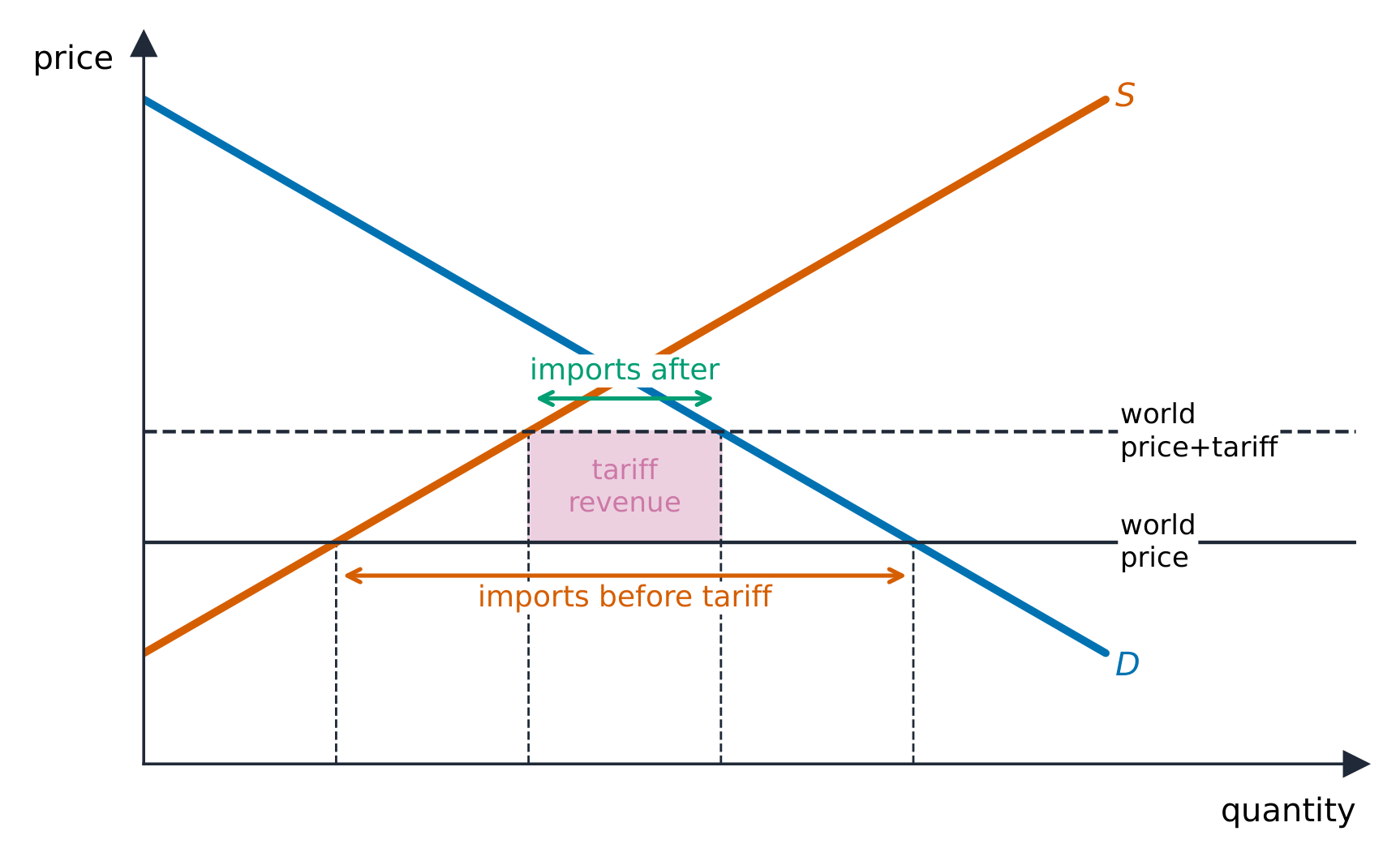
当一个国家以一个世界价格(world price)开放贸易时:

一项关税提高国内供给、削减需求,并缩小进口
  • 若世界价格低于国内价格,这个国家进口(imports)——消费者获得的多于生产者失去的,所以总剩余上升。
  • 若世界价格高于国内价格,这个国家出口(exports)——生产者获得的多于消费者失去的。

一项关税(tariff)(对进口的一项税)或一项配额(quota)(对进口的一个限制)提高国内价格、帮助国内生产者、更多地伤害消费者,并造成无谓损失。自由贸易最大化总剩余,这是支持它的核心效率论据。

词汇表 训练
英文 中文 拼音
world price 世界价格 shì jiè jià gé
imports 进口 jìn kǒu
exports 出口 chū kǒu
tariff 关税 guān shuì
quota 配额 pèi é
2.9

考试技巧

  • 把沿一条曲线的一个移动(自身价格)与一个移动(一个决定因素)分开;一个单一移动给一个确定的结果,一个双重移动使一个变量不确定。
  • 计算弹性 $E_d=|\%\Delta Q \div \%\Delta P|$;富有弹性($>1$)意味着一次降价提高总收入,缺乏弹性($<1$)降低它。
  • 读交叉价格弹性(替代品 $+$、互补品 $-$)和收入弹性(正常 $+$、低档 $-$)的符号。
  • 给一个税或价格管制的消费者/生产者剩余无谓损失涂阴影;归宿落在更缺乏弹性的一侧。
  • 一个在均衡之下的价格上限造成一个短缺;一个在均衡之上的价格下限造成一个过剩。

本主题的互动课程

逐步学习,并即时检测练习。

AP 微观经济学历年真题

AP 微观经济学的更多主题

登录或创建账号

IGCSE, A-Level & AP