Price Elasticity of Supply · 供给价格弹性
| English | 中文 | Pinyin · 拼音 |
|---|---|---|
| price elasticity of supply/praɪs ɪlæˈstɪsɪti ɒv səˈplaɪ/ | 供给价格弹性 | gōng jǐ jià gé tán xìng |
| midpoint (arc) method/ˈmɪdpɔɪnt ˈmeθəd/ | 中点法 | zhōng diǎn fǎ |
| elastic/ɪˈlæstɪk/ | 富有弹性 | fù yǒu tán xìng |
| perfectly inelastic/ˈpɜːfektlɪ ɪnɪˈlæstɪk/ | 完全无弹性 | wán quán wú tán xìng |
| inelastic/ɪnɪˈlæstɪk/ | 缺乏弹性 | quē fá tán xìng |
| perfectly elastic/ˈpɜːfektlɪ ɪˈlæstɪk/ | 完全弹性 | wán quán tán xìng |
| time horizon/taɪm həˈraɪzn/ | 时间跨度 | shí jiān kuà dù |
| spare capacity/speə kəˈpæsɪti/ | 闲置产能 | xián zhì chǎn néng |
Can sellers react in time?
- A price jump is an invitation to sell more — but can sellers actually do it?
- A baker can bake extra loaves by tonight; an oil field takes years to expand.
- How quickly quantity supplied responds to price is its own kind of elasticity.
- It is called price elasticity of supply 供给价格弹性 (PES).
卖家来得及反应吗?
- 价格跳涨是一份多卖的邀请——但卖家能做到吗?
- 面包师今晚就能多烤面包;油田却要好几年才能扩产。
- 供给量对价格反应有多快,是它自己的一种弹性。
- 它叫做供给价格弹性(price elasticity of supply,PES)。
Measuring PES
- PES answers: "if price changes by 1%, by what % does quantity supplied change?"
- Formula: $\text{PES} = \dfrac{\%\,\Delta\,\text{quantity supplied}}{\%\,\Delta\,\text{price}}$.
- Because price and quantity supplied move together, PES is normally positive.
- Use the same midpoint (arc) method 中点法 as PED: divide each change by the average of the two values.
衡量 PES
- PES 回答:"如果价格变动 1%,供给量变动百分之几?"
- 公式:$\text{PES} = \dfrac{\%\,\Delta\,\text{quantity supplied}}{\%\,\Delta\,\text{price}}$。
- 因为价格与供给量同向变动,PES 通常是正的。
- 用与 PED 相同的中点法(midpoint method):把每个变化除以两个值的平均。
Price elasticity of supply is normally: · 供给价格弹性通常是:
Supply obeys a direct relationship, so PES is positive. · 供给遵循正向关系,所以 PES 为正。
Price rises causing a 30% rise in quantity supplied and a 10% rise in price. What is PES? · 价格上涨使供给量上升 30%,价格上升 10%。PES 是多少?
$\text{PES} = 30\% \div 10\% = 3$ — elastic supply. · $\text{PES} = 30\% \div 10\% = 3$ —— 富有弹性的供给。
From elastic to perfectly inelastic
- Elastic 富有弹性: $\text{PES} > 1$ — output changes a lot. Inelastic 缺乏弹性: $\text{PES} < 1$ — output barely moves.
- Perfectly elastic 完全弹性: $\text{PES} = \infty$, a horizontal line — any amount at one price.
- Perfectly inelastic 完全无弹性: $\text{PES} = 0$, a vertical line — a fixed quantity no matter the price.
从富有弹性到完全无弹性
- 富有弹性(elastic):$\text{PES} > 1$ —— 产量变化很大。缺乏弹性(inelastic):$\text{PES} < 1$ —— 产量几乎不动。
- 完全弹性(perfectly elastic):$\text{PES} = \infty$,一条水平线 —— 在同一价格下提供任意数量。
- 完全无弹性(perfectly inelastic):$\text{PES} = 0$,一条竖直线 —— 无论价格如何,数量固定。
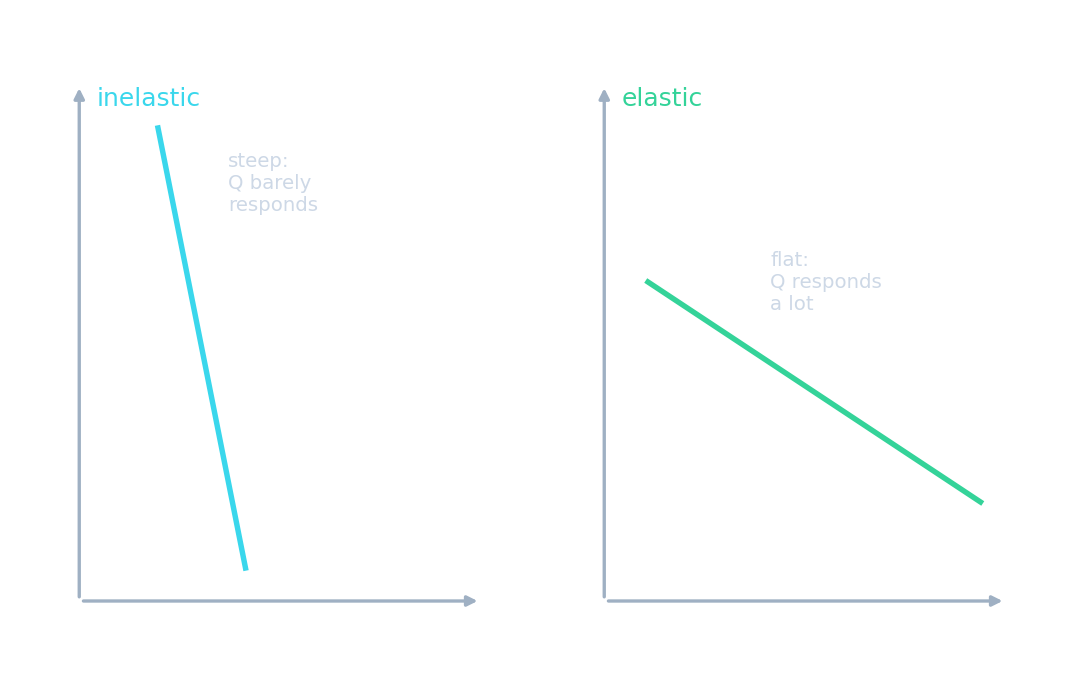
Elastic or inelastic supply? · 供给富有弹性还是缺乏弹性?
Supply is more elastic when firms can change output quickly — with spare capacity or plenty of time. It is inelastic when quantity is fixed. · 当企业能迅速改变产量时(有闲置产能或充足时间),供给更有弹性;当数量固定时,供给缺乏弹性。
A supply curve drawn as a vertical line has a PES of: · 画成一条竖直线的供给曲线,其 PES 为:
A vertical supply means quantity is fixed no matter the price — PES = 0. · 竖直的供给意味着无论价格如何数量都固定——PES = 0。
What makes supply elastic
- Time horizon 时间跨度: given more time, firms build, hire, and adjust — so supply is far more elastic in the long run.
- Spare capacity 闲置产能: idle machines and spare workers let a firm raise output quickly.
- With no spare capacity and no time, supply is stuck — inelastic.
什么让供给更有弹性
- 时间跨度(time horizon):时间越长,企业能建厂、招人、调整——所以供给在长期富有弹性得多。
- 闲置产能(spare capacity):闲置的机器和空余的工人,让企业能迅速提高产量。
- 既没有闲置产能、又没有时间,供给就被卡住了——缺乏弹性。
Supply is usually more elastic in the long run than in the short run. · 供给在长期通常比短期更有弹性。
Given more time, firms can build capacity and hire, so output responds more. · 有更多时间,企业能扩建产能、招人,所以产量反应更大。
Idle machines and unused workers give a firm ______ capacity, which makes supply more elastic. · 闲置的机器和空余的工人给企业______产能,这让供给更有弹性。
Spare capacity lets output rise quickly when price rises. · 闲置产能让产量在价格上升时迅速提高。
Select all · 所有 that make supply more elastic. · 选出所有让供给更有弹性的因素。
Time, spare capacity and easy storage all let quantity respond; a fixed quantity is inelastic. · 时间、闲置产能和易储存都让数量能够反应;固定数量则缺乏弹性。
PES = %ΔQ supplied ÷ %ΔP (normally positive, via the midpoint method). $\text{PES}>1$ is elastic, $<1$ inelastic; a horizontal curve is perfectly elastic, a vertical one perfectly inelastic. Supply is more elastic with more time and spare capacity.
PES = 供给量变动% ÷ 价格变动%(通常为正,用中点法)。$\text{PES}>1$ 为富有弹性,$<1$ 为缺乏弹性;水平曲线是完全弹性,竖直曲线是完全无弹性。时间更长、有闲置产能时,供给更有弹性。