| Enduring Understanding | Learning Objective | Essential Knowledge |
|---|---|---|
MKT-1 | MKT-1.A |
|
AP 微观经济学
学习建议
AP 微观经济学涵盖稀缺与机会成本、供给与需求、弹性、生产与成本、四种市场结构、要素市场,以及市场失灵与政府干预。这是一份不大但要学透的考纲。
图就是答案。自由作答的大部分分数给的是标注正确的图——写出坐标轴名称、标注曲线、标出新均衡点、画出移动方向。只用文字解释一次你没有画出来的移动,得分很少。
要练到能快速、准确地手绘,尤其是成本曲线和完全竞争与垄断的对比,它们几乎每次都考。
笔记覆盖全部六个单元,成本曲线与市场图是画出来的,而不是用文字描述。带评分标准的历年FRQ在资料库中。微观的给分常在于画出移动并说明其结果,所以示范答案始终以图为中心。
-
1
基本经济概念
1.1
稀缺性
大纲
来源:美国大学理事会 AP 课程与考试说明
经济学(economics)以一个顽固的事实开始:人们的欲望实际上是无限的,但满足它们的资源(resources)是有限的。这个差距是稀缺性(scarcity),而它是经济学存在的原因——若一切都免费而无穷,就没有什么要决定的。
这些资源(生产要素(factors of production))是土地(land)(自然资源)、劳动(labor)(人的努力)、资本(capital)(工具、机器、建筑),和企业家才能(entrepreneurship)(组织其他三个并承担风险)。因为这些是稀缺的,每个经济都必须回答三个问题:生产什么、如何生产,和为谁生产。
稀缺性迫使选择,而每个选择都有一个机会成本(opportunity cost)——你放弃的下一个最好的替代的价值。这一个思想贯穿整个课程:任何东西的真正成本是你为得到它而牺牲的,不只是你付的钱。
词汇表 训练英文 中文 拼音 Economics/ˌiːkəˈnɒmɪks/ 经济学 jīng jì xué resources/rɪˈzɔːsɪz/ 资源 zī yuán scarcity/ˈskeəsɪti/ 稀缺性 xī quē xìng factors of production/ˈfæktəz ɒv prəˈdʌkʃn/ 生产要素 shēng chǎn yào sù labor/ˈleɪbə/ 劳动 láo dòng capital/ˈkæpɪtl/ 资本 zī běn entrepreneurship/ˌɒntrɪprəˈnjʊəʃɪp/ 企业家才能 qǐ yè jiā cái néng opportunity cost/ɒpəˈtjuːnɪti kɒst/ 机会成本 jī huì chéng běn 1.2
资源配置与经济体制
大纲
Enduring Understanding Learning Objective Essential Knowledge MKT-1
Most resources are scarce, and in most cases the use of resources involves constraints and trade-offs.MKT-1.B
Define how resource allocation is influenced by the economic system adopted by society.- MKT-1.B.1 Resource allocation involves answering three basic questions: What goods and services to produce? How to produce those goods and services? And who consumes those goods and services?
- MKT-1.B.2 Resource allocation is significantly influenced by the economic system adopted by society, such as command economy, market economy, or mixed economy. Each system involves a particular set of institutional arrangements and a coordinating mechanism for allocating scarce resources and distributing output.
来源:美国大学理事会 AP 课程与考试说明
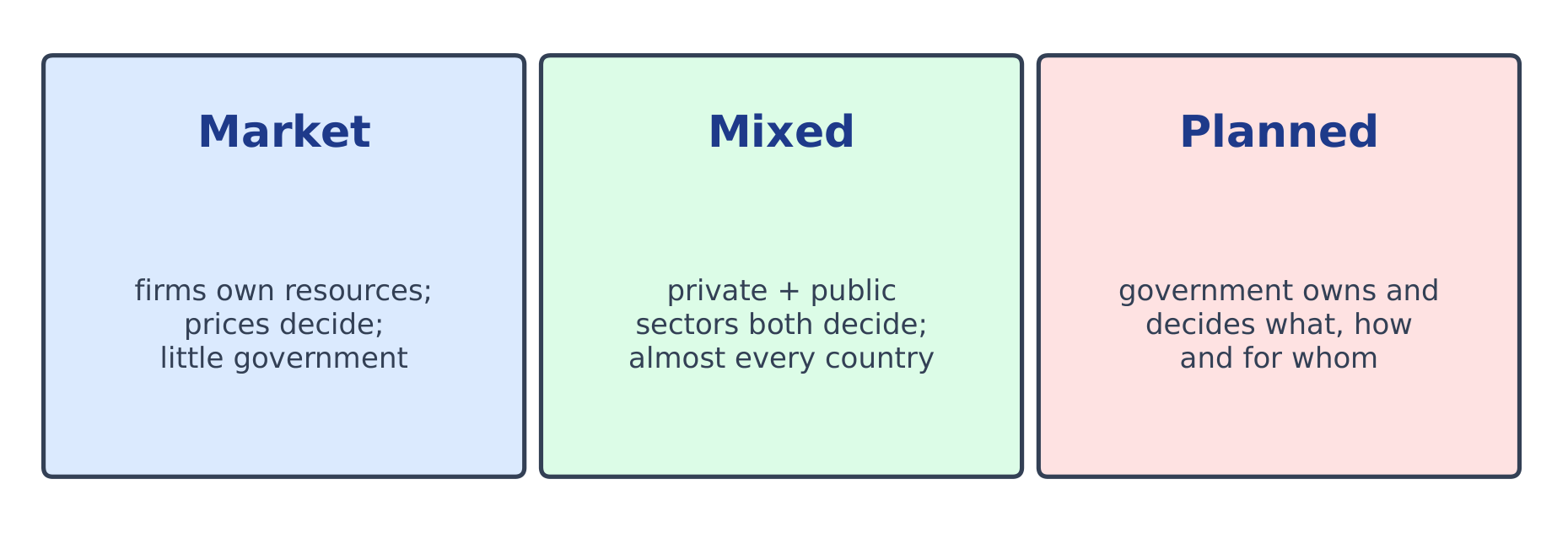
一个经济体制(economic system)是一个社会回答三个问题的方式。
经济体制形成一个从自由市场到完全政府计划的谱 - 在一个市场经济(market economy)里,私人买者和卖者通过价格决定;自利和竞争协调他们("看不见的手")。
- 在一个计划经济(command economy)里,政府拥有资源并计划生产。
- 真实经济是混合经济(mixed)——大多是市场,政府提供一些物品并纠正问题。
市场的关键优势是价格自动携带信息和激励(incentives),不需要中央计划者。
探索Explore how prices coordinate a market
In a market economy no one is in charge, yet the price finds the level where quantity supplied meets quantity demanded. Drag the demand and supply lines and watch the equilibrium price act as a signal and an incentive.
词汇表 训练英文 中文 拼音 economic system/ˌiːkəˈnɒmɪk ˈsɪstəm/ 经济体制 jīng jì tǐ zhì market economy/ˈmɑːkɪt ɪˈkɒnəmi/ 市场经济 shì chǎng jīng jì command economy/kəˈmænd ɪˈkɒnəmi/ 计划经济 jì huà jīng jì mixed/mɪkst/ 混合经济 hùn hé jīng jì incentives/ɪnˈsentɪvz/ 激励 jī lì 1.3
生产可能性曲线
大纲
Enduring Understanding Learning Objective Essential Knowledge MKT-1
Most resources are scarce, and in most cases the use of resources involves constraints and trade-offs.MKT-1.C
a. Define (using graphs as appropriate) the production possibilities curve (PPC) and related terms.
b. Explain (using graphs as appropriate) how the production possibilities curve (PPC) illustrates opportunity costs, trade-offs, inefficiency, efficiency, and economic growth or contraction under various conditions.
c. Calculate (using data from PPCs or tables as appropriate) opportunity cost.- MKT-1.C.1 The PPC is a model used to show the trade-offs associated with allocating resources.
- MKT-1.C.2 The PPC can be used to illustrate the concepts of scarcity, opportunity cost, efficiency, underutilized resources, and economic growth or contraction.
- MKT-1.C.3 The shape of the PPC depends on whether opportunity costs are constant, increasing, or decreasing.
- MKT-1.C.4 The PPC can shift due to changes in factors of production as well as changes in productivity/technology.
- MKT-1.C.5 Economic growth results in an outward shift of the PPC.
来源:美国大学理事会 AP 课程与考试说明
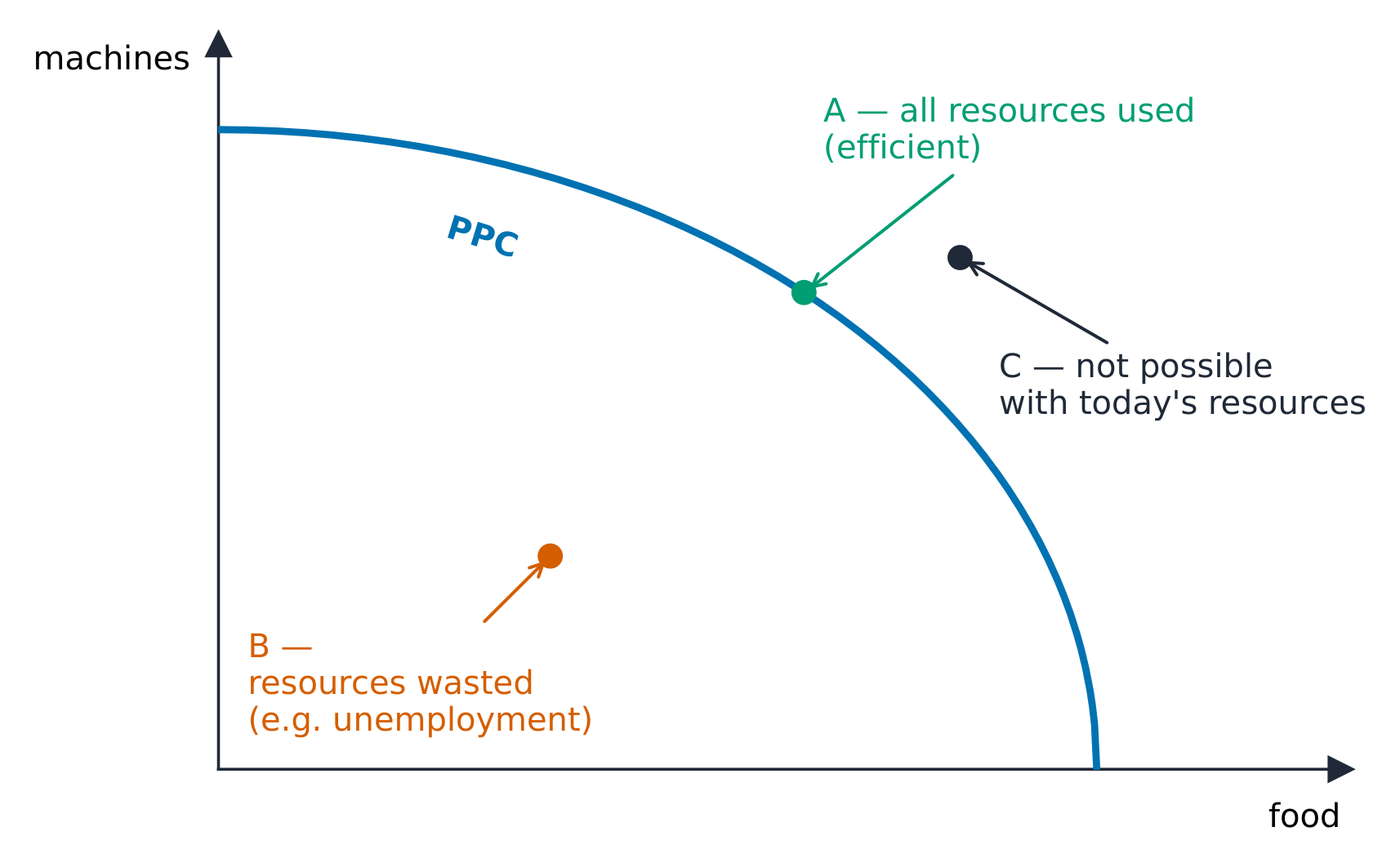
生产可能性边界 生产可能性曲线(PPC)(production possibilities curve)显示一个经济用它的资源和技术充分而高效地使用能生产的两种物品的最大组合。
生产可能性曲线上、内和外的点 - 曲线上的点是有效率(efficient)的;里面的点是低效的(浪费的或失业的资源);外面的点当前是无法实现(unattainable)的。
- PPC 向下的斜率显示机会成本:制造更多一种物品意味着制造更少另一种。一个点的斜率就是水平轴上物品的机会成本。
- 一条向外凸(凹)的 PPC 显示增加的机会成本——资源不等同地适合两种物品,所以制造更多一种要花越来越多另一种。一条直线 PPC 意味着恒定的机会成本。
- 经济增长(economic growth)(更多资源、更好技术)使整条曲线向外移动。
考试技能: 准备好从一条 PPC 读机会成本、决定一个点是有效率/低效/无法实现,并解释什么使曲线移动。
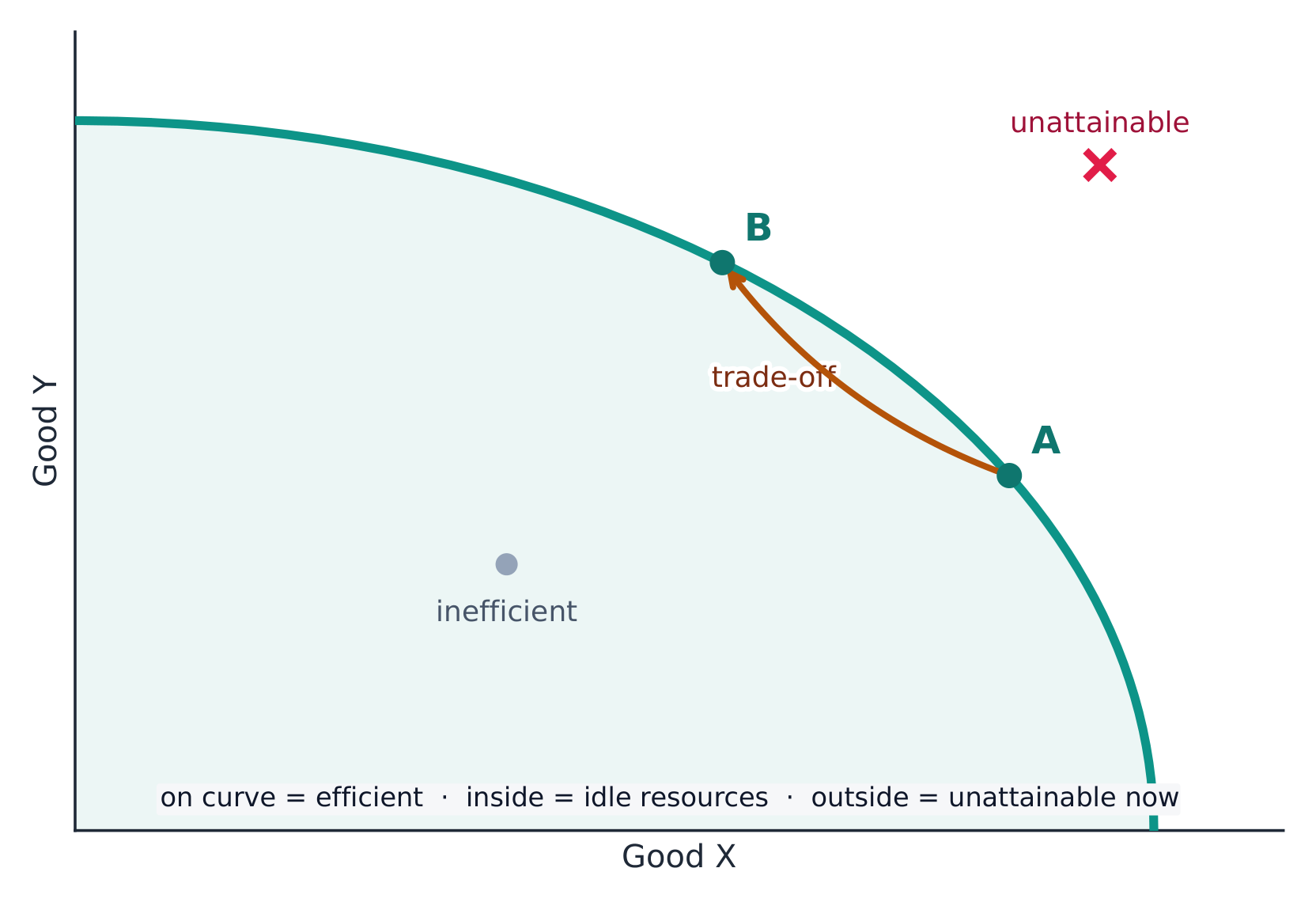
一条生产可能性曲线:有效率、低效和无法实现的点 探索Explore the production possibilities curve
Making more of one good means giving up some of the other — that trade-off is the opportunity cost, and the bowed shape shows the law of increasing opportunity cost. Drag along the curve, then grow the economy to push the whole frontier out.
词汇表 训练英文 中文 拼音 production possibilities curve (PPC)/prəˈdʌkʃn ˌpɒsəˈbɪlɪtiz kɜːv/ 生产可能性曲线 shēng chǎn kě néng xìng qū xiàn efficient/ɪˈfɪʃənt/ 有效率 yǒu xiào lǜ unattainable/ʌnəˈteɪnəbl/ 无法实现 wú fǎ shí xiàn Economic growth/ˌiːkəˈnɒmɪk ɡrəʊθ/ 经济增长 jīng jì zēng zhǎng 1.4
比较优势与贸易收益
大纲
Enduring Understanding Learning Objective Essential Knowledge MKT-2
The consequences of scarcity can be mitigated through specialization in production and by exchange.MKT-2.A
a. Define absolute advantage and comparative advantage.
b. Determine (using data from PPCs or tables as appropriate) absolute and comparative advantage.- MKT-2.A.1 Absolute advantage describes a situation in which an individual, business, or country can produce more of a good or service than any other producer with the same quantity of resources.
- MKT-2.A.2 Comparative advantage describes a situation in which an individual, business, or country can produce a good or service at a lower opportunity cost than another producer.
MKT-2.B
a. Explain (using data from PPCs or tables as appropriate) how specialization according to comparative advantage with appropriate terms of trade can lead to gains from trade.
b. Calculate (using data from PPCs or tables as appropriate) mutually beneficial terms of trade.- MKT-2.B.1 Production specialization according to comparative advantage, not absolute advantage, results in exchange opportunities that lead to consumption possibilities beyond the PPC.
- MKT-2.B.2 Comparative advantage and opportunity costs determine the terms of trade for exchange under which mutually beneficial trade can occur.
来源:美国大学理事会 AP 课程与考试说明
两个生产者能通过专业化(specializing)都从贸易获益。
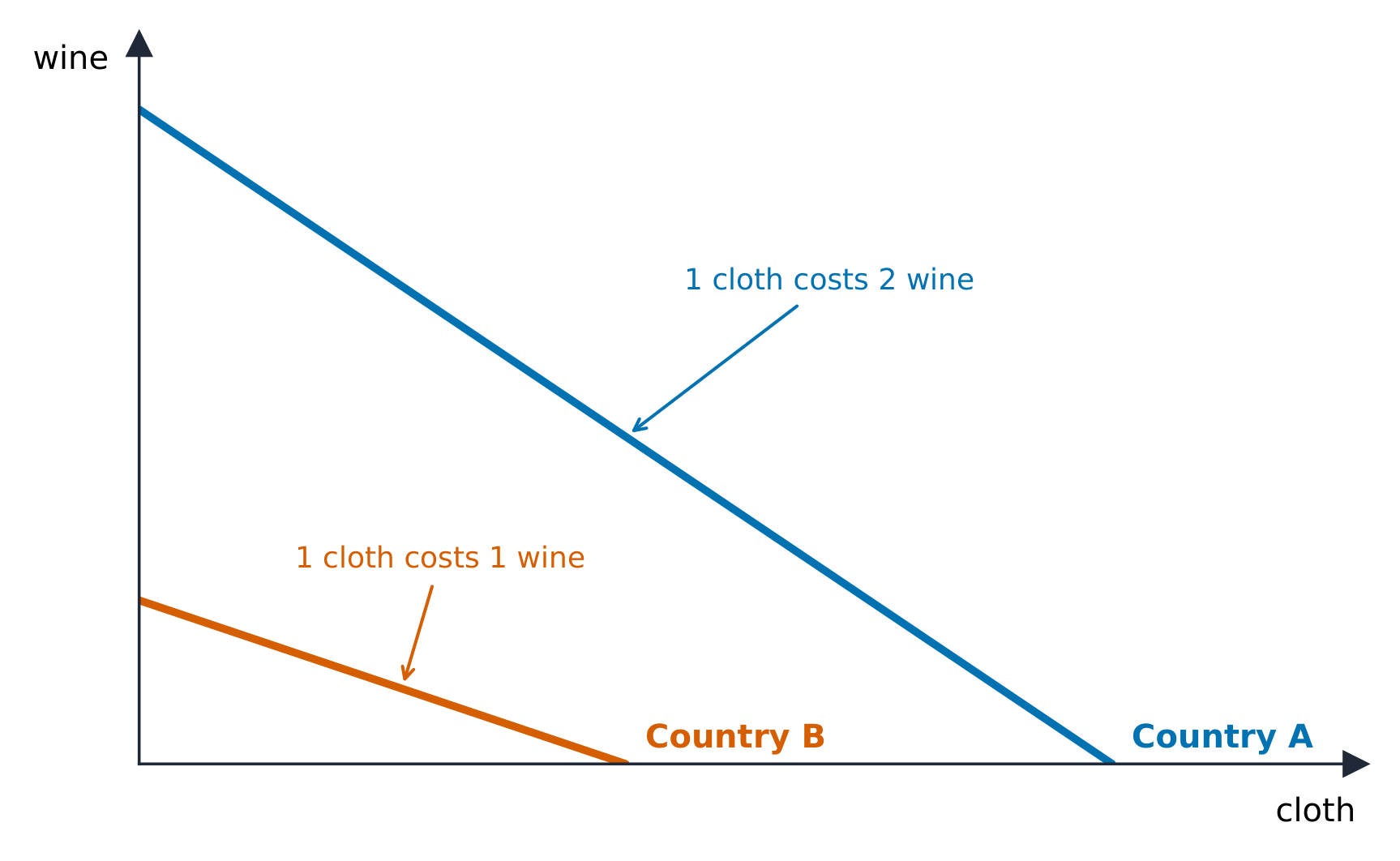
比较优势来自斜率不同的生产可能性曲线 - 一个生产者在一种物品上有一个绝对优势(absolute advantage),若它能用相同的资源制造更多它。
- 一个生产者有一个比较优势(comparative advantage),若它对那种物品有更低的机会成本。比较优势——不是绝对——决定谁应当专业化。
- 从产出数据计算机会成本:对每个生产者,一单位物品 X 值(Y 的单位数)$\div$(X 的单位数)。放弃更少 Y 的生产者应当制造 X。
- 若它们以它们两个机会成本之间的一个比率交易,两侧都获益——贸易条件(terms of trade)。按比较优势专业化让总产出超过任一方单独能制造的,所以消费能位于每个生产者自己 PPC 的外面。
Worked example. 安娜每天能制造 $20$ 件衬衫或 $10$ 张桌子;本能制造 $12$ 件衬衫或 $12$ 张桌子。对安娜一张桌子值 $\tfrac{20}{10}=2$ 件衬衫;对本它值 $\tfrac{12}{12}=1$ 件衬衫。本放弃更少衬衫,所以本专门于桌子而安娜于衬衫。任何每桌子在 $1$ 和 $2$ 件衬衫之间的贸易条件——比如说 $1.5$ ——使两者都比单独生产更好。
考试技能: 这些计算几乎每年出现——练习从产出表和投入表两者找到比较优势,并陈述一个有效的贸易条件范围。
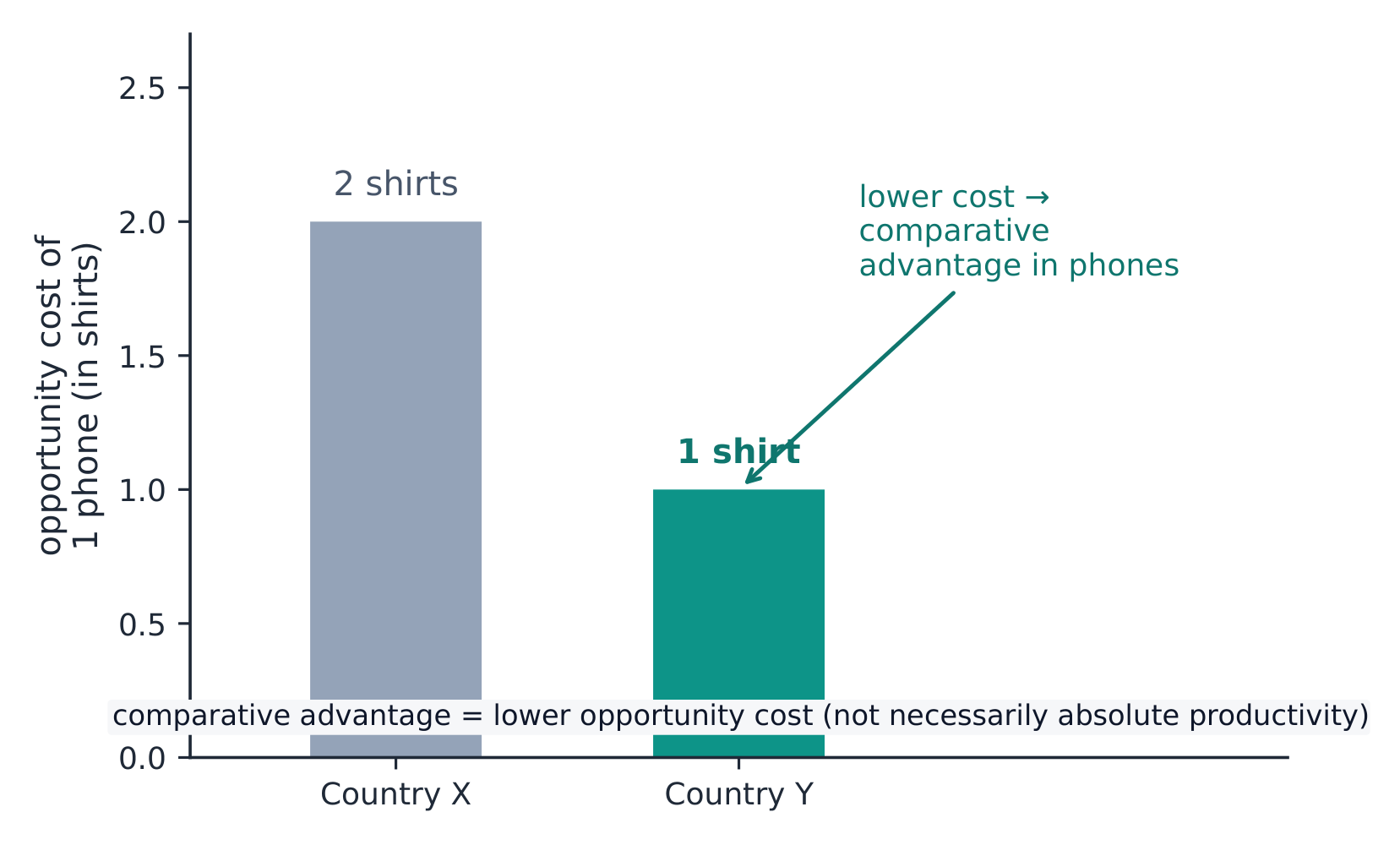
比较优势归于机会成本更低的生产者 
Container shipping: comparative advantage and trade let countries specialise and gain 探索See why trade lets you consume beyond the frontier
A producer should specialize where its opportunity cost is lowest, then trade for the rest. Because the terms of trade lie between the two producers' costs, trade lets a country consume outside its own production frontier.
词汇表 训练英文 中文 拼音 specializing/ˈspeʃəlaɪzɪŋ/ 专业化 zhuān yè huà absolute advantage/ˈæbsəluːt ədˈvæntɪdʒ/ 绝对优势 jué duì yōu shì comparative advantage/kəmˈpærətɪv ədˈvæntɪdʒ/ 比较优势 bǐ jiào yōu shì terms of trade/tɜːmz ɒv treɪd/ 贸易条件 mào yì tiáo jiàn 1.5
成本收益分析
大纲
Enduring Understanding Learning Objective Essential Knowledge CBA-1
Rational economic decisions require the evaluation of costs and benefits.CBA-1.A
a. Define opportunity cost.
b. Explain the opportunity costs associated with choices.
c. Calculate the opportunity costs associated with choices.- CBA-1.A.1 Rational agents consider opportunity costs, whether implicit or explicit, when calculating the total economic costs of any decision.
- CBA-1.A.2 Total benefits form the metric "utility" for consumers and total revenue for firms.
CBA-1.B
a. Explain a decision by comparing total benefits and total costs (using a table or a graph when appropriate).
b. Calculate total benefits and total costs (using a table or graph where appropriate).- CBA-1.B.1 Total net benefits, the difference between total benefits and total costs, are maximized at the optimal choice.
- CBA-1.B.2 Some decisions permit rational agents to look at only marginal benefit and marginal cost. Other decisions cannot be broken down into increments in this way and must be evaluated by looking at total benefits and total costs.
来源:美国大学理事会 AP 课程与考试说明
理性的决策者权衡收益对成本。一个行动只有当它的收益至少与它的成本一样大——包括机会成本——才值得。已经花掉且不可收回的钱是一个沉没成本(sunk cost)而应当在决定中被忽略:只有未来的成本和收益重要。
探索Weigh total benefit against total cost
A choice is worth it only while the benefit of one more unit beats its cost. Where total revenue meets total cost is the break-even point; past it, extra activity adds more cost than value.
词汇表 训练英文 中文 拼音 sunk cost/sʌŋk kɒst/ 沉没成本 chén mò chéng běn 1.6
边际分析与消费者选择
大纲
Enduring Understanding Learning Objective Essential Knowledge CBA-2
To determine the optimal level at which to pursue an activity whose total benefits exceed total cost, rational economic agents compare marginal benefits and marginal costs.CBA-2.A
a. Define the key assumptions of consumer choice theory.
b. Explain (using a table or graph as appropriate) how a rational consumer's decision making involves the use of marginal benefits and marginal costs.
c. Calculate (using a table or a graph when appropriate) how a rational consumer's decision making involves the use of marginal benefits and marginal costs.- CBA-2.A.1 Consumers face constraints and have to make optimal decisions accounting for these constraints.
- CBA-2.A.2 In a model of rational consumer choice, consumers are assumed to make choices so as to maximize their total utility.
- CBA-2.A.3 Consumers experience diminishing marginal utility in the consumption of goods and services.
- CBA-2.A.4 Consumers allocate their limited income to purchase the combination of goods that maximizes their utility by equating/comparing the marginal utility of the last dollar spent on each good.
- Exclusion statement: Indifference curves are beyond the scope of the course and the AP Exam, but equating the ratios of marginal utility to price is within the scope.
CBA-2.B
a. Define marginal analysis and related terms.
b. Explain a decision using marginal analysis (using a table or a graph when appropriate).- CBA-2.B.1 Marginal analysis involves comparing the additional benefit of increasing a given activity with the additional cost. Comparing marginal benefit (MB) with marginal cost (MC) helps individuals (firms) decide whether to increase, decrease, or maintain their consumption (production) levels.
- CBA-2.B.2 The optimal quantity at any point in time does not depend on fixed costs (sunk costs) or fixed benefits that have already been determined by past choices.
- CBA-2.B.3 The optimal quantity is achieved when marginal benefit is equal to marginal cost or where total benefit is maximized.
来源:美国大学理事会 AP 课程与考试说明
大多数真实的决定不是"全有或全无"而是"多一点或少一点"。边际分析(marginal analysis)把边际收益(marginal benefit)(多一单位的收益)与边际成本(marginal cost)(多一单位的成本)比较。
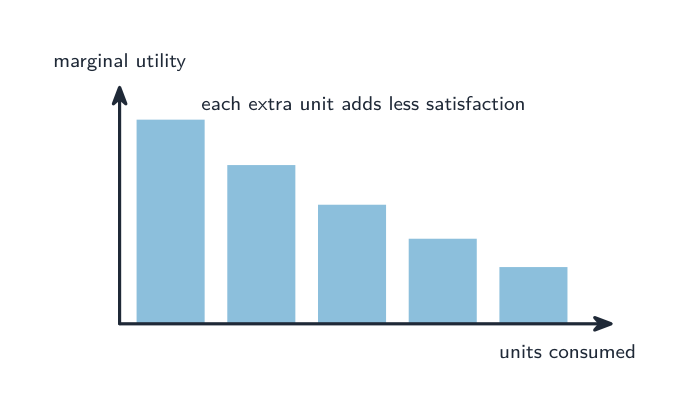
每消费一个额外单位给出更少的额外满足(边际效用递减) - 决策规则: 在边际收益 $>$ 边际成本时继续做这个活动;在 MB $=$ MC 处停止。那个点最大化净收益(总收益减总成本)。
- 消费者从物品得到效用(utility)(满足),但每个额外单位通常给出更少的增加满足——边际效用递减法则(law of diminishing marginal utility)。
- 一个消费者通过效用最大化规则(utility-maximizing rule)最大化总效用:花费使得每美元的边际效用在所有物品间相等,$\dfrac{MU_x}{P_x}=\dfrac{MU_y}{P_y}$,用尽整个预算。若一种物品每美元给出更多效用,买更多它直到比率均衡。
Worked example. 一个消费者在物品 X($MU_x=20$,$P_x=\$2$)和物品 Y($MU_y=15$,$P_y=\$1$)之间选择。每美元的效用对 X 是 $\tfrac{20}{2}=10$ 但对 Y 是 $\tfrac{15}{1}=15$。Y 每美元传递更多满足,所以消费者应当买更多 Y 和更少 X;当他们这样做时,$MU_y$ 下降而 $MU_x$ 上升,直到 $\tfrac{MU_x}{2}=\tfrac{MU_y}{1}$ 而预算被花掉。
考试技能: "MB = MC"逻辑和"每美元相等 MU"规则被反复考查——能够从一张表找到最优数量并解释为什么它是最优的。
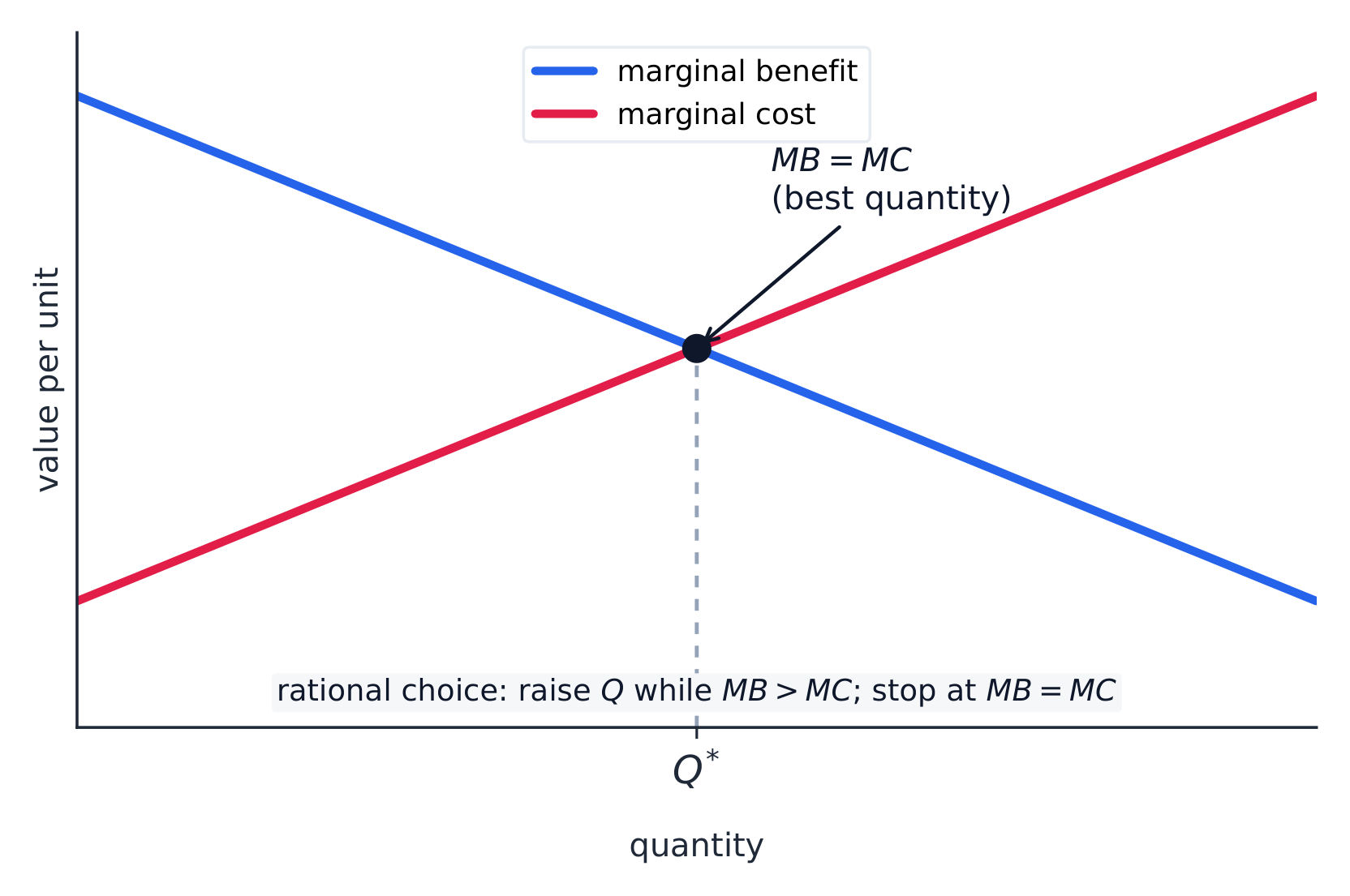
理性选择:在边际收益超过边际成本时继续,在它们相等处停止 词汇表 训练英文 中文 拼音 Marginal analysis/ˈmɑːdʒɪnl əˈnæləsɪs/ 边际分析 biān jì fēn xī marginal benefit/ˈmɑːdʒɪnl ˈbenɪfɪt/ 边际收益 biān jì shōu yì marginal cost/ˈmɑːdʒɪnl kɒst/ 边际成本 biān jì chéng běn utility/juːˈtɪlɪti/ 效用 xiào yòng law of diminishing marginal utility/lɔː ɒv dɪˈmɪnɪʃɪŋ ˈmɑːdʒɪnl juːˈtɪlɪti/ 边际效用递减法则 biān jì xiào yòng dì jiǎn fǎ zé 1.6
考试技巧
- 机会成本是放弃的下一个最好的替代;在任何决定中忽略沉没成本。
- 比较优势(更低的机会成本)决定专业化和贸易的收益。
- 应用边际分析:在 MB > MC 时继续做一个活动,在 MB = MC 处停止。
- 通过使物品间每美元的边际效用均衡来最大化效用。
- 从 PPC 斜率读机会成本;一条弯的曲线显示增加的成本。
-
2
供给与需求
2.1
需求
大纲
Enduring Understanding Learning Objective Essential Knowledge MKT-3
Individuals and firms respond to incentives and face constraints.MKT-3.A
a. Define (using graphs as appropriate) key terms and factors related to consumer decision making and the law of demand.
b. Explain (using graphs as appropriate) the relationship between price and quantity demanded and how buyers respond to incentives and constraints.- MKT-3.A.1 A well-defined system of property rights is necessary for the market system to function well.
- MKT-3.A.2 Economic agents respond to incentives.
- MKT-3.A.3 Individuals often respond to incentives, such as those presented by prices, but also face constraints, such as income, time, and legal and regulatory frameworks.
- MKT-3.A.4 The law of demand suggests that a change in the own-price causes a change in quantity demanded in the opposite direction and a movement along a demand (marginal benefit) curve.
- MKT-3.A.5 The conceptual relationship between price and quantity stated by the law of demand leads to downward-sloping demand curves explained by the income effect and substitution effect and/or by diminishing marginal utility.
- MKT-3.A.6 The market demand curve (schedule) is derived from the summation of individual demand curves (schedules).
MKT-3.B
Explain (using graphs as appropriate) buyers' responses to changes in incentives and constraints.- MKT-3.B.1 Changes in the determinants of consumer demand can cause the demand curve to shift.
来源:美国大学理事会 AP 课程与考试说明
供求:需求右移使价与量上升 一个市场只有在产权(property rights)明确定义时才运作——所有者能使用、把他人排除在外并交易他们的资源;没有产权,价格无法协调交换。在那个框架内,两股力量是需求和供给。
需求(demand)是一种物品的价格和买者愿意并能够购买的数量之间的关系。需求定律(law of demand)说价格和需求量朝相反方向移动,所以需求曲线向下倾斜。两个原因:替代效应(substitution effect)(当一种物品变贵时,买者转向替代品)和收入效应(income effect)(一个更高的价格缩小实际购买力)。
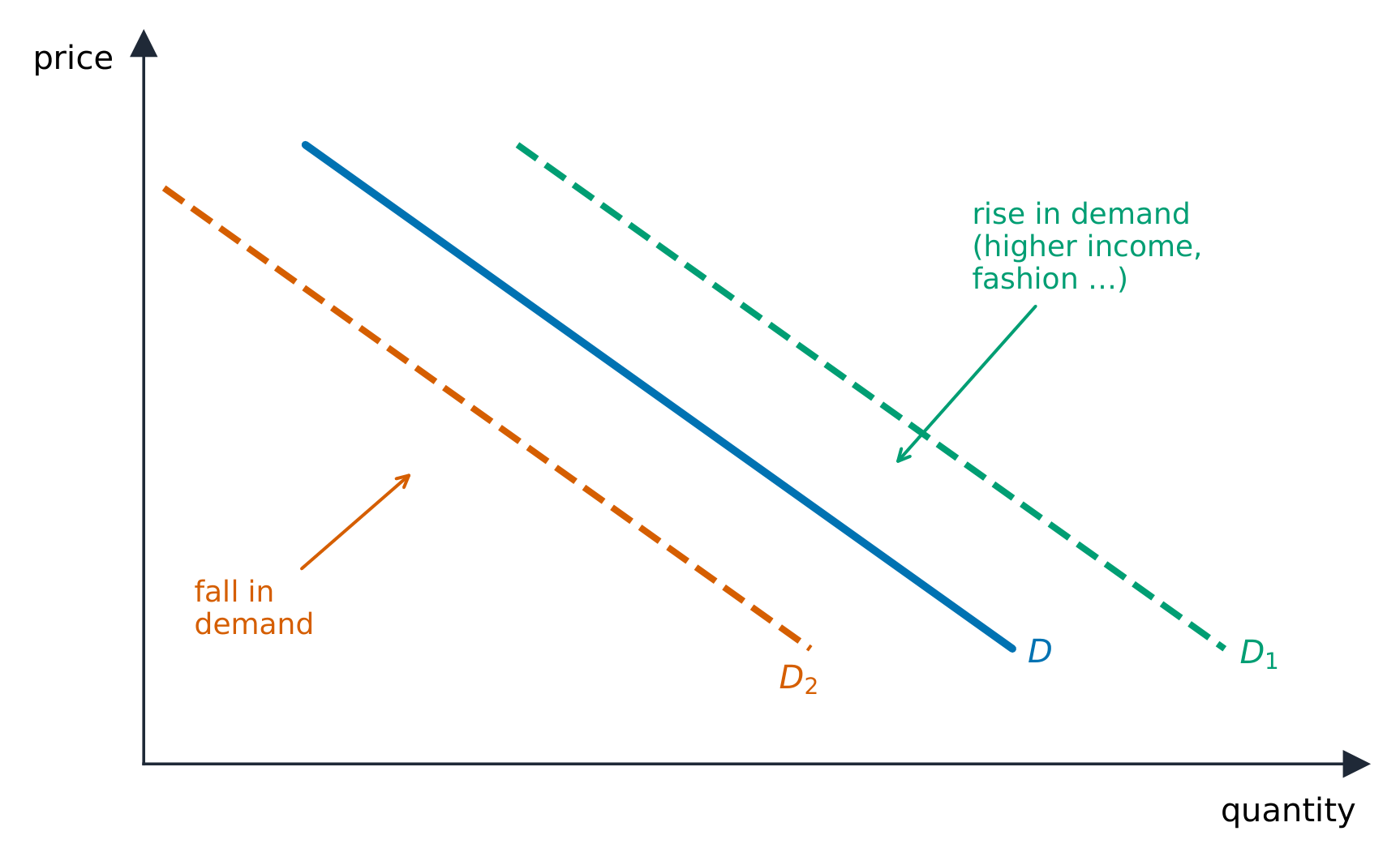
需求曲线向下倾斜;收入、偏好和相关价格移动它 把一个需求量的变化(沿曲线的一个移动,只由物品自身价格造成)与一个需求的变化(整条曲线的一个移动)区分开。需求随决定因素(determinants)移动,记作 TRIBE:
- Tastes/preferences(偏好),
- Related goods(相关物品)——一个替代品(substitute)价格的上升提高需求;一个互补品(complement)价格的上升降低它,
- Income(收入)——对一个正常商品(normal good)更多收入提高需求;对一个低档商品(inferior good)它降低它,
- Buyers(买者)(消费者数量),
- Expectations(预期)未来价格或收入。
市场需求曲线是每个个体买者需求曲线的水平相加(horizontal summation)——在每个价格上,把所有买者想要的数量加起来。这就是为什么更多的买者(上面的 B)把整条市场曲线向右移动。
探索Shift demand and watch price and quantity
The demand curve slopes down: lower price, more wanted. A change in income, tastes or related-good prices shifts the whole curve, moving the equilibrium.
词汇表 训练英文 中文 拼音 property rights/ˈprɒpəti raɪts/ 产权 chǎn quán Demand/dɪˈmænd/ 需求 xū qiú law of demand/lɔː ɒv dɪˈmænd/ 需求定律 xū qiú dìng lǜ substitution effect/ˌsʌbstɪˈtjuːʃn ɪˈfekt/ 替代效应 tì dài xiào yìng income effect/ˈɪŋkʌm ɪˈfekt/ 收入效应 shōu rù xiào yìng determinants/dɪˈtɜːmɪnənts/ 决定因素 jué dìng yīn sù substitute/ˈsʌbstɪtjuːt/ 替代品 tì dài pǐn complement/ˈkɒmplɪmənt/ 互补品 hù bǔ pǐn normal good/ˈnɔːml ɡʊd/ 正常商品 zhèng cháng shāng pǐn inferior good/ɪnˈfɪərɪə ɡʊd/ 低档商品 dī dàng shāng pǐn horizontal summation/ˌhɒrɪˈzɒntl sʌˈmeɪʃn/ 水平相加 shuǐ píng xiāng jiā Supply/səˈplaɪ/ 供给 gōng jǐ 2.2
供给
大纲
Enduring Understanding Learning Objective Essential Knowledge MKT-3
Individuals and firms respond to incentives and face constraints.MKT-3.C
a. Define (using graphs as appropriate) the law of supply.
b. Explain (using graphs as appropriate) the relationship between price and quantity supplied.- MKT-3.C.1 A change in own-price causes a change in quantity supplied in the same direction and a movement along a supply curve.
- MKT-3.C.2 The market supply curve (schedule) is derived from the summation of individual supply curves (schedules). The market supply curve is upward-sloping.
MKT-3.D
Explain (using graphs as appropriate) producers' (sellers') responses to changes in incentives and technology.- MKT-3.D.1 Changes in the determinants of supply can cause the supply curve to shift.
来源:美国大学理事会 AP 课程与考试说明
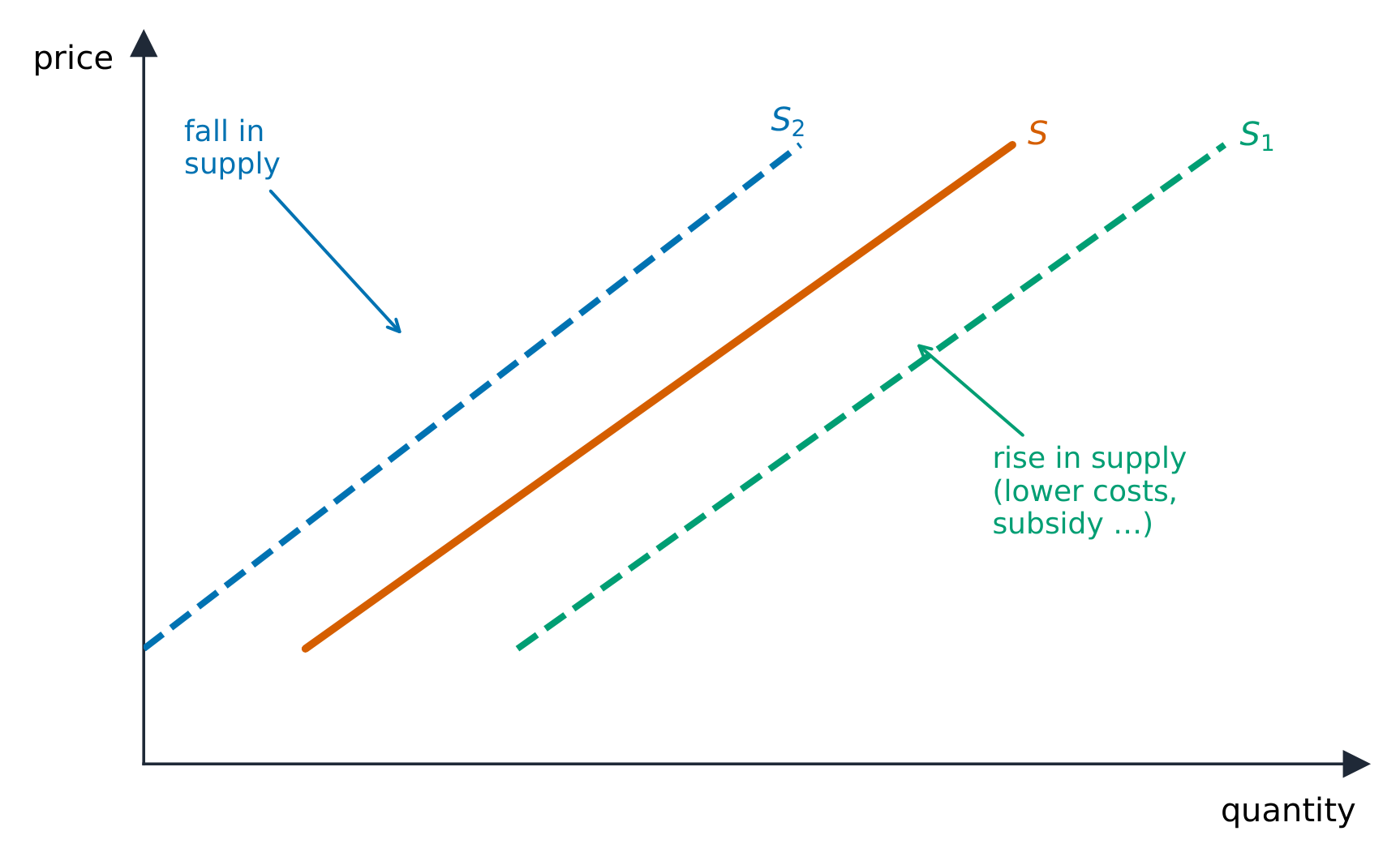
供给曲线的移动 供给(supply)是价格和卖者会提供的数量之间的关系。供给定律(law of supply):价格和供给量朝相同方向移动,所以供给曲线向上倾斜(更高的价格覆盖更高的边际成本并奖励更多产出)。
供给曲线向上倾斜;成本、技术、税和补贴移动它 再次把一个供给量的变化(沿曲线的移动,来自物品自身价格)与一个供给的变化(一个移动)分开。供给随投入价格、技术、税收和补贴(subsidies)、一个企业能制造的其他物品的价格、卖者数量,和预期移动。和需求一样,市场供给曲线是个体企业供给曲线的水平相加——在每个价格上,把所有企业提供的数量加起来——所以更多的卖者把市场供给向右移动。
考试技能: 在自由回答部分你必须画正确标注的供求图并在正确的方向移动正确的曲线——先决定事件是改变一个"自身价格"(沿曲线移动)还是一个决定因素(移动)。
词汇表 训练英文 中文 拼音 law of supply/lɔː ɒv səˈplaɪ/ 供给定律 gōng jǐ dìng lǜ subsidies/ˈsʌbsɪdiz/ 补贴 bǔ tiē 2.3
需求价格弹性
大纲
Enduring Understanding Learning Objective Essential Knowledge MKT-3
Individuals and firms respond to incentives and face constraints.MKT-3.E
a. Define measures of elasticity.
b. Explain (using graphs where appropriate) measures of elasticity and the impact of a given price change on total revenue or total expenditure.
c. Calculate (using data from a graph or a table as appropriate) measures of elasticity.- MKT-3.E.1 Economists use the concept of elasticity to measure the magnitude of percentage changes in quantity owing to any given changes in the own-price, income, and prices of related goods.
- MKT-3.E.2 Price elasticity of demand is measured by the percentage change in quantity demanded divided by the percentage change in price or the responsiveness of the quantity demanded to changes in price. Elasticity varies along a linear demand curve, meaning slope is not elasticity.
- MKT-3.E.3 Ranges of values of elasticity of demand are described as elastic or inelastic with the separating benchmark being a magnitude of 1, where the change in the price and the change in the quantity demanded are proportional.
- a. When the magnitude of the value of elasticity is greater than 1, the demand is described as being elastic with respect to that price in the range of the given change.
- b. When the magnitude of the value of elasticity is less than 1, the demand is described as being inelastic with respect to that price in the range of the given change.
- c. When the magnitude of the value of elasticity is equal to 1, the demand is described as being unit elastic with respect to that price in the range of the given change.
- MKT-3.E.4 The price elasticity of demand depends on certain factors such as the availability of substitutes.
- MKT-3.E.5 The impact of a given price change on total revenue or total expenditure will depend on whether demand is elastic, inelastic, or unit elastic.
来源:美国大学理事会 AP 课程与考试说明
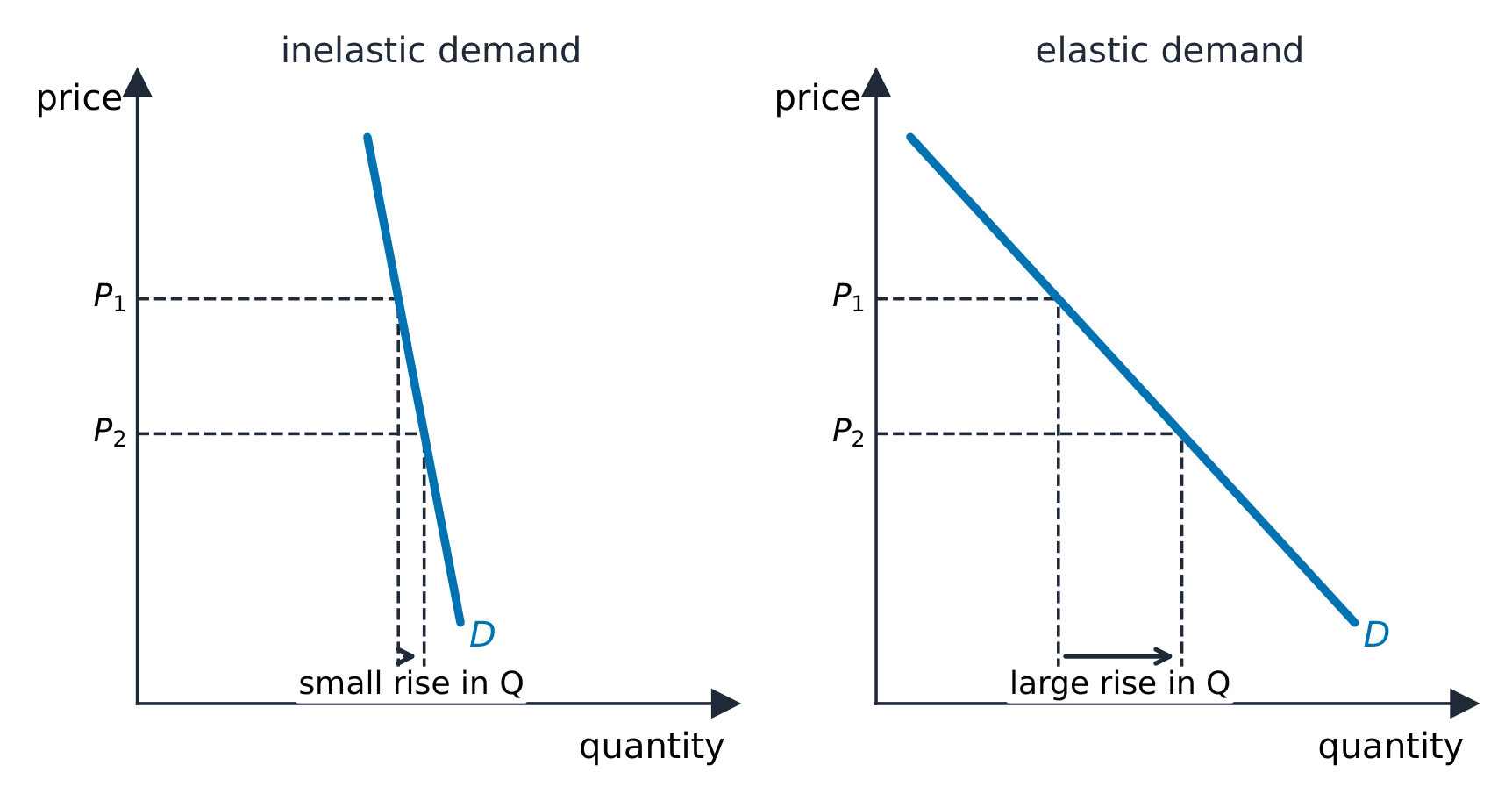
需求的价格弹性 需求价格弹性(price elasticity of demand)测量需求量对一个价格变化多有响应:
$$E_d=\left|\frac{\%\ \Delta\ \text{quantity demanded}}{\%\ \Delta\ \text{price}}\right|.$$缺乏弹性与富有弹性的需求:对一个价格变化的一个小与大的响应 - $E_d>1$:富有弹性(elastic)(数量强烈响应);
- $E_d<1$:缺乏弹性(inelastic)(数量几乎不响应);
- $E_d=1$:单位弹性(unit elastic)。
当有更多替代品、物品是一个奢侈品、它占收入的一个大份额,或买者有更多时间去调整时,需求更富有弹性。弹性与总收入(total revenue)($P\times Q$)联系:若需求富有弹性,一次降价提高收入;若缺乏弹性,一次降价降低它。沿一条直线需求曲线,弹性随着你向下移动而下降(顶部富有弹性、底部缺乏弹性)。
Worked example. 一次从 $\$10$ 到 $\$12$ 的价格上升(一个 $+20\%$ 的变化)使需求量从 $100$ 削减到 $85$(一个 $-15\%$ 的变化)。那么 $E_d=\left|\dfrac{-15\%}{20\%}\right|=0.75<1$,所以需求缺乏弹性。因为它缺乏弹性,价格上升提高总收入:从 $\$10\times100=\$1000$ 到 $\$12\times85=\$1020$。
探索Stretch price and measure elasticity
Price elasticity of demand is how strongly quantity responds to price. A steep curve is inelastic (small response); a shallow one is elastic (large response).
词汇表 训练英文 中文 拼音 Price elasticity of demand/praɪs ɪlæˈstɪsɪti ɒv dɪˈmænd/ 需求价格弹性 xū qiú jià gé tán xìng elastic/ɪˈlæstɪk/ 富有弹性 fù yǒu tán xìng inelastic/ɪnɪˈlæstɪk/ 缺乏弹性 quē fá tán xìng total revenue/ˈtəʊtl ˈrevənjuː/ 总收入 zǒng shōu rù 2.4
供给价格弹性
大纲
Enduring Understanding Learning Objective Essential Knowledge MKT-3
Individuals and firms respond to incentives and face constraints.MKT-3.E
a. Define measures of elasticity.
b. Explain (using graphs where appropriate) measures of elasticity and the impact of a given price change on total revenue or total expenditure.
c. Calculate (using data from a graph or a table as appropriate) measures of elasticity.- MKT-3.E.6 Price elasticity of supply is measured by the percentage change in quantity supplied divided by the percentage change in price, or the responsiveness of the quantity supplied to changes in price.
- MKT-3.E.7 Ranges of values of elasticity of supply are described as elastic or inelastic with the separating benchmark being a magnitude of 1, where the change in the price and the change in the quantity supplied are proportional.
- a. When the magnitude of the value of elasticity is greater than 1, the supply is described as being elastic with respect to that price in the range of the given change.
- b. When the magnitude of the value of elasticity is less than 1, the supply is described as being inelastic with respect to that price in the range of the given change.
- c. When the magnitude of the value of elasticity is equal to 1, the supply is described as being unit elastic with respect to that price in the range of the given change.
- MKT-3.E.8 The price elasticity of supply depends on certain factors such as the price of alternative inputs.
来源:美国大学理事会 AP 课程与考试说明
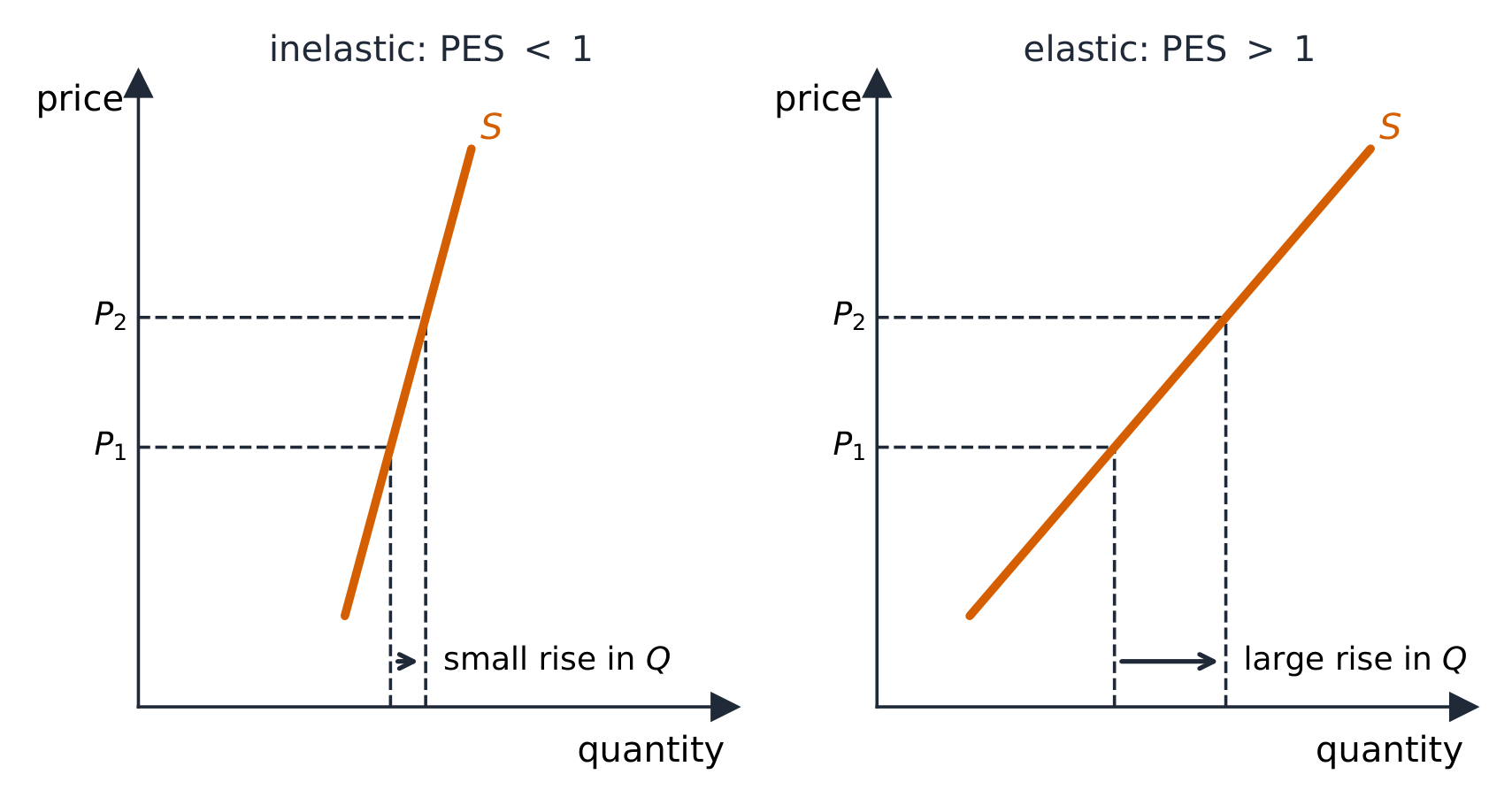
供给价格弹性(price elasticity of supply),$E_s=\dfrac{\%\ \Delta\ Q_s}{\%\ \Delta\ P}$,测量卖者多有响应。当企业能容易地调整产出时供给更富有弹性——闲置产能、可储存的物品,而最重要的是更多时间(供给在长期比短期更富有弹性)。
当 PES 低于 1 时同样的价格上升给出一个小的供给响应,高于 1 时一个大的 词汇表 训练英文 中文 拼音 Price elasticity of supply/praɪs ɪlæˈstɪsɪti ɒv səˈplaɪ/ 供给价格弹性 gōng jǐ jià gé tán xìng 2.5
其他弹性
大纲
Enduring Understanding Learning Objective Essential Knowledge MKT-3
Individuals and firms respond to incentives and face constraints.MKT-3.E
a. Define measures of elasticity.
b. Explain (using graphs where appropriate) measures of elasticity and the impact of a given price change on total revenue or total expenditure.
c. Calculate (using data from a graph or a table as appropriate) measures of elasticity.- MKT-3.E.9 Elasticity can be measured for any determinant of demand or supply, not just the price.
- MKT-3.E.10 Income elasticity of demand is measured by the percentage change in the quantity demanded divided by the percentage change in consumers' income. Economists use the income elasticity of demand to determine whether a good is normal or inferior.
- MKT-3.E.11 Cross-price elasticity of demand is measured by the percentage change in the quantity demanded of one good divided by the percentage change in the price of another good. Economists use the cross-price elasticity of demand to determine whether goods are substitutes, complements, or not related.
来源:美国大学理事会 AP 课程与考试说明
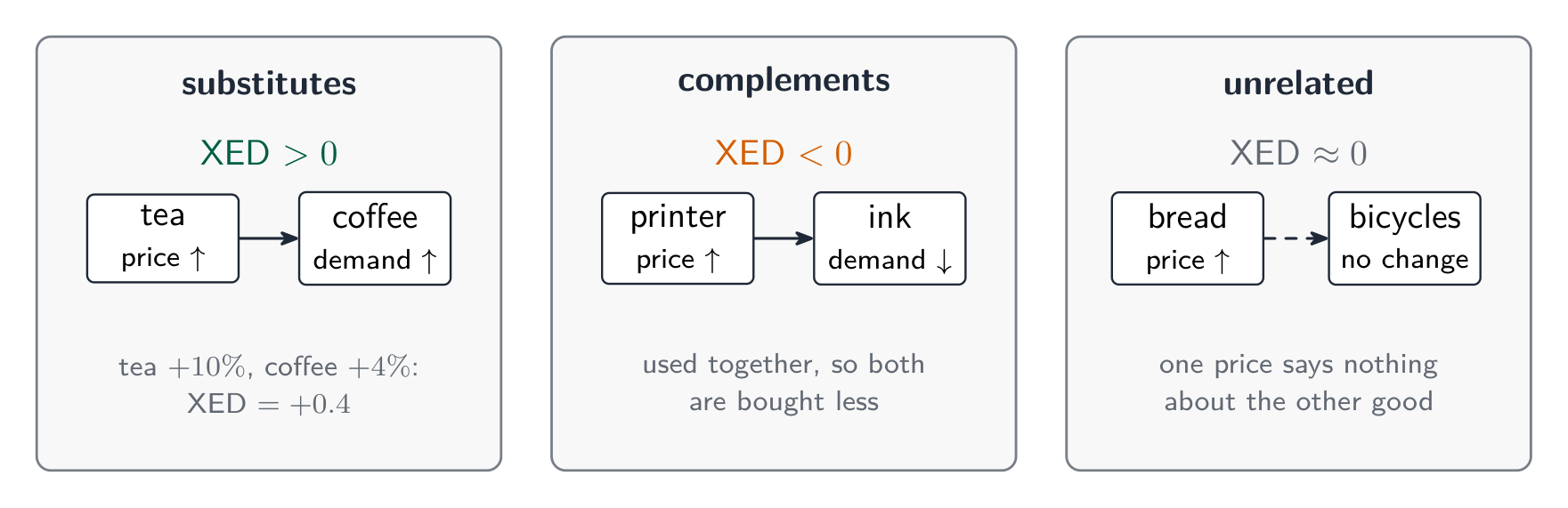
- 交叉价格弹性(cross-price elasticity)$=\dfrac{\%\ \Delta\ Q_x}{\%\ \Delta\ P_y}$:对替代品正,对互补品负——符号告诉你这个关系。
- 收入弹性(income elasticity)$=\dfrac{\%\ \Delta\ Q}{\%\ \Delta\ \text{income}}$:对正常商品正(而对奢侈品 $>1$),对低档商品负。
Worked example. 当咖啡的价格上升 $10\%$ 时,茶的需求量上升 $6\%$:交叉价格弹性 $=\dfrac{+6\%}{+10\%}=+0.6$。正号确认咖啡和茶是替代品。若相反收入的一次 $5\%$ 上升使餐厅餐需求上升 $10\%$,收入弹性 $=\dfrac{10\%}{5\%}=+2$ ——一个正常商品,而一个奢侈品,因为它超过 $1$。
交叉弹性:对替代品正,对互补品负 考试技能: 你被期望计算一个弹性、给它分类,并读一个符号作为替代品/互补品或正常/低档的证据。
词汇表 训练英文 中文 拼音 Cross-price elasticity/krɒs praɪs ɪlæˈstɪsɪti/ 交叉价格弹性 jiāo chā jià gé tán xìng Income elasticity/ˈɪŋkʌm ɪlæˈstɪsɪti/ 收入弹性 shōu rù tán xìng 2.6
市场均衡与消费者和生产者剩余
大纲
Enduring Understanding Learning Objective Essential Knowledge MKT-4
Although equilibria are stable, an economy can move from one equilibrium to another if market conditions change.MKT-4.A
a. Define (using graphs as appropriate) market equilibrium, consumer surplus, and producer surplus.
b. Explain (using graphs as appropriate) how equilibrium price, quantity, consumer surplus, and producer surplus for a good or service are determined.
c. Calculate (using data from a graph or table as appropriate) areas of consumer surplus and producer surplus at equilibrium.- MKT-4.A.1 The supply-demand model is a tool for understanding what factors influence prices and quantities and why prices and quantities might differ across markets or change over time.
- MKT-4.A.2 In a perfectly competitive market, equilibrium is achieved (and markets clear with no shortages or surpluses) when the price of a good or service brings the quantity supplied and quantity demanded into balance, in the sense that buyers wish to purchase the same quantity that sellers wish to provide.
- MKT-4.A.3 Equilibrium price provides information to economic decision-makers to guide resource allocation.
- MKT-4.A.4 Economists use consumer surplus and producer surplus to measure the benefits markets create to buyers and sellers and understand market efficiency.
- MKT-4.A.5 Market equilibrium maximizes total economic surplus in the absence of market failures, meaning that perfectly competitive markets are efficient.
来源:美国大学理事会 AP 课程与考试说明
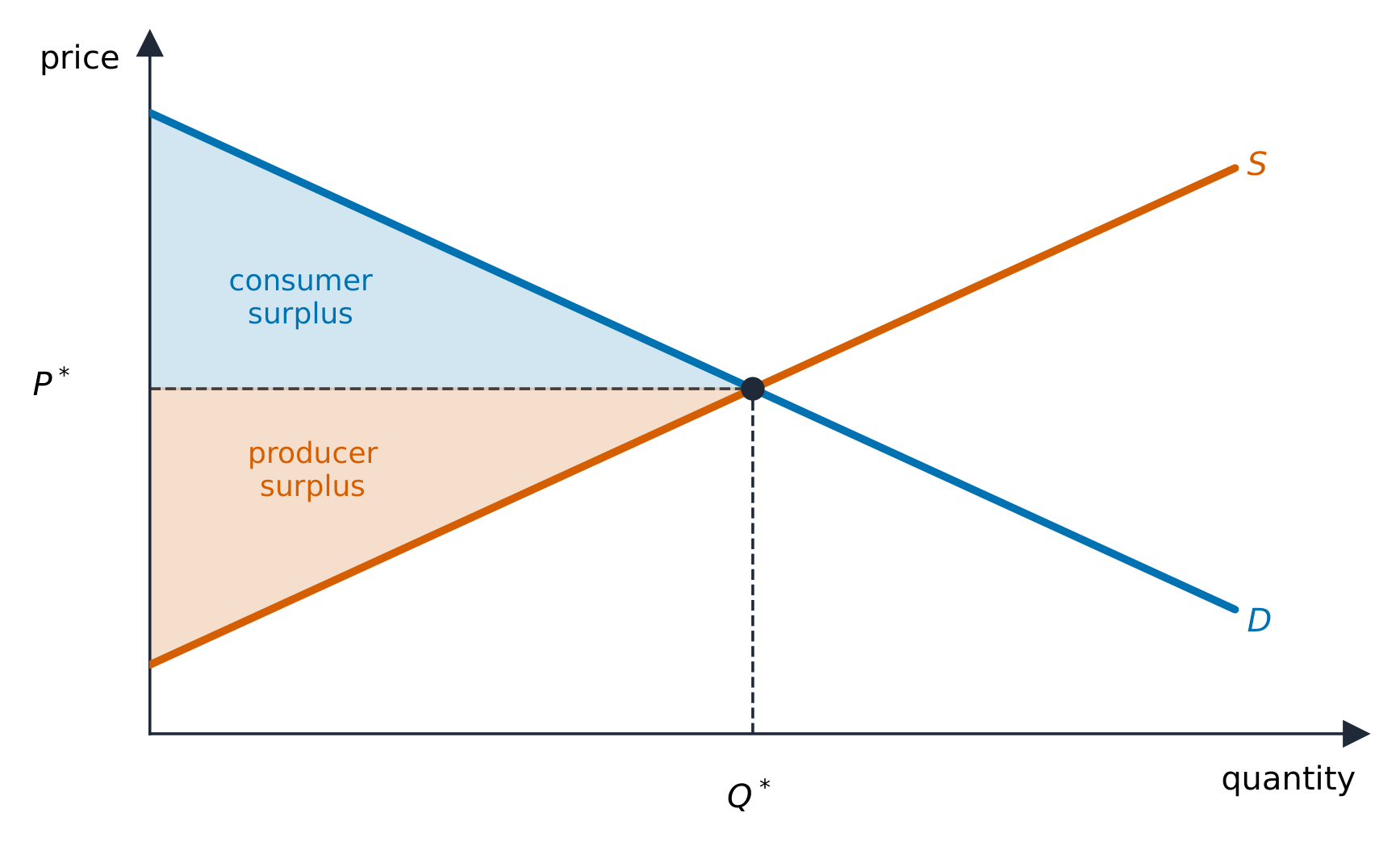
消费者与生产者剩余 均衡(equilibrium)是供给遇到需求的地方:均衡价格使市场出清,所以需求量等于供给量而没有短缺或过剩。
市场均衡处的消费者剩余和生产者剩余 - 消费者剩余(consumer surplus)是需求曲线之下和价格之上的面积——买者会付的和他们实际付的之间的差距。
- 生产者剩余(producer surplus)是供给曲线之上和价格之下的面积——价格和卖者最低可接受价格之间的差距。
- 它们的和是总剩余(total surplus),而竞争均衡最大化它——这就是为什么自由市场被称为配置有效率(allocatively efficient)。
探索See consumer and producer surplus
At equilibrium the market clears. The gap between what buyers would pay and the price is consumer surplus; the gap above sellers' costs is producer surplus.
词汇表 训练英文 中文 拼音 Equilibrium/ˌiːkwɪˈlɪbrɪəm/ 均衡 jūn héng Consumer surplus/kənˈsuːmə ˈsɜːpləs/ 消费者剩余 xiāo fèi zhě shèng yú Producer surplus/prəˈdjuːsə ˈsɜːpləs/ 生产者剩余 shēng chǎn zhě shèng yú total surplus/ˈtəʊtl ˈsɜːpləs/ 总剩余 zǒng shèng yú allocatively efficient/ˈæləkətɪvli ɪˈfɪʃənt/ 配置有效率 pèi zhì yǒu xiào lǜ surplus/ˈsɜːpləs/ 过剩 guò shèng 2.7
市场非均衡与均衡变动
大纲
Enduring Understanding Learning Objective Essential Knowledge MKT-4
Although equilibria are stable, an economy can move from one equilibrium to another if market conditions change.MKT-4.B
a. Define a surplus and shortage.
b. Explain (using graphs where appropriate) how changes in underlying conditions and shocks to a competitive market can alter price, quantity, consumer surplus, and producer surplus.
c. Calculate (using data from a graph or table as appropriate) changes in price, quantity, consumer surplus, and producer surplus in response to changes in market conditions or market disequilibrium.- MKT-4.B.1 Whenever markets experience imbalances—creating disequilibrium prices and quantities, surpluses, and shortages—market forces drive price and quantity toward equilibrium.
- MKT-4.B.2 Factors that shift the market demand and market supply curves cause price, quantity, consumer surplus, producer surplus, and total economic surplus (within that market) to change. The impact of the change depends on the price elasticities of demand and supply.
来源:美国大学理事会 AP 课程与考试说明
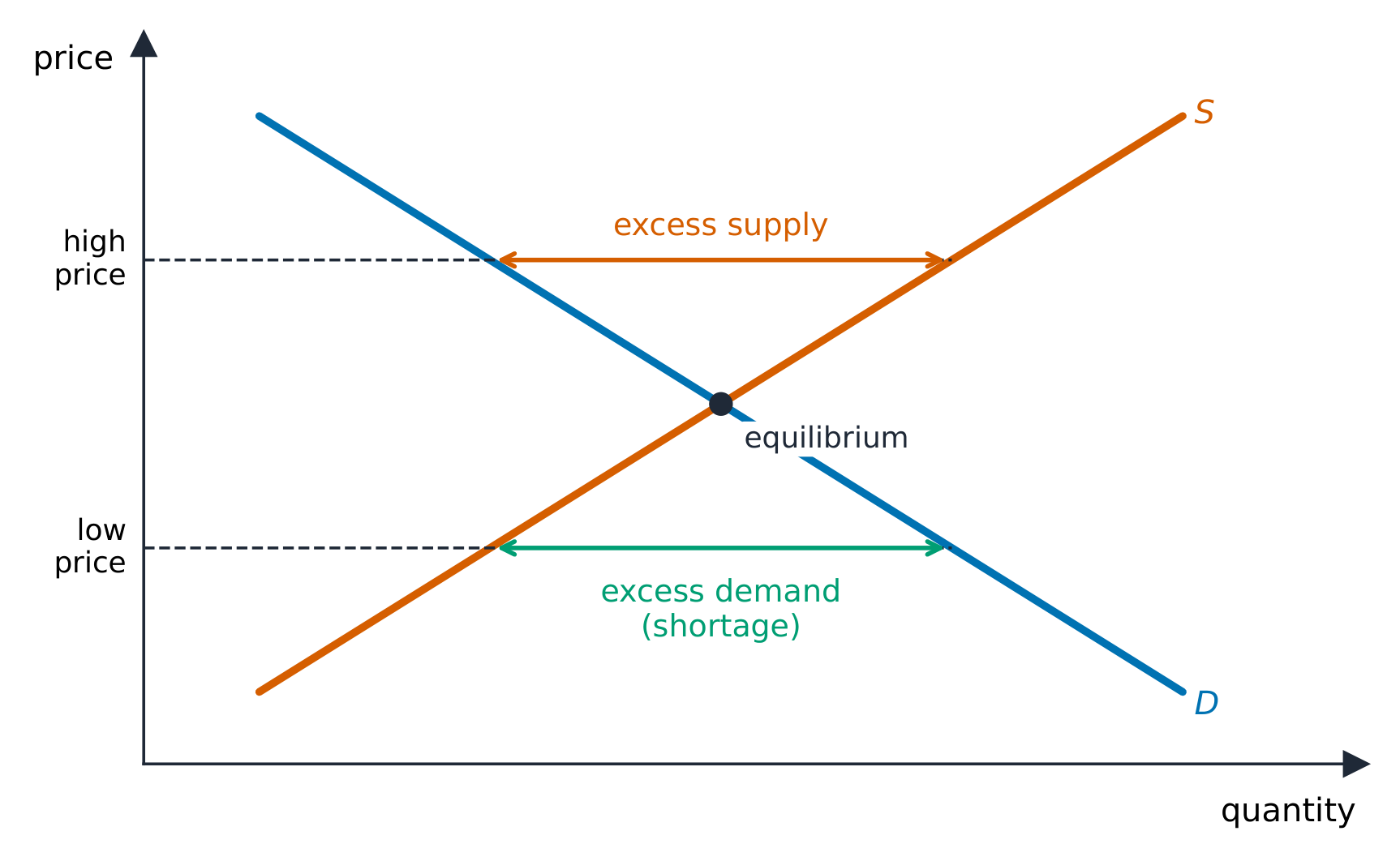
离开均衡市场自我纠正:均衡价格之上有一个过剩(surplus)(超额供给)把价格推低;它之下一个短缺(shortage)(超额需求)把价格推高。
均衡之上有超额供给;它之下,超额需求 当一个决定因素移动一条曲线时,均衡可预测地移动。一个单一移动给价格和数量两者一个确定的结果。当两条曲线都移动时,价格或数量之一是不确定的(indeterminate)(取决于这些移动的相对大小)——一个最爱的考试陷阱。通过画这些移动来算出它们。
词汇表 训练英文 中文 拼音 shortage/ˈʃɔːtɪdʒ/ 短缺 duǎn quē 2.8
政府干预市场的影响
大纲
Enduring Understanding Learning Objective Essential Knowledge POL-1
Government policies influence consumer and producer behavior and therefore affect market outcomes.POL-1.A
a. Define forms of government price and quantity intervention.
b. Explain (using graphs where appropriate) how government policies alter consumer and producer behaviors that influence incentives and therefore affect outcomes.
c. Calculate (using data from a graph or table where appropriate) changes in market outcomes resulting from government policies.- POL-1.A.1 Some government policies, such as price floors, price ceilings, and other forms of price and quantity regulation, affect incentives and outcomes in all market structures.
- POL-1.A.2 Governments use taxes and subsidies to change incentives in ways that influence consumer and producer behavior, shifting the supply and demand curves accordingly.
- POL-1.A.3 Taxes and subsidies affect government revenues or costs.
- POL-1.A.4 Government intervention in a market producing the efficient quantity through taxes, subsidies, price controls, or quantity controls can only decrease allocative efficiency.
- POL-1.A.5 Deadweight loss represents the losses to buyers and sellers as a result of government intervention in an efficient market.
- POL-1.A.6 The incidence of taxes and subsidies imposed on goods traded in perfectly competitive markets depends on the elasticity of supply and demand.
来源:美国大学理事会 AP 课程与考试说明
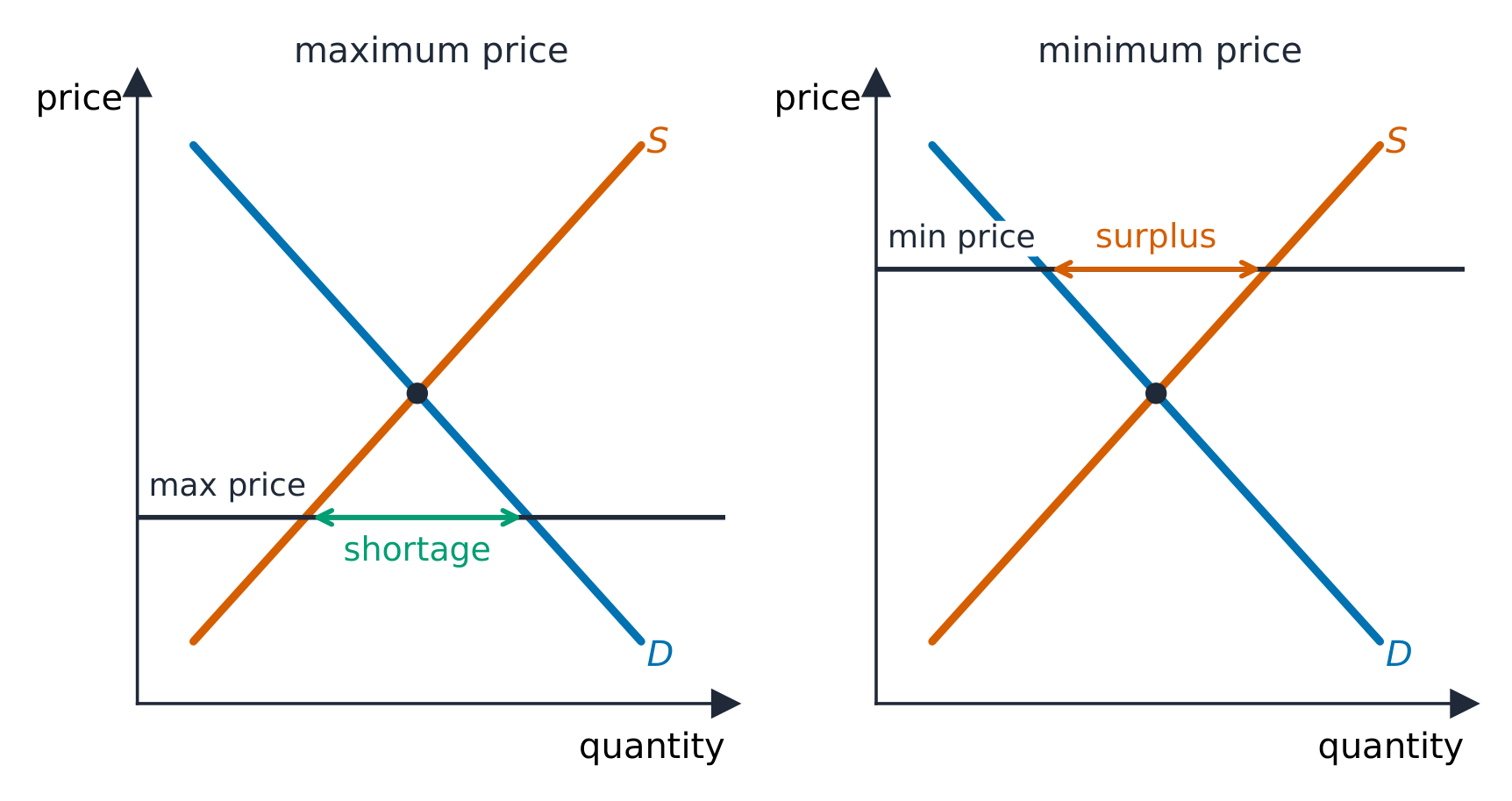
价格上限导致短缺 税收与无谓损失 政府干预,通常减少总剩余:
一个价格上限造成一个短缺;一个价格下限造成一个过剩 - 一个在均衡之下的价格上限(price ceiling)(一个法定最大值,像租金管制)造成一个持续的短缺。
- 一个在均衡之上的价格下限(price floor)(一个法定最小值,像最低工资)造成一个持续的过剩。
- 一项消费税(excise tax)使供给向上移动这个税;负担(税收归宿(tax incidence))更重地落在更缺乏弹性的一侧。
- 一项补贴使供给向下移动,提高数量。
这些每一个都造成无谓损失(deadweight loss)——不再发生的互利交易,显示为新数量处曲线之间的一个三角形。
考试技能: 在一个图上,能够给消费者剩余、生产者剩余、来自一个税的政府收入,和无谓损失涂阴影,并说谁承担这个税以及为什么。
探索Add a tax or price control
A price ceiling below equilibrium causes shortages; a tax drives a wedge between what buyers pay and sellers get, shrinking the quantity traded.
词汇表 训练英文 中文 拼音 price ceiling/praɪs ˈsiːlɪŋ/ 价格上限 jià gé shàng xiàn price floor/praɪs flɔː/ 价格下限 jià gé xià xiàn excise tax/ekˈsaɪz tæks/ 消费税 xiāo fèi shuì tax incidence/tæks ˈɪnsɪdəns/ 税收归宿 shuì shōu guī sù deadweight loss/ˈdedweɪt lɒs/ 无谓损失 wú wèi sǔn shī 2.9
国际贸易与公共政策
大纲
Enduring Understanding Learning Objective Essential Knowledge POL-1
Government policies influence consumer and producer behavior and therefore affect market outcomes.POL-1.B
a. Define tariffs and quotas.
b. Explain (using graphs where appropriate) how markets are affected by public policy related to international trade.
c. Calculate (using data from a graph or table as appropriate) changes in market outcomes resulting from public policy related to international trade.- POL-1.B.1 Equilibria in competitive markets may be altered by the decision to open an economy to trade with other countries; equilibrium price can be higher or lower than under autarky, and the gap between domestic supply and demand is filled by trade. Opening an economy to trade with other countries affects consumer surplus, producer surplus, and total economic surplus.
- POL-1.B.2 Tariffs, which governments sometimes use to influence international trade, affect domestic price, quantity, government revenue, and consumer surplus and total economic surplus.
- POL-1.B.3 Quotas can be used to alter quantities produced and therefore affect price, consumer surplus, and total economic surplus.
- Exclusion statement: The graphing of quotas is beyond the scope of the course and the AP Exam, but understanding how quotas affect quantities produced is within the scope.
来源:美国大学理事会 AP 课程与考试说明
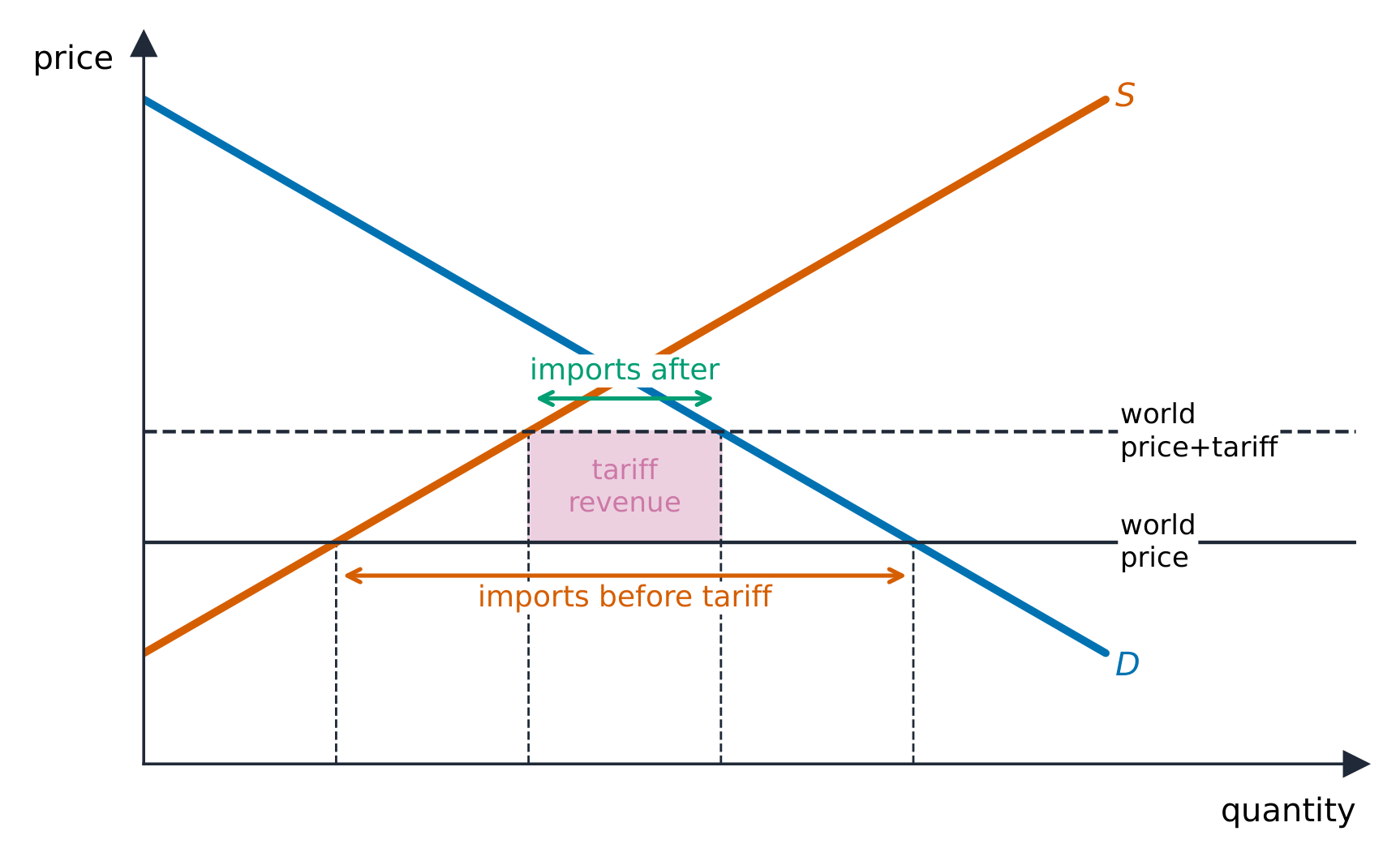
当一个国家以一个世界价格(world price)开放贸易时:
一项关税提高国内供给、削减需求,并缩小进口 - 若世界价格低于国内价格,这个国家进口(imports)——消费者获得的多于生产者失去的,所以总剩余上升。
- 若世界价格高于国内价格,这个国家出口(exports)——生产者获得的多于消费者失去的。
一项关税(tariff)(对进口的一项税)或一项配额(quota)(对进口的一个限制)提高国内价格、帮助国内生产者、更多地伤害消费者,并造成无谓损失。自由贸易最大化总剩余,这是支持它的核心效率论据。
词汇表 训练英文 中文 拼音 world price/wɜːld praɪs/ 世界价格 shì jiè jià gé imports/ɪmˈpɔːts/ 进口 jìn kǒu exports/ˈekspɔːts/ 出口 chū kǒu tariff/ˈtærɪf/ 关税 guān shuì quota/ˈkwəʊtə/ 配额 pèi é 2.9
考试技巧
- 把沿一条曲线的一个移动(自身价格)与一个移动(一个决定因素)分开;一个单一移动给一个确定的结果,一个双重移动使一个变量不确定。
- 计算弹性 $E_d=|\%\Delta Q \div \%\Delta P|$;富有弹性($>1$)意味着一次降价提高总收入,缺乏弹性($<1$)降低它。
- 读交叉价格弹性(替代品 $+$、互补品 $-$)和收入弹性(正常 $+$、低档 $-$)的符号。
- 给一个税或价格管制的消费者/生产者剩余和无谓损失涂阴影;归宿落在更缺乏弹性的一侧。
- 一个在均衡之下的价格上限造成一个短缺;一个在均衡之上的价格下限造成一个过剩。
-
3
生产、成本与完全竞争模型
3.1
生产函数
大纲
Enduring Understanding Learning Objective Essential Knowledge PRD-1
Firms' production and cost constraints over different input and output levels shape optimal decisions in the short run and long run.PRD-1.A
a. Define (using graphs where appropriate) key terms and concepts relating to production and cost.
b. Explain (using graphs where appropriate) how production and cost are related in the short run and long run.
c. Calculate (using data from a graph or table as appropriate) the various measures of productivity and short-run and long-run costs.- PRD-1.A.1 The production function explains the relationship between inputs and outputs both in the short run and the long run.
- PRD-1.A.2 Marginal product and average product change as input usage changes, and hence, total product changes.
- PRD-1.A.3 Diminishing marginal returns occur as the firm employs more of one input, holding other inputs constant, to produce a product (output) in the short run.
来源:美国大学理事会 AP 课程与考试说明
生产函数(production function)把投入连接到产出。在短期(short run)至少一个投入(通常是资本)是固定(fixed)的;在长期(long run)所有投入都变化。
- 总产量(total product)是总产出。
- 边际产量(marginal product)(MP)是来自多一单位可变投入(通常是劳动)的额外产出:$MP=\dfrac{\Delta\ \text{output}}{\Delta\ \text{labor}}$。
- 平均产量(average product)是每个工人的产出。
随着你把工人加到固定的资本,MP 最终下降——边际收益递减法则(law of diminishing marginal returns)。MP 的这个形状是驱动下面成本曲线形状的东西。
词汇表 训练英文 中文 拼音 production function/prəˈdʌkʃn ˈfʌŋkʃn/ 生产函数 shēng chǎn hán shù short run/ʃɔːt rʌn/ 短期 duǎn qī fixed/fɪkst/ 固定 gù dìng long run/lɒŋ rʌn/ 长期 cháng qī Total product/ˈtəʊtl ˈprɒdʌkt/ 总产量 zǒng chǎn liàng Marginal product/ˈmɑːdʒɪnl ˈprɒdʌkt/ 边际产量 biān jì chǎn liàng Average product/ˈævrɪdʒ ˈprɒdʌkt/ 平均产量 píng jūn chǎn liàng law of diminishing marginal returns/lɔː ɒv dɪˈmɪnɪʃɪŋ ˈmɑːdʒɪnl rɪˈtɜːnz/ 边际收益递减法则 biān jì shōu yì dì jiǎn fǎ zé 3.2
短期生产成本
大纲
Enduring Understanding Learning Objective Essential Knowledge PRD-1
Firms' production and cost constraints over different input and output levels shape optimal decisions in the short run and long run.PRD-1.A
a. Define (using graphs where appropriate) key terms and concepts relating to production and cost.
b. Explain (using graphs where appropriate) how production and cost are related in the short run and long run.
c. Calculate (using data from a graph or table as appropriate) the various measures of productivity and short-run and long-run costs.- PRD-1.A.4 Fixed costs and variable costs determine the total cost.
- PRD-1.A.5 Marginal cost, average (fixed, variable, and total) cost, total cost, and total variable cost change as total output changes, but total fixed cost remains constant at all output levels, including zero output.
- PRD-1.A.6 Production functions with diminishing marginal returns yield an upward-sloping marginal cost curve.
- PRD-1.A.7 Specialization and the division of labor reduce marginal costs for firms.
- PRD-1.A.8 Cost curves can shift in response to changes in input costs and productivity.
来源:美国大学理事会 AP 课程与考试说明
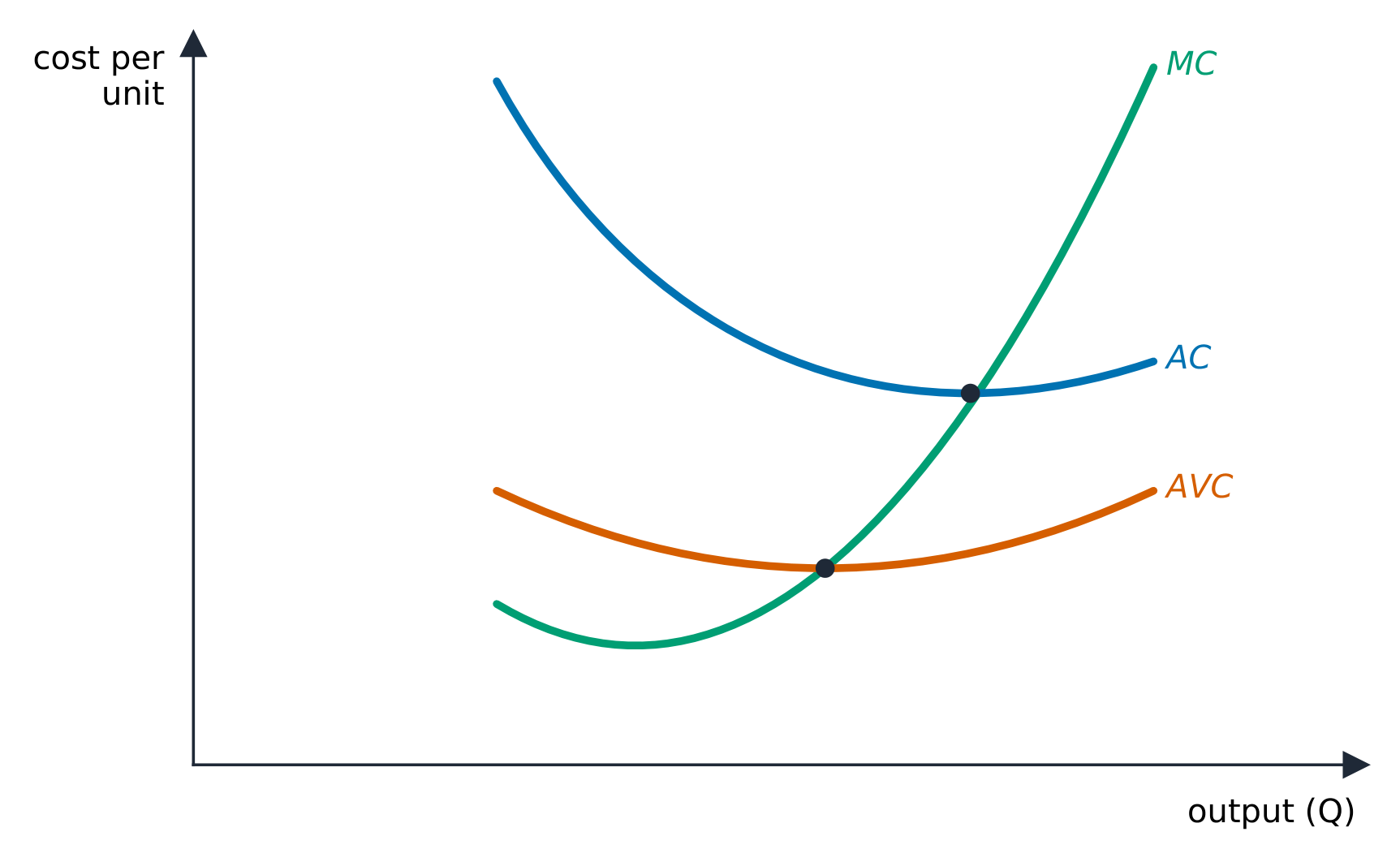
短期成本曲线 成本分成固定和可变:
短期边际、平均和平均可变成本曲线 - 固定成本(fixed cost)(FC)不随产出变化(工厂的租金)。
- 可变成本(variable cost)(VC)随产出上升(材料、劳动)。
- 总成本(total cost)$TC=FC+VC$。
每单位成本最重要:
- 平均固定成本(average fixed cost)$AFC=FC/Q$ 持续下降(分摊固定成本)。
- 平均可变成本(average variable cost)$AVC=VC/Q$ 和平均总成本(average total cost)$ATC=TC/Q$ 是 U 形的。
- 边际成本(marginal cost)$MC=\dfrac{\Delta TC}{\Delta Q}$ 是多一单位的成本。
两个关键事实:MC 是 MP 的镜像(当 MP 上升时,MC 下降,反之亦然),而 MC 在它们的最小点切 AVC 和 ATC 两者(当边际低于平均时,平均下降;当高于时,它上升)。
Worked example. 一个企业有固定成本 $FC=\$100$。在 $Q=10$ 它的总成本是 $\$300$,所以可变成本是 $\$200$:那么 $ATC=\tfrac{300}{10}=\$30$、$AVC=\tfrac{200}{10}=\$20$,而 $AFC=\tfrac{100}{10}=\$10$(注意 $AFC+AVC=ATC$)。若把产出提高到 $Q=11$ 把总成本推到 $\$325$,那第 $11$ 单位的边际成本是 $\dfrac{\Delta TC}{\Delta Q}=\dfrac{325-300}{1}=\$25$。
探索Explore the U-shaped cost curves
As output rises, marginal cost eventually climbs (diminishing returns) and cuts through the U-shaped average cost at its minimum — the most efficient scale.
词汇表 训练英文 中文 拼音 Fixed cost/fɪkst kɒst/ 固定成本 gù dìng chéng běn Variable cost/ˈveərɪəbl kɒst/ 可变成本 kě biàn chéng běn Total cost/ˈtəʊtl kɒst/ 总成本 zǒng chéng běn Marginal cost/ˈmɑːdʒɪnl kɒst/ 边际成本 biān jì chéng běn 3.3
长期生产成本
大纲
Enduring Understanding Learning Objective Essential Knowledge PRD-1
Firms' production and cost constraints over different input and output levels shape optimal decisions in the short run and long run.PRD-1.A
a. Define (using graphs where appropriate) key terms and concepts relating to production and cost.
b. Explain (using graphs where appropriate) how production and cost are related in the short run and long run.
c. Calculate (using data from a graph or table as appropriate) the various measures of productivity and short-run and long-run costs.- PRD-1.A.9 In the long run, firms can adjust all their inputs, and as a result, all costs become variable.
- PRD-1.A.10 The relationship between inputs and outputs in the long run is described by the scale of production—increasing, decreasing, or constant returns to scale.
- PRD-1.A.11 The long-run average total cost is characterized by economies of scale, diseconomies of scale, or constant returns to scale (efficient scale).
- PRD-1.A.12 The minimum efficient scale plays a role in determining the concentration of firms in a market and the market structure.
来源:美国大学理事会 AP 课程与考试说明
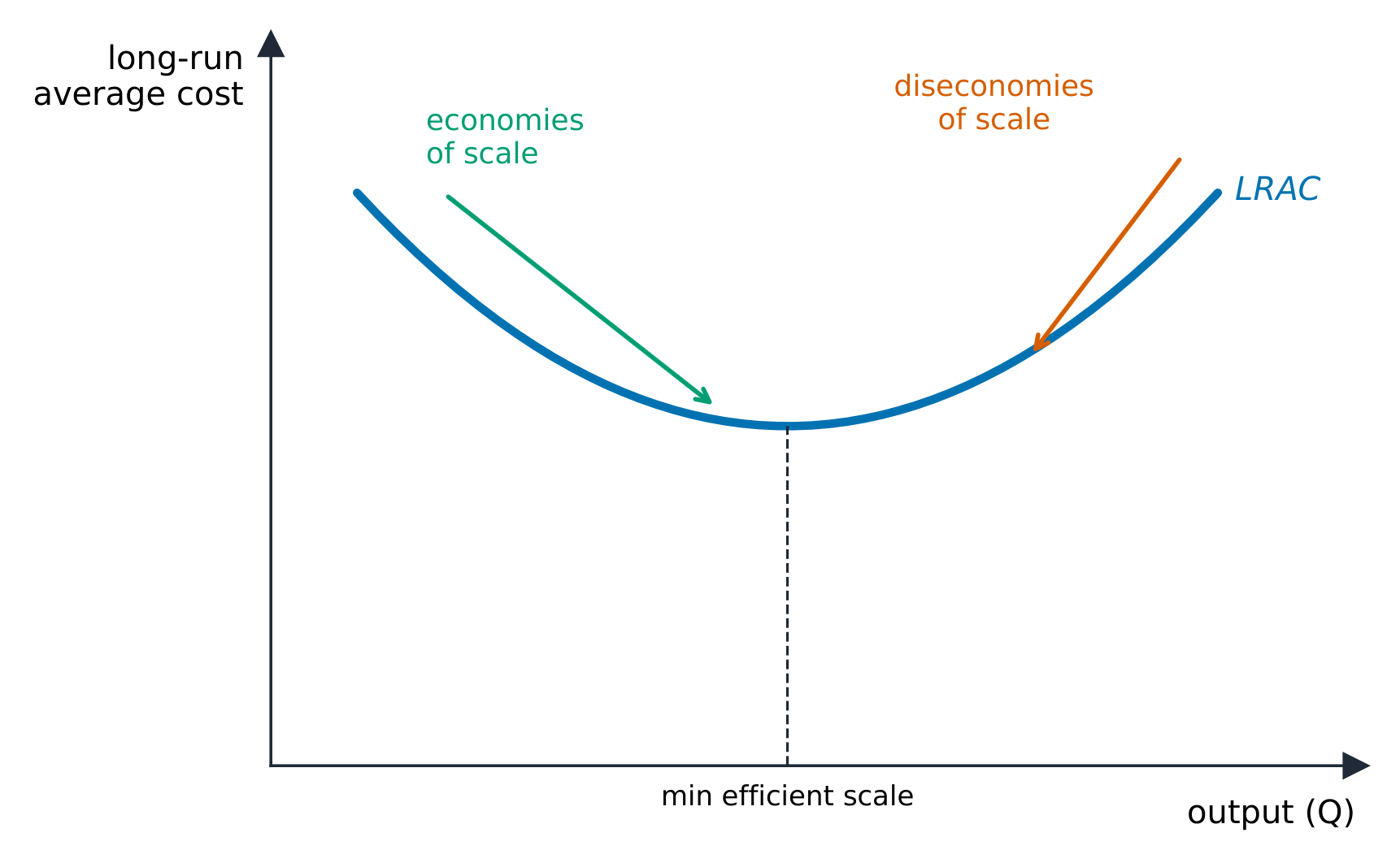
在长期所有投入——包括工厂规模——都能变化,所以只有长期平均总成本(LRATC)(long-run average total cost)曲线重要。它的形状显示规模报酬:
长期平均成本曲线上的规模经济和规模不经济 - 规模经济(economies of scale):LRATC 随着产出增长而下降(批量购买、专业化)。
- 规模报酬不变(constant returns to scale):LRATC 平坦。
- 规模不经济(diseconomies of scale):LRATC 上升(一个太大而不能好好管理的企业)。
考试技能: 知道"收益递减"是一个短期思想(一个固定投入)而"规模经济"是一个长期思想(所有投入变化)——考官考查这个区别。
词汇表 训练英文 中文 拼音 Economies of scale/ɪˈkɒnəmiz ɒv skeɪl/ 规模经济 guī mó jīng jì Diseconomies of scale/ˌdɪsɪˈkɒnəmiz ɒv skeɪl/ 规模不经济 guī mó bù jīng jì 3.4
利润的类型
大纲
Enduring Understanding Learning Objective Essential Knowledge CBA-2
To determine the optimal level at which to pursue an activity whose total benefits exceed total cost, rational economic agents compare marginal benefits and marginal costs.CBA-2.C
a. Define the different types of profit.
b. Explain how firms respond to profit opportunities.
c. Calculate a firm's profit or loss.- CBA-2.C.1 Firms respond to economic profit (loss) rather than accounting profit.
- CBA-2.C.2 Accounting profit fails to account for implicit costs (such as cost of financial capital, compensation for risk, or an entrepreneur's time), which, if fully compensated, result in normal profit.
来源:美国大学理事会 AP 课程与考试说明
经济学家计入所有机会成本,包括所有者的:
- 显性成本(explicit costs)是自掏腰包的支付;隐性成本(implicit costs)是所有者提供资源的机会成本(放弃的薪水、放弃的利息)。
- 会计利润(accounting profit)$=$ 收入 $-$ 显性成本。
- 经济利润(economic profit)$=$ 收入 $-$ 显性 $-$ 隐性成本。
因为经济利润减去更多,它更小。零经济利润(一个正常利润(normal profit))仍然意味着所有者赚取恰好他们资源的机会成本——一个完全可接受的结果。
Worked example. 一个店主收入 $\$200{,}000$ 并付 $\$120{,}000$ 显性成本,所以会计利润是 $\$80{,}000$。但她放弃了别处一个 $\$70{,}000$ 的薪水和她投资的储蓄上 $\$5{,}000$ 的利息—— $\$75{,}000$ 的隐性成本。她的经济利润是 $80{,}000-75{,}000=\$5{,}000$:仍然为正,所以留在生意里真正击败她下一个最好的替代。
词汇表 训练英文 中文 拼音 Explicit costs/ekˈsplɪsɪt kɒsts/ 显性成本 xiǎn xìng chéng běn implicit costs/ɪmˈplɪsɪt kɒsts/ 隐性成本 yǐn xìng chéng běn Accounting profit/əˈkaʊntɪŋ ˈprɒfɪt/ 会计利润 kuài jì lì rùn Economic profit/ˌiːkəˈnɒmɪk ˈprɒfɪt/ 经济利润 jīng jì lì rùn normal profit/ˈnɔːml ˈprɒfɪt/ 正常利润 zhèng cháng lì rùn 3.5
利润最大化
大纲
Enduring Understanding Learning Objective Essential Knowledge CBA-2
To determine the optimal level at which to pursue an activity whose total benefits exceed total cost, rational economic agents compare marginal benefits and marginal costs.CBA-2.D
a. Define (using graphs or data as appropriate) the profit-maximizing rule.
b. Explain (using a graph or data as appropriate) the profit-maximizing level of production.- CBA-2.D.1 Firms are assumed to produce output to maximize their profits by comparing marginal revenue and marginal cost.
来源:美国大学理事会 AP 课程与考试说明
每个企业,在每个市场结构里,在边际收入等于边际成本的数量最大化利润:
$$MR=MC.$$生产每个 MR 超过它 MC 的单位;在它们相等时停止。生产更少留下未制造的有利可图的单位;生产更多添加花费比它们赚的更多的单位。3.6
企业的短期生产决策与长期进入或退出市场的决策
大纲
Enduring Understanding Learning Objective Essential Knowledge PRD-2
Firms' short-run decisions to produce output, and long-run decisions to enter or exit a market, are based on profitability.PRD-2.A
Explain (using graphs or data where appropriate) firms' short-run decisions to produce positive output levels, or long-run decisions to enter or exit a market in response to profit-making opportunities.- PRD-2.A.1 In the short run, firms decide to operate (i.e., produce positive output) or shut down (i.e., produce zero output) by comparing total revenue to total variable cost or price to average variable cost (AVC).
- PRD-2.A.2 In the absence of barriers to entry or exit, in the long run (i.e., once factors that are fixed in the short run become variable), firms enter a market in which there are profit-making opportunities and exit a market when they anticipate economic losses.
来源:美国大学理事会 AP 课程与考试说明
即使在 $MR=MC$,一个企业必须检查是否运营:
- 短期——停业规则: 只有当价格覆盖平均可变成本($P\geq AVC$)时才继续生产。若 $P
- 利润检查: 在利润最大化数量把 $P$ 与 $ATC$ 比较—— $P>ATC$ 意味着经济利润、$P
- 长期——进入和退出: 经济利润吸引进入(entry);损失造成退出(exit)。这继续直到经济利润是零。
词汇表 训练英文 中文 拼音 entry/ˈentri/ 进入 jìn rù exit/ˈeɡzɪt/ 退出 tuì chū 3.7
完全竞争
大纲
Enduring Understanding Learning Objective Essential Knowledge PRD-3
Even with a common goal of profit-maximization, market structure constrains and influences prices, output, and efficiency.PRD-3.A
a. Define (using graphs as appropriate) the characteristics of perfectly competitive markets and efficiency.
b. Explain (using graphs where appropriate) equilibrium and firm decision making in perfectly competitive markets and how prices in perfectly competitive markets lead to efficient outcomes.
c. Calculate (using data from a graph or table as appropriate) economic profit (loss) in perfectly competitive markets.- PRD-3.A.1 A perfectly competitive market is efficient. Firms in perfectly competitive markets face no barriers to entry and have no market power.
- PRD-3.A.2 In perfectly competitive markets, prices communicate to consumers and producers the magnitude of others' marginal costs of production and marginal benefits of consumption and provide incentives to act on that information (i.e., price equals marginal cost in an efficient market).
- PRD-3.A.3 In perfectly competitive markets, firms can sell all their outputs at a constant price determined by the market.
- PRD-3.A.4 At a competitive market equilibrium, firms are price takers and select output to maximize profit by producing the level of output where the marginal cost equals marginal revenue (at the price).
- PRD-3.A.5 At a competitive market equilibrium, the price of a product equals both the private marginal benefit received by the last unit consumed and the private marginal cost incurred to produce the last unit, thus achieving allocative efficiency.
- PRD-3.A.6 In a short-run competitive equilibrium, price can either be above or below its long-run competitive level resulting in profits or losses, motivating entry or exit of firms and moving prices and quantities toward long-run equilibrium.
- PRD-3.A.7 In a long-run perfectly competitive equilibrium, productive efficiency implies all operating firms produce at efficient scale, price equals marginal cost and minimum average total cost, and firms earn zero economic profit.
- PRD-3.A.8 Firms may be in a constant cost, increasing cost, or decreasing cost industry. Long-run prices depend on the portion of the long-run cost curves on which firms operate.
- PRD-3.A.9 A perfectly competitive market in long-run equilibrium is allocatively and productively efficient.
来源:美国大学理事会 AP 课程与考试说明
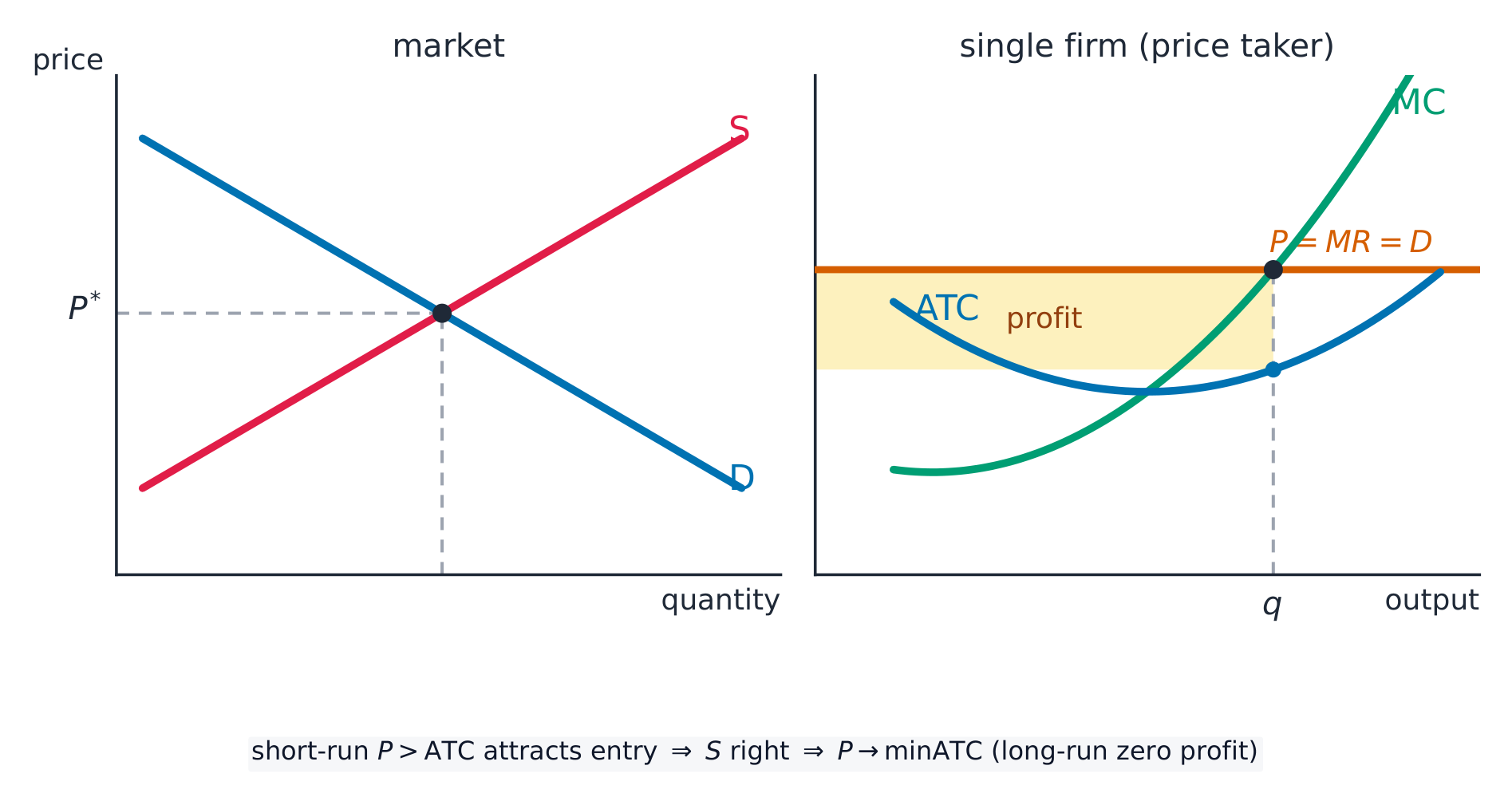
一个完全竞争(perfectly competitive)市场有许多小企业、一个相同(同质)的产品、自由进入和退出,和完美的信息。每个企业是一个价格接受者(price taker)——太小而不能影响价格——所以它在市场价格面对一条水平需求曲线,而价格 = 边际收入 = 平均收入($P=MR=AR$)。
这就是经济学家看重完全竞争的原因。在长期均衡中,它既是配置有效的(allocatively efficient)又是生产有效的(productively efficient)。配置效率成立,是因为企业在 $P = MC$ 处生产:价格(社会从最后一单位获得的边际收益)等于它的边际成本,所以恰好生产了正确的数量。生产效率成立,是因为自由进入把价格压到平均总成本的最低点,所以商品以尽可能低的成本生产。市场价格本身就是一个信号,传达每个人的边际成本和边际收益。
市场设定价格;价格接受的企业在 MC = P 处生产,这里带短期利润 并排的面板是考试想要的图:市场(左)固定价格 $P^{*}$;企业(右)把它作为一条水平线接受并在 $MC=P$ 处生产。当 $P>ATC$ 时有一个短期利润(阴影框);那个利润吸引进入,它使市场供给右移并把价格推低。
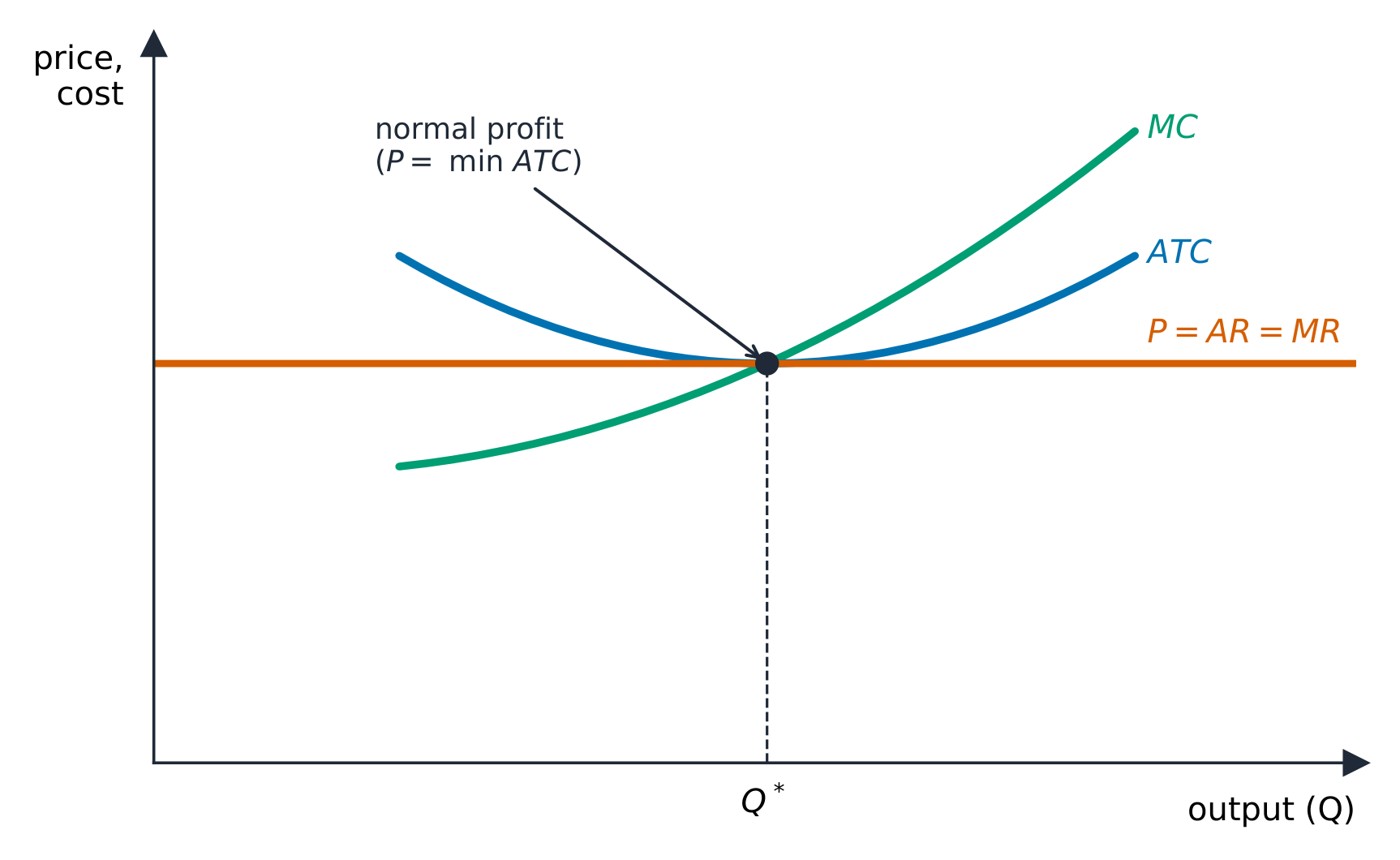
一个完全竞争的企业在长期只赚正常利润 - 短期: 企业能赚利润、盈亏平衡,或承受一个损失,在 $P=MC$ 处生产。
- 长期: 进入和退出驱动企业到零经济利润,在 $P=MC=ATC$ 处以最小 ATC 生产。这个双重效率——生产效率(productive efficiency)(最低成本产出)和配置效率(allocative efficiency)($P=MC$,所以最后一单位的价值等于它的成本)——是评判每个其他市场结构的基准。
考试技能: 能够画并排的市场和单个企业图、显示一个短期利润或损失,然后显示进入/退出如何在最小 ATC 恢复长期均衡。
探索A price-taking firm in a competitive market
In perfect competition the market sets the price and each firm is a price-taker. It produces where price equals marginal cost, earning zero economic profit in the long run.
词汇表 训练英文 中文 拼音 perfectly competitive/ˈpɜːfektlɪ kəmˈpetɪtɪv/ 完全竞争 wán quán jìng zhēng price taker/praɪs ˈteɪkə/ 价格接受者 jià gé jiē shòu zhě allocatively efficient/ˈæləkətɪvli ɪˈfɪʃənt/ 配置效率 pèi zhì xiào lǜ productively efficient/prəˈdʌktɪvli ɪˈfɪʃənt/ 生产效率 shēng chǎn xiào lǜ 3.7
考试技巧
- 知道成本曲线:AFC 下降、ATC/AVC 是 U 形的,而 MC 在它们的最小点切 ATC 和 AVC。
- 每个企业在 MR = MC 最大化利润;检查停业规则(短期 $P \ge AVC$)。
- 把会计利润(收入 − 显性成本)与经济利润(也减隐性/机会成本)区分开;零经济利润是正常的。
- "收益递减"是短期(一个固定投入);"规模经济"是长期(所有投入变化)。
- 在完全竞争 $P=MR=AR$;进入/退出驱动长期经济利润到最小 ATC 处的零。
-
4
不完全竞争
4.1
不完全竞争市场导论

大纲
Enduring Understanding Learning Objective Essential Knowledge PRD-3
Even with a common goal of profit-maximization, market structure constrains and influences prices, output, and efficiency.PRD-3.B
a. Define (using graphs where appropriate) the characteristics of imperfectly competitive markets and inefficiency.- PRD-3.B.1 Imperfectly competitive markets include monopoly, oligopoly, and monopolistic competition in product markets and monopsony in factor markets.
- PRD-3.B.2 In imperfectly competitive output markets and assuming all else is constant, a firm must lower price to sell additional units.
- PRD-3.B.3 In imperfectly competitive markets, consumers and producers respond to prices that are above the marginal costs of production and/or marginal benefits of consumption (i.e., price is greater than marginal cost in an inefficient market).
- PRD-3.B.4 Incentives to enter an industry may be mitigated by barriers to entry. Barriers to entry—such as high fixed/start-up costs, legal barriers to entry, and exclusive ownership of key resources—can sustain imperfectly competitive market structures.
来源:美国大学理事会 AP 课程与考试说明
大多数真实市场是不完全竞争(imperfectly competitive)的:企业有一些市场势力(market power)——设定价格而不是接受它的能力。那个势力的来源是企业面对的一条向下倾斜的需求曲线,这意味着要多卖一单位企业必须降低所有单位的价格。
市场结构从完全竞争到垄断不等 因为这个,对每个有市场势力的企业边际收入低于价格($MR
Worked example. 一个有市场势力的企业面对需求 $P=100-Q$。卖 $1$ 单位给出 $P=\$99$ 和总收入 $\$99$;卖第 $2$ 个把价格在两个单位上推低到 $\$98$,所以收入上升到 $2\times98=\$196$。那第 $2$ 单位的边际收入是 $196-99=\$97$ ——低于它 $\$98$ 的价格。一般地 $MR=100-2Q$,下降得两倍于需求那么快。
词汇表 训练英文 中文 拼音 imperfectly competitive/ɪmˈpɜːfektlɪ kəmˈpetɪtɪv/ 不完全竞争 bù wán quán jìng zhēng market power/ˈmɑːkɪt ˈpaʊə/ 市场势力 shì chǎng shì lì 4.2
垄断
大纲
Enduring Understanding Learning Objective Essential Knowledge PRD-3
Even with a common goal of profit-maximization, market structure constrains and influences prices, output, and efficiency.PRD-3.B
b. Explain (using graphs where appropriate) equilibrium, firm decision making, consumer surplus, producer surplus, profit (loss), and deadweight loss in imperfectly competitive markets and why prices in imperfectly competitive markets cannot be relied on to coordinate the actions of all possible market participants and can lead to inefficient outputs. c. Calculate (using data from a graph or table as appropriate) areas of consumer surplus, producer surplus, profit (loss), and deadweight loss in imperfectly competitive markets.- PRD-3.B.5 A monopoly exists because of barriers to entry.
- PRD-3.B.6 In a monopoly, equilibrium (profit-maximizing) quantity is determined by equating marginal revenue (MR) to marginal cost (MC). The price charged is greater than the marginal cost.
- Equation: $MR = MC$
- PRD-3.B.7 In a natural monopoly, long-run economies of scale for a single firm exist throughout the entire effective demand of its product.
来源:美国大学理事会 AP 课程与考试说明
垄断:MR = MC 定价 一个垄断(monopoly)是一个没有相近替代品的产品的单一卖者,受进入壁垒(barriers to entry)(规模经济——一个自然垄断(natural monopoly)——对一种关键资源的控制、专利,或政府许可)保护。
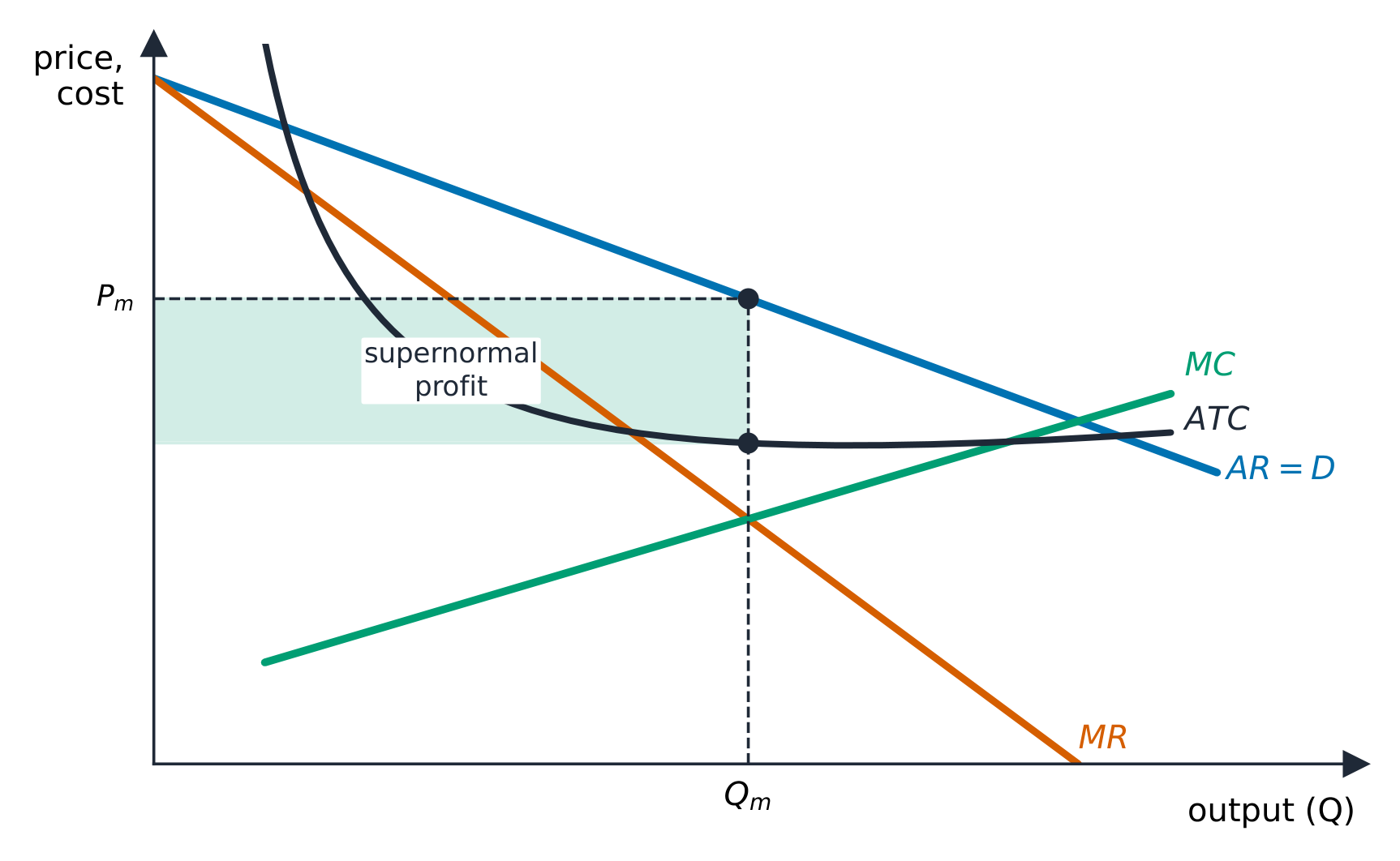
一个垄断在 MC = MR 处最大化利润并能赚超常利润 - 垄断者在 $MR=MC$ 最大化利润,然后在那个数量收取需求曲线允许的最高价格(向上读价格到需求曲线,不是 MR 曲线)。
- 与完全竞争相比它生产更少并收取更多,赚取长期经济利润,因为进入被阻止。
- 这种生产不足造成无谓损失(deadweight loss)——垄断是配置低效的,因为 $P>MC$:最后一单位值的多于它花的,却不被制造。
政府可能用反垄断(antitrust)法回应,或把一个自然垄断的价格监管向 $P=MC$(社会最优,但可能造成一个损失)或 $P=ATC$(公平回报,盈亏平衡)。
考试技能: 垄断图是一个主要项目——显示 $MR=MC$ 处的数量、需求曲线上向上的价格,并给利润($P$ 和 $ATC$ 之间)和无谓损失(到竞争数量的三角形)涂阴影。

A large utility plant: monopoly and market power mean a single firm can set price above marginal cost 探索A monopoly's cost curves
A monopoly is the sole seller, so it faces the whole downward demand curve and its marginal revenue lies below price. It produces where MR = MC — less output, higher price than competition.
词汇表 训练英文 中文 拼音 monopoly/məˈnɒpəli/ 垄断 lǒng duàn barriers to entry/ˈbærɪəz tʊ ˈentri/ 进入壁垒 jìn rù bì lěi natural monopoly/ˈnætʃərəl məˈnɒpəli/ 自然垄断 zì rán lǒng duàn deadweight loss/ˈdedweɪt lɒs/ 无谓损失 wú wèi sǔn shī antitrust/ˌæntɪˈtrʌst/ 反垄断 fǎn lǒng duàn 4.3
价格歧视
大纲
Enduring Understanding Learning Objective Essential Knowledge PRD-3
Even with a common goal of profit-maximization, market structure constrains and influences prices, output, and efficiency.PRD-3.B
b. Explain (using graphs where appropriate) equilibrium, firm decision making, consumer surplus, producer surplus, profit (loss), and deadweight loss in imperfectly competitive markets and why prices in imperfectly competitive markets cannot be relied on to coordinate the actions of all possible market participants and can lead to inefficient outputs. c. Calculate (using data from a graph or table as appropriate) areas of consumer surplus, producer surplus, profit (loss), and deadweight loss in imperfectly competitive markets.- PRD-3.B.8 A firm with market power can engage in price discrimination to increase its profits or capture additional consumer surplus under certain conditions.
- PRD-3.B.9 With perfect price discrimination, a monopolist produces the quantity where price equals marginal cost (just as a competitive market would) but extracts all economic surplus associated with its product and eliminates all deadweight loss.
- Equation: $P = MC$
来源:美国大学理事会 AP 课程与考试说明
价格歧视(price discrimination)是对同一物品向不同买者收取不同的价格。它需要市场势力、按支付意愿分开买者的能力,和防止转售的能力。
在完全(一级)价格歧视下,企业向每个买者收取他们的最高价格。结果:企业生产有效率的数量(在 $P=MC$,没有无谓损失),但把所有消费者剩余转换成生产者剩余(利润)。真实的例子——学生折扣、航空票价、优惠券——是部分的版本。
探索Elasticity and price discrimination
Price discrimination charges each group a different price by their elasticity: inelastic buyers (who won't switch) pay more, elastic buyers pay less. Stretch the curve to see why.
词汇表 训练英文 中文 拼音 Price discrimination/praɪs dɪˌskrɪmɪˈneɪʃn/ 价格歧视 jià gé qí shì 4.4
垄断竞争
大纲
Enduring Understanding Learning Objective Essential Knowledge PRD-3
Even with a common goal of profit-maximization, market structure constrains and influences prices, output, and efficiency.PRD-3.B
b. Explain (using graphs where appropriate) equilibrium, firm decision making, consumer surplus, producer surplus, profit (loss), and deadweight loss in imperfectly competitive markets and why prices in imperfectly competitive markets cannot be relied on to coordinate the actions of all possible market participants and can lead to inefficient outputs. c. Calculate (using data from a graph or table as appropriate) areas of consumer surplus, producer surplus, profit (loss), and deadweight loss in imperfectly competitive markets.- PRD-3.B.10 In a market with monopolistic competition, firms producing differentiated products may earn positive, negative, or zero economic profit in the short run. Firms typically use advertising as a means of differentiating their product. Free entry and exit drive profits to zero in the long run. The output level, however, is smaller than the output level needed to minimize average total costs, creating excess capacity. The price is greater than marginal cost, creating allocative inefficiency.
来源:美国大学理事会 AP 课程与考试说明
垄断竞争(monopolistic competition)有许多卖差异化(differentiated)产品的企业,带容易进入和退出(餐厅、沙龙、服装品牌)。产品差异化给每个企业一条向下倾斜的需求曲线因而一些定价势力。
- 短期: 像一个垄断——在 $MR=MC$ 生产,而利润或损失是可能的。
- 长期: 容易进入把利润竞争掉,所以每个企业赚零经济利润,在需求与 ATC 相切的地方生产。
- 因为它仍然收取 $P>MC$ 而不在最小 ATC 生产,它有过剩产能(excess capacity),既不配置有效率也不生产有效率。社会接受的权衡是产品多样性和选择。
词汇表 训练英文 中文 拼音 Monopolistic competition/məˈnɒpəlɪstɪk ˌkɒmpəˈtɪʃn/ 垄断竞争 lǒng duàn jìng zhēng differentiated/ˌdɪfəˈrenʃɪeɪtɪd/ 差异化 chā yì huà excess capacity/ekˈses kəˈpæsɪti/ 过剩产能 guò shèng chǎn néng 4.5
寡头垄断与博弈论
大纲
Enduring Understanding Learning Objective Essential Knowledge PRD-3
Even with a common goal of profit-maximization, market structure constrains and influences prices, output, and efficiency.PRD-3.C
a. Define (using tables as appropriate) key terms, strategies, and concepts relating to oligopolies and simple games. b. Explain (using tables as appropriate) strategies and equilibria in simple games and the connections to theoretical behaviors in various oligopoly market and non-market settings. c. Calculate (using tables as appropriate) the incentive sufficient to alter a player's dominant strategy.- PRD-3.C.1 An oligopoly is an inefficient market structure with high barriers to entry, where there are few firms acting interdependently.
- PRD-3.C.2 Firms in an oligopoly have an incentive to collude and form cartels.
- PRD-3.C.3 A game is a situation in which a number of individuals take actions, and the payoff for each individual depends directly on both the individual's own choice and the choices of others.
- PRD-3.C.4 A strategy is a complete plan of actions for playing a game; the normal form model of a game shows the payoffs that result from each collection of strategies (one for each player).
- PRD-3.C.5 A player has a dominant strategy when the payoff to a particular action is always higher independent of the action taken by the other player.
- PRD-3.C.6 A Nash equilibrium is a condition describing the set of actions in which no player can increase his or her payoff by unilaterally taking another action, given the other players' actions.
- Exclusion statement: Dominant strategies and Nash equilibrium with more than two players or more than two actions per player, mixed-strategy equilibria, extensive form games, and normal form games with more than two players or more than two actions per player are beyond the scope of the course and the AP Exam.
- PRD-3.C.7 Oligopolists have difficulty achieving the monopoly outcome for reasons similar to those that prevent players from achieving a cooperative outcome in the Prisoner's Dilemma; nevertheless, prices are generally higher and quantities lower with oligopoly (or duopoly) than with perfect competition.
来源:美国大学理事会 AP 课程与考试说明
一个寡头垄断(oligopoly)是一个有少数大的、相互依存(interdependent)企业的市场(汽车、航空、手机)。因为每个企业的最佳行动取决于竞争者的行动,我们用博弈论(game theory)分析它们。
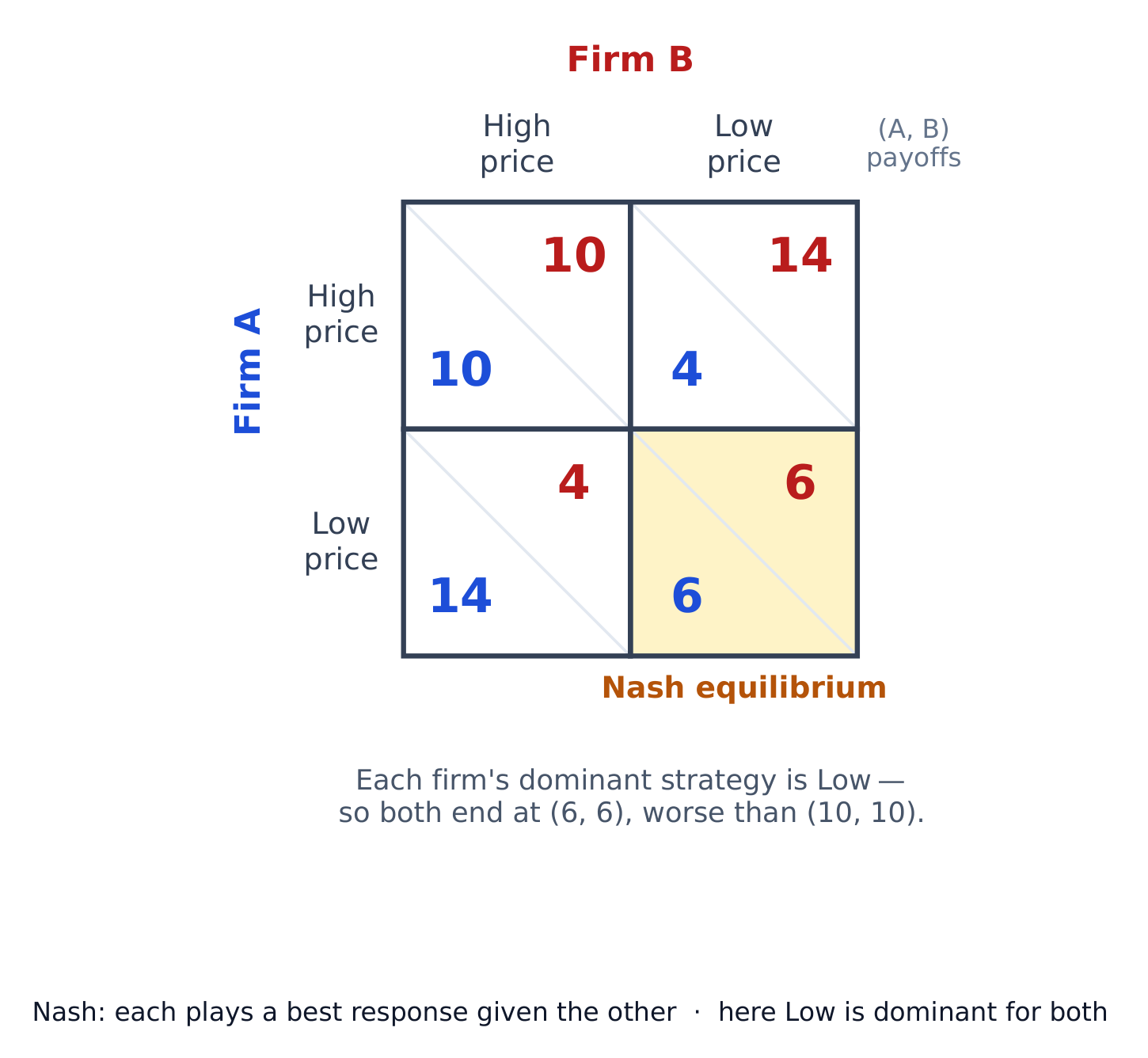
- 一个收益矩阵(payoff matrix)显示每个选择组合下每个企业的利润。
- 一个优势策略(dominant strategy)是一个企业的最佳选择,不管竞争者做什么。
- 一个纳什均衡(Nash equilibrium)是一个结果,其中没有企业能通过单方面改变它的选择做得更好。
- 经典的囚徒困境(prisoners' dilemma)显示为什么企业常常无法合作:两者会通过勾结(colluding)(表现得像一个垄断)获益,但每个都有一个作弊的激励,所以它们最终处于近乎竞争的、更低利润的结果。勾结(collusion)和卡特尔(cartels)因相同的原因不稳定(而且通常非法)。
Worked example. 两个企业各选择一个高或低价格。利润(A,B):都高 $\to(10,10)$;A 低、B 高 $\to(14,4)$;A 高、B 低 $\to(4,14)$;都低 $\to(6,6)$。对 A:若 B 出高,低($14$)击败高($10$);若 B 出低,低($6$)击败高($4$)——所以低是 A 的优势策略,而按对称也是 B 的。纳什均衡是都低 $(6,6)$,对两者都比合作的 $(10,10)$ 更糟——运行中的囚徒困境。
一个囚徒困境:每个企业的优势策略是低,给出纳什均衡 考试技能: 能够从一个 2×2 收益矩阵找到每个企业的优势策略和纳什均衡,并解释为什么合作的结果难以维持。
词汇表 训练英文 中文 拼音 oligopoly/ˌɒlɪˈɡɒpəli/ 寡头垄断 guǎ tóu lǒng duàn interdependent/ˌɪntədɪˈpendənt/ 相互依存 xiāng hù yī cún game theory/ɡeɪm ˈθɪəri/ 博弈论 bó yì lùn payoff matrix/ˈpeɪɒf ˈmeɪtrɪks/ 收益矩阵 shōu yì jǔ zhèn dominant strategy/ˈdɒmɪnənt ˈstrætədʒi/ 优势策略 yōu shì cè lüè Nash equilibrium/næʃ ˌiːkwɪˈlɪbrɪəm/ 纳什均衡 nà shén jūn héng prisoners' dilemma/ˈprɪzənəz daɪˈlemə/ 囚徒困境 qiú tú kùn jìng colluding/kəˈluːdɪŋ/ 勾结 gōu jié cartels/kɑːˈtelz/ 卡特尔 kǎ tè ěr 4.5
考试技巧
- 一个有市场势力的企业面对一条向下倾斜的需求,所以 MR < P(MR 有两倍的斜率)。
- 一个垄断在 MR = MC 处生产,然后收取需求曲线上向上的价格;它造成无谓损失,因为 $P > MC$。
- 在完全价格歧视下企业生产有效率的数量但捕获所有消费者剩余。
- 垄断竞争以过剩产能赚零长期利润(产品多样性是权衡)。
- 在一个寡头垄断里从收益矩阵找到优势策略和纳什均衡;合作的结果难以维持。
-
5
要素市场
5.1
要素市场导论
大纲
Enduring Understanding Learning Objective Essential Knowledge PRD-4
Factor prices provide incentives and convey information to firms and factors of production.PRD-4.A
a. Define (using graphs where appropriate) key terms and concepts relating to factor markets.
b. Explain (using graphs where appropriate) the relationship between factors of production, firms, and factor prices.
c. Calculate (using data from a graph or table where appropriate) the marginal revenue product and marginal resource cost.- PRD-4.A.1 Factors of production (labor, capital, and land) respond to factor prices (wages, interest, and rent), and employers' (firms') decision to hire is based on the productivity of the factors, output price, and cost of the factor.
- PRD-4.A.2 The quantity of labor demanded is negatively related to the wage rate, while the quantity of labor supplied is positively related to the wage rate in a given labor market, other things constant.
来源:美国大学理事会 AP 课程与考试说明
一个要素市场(factor market)是企业购买生产要素——劳动、土地、资本——的地方。角色反转:企业需求而家庭供给。最被考查的要素是劳动。
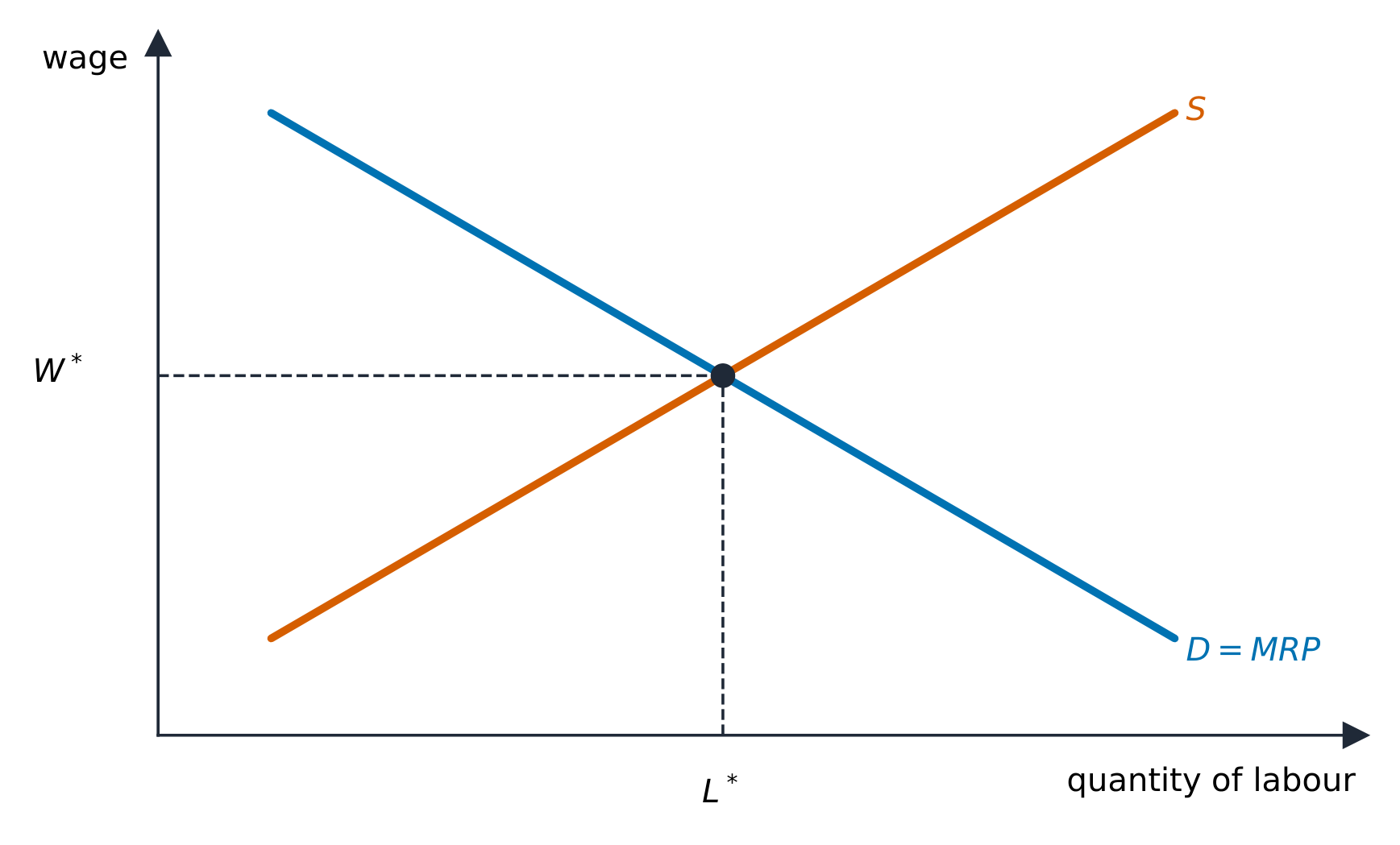
一个竞争性劳动市场在劳动需求遇到劳动供给的地方设定工资 要素需求是一个派生需求(derived demand)——企业想要劳动不是为了它本身而是为了它生产的产出(和收入)。所以对工人的需求取决于对他们制造的产品的需求。
探索A labour (factor) market
In a factor market firms demand labour and households supply it; the wage settles where demand meets supply. Shift either curve and watch the wage and employment move.
词汇表 训练英文 中文 拼音 factor market/ˈfæktə ˈmɑːkɪt/ 要素市场 yào sù shì chǎng derived demand/dɪˈraɪvd dɪˈmænd/ 派生需求 pài shēng xū qiú 5.2
要素需求与要素供给的变动
大纲
Enduring Understanding Learning Objective Essential Knowledge PRD-4
Factor prices provide incentives and convey information to firms and factors of production.PRD-4.B
Explain (using graphs where appropriate) firms' and factors' responses to changes in incentives and constraints.- PRD-4.B.1 Changes in the determinants of labor demand, such as the output price and the productivity of the worker, cause the labor demand curve to shift.
- PRD-4.B.2 Changes in the determinants of labor supply (such as immigration, education, working conditions, age distribution, availability of alternative options, preferences for leisure, and cultural expectations) cause the labor supply curve to shift.
来源:美国大学理事会 AP 课程与考试说明
劳动需求在以下时移动:
- 产品价格或产品需求变化(更有价值的产出 $\Rightarrow$ 需求更多劳动),
- 工人生产率变化(更好的培训或资本),
- 其他投入的价格变化(一个替代投入像机器,或一个互补品)。
劳动供给随合格工人的数量、移民、工人的偏好(吸引他们所需的工资),和其他工作里可得的工资而移动。市场工资在劳动需求遇到劳动供给的地方设定。
5.3
完全竞争要素市场中的利润最大化行为

大纲
Enduring Understanding Learning Objective Essential Knowledge PRD-4
Factor prices provide incentives and convey information to firms and factors of production.PRD-4.C
a. Define (using graphs as appropriate) the characteristics of perfectly competitive factor markets.
b. Explain (using graphs where appropriate) the profit-maximizing behavior of firms buying labor (with other inputs fixed) in perfectly competitive markets.
c. Calculate (using data from a graph or table where appropriate) measures representing the profit-maximizing behavior of firms buying labor (with other inputs fixed) in perfectly competitive markets.- PRD-4.C.1 In a perfectly competitive labor market, the wage is set by the market and each firm hires the quantity of workers, where the marginal factor (resource) cost (wage) equals the marginal revenue product of labor. A typical firm may be a perfect competitor in the labor market even if it is an imperfect competitor in its output markets.
- PRD-4.C.2 A typical firm hires labor in a perfectly competitive labor market as long as the marginal revenue product of labor is greater than the market wage.
- PRD-4.C.3 To minimize costs or maximize profits, firms allocate inputs such that the last dollar spent on each input yields the same amount of marginal product.
来源:美国大学理事会 AP 课程与考试说明
一个企业用与其他一切相同的边际逻辑决定雇用多少工人——比较多一个工人的边际收益和边际成本。
- 一个工人的边际收益是边际收益产品(marginal revenue product)(MRP):来自多一个工人的额外收入,$MRP = MP \times$ 产品价格(在一个竞争性产品市场,那里 $P=MR$)。MRP 随着更多工人被雇用而下降,因为边际产量递减。
- 一个工人的边际成本是工资(在一个竞争性劳动市场企业是一个工资接受者,所以边际要素成本 $=$ 工资)。
- 雇用规则: 雇用工人直到 $MRP = \text{wage}$(更一般地,$MRP = MFC$)。MRP 曲线是企业的劳动需求曲线。
Worked example. 一个工人的边际产量是 $8$ 单位而企业在一个竞争性市场以 $\$5$ 卖每个,所以 $MRP=8\times\$5=\$40$。若工资是 $\$30$,企业雇用这个工人,因为 $MRP>\text{wage}$。随着更多工人加入,边际产量递减把 MRP 拉低;企业继续雇用直到一个 $MP=6$ 的工人给出 $MRP=6\times\$5=\$30$,恰好是工资——利润最大化的停止点。
要选择两个投入的最低成本组合,在投入间设定每美元 MP 相等:$\dfrac{MP_L}{P_L}=\dfrac{MP_K}{P_K}$ ——与消费者选择相同的每美元相等回报规则。
考试技能: 从一张表计算 MRP(边际产量 $\times$ 价格)并求在一个给定工资雇用多少工人——一个常见的自由回答任务。
A car assembly line: firms hire labour until the marginal revenue product equals the wage 词汇表 训练英文 中文 拼音 marginal revenue product/ˈmɑːdʒɪnl ˈrevənjuː ˈprɒdʌkt/ 边际收益产品 biān jì shōu yì chǎn pǐn 5.4
买方垄断市场

大纲
Enduring Understanding Learning Objective Essential Knowledge PRD-4
Factor prices provide incentives and convey information to firms and factors of production.PRD-4.D
a. Define (using graphs as appropriate) the characteristics of monopsonistic markets.
b. Explain (using graphs where appropriate) the profit-maximizing behavior of firms buying labor (with other inputs fixed) in monopsonistic markets.
c. Calculate (using data from a graph or table where appropriate) measures representing the profit-maximizing behavior of firms buying labor (with other inputs fixed) in monopsonistic markets.- PRD-4.D.1 In a monopsonistic labor market, a typical firm hires additional labor as long as the marginal revenue product is greater than the marginal factor (resource) cost (the wage of a new unit of labor plus the wage increase given to all existing labor).
- PRD-4.D.2 When a typical firm hires additional workers in a monopsonistic labor market, the marginal factor (resource) cost is greater than the supply price of labor.
来源:美国大学理事会 AP 课程与考试说明
一个买方垄断(monopsony)是一个有一个要素的单一买者的市场——例如,一个镇里唯一的大雇主。
- 因为它是整个市场,买方垄断者面对一条向上倾斜的劳动供给曲线:要雇用更多工人它必须为每个人提高工资。
- 所以边际要素成本(marginal factor cost)(MFC)高于工资(像垄断的 $MR
- 买方垄断者在 $MRP = MFC$ 雇用,然后付供给曲线在那个数量允许的更低工资。
- 结果:与一个竞争性劳动市场相比,一个买方垄断以一个更低的工资雇用更少工人——垄断的镜像。
一个买方垄断在 MFC = MRP 处雇用并付比一个竞争性市场更低的工资 考试技能: 画买方垄断图(供给、它之上的 MFC、MRP 作为需求)、在 $MRP=MFC$ 标记数量和供给曲线上向下的工资,并把它与竞争性工资和数量对比。
词汇表 训练英文 中文 拼音 monopsony/ˈmɒnəʊpsəni/ 买方垄断 mǎi fāng lǒng duàn marginal factor cost/ˈmɑːdʒɪnl ˈfæktə kɒst/ 边际要素成本 biān jì yào sù chéng běn 5.4
考试技巧
- 要素需求是派生需求;雇用劳动直到 MRP = 工资(MRP = 边际产量 × 价格)。
- MRP 随着更多工人被雇用而下降(边际产量递减)。
- 对于最低成本的投入使用,在投入间使每美元的边际产量均衡。
- 一个买方垄断面对一条向上的供给,所以它的边际要素成本高于工资;它以一个更低的工资雇用更少工人。
- 画买方垄断图(供给、它之上的 MFC、MRP 作为需求)并与竞争性结果对比。
-
6
市场失灵与政府的作用
6.1
社会有效与无效的市场结果
大纲
Enduring Understanding Learning Objective Essential Knowledge POL-2
Perfectly competitive markets allocate resources efficiently, but imperfect competition often results in market inefficiencies.POL-2.A
a. Define social efficiency.
b. Explain (using graphs where appropriate) why resource allocation in perfectly competitive markets is socially efficient.- POL-2.A.1 The optimal quantity of a good occurs where the marginal benefit of consuming the last unit equals the marginal cost of producing that last unit, thus maximizing total economic surplus.
- POL-2.A.2 The market equilibrium quantity is equal to the socially optimal quantity only when all social benefits and costs are internalized by individuals in the market. Total economic surplus is maximized at that quantity. [See also PRD-3 and POL-3.]
POL-2.B
Explain (using graphs where appropriate) how private incentives can lead to actions by rational agents that are socially undesirable (inefficient) market outcomes.- POL-2.B.1 Rational agents can pursue private actions to exploit or exercise market characteristics known as market power.
- POL-2.B.2 Rational agents make optimal decisions by equating private marginal benefits and private marginal costs that can result in market inefficiencies.
- POL-2.B.3 Policymakers use cost-benefit analysis to evaluate different actions to reduce or eliminate market inefficiencies.
- POL-2.B.4 Market inefficiencies can be eliminated by designing policies that equate marginal social benefit with marginal social cost.
POL-2.C
a. Explain equilibrium allocations in imperfect markets relative to efficient allocations (using graphs where appropriate) and why these markets are inefficient.
b. Calculate (using graphs where appropriate) the deadweight loss resulting from the production of a non-efficient quantity.- POL-2.C.1 Equilibrium allocations can deviate from efficient allocations due to situations such as monopoly; oligopoly; monopolistic competition; negative and positive externalities in production or consumption; asymmetric information; and insufficient production of public goods.
- POL-2.C.2 Producing any non-efficient quantity results in deadweight loss.
来源:美国大学理事会 AP 课程与考试说明
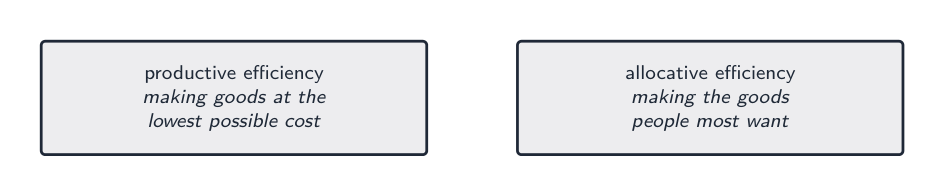
一个市场结果是社会有效率(socially efficient)的,当它最大化总剩余时——当最后一单位的边际社会收益等于边际社会成本时。完全竞争自己达到这个。但有时市场无法达到,生产太多或太少。这是市场失灵(market failure),而它是政府行动的主要经济理由。
生产效率是最低成本;配置效率是制造人们想要的 词汇表 训练英文 中文 拼音 socially efficient/ˈsəʊʃəli ɪˈfɪʃənt/ 社会有效率 shè huì yǒu xiào lǜ market failure/ˈmɑːkɪt ˈfeɪlɪə/ 市场失灵 shì chǎng shī líng 6.2
外部性
大纲
Enduring Understanding Learning Objective Essential Knowledge POL-3
Private incentives can fail to account for all socially relevant considerations.POL-3.A
a. Define externalities.
b. Explain (using graphs where appropriate) how in the presence of externalities, private markets do not take into consideration social costs or social benefits.- POL-3.A.1 The socially optimal quantity of a good occurs where the marginal social benefit of consuming the last unit equals the marginal social cost of producing that last unit, thus maximizing total economic surplus.
- POL-3.A.2 Externalities are either positive or negative and arise from lack of well-defined property rights and/or high transaction costs.
- POL-3.A.3 In the presence of externalities, rational agents respond to private costs and benefits and not to external costs and benefits.
- POL-3.A.4 Rational agents have the incentive to free ride when a good is non-excludable.
POL-3.B
Explain (using graphs where appropriate) how public policies address positive or negative externalities.- POL-3.B.1 Policies that address positive or negative externalities include taxes/subsidies, environmental regulation, public provision, the assignment of property rights, and the reassignment of property rights through private transactions.
来源:美国大学理事会 AP 课程与考试说明
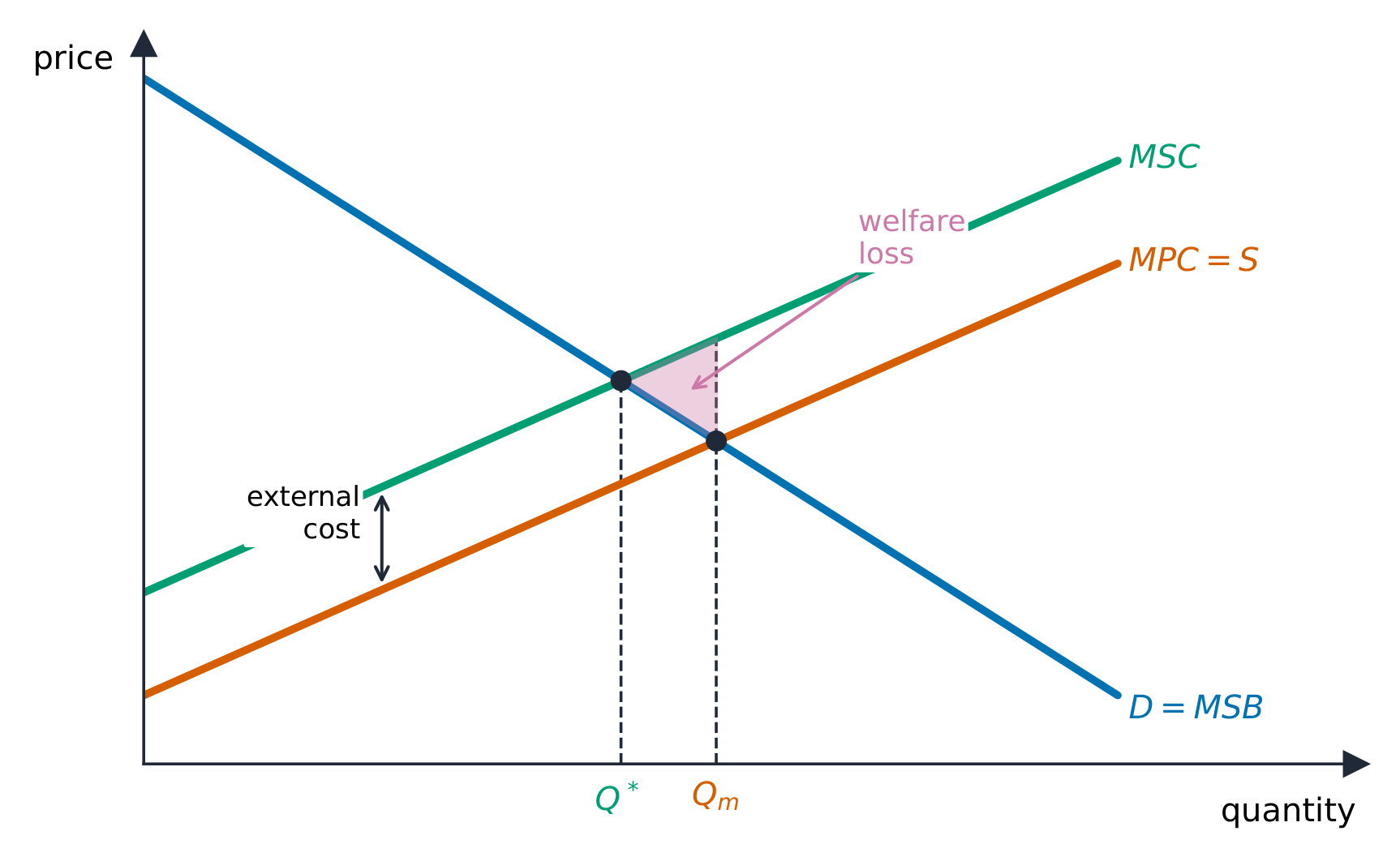
负外部性 一个外部性(externality)是一个落在一个不涉及交易的第三方身上的成本或收益——所以私人决策者忽略它。
一个负外部性:市场过度生产,造成一个福利损失 - 一个负外部性(negative externality)(污染)意味着边际社会成本 > 边际私人成本。市场过度生产;无谓损失是一个三角形。修复:一个庇古税(Pigovian tax)或监管以使生产者"内部化"成本(把私人成本向上移到社会成本)。
- 一个正外部性(positive externality)(疫苗接种、教育)意味着边际社会收益 > 边际私人收益。市场生产不足。修复:对消费者或生产者的一个补贴。
- 科斯定理(Coase theorem):若产权清晰而讨价还价没有成本,私人各方能自己解决一个外部性——但那在许多人涉及时很少见。

拥堵是一种负外部性:每个司机都给其他所有司机带来成本,而没有任何价格去收取它 Worked example. 一个工厂一种化学品的私人边际成本是每单位 $\$8$,但每单位也向邻居倾倒 $\$3$ 的污染,所以边际社会成本是 $\$11$。忽略这 $\$3$,市场过度生产。一项恰好每单位 $\$3$ 的庇古税把企业的私人成本提高到 $\$11$ ——现在等于社会成本——所以企业把产出削减到有效率的数量而外部性被"内部化"。
考试技能: 辨别一个外部性是正的还是负的、在一个图上显示私人和社会曲线分歧、标记无谓损失,并命名纠正的税或补贴。

Industrial pollution: a negative externality where social cost exceeds private cost 探索A market with an externality
An externality makes private cost differ from social cost, so the free-market quantity is inefficient. See the deadweight loss and how a tax or subsidy corrects it.
词汇表 训练英文 中文 拼音 externality/ekˈstɜːnælɪti/ 外部性 wài bù xìng negative externality/ˈneɡətɪv ekˈstɜːnælɪti/ 负外部性 fù wài bù xìng Pigovian tax/pɪˈɡəʊvɪən tæks/ 庇古税 bì gǔ shuì positive externality/ˈpɒzɪtɪv ekˈstɜːnælɪti/ 正外部性 zhèng wài bù xìng Coase theorem/kəʊs ˈθɪərəm/ 科斯定理 kē sī dìng lǐ 6.3
公共物品与私人物品
大纲
Enduring Understanding Learning Objective Essential Knowledge POL-3
Private incentives can fail to account for all socially relevant considerations.POL-3.C
a. Define whether goods are rival and/or excludable.
b. Explain how the nature of rival and/or excludable goods influences the behavior of individuals and groups.- POL-3.C.1 Private goods are rival and excludable, and public goods are non-rival and non-excludable.
- POL-3.C.2 Due to the free rider problem, private individuals usually lack the incentive to produce public goods, leaving government as the only producer.
- POL-3.C.3 Governments sometimes choose to produce private goods, such as educational services, and to allow free access to them.
- POL-3.C.4 Some natural resources are, by their nature, non-excludable and rival and therefore open access. Private individuals inefficiently overconsume such resources.
来源:美国大学理事会 AP 课程与考试说明
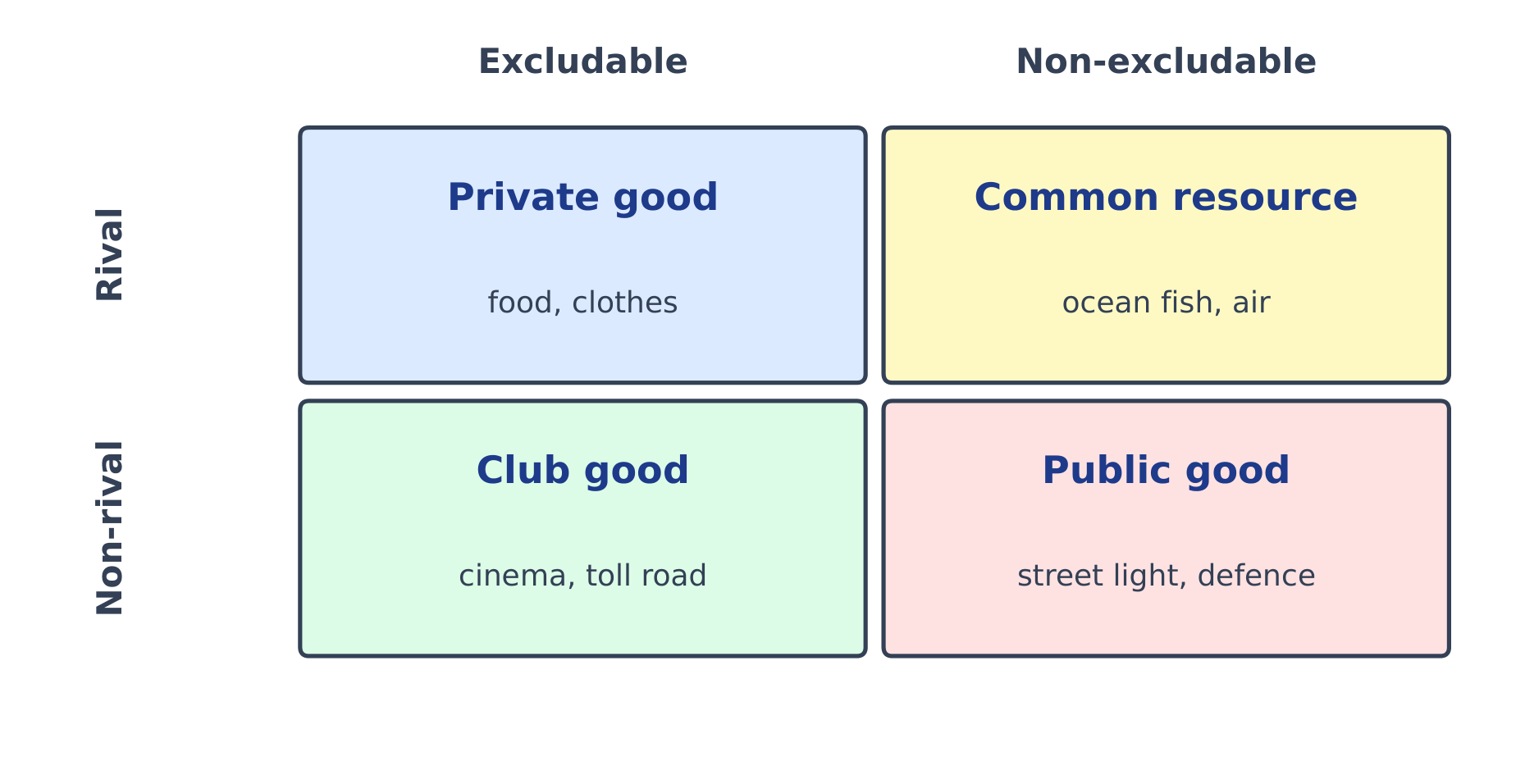
物品沿两个特征不同:竞争性(rivalry)(一个人的使用是否减少另一个人的?)和排他性(excludability)(非付费者能被排除在外吗?)。
物品按它们是否竞争性和排他性分类 - 一个私人物品(private good)是竞争性和排他性的(一个三明治)——市场很好地处理这些。
- 一个公共物品(public good)是非竞争性和非排他性的(国防、一座灯塔)。因为非付费者不能被排除,人们搭便车(free-ride)——不付钱地享受它——所以市场供给不足它,而政府通常供给它。
- 公共资源(common resources)是竞争性但非排他性的(海洋鱼);过度使用毁掉它们——公地悲剧(tragedy of the commons)。
词汇表 训练英文 中文 拼音 rivalry/ˈraɪvəlri/ 竞争性 jìng zhēng xìng excludability/eksˌkluːdəˈbɪlɪti/ 排他性 pái tā xìng private good/ˈpraɪvət ɡʊd/ 私人物品 sī rén wù pǐn public good/ˈpʌblɪk ɡʊd/ 公共物品 gōng gòng wù pǐn free-ride/friː raɪd/ 搭便车 dā biàn chē Common resources/ˈkɒmən rɪˈzɔːsɪz/ 公共资源 gōng gòng zī yuán tragedy of the commons/ˈtrædʒədi ɒvðə ˈkɒmənz/ 公地悲剧 gōng dì bēi jù 6.4
政府干预对不同市场结构的影响
大纲
Enduring Understanding Learning Objective Essential Knowledge POL-4
In imperfect markets, well-designed government policy can reduce waste.POL-4.A
a. Define government policy interventions in imperfect markets.
b. Explain (using graphs where appropriate) how government policies can alter market outcomes in perfectly and imperfectly competitive markets.
c. Calculate (using data from a graph or table as appropriate) changes in market outcomes resulting from government policies in perfectly competitive and imperfectly competitive markets.- POL-4.A.1 Per-unit taxes and subsidies affect the total price consumers pay, net price firms receive, equilibrium quantity, consumer and producer surpluses, deadweight loss, and government revenue or cost. The impact of change depends on the price elasticity of demand and supply.
- POL-4.A.2 Lump-sum taxes and lump-sum subsidies do not change either marginal cost or marginal benefit; only fixed costs will be affected.
- POL-4.A.3 Binding price ceilings and floors affect prices and quantities differently depending on the market structures (perfect competition, monopoly, monopolistic competition, and monopsony) and the price elasticities of supply and demand.
- POL-4.A.4 Government intervention in imperfect markets can increase efficiency if the policy correctly addresses the incentives that led to the market failure.
- POL-4.A.5 Government can use price regulation to address inefficiency due to monopoly.
- POL-4.A.6 A natural monopoly will require a lump-sum subsidy to produce at the allocatively efficient quantity.
- POL-4.A.7 Governments use antitrust policy in an attempt to make markets more competitive.
- Exclusion statement: A graph of inefficiency and policy due to collusion is beyond the scope of the course and the AP Exam.
来源:美国大学理事会 AP 课程与考试说明
政府工具按结构不同地改变结果:
- 把一个垄断的价格监管向 $P=MC$ 能增加效率(不像一个竞争性市场里的一个价格管制,它造成短缺/过剩)。
- 反垄断法(antitrust laws)拆分或阻止反竞争的合并和勾结。
- 当外部性存在时,税收和补贴使产出朝社会有效率的数量移动。
关键洞见:同一个政策能帮助或伤害效率,取决于市场是否已经有效率(竞争性)还是已经失灵(垄断、外部性)。
从量 vs 定额。 一个从量税(per-unit tax)加到边际成本上,所以它把供给上移、抬高价格、减少数量并造成无谓损失。一个定额税(lump-sum tax)(一笔固定收费,像牌照费)不改变边际成本或边际收益,所以在短期里利润最大化的价格和数量不变——只有企业的利润下降;在长期里它改变进入和退出。对一个自然垄断,把价格监管向下到 $P=MC$(配置有效率)会迫使亏损,所以需要一个定额补贴(lump-sum subsidy)来使它继续生产那个有效率的数量。
词汇表 训练英文 中文 拼音 Antitrust laws/ˌæntɪˈtrʌst lɔːz/ 反垄断法 fǎn lǒng duàn fǎ per-unit tax/pɜː ˈjuːnɪt tæks/ 从量税 cóng liàng shuì lump-sum tax/lʌmp sʌm tæks/ 定额税 dìng é shuì lump-sum subsidy/lʌmp sʌm ˈsʌbsɪdi/ 定额补贴 dìng é bǔ tiē 6.5
不平等
大纲
Enduring Understanding Learning Objective Essential Knowledge POL-5
Market outcomes can result in income inequality.POL-5.A
Define measures of economic inequality in income and wealth.- POL-5.A.1 Income levels and poverty rates vary greatly both across and within groups (e.g., age, gender, race) and countries.
- POL-5.A.2 The Lorenz curve and Gini coefficient are used to represent the degree of inequality in distributions and to compare distributions across different countries, policies, or time periods.
- Exclusion statement: Drawing the Lorenz curve and calculating Gini coefficients are beyond the scope of the course and the AP Exam.
POL-5.B
Explain sources of income and wealth inequality.- POL-5.B.1 Each factor of production receives the value of its marginal product, which can contribute to income inequality.
- POL-5.B.2 Sources of income and wealth inequality include differences in tax structures (progressive and regressive tax structures), human capital, social capital, inheritance, effects of discrimination, access to financial markets, mobility, and bargaining power within economic and social units (firms, labor unions, and families).
来源:美国大学理事会 AP 课程与考试说明
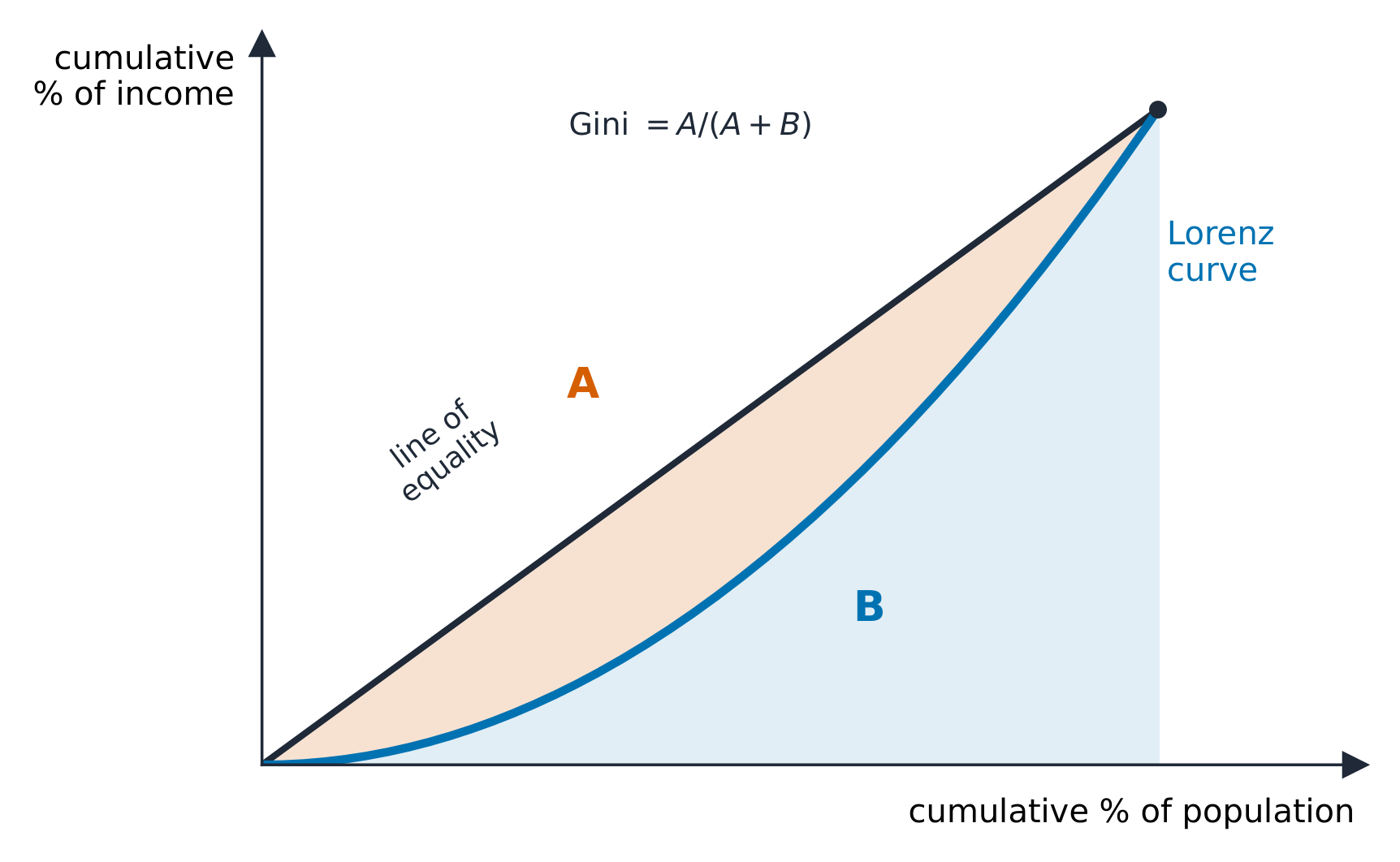
市场奖励生产率,但结果的收入分配(income distribution)能很不平等。经济学家用洛伦兹曲线(Lorenz curve)(收入份额对人口份额;它离 45° 线弯曲得越远越不平等)和基尼系数(Gini coefficient)(0 = 完美平等,1 = 完美不平等)来测量它。
洛伦兹曲线和基尼系数测量收入不平等 Worked example. 假设最穷的 $20\%$ 家庭只赚收入的 $5\%$,而最富的 $20\%$ 赚 $50\%$。在完美平等下每 $20\%$ 会恰好赚 $20\%$,所以洛伦兹曲线会是 $45°$ 线。因为底部五分之一远低于 $20\%$ 而顶部五分之一远高于,曲线在对角线之下弯曲很远——一个大的差距,意味着一个高基尼系数和实质的不平等。
不平等的来源包括人力资本(human capital)(技能、教育)、继承和歧视的差异。政府通过累进税(progressive taxes)(对更高收入更高的税率)和转移支付(transfer payments)(福利、补贴)再分配。有一个被辩论的效率与公平权衡(efficiency–equity trade-off):再分配能减少工作激励,所以社会平衡公平与总蛋糕的大小。

Wealth and poverty side by side: markets alone may leave large income inequality unaddressed 探索Measure inequality with a Lorenz curve
A Lorenz curve plots cumulative income against cumulative population; the further it bows from the diagonal, the more unequal — summarised by the Gini coefficient.
词汇表 训练英文 中文 拼音 income distribution/ˈɪŋkʌm ˌdɪstrɪˈbjuːʃn/ 收入分配 shōu rù fēn pèi Lorenz curve/ˈlɒrənts kɜːv/ 洛伦兹曲线 luò lún zī qū xiàn Gini coefficient/ˈdʒiːni ˌkəʊɪˈfɪʃənt/ 基尼系数 jī ní xì shù human capital/ˈhjuːmən ˈkæpɪtl/ 人力资本 rén lì zī běn progressive taxes/prəˈɡresɪv ˈtæksɪz/ 累进税 lèi jìn shuì transfer payments/ˈtrænsfɜː ˈpeɪmənts/ 转移支付 zhuǎn yí zhī fù efficiency–equity trade-off/ɪˈfɪʃənsi ˈekwɪti treɪd ɒf/ 效率与公平权衡 xiào lǜ yǔ gōng píng quán héng 6.5
考试技巧
- 一个负外部性使市场过度生产;用一个等于外部成本的庇古税纠正。一个正外部性生产不足;用一个补贴纠正。
- 一个公共物品是非竞争性和非排他性的,所以搭便车导致市场供给不足它。
- 按竞争性和排他性给物品分类;公共资源(竞争性、非排他性)遭受公地悲剧。
- 同一个政策能帮助或伤害效率,取决于市场是否已经有效率还是失灵。
- 用洛伦兹曲线和基尼系数(0 = 平等,1 = 不平等)测量不平等。