| Enduring Understanding | Learning Objective | Essential Knowledge |
|---|---|---|
MKT-1 | MKT-1.A |
|
基本经济概念
AP 微观经济学 · 第 1 主题
 8:34
8:34
Basic Economic Concepts
A day has only twenty-four hours. Think what you want to fit into one: sleep, school, homework, sport, time with friends. Add it up honestly and it comes to…
英文讲解 · 内嵌中英文字幕
1.1
稀缺性
大纲
来源:美国大学理事会 AP 课程与考试说明
经济学(economics)以一个顽固的事实开始:人们的欲望实际上是无限的,但满足它们的资源(resources)是有限的。这个差距是稀缺性(scarcity),而它是经济学存在的原因——若一切都免费而无穷,就没有什么要决定的。
这些资源(生产要素(factors of production))是土地(land)(自然资源)、劳动(labor)(人的努力)、资本(capital)(工具、机器、建筑),和企业家才能(entrepreneurship)(组织其他三个并承担风险)。因为这些是稀缺的,每个经济都必须回答三个问题:生产什么、如何生产,和为谁生产。
稀缺性迫使选择,而每个选择都有一个机会成本(opportunity cost)——你放弃的下一个最好的替代的价值。这一个思想贯穿整个课程:任何东西的真正成本是你为得到它而牺牲的,不只是你付的钱。
词汇表
训练
| 英文 | 中文 | 拼音 |
|---|---|---|
| Economics/ˌiːkəˈnɒmɪks/ | 经济学 | jīng jì xué |
| resources/rɪˈzɔːsɪz/ | 资源 | zī yuán |
| scarcity/ˈskeəsɪti/ | 稀缺性 | xī quē xìng |
| factors of production/ˈfæktəz ɒv prəˈdʌkʃn/ | 生产要素 | shēng chǎn yào sù |
| labor/ˈleɪbə/ | 劳动 | láo dòng |
| capital/ˈkæpɪtl/ | 资本 | zī běn |
| entrepreneurship/ˌɒntrɪprəˈnjʊəʃɪp/ | 企业家才能 | qǐ yè jiā cái néng |
| opportunity cost/ɒpəˈtjuːnɪti kɒst/ | 机会成本 | jī huì chéng běn |
1.2
资源配置与经济体制
大纲
| Enduring Understanding | Learning Objective | Essential Knowledge |
|---|---|---|
MKT-1 | MKT-1.B |
|
来源:美国大学理事会 AP 课程与考试说明
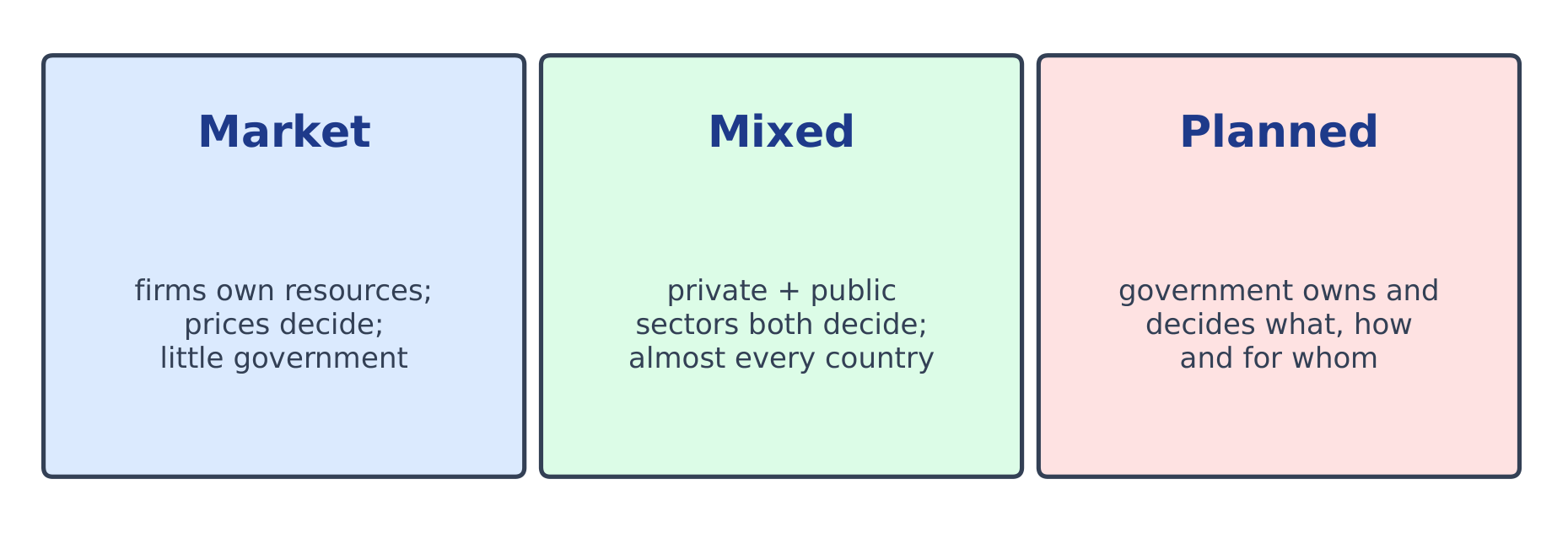
一个经济体制(economic system)是一个社会回答三个问题的方式。
- 在一个市场经济(market economy)里,私人买者和卖者通过价格决定;自利和竞争协调他们("看不见的手")。
- 在一个计划经济(command economy)里,政府拥有资源并计划生产。
- 真实经济是混合经济(mixed)——大多是市场,政府提供一些物品并纠正问题。
市场的关键优势是价格自动携带信息和激励(incentives),不需要中央计划者。
探索
Explore how prices coordinate a market
In a market economy no one is in charge, yet the price finds the level where quantity supplied meets quantity demanded. Drag the demand and supply lines and watch the equilibrium price act as a signal and an incentive.
词汇表
训练
| 英文 | 中文 | 拼音 |
|---|---|---|
| economic system/ˌiːkəˈnɒmɪk ˈsɪstəm/ | 经济体制 | jīng jì tǐ zhì |
| market economy/ˈmɑːkɪt ɪˈkɒnəmi/ | 市场经济 | shì chǎng jīng jì |
| command economy/kəˈmænd ɪˈkɒnəmi/ | 计划经济 | jì huà jīng jì |
| mixed/mɪkst/ | 混合经济 | hùn hé jīng jì |
| incentives/ɪnˈsentɪvz/ | 激励 | jī lì |
1.3
生产可能性曲线
大纲
| Enduring Understanding | Learning Objective | Essential Knowledge |
|---|---|---|
MKT-1 | MKT-1.C |
|
来源:美国大学理事会 AP 课程与考试说明
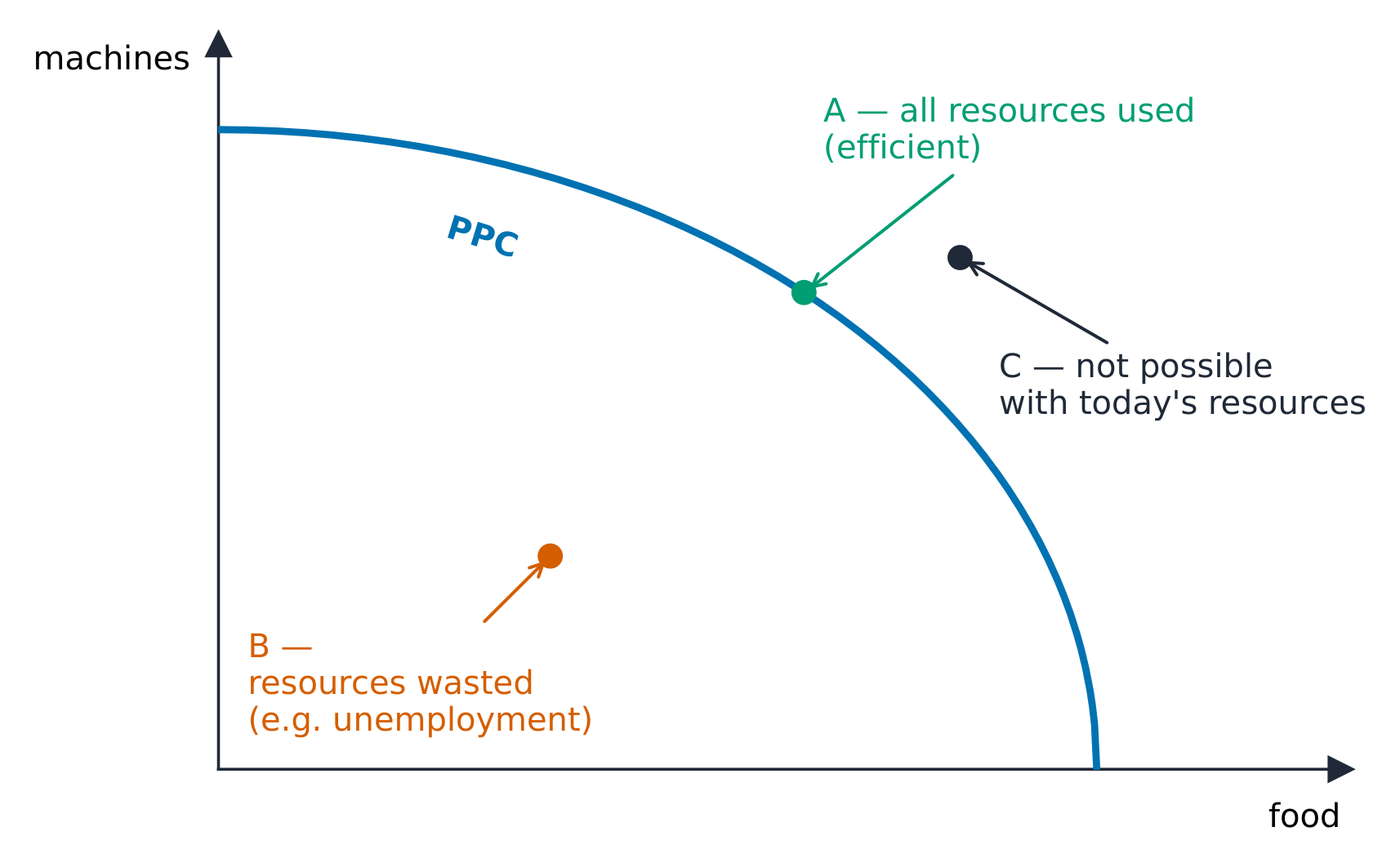
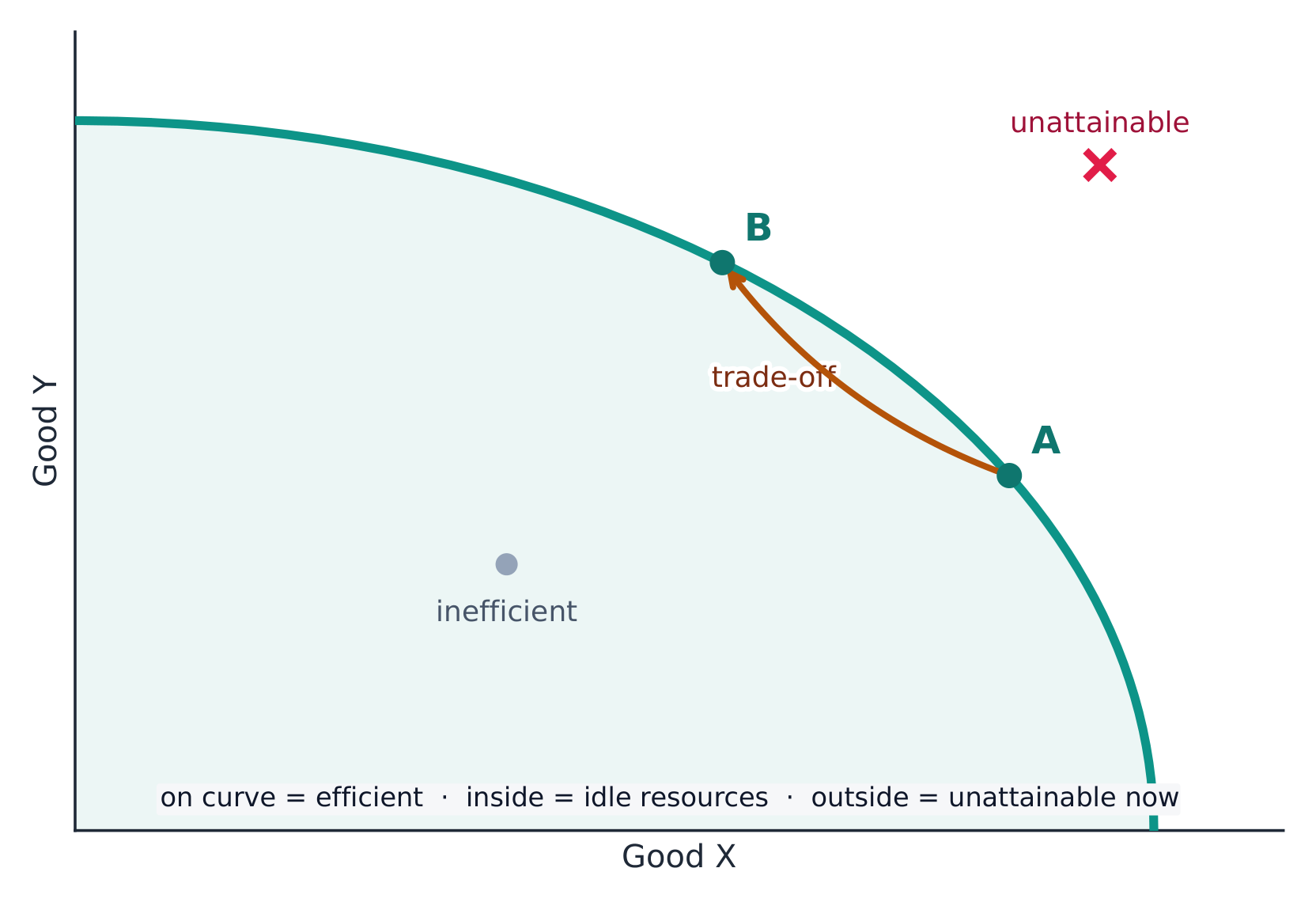
生产可能性曲线(PPC)(production possibilities curve)显示一个经济用它的资源和技术充分而高效地使用能生产的两种物品的最大组合。
- 曲线上的点是有效率(efficient)的;里面的点是低效的(浪费的或失业的资源);外面的点当前是无法实现(unattainable)的。
- PPC 向下的斜率显示机会成本:制造更多一种物品意味着制造更少另一种。一个点的斜率就是水平轴上物品的机会成本。
- 一条向外凸(凹)的 PPC 显示增加的机会成本——资源不等同地适合两种物品,所以制造更多一种要花越来越多另一种。一条直线 PPC 意味着恒定的机会成本。
- 经济增长(economic growth)(更多资源、更好技术)使整条曲线向外移动。
考试技能: 准备好从一条 PPC 读机会成本、决定一个点是有效率/低效/无法实现,并解释什么使曲线移动。
探索
Explore the production possibilities curve
Making more of one good means giving up some of the other — that trade-off is the opportunity cost, and the bowed shape shows the law of increasing opportunity cost. Drag along the curve, then grow the economy to push the whole frontier out.
词汇表
训练
| 英文 | 中文 | 拼音 |
|---|---|---|
| production possibilities curve (PPC)/prəˈdʌkʃn ˌpɒsəˈbɪlɪtiz kɜːv/ | 生产可能性曲线 | shēng chǎn kě néng xìng qū xiàn |
| efficient/ɪˈfɪʃənt/ | 有效率 | yǒu xiào lǜ |
| unattainable/ʌnəˈteɪnəbl/ | 无法实现 | wú fǎ shí xiàn |
| Economic growth/ˌiːkəˈnɒmɪk ɡrəʊθ/ | 经济增长 | jīng jì zēng zhǎng |
1.4
比较优势与贸易收益
大纲
| Enduring Understanding | Learning Objective | Essential Knowledge |
|---|---|---|
MKT-2 | MKT-2.A |
|
MKT-2.B |
|
来源:美国大学理事会 AP 课程与考试说明
两个生产者能通过专业化(specializing)都从贸易获益。
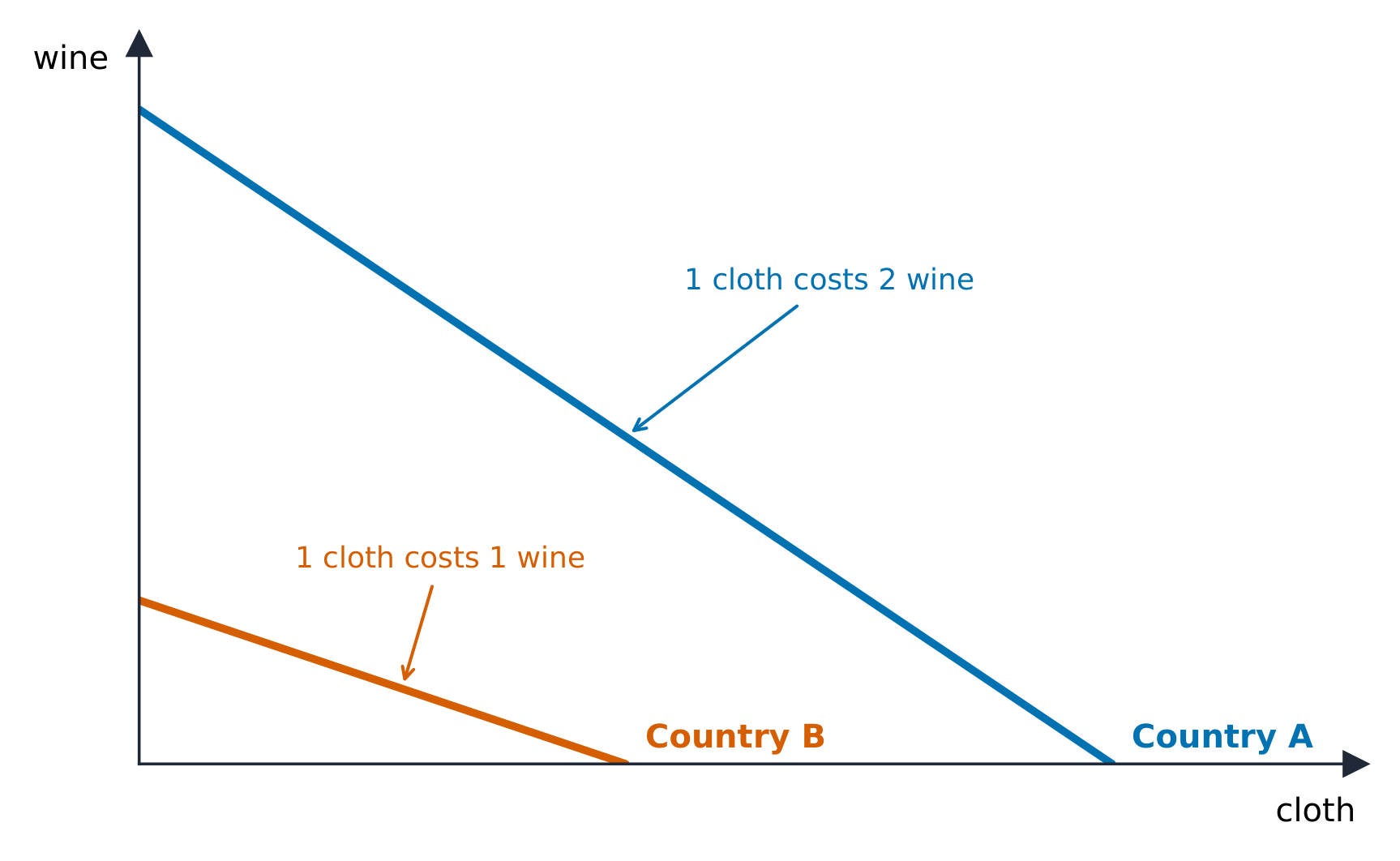
- 一个生产者在一种物品上有一个绝对优势(absolute advantage),若它能用相同的资源制造更多它。
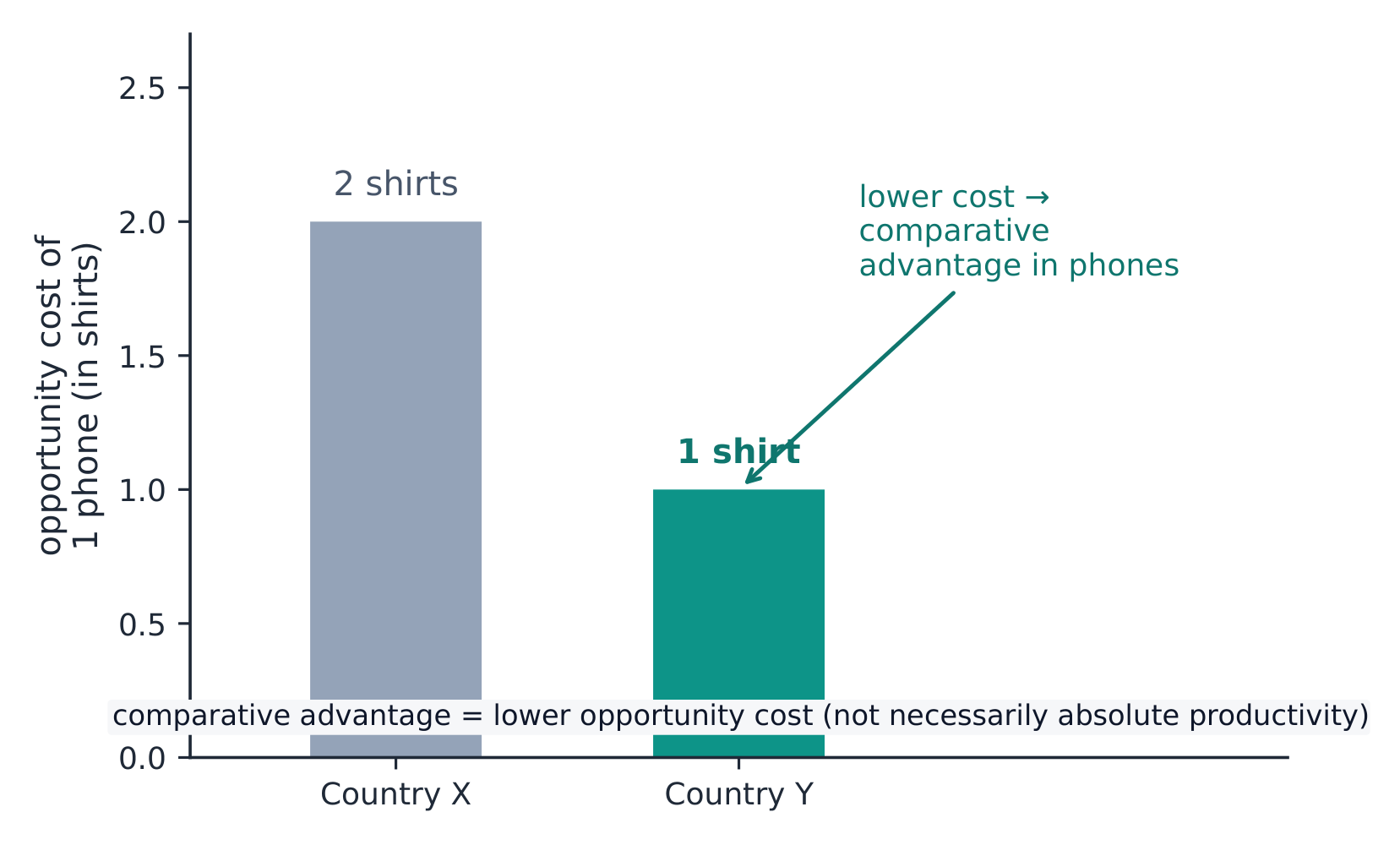
- 一个生产者有一个比较优势(comparative advantage),若它对那种物品有更低的机会成本。比较优势——不是绝对——决定谁应当专业化。
- 从产出数据计算机会成本:对每个生产者,一单位物品 X 值(Y 的单位数)$\div$(X 的单位数)。放弃更少 Y 的生产者应当制造 X。
- 若它们以它们两个机会成本之间的一个比率交易,两侧都获益——贸易条件(terms of trade)。按比较优势专业化让总产出超过任一方单独能制造的,所以消费能位于每个生产者自己 PPC 的外面。
Worked example. 安娜每天能制造 $20$ 件衬衫或 $10$ 张桌子;本能制造 $12$ 件衬衫或 $12$ 张桌子。对安娜一张桌子值 $\tfrac{20}{10}=2$ 件衬衫;对本它值 $\tfrac{12}{12}=1$ 件衬衫。本放弃更少衬衫,所以本专门于桌子而安娜于衬衫。任何每桌子在 $1$ 和 $2$ 件衬衫之间的贸易条件——比如说 $1.5$ ——使两者都比单独生产更好。
考试技能: 这些计算几乎每年出现——练习从产出表和投入表两者找到比较优势,并陈述一个有效的贸易条件范围。
探索
See why trade lets you consume beyond the frontier
A producer should specialize where its opportunity cost is lowest, then trade for the rest. Because the terms of trade lie between the two producers' costs, trade lets a country consume outside its own production frontier.
词汇表
训练
| 英文 | 中文 | 拼音 |
|---|---|---|
| specializing/ˈspeʃəlaɪzɪŋ/ | 专业化 | zhuān yè huà |
| absolute advantage/ˈæbsəluːt ədˈvæntɪdʒ/ | 绝对优势 | jué duì yōu shì |
| comparative advantage/kəmˈpærətɪv ədˈvæntɪdʒ/ | 比较优势 | bǐ jiào yōu shì |
| terms of trade/tɜːmz ɒv treɪd/ | 贸易条件 | mào yì tiáo jiàn |
1.5
成本收益分析
大纲
| Enduring Understanding | Learning Objective | Essential Knowledge |
|---|---|---|
CBA-1 | CBA-1.A |
|
CBA-1.B |
|
来源:美国大学理事会 AP 课程与考试说明
理性的决策者权衡收益对成本。一个行动只有当它的收益至少与它的成本一样大——包括机会成本——才值得。已经花掉且不可收回的钱是一个沉没成本(sunk cost)而应当在决定中被忽略:只有未来的成本和收益重要。
探索
Weigh total benefit against total cost
A choice is worth it only while the benefit of one more unit beats its cost. Where total revenue meets total cost is the break-even point; past it, extra activity adds more cost than value.
词汇表
训练
| 英文 | 中文 | 拼音 |
|---|---|---|
| sunk cost/sʌŋk kɒst/ | 沉没成本 | chén mò chéng běn |
1.6
边际分析与消费者选择
大纲
| Enduring Understanding | Learning Objective | Essential Knowledge |
|---|---|---|
CBA-2 | CBA-2.A |
|
CBA-2.B |
|
来源:美国大学理事会 AP 课程与考试说明
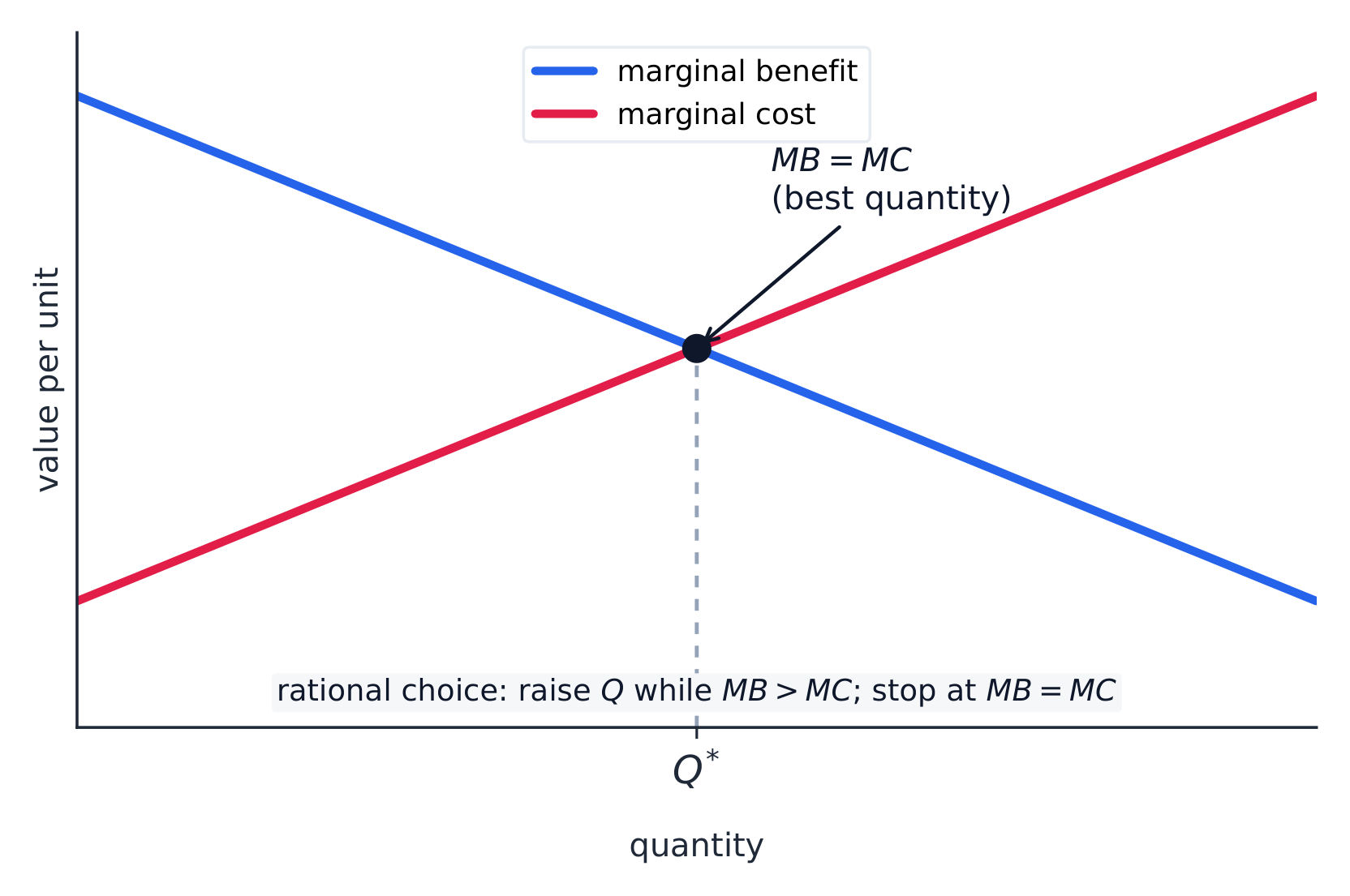
大多数真实的决定不是"全有或全无"而是"多一点或少一点"。边际分析(marginal analysis)把边际收益(marginal benefit)(多一单位的收益)与边际成本(marginal cost)(多一单位的成本)比较。
- 决策规则: 在边际收益 $>$ 边际成本时继续做这个活动;在 MB $=$ MC 处停止。那个点最大化净收益(总收益减总成本)。
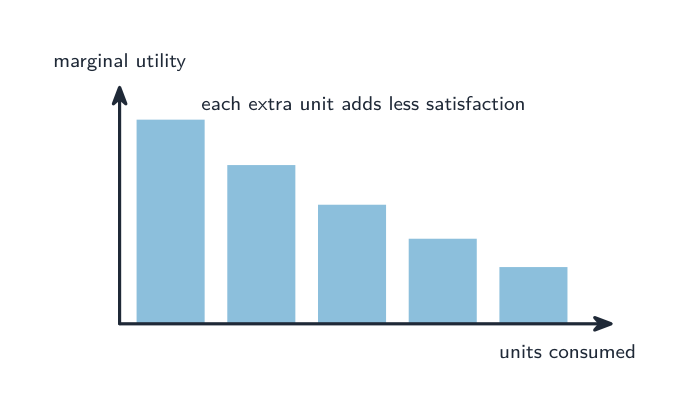
- 消费者从物品得到效用(utility)(满足),但每个额外单位通常给出更少的增加满足——边际效用递减法则(law of diminishing marginal utility)。
- 一个消费者通过效用最大化规则(utility-maximizing rule)最大化总效用:花费使得每美元的边际效用在所有物品间相等,$\dfrac{MU_x}{P_x}=\dfrac{MU_y}{P_y}$,用尽整个预算。若一种物品每美元给出更多效用,买更多它直到比率均衡。
Worked example. 一个消费者在物品 X($MU_x=20$,$P_x=\$2$)和物品 Y($MU_y=15$,$P_y=\$1$)之间选择。每美元的效用对 X 是 $\tfrac{20}{2}=10$ 但对 Y 是 $\tfrac{15}{1}=15$。Y 每美元传递更多满足,所以消费者应当买更多 Y 和更少 X;当他们这样做时,$MU_y$ 下降而 $MU_x$ 上升,直到 $\tfrac{MU_x}{2}=\tfrac{MU_y}{1}$ 而预算被花掉。
考试技能: "MB = MC"逻辑和"每美元相等 MU"规则被反复考查——能够从一张表找到最优数量并解释为什么它是最优的。
词汇表
训练
| 英文 | 中文 | 拼音 |
|---|---|---|
| Marginal analysis/ˈmɑːdʒɪnl əˈnæləsɪs/ | 边际分析 | biān jì fēn xī |
| marginal benefit/ˈmɑːdʒɪnl ˈbenɪfɪt/ | 边际收益 | biān jì shōu yì |
| marginal cost/ˈmɑːdʒɪnl kɒst/ | 边际成本 | biān jì chéng běn |
| utility/juːˈtɪlɪti/ | 效用 | xiào yòng |
| law of diminishing marginal utility/lɔː ɒv dɪˈmɪnɪʃɪŋ ˈmɑːdʒɪnl juːˈtɪlɪti/ | 边际效用递减法则 | biān jì xiào yòng dì jiǎn fǎ zé |
1.6
考试技巧
- 机会成本是放弃的下一个最好的替代;在任何决定中忽略沉没成本。
- 比较优势(更低的机会成本)决定专业化和贸易的收益。
- 应用边际分析:在 MB > MC 时继续做一个活动,在 MB = MC 处停止。
- 通过使物品间每美元的边际效用均衡来最大化效用。
- 从 PPC 斜率读机会成本;一条弯的曲线显示增加的成本。
本主题的互动课程
逐步学习,并即时检测练习。