| Enduring Understanding | Learning Objective | Essential Knowledge |
|---|---|---|
PRD-1 | PRD-1.A |
|
生产、成本与完全竞争模型
AP 微观经济学 · 第 3 主题
 8:56
8:56
Production, Cost & Perfect Competition
Picture a small bakery with one kitchen and one oven. Hire your first baker and you get thirty extra loaves a day. Hire a second and you get twenty-six more. A…
英文讲解 · 内嵌中英文字幕
3.1
生产函数
大纲
来源:美国大学理事会 AP 课程与考试说明
生产函数(production function)把投入连接到产出。在短期(short run)至少一个投入(通常是资本)是固定(fixed)的;在长期(long run)所有投入都变化。
- 总产量(total product)是总产出。
- 边际产量(marginal product)(MP)是来自多一单位可变投入(通常是劳动)的额外产出:$MP=\dfrac{\Delta\ \text{output}}{\Delta\ \text{labor}}$。
- 平均产量(average product)是每个工人的产出。
随着你把工人加到固定的资本,MP 最终下降——边际收益递减法则(law of diminishing marginal returns)。MP 的这个形状是驱动下面成本曲线形状的东西。
词汇表
训练
| 英文 | 中文 | 拼音 |
|---|---|---|
| production function/prəˈdʌkʃn ˈfʌŋkʃn/ | 生产函数 | shēng chǎn hán shù |
| short run/ʃɔːt rʌn/ | 短期 | duǎn qī |
| fixed/fɪkst/ | 固定 | gù dìng |
| long run/lɒŋ rʌn/ | 长期 | cháng qī |
| Total product/ˈtəʊtl ˈprɒdʌkt/ | 总产量 | zǒng chǎn liàng |
| Marginal product/ˈmɑːdʒɪnl ˈprɒdʌkt/ | 边际产量 | biān jì chǎn liàng |
| Average product/ˈævrɪdʒ ˈprɒdʌkt/ | 平均产量 | píng jūn chǎn liàng |
| law of diminishing marginal returns/lɔː ɒv dɪˈmɪnɪʃɪŋ ˈmɑːdʒɪnl rɪˈtɜːnz/ | 边际收益递减法则 | biān jì shōu yì dì jiǎn fǎ zé |
3.2
短期生产成本
大纲
| Enduring Understanding | Learning Objective | Essential Knowledge |
|---|---|---|
PRD-1 | PRD-1.A |
|
来源:美国大学理事会 AP 课程与考试说明
成本分成固定和可变:
- 固定成本(fixed cost)(FC)不随产出变化(工厂的租金)。
- 可变成本(variable cost)(VC)随产出上升(材料、劳动)。
- 总成本(total cost)$TC=FC+VC$。
每单位成本最重要:
- 平均固定成本(average fixed cost)$AFC=FC/Q$ 持续下降(分摊固定成本)。
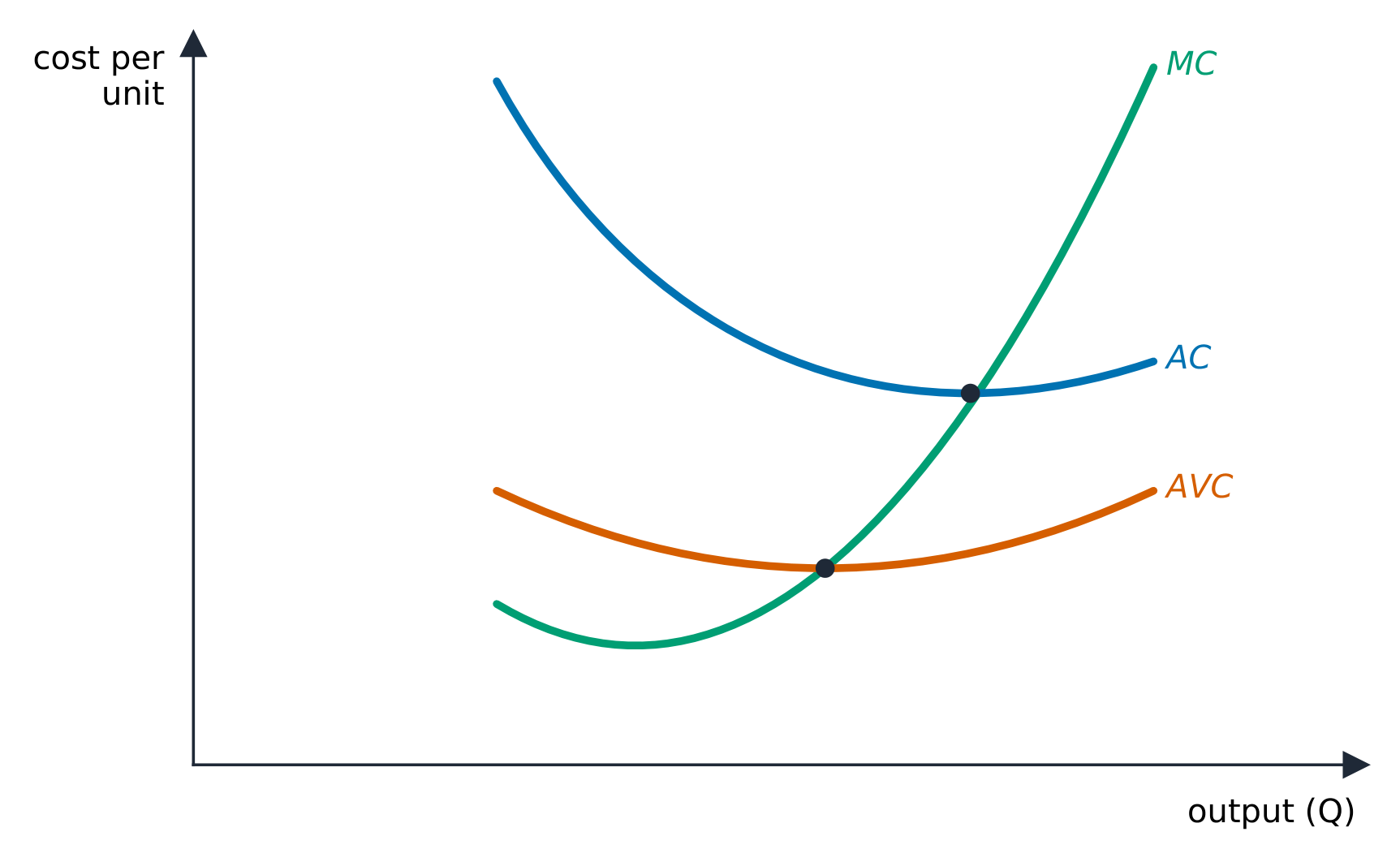
- 平均可变成本(average variable cost)$AVC=VC/Q$ 和平均总成本(average total cost)$ATC=TC/Q$ 是 U 形的。
- 边际成本(marginal cost)$MC=\dfrac{\Delta TC}{\Delta Q}$ 是多一单位的成本。
两个关键事实:MC 是 MP 的镜像(当 MP 上升时,MC 下降,反之亦然),而 MC 在它们的最小点切 AVC 和 ATC 两者(当边际低于平均时,平均下降;当高于时,它上升)。
Worked example. 一个企业有固定成本 $FC=\$100$。在 $Q=10$ 它的总成本是 $\$300$,所以可变成本是 $\$200$:那么 $ATC=\tfrac{300}{10}=\$30$、$AVC=\tfrac{200}{10}=\$20$,而 $AFC=\tfrac{100}{10}=\$10$(注意 $AFC+AVC=ATC$)。若把产出提高到 $Q=11$ 把总成本推到 $\$325$,那第 $11$ 单位的边际成本是 $\dfrac{\Delta TC}{\Delta Q}=\dfrac{325-300}{1}=\$25$。
探索
Explore the U-shaped cost curves
As output rises, marginal cost eventually climbs (diminishing returns) and cuts through the U-shaped average cost at its minimum — the most efficient scale.
词汇表
训练
| 英文 | 中文 | 拼音 |
|---|---|---|
| Fixed cost/fɪkst kɒst/ | 固定成本 | gù dìng chéng běn |
| Variable cost/ˈveərɪəbl kɒst/ | 可变成本 | kě biàn chéng běn |
| Total cost/ˈtəʊtl kɒst/ | 总成本 | zǒng chéng běn |
| Marginal cost/ˈmɑːdʒɪnl kɒst/ | 边际成本 | biān jì chéng běn |
3.3
长期生产成本
大纲
| Enduring Understanding | Learning Objective | Essential Knowledge |
|---|---|---|
PRD-1 | PRD-1.A |
|
来源:美国大学理事会 AP 课程与考试说明
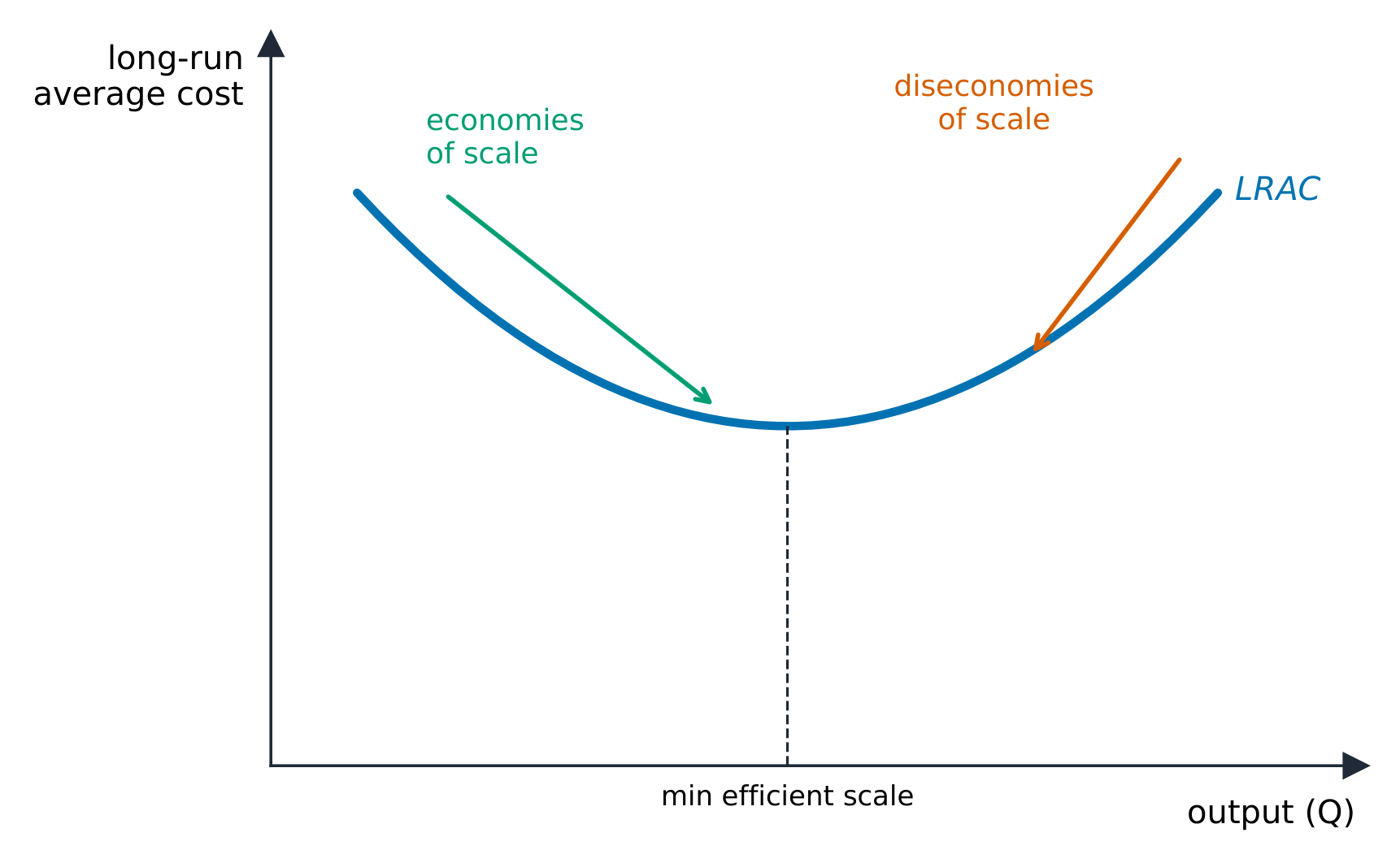
在长期所有投入——包括工厂规模——都能变化,所以只有长期平均总成本(LRATC)(long-run average total cost)曲线重要。它的形状显示规模报酬:
- 规模经济(economies of scale):LRATC 随着产出增长而下降(批量购买、专业化)。
- 规模报酬不变(constant returns to scale):LRATC 平坦。
- 规模不经济(diseconomies of scale):LRATC 上升(一个太大而不能好好管理的企业)。
考试技能: 知道"收益递减"是一个短期思想(一个固定投入)而"规模经济"是一个长期思想(所有投入变化)——考官考查这个区别。
词汇表
训练
| 英文 | 中文 | 拼音 |
|---|---|---|
| Economies of scale/ɪˈkɒnəmiz ɒv skeɪl/ | 规模经济 | guī mó jīng jì |
| Diseconomies of scale/ˌdɪsɪˈkɒnəmiz ɒv skeɪl/ | 规模不经济 | guī mó bù jīng jì |
3.4
利润的类型
大纲
| Enduring Understanding | Learning Objective | Essential Knowledge |
|---|---|---|
CBA-2 | CBA-2.C |
|
来源:美国大学理事会 AP 课程与考试说明
经济学家计入所有机会成本,包括所有者的:
- 显性成本(explicit costs)是自掏腰包的支付;隐性成本(implicit costs)是所有者提供资源的机会成本(放弃的薪水、放弃的利息)。
- 会计利润(accounting profit)$=$ 收入 $-$ 显性成本。
- 经济利润(economic profit)$=$ 收入 $-$ 显性 $-$ 隐性成本。
因为经济利润减去更多,它更小。零经济利润(一个正常利润(normal profit))仍然意味着所有者赚取恰好他们资源的机会成本——一个完全可接受的结果。
Worked example. 一个店主收入 $\$200{,}000$ 并付 $\$120{,}000$ 显性成本,所以会计利润是 $\$80{,}000$。但她放弃了别处一个 $\$70{,}000$ 的薪水和她投资的储蓄上 $\$5{,}000$ 的利息—— $\$75{,}000$ 的隐性成本。她的经济利润是 $80{,}000-75{,}000=\$5{,}000$:仍然为正,所以留在生意里真正击败她下一个最好的替代。
词汇表
训练
| 英文 | 中文 | 拼音 |
|---|---|---|
| Explicit costs/ekˈsplɪsɪt kɒsts/ | 显性成本 | xiǎn xìng chéng běn |
| implicit costs/ɪmˈplɪsɪt kɒsts/ | 隐性成本 | yǐn xìng chéng běn |
| Accounting profit/əˈkaʊntɪŋ ˈprɒfɪt/ | 会计利润 | kuài jì lì rùn |
| Economic profit/ˌiːkəˈnɒmɪk ˈprɒfɪt/ | 经济利润 | jīng jì lì rùn |
| normal profit/ˈnɔːml ˈprɒfɪt/ | 正常利润 | zhèng cháng lì rùn |
3.5
利润最大化
大纲
| Enduring Understanding | Learning Objective | Essential Knowledge |
|---|---|---|
CBA-2 | CBA-2.D |
|
来源:美国大学理事会 AP 课程与考试说明
每个企业,在每个市场结构里,在边际收入等于边际成本的数量最大化利润:
$$MR=MC.$$
生产每个 MR 超过它 MC 的单位;在它们相等时停止。生产更少留下未制造的有利可图的单位;生产更多添加花费比它们赚的更多的单位。
3.6
企业的短期生产决策与长期进入或退出市场的决策
大纲
| Enduring Understanding | Learning Objective | Essential Knowledge |
|---|---|---|
PRD-2 | PRD-2.A |
|
来源:美国大学理事会 AP 课程与考试说明
即使在 $MR=MC$,一个企业必须检查是否运营:
- 短期——停业规则: 只有当价格覆盖平均可变成本($P\geq AVC$)时才继续生产。若 $P
- 利润检查: 在利润最大化数量把 $P$ 与 $ATC$ 比较—— $P>ATC$ 意味着经济利润、$P
- 长期——进入和退出: 经济利润吸引进入(entry);损失造成退出(exit)。这继续直到经济利润是零。
词汇表
训练
| 英文 | 中文 | 拼音 |
|---|---|---|
| entry/ˈentri/ | 进入 | jìn rù |
| exit/ˈeɡzɪt/ | 退出 | tuì chū |
3.7
完全竞争
大纲
| Enduring Understanding | Learning Objective | Essential Knowledge |
|---|---|---|
PRD-3 | PRD-3.A |
|
来源:美国大学理事会 AP 课程与考试说明
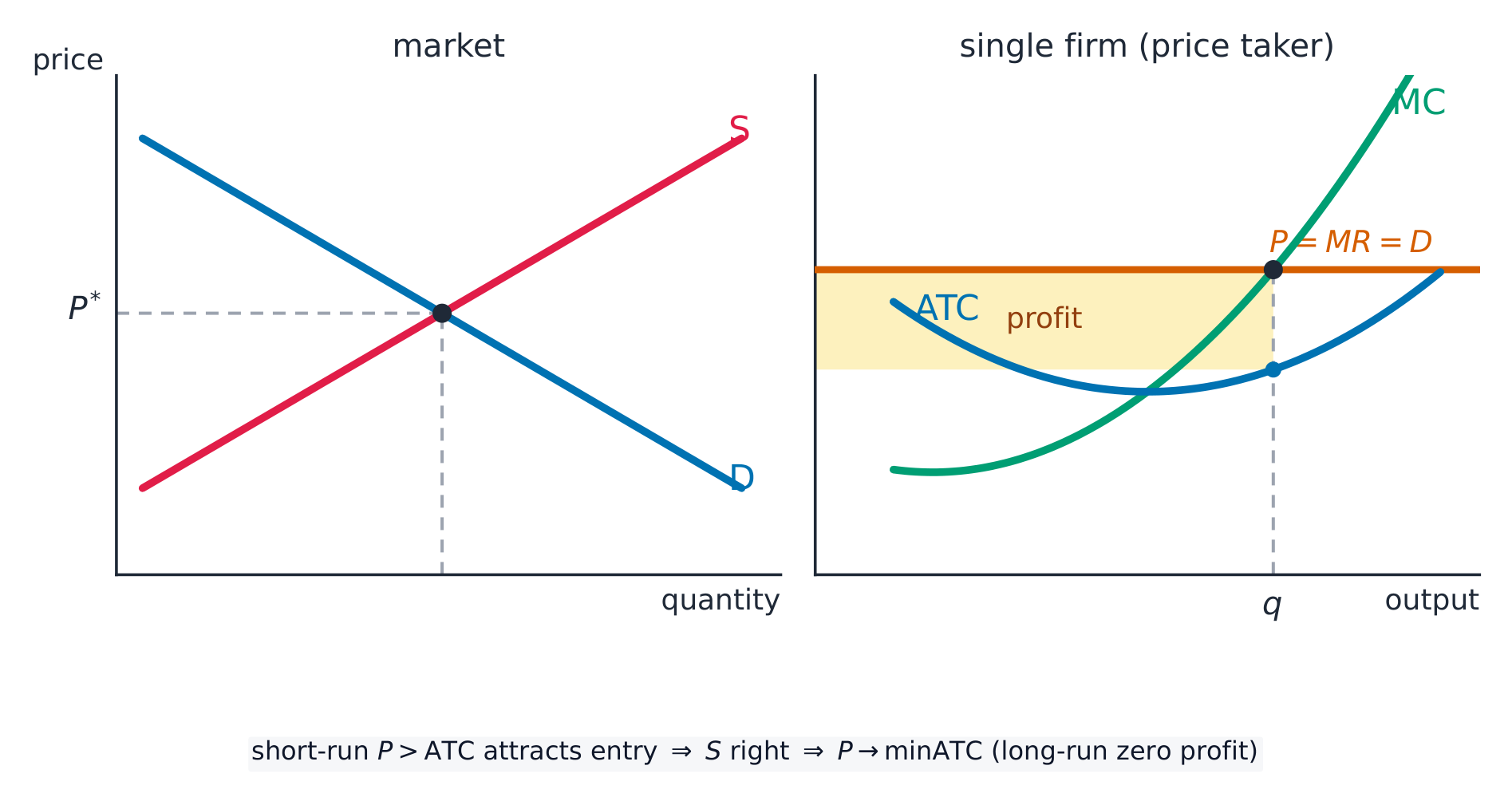
一个完全竞争(perfectly competitive)市场有许多小企业、一个相同(同质)的产品、自由进入和退出,和完美的信息。每个企业是一个价格接受者(price taker)——太小而不能影响价格——所以它在市场价格面对一条水平需求曲线,而价格 = 边际收入 = 平均收入($P=MR=AR$)。
这就是经济学家看重完全竞争的原因。在长期均衡中,它既是配置有效的(allocatively efficient)又是生产有效的(productively efficient)。配置效率成立,是因为企业在 $P = MC$ 处生产:价格(社会从最后一单位获得的边际收益)等于它的边际成本,所以恰好生产了正确的数量。生产效率成立,是因为自由进入把价格压到平均总成本的最低点,所以商品以尽可能低的成本生产。市场价格本身就是一个信号,传达每个人的边际成本和边际收益。
并排的面板是考试想要的图:市场(左)固定价格 $P^{*}$;企业(右)把它作为一条水平线接受并在 $MC=P$ 处生产。当 $P>ATC$ 时有一个短期利润(阴影框);那个利润吸引进入,它使市场供给右移并把价格推低。
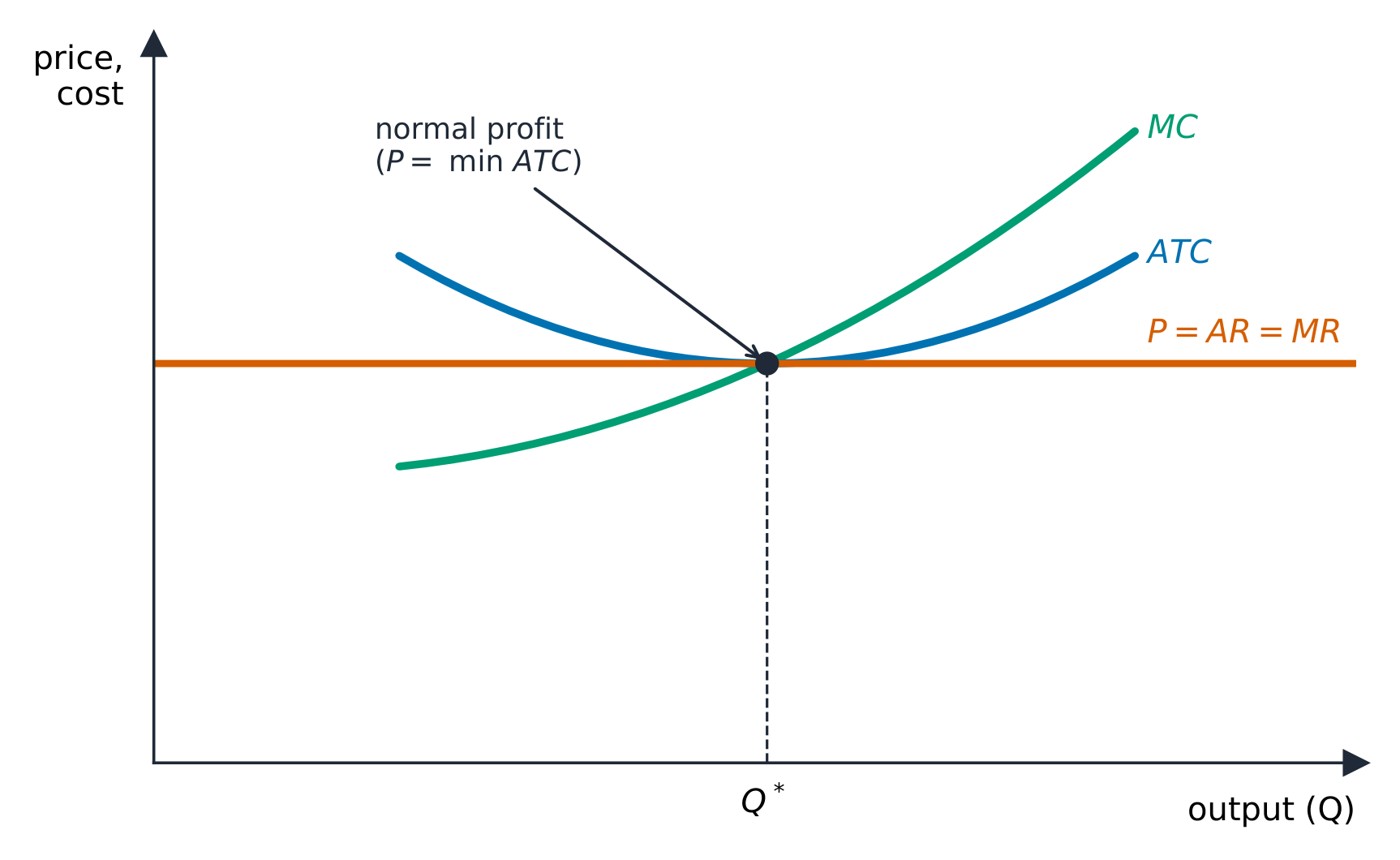
- 短期: 企业能赚利润、盈亏平衡,或承受一个损失,在 $P=MC$ 处生产。
- 长期: 进入和退出驱动企业到零经济利润,在 $P=MC=ATC$ 处以最小 ATC 生产。这个双重效率——生产效率(productive efficiency)(最低成本产出)和配置效率(allocative efficiency)($P=MC$,所以最后一单位的价值等于它的成本)——是评判每个其他市场结构的基准。
考试技能: 能够画并排的市场和单个企业图、显示一个短期利润或损失,然后显示进入/退出如何在最小 ATC 恢复长期均衡。
探索
A price-taking firm in a competitive market
In perfect competition the market sets the price and each firm is a price-taker. It produces where price equals marginal cost, earning zero economic profit in the long run.
词汇表
训练
| 英文 | 中文 | 拼音 |
|---|---|---|
| perfectly competitive/ˈpɜːfektlɪ kəmˈpetɪtɪv/ | 完全竞争 | wán quán jìng zhēng |
| price taker/praɪs ˈteɪkə/ | 价格接受者 | jià gé jiē shòu zhě |
| allocatively efficient/ˈæləkətɪvli ɪˈfɪʃənt/ | 配置效率 | pèi zhì xiào lǜ |
| productively efficient/prəˈdʌktɪvli ɪˈfɪʃənt/ | 生产效率 | shēng chǎn xiào lǜ |
3.7
考试技巧
- 知道成本曲线:AFC 下降、ATC/AVC 是 U 形的,而 MC 在它们的最小点切 ATC 和 AVC。
- 每个企业在 MR = MC 最大化利润;检查停业规则(短期 $P \ge AVC$)。
- 把会计利润(收入 − 显性成本)与经济利润(也减隐性/机会成本)区分开;零经济利润是正常的。
- "收益递减"是短期(一个固定投入);"规模经济"是长期(所有投入变化)。
- 在完全竞争 $P=MR=AR$;进入/退出驱动长期经济利润到最小 ATC 处的零。
本主题的互动课程
逐步学习,并即时检测练习。