Long-Run Production Costs · 长期生产成本
| English | 中文 | Pinyin · 拼音 |
|---|---|---|
| no fixed costs/nəʊ fɪkst kɒsts/ | 无固定成本 | wú gù dìng chéng běn |
| long-run average total cost/lɒŋ rʌn ˈævrɪdʒ ˈtəʊtl kɒst/ | 长期平均总成本 | cháng qī píng jūn zǒng chéng běn |
| envelope/ˈenvələʊp/ | 包络线 | bāo luò xiàn |
| economies of scale/ɪˈkɒnəmiz ɒv skeɪl/ | 规模经济 | guī mó jīng jì |
| diseconomies of scale/ˌdɪsɪˈkɒnəmiz ɒv skeɪl/ | 规模不经济 | guī mó bù jīng jì |
| constant returns to scale/ˈkɒnstənt rɪˈtɜːnz tə skeɪl/ | 规模报酬不变 | guī mó bào chóu bù biàn |
| minimum efficient scale/ˈmɪnɪməm ɪˈfɪʃənt skeɪl/ | 最小有效规模 | zuì xiǎo yǒu xiào guī mó |
| returns to scale/rɪˈtɜːnz tə skeɪl/ | 规模报酬 | guī mó bào chóu |
| diminishing marginal returns/dɪˈmɪnɪʃɪŋ ˈmɑːdʒɪnl rɪˈtɜːnz/ | 边际收益递减 | biān jì shōu yì dì jiǎn |
No factory is fixed forever
- Given enough time, a firm can rebuild itself at any size.
- A workshop can become a plant; a plant can become a mega-factory.
- With nothing fixed, costs behave in a whole new way.
- Welcome to the long run — where the firm chooses its own scale.
没有工厂是永远固定的
- 只要时间足够,企业可以把自己重建成任何规模。
- 小作坊能变成工厂;工厂能变成超级大厂。
- 当没有任何东西固定,成本会以全新的方式表现。
- 欢迎来到长期——企业自己选择规模。
The long-run average cost curve
- In the long run there are no fixed costs 无固定成本 — every input can change.
- Each factory size has its own short-run ATC curve.
- The long-run average total cost 长期平均总成本 (LRATC) curve traces the lowest cost at each output.
- It hugs the bottom of all the short-run curves — an envelope 包络线 of them.
长期平均成本曲线
- 在长期没有固定成本(no fixed costs)——每个投入都能改变。
- 每一种工厂规模都有自己的短期 ATC 曲线。
- 长期平均总成本(long-run average total cost,LRATC)曲线描出每个产量下最低的成本。
- 它紧贴所有短期曲线的底部——是它们的包络线(envelope)。
Because the LRATC hugs the bottom of all the short-run curves, it is called their . · 因为 LRATC 紧贴所有短期曲线的底部,它被称为它们的。
The LRATC envelope traces the lowest cost at each level of output. · LRATC 包络线描出每个产量下的最低成本。
Three regions of scale
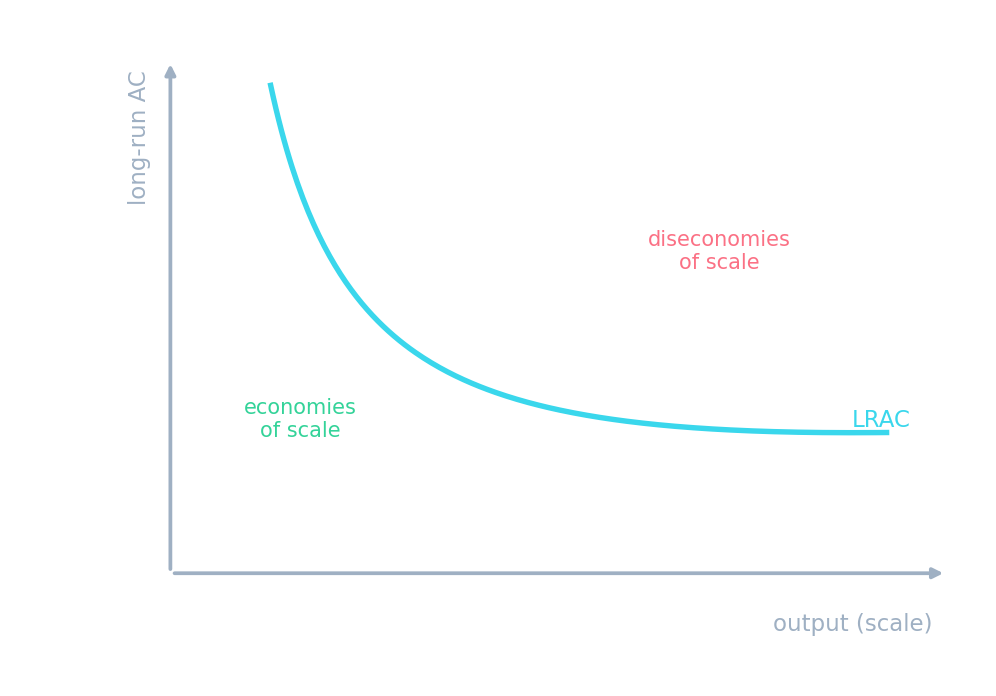
- Economies of scale 规模经济: LRATC falls — bulk buying, specialised machines, division of labour.
- Constant returns to scale 规模报酬不变: LRATC is flat.
- Diseconomies of scale 规模不经济: LRATC rises — a giant firm is hard to manage.
- The minimum efficient scale 最小有效规模 is the smallest output that already reaches the lowest LRATC.
规模的三个区间
- 规模经济(economies of scale):LRATC 下降——批量采购、专用机器、劳动分工。
- 规模报酬不变(constant returns to scale):LRATC 持平。
- 规模不经济(diseconomies of scale):LRATC 上升——巨型企业难以管理。
- 最小有效规模(minimum efficient scale)是已经达到最低 LRATC 的最小产量。
Economies or diseconomies? · 规模经济还是规模不经济?
As a firm grows, unit cost first falls (economies of scale), may stay flat (constant returns), then rises (diseconomies of scale). · 随着企业成长,单位成本先下降(规模经济),可能持平(规模报酬不变),再上升(规模不经济)。
A firm enjoys economies of scale when, as it grows: · 当企业成长时出现规模经济,是指:
Economies of scale = a falling LRATC as the firm gets bigger. · 规模经济 = 企业变大时 LRATC 下降。
The minimum efficient scale is: · 最小有效规模是:
It is the smallest scale that already achieves the minimum cost per unit. · 它是已经达到最低单位成本的最小规模。
A car maker's LRATC is 20,000 at 100k cars and 14,000 at 300k cars. Between them the firm has: · 一家汽车厂 LRATC 在 10 万辆时为 20,000、30 万辆时为 14,000。两者之间企业处于:
Cost per car falls from 20,000 to 14,000 as output rises — economies of scale. · 产量上升时每辆车成本从 20,000 降到 14,000——规模经济。
Select all · 所有 that can cause diseconomies of scale. · 选出所有可能造成规模不经济的因素。
Management and coordination problems raise unit cost; bulk buying lowers it (an economy). · 管理与协调问题抬高单位成本;批量采购降低它(属于规模经济)。
Don't mix up two ideas
- Returns to scale (long run): change all inputs together — nothing is fixed.
- Diminishing marginal returns (short run): add one variable input while others stay fixed.
These sound alike but differ. Scale is a long-run idea (all inputs move); diminishing returns is a short-run idea (one input moves against a fixed one). Name the run first.
别把两个概念搞混
- 规模报酬(returns to scale,长期):所有投入一起改变——没有固定的东西。
- 边际收益递减(diminishing marginal returns,短期):加一个可变投入,其余保持固定。
这两个听着像,其实不同。规模是长期概念(所有投入都动);收益递减是短期概念(一个投入对着固定投入动)。先说清是哪个"期"。
Returns to scale (long run) involves changing all inputs at once, while diminishing marginal returns (short run) adds one input against a fixed one. · 规模报酬(长期)是所有投入一起改变,而边际收益递减(短期)是加一个投入、对着一个固定投入。
Scale is a long-run, all-inputs idea; diminishing returns is short-run, one-input. · 规模是长期、全投入的概念;收益递减是短期、单投入的概念。
The LRATC is the envelope of the short-run curves, with no fixed costs. It falls (economies of scale), flattens (constant returns), then rises (diseconomies of scale); its lowest output is the minimum efficient scale. Don't confuse long-run scale with short-run diminishing returns.
LRATC 是短期曲线的包络线,没有固定成本。它先下降(规模经济)、变平(规模报酬不变),再上升(规模不经济);它的最低产量是最小有效规模。别把长期的规模与短期的收益递减混淆。