跳到主要内容

不完全竞争

AP 微观经济学 · 第 4 主题

训练
讲义 词汇表
4.1

不完全竞争市场导论

大纲
Enduring UnderstandingLearning ObjectiveEssential Knowledge

PRD-3
Even with a common goal of profit-maximization, market structure constrains and influences prices, output, and efficiency.

PRD-3.B
a. Define (using graphs where appropriate) the characteristics of imperfectly competitive markets and inefficiency.

  • PRD-3.B.1 Imperfectly competitive markets include monopoly, oligopoly, and monopolistic competition in product markets and monopsony in factor markets.
  • PRD-3.B.2 In imperfectly competitive output markets and assuming all else is constant, a firm must lower price to sell additional units.
  • PRD-3.B.3 In imperfectly competitive markets, consumers and producers respond to prices that are above the marginal costs of production and/or marginal benefits of consumption (i.e., price is greater than marginal cost in an inefficient market).
  • PRD-3.B.4 Incentives to enter an industry may be mitigated by barriers to entry. Barriers to entry—such as high fixed/start-up costs, legal barriers to entry, and exclusive ownership of key resources—can sustain imperfectly competitive market structures.

来源:美国大学理事会 AP 课程与考试说明

大多数真实市场是不完全竞争(imperfectly competitive)的:企业有一些市场势力(market power)——设定价格而不是接受它的能力。那个势力的来源是企业面对的一条向下倾斜的需求曲线,这意味着要多卖一单位企业必须降低所有单位的价格

市场结构从完全竞争到垄断不等
市场结构从完全竞争到垄断不等

因为这个,对每个有市场势力的企业边际收入低于价格($MR)。在一条直线需求曲线上 MR 曲线有相同的截距但两倍的斜率,位于需求之下。这一个事实—— $MR ——把每个不完全市场与完全竞争分开,并解释为什么它们生产更少并收取更多

Worked example. 一个有市场势力的企业面对需求 $P=100-Q$。卖 $1$ 单位给出 $P=\$99$ 和总收入 $\$99$;卖第 $2$ 个把价格在两个单位上推低到 $\$98$,所以收入上升到 $2\times98=\$196$。那第 $2$ 单位的边际收入是 $196-99=\$97$ ——低于它 $\$98$ 的价格。一般地 $MR=100-2Q$,下降得两倍于需求那么快。

词汇表 训练
英文 中文 拼音
imperfectly competitive 不完全竞争 bù wán quán jìng zhēng
market power 市场势力 shì chǎng shì lì
4.2

垄断

大纲
Enduring UnderstandingLearning ObjectiveEssential Knowledge

PRD-3
Even with a common goal of profit-maximization, market structure constrains and influences prices, output, and efficiency.

PRD-3.B
b. Explain (using graphs where appropriate) equilibrium, firm decision making, consumer surplus, producer surplus, profit (loss), and deadweight loss in imperfectly competitive markets and why prices in imperfectly competitive markets cannot be relied on to coordinate the actions of all possible market participants and can lead to inefficient outputs. c. Calculate (using data from a graph or table as appropriate) areas of consumer surplus, producer surplus, profit (loss), and deadweight loss in imperfectly competitive markets.

  • PRD-3.B.5 A monopoly exists because of barriers to entry.
  • PRD-3.B.6 In a monopoly, equilibrium (profit-maximizing) quantity is determined by equating marginal revenue (MR) to marginal cost (MC). The price charged is greater than the marginal cost.
    • Equation: $MR = MC$
  • PRD-3.B.7 In a natural monopoly, long-run economies of scale for a single firm exist throughout the entire effective demand of its product.

来源:美国大学理事会 AP 课程与考试说明

垄断:MR = MC 定价

一个垄断(monopoly)是一个没有相近替代品的产品的单一卖者,受进入壁垒(barriers to entry)(规模经济——一个自然垄断(natural monopoly)——对一种关键资源的控制、专利,或政府许可)保护。

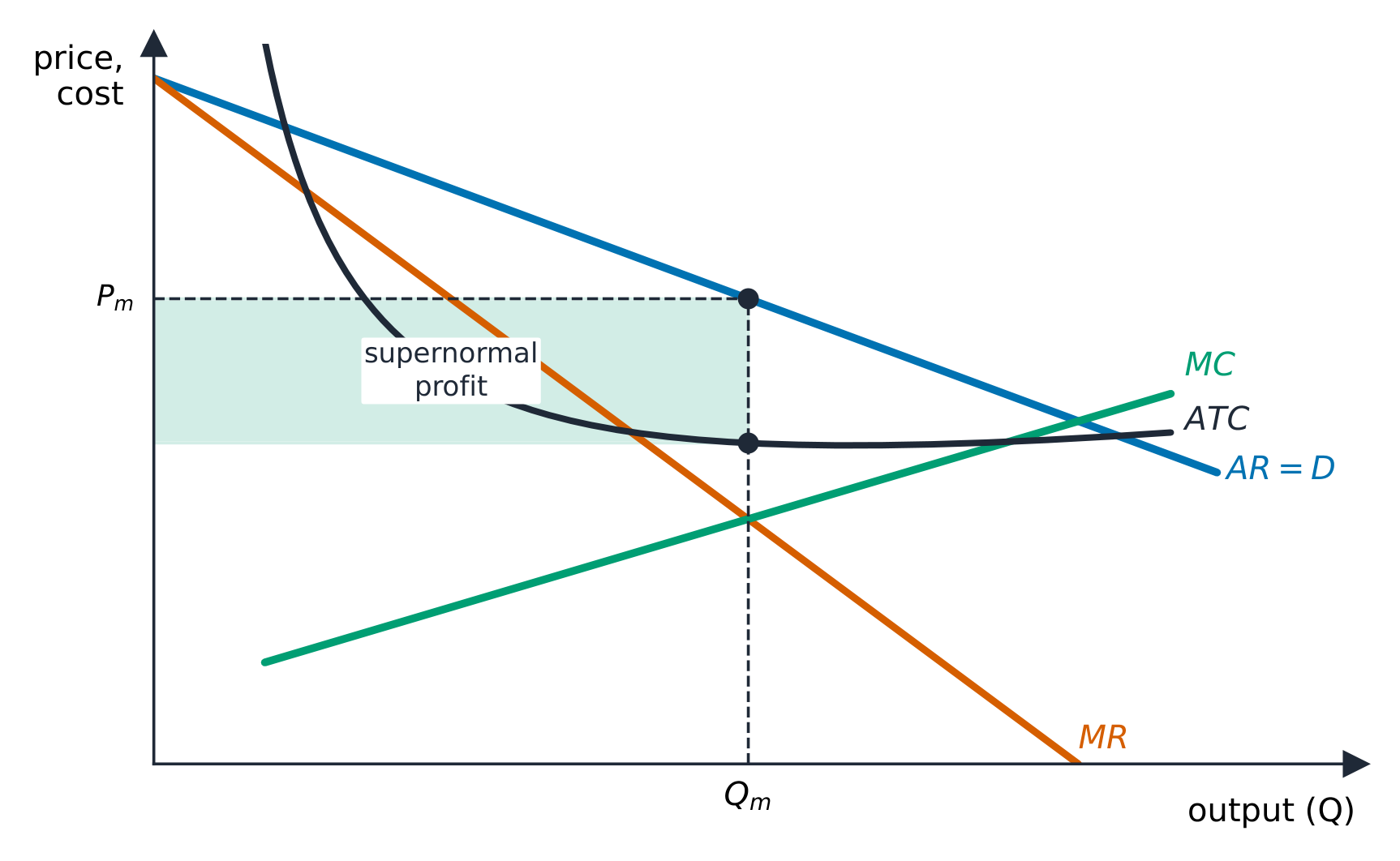
一个垄断在 MC = MR 处最大化利润并能赚超常利润
  • 垄断者在 $MR=MC$ 最大化利润,然后在那个数量收取需求曲线允许的最高价格(向上读价格到需求曲线,不是 MR 曲线)。
  • 与完全竞争相比它生产更少并收取更多,赚取长期经济利润,因为进入被阻止。
  • 这种生产不足造成无谓损失(deadweight loss)——垄断是配置低效的,因为 $P>MC$:最后一单位值的多于它花的,却不被制造。

政府可能用反垄断(antitrust)法回应,或把一个自然垄断的价格监管向 $P=MC$(社会最优,但可能造成一个损失)或 $P=ATC$(公平回报,盈亏平衡)。

考试技能: 垄断图是一个主要项目——显示 $MR=MC$ 处的数量、需求曲线上向上的价格,并给利润($P$$ATC$ 之间)和无谓损失(到竞争数量的三角形)涂阴影。

A large utility plant: monopoly and market power mean a single firm can set price above marginal cost
探索

A monopoly's cost curves

A monopoly is the sole seller, so it faces the whole downward demand curve and its marginal revenue lies below price. It produces where MR = MC — less output, higher price than competition.

词汇表 训练
英文 中文 拼音
monopoly 垄断 lǒng duàn
barriers to entry 进入壁垒 jìn rù bì lěi
natural monopoly 自然垄断 zì rán lǒng duàn
deadweight loss 无谓损失 wú wèi sǔn shī
antitrust 反垄断 fǎn lǒng duàn
4.3

价格歧视

大纲
Enduring UnderstandingLearning ObjectiveEssential Knowledge

PRD-3
Even with a common goal of profit-maximization, market structure constrains and influences prices, output, and efficiency.

PRD-3.B
b. Explain (using graphs where appropriate) equilibrium, firm decision making, consumer surplus, producer surplus, profit (loss), and deadweight loss in imperfectly competitive markets and why prices in imperfectly competitive markets cannot be relied on to coordinate the actions of all possible market participants and can lead to inefficient outputs. c. Calculate (using data from a graph or table as appropriate) areas of consumer surplus, producer surplus, profit (loss), and deadweight loss in imperfectly competitive markets.

  • PRD-3.B.8 A firm with market power can engage in price discrimination to increase its profits or capture additional consumer surplus under certain conditions.
  • PRD-3.B.9 With perfect price discrimination, a monopolist produces the quantity where price equals marginal cost (just as a competitive market would) but extracts all economic surplus associated with its product and eliminates all deadweight loss.
    • Equation: $P = MC$

来源:美国大学理事会 AP 课程与考试说明

价格歧视(price discrimination)是对同一物品向不同买者收取不同的价格。它需要市场势力、按支付意愿分开买者的能力,和防止转售的能力。

完全(一级)价格歧视下,企业向每个买者收取他们的最高价格。结果:企业生产有效率的数量(在 $P=MC$,没有无谓损失),但把所有消费者剩余转换成生产者剩余(利润)。真实的例子——学生折扣、航空票价、优惠券——是部分的版本。

探索

Elasticity and price discrimination

Price discrimination charges each group a different price by their elasticity: inelastic buyers (who won't switch) pay more, elastic buyers pay less. Stretch the curve to see why.

词汇表 训练
英文 中文 拼音
Price discrimination 价格歧视 jià gé qí shì
4.4

垄断竞争

大纲
Enduring UnderstandingLearning ObjectiveEssential Knowledge

PRD-3
Even with a common goal of profit-maximization, market structure constrains and influences prices, output, and efficiency.

PRD-3.B
b. Explain (using graphs where appropriate) equilibrium, firm decision making, consumer surplus, producer surplus, profit (loss), and deadweight loss in imperfectly competitive markets and why prices in imperfectly competitive markets cannot be relied on to coordinate the actions of all possible market participants and can lead to inefficient outputs. c. Calculate (using data from a graph or table as appropriate) areas of consumer surplus, producer surplus, profit (loss), and deadweight loss in imperfectly competitive markets.

  • PRD-3.B.10 In a market with monopolistic competition, firms producing differentiated products may earn positive, negative, or zero economic profit in the short run. Firms typically use advertising as a means of differentiating their product. Free entry and exit drive profits to zero in the long run. The output level, however, is smaller than the output level needed to minimize average total costs, creating excess capacity. The price is greater than marginal cost, creating allocative inefficiency.

来源:美国大学理事会 AP 课程与考试说明

垄断竞争(monopolistic competition)有许多差异化(differentiated)产品的企业,带容易进入和退出(餐厅、沙龙、服装品牌)。产品差异化给每个企业一条向下倾斜的需求曲线因而一些定价势力。

  • 短期: 像一个垄断——在 $MR=MC$ 生产,而利润或损失是可能的。
  • 长期: 容易进入把利润竞争掉,所以每个企业赚零经济利润,在需求与 ATC 相切的地方生产。
  • 因为它仍然收取 $P>MC$在最小 ATC 生产,它有过剩产能(excess capacity),既不配置有效率也不生产有效率。社会接受的权衡是产品多样性和选择。
词汇表 训练
英文 中文 拼音
Monopolistic competition 垄断竞争 lǒng duàn jìng zhēng
differentiated 差异化 chā yì huà
excess capacity 过剩产能 guò shèng chǎn néng
4.5

寡头垄断与博弈论

大纲
Enduring UnderstandingLearning ObjectiveEssential Knowledge

PRD-3
Even with a common goal of profit-maximization, market structure constrains and influences prices, output, and efficiency.

PRD-3.C
a. Define (using tables as appropriate) key terms, strategies, and concepts relating to oligopolies and simple games. b. Explain (using tables as appropriate) strategies and equilibria in simple games and the connections to theoretical behaviors in various oligopoly market and non-market settings. c. Calculate (using tables as appropriate) the incentive sufficient to alter a player's dominant strategy.

  • PRD-3.C.1 An oligopoly is an inefficient market structure with high barriers to entry, where there are few firms acting interdependently.
  • PRD-3.C.2 Firms in an oligopoly have an incentive to collude and form cartels.
  • PRD-3.C.3 A game is a situation in which a number of individuals take actions, and the payoff for each individual depends directly on both the individual's own choice and the choices of others.
  • PRD-3.C.4 A strategy is a complete plan of actions for playing a game; the normal form model of a game shows the payoffs that result from each collection of strategies (one for each player).
  • PRD-3.C.5 A player has a dominant strategy when the payoff to a particular action is always higher independent of the action taken by the other player.
  • PRD-3.C.6 A Nash equilibrium is a condition describing the set of actions in which no player can increase his or her payoff by unilaterally taking another action, given the other players' actions.
    • Exclusion statement: Dominant strategies and Nash equilibrium with more than two players or more than two actions per player, mixed-strategy equilibria, extensive form games, and normal form games with more than two players or more than two actions per player are beyond the scope of the course and the AP Exam.
  • PRD-3.C.7 Oligopolists have difficulty achieving the monopoly outcome for reasons similar to those that prevent players from achieving a cooperative outcome in the Prisoner's Dilemma; nevertheless, prices are generally higher and quantities lower with oligopoly (or duopoly) than with perfect competition.

来源:美国大学理事会 AP 课程与考试说明

一个寡头垄断(oligopoly)是一个有少数大的、相互依存(interdependent)企业的市场(汽车、航空、手机)。因为每个企业的最佳行动取决于竞争者的行动,我们用博弈论(game theory)分析它们。

  • 一个收益矩阵(payoff matrix)显示每个选择组合下每个企业的利润。
  • 一个优势策略(dominant strategy)是一个企业的最佳选择,不管竞争者做什么。
  • 一个纳什均衡(Nash equilibrium)是一个结果,其中没有企业能通过单方面改变它的选择做得更好。
  • 经典的囚徒困境(prisoners' dilemma)显示为什么企业常常无法合作:两者会通过勾结(colluding)(表现得像一个垄断)获益,但每个都有一个作弊的激励,所以它们最终处于近乎竞争的、更低利润的结果。勾结(collusion)和卡特尔(cartels)因相同的原因不稳定(而且通常非法)。

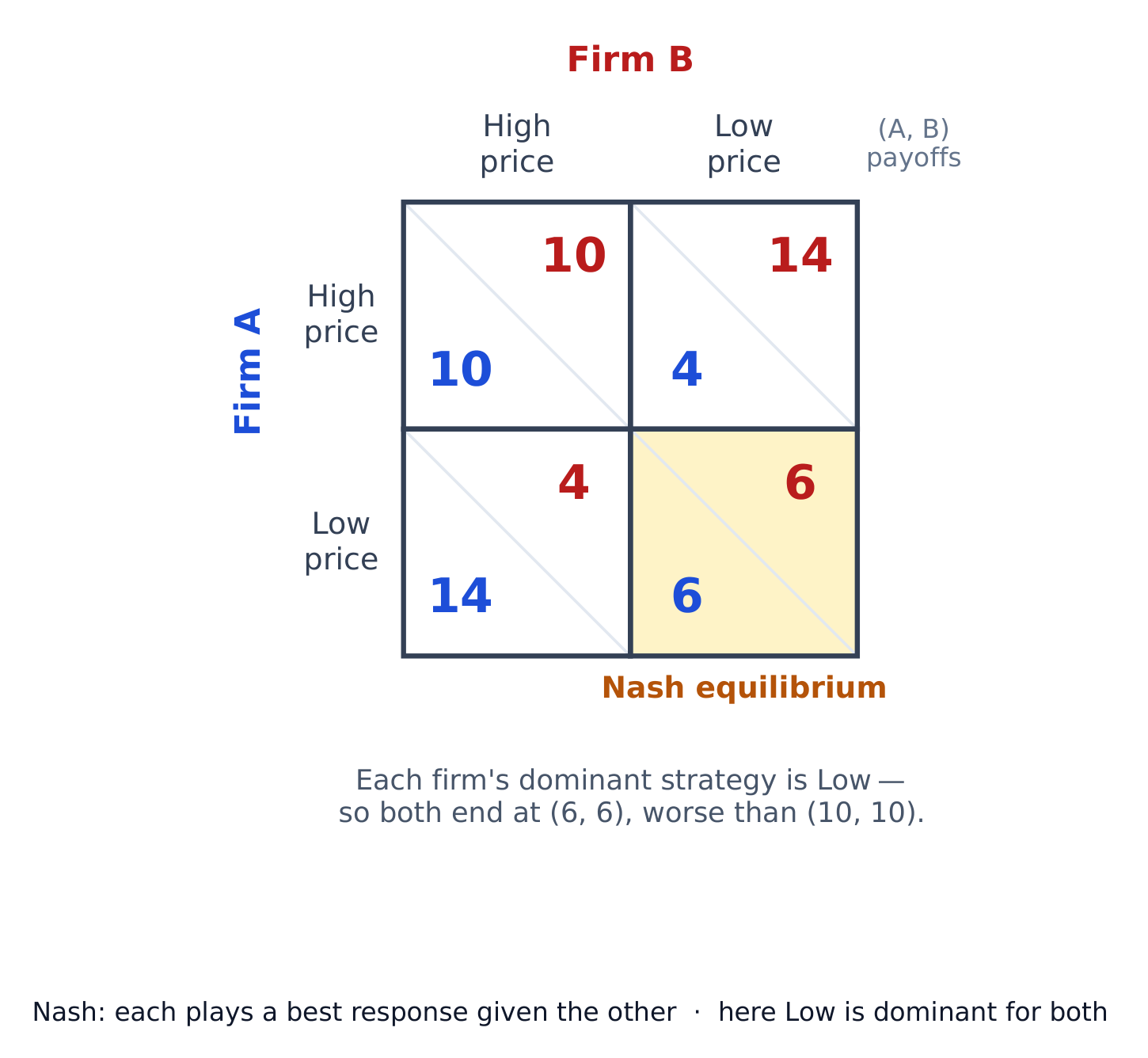
Worked example. 两个企业各选择一个价格。利润(A,B):都高 $\to(10,10)$;A 低、B 高 $\to(14,4)$;A 高、B 低 $\to(4,14)$;都低 $\to(6,6)$。对 A:若 B 出高,低($14$)击败高($10$);若 B 出低,低($6$)击败高($4$)——所以低是 A 的优势策略,而按对称也是 B 的。纳什均衡是都低 $(6,6)$,对两者都比合作的 $(10,10)$ 更糟——运行中的囚徒困境。

一个囚徒困境:每个企业的优势策略是低,给出纳什均衡

考试技能: 能够从一个 2×2 收益矩阵找到每个企业的优势策略和纳什均衡,并解释为什么合作的结果难以维持。

词汇表 训练
英文 中文 拼音
oligopoly 寡头垄断 guǎ tóu lǒng duàn
interdependent 相互依存 xiāng hù yī cún
game theory 博弈论 bó yì lùn
payoff matrix 收益矩阵 shōu yì jǔ zhèn
dominant strategy 优势策略 yōu shì cè lüè
Nash equilibrium 纳什均衡 nà shén jūn héng
prisoners' dilemma 囚徒困境 qiú tú kùn jìng
colluding 勾结 gōu jié
cartels 卡特尔 kǎ tè ěr
4.5

考试技巧

  • 一个有市场势力的企业面对一条向下倾斜的需求,所以 MR < P(MR 有两倍的斜率)。
  • 一个垄断在 MR = MC 处生产,然后收取需求曲线上向上的价格;它造成无谓损失,因为 $P > MC$
  • 在完全价格歧视下企业生产有效率的数量但捕获所有消费者剩余。
  • 垄断竞争以过剩产能赚零长期利润(产品多样性是权衡)。
  • 在一个寡头垄断里从收益矩阵找到优势策略纳什均衡;合作的结果难以维持。

本主题的互动课程

逐步学习,并即时检测练习。

AP 微观经济学历年真题

AP 微观经济学的更多主题

登录或创建账号

IGCSE, A-Level & AP