| English | 释义 | 拼音 |
|---|---|---|
| oligopoly/ˌɒlɪˈɡɒpəli/ | 寡头垄断 | guǎ tóu lǒng duàn |
| barriers to entry/ˈbærɪəz tʊ ˈentri/ | 进入壁垒 | jìn rù bì lěi |
| mutual interdependence/ˈmjuːtʃuːəl ˌɪntədɪˈpendəns/ | 相互依存 | xiāng hù yī cún |
| collusion/kəˈluːʒn/ | 合谋 | hé móu |
| cartel/kɑːˈtel/ | 卡特尔 | kǎ tè ěr |
| game theory/ɡeɪm ˈθɪəri/ | 博弈论 | bó yì lùn |
| payoff matrix/ˈpeɪɒf ˈmeɪtrɪks/ | 收益矩阵 | shōu yì jǔ zhèn |
| dominant strategy/ˈdɒmɪnənt ˈstrætədʒi/ | 优势策略 | yōu shì cè lüè |
| Nash equilibrium/næʃ ˌiːkwɪˈlɪbrɪəm/ | 纳什均衡 | nà shén jūn héng |
| prisoner's dilemma/ˈprɪzənəz daɪˈlemə/ | 囚徒困境 | qiú tú kùn jìng |
When rivals watch each other
- In many countries three or four mobile networks share the market, and two firms, Airbus and Boeing, build almost all large passenger jets. When one cuts prices or launches a new plan, the others must answer.
- A market with a few large, interdependent firms is an oligopoly 寡头垄断. Before any firm acts, it asks: "What will my rivals do in reply?"
Features of oligopoly
- A few large firms; high barriers to entry 进入壁垒 (huge start-up costs, patents, economies of scale); products may be identical (steel) or differentiated (phones, cars).
- The defining feature is mutual interdependence 相互依存: each firm's best choice depends on its rivals' choices. Price and output usually lie between perfect competition and monopoly, and firms can earn economic profit in the long run because entry is hard.
The defining feature of an oligopoly is:
难度 1/5 · 今日首次完成可获 100 金币及少量额外奖励
With only a few firms, each must consider how rivals will react.
Why can firms in an oligopoly keep earning economic profit in the long run, unlike firms in perfect competition?
难度 1/5 · 今日首次完成可获 100 金币及少量额外奖励
In perfect competition, profit attracts entry until it disappears. Barriers to entry block that process.
Collusion and cartels
- Firms would earn the most by acting together like one monopoly. Through collusion 合谋 they may form a cartel 卡特尔 that cuts output and raises prices; OPEC sets oil production targets this way. In the US and most countries, price-fixing between firms is illegal.
- Cartels are unstable: once the price is high, each member gains by secretly selling more than its share. If several cheat, output rises and the price falls back.
最佳反应与稳定结果
固定对手的选择,比较一家企业自己的收益。联合利润较高的结果未必能抵御单方改变策略。
When firms collude to restrict output and raise prices, they form a ______.
难度 1/5 · 今日首次完成可获 100 金币及少量额外奖励
A cartel acts like a monopoly, but cheating makes it unstable.
Why are cartels unstable?
难度 1/5 · 今日首次完成可获 100 金币及少量额外奖励
Cheating raises one firm's profit at the others' expense.
Game theory: reading a payoff matrix
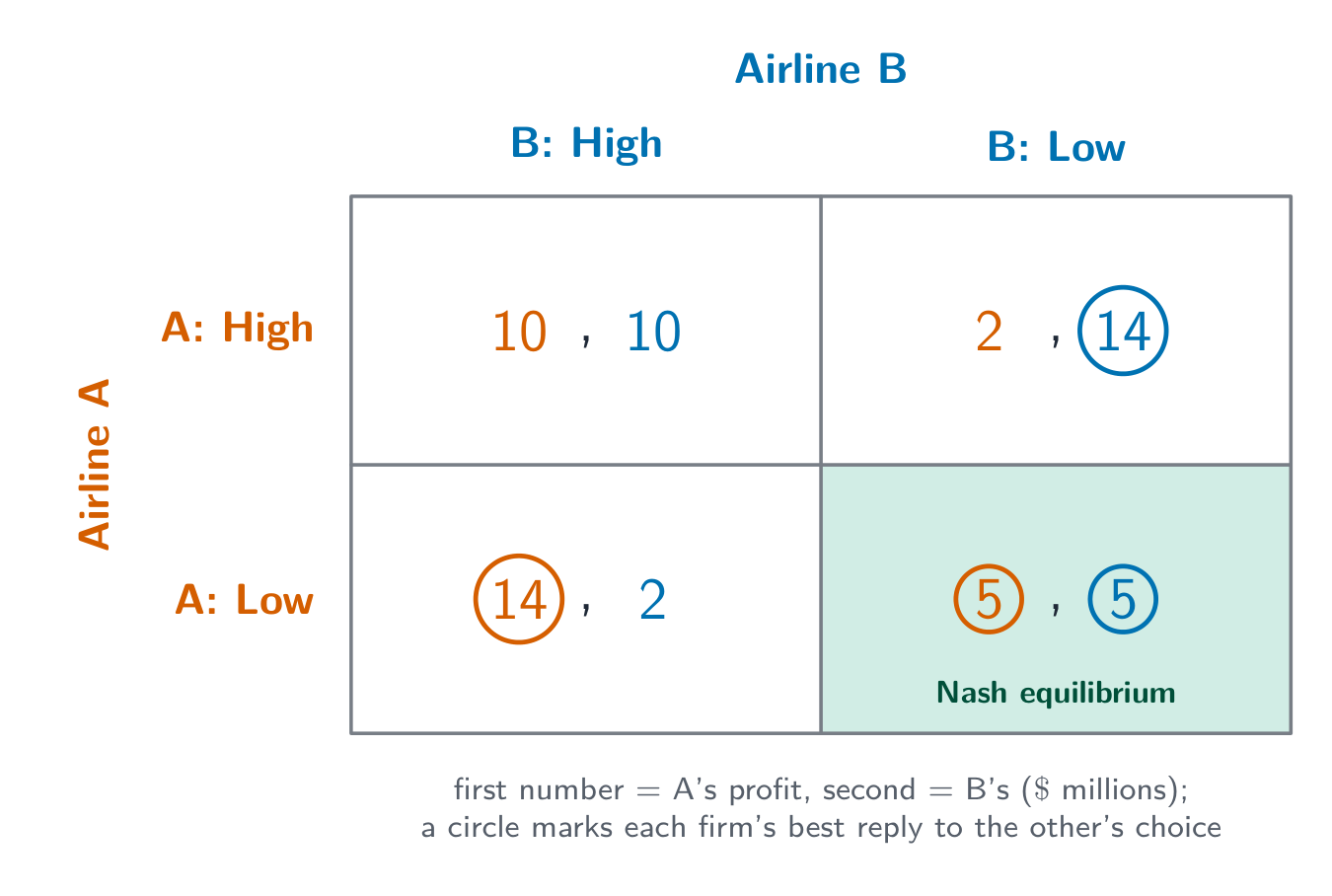
- Game theory 博弈论 studies strategic choices with a payoff matrix 收益矩阵. The row player's payoff is listed first. A dominant strategy 优势策略 is best whatever the rival does. A Nash equilibrium 纳什均衡 is a cell where neither firm can gain by changing only its own choice.
- The circle method: for each choice of B, circle A's higher payoff in that column; for each choice of A, circle B's higher payoff in that row. A firm that has its circles in the same row (or column) every time has a dominant strategy. A cell with both payoffs circled is a Nash equilibrium.
A dominant strategy is a choice that is best:
难度 1/5 · 今日首次完成可获 100 金币及少量额外奖励
It beats the alternatives regardless of the rival's choice.
At a Nash equilibrium, no firm can improve its payoff by changing only its own choice.
难度 1/5 · 今日首次完成可获 100 金币及少量额外奖励
That is exactly what makes a Nash equilibrium stable.
Payoffs (Row, Column): (Up, Left) 3, 5; (Up, Right) 7, 2; (Down, Left) 4, 6; (Down, Right) 6, 3. Which is the Nash equilibrium?
难度 1/5 · 今日首次完成可获 100 金币及少量额外奖励
Column prefers Left in both rows (5 > 2, 6 > 3). Given Left, Row prefers Down (4 > 3). At (Down, Left) neither can gain by changing alone.
Worked example: a prisoner's dilemma
In the airline game above: does each airline have a dominant strategy, and where is the Nash equilibrium?
- For A: if B is High, Low gives 14 > 10; if B is Low, Low gives 5 > 2. So Low is A's dominant strategy; by symmetry it is B's too. Nash equilibrium: (Low, Low) = (5, 5).
- Both would earn more at (High, High) = (10, 10), but each gains by undercutting the other. This is a prisoner's dilemma 囚徒困境: each firm's self-interest leads to an outcome worse for both, which is exactly why cartels keep breaking down.
Both firms earn 10 if both keep prices high, 5 if both go low, but a lone undercutter earns 12 (rival gets 2). The Nash equilibrium is:
难度 1/5 · 今日首次完成可获 100 金币及少量额外奖励
"Low" is each firm's dominant strategy, so both pick it — earning 5 each, worse than the cooperative 10.
The result where both firms compete and end up worse off than cooperating is the prisoner's ______.
难度 1/5 · 今日首次完成可获 100 金币及少量额外奖励
Rational self-interest leads to a worse joint outcome — the prisoner's dilemma.
At a Nash equilibrium, no player can improve their payoff by changing strategy alone.
难度 1/5 · 今日首次完成可获 100 金币及少量额外奖励
Each is making its best response to the other.
Worked FRQ answer
Question: Firms X and Y choose whether to advertise. Payoffs are (X, Y) in thousands of dollars.
| Y: Advertise | Y: Don't | |
|---|---|---|
| X: Advertise | 6, 4 | 9, 3 |
| X: Don't | 4, 7 | 8, 8 |
(a) Does Firm X have a dominant strategy? Explain. (b) Does Firm Y have a dominant strategy? Explain. (c) Identify the Nash equilibrium. (d) The government gives Firm Y a payment of 2 whenever Y does not advertise. Find Y's new dominant strategy, if any, and the new Nash equilibrium.
(a) Yes, advertise. If Y advertises, X earns 6 > 4 by advertising; if Y does not, X earns 9 > 8 by advertising.
(b) No. If X advertises, Y does better by advertising (4 > 3); if X does not, Y does better by not advertising (8 > 7). Y's best choice depends on X.
(c) X will advertise, and Y's best reply to that is to advertise: (Advertise, Advertise) = (6, 4).
(d) Y's "Don't" payoffs become 5 and 10. If X advertises, Y gets 5 > 4 by not advertising; if X does not, 10 > 7. So not advertising is now Y's dominant strategy. X's best reply is still to advertise (9 > 8), so the new Nash equilibrium is (Advertise, Don't) = (9, 5).
- Why it scores: every answer compares the right pair of numbers (the same firm's payoffs, across its own two choices) and quotes them. A common lost point is comparing X's payoff with Y's. In (d), add the payment only to Y's payoffs in the "Don't" column.
FRQ practice. Two cafés, North and South, choose a price. Payoffs (North, South) in dollars per day: (High, High) 300, 250; (High, Low) 150, 280; (Low, High) 320, 120; (Low, Low) 200, 200. (a) Does North have a dominant strategy? Explain with numbers. (b) Does South? Explain. (c) Identify the Nash equilibrium. (d) Is it the outcome with the highest combined profit?
Compare each café's own payoffs across its own two choices.
Common errors. Comparing one firm's payoff with the other firm's. Calling the best joint outcome the Nash equilibrium. Saying a firm with no dominant strategy cannot be part of a Nash equilibrium: it simply plays its best reply. Forgetting that a payoff change (tax, subsidy) changes only the cells it applies to.
An oligopoly has a few firms, high barriers to entry and mutual interdependence. Cartels raise profit but are unstable, because each member gains by cheating. In a payoff matrix, compare a firm's own payoffs across its choices: a dominant strategy is best whatever the rival does; a Nash equilibrium is a cell where no firm gains by changing alone. The prisoner's dilemma shows why rivals end up worse off than if they cooperated.
Write from a Nash payoff of 3
- Both keep prices high and each earns 8.
- Both go low and each earns 3. A lone undercutter earns 11 and the rival earns 1.
If both firms keep prices high, each earns 8. If both go low, each earns 3. A lone undercutter earns 11 and the other firm earns 1. What is the Nash payoff for each firm?
Each firm prefers to undercut whatever the other does, so both end on 3.
What does each firm earn in the Nash equilibrium?
难度 1/5 · 今日首次完成可获 100 金币及少量额外奖励
Both play low, and the low-low cell pays 3 each. Other options — 8 (the cooperative payoff); 5 (the lesson Nash payoff).