跳到主要内容

要素市场

AP 微观经济学 · 第 5 主题

训练
讲义 词汇表
5.1

要素市场导论

大纲
Enduring UnderstandingLearning ObjectiveEssential Knowledge

PRD-4
Factor prices provide incentives and convey information to firms and factors of production.

PRD-4.A
a. Define (using graphs where appropriate) key terms and concepts relating to factor markets.
b. Explain (using graphs where appropriate) the relationship between factors of production, firms, and factor prices.
c. Calculate (using data from a graph or table where appropriate) the marginal revenue product and marginal resource cost.

  • PRD-4.A.1 Factors of production (labor, capital, and land) respond to factor prices (wages, interest, and rent), and employers' (firms') decision to hire is based on the productivity of the factors, output price, and cost of the factor.
  • PRD-4.A.2 The quantity of labor demanded is negatively related to the wage rate, while the quantity of labor supplied is positively related to the wage rate in a given labor market, other things constant.

来源:美国大学理事会 AP 课程与考试说明

一个要素市场(factor market)是企业购买生产要素——劳动、土地、资本——的地方。角色反转:企业需求家庭供给。最被考查的要素是劳动

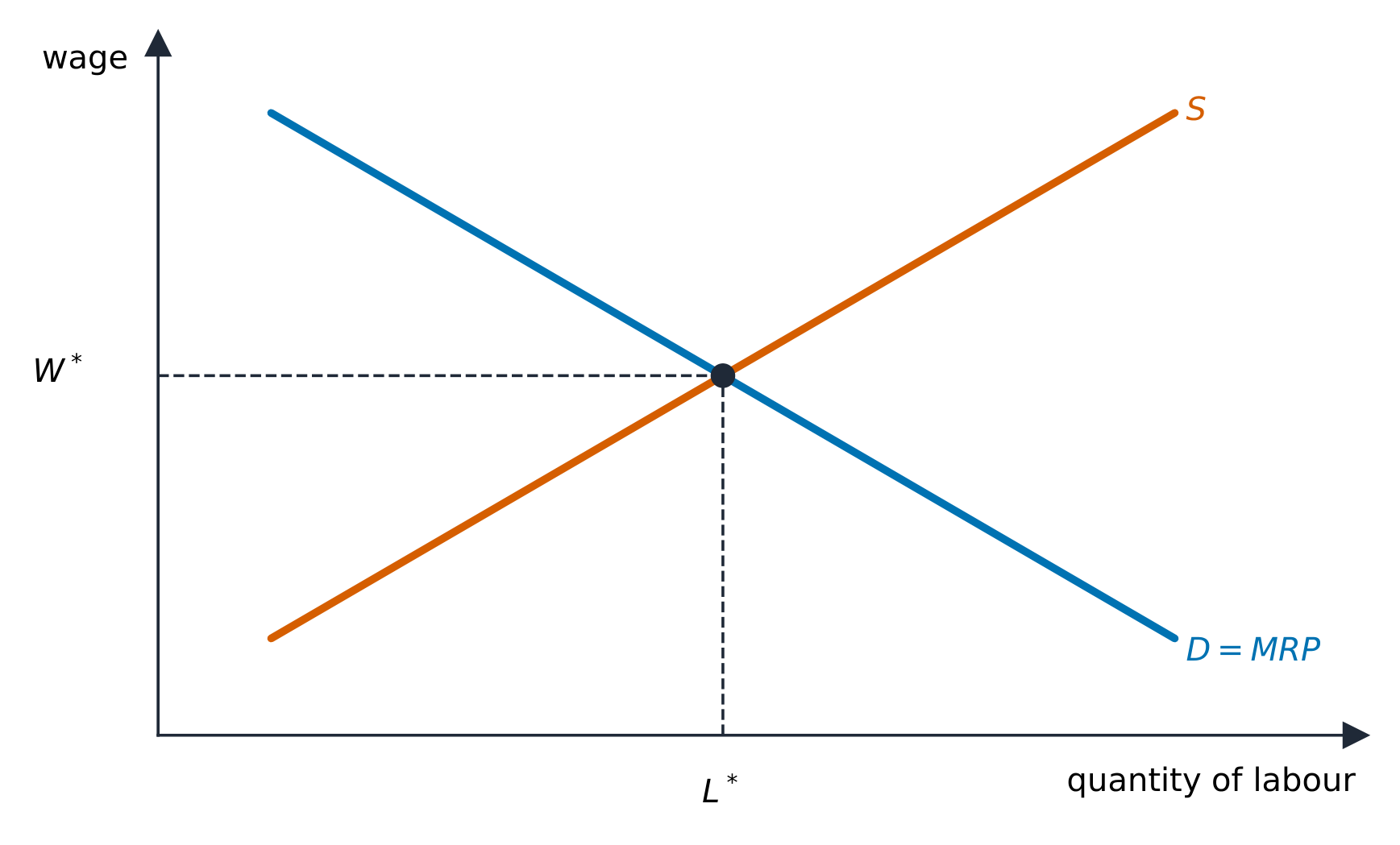
一个竞争性劳动市场在劳动需求遇到劳动供给的地方设定工资

要素需求是一个派生需求(derived demand)——企业想要劳动不是为了它本身而是为了它生产的产出(和收入)。所以对工人的需求取决于对他们制造的产品的需求。

探索

A labour (factor) market

In a factor market firms demand labour and households supply it; the wage settles where demand meets supply. Shift either curve and watch the wage and employment move.

词汇表 训练
英文 中文 拼音
factor market 要素市场 yào sù shì chǎng
derived demand 派生需求 pài shēng xū qiú
5.2

要素需求与要素供给的变动

大纲
Enduring UnderstandingLearning ObjectiveEssential Knowledge

PRD-4
Factor prices provide incentives and convey information to firms and factors of production.

PRD-4.B
Explain (using graphs where appropriate) firms' and factors' responses to changes in incentives and constraints.

  • PRD-4.B.1 Changes in the determinants of labor demand, such as the output price and the productivity of the worker, cause the labor demand curve to shift.
  • PRD-4.B.2 Changes in the determinants of labor supply (such as immigration, education, working conditions, age distribution, availability of alternative options, preferences for leisure, and cultural expectations) cause the labor supply curve to shift.

来源:美国大学理事会 AP 课程与考试说明

劳动需求在以下时移动:

  • 产品价格或产品需求变化(更有价值的产出 $\Rightarrow$ 需求更多劳动),
  • 工人生产率变化(更好的培训或资本),
  • 其他投入的价格变化(一个替代投入像机器,或一个互补品)。

劳动供给合格工人的数量移民、工人的偏好(吸引他们所需的工资),和其他工作里可得的工资而移动。市场工资在劳动需求遇到劳动供给的地方设定。

5.3

完全竞争要素市场中的利润最大化行为

大纲
Enduring UnderstandingLearning ObjectiveEssential Knowledge

PRD-4
Factor prices provide incentives and convey information to firms and factors of production.

PRD-4.C
a. Define (using graphs as appropriate) the characteristics of perfectly competitive factor markets.
b. Explain (using graphs where appropriate) the profit-maximizing behavior of firms buying labor (with other inputs fixed) in perfectly competitive markets.
c. Calculate (using data from a graph or table where appropriate) measures representing the profit-maximizing behavior of firms buying labor (with other inputs fixed) in perfectly competitive markets.

  • PRD-4.C.1 In a perfectly competitive labor market, the wage is set by the market and each firm hires the quantity of workers, where the marginal factor (resource) cost (wage) equals the marginal revenue product of labor. A typical firm may be a perfect competitor in the labor market even if it is an imperfect competitor in its output markets.
  • PRD-4.C.2 A typical firm hires labor in a perfectly competitive labor market as long as the marginal revenue product of labor is greater than the market wage.
  • PRD-4.C.3 To minimize costs or maximize profits, firms allocate inputs such that the last dollar spent on each input yields the same amount of marginal product.

来源:美国大学理事会 AP 课程与考试说明

一个企业用与其他一切相同的边际逻辑决定雇用多少工人——比较多一个工人的边际收益和边际成本。

  • 一个工人的边际收益是边际收益产品(marginal revenue product)(MRP):来自多一个工人的额外收入,$MRP = MP \times$ 产品价格(在一个竞争性产品市场,那里 $P=MR$)。MRP 随着更多工人被雇用而下降,因为边际产量递减
  • 一个工人的边际成本是工资(在一个竞争性劳动市场企业是一个工资接受者,所以边际要素成本 $=$ 工资)。
  • 雇用规则: 雇用工人直到 $MRP = \text{wage}$(更一般地,$MRP = MFC$)。MRP 曲线是企业的劳动需求曲线。

Worked example. 一个工人的边际产量是 $8$ 单位而企业在一个竞争性市场以 $\$5$ 卖每个,所以 $MRP=8\times\$5=\$40$。若工资是 $\$30$,企业雇用这个工人,因为 $MRP>\text{wage}$。随着更多工人加入,边际产量递减把 MRP 拉低;企业继续雇用直到一个 $MP=6$ 的工人给出 $MRP=6\times\$5=\$30$,恰好是工资——利润最大化的停止点。

要选择两个投入的最低成本组合,在投入间设定每美元 MP 相等:$\dfrac{MP_L}{P_L}=\dfrac{MP_K}{P_K}$ ——与消费者选择相同的每美元相等回报规则。

考试技能: 从一张表计算 MRP(边际产量 $\times$ 价格)并求在一个给定工资雇用多少工人——一个常见的自由回答任务。

A car assembly line: firms hire labour until the marginal revenue product equals the wage
词汇表 训练
英文 中文 拼音
marginal revenue product 边际收益产品 biān jì shōu yì chǎn pǐn
5.4

买方垄断市场

大纲
Enduring UnderstandingLearning ObjectiveEssential Knowledge

PRD-4
Factor prices provide incentives and convey information to firms and factors of production.

PRD-4.D
a. Define (using graphs as appropriate) the characteristics of monopsonistic markets.
b. Explain (using graphs where appropriate) the profit-maximizing behavior of firms buying labor (with other inputs fixed) in monopsonistic markets.
c. Calculate (using data from a graph or table where appropriate) measures representing the profit-maximizing behavior of firms buying labor (with other inputs fixed) in monopsonistic markets.

  • PRD-4.D.1 In a monopsonistic labor market, a typical firm hires additional labor as long as the marginal revenue product is greater than the marginal factor (resource) cost (the wage of a new unit of labor plus the wage increase given to all existing labor).
  • PRD-4.D.2 When a typical firm hires additional workers in a monopsonistic labor market, the marginal factor (resource) cost is greater than the supply price of labor.

来源:美国大学理事会 AP 课程与考试说明

一个买方垄断(monopsony)是一个有一个要素的单一买者的市场——例如,一个镇里唯一的大雇主。

  • 因为它是整个市场,买方垄断者面对一条向上倾斜的劳动供给曲线:要雇用更多工人它必须为每个人提高工资。
  • 所以边际要素成本(marginal factor cost)(MFC)高于工资(像垄断的 $MR,反过来),而 MFC 曲线位于供给曲线之上。
  • 买方垄断者在 $MRP = MFC$ 雇用,然后付供给曲线在那个数量允许的更低工资
  • 结果:与一个竞争性劳动市场相比,一个买方垄断以一个更低的工资雇用更少工人——垄断的镜像。
一个买方垄断在 MFC = MRP 处雇用并付比一个竞争性市场更低的工资

考试技能: 画买方垄断图(供给、它之上的 MFC、MRP 作为需求)、在 $MRP=MFC$ 标记数量和供给曲线上向下的工资,并把它与竞争性工资和数量对比。

词汇表 训练
英文 中文 拼音
monopsony 买方垄断 mǎi fāng lǒng duàn
marginal factor cost 边际要素成本 biān jì yào sù chéng běn
5.4

考试技巧

  • 要素需求是派生需求;雇用劳动直到 MRP = 工资(MRP = 边际产量 × 价格)。
  • MRP 随着更多工人被雇用而下降(边际产量递减)。
  • 对于最低成本的投入使用,在投入间使每美元的边际产量均衡。
  • 一个买方垄断面对一条向上的供给,所以它的边际要素成本高于工资;它以一个更低的工资雇用更少工人。
  • 画买方垄断图(供给、它之上的 MFC、MRP 作为需求)并与竞争性结果对比。

本主题的互动课程

逐步学习,并即时检测练习。

AP 微观经济学历年真题

AP 微观经济学的更多主题

登录或创建账号

IGCSE, A-Level & AP