跳到主要内容

市场失灵与政府的作用

AP 微观经济学 · 第 6 主题

训练
讲义 词汇表
6.1

社会有效与无效的市场结果

大纲
Enduring UnderstandingLearning ObjectiveEssential Knowledge

POL-2
Perfectly competitive markets allocate resources efficiently, but imperfect competition often results in market inefficiencies.

POL-2.A
a. Define social efficiency.
b. Explain (using graphs where appropriate) why resource allocation in perfectly competitive markets is socially efficient.

  • POL-2.A.1 The optimal quantity of a good occurs where the marginal benefit of consuming the last unit equals the marginal cost of producing that last unit, thus maximizing total economic surplus.
  • POL-2.A.2 The market equilibrium quantity is equal to the socially optimal quantity only when all social benefits and costs are internalized by individuals in the market. Total economic surplus is maximized at that quantity. [See also PRD-3 and POL-3.]

POL-2.B
Explain (using graphs where appropriate) how private incentives can lead to actions by rational agents that are socially undesirable (inefficient) market outcomes.

  • POL-2.B.1 Rational agents can pursue private actions to exploit or exercise market characteristics known as market power.
  • POL-2.B.2 Rational agents make optimal decisions by equating private marginal benefits and private marginal costs that can result in market inefficiencies.
  • POL-2.B.3 Policymakers use cost-benefit analysis to evaluate different actions to reduce or eliminate market inefficiencies.
  • POL-2.B.4 Market inefficiencies can be eliminated by designing policies that equate marginal social benefit with marginal social cost.

POL-2.C
a. Explain equilibrium allocations in imperfect markets relative to efficient allocations (using graphs where appropriate) and why these markets are inefficient.
b. Calculate (using graphs where appropriate) the deadweight loss resulting from the production of a non-efficient quantity.

  • POL-2.C.1 Equilibrium allocations can deviate from efficient allocations due to situations such as monopoly; oligopoly; monopolistic competition; negative and positive externalities in production or consumption; asymmetric information; and insufficient production of public goods.
  • POL-2.C.2 Producing any non-efficient quantity results in deadweight loss.

来源:美国大学理事会 AP 课程与考试说明

一个市场结果是社会有效率(socially efficient)的,当它最大化总剩余时——当最后一单位的边际社会收益等于边际社会成本时。完全竞争自己达到这个。但有时市场无法达到,生产太多或太少。这是市场失灵(market failure),而它是政府行动的主要经济理由。

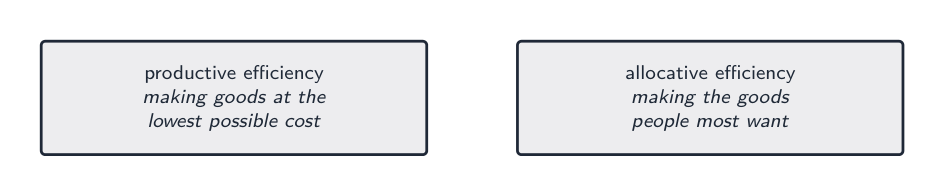
生产效率是最低成本;配置效率是制造人们想要的
词汇表 训练
英文 中文 拼音
socially efficient 社会有效率 shè huì yǒu xiào lǜ
market failure 市场失灵 shì chǎng shī líng
6.2

外部性

大纲
Enduring UnderstandingLearning ObjectiveEssential Knowledge

POL-3
Private incentives can fail to account for all socially relevant considerations.

POL-3.A
a. Define externalities.
b. Explain (using graphs where appropriate) how in the presence of externalities, private markets do not take into consideration social costs or social benefits.

  • POL-3.A.1 The socially optimal quantity of a good occurs where the marginal social benefit of consuming the last unit equals the marginal social cost of producing that last unit, thus maximizing total economic surplus.
  • POL-3.A.2 Externalities are either positive or negative and arise from lack of well-defined property rights and/or high transaction costs.
  • POL-3.A.3 In the presence of externalities, rational agents respond to private costs and benefits and not to external costs and benefits.
  • POL-3.A.4 Rational agents have the incentive to free ride when a good is non-excludable.

POL-3.B
Explain (using graphs where appropriate) how public policies address positive or negative externalities.

  • POL-3.B.1 Policies that address positive or negative externalities include taxes/subsidies, environmental regulation, public provision, the assignment of property rights, and the reassignment of property rights through private transactions.

来源:美国大学理事会 AP 课程与考试说明

负外部性

一个外部性(externality)是一个落在一个不涉及交易的第三方身上的成本或收益——所以私人决策者忽略它。

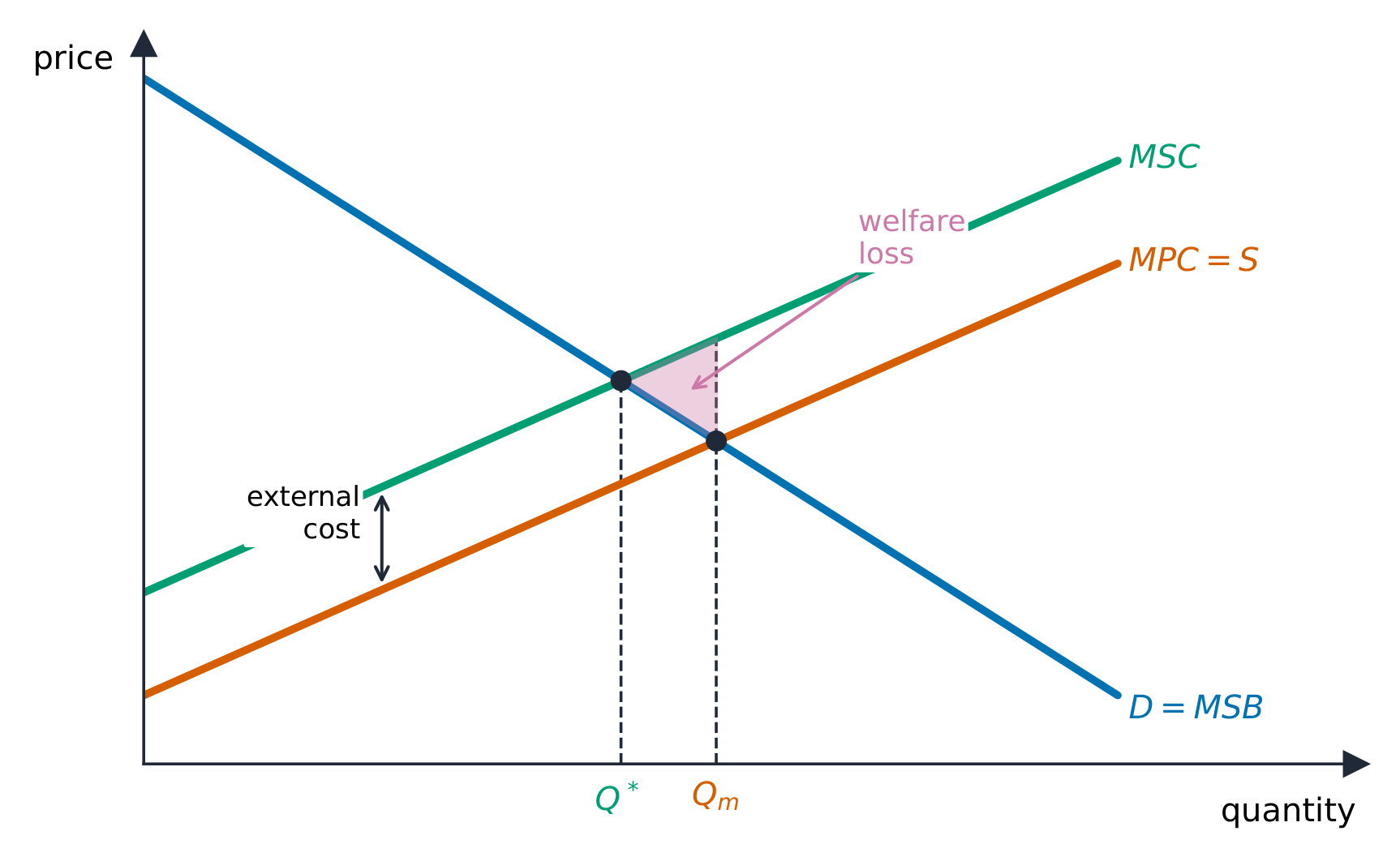
一个负外部性:市场过度生产,造成一个福利损失
  • 一个负外部性(negative externality)(污染)意味着边际社会成本 > 边际私人成本。市场过度生产;无谓损失是一个三角形。修复:一个庇古税(Pigovian tax)或监管以使生产者"内部化"成本(把私人成本向上移到社会成本)。
  • 一个正外部性(positive externality)(疫苗接种、教育)意味着边际社会收益 > 边际私人收益。市场生产不足。修复:对消费者或生产者的一个补贴
  • 科斯定理(Coase theorem):若产权清晰而讨价还价没有成本,私人各方能自己解决一个外部性——但那在许多人涉及时很少见。

Worked example. 一个工厂一种化学品的私人边际成本是每单位 $\$8$,但每单位也向邻居倾倒 $\$3$ 的污染,所以边际社会成本是 $\$11$。忽略这 $\$3$,市场过度生产。一项恰好每单位 $\$3$ 的庇古税把企业的私人成本提高到 $\$11$ ——现在等于社会成本——所以企业把产出削减到有效率的数量而外部性被"内部化"。

考试技能: 辨别一个外部性是正的还是负的、在一个图上显示私人和社会曲线分歧、标记无谓损失,并命名纠正的税或补贴。

Industrial pollution: a negative externality where social cost exceeds private cost
探索

A market with an externality

An externality makes private cost differ from social cost, so the free-market quantity is inefficient. See the deadweight loss and how a tax or subsidy corrects it.

词汇表 训练
英文 中文 拼音
externality 外部性 wài bù xìng
negative externality 负外部性 fù wài bù xìng
Pigovian tax 庇古税 bì gǔ shuì
positive externality 正外部性 zhèng wài bù xìng
Coase theorem 科斯定理 kē sī dìng lǐ
6.3

公共物品与私人物品

大纲
Enduring UnderstandingLearning ObjectiveEssential Knowledge

POL-3
Private incentives can fail to account for all socially relevant considerations.

POL-3.C
a. Define whether goods are rival and/or excludable.
b. Explain how the nature of rival and/or excludable goods influences the behavior of individuals and groups.

  • POL-3.C.1 Private goods are rival and excludable, and public goods are non-rival and non-excludable.
  • POL-3.C.2 Due to the free rider problem, private individuals usually lack the incentive to produce public goods, leaving government as the only producer.
  • POL-3.C.3 Governments sometimes choose to produce private goods, such as educational services, and to allow free access to them.
  • POL-3.C.4 Some natural resources are, by their nature, non-excludable and rival and therefore open access. Private individuals inefficiently overconsume such resources.

来源:美国大学理事会 AP 课程与考试说明

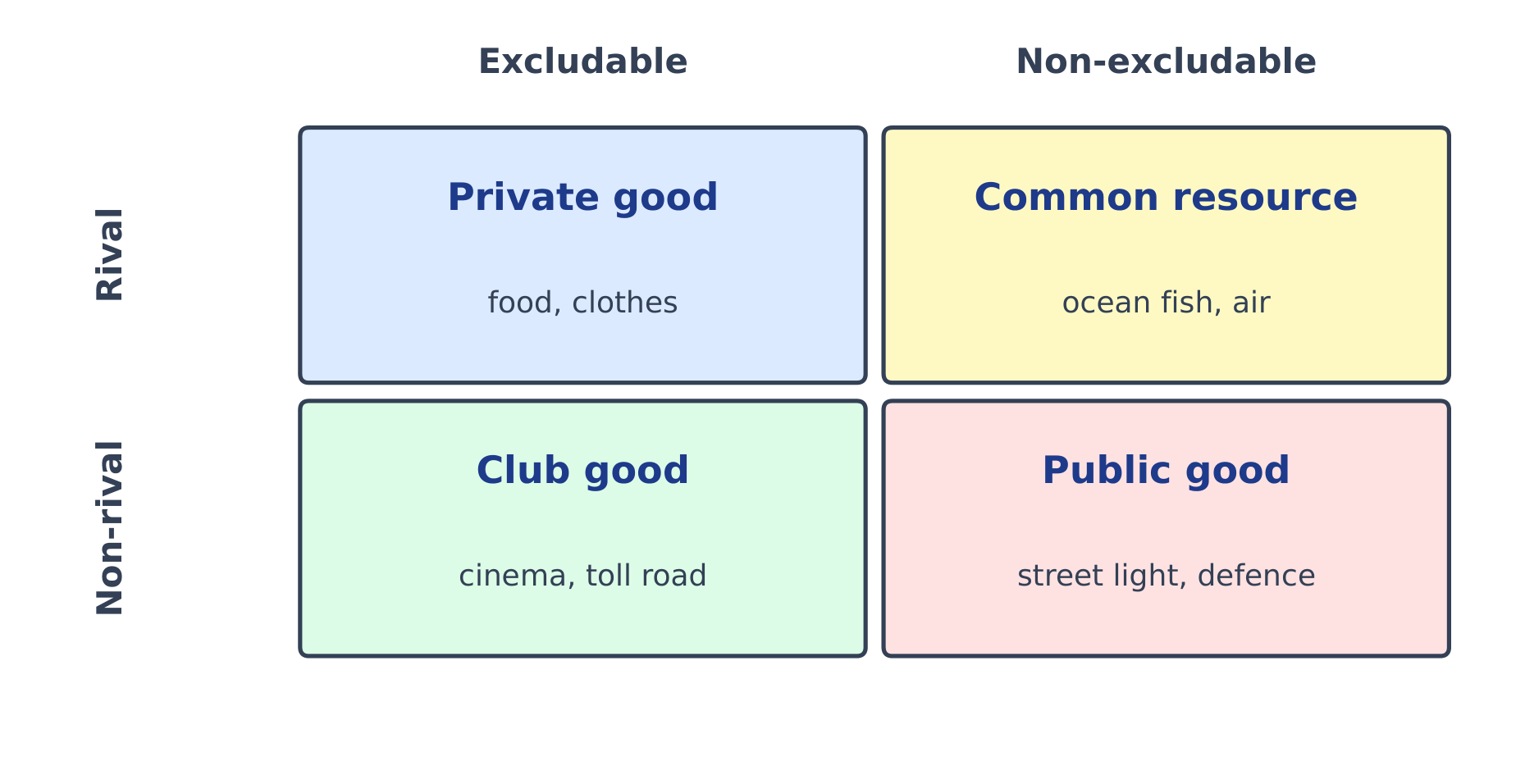
物品沿两个特征不同:竞争性(rivalry)(一个人的使用是否减少另一个人的?)和排他性(excludability)(非付费者能被排除在外吗?)。

物品按它们是否竞争性和排他性分类
物品按它们是否竞争性和排他性分类
  • 一个私人物品(private good)是竞争性和排他性的(一个三明治)——市场很好地处理这些。
  • 一个公共物品(public good)是非竞争性和非排他性的(国防、一座灯塔)。因为非付费者不能被排除,人们搭便车(free-ride)——不付钱地享受它——所以市场供给不足它,而政府通常供给它。
  • 公共资源(common resources)是竞争性但非排他性的(海洋鱼);过度使用毁掉它们——公地悲剧(tragedy of the commons)。
词汇表 训练
英文 中文 拼音
rivalry 竞争性 jìng zhēng xìng
excludability 排他性 pái tā xìng
private good 私人物品 sī rén wù pǐn
public good 公共物品 gōng gòng wù pǐn
free-ride 搭便车 dā biàn chē
Common resources 公共资源 gōng gòng zī yuán
tragedy of the commons 公地悲剧 gōng dì bēi jù
6.4

政府干预对不同市场结构的影响

大纲
Enduring UnderstandingLearning ObjectiveEssential Knowledge

POL-4
In imperfect markets, well-designed government policy can reduce waste.

POL-4.A
a. Define government policy interventions in imperfect markets.
b. Explain (using graphs where appropriate) how government policies can alter market outcomes in perfectly and imperfectly competitive markets.
c. Calculate (using data from a graph or table as appropriate) changes in market outcomes resulting from government policies in perfectly competitive and imperfectly competitive markets.

  • POL-4.A.1 Per-unit taxes and subsidies affect the total price consumers pay, net price firms receive, equilibrium quantity, consumer and producer surpluses, deadweight loss, and government revenue or cost. The impact of change depends on the price elasticity of demand and supply.
  • POL-4.A.2 Lump-sum taxes and lump-sum subsidies do not change either marginal cost or marginal benefit; only fixed costs will be affected.
  • POL-4.A.3 Binding price ceilings and floors affect prices and quantities differently depending on the market structures (perfect competition, monopoly, monopolistic competition, and monopsony) and the price elasticities of supply and demand.
  • POL-4.A.4 Government intervention in imperfect markets can increase efficiency if the policy correctly addresses the incentives that led to the market failure.
  • POL-4.A.5 Government can use price regulation to address inefficiency due to monopoly.
  • POL-4.A.6 A natural monopoly will require a lump-sum subsidy to produce at the allocatively efficient quantity.
  • POL-4.A.7 Governments use antitrust policy in an attempt to make markets more competitive.
    • Exclusion statement: A graph of inefficiency and policy due to collusion is beyond the scope of the course and the AP Exam.

来源:美国大学理事会 AP 课程与考试说明

政府工具按结构不同地改变结果:

  • 把一个垄断的价格监管$P=MC$增加效率(不像一个竞争性市场里的一个价格管制,它造成短缺/过剩)。
  • 反垄断法(antitrust laws)拆分或阻止反竞争的合并和勾结。
  • 当外部性存在时,税收和补贴使产出朝社会有效率的数量移动。

关键洞见:同一个政策能帮助或伤害效率,取决于市场是否已经有效率(竞争性)还是已经失灵(垄断、外部性)。

从量 vs 定额。 一个从量税(per-unit tax)加到边际成本上,所以它把供给上移、抬高价格、减少数量并造成无谓损失。一个定额税(lump-sum tax)(一笔固定收费,像牌照费)改变边际成本或边际收益,所以在短期里利润最大化的价格和数量不变——只有企业的利润下降;在长期里它改变进入和退出。对一个自然垄断,把价格监管向下到 $P=MC$(配置有效率)会迫使亏损,所以需要一个定额补贴(lump-sum subsidy)来使它继续生产那个有效率的数量。

词汇表 训练
英文 中文 拼音
Antitrust laws 反垄断法 fǎn lǒng duàn fǎ
per-unit tax 从量税 cóng liàng shuì
lump-sum tax 定额税 dìng é shuì
lump-sum subsidy 定额补贴 dìng é bǔ tiē
6.5

不平等

大纲
Enduring UnderstandingLearning ObjectiveEssential Knowledge

POL-5
Market outcomes can result in income inequality.

POL-5.A
Define measures of economic inequality in income and wealth.

  • POL-5.A.1 Income levels and poverty rates vary greatly both across and within groups (e.g., age, gender, race) and countries.
  • POL-5.A.2 The Lorenz curve and Gini coefficient are used to represent the degree of inequality in distributions and to compare distributions across different countries, policies, or time periods.
    • Exclusion statement: Drawing the Lorenz curve and calculating Gini coefficients are beyond the scope of the course and the AP Exam.

POL-5.B
Explain sources of income and wealth inequality.

  • POL-5.B.1 Each factor of production receives the value of its marginal product, which can contribute to income inequality.
  • POL-5.B.2 Sources of income and wealth inequality include differences in tax structures (progressive and regressive tax structures), human capital, social capital, inheritance, effects of discrimination, access to financial markets, mobility, and bargaining power within economic and social units (firms, labor unions, and families).

来源:美国大学理事会 AP 课程与考试说明

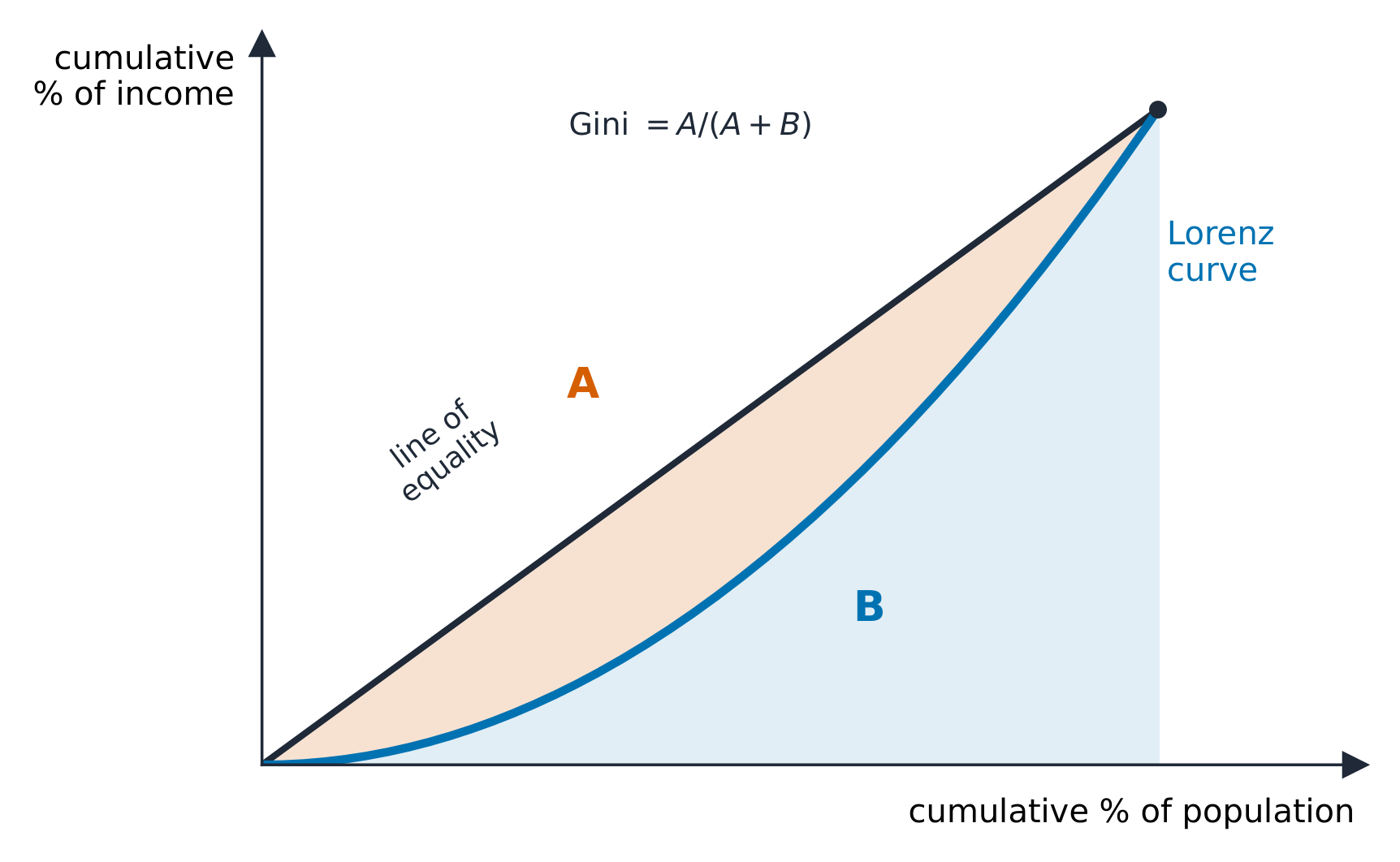
市场奖励生产率,但结果的收入分配(income distribution)能很不平等。经济学家用洛伦兹曲线(Lorenz curve)(收入份额对人口份额;它离 45° 线弯曲得越远越不平等)和基尼系数(Gini coefficient)(0 = 完美平等,1 = 完美不平等)来测量它。

洛伦兹曲线和基尼系数测量收入不平等
洛伦兹曲线和基尼系数测量收入不平等

Worked example. 假设最穷的 $20\%$ 家庭只赚收入的 $5\%$,而最富的 $20\%$$50\%$。在完美平等下每 $20\%$ 会恰好赚 $20\%$,所以洛伦兹曲线会是 $45°$ 线。因为底部五分之一远低于 $20\%$ 而顶部五分之一远高于,曲线在对角线之下弯曲很远——一个大的差距,意味着一个高基尼系数和实质的不平等。

不平等的来源包括人力资本(human capital)(技能、教育)、继承和歧视的差异。政府通过累进税(progressive taxes)(对更高收入更高的税率)和转移支付(transfer payments)(福利、补贴)再分配。有一个被辩论的效率与公平权衡(efficiency–equity trade-off):再分配能减少工作激励,所以社会平衡公平与总蛋糕的大小。

Wealth and poverty side by side: markets alone may leave large income inequality unaddressed
探索

Measure inequality with a Lorenz curve

A Lorenz curve plots cumulative income against cumulative population; the further it bows from the diagonal, the more unequal — summarised by the Gini coefficient.

词汇表 训练
英文 中文 拼音
income distribution 收入分配 shōu rù fēn pèi
Lorenz curve 洛伦兹曲线 luò lún zī qū xiàn
Gini coefficient 基尼系数 jī ní xì shù
human capital 人力资本 rén lì zī běn
progressive taxes 累进税 lèi jìn shuì
transfer payments 转移支付 zhuǎn yí zhī fù
efficiency–equity trade-off 效率与公平权衡 xiào lǜ yǔ gōng píng quán héng
6.5

考试技巧

  • 一个负外部性使市场过度生产;用一个等于外部成本的庇古税纠正。一个正外部性生产不足;用一个补贴纠正。
  • 一个公共物品是非竞争性和非排他性的,所以搭便车导致市场供给不足它。
  • 按竞争性和排他性给物品分类;公共资源(竞争性、非排他性)遭受公地悲剧。
  • 同一个政策能帮助或伤害效率,取决于市场是否已经有效率还是失灵。
  • 洛伦兹曲线基尼系数(0 = 平等,1 = 不平等)测量不平等。

本主题的互动课程

逐步学习,并即时检测练习。

AP 微观经济学历年真题

AP 微观经济学的更多主题

登录或创建账号

IGCSE, A-Level & AP