| English | 释义 | 拼音 |
|---|---|---|
| monopoly/məˈnɒpəli/ | 垄断 | lǒng duàn |
| price maker/praɪs ˈmeɪkə/ | 价格制定者 | jià gé zhì dìng zhě |
| marginal revenue/ˈmɑːdʒɪnl ˈrevənjuː/ | 边际收入 | biān jì shōu rù |
| deadweight loss/ˈdedweɪt lɒs/ | 无谓损失 | wú wèi sǔn shī |
| allocatively inefficient/ˈæləkətɪvli ɪnɪˈfɪʃənt/ | 配置无效率 | pèi zhì wú xiào lǜ |
| natural monopoly/ˈnætʃərəl məˈnɒpəli/ | 自然垄断 | zì rán lǒng duàn |
The only game in town
- One water company. One railway. One patent-holding drug maker.
- When a firm is the sole seller of something with no close substitute, the rules change.
- It no longer takes the price — it makes it.
- That is a monopoly 垄断.
A price maker with MR below price
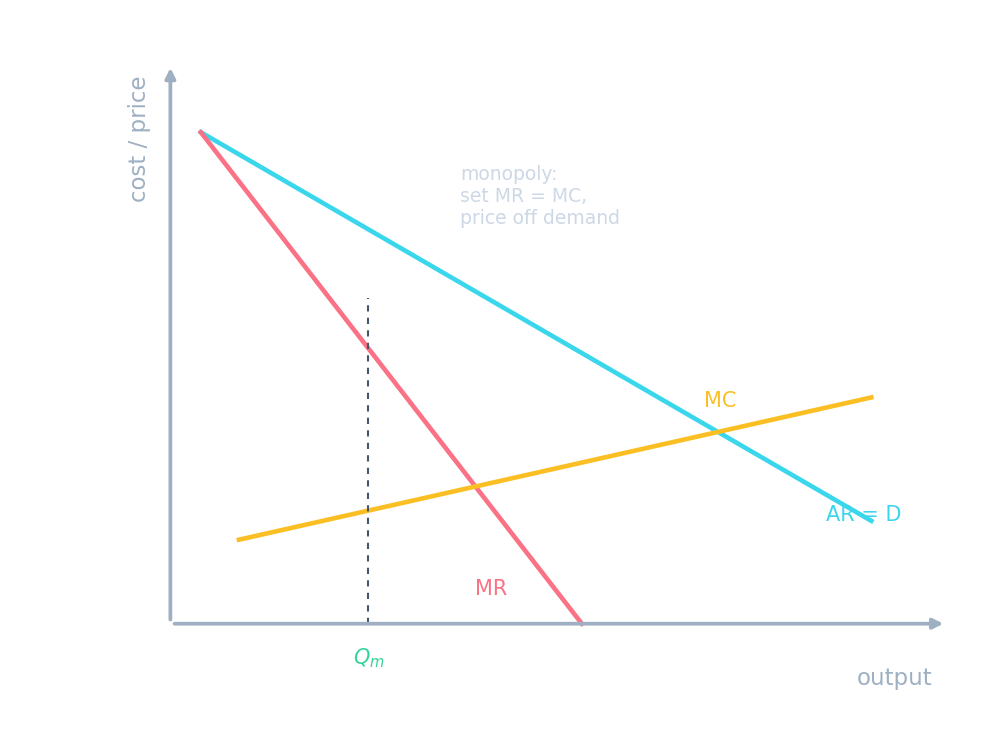
- A monopoly is a price maker 价格制定者 — it chooses the price by choosing how much to produce.
- To sell one more unit, it must lower the price on every unit.
- So its marginal revenue 边际收入 is less than the price — the MR curve lies below demand.
新增销售收入与原有销量的降价损失
区分新增单位的收入与原有单位的降价损失,并区分区间边际收入与点导数。
垄断是价格制定者,意思是它:
难度 1/5 · 今日首次完成可获 100 金币及少量额外奖励
没有对手,垄断者选择需求曲线上使利润最大的点。
对垄断者,边际收入低于价格,因为想多卖就得把每个单位的价格都降下来。
难度 1/5 · 今日首次完成可获 100 金币及少量额外奖励
给所有单位降价,使额外收入(MR)小于价格。
Find the monopoly outcome
- The monopolist still obeys the rule: produce where $MR = MC$ to get $Q_M$.
- Then go up to the demand curve to read the price $P_M$.
- Because $P_M > MC$, the last unit is worth more to buyers than it costs to make — but the monopolist won't make it.
- Those lost trades are the deadweight loss 无谓损失, so a monopoly is allocatively inefficient 配置无效率.
企业的成本曲线
垄断者仍在边际收入与边际成本相遇处生产——但随后按向下倾斜的需求收取更高价格。
需求是 P = 100 − Q,所以 MR = 100 − 2Q。当 MC = 20 时,MR = MC 处的垄断数量是多少?
难度 2/5 · 今日首次完成可获 140 金币及少量额外奖励
令 100 − 2Q = 20 → 2Q = 80 → Q = 40。
用同样的需求 P = 100 − Q,在 Q = 40 时垄断者收取的价格是多少?
难度 2/5 · 今日首次完成可获 140 金币及少量额外奖励
从需求读出价格:P = 100 − 40 = 60。因为 60 > MC = 20,存在无谓损失。
垄断配置无效率,因为在它的产量下:
难度 1/5 · 今日首次完成可获 100 金币及少量额外奖励
P > MC 表示最后一个单位的价值高于成本,却没有生产——无谓损失。
Natural monopoly
- A natural monopoly 自然垄断 has such large fixed costs (a water or power network) that one firm serves the whole market at lower average cost than two could.
- Here, competition would waste resources by duplicating the network.
因固定成本极大而由一家企业服务最省的市场,是______垄断。
难度 1/5 · 今日首次完成可获 100 金币及少量额外奖励
自然垄断(如自来水网络)由一家企业以更低平均成本服务所有人。
Worked examples
1. A monopolist faces $P = 100 - 2Q$, so $MR = 100 - 4Q$, and $MC = 20$. Set $MR = MC$: $100 - 4Q = 20$, so $Q = 20$ and, from the demand curve, $P = 100 - 2 \times 20 = 60$. With constant $ATC = 20$, profit $= (60 - 20) \times 20 = 800$.
2. A competitive market would produce where $P = MC$: $100 - 2Q = 20$, so $Q = 40$. Deadweight loss is the triangle $\tfrac12 \times (40 - 20) \times (60 - 20) = 400$.
需求函数为 P = 50 − Q,因此边际收益为 50 − 2Q。边际成本为 10。单一价格垄断者会选择什么产量和价格?
40 除以 2 等于 20,且 50 减去 20 等于 30。
垄断者收取的价格是多少?
难度 1/5 · 今日首次完成可获 100 金币及少量额外奖励
需求曲线上对应的数量20给出价格30。其他选项——60(课程中的垄断价格);10(边际成本)。
A monopoly is the sole seller and a price maker, with marginal revenue below price. It sets $Q_M$ where $MR = MC$, then charges $P_M$ off the demand curve. Because $P_M > MC$ it is allocatively inefficient — a deadweight loss. A natural monopoly is cheapest served by one firm.
Write from the data: find the monopoly quantity
- Demand is P = 50 minus Q, so marginal revenue is 50 minus 2Q.
- Marginal cost is 10. Find quantity and price.