| English | 释义 | 拼音 |
|---|---|---|
| trade/treɪd/ | 贸易 | mào yì |
| specialise/ˈspeʃəlaɪz/ | 专业化 | zhuān yè huà |
| comparative advantage/kəmˈpærətɪv ədˈvæntɪdʒ/ | 比较优势 | bǐ jiào yōu shì |
| absolute advantage/ˈæbsəluːt ədˈvæntɪdʒ/ | 绝对优势 | jué duì yōu shì |
| opportunity cost/ɒpəˈtjuːnɪti kɒst/ | 机会成本 | jī huì chéng běn |
| terms of trade/tɜːmz ɒv treɪd/ | 贸易条件 | mào yì tiáo jiàn |
Why trade if you're better at everything?
- Suppose your country can make more of every good than your neighbour.
- It sounds like you should just make everything yourself.
- Yet both countries end up richer if they each specialise and then trade.
- The reason is one of the most surprising ideas in all of economics: comparative advantage 比较优势.
Absolute vs comparative advantage
- Absolute advantage 绝对优势 means making more of a good with the same resources.
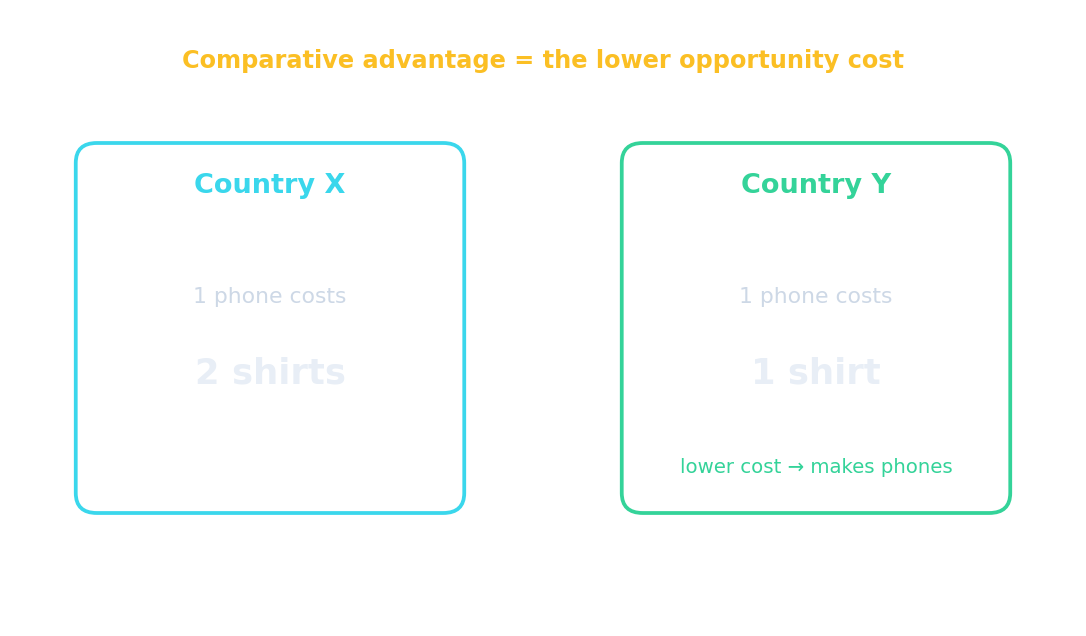
- Comparative advantage 比较优势 means having the lower opportunity cost 机会成本 of making it.
- These are not the same: one producer can hold the absolute advantage in everything, yet the comparative advantage in only some things.
- For trade, the rule that matters is comparative, not absolute.
绝对优势还是比较优势?
绝对优势看谁产量更多;比较优势看谁机会成本更低。只有比较优势决定谁该专业化。
当一个国家在某商品上有绝对优势时,它能:
难度 1/5 · 今日首次完成可获 100 金币及少量额外奖励
绝对优势看产量本身;比较优势看机会成本。
Work out who should make what
- Worked example. In one day: Country X can make 10 phones or 20 shirts; Country Y can make 4 phones or 4 shirts.
- X's opportunity cost of 1 phone is $20/10 = 2$ shirts; Y's is $4/4 = 1$ shirt.
- Y gives up fewer shirts per phone, so Y should make the phones.
- Checking shirts: X gives up $10/20 = 0.5$ phones each, Y gives up $1$ — so X should make the shirts.
X:10 部手机或 20 件衬衫。Y:4 部手机或 4 件衬衫。谁在手机上有比较优势?
难度 1/5 · 今日首次完成可获 100 金币及少量额外奖励
Y 每部手机放弃 1 件衬衫,X 放弃 2 件——Y 的机会成本更低。
X 国一天能造 10 部手机或 20 件衬衫。一部手机的机会成本(以衬衫计)是多少?
难度 2/5 · 今日首次完成可获 140 金币及少量额外奖励
放弃 20 件衬衫可换来 10 部手机,所以每部手机的成本是 $20/10 = 2$ 件衬衫。
Specialise, then trade
- Each producer specialises 专业化 in the good where its opportunity cost is lower.
- They then trade 贸易 for the rest, and both can consume beyond their own PPC.
- The terms of trade 贸易条件 (the swap rate) must sit between the two opportunity costs for both sides to gain.
- Remember: X was absolutely better at both goods, yet trade still made both better off.
如果一个国家生产每种商品都更强,那么贸易就不能让双方都受益。
难度 1/5 · 今日首次完成可获 100 金币及少量额外奖励
只要机会成本不同,双方就能从专业化和贸易中获益——即使在这种情况下也一样。
一个生产者应在它有比较优势的商品上______。
难度 1/5 · 今日首次完成可获 100 金币及少量额外奖励
在机会成本最低的地方专业化,再贸易换取其余。
选出关于贸易收益的所有正确说法。
难度 2/5 · 今日首次完成可获 140 金币及少量额外奖励
当双方按比较优势专业化、并以介于机会成本之间的条件贸易时,双方都获益。
Comparative advantage is the lower opportunity cost — not making more (that is absolute advantage). Each producer should specialise where its opportunity cost is lower and trade for the rest. This works even if one producer is better at everything, and lets both consume beyond their own PPC.
Write from the data given
- Country P makes 6 boats or 18 nets. Country Q makes 3 boats or 3 nets.
- Find each country's opportunity cost of one boat.
P每天可生产6艘船或18张网,Q每天可生产3艘船或3张网。每个国家的每艘船机会成本(以张网为单位)是多少?谁在生产船只方面具有比较优势?
18除以6等于3,且3除以3等于1。
谁在船只生产上具有比较优势?
难度 1/5 · 今日首次完成可获 100 金币及少量额外奖励
Q的1净收益比P的3净收益具有更低的机会成本。