- understand that an electric current is a flow of charge carriers
- understand that the charge on charge carriers is quantised
- recall and use $Q = It$
- use, for a current-carrying conductor, the expression $I = Anvq$, where $n$ is the number density of charge carriers
电学
A-Level 物理 · 第 9 主题
 17:50
17:50
Electric Current
Flip a switch, and the light comes on instantly. So the electrons must be racing through the wire at the speed of light — right? Wrong. Inside a copper wire…
英文讲解 · 内嵌中英文字幕
9.1
电流

大纲
来源:剑桥国际大纲
电流(electric current)是载流子(charge carriers)的流动。在金属中载流子是带负电的传导电子(electrons);在电解质(electrolyte)中它们是带正电和负电的离子(ions);在半导体(semiconductor)中它们可能是电子或"空穴"(holes)。常规电流(conventional current)方向是正电荷会流动的方向——与导线中电子的真实流动方向相反。
电荷
电荷是量子化的(quantised):最小的自由电荷单位是基本电荷(elementary charge)
$$e = 1.60 \times 10^{-19}\ \text{C}.$$
本大纲中的每一个自由电荷都是 $e$ 的整数倍。电荷的单位是库仑(coulomb),$\text{C}$。
所以一个粒子可以带 $4.8 \times 10^{-19}\ \text{C}$(三个电子的电荷)或 $-2.4 \times 10^{-18}\ \text{C}$(十五个),但绝不会带 $1.1 \times 10^{-19}\ \text{C}$ 或 $6.4 \times 10^{-20}\ \text{C}$;一组给出载流子电荷为 $2.5 \times 10^{-19}\ \text{C}$ 的测量不可能正确,因为它不是 $e$ 的倍数。一分的定义:电流是载流子的流动;库仑是电流为一安培时一秒内经过某点的电荷(安培乘以秒);载流子可以是电子、质子、离子或 $\alpha$ 粒子,但绝不是中子。
电流是电荷的流动速率
如果电荷 $Q$ 在时间 $t$ 内经过某一点,电流是
$$I = \frac{Q}{t}, \qquad Q = It.$$
电流的单位:安培,$\text{A}$($= \text{C s}^{-1}$)。对于变化的电流,一段时间内流过的电荷是 $I$–$t$ 图线下方的面积。
例题。 一个 $0.50\ \text{A}$ 的电流流动了 $2.0$ 分钟。求流过的电荷,以及这代表多少个电子。($e = 1.60 \times 10^{-19}\ \text{C}$。)
$$Q = It = 0.50 \times 120 = 60\ \text{C}, \qquad N = \frac{Q}{e} = \frac{60}{1.60 \times 10^{-19}} \approx 3.8 \times 10^{20}.$$
同样的两行回答"$4.0\ \text{mA}$ 下 $10$ 小时内有多少电子经过"(先把时间换成秒:$N = It/e = 4.0 \times 10^{-3} \times 36\,000 / (1.60 \times 10^{-19}) = 9.0 \times 10^{20}$),以及反过来的"$24$ 小时内 $6.0 \times 10^{23}$ 个电子经过时的平均电流"($I = Ne/t = 1.1\ \text{A}$)。$\alpha$ 粒子束也载有电流:每个带 $2e$,所以 $6.9 \times 10^{-9}\ \text{A}$ 的束流是每秒 $6.9 \times 10^{-9} / (2 \times 1.60 \times 10^{-19}) = 2.2 \times 10^{10}$ 个粒子。在 $30\ \mu\text{s}$ 内转移 $1 \times 10^{20}$ 个电子的闪电是 $Ne/t = 5.3 \times 10^{5}\ \text{A}$ 的电流。
漂移速度方程
对于一个横截面积为 $A$ 的均匀导体,每单位体积有 $n$ 个载流子(数密度(number density)),每个带电荷 $q$,以平均漂移速度(drift velocity)$v$ 运动:
$$I = A n v q.$$
例题。 一根横截面积 $1.0 \times 10^{-6}\ \text{m}^2$ 的铜丝载着 $5.0\ \text{A}$ 的电流。铜每 $\text{m}^3$ 有 $n = 8.5 \times 10^{28}$ 个自由电子。求漂移速度。($e = 1.60 \times 10^{-19}\ \text{C}$。)
重排 $I = Anvq$ 得 $v = \dfrac{I}{Anq}$:
$$v = \frac{5.0}{(1.0 \times 10^{-6})(8.5 \times 10^{28})(1.60 \times 10^{-19})} \approx 3.7 \times 10^{-4}\ \text{m s}^{-1}.$$
电子漂移得非常慢——每秒不到一毫米。
这个计算前常有两个"证明"步骤。每个原子有一个自由电子的金属,数密度是 $n = \dfrac{\text{密度} \times N_{\text{A}}}{\text{摩尔质量}}$:对铜,$8.9 \times 10^{3} \times 6.02 \times 10^{23} / 0.0635 = 8.5 \times 10^{28}\ \text{m}^{-3}$。而电子漂移过整根导线的时间是 $t = L / v$:以 $3.7 \times 10^{-4}\ \text{m s}^{-1}$ 走完 $2.0\ \text{m}$ 的导线要 $5\,400\ \text{s}$,一个半小时,尽管电流几乎瞬间就建立了。在这两者之间,方程 $I = Anvq$ 作为比值使用远多于作为计算:
- 串联的两根导线电流相同;若导线 Y 的直径是 X 的两倍(面积四倍)、金属相同,其电子以四分之一的速度漂移。长度和直径相同但金属不同的两根导线,漂移速度与它们的数密度成反比。
- 变窄的导线(楔形、锥形杆、粗细股组成的电缆)在每个横截面上电流相同,所以面积减小处漂移速度增大:$v \propto 1/A \propto 1/r^{2}$。沿渐细导线的 $v$ 对距离的示意图是一条向细端越来越陡地上升的曲线,不是直线。
- 电流固定时,均匀导线两端的电势差与其长度成正比,因为 $V = IR = I\rho L / A$ 中 $I$、$\rho$ 和 $A$ 恒定。
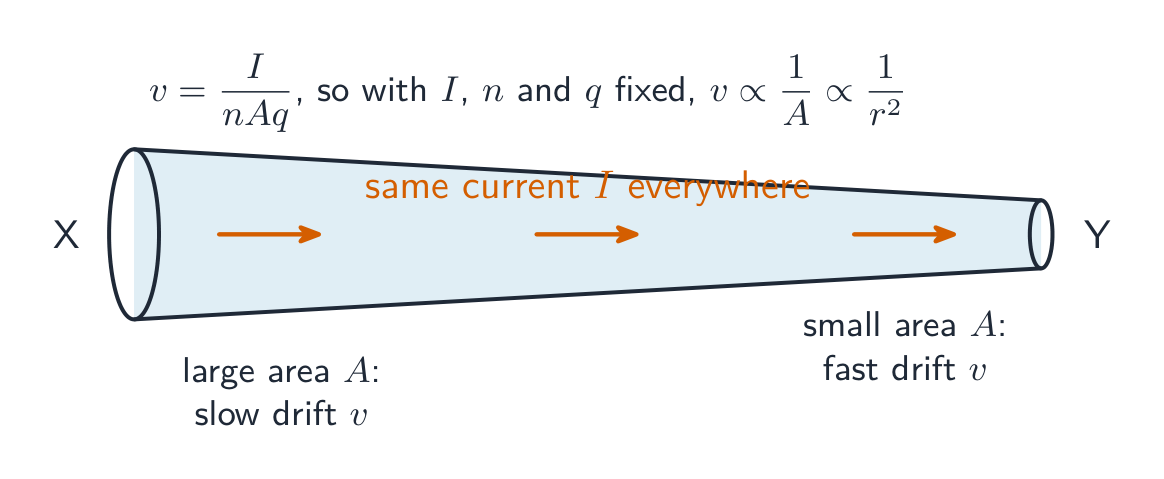
用这个来比较电流:
- 相同 $I$ 下更细的导线(较小的 $A$)需要更快的漂移 $v$。
- 半导体的自由载流子比金属少得多(较小的 $n$),所以相同 $I$ 下漂移速度大得多。
- 在串联(series)元件中,$I$ 处处相同,所以如果 $A$ 不变但材料改变,$nv$ 会反向变化。
探索
Current, voltage and resistance
Current is the rate of flow of charge. Raise the voltage and current rises; raise the resistance and it falls — I = V / R.
词汇表
训练
| 英文 | 中文 | 拼音 |
|---|---|---|
| electric current/ɪˈlektrɪk ˈkʌrənt/ | 电流 | diàn liú |
| charge carrier/tʃɑːdʒ ˈkærɪə/ | 载流子 | zài liú zǐ |
| electron/ɪˈlektrɒn/ | 电子 | diàn zi |
| electrolyte/ɪˈlektrəlaɪt/ | 电解质 | diàn jiě zhì |
| ion/ˈaɪɒn/ | 离子 | lí zi |
| semiconductor/ˌsemɪkənˈdʌktə/ | 半导体 | bàn dǎo tǐ |
| holes/həʊlz/ | 空穴 | kōng xué |
| hole/həʊl/ | 空穴 | kōng xué |
| conventional current/kənˈvenʃənl ˈkʌrənt/ | 常规电流 | cháng guī diàn liú |
| quantised/ˈkwɒntaɪzd/ | 量子化 | liàng zǐ huà |
| elementary charge/ˌelɪˈmentəri tʃɑːdʒ/ | 基本电荷 | jī běn diàn hè |
| coulomb/ˈkuːlɒm/ | 库仑 | kù lún |
| drift velocity/drɪft vəˈlɒsɪti/ | 漂移速度 | piāo yí sù dù |
| number density/ˈnʌmbə ˈdensɪti/ | 数密度 | shù mì dù |
| series/ˈsɪəriːz/ | 串联 | chuàn lián |
9.2
电势差与功率
大纲
- define the potential difference across a component as the energy transferred per unit charge
- recall and use $V = W/Q$
- recall and use $P = VI$, $P = I^2R$ and $P = V^2/R$
来源:剑桥国际大纲
一个元件两端的电势差(potential difference,p.d.)是电荷经过它时每单位电荷转移的能量(energy):
$$V = \frac{W}{Q}.$$
单位:伏特(volt),$\text{V}$($= \text{J C}^{-1}$)。
如果 $1\ \text{C}$ 的电荷经过一个元件时有 $1\ \text{J}$ 的电能变成其他形式(热、光、动能……),那么它两端的电势差就是 $1\ \text{V}$。
一个电源的电动势(electromotive force,e.m.f.)是电源每单位电荷所给予的能量。公式与电势差相同;区别在方向:电动势是电源给予电荷的能量;电势差是电荷交给元件的能量。
阅卷人接受的定义:元件两端的电势差是每单位电荷经过该元件时(从电能到其他形式)转移的能量;电源的电动势是电源在驱动电荷绕完整回路一周时每单位电荷从其他形式(电池中的化学能)转移为电能的能量;一伏特是一焦耳每库仑。因此"标着 $9.0\ \text{V}$"的电池给整个电路中的每库仑电荷 $9.0\ \text{J}$ 的电能,而电荷与电势差的乘积就是转移的能量。
词汇表
训练
| 英文 | 中文 | 拼音 |
|---|---|---|
| potential difference/pəˈtenʃl ˈdɪfrəns/ | 电势差 | diàn shì chā |
| energy/ˈenədʒi/ | 能量 | néng liàng |
| volt/vəʊlt/ | 伏特 | fú tè |
| electromotive force/ɪˌlektrəʊˈməʊtɪv fɔːs/ | 电动势 | diàn dòng shì |
9.2
电功率

联立 $V = W/Q$ 和 $I = Q/t$:
$$P = \frac{W}{t} = V I.$$
用欧姆定律 $V = IR$:
$$P = V I = I^{2} R = \frac{V^{2}}{R}.$$
选用含你已知量的形式。例子:
- 两个电阻相等的加热器——电流较大的那个给出更多功率(power)($P = I^{2}R$)。
- 跨接在相同电压(voltage)上、并联(parallel)的两个电阻——$R$ 较小的那个给出更多功率($P = V^{2}/R$)。
- 一个标着"$2.4\ \text{kW}, 240\ \text{V}$"的水壶消耗 $I = P/V = 10\ \text{A}$,电阻为 $R = V^{2}/P = 24\ \Omega$。
时间 $t$ 内转移的能量是 $E = P t$。
例题。 两个灯泡,P 额定 $250\ \text{V}$、$50\ \text{W}$,Q 额定 $250\ \text{V}$、$200\ \text{W}$,串联接到 $250\ \text{V}$ 电源上。哪个更亮?
它们在额定电压下的电阻是 $R = V^{2}/P$:P 为 $1250\ \Omega$,Q 为 $313\ \Omega$。串联时电流相同,所以由 $P = I^{2}R$,电阻较大的灯泡 P 消耗更多功率:"较弱"的灯反而更亮。并联时两者电压相同,$P = V^{2}/R$ 偏向电阻较小者:Q。"说明并解释哪个电阻消耗更多功率"要先说出两者共有的量(串联是电流,并联是电压),再用含该量的那种功率公式。
例题。 电源通过两根各 $0.10\ \Omega$ 的电缆以 $240\ \text{V}$ 向水壶输送 $2.4\ \text{kW}$。求电缆中损失的功率。
电流是 $I = P/V = 10\ \text{A}$,所以电缆消耗 $I^{2}R = 10^{2} \times 0.20 = 20\ \text{W}$,水壶得到 $2380\ \text{W}$。为一个元件供电的电路,其效率是该元件的功率除以电源的总功率:在同一电流下,$0.86\ \Omega$ 的串联电阻两端为 $6.0\ \text{V}$、元件两端为 $4.5\ \text{V}$ 时,效率是 $4.5 / (6.0 + 4.5) = 43\%$。接在固定电压上的热敏电阻消耗 $P = V^{2}/R$,所以温度升高、$R$ 下降时,功率上升。水壶从 $250\ \text{V}$ 电源大约取 $10\ \text{A}$;手机充电器只取几分之一安培。
探索
Electrical power
P = VI
At a fixed voltage, power is proportional to the current it drives.
词汇表
训练
| 英文 | 中文 | 拼音 |
|---|---|---|
| power/ˈpaʊə/ | 功率 | gōng lǜ |
| voltage/ˈvəʊltɪdʒ/ | 电压 | diàn yā |
| parallel/ˈpærəlel/ | 并联 | bìng lián |
9.3
电阻与电阻率

大纲
- define resistance
- recall and use $V = IR$
- sketch the $I\text{--}V$ characteristics of a metallic conductor at constant temperature, a semiconductor diode and a filament lamp
- explain that the resistance of a filament lamp increases as current increases because its temperature increases
- state Ohm's law
- recall and use $R = \rho L/A$
- understand that the resistance of a light-dependent resistor (LDR) decreases as the light intensity increases
- understand that the resistance of a thermistor decreases as the temperature increases (it will be assumed that thermistors have a negative temperature coefficient)
来源:剑桥国际大纲
一个元件的电阻(resistance)$R$ 是
$$R = \frac{V}{I}.$$
单位:欧姆(ohm),$\Omega$($= \text{V A}^{-1}$)。电阻取决于测量时的条件(例如温度)。
欧姆定律
当一个导体中的电流与它两端的电势差成正比时,只要条件(尤其是温度)保持不变,它就遵守欧姆定律(Ohm's law)。对于这样的导体 $R$ 是常数,$I$–$V$ 图是过原点的直线。
欧姆定律是一个实验结果,不是一个定义。定义 $R = V/I$ 对任何元件都成立;只有欧姆式元件才有恒定的 $R$。
给分的表述:电阻是元件两端电势差与其中电流之比;欧姆是一伏特的电势差产生一安培电流时元件的电阻(一伏特每安培);欧姆定律指出,只要温度(和其他物理条件)保持不变,金属导体中的电流与其两端的电势差成正比。在几张 $I$–$V$ 图中,只有过原点的直线遵守欧姆定律;不过原点的直线或任何曲线都不遵守。
$I$–$V$ 特性曲线
你应当能够画出这些:
- 恒温下的金属丝——过原点的直线(恒定的 $R$)。反转电势差使电流反向流动,给出两个方向上的直线。
- 灯丝灯泡(filament lamp)——过原点,起初陡峭,然后随 $V$(和 $I$)增大而变平。原因:更大的电流加热灯丝,所以它的电阻上升,斜率 $1/R$ 下降。
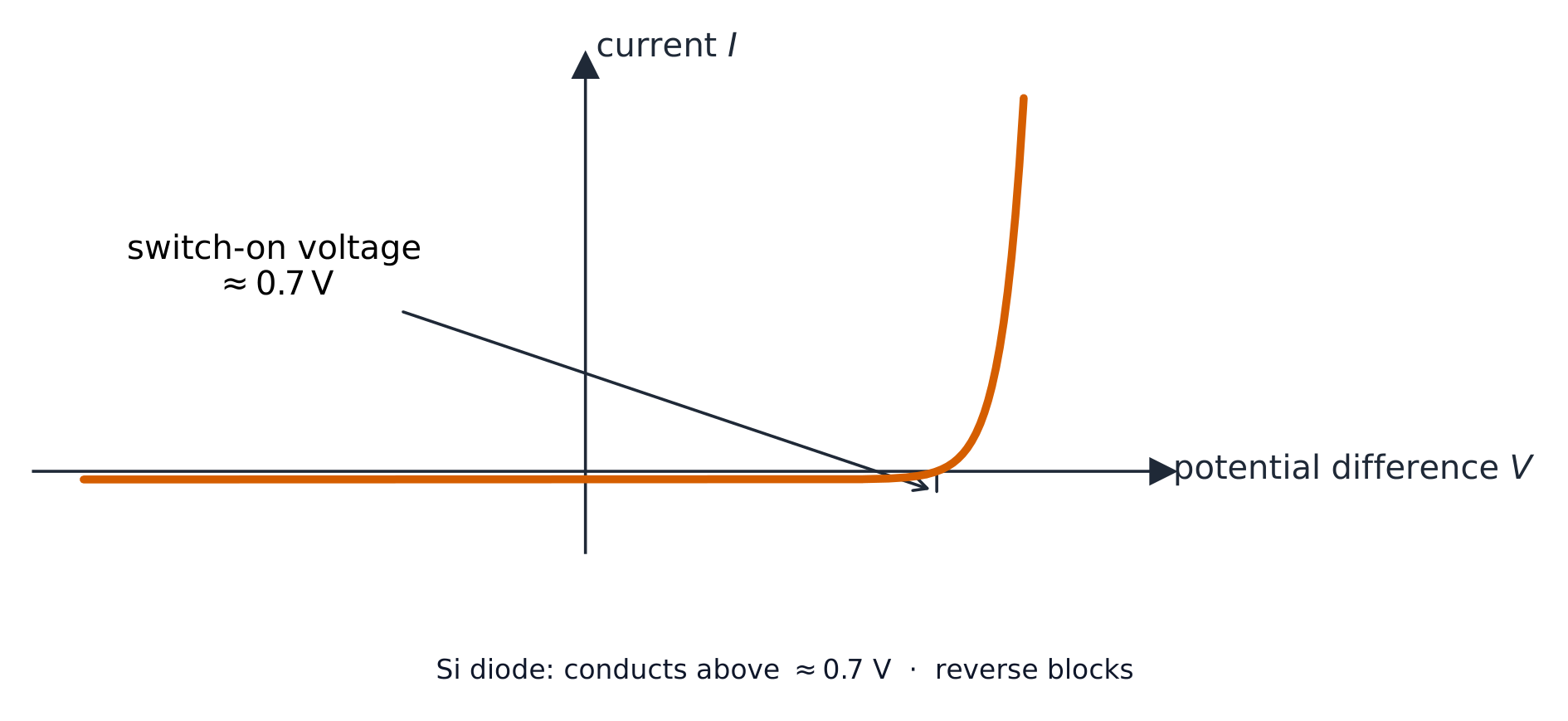
- 半导体二极管(semiconductor diode)——在负 $V$ 或小的正 $V$ 时几乎没有电流。超过一个"导通"电压(硅约 $0.7\ \text{V}$)后,电流急剧上升。
解释灯丝灯泡图线的形状(三分):电流增大时灯丝温度升高;晶格离子以更大振幅振动,所以自由电子与它们碰撞更频繁;每次碰撞都从电子取走能量,所以电阻增大;在图上比值 $V/I$ 变大而斜率变小。"电流减小"时反过来:温度下降,所以电阻下降。从任何特性曲线都要读出两点。某点的电阻是该点的 $V/I$,绝不是曲线的斜率,所以二极管的电阻在导通电压以下非常大(实际上无穷大),然后随 $V$ 进一步增大而急剧下降;在相同电势差下,四个元件中电流最小的那个电阻最大。而当灯泡(或二极管)与电阻串联时,两者电流相同、电势差相加:在元件自己的电势差处从它的曲线读出电流,再对电阻用 $V = IR$,电源电压是两者之和。


电阻率
对于一个长度为 $L$、横截面积为 $A$ 的均匀导体,
$$R = \frac{\rho L}{A}.$$
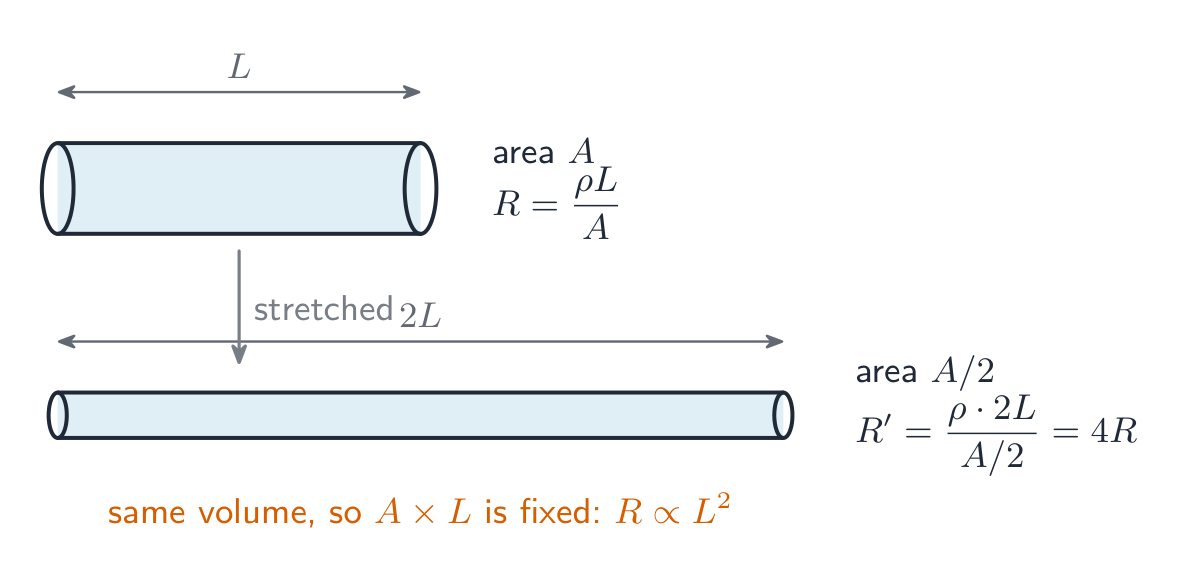
$\rho$ 是电阻率(resistivity),材料的一个性质,单位为 $\Omega\ \text{m}$。长度翻倍使 $R$ 翻倍;面积翻倍使它减半;直径减半使面积变为四分之一,因而使 $R$ 变为四倍大。
例题。 一根长 $2.0\ \text{m}$、横截面积 $1.7 \times 10^{-7}\ \text{m}^2$ 的铜丝,电阻率为 $1.7 \times 10^{-8}\ \Omega\ \text{m}$。求它的电阻。
$$R = \frac{\rho L}{A} = \frac{(1.7 \times 10^{-8})(2.0)}{1.7 \times 10^{-7}} = 0.20\ \Omega.$$
典型值:室温下的铜 $\rho \sim 1.7 \times 10^{-8}\ \Omega\ \text{m}$;一个绝缘体(insulator)$\rho \sim 10^{15}\ \Omega\ \text{m}$ 或更大。


金属的电阻率随温度上升(更多的晶格振动(lattice vibration)散射(scatters)电子),这就是灯丝灯泡的 $I$–$V$ 线弯曲的原因。
大多数电阻率题目是比值。拉伸导线时其体积($A \times L$)不变,所以长度变为 $k$ 倍,面积就变为 $1/k$,$R = \rho L / A$ 变为 $k^{2}$ 倍:长度三倍(同样质量、同样金属)的导线电阻是九倍;直径降到原来 $0.940$ 的导线,面积乘以 $0.884$,长度除以 $0.884$,电阻乘以 $1/0.884^{2} = 1.28$。
例题。 一根电阻 $9.6\ \Omega$、长 $20\ \text{m}$ 的铜避雷针,电阻率为 $1.7 \times 10^{-8}\ \Omega\ \text{m}$。求它的半径。
$A = \rho L / R = 1.7 \times 10^{-8} \times 20 / 9.6 = 3.5 \times 10^{-8}\ \text{m}^{2}$,$r = \sqrt{A / \pi} = 1.1 \times 10^{-4}\ \text{m}$。半径加倍(长度不变)使电阻变为四分之一。其他标准比值:并联的股线——七根相同的股线分担电流,所以电缆的电阻是一根的七分之一;电阻相同的两根导线中,若一种金属的电阻率是另一种的两倍,第二根就需要两倍的面积(直径为 $\sqrt{2}$ 倍)才能长度相同;导线的单位长度电阻 $0.92\ \Omega\ \text{m}^{-1}$ 乘以它的面积 $5.3 \times 10^{-7}\ \text{m}^{2}$ 就是它的电阻率 $4.9 \times 10^{-7}\ \Omega\ \text{m}$;一个长 $60\ \text{mm}$、直径 $20\ \text{mm}$ 的导电橡皮泥圆柱,或边长为 $a$ 的立方体($R = \rho a / a^{2} = \rho / a$),都用同一个 $R = \rho L / A$,取该形状自己的长度和端面面积。导线受拉时,$R_{0} = \rho L / A$ 仍给出它的电阻,而使它变长变细的拉伸从两方面提高 $R$。因为 $\rho = RA/L = R\pi d^{2}/(4L)$,测得的电阻率的百分比不确定度等于 $R$ 和 $L$ 的百分比不确定度之和再加上 $d$ 的两倍。
探索
What resistance depends on: R = ρL/A
A longer wire has more resistance; a thicker one (bigger area) has less. Change the length, area and metal.
探索
Resistance (Ohm's law)
V = R·I
Ohm's law: voltage is proportional to current — the gradient is the resistance R.
探索
Ohm's law: V = IR
V = aI
Drag the resistance. For an ohmic conductor voltage is proportional to current — a straight line whose gradient is the resistance.
词汇表
训练
| 英文 | 中文 | 拼音 |
|---|---|---|
| ohm/əʊm/ | 欧姆 | ōu mǔ |
| Ohm's law/əʊmz lɔː/ | 欧姆定律 | ōu mǔ dìng lǜ |
| resistance/rɪˈzɪstəns/ | 电阻 | diàn zǔ |
| filament lamp/ˈfɪləmənt læmp/ | 灯丝灯泡 | dēng sī dēng pào |
| semiconductor diode/ˌsemɪkənˈdʌktə ˈdaɪəʊd/ | 二极管 | èr jí guǎn |
| diode/ˈdaɪəʊd/ | 二极管 | èr jí guǎn |
| resistivity/ˌriːzɪˈstɪvəti/ | 电阻率 | diàn zǔ lǜ |
| insulator/ˈɪnsjuːleɪtə/ | 绝缘体 | jué yuán tǐ |
| lattice vibration/ˈlætɪs vaɪˈbreɪʃn/ | 晶格振动 | jīng gé zhèn dòng |
| scatters/ˈskætəz/ | 散射 | sǎn shè |
9.3
光敏电阻(LDR)
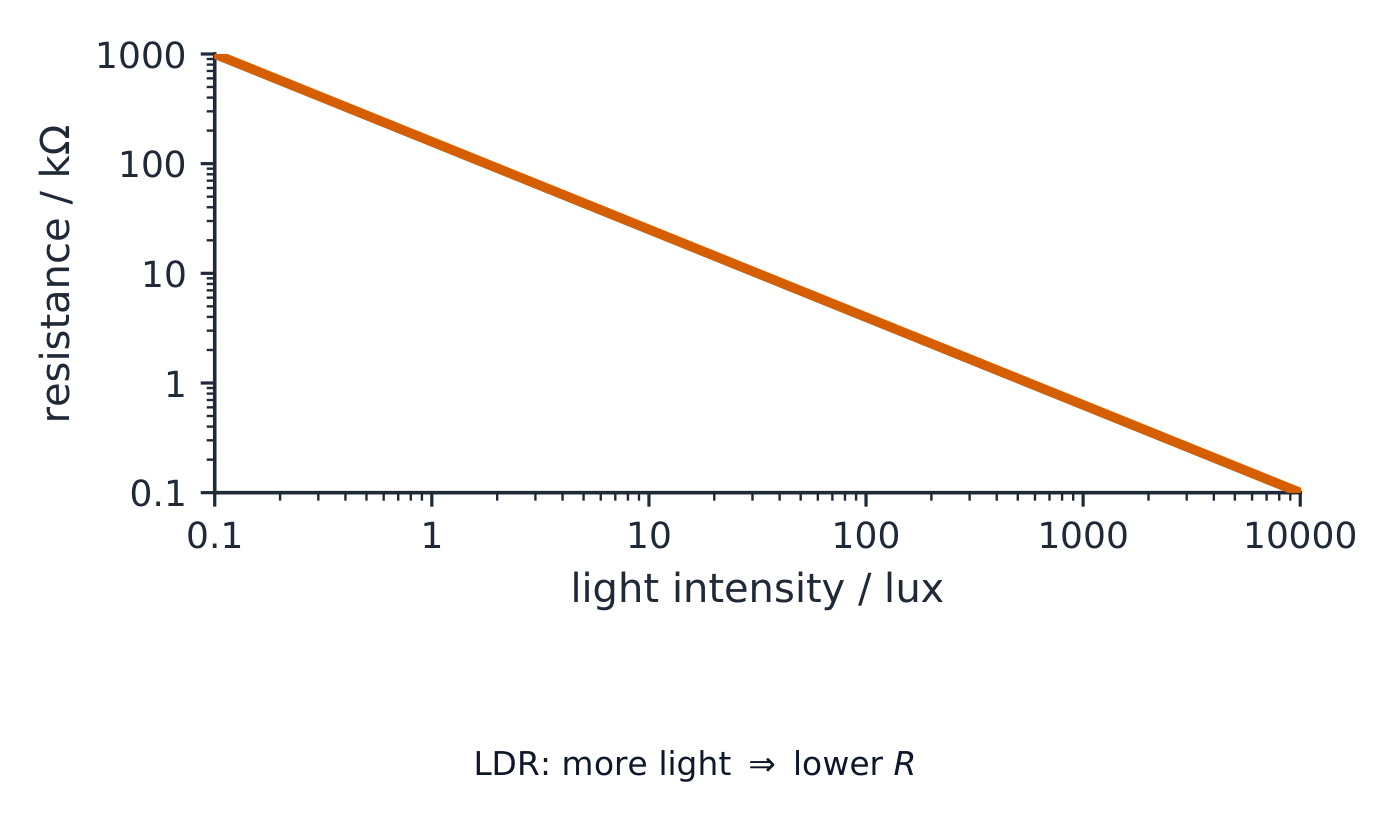
光敏电阻(light-dependent resistor,LDR)是一种半导体,它的电阻随光强上升而下降。在明亮的光下 $R$ 可能是几百 $\Omega$;在黑暗中它可以达到兆欧。LDR 用于光感电路(路灯、相机测光表)。这里光强(light intensity)控制电阻。
词汇表
训练
| 英文 | 中文 | 拼音 |
|---|---|---|
| light-dependent resistor/laɪt dɪˈpendənt rɪˈzɪstə/ | 光敏电阻 | guāng mǐn diàn zǔ |
| light intensity/laɪt ɪnˈtensɪti/ | 光强 | guāng qiáng |
9.3
热敏电阻
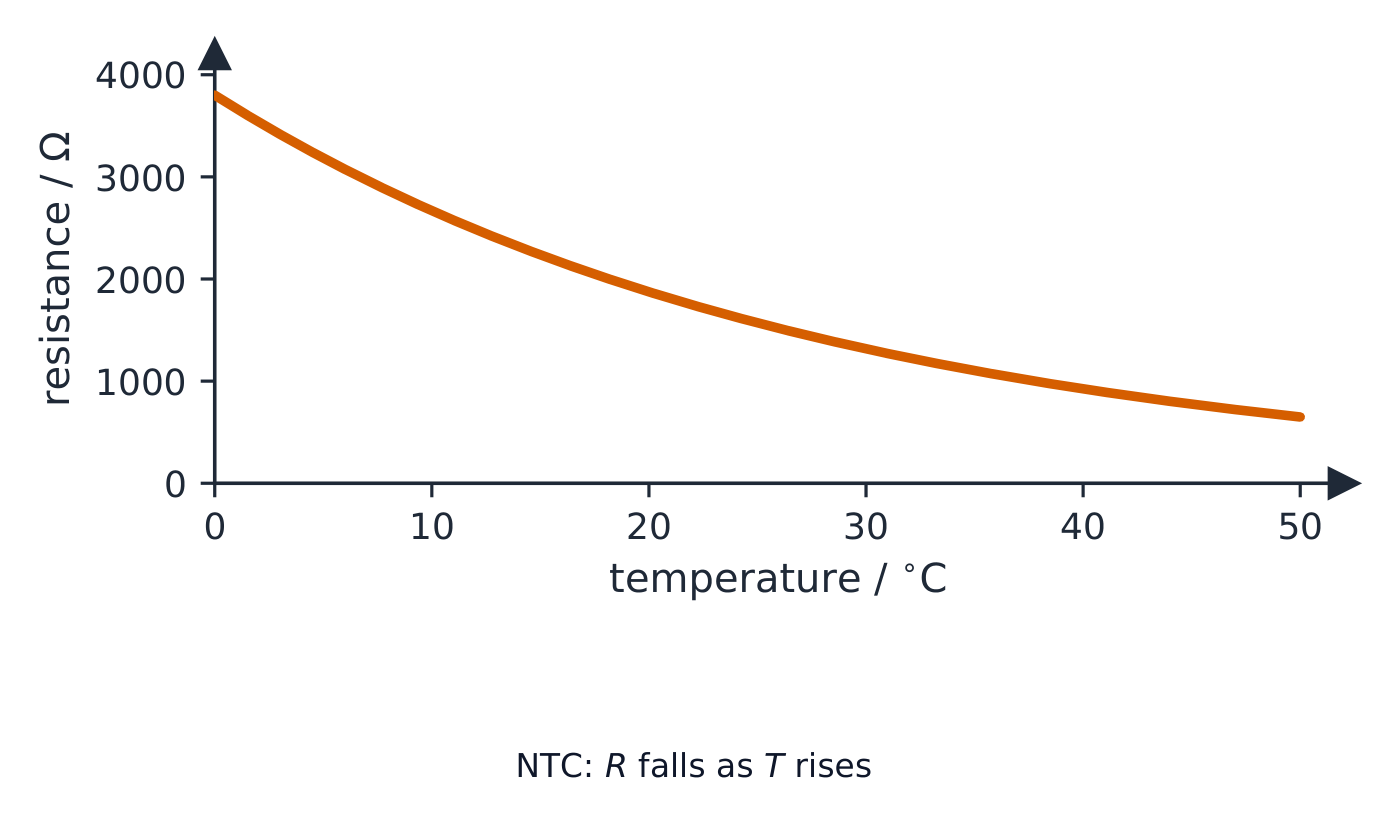
在本大纲中,热敏电阻(thermistor)有一个负温度系数(negative temperature coefficient):它的电阻随温度上升而下降。这对感测温度很有用——把它放进一个分压器(potential divider)中,输出电压就随温度变化。
这与金属相反:在半导体中,更多的热能释放出更多的载流子,这比额外的散射更重要。
热敏电阻的电阻对温度的示意图从 $0\ °\text{C}$ 处的 $R_{0}$ 出发,沿一条逐渐变平的曲线下降:下降不是线性的,这就是热敏电阻用作温度计的缺点(刻度不均匀,所以需要校准)。当 LDR 上的光增强或热敏电阻被加热时,它的电阻下降,电路中的电流上升,它两端的电势差(与固定电阻串联时)下降而电阻两端的电势差上升;固定电阻和恒温下的金属丝保持电阻不变,而灯丝灯泡的电阻随电流上升。
词汇表
训练
| 英文 | 中文 | 拼音 |
|---|---|---|
| thermistor/ˈθɜːmɪstə/ | 热敏电阻 | rè mǐn diàn zǔ |
| negative temperature coefficient/ˈneɡətɪv ˈtemprɪtʃə ˌkəʊɪˈfɪʃənt/ | 负温度系数 | fù wēn dù xì shù |
| potential divider/pəˈtenʃl dɪˈvaɪdə/ | 分压器 | fēn yā qì |
9.3
考官认可的定义
定义题按固定的表述给分。把这些记准确,并且只写一个答案。
| 术语 | 定义 |
|---|---|
| 电流(electric current) | 载流子的流动 |
| 库仑(coulomb) | 电流为一安培时一秒内经过某点的电荷 |
| 电势差(potential difference) | 每单位电荷经过元件时从电能转移为其他形式的能量 |
| 电动势(electromotive force,e.m.f.) | 电源驱动电荷绕完整回路一周时,每单位电荷从其他形式转移为电能的能量 |
| 伏特(volt) | 一焦耳每库仑 |
| 电阻(resistance) | 元件两端的电势差与其中电流之比 |
| 欧姆(ohm) | 一伏特的电势差产生一安培电流时元件的电阻 |
| 欧姆定律(Ohm's law) | 只要温度保持不变,金属导体中的电流与其两端的电势差成正比 |
| 电阻率(resistivity) | $R = \rho L / A$ 中的常数 $\rho$,材料的性质,单位 $\Omega\ \text{m}$ |
| 数密度(number density) | 导体单位体积内的载流子数目 |
9.3
考试技巧
- 用 $I = Q/t$、$V = W/Q$(每单位电荷的能量)和 $P = VI = I^2 R = V^2/R$。
- **欧姆定律($V = IR$)**只适用于恒温下的欧姆式导体——灯丝灯泡是非欧姆式的。
- 画出并解读电阻、灯丝灯泡和二极管的 $I$-$V$ 特性曲线。
- LDR 的电阻随光下降;热敏电阻的电阻随温度上升而下降。
常见错误
- 从弯曲的 $I$–$V$ 图的斜率取电阻。电阻是该点的 $V/I$;只有过原点的直线,它才是斜率的倒数。
- 在 $Q = It$ 中把时间留在分钟或小时。先换成秒。
- 说灯丝灯泡的电阻"因为电压"而上升。链条是电流、温度、离子振动、更多碰撞、更大电阻。
- 忘了被拉伸的导线在两方面改变。体积不变时长度增大、面积减小,所以 $R \propto L^{2}$。
- 在 $A = \pi r^{2}$ 中把直径当作半径,或不换算 $\text{mm}^{2}$。
- 用错误的形式比较功率。串联元件电流相同,用 $I^{2}R$;并联元件电压相同,用 $V^{2}/R$。
本主题的互动课程
逐步学习,并即时检测练习。