- describe what is meant by wave motion as illustrated by vibration in ropes, springs and ripple tanks
- understand and use the terms displacement, amplitude, phase difference, period, frequency, wavelength and speed
- understand the use of the time-base and $y$-gain of a cathode-ray oscilloscope (CRO) to determine frequency and amplitude
- derive, using the definitions of speed, frequency and wavelength, the wave equation $v = f\lambda$
- recall and use $v = f\lambda$
- understand that energy is transferred by a progressive wave
- recall and use $\text{intensity} = \text{power}/\text{area}$ and $\text{intensity} \propto (\text{amplitude})^2$ for a progressive wave
波
A-Level 物理 · 第 7 主题
 16:46
16:46
Waves
You are standing on a street corner. An ambulance races toward you, siren wailing at a high pitch — and the instant it passes, the pitch suddenly drops. The…
英文讲解 · 内嵌中英文字幕
7.1
行波

大纲
来源:剑桥国际大纲

波(wave)把能量(energy)从一个地方带到另一个地方,而整体上不移动物质。介质(medium)的粒子绕固定的平衡位置振动(oscillate);只有扰动(及其能量)在传播(propagate)。例子:绳上的横波(transverse wave)、弹簧上的纵波(longitudinal wave)、水面上的波纹,以及空气中的声音。传播并携带能量的波是行波(progressive wave)。
波动(wave motion)是介质粒子的一系列振动,每个粒子把扰动传给下一个:抖动绳子的一端、推弹簧的一端,或触碰水波槽(ripple tank)的水面,振动就从起点向外传播。一分的定义:行波把能量从一个地方传递到另一个地方而不传递物质;粒子只绕它们的平衡位置振动。
关键术语
- 位移(displacement)$y$——某一时刻一个粒子离开它平衡位置的距离。是一个矢量(vector)。
- 振幅(amplitude)$A$——离开平衡位置的最大位移。
- 波长(wavelength)$\lambda$——沿波在两个同相(in phase)运动的点之间(例如两个相邻的波峰(crests))的最短距离。
- 周期(period)$T$——一个粒子完成一次完整振动所用的时间。
- 频率(frequency)$f$——每秒完整振动的次数;$f = 1/T$。单位:赫兹(hertz),$\text{Hz}$。
- 速率(speed)$v$——波峰沿介质传播的快慢。
- 相位差(phase difference)——一个振动比另一个超前或滞后的那一部分周期。以弧度(radians,一个完整周期是 $2\pi$)或度(一个完整周期是 $360°$)给出。
相隔一个波长的两点同相(相位差 0 或 $2\pi$)。相隔半个波长的两点恰好反相(相位差 $\pi$)。
要从位移-距离图求两点的相位差,用它们的间距除以波长再乘 $360°$(或 $2\pi$):波长 $2.0\ \text{m}$($v = 600\ \text{m s}^{-1}$,$f = 300\ \text{Hz}$)的波上相距 $0.50\ \text{m}$ 的两点相位相差 $0.25 \times 360° = 90°$。只有周期的分数才重要,所以 $450°$ 与 $90°$ 相同。从两张位移-时间图,把两个峰之间的时间差读成周期的分数。图示瞬间某一点朝哪个方向运动?整个波形沿传播方向移动,所以每个点都会取得波来的那一侧相邻点此刻的位移;处在波峰或波谷的点此刻暂时静止。
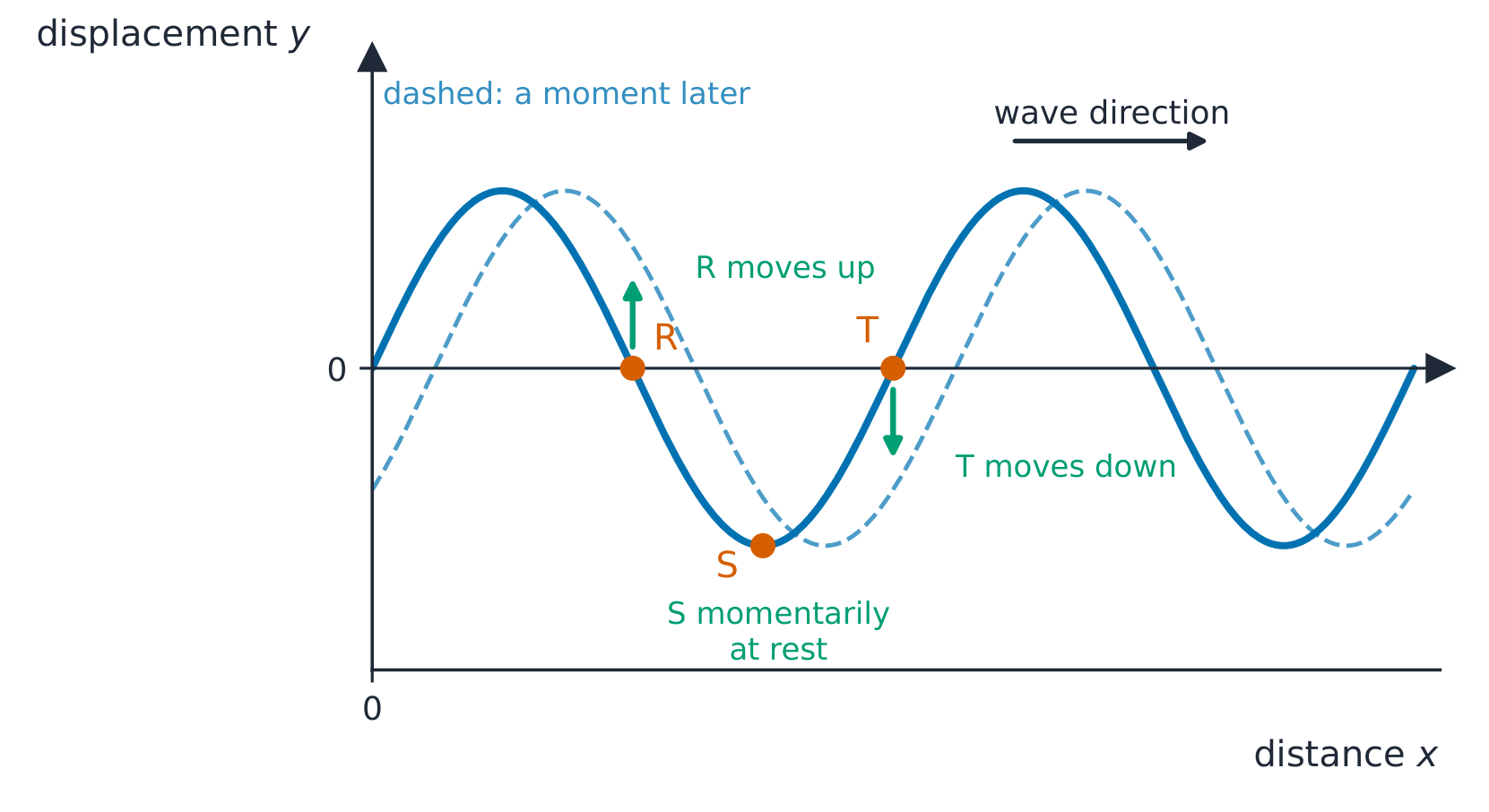
例题。 弦上的 R、T 两点相距 $0.62\ \text{cm}$,相位相差四分之一个周期。波速为 $0.27\ \text{m s}^{-1}$。求频率。
四分之一个周期就是四分之一个波长,所以 $\lambda = 4 \times 0.62 = 2.5\ \text{cm}$,$f = v / \lambda = 0.27 / 0.025 = 11\ \text{Hz}$。
波动方程
在一个周期 $T$ 内,波向前移动一个波长 $\lambda$。所以速率 $= \text{distance} / \text{time} = \lambda / T = \lambda f$:
$$v = f \lambda.$$
这直接来自速率、频率和波长的定义,对每一个行波都成立。两分的推导要写出两步:在一个周期 $T$ 内波传播一个波长 $\lambda$,所以 $v = \lambda / T$;又 $f = 1/T$,所以 $v = f\lambda$。因为 $v$ 由介质决定,频率越高波长越短。求周期的题就是同一个方程反过来用:波长 $460\ \text{nm}$ 的光,$f = c / \lambda = 6.5 \times 10^{14}\ \text{Hz}$,$T = 1/f = 1.5 \times 10^{-15}\ \text{s}$。
读示波器图线
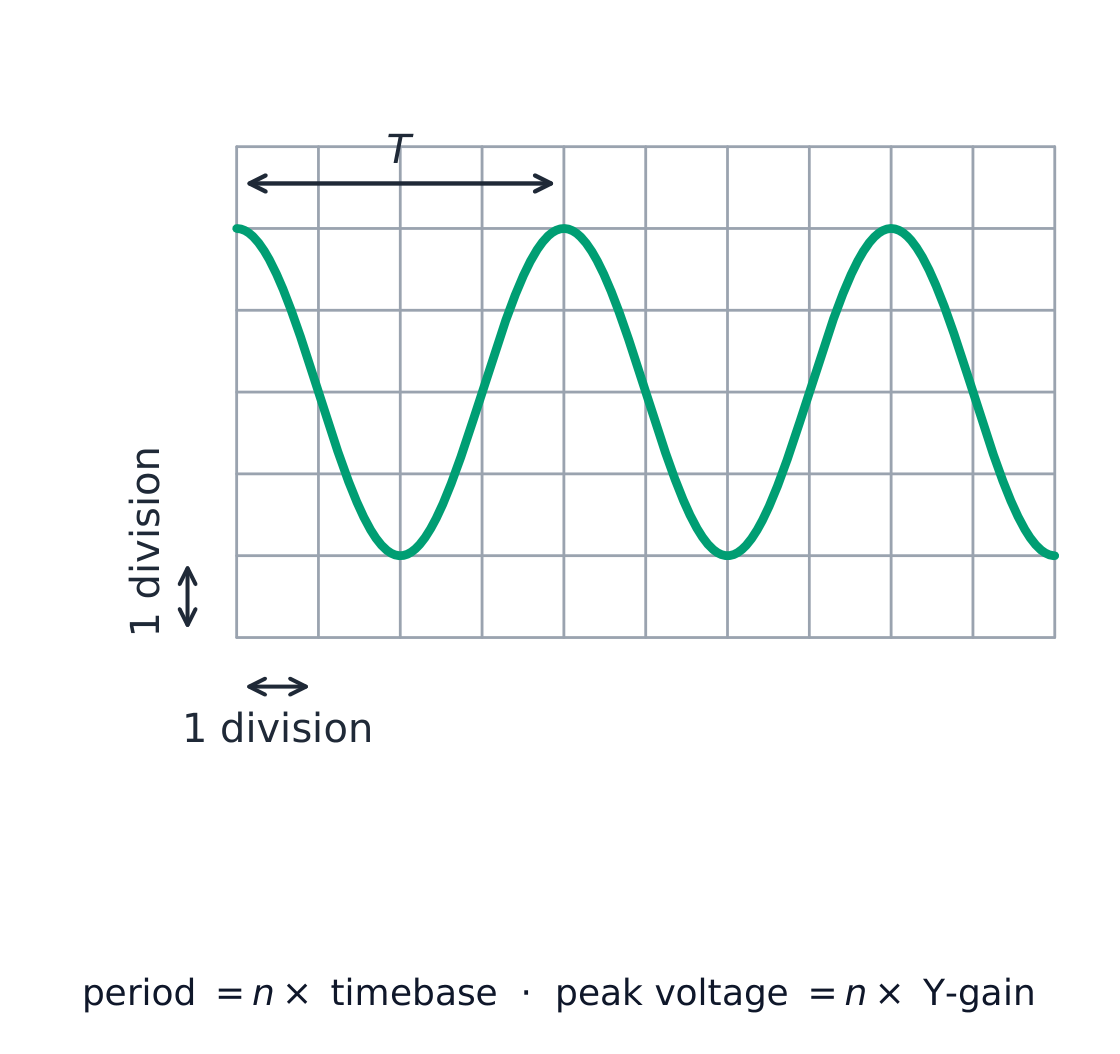
阴极射线示波器(cathode-ray oscilloscope,CRO)把一个电压信号——对声音而言,就是麦克风的输出——对时间画出来。有两个旋钮很重要:
- 时基(time-base,横向每格的秒数):把屏幕上的水平距离转换成时间。把周期 $T$ 读作两个相邻峰之间的距离,然后 $f = 1/T$。
- 垂直增益(y-gain,竖向每格的伏数):把竖直距离转换成电压。以伏为单位的振幅是从中线量起的峰高。
如果时基是 $5\ \text{ms}/\text{div}$,而一个完整周期占 $4$ 格,那么 $T = 4 \times 5\ \text{ms} = 20\ \text{ms}$,$f = 50\ \text{Hz}$。
时基是屏幕上横向一格(或一厘米)所代表的时间,单位 $\text{s}\ \text{div}^{-1}$。要为给定的信号设置它,倒过来算:$2000\ \text{Hz}$ 的声音 $T = 0.50\ \text{ms}$,所以要让一个周期占 $2.5\ \text{cm}$,时基必须是 $0.50 / 2.5 = 0.20\ \text{ms cm}^{-1}$。求振幅,用峰高的格数乘以垂直增益:$3.5\ \text{mV cm}^{-1}$ 下的 $2.0$ 格是 $7.0\ \text{mV}$。当声音的强度在频率不变时减到四分之一,图线的周期不变,峰高减半,因为 $I \propto A^{2}$。

波的强度
波携带能量。某点的强度(intensity)是垂直于传播方向穿过单位面积的功率(power):
$$I = \frac{P}{A}.$$
单位:$\text{W m}^{-2}$。
强度与振幅的平方成正比:
$$I \propto A^{2}.$$
对于一个向各方向均匀发出能量的点源(point source),波前(wavefronts)是球面;距离 $r$ 处的表面积是 $4\pi r^{2}$,所以
$$I = \frac{P}{4\pi r^{2}}, \qquad I \propto \frac{1}{r^{2}}.$$
距离翻倍使强度变为四分之一,这意味着振幅减半(因为 $I \propto A^{2}$)。
例题。 一盏灯向各方向均匀发出 $60\ \text{W}$ 的光。求 $2.0\ \text{m}$ 外光的强度。
$$I = \frac{P}{4\pi r^{2}} = \frac{60}{4\pi (2.0)^{2}} \approx 1.2\ \text{W m}^{-2}.$$
例题。 功率 $750\ \text{W}$ 的光垂直照在边长 $1.2\ \text{m}$ 的正方形太阳能板上。求强度。
$I = P/A = 750 / 1.2^{2} = 520\ \text{W m}^{-2}$。同样的光照下,较小的板接收相同的强度但更少的功率,与它的面积成比例。反过来,半径为 $r$ 的放大镜收集功率 $I \times \pi r^{2}$,把它集中到一个小光斑上。
选择题常考的两条规则。因为 $I \propto A^{2}$,两个强度之比是振幅之比的平方:振幅 $3.0\ \text{cm}$ 和 $2.0\ \text{cm}$ 的两个波强度之比为 $2.25$;振幅减到一半,强度减到四分之一。对于点源,$I \propto 1/r^{2}$ 意味着 $A \propto 1/r$,所以 $A/A_{0}$ 对 $d/x_{0}$ 的示意图是一条随 $1/d$ 下降的曲线,不是直线。评分标准要的一句话:强度与振幅的平方成正比。
探索
Progressive waves
y = a sin(bx + c)
A wave: a is amplitude, b sets the wavelength, c the phase.
词汇表
训练
| 英文 | 中文 | 拼音 |
|---|---|---|
| progressive wave/prəˈɡresɪv weɪv/ | 行波 | xíng bō |
| wave/weɪv/ | 波 | bō |
| energy/ˈenədʒi/ | 能量 | néng liàng |
| frequency/ˈfriːkwənsi/ | 频率 | pín lǜ |
| phase difference/feɪz ˈdɪfrəns/ | 相位差 | xiàng wèi chā |
| medium/ˈmiːdɪəm/ | 介质 | jiè zhì |
| oscillate/ˈɒsɪleɪt/ | 振动 | zhèn dòng |
| propagates/ˈprɒpəɡeɪts/ | 传播 | chuán bō |
| propagate/ˈprɒpəɡeɪt/ | 传播 | chuán bō |
| transverse wave/trænsˈvɜːs weɪv/ | 横波 | héng bō |
| longitudinal wave/ˌlɒŋɡɪˈtjuːdɪnl weɪv/ | 纵波 | zòng bō |
| Wave motion/weɪv ˈməʊʃn/ | 波动 | bō dòng |
| ripple tank/ˈrɪpl tæŋk/ | 水波槽 | shuǐ bō cáo |
| displacement/dɪˈspleɪsmənt/ | 位移 | wèi yí |
| vector/ˈvektə/ | 矢量 | shǐ liàng |
| amplitude/ˈæmplɪtjuːd/ | 振幅 | zhèn fú |
| wavelength/ˈweɪvleŋθ/ | 波长 | bō cháng |
| in phase/ɪn feɪz/ | 同相 | tóng xiāng |
| crest/krest/ | 波峰 | bō fēng |
| period/ˈpɪərɪəd/ | 周期 | zhōu qī |
| hertz/hɜːts/ | 赫兹 | hè zī |
| speed/spiːd/ | 速率 | sù lǜ |
| radian/ˈreɪdɪən/ | 弧度 | hú dù |
| cathode-ray oscilloscope/ˈkæθəʊd reɪ ɒˈsɪləskəʊp/ | 示波器 | shì bō qì |
| time-base/taɪm beɪs/ | 时基 | shí jī |
| y-gain/waɪ ɡeɪn/ | 垂直增益 | chuí zhí zēng yì |
| intensity/ɪnˈtensɪti/ | 强度 | qiáng dù |
| power/ˈpaʊə/ | 功率 | gōng lǜ |
| point source/pɔɪnt sɔːs/ | 点源 | diǎn yuán |
| source/sɔːs/ | 波源 | bō yuán |
| wavefront/ˈweɪvfrʌnt/ | 波前 | bō qián |
7.2
横波与纵波

大纲
- compare transverse and longitudinal waves
- analyse and interpret graphical representations of transverse and longitudinal waves
来源:剑桥国际大纲
横波
粒子在与能量传播方向垂直(perpendicular)的方向上振动。绳上的波、所有电磁波,以及地球中的 S 波都是横波。
纵波
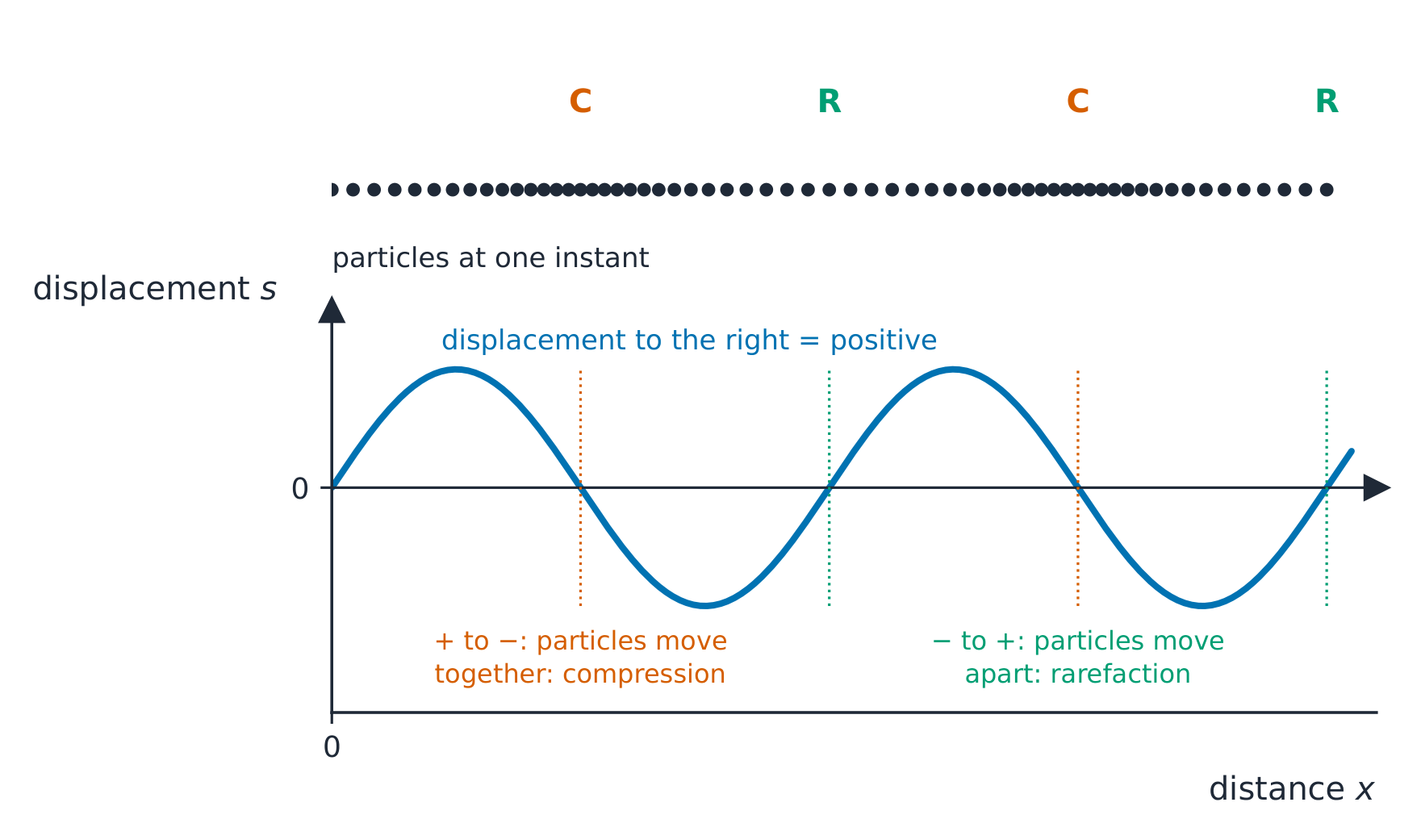
粒子在与能量传播方向平行的方向上振动。任何介质中的声音、地球中的 P 波,以及弹簧上的挤压都是纵波。这种波由压缩(compressions,压强较高,粒子靠得近)和稀疏(rarefactions,压强较低,粒子散得开)构成。

波的图像
某一时刻粒子位移对位置的图,对两种波来说看起来都像一条正弦曲线(sine curve)。区别在于:对横波,位移轴是真正的横向位移;对纵波,它是沿传播方向的小幅前后位移(一个方向为正,另一个为负)。
对纵波,取向右的位移为正。图线从正变负地穿过零的地方,两侧的粒子都朝那一点移动了,所以那里是压缩;从负变正地穿过零的地方,粒子彼此离开了,是稀疏。相邻两个压缩相距一个波长,一个压缩与下一个稀疏相距半个波长。粒子运动方向的规则与横波相同:它朝波来的那一侧相邻点的位移运动。

某一空间点上粒子位移对时间的图对两种波来说也是一条正弦曲线。从这张图读出周期 $T$。
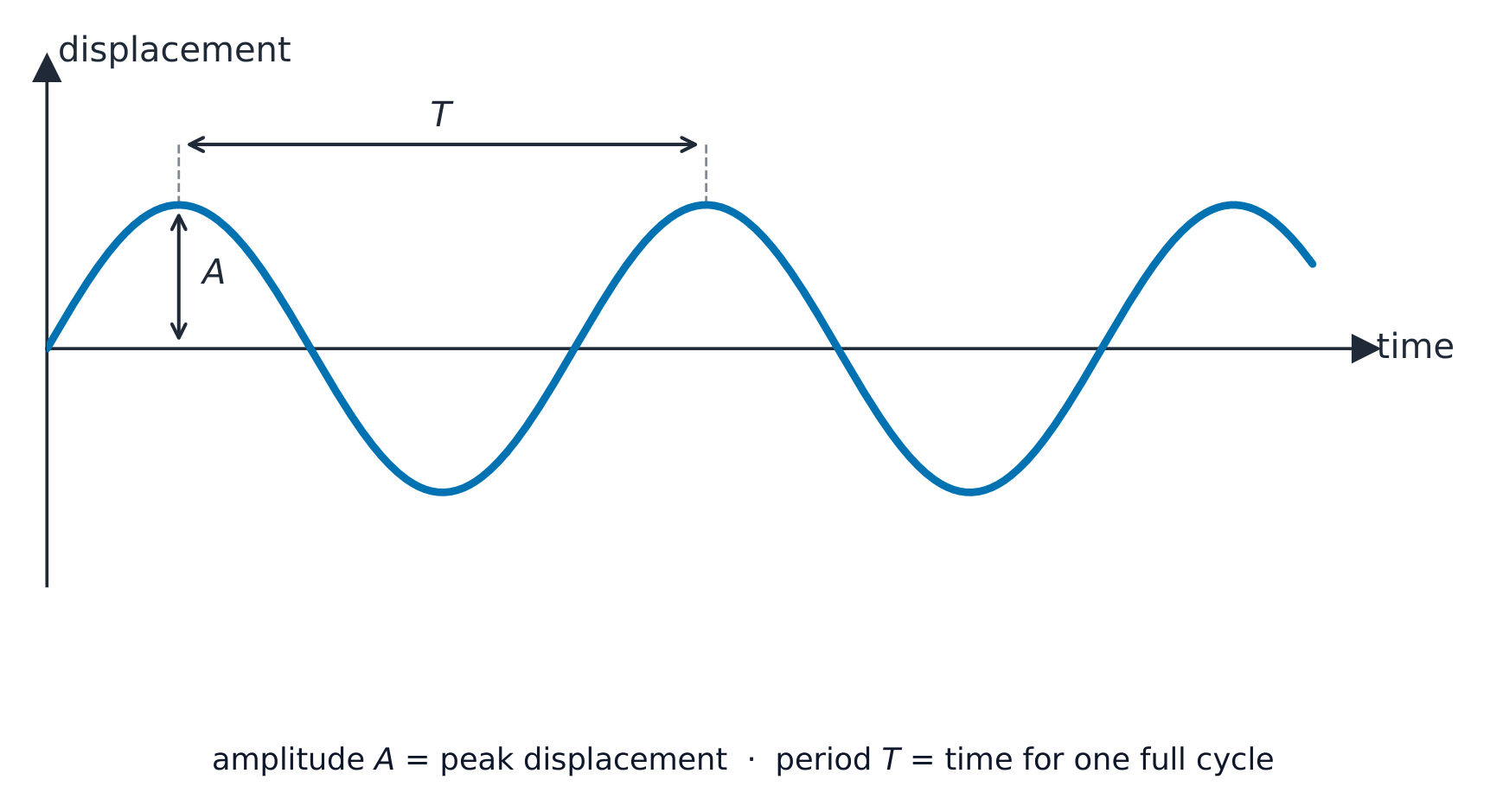
两分的比较,参照能量传递的方向:横波的振动垂直于能量传递方向;纵波的振动与它平行。两种波都传递能量而不传递物质,都能反射、折射和衍射,都能形成驻波(主题 8)。只有横波能被偏振,而且只有电磁波(全是横波)能在真空中传播;声音需要介质。把两张图合起来读:位移-距离图给出 $\lambda$,位移-时间图给出 $T$,而 $v = \lambda / T$。
探索
Transverse waves
y = a sin(bx + c)
Change the amplitude and wavelength of the wave.
词汇表
训练
| 英文 | 中文 | 拼音 |
|---|---|---|
| perpendicular/ˌpɜːpənˈdɪkjʊlə/ | 垂直 | chuí zhí |
| sine curve/saɪn kɜːv/ | 正弦曲线 | zhèng xián qū xiàn |
| compression/kəmˈpreʃn/ | 压缩 | yā suō |
| rarefaction/ˌreərɪˈfækʃn/ | 稀疏 | xī shū |
7.3
声波的多普勒效应

大纲
- understand that when a source of sound waves moves relative to a stationary observer, the observed frequency is different from the source frequency (understanding of the Doppler effect for a stationary source and a moving observer is not required)
- use the expression $f_{\text{o}} = f_{\text{s}} v / (v \pm v_{\text{s}})$ for the observed frequency when a source of sound waves moves relative to a stationary observer
来源:剑桥国际大纲
当声音的波源(source)相对一个静止(stationary)的观察者(observer)运动时,听到的频率与波源频率不同。这就是多普勒效应(Doppler effect)。
- 波源朝观察者运动:前方的波前被挤压,所以波长较短,听到的频率较高。
- 波源远离观察者运动:后方的波前被拉开,所以波长较长,听到的频率较低。
公式(波源以速率 $v_{\text{s}}$ 沿到观察者的连线运动;波速 $v$,波源频率 $f_{\text{s}}$,听到的频率 $f_{\text{o}}$):
$$f_{\text{o}} = \frac{v \cdot f_{\text{s}}}{v \pm v_{\text{s}}}.$$
选择符号来符合物理:
- 波源朝观察者运动时,分母取减号($f_{\text{o}} > f_{\text{s}}$),
- 波源远离时取加号($f_{\text{o}} < f_{\text{s}}$)。
你只需要静止观察者的情形。
例题。 一个 $f_{\text{s}} = 800\ \text{Hz}$ 的汽车喇叭以 $30\ \text{m s}^{-1}$ 朝一个静止的听者运动。声速 $v = 340\ \text{m s}^{-1}$:
$$f_{\text{o}} = \frac{340 \times 800}{340 - 30} = \frac{272\,000}{310} \approx 877\ \text{Hz}.$$
以同样的速率远离时,听者听到 $340 \times 800 / (340 + 30) = 735\ \text{Hz}$:汽车接近时频率恒定,经过时下降,远离时又恒定在较低的值。匀速经过的波源,观察到的频率对时间的示意图是两段水平线由一段下降连接。反过来算,$1200\ \text{Hz}$ 的波源被听成 $960\ \text{Hz}$,说明它在远离($f_{\text{o}} < f_{\text{s}}$):由 $960 = 1200 \times 340 / (340 + v_{\text{s}})$ 得 $v_{\text{s}} = 85\ \text{m s}^{-1}$。一个发出 $846\ \text{Hz}$、以 $25\ \text{m s}^{-1}$ 在水平圆周上甩动的蜂鸣器,听到的频率在 $846 \times 330 / 355 = 786\ \text{Hz}$(正在直接远离)和 $846 \times 330 / 305 = 915\ \text{Hz}$(正在直接接近)之间,每转一圈各出现一次。如果声音的示波器图线周期持续增大,观察到的频率在下降:波源正在以越来越大的速率远离。多普勒效应对所有波都发生,包括光(主题 25);这里只考声音的公式。
探索
Doppler effect
Send the source moving and watch the wavefronts bunch up ahead (higher pitch) and stretch out behind — the siren effect, controlled by the source's speed.
词汇表
训练
| 英文 | 中文 | 拼音 |
|---|---|---|
| stationary/ˈsteɪʃənəri/ | 静止 | jìng zhǐ |
| Doppler effect/ˈdɒplə ɪˈfekt/ | 多普勒效应 | duō pǔ lè xiào yìng |
| observer/ɒbˈzɜːvə/ | 观察者 | guān chá zhě |
7.4
电磁波谱
大纲
- state that all electromagnetic waves are transverse waves that travel with the same speed $c$ in free space
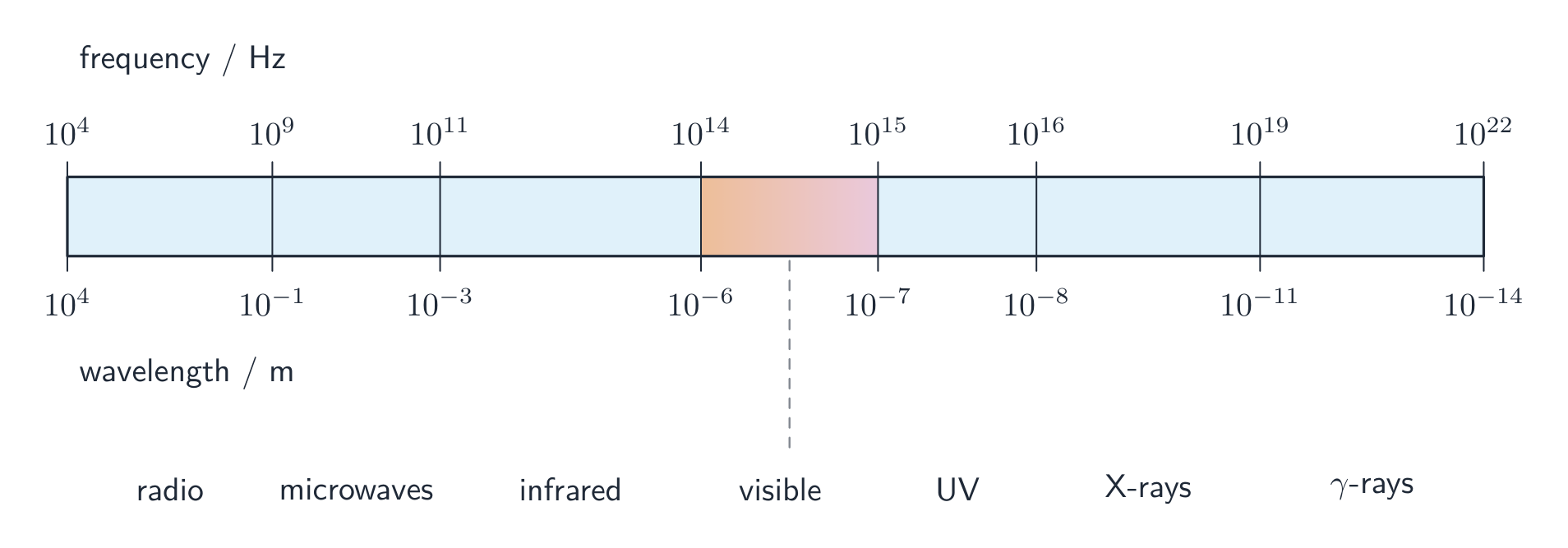
- recall the approximate range of wavelengths in free space of the principal regions of the electromagnetic spectrum from radio waves to $\gamma$-rays
- recall that wavelengths in the range 400–700 nm in free space are visible to the human eye
来源:剑桥国际大纲
所有电磁波(electromagnetic waves,EM 波)都是横波,并在真空(vacuum)中以相同的速率传播:
$$c = 3.00 \times 10^{8}\ \text{m s}^{-1}.$$
电磁波谱(electromagnetic spectrum)包括无线电波、微波(microwaves)、红外线(infrared)、可见光、紫外线(ultraviolet)、X 射线(X-rays)和 $\gamma$ 射线(γ-rays)。
自由空间中的大致波长范围(记住数量级):
- 无线电波:$> 10^{-1}\ \text{m}$(可达许多千米)。
- 微波:$10^{-3}\ \text{m}$ 到 $10^{-1}\ \text{m}$。
- 红外线:$\sim 7 \times 10^{-7}\ \text{m}$ 到 $10^{-3}\ \text{m}$。
- 可见光:$400\ \text{nm}$(紫)到 $700\ \text{nm}$(红),即 $4 \times 10^{-7}\ \text{m}$ 到 $7 \times 10^{-7}\ \text{m}$。
- 紫外线:$\sim 10^{-8}\ \text{m}$ 到 $4 \times 10^{-7}\ \text{m}$。
- X 射线:$\sim 10^{-11}\ \text{m}$ 到 $10^{-8}\ \text{m}$。
- $\gamma$ 射线:$< 10^{-11}\ \text{m}$。
各区域之间的边界并不清晰。用 $c = f\lambda$ 在波长和频率之间换算。只有波长 $400$–$700\ \text{nm}$ 的光才能被看见。
要判断区域,用 $\lambda = c / f$ 换算成波长再与范围比较:$2.1\ \text{cm}$ 是微波;$138\ \text{pm} = 1.4 \times 10^{-10}\ \text{m}$ 是 X 射线;$30\ \text{THz}$ 给出 $\lambda = 1.0 \times 10^{-5}\ \text{m}$,红外线;$3.0 \times 10^{16}\ \text{Hz}$ 给出 $1.0 \times 10^{-8}\ \text{m}$,紫外线。可见光的频率约在 $4.3 \times 10^{14}$ 到 $7.5 \times 10^{14}\ \text{Hz}$ 之间,所以 $5.0 \times 10^{14}\ \text{Hz}$ 的波能被看见,而波长 $5.0 \times 10^{-6}\ \text{m}$ 的波(红外线)不能。红光比绿光波长更长、频率更低。"按波长增大排列"的顺序是 $\gamma$ 射线、X 射线、紫外线、可见光、红外线、微波、无线电波。一个光脉冲从 $150\ \text{m}$ 外的墙反射回来需要 $2 \times 150 / (3.00 \times 10^{8}) = 1.0\ \mu\text{s}$。
探索
Slide across the spectrum
Radio waves, visible light and gamma rays are all the same wave — only the wavelength changes, and with it the frequency, photon energy and everyday use.
词汇表
训练
| 英文 | 中文 | 拼音 |
|---|---|---|
| electromagnetic waves/ɪˌlektrəʊməɡˈnetɪk weɪvz/ | 电磁波 | diàn cí bō |
| electromagnetic wave/ɪˌlektrəʊməɡˈnetɪk weɪv/ | 电磁波 | diàn cí bō |
| vacuum/ˈvækjuːm/ | 真空 | zhēn kōng |
| electromagnetic spectrum/ɪˌlektrəʊməɡˈnetɪk ˈspektrəm/ | 电磁波谱 | diàn cí bō pǔ |
| microwaves/ˈmaɪkrəʊweɪvz/ | 微波 | wēi bō |
| infrared/ˌɪnfrəˈred/ | 红外线 | hóng wài xiàn |
| ultraviolet/ˌʊltrəˈvaɪəlɪt/ | 紫外线 | zǐ wài xiàn |
| X-rays/eks reɪz/ | X射线 | X shè xiàn |
| γ-rays/ˈɡæmə reɪz/ | γ射线 | γ shè xiàn |
| gamma-rays/ˈɡæmə reɪz/ | γ射线 | γ shè xiàn |
7.5
偏振

大纲
- understand that polarisation is a phenomenon associated with transverse waves
- recall and use Malus’s law ($I = I_0 \cos^2\theta$) to calculate the intensity of a plane-polarised electromagnetic wave after transmission through a polarising filter or a series of polarising filters (calculation of the effect of a polarising filter on the intensity of an unpolarised wave is not required)
来源:剑桥国际大纲
偏振(polarisation)是指使一个横波只在一个平面内振动。
- 只有横波能被偏振——振动垂直于传播方向,所以不同的垂直平面是真实的选择。
- 纵波(声音)不能被偏振——振动沿传播方向,所以没有其他平面。
所以偏振是一个判据:如果一个波能被偏振,它一定是横波。

马吕斯定律
强度为 $I_{0}$ 的平面偏振(plane-polarised)光穿过一个偏振片(polarising filter),其透光轴(transmission axis)与偏振面成 $\theta$ 角。透过的强度由马吕斯定律(Malus's law)给出:
$$I = I_{0} \cos^{2}\theta.$$
- $\theta = 0°$:偏振片与偏振方向对齐,$I = I_{0}$,全部透过。
- $\theta = 90°$:偏振片成直角,$I = 0$,全部被挡住。
- $\theta = 60°$:$I = I_{0} \cos^{2} 60° = I_{0} \cdot 0.25 = I_{0}/4$。
例题。 强度为 $12\ \text{W m}^{-2}$ 的平面偏振光遇到一个透光轴与偏振面成 $30°$ 角的偏振片。求透过的强度。
$$I = I_{0}\cos^{2}\theta = 12 \times \cos^{2} 30° = 12 \times 0.75 = 9.0\ \text{W m}^{-2}.$$

对于一排两个偏振片,用马吕斯定律两次,每次用两片之间的夹角。每次都要小心角度——过了第一个偏振片后,偏振沿那个偏振片的轴,第二个偏振片的角度从那里量起。
(你不需要算出偏振片对一个未偏振波的作用。)
当偏振片在平面偏振光前转过 $360°$ 时,透过的强度按 $\cos^{2}\theta$ 变化:透光轴与偏振面平行($0°$ 和 $180°$)时最大,垂直($90°$ 和 $270°$)时为零,永远不为负。因为 $I \propto A^{2}$,透过的振幅是 $A_{0}\cos\theta$:在 $45°$ 时强度减半,振幅降到原来的 $0.71$。对于两个偏振片,第一个把偏振面定在它自己的轴上,所以第二个偏振片的角度从那里量起:竖直偏振光先后穿过与竖直成 $50°$ 和 $80°$ 的偏振片,保留 $\cos^{2} 50° \times \cos^{2} 30° = 0.31$ 的强度。一分的定义:偏振是横波只在一个平面(包含传播方向)内振动;声音不能被偏振,因为它的振动沿着传播方向,没有可供选择的平面。
探索
Polarisation intensity lab
intensity changes with polariser angle
Rotate a polariser and see why only transverse waves can be polarised.
词汇表
训练
| 英文 | 中文 | 拼音 |
|---|---|---|
| polarisation/ˌpəʊləraɪˈzeɪʃn/ | 偏振 | piān zhèn |
| polarising filter/ˈpəʊləraɪzɪŋ ˈfɪltə/ | 偏振片 | piān zhèn piàn |
| Malus's law/ˈmæləsɪz lɔː/ | 马吕斯定律 | mǎ lǚ sī dìng lǜ |
| plane-polarised/pleɪn ˈpəʊləraɪzd/ | 平面偏振 | píng miàn piān zhèn |
| transmission axis/trænˈsmɪʃn ˈæksɪs/ | 透光轴 | tòu guāng zhóu |
7.5
考官认可的定义
定义题按固定的表述给分。把这些记准确,并且只写一个答案。
| 术语 | 定义 |
|---|---|
| 行波(progressive wave) | 把能量从一个地方传递到另一个地方而不传递物质的波 |
| 横波(transverse wave) | 振动垂直于能量传递方向的波 |
| 纵波(longitudinal wave) | 振动平行于能量传递方向的波 |
| 位移(displacement) | 粒子离开平衡位置的距离,带方向 |
| 振幅(amplitude) | 粒子离开平衡位置的最大位移 |
| 波长(wavelength) | 波上两个同相的点之间的最小距离(例如相邻的波峰) |
| 周期(period) | 一个粒子完成一次完整振动的时间(或波传播一个波长的时间) |
| 频率(frequency) | 单位时间内的振动次数(或单位时间内经过某点的波前数) |
| 相位差(phase difference) | 一个振动比另一个超前或滞后的周期分数,以角度表示 |
| 强度(intensity) | 垂直于传播方向的单位面积上的功率 |
| 多普勒效应(Doppler effect) | 波源相对观察者运动时观察到的频率的改变 |
| 偏振(polarisation) | 横波的振动只在一个平面(包含传播方向)内 |
| 时基(time-base) | 示波器屏幕上横向一格所代表的时间 |
7.5
考试技巧
- 精确地定义术语(位移、振幅、波长、周期、频率)并用 $v = f\lambda$。
- 区分横波(振动垂直于传播)和纵波(平行);只有横波能被偏振。
- 对于多普勒效应,波源接近时观察到的频率上升,远离时下降。
- 记住电磁波谱的顺序;它的所有波在真空中都以 $c$ 传播。
常见错误
- 相位差超过一个周期,或者题目要弧度却给了度。只有周期的分数才重要:$450°$ 就是 $90°$,而 $90°$ 是 $\pi/2$。
- 从位移-时间图读波长。那张图给出周期;波长来自位移-距离图。
- 振幅加倍就把强度"加倍"。强度随振幅的平方变化:四倍。
- 凭感觉选多普勒公式的符号。接近时分母取减号(频率升高);远离时取加号(频率降低)。检查答案在 $f_{\text{s}}$ 的正确一侧。
- 第二个偏振片沿用第一个的角度。经过一个偏振片后,光沿那个偏振片的轴偏振,下一个角度从那里量起。
- 说声音能被偏振。只有横波能。
本主题的互动课程
逐步学习,并即时检测练习。