- understand that deformation is caused by tensile or compressive forces (forces and deformations will be assumed to be in one dimension only)
- understand and use the terms load, extension, compression and limit of proportionality
- recall and use Hooke's law
- recall and use the formula for the spring constant $k = F/x$
- define and use the terms stress, strain and the Young modulus
- describe an experiment to determine the Young modulus of a metal in the form of a wire
固体的形变
A-Level 物理 · 第 6 主题
 16:50
16:50
Deformation
A bungee jumper steps off a bridge and falls — faster and faster, straight toward the ground. Then, at the last moment, an elastic cord snaps tight and pulls…
英文讲解 · 内嵌中英文字幕
6.1
应力与应变
大纲
来源:剑桥国际大纲
当一个力沿固体的长度方向作用时,物体会改变形状(形变(deformation))。两种情形(这里当作一维处理):
- 拉伸(tensile)力使物体伸长——产生一个伸长量(extension)$x$,
- 压缩(compressive)力挤压物体——产生一个压缩(compression),当作负的伸长量。
施加的力是负载(load)。相对自然长度的改变就是伸长量(或压缩量)。
两者都从自然的、未拉伸的长度量起,绝不从加载后的长度量起:在一个箱子压在弹簧上的图中,弹簧缩短的距离就是它的压缩量。弹簧自身的质量通常说成可忽略的(negligible),所以作用在它上面的只有负载和它提供的张力。
探索
Hooke's law spring
Hang a load on the real spring: up to the elastic limit the extension is proportional to the force; beyond it the spring is stretched for good.
词汇表
训练
| 英文 | 中文 | 拼音 |
|---|---|---|
| deformation/ˌdiːfɔːˈmeɪʃn/ | 形变 | xíng biàn |
| tensile/ˈtensaɪl/ | 拉伸 | lā shēn |
| extension/ekˈstenʃn/ | 伸长量 | shēn cháng liàng |
| compression/kəmˈpreʃn/ | 压缩 | yā suō |
| load/ləʊd/ | 负载 | fù zài |
| negligible/ˈneɡlɪdʒəbl/ | 可忽略的 | kě hū lüè de |
6.1
胡克定律与弹簧劲度系数

对于许多材料在小伸长量下,伸长量与负载成正比——这就是胡克定律(Hooke's law)。把它们联系起来的常数是劲度系数(spring constant)$k$:
$$F = kx \qquad\Longleftrightarrow\qquad k = \frac{F}{x}.$$
$k$ 的单位:$\text{N m}^{-1}$。
例题。 当挂上一个 $2.0\ \text{N}$ 的负载时,一根弹簧伸长了 $4.0\ \text{cm}$。求它的劲度系数。
把伸长量换成米($4.0\ \text{cm} = 0.040\ \text{m}$):
$$k = \frac{F}{x} = \frac{2.0}{0.040} = 50\ \text{N m}^{-1}.$$
对于一分的"陈述胡克定律",用文字写出:只要不超过比例极限,伸长量与所施加的力(负载)成正比。 劲度系数是每单位伸长量的力;选择题的干扰项是"每单位力的伸长量"(那是 $1/k$)和 $\tfrac{1}{2}Fx$(储存的能量)。
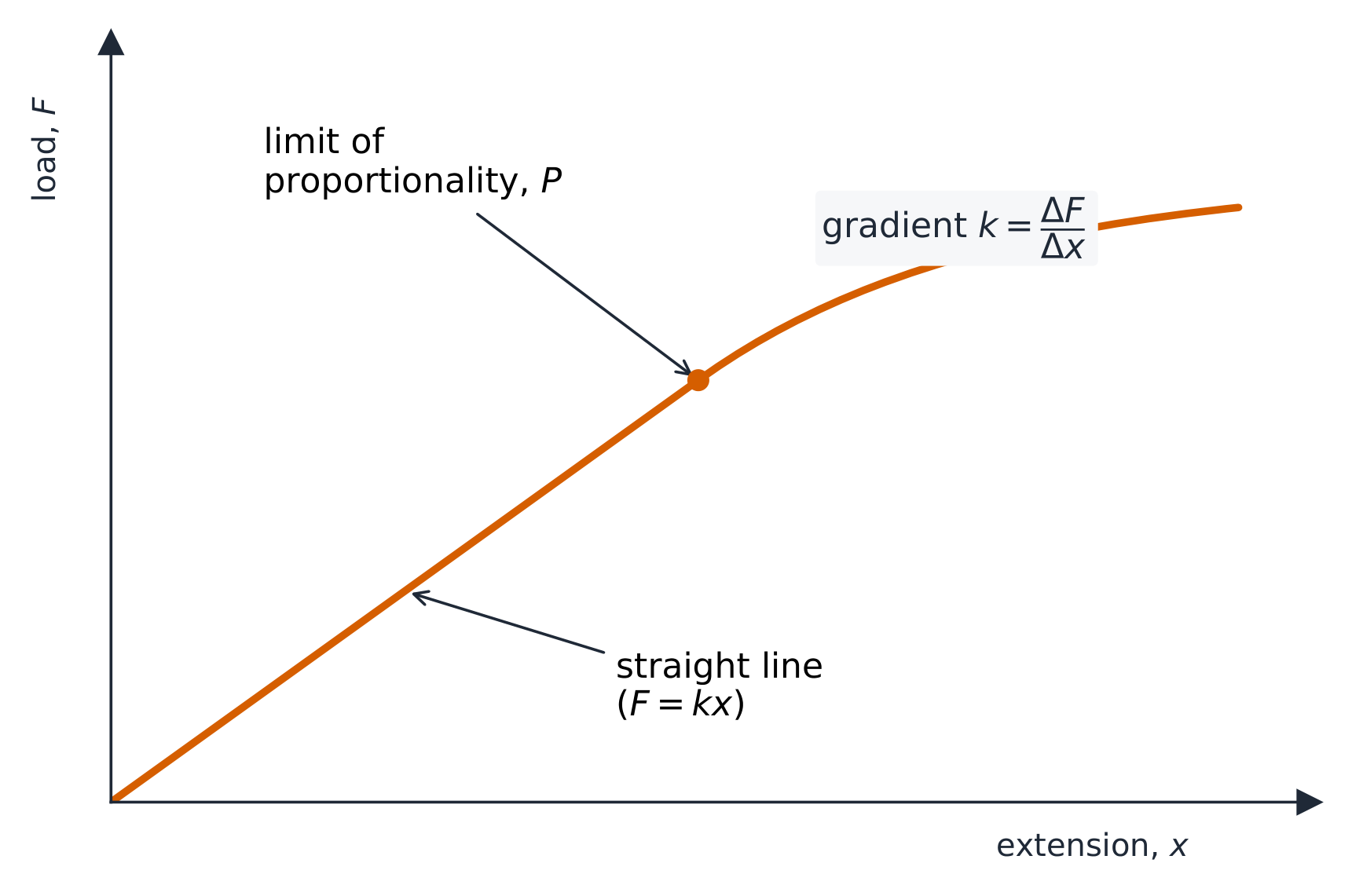
读图:
- 力-伸长量($F$ 对 $x$)图在胡克定律区域内的斜率是 $k$。
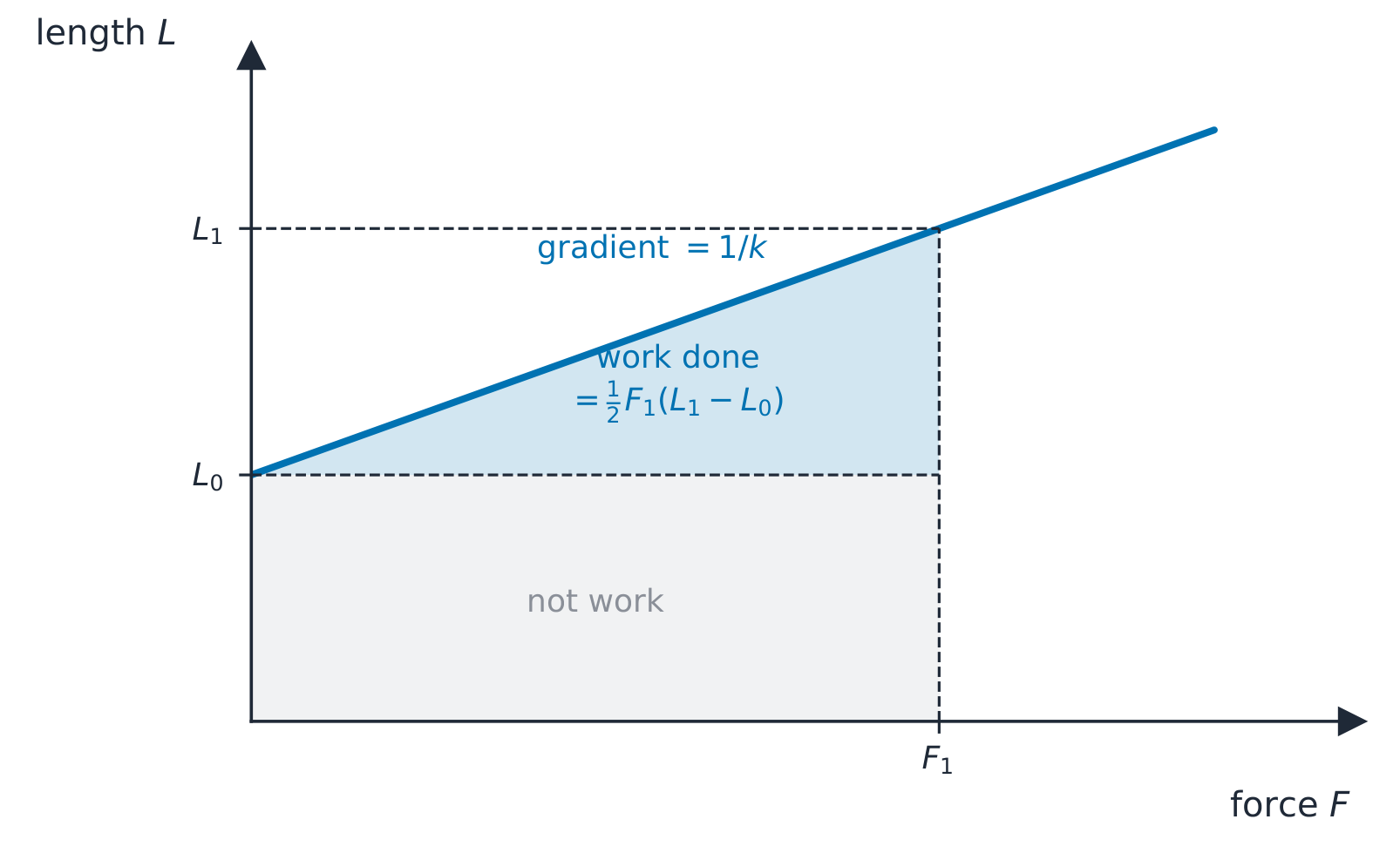
- 伸长量-力($x$ 对 $F$)图在胡克定律区域内的斜率是 $1/k$。
一个常见陷阱:如果一张图画的是长度 $L$ 对力,你仍能从斜率求出劲度系数(因为 $L = L_{0} + F/k$,斜率是 $1/k$——要仔细读出它)。
例题。 一根弹簧在 $0.80\ \text{N}$ 的力下长 $90\ \text{mm}$,在 $1.30\ \text{N}$ 下长 $115\ \text{mm}$。求劲度系数和未拉伸时的长度。
多出的 $0.50\ \text{N}$ 的力产生多出的 $25\ \text{mm} = 0.025\ \text{m}$ 的伸长量,所以 $k = 0.50 / 0.025 = 20\ \text{N m}^{-1}$。在 $0.80\ \text{N}$ 时伸长量为 $x = F/k = 0.80 / 20 = 0.040\ \text{m}$,所以未拉伸的长度是 $90 - 40 = 50\ \text{mm}$。在长度对力的图上,长度轴上的截距是 $L_{0}$,斜率是 $1/k$,而拉伸弹簧所做的功是图线与 $L = L_{0}$ 这条水平线之间的三角形,不是一直到力轴的整个面积:$L_{0}$ 下方的矩形是未拉伸长度乘以力,没有任何意义。
比例极限
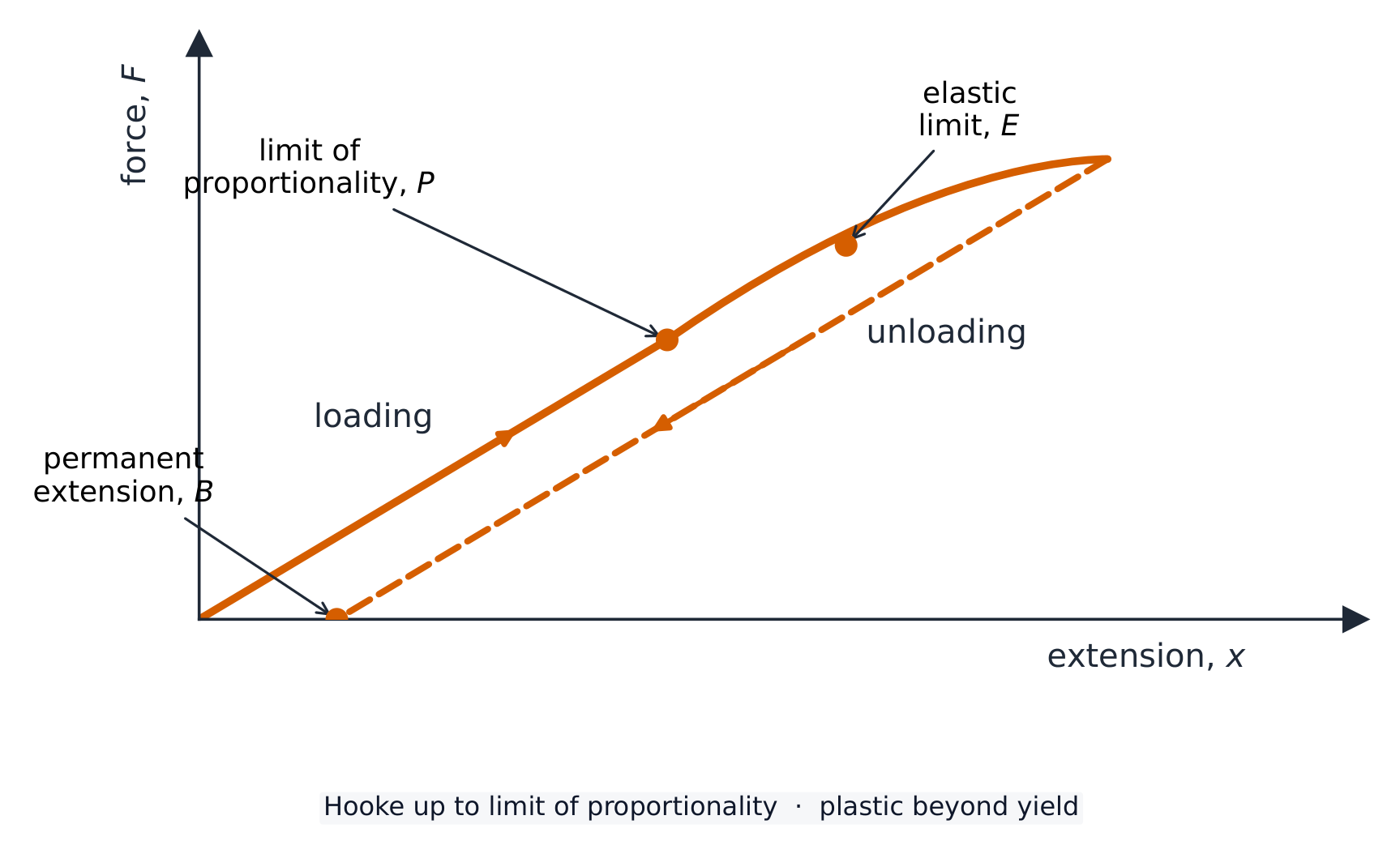
胡克定律只在比例极限(limit of proportionality)之前成立。过了这一点,$F$ 对 $x$ 的线弯曲,不再是直的。材料可能再往前一点仍是弹性的(elastic,去掉负载后回到它最初的长度),然后变成塑性的(plastic)。
串联和并联的弹簧
你可能需要合成劲度系数:
- 串联(series,一根弹簧挂在另一根下面):相同的负载穿过两根,总伸长量是两者之和,所以 $\dfrac{1}{k_{\text{total}}} = \dfrac{1}{k_{1}} + \dfrac{1}{k_{2}}$。
- 并联(parallel,两根弹簧并排挂同一个负载):每根承担一半负载(若它们相同),伸长量相等,所以 $k_{\text{total}} = k_{1} + k_{2}$。

例题。 劲度系数为 $6.0\ \text{N cm}^{-1}$ 和 $4.0\ \text{N cm}^{-1}$ 的两根弹簧首尾相接,下面挂一个 $80\ \text{N}$ 的负载。求总伸长量。
每根弹簧都承受全部 $80\ \text{N}$,所以伸长量分别是 $80/6.0 = 13.3\ \text{cm}$ 和 $80/4.0 = 20\ \text{cm}$:总共 $33\ \text{cm}$(与由 $1/k = 1/6.0 + 1/4.0$ 得 $k = 2.4\ \text{N cm}^{-1}$ 一致)。三根相同的弹簧全部并联时合成劲度系数最大($3k$),全部串联时最小($k/3$)。当一个负载由两根相同的并联弹簧分担时,每根承受一半的力,因而储存的能量是单根弹簧承受全部负载时的四分之一;两根一起储存的能量是单根弹簧的一半。以 $\text{N cm}^{-1}$ 计的劲度系数比同一个常数以 $\text{N m}^{-1}$ 计时小 $100$ 倍;按题目要求的单位给出。
探索
Hooke's law
F = k·x
Force is proportional to extension — the gradient is the spring constant k.
探索
Hooke's law
F = kx
Up to the limit, extension is proportional to force — the gradient is the spring constant k.
探索
Hooke's law: F = kx
F = ax
Drag the spring constant. Force is proportional to extension — a straight line through the origin whose gradient is the spring constant.
词汇表
训练
| 英文 | 中文 | 拼音 |
|---|---|---|
| Hooke's law/hʊks lɔː/ | 胡克定律 | hú kè dìng lǜ |
| elastic/ɪˈlæstɪk/ | 弹性 | tán xìng |
| spring constant/sprɪŋ ˈkɒnstənt/ | 劲度系数 | jìn dù xì shù |
| limit of proportionality/ˈlɪmɪt ɒv prəˌpɔːʃəˈnælɪti/ | 比例极限 | bǐ lì jí xiàn |
| plastic/ˈplæstɪk/ | 塑性 | sù xìng |
| series/ˈsɪəriːz/ | 串联 | chuàn lián |
| parallel/ˈpærəlel/ | 并联 | bìng lián |
6.1
应力、应变与杨氏模量

对于承受拉伸负载、横截面均匀的金属丝:
- 应力(stress)$\sigma = \dfrac{F}{A}$,其中 $F$ 是负载,$A$ 是横截面积(cross-sectional area)。单位:$\text{Pa}$。
- 应变(strain)$\varepsilon = \dfrac{x}{L_{0}}$,其中 $x$ 是伸长量,$L_{0}$ 是原长。应变没有单位(它是两个长度的比值)。
对于一分的定义:应力是每单位横截面积上的力(垂直作用于该面积的力);应变是每单位原长的伸长量。应力的单位 $\text{Pa} = \text{N m}^{-2}$,用基本单位写是 $\text{kg m}^{-1}\ \text{s}^{-2}$。圆形金属丝的面积由它的直径 $d$ 得出:$A = \pi d^{2}/4 = \pi r^{2}$,把 $d$ 当作 $r$ 会使面积大四倍。把 $\text{mm}^{2}$ 换成 $\text{m}^{2}$ 要乘 $10^{-6}$。
例题。 一个 $18\ \text{N}$ 的拉力作用在横截面积为 $3.2\ \text{mm}^{2}$ 的金属丝上。求应力。
$\sigma = F/A = 18 / (3.2 \times 10^{-6}) = 5.6 \times 10^{6}\ \text{Pa}$。同一个力作用在整根金属丝上,所以一端直径为 $2d$、另一端为 $d$ 的螺栓在细的一端应力是四倍($\sigma \propto 1/d^{2}$),而半径为三倍的金属丝承受的应力是九分之一。
杨氏模量(Young modulus)是胡克定律区域内应力与应变之比:
$$E = \frac{\sigma}{\varepsilon} = \frac{F / A}{x / L_{0}} = \frac{F L_{0}}{A x}.$$
单位:$\text{Pa}$(金属约为 $10^{11}$;例如钢 $\approx 2.0 \times 10^{11}$ Pa)。
例题。 一根长 $2.0\ \text{m}$、横截面积 $1.5 \times 10^{-7}\ \text{m}^2$ 的钢丝在 $15\ \text{N}$ 的负载下伸长 $1.0\ \text{mm}$。求杨氏模量。
$$E = \frac{F L_{0}}{A x} = \frac{15 \times 2.0}{(1.5 \times 10^{-7})(1.0 \times 10^{-3})} = 2.0 \times 10^{11}\ \text{Pa}.$$
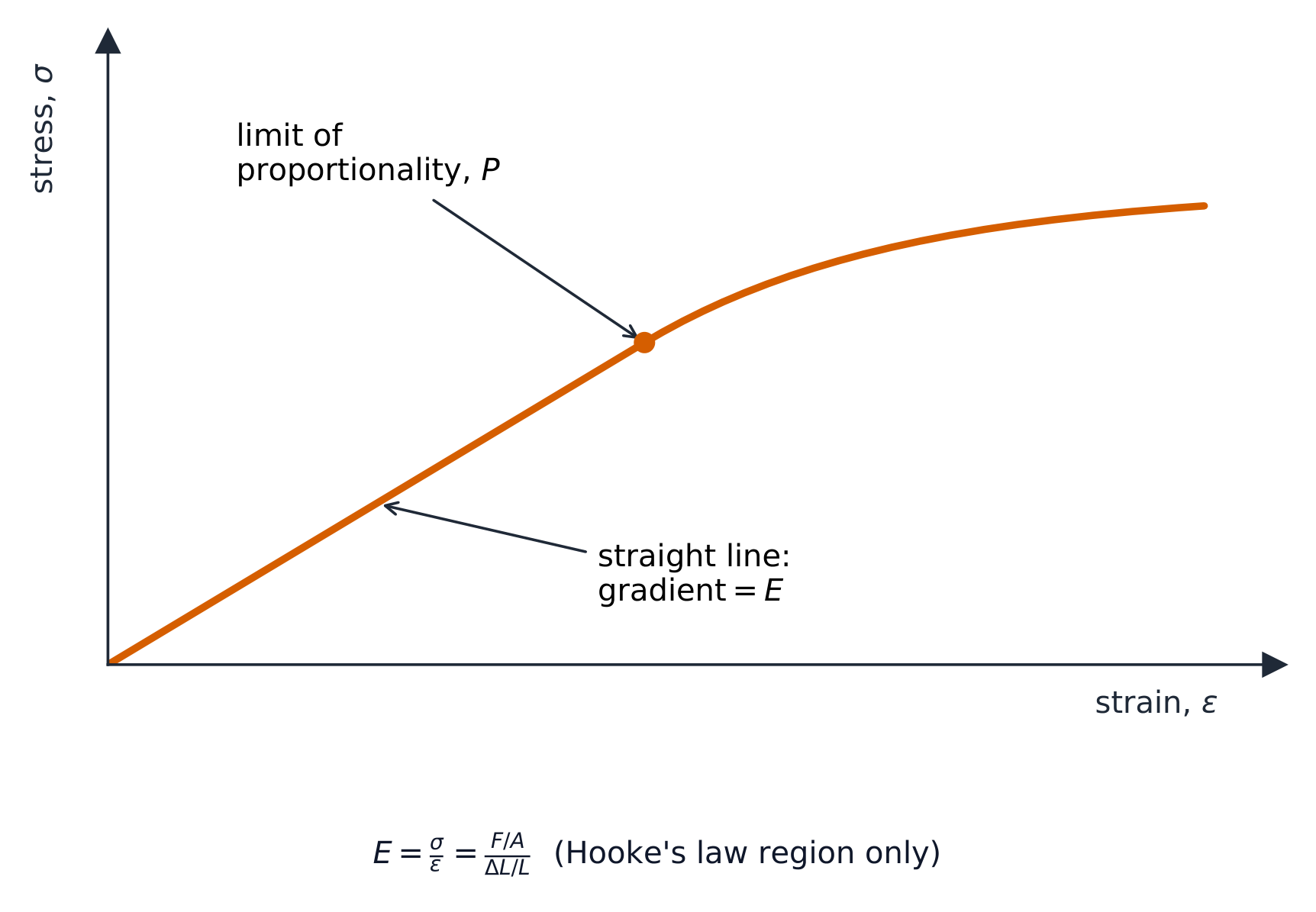
杨氏模量是材料的一个性质——它不取决于金属丝的形状或大小。劲度系数 $k$ 既取决于材料又取决于大小:$k = EA/L_{0}$。
对于一分的定义:杨氏模量是应力与应变之比(对于在比例极限内形变的材料)。因为它属于材料,同一种金属的较粗的金属丝有相同的杨氏模量:在相同负载下它伸长得更少,是因为它的面积更大,而不是因为这种金属更硬。"证明 $k = EA/L_{0}$"的题要两行:$k = F/x$ 和 $E = FL_{0}/(Ax)$,所以 $E = kL_{0}/A$。由此得出两点:只要胡克定律成立,无论力多大,金属丝的劲度系数都保持恒定;同一种金属、直径两倍的金属丝劲度系数是四倍。
例题。 一根长 $1.7\ \text{m}$、直径 $0.64\ \text{mm}$ 的铜丝,杨氏模量为 $1.2 \times 10^{11}\ \text{Pa}$。求它的劲度系数。
$A = \pi (0.32 \times 10^{-3})^{2} = 3.2 \times 10^{-7}\ \text{m}^{2}$,所以 $k = EA/L_{0} = 1.2 \times 10^{11} \times 3.2 \times 10^{-7} / 1.7 = 2.3 \times 10^{4}\ \text{N m}^{-1}$。
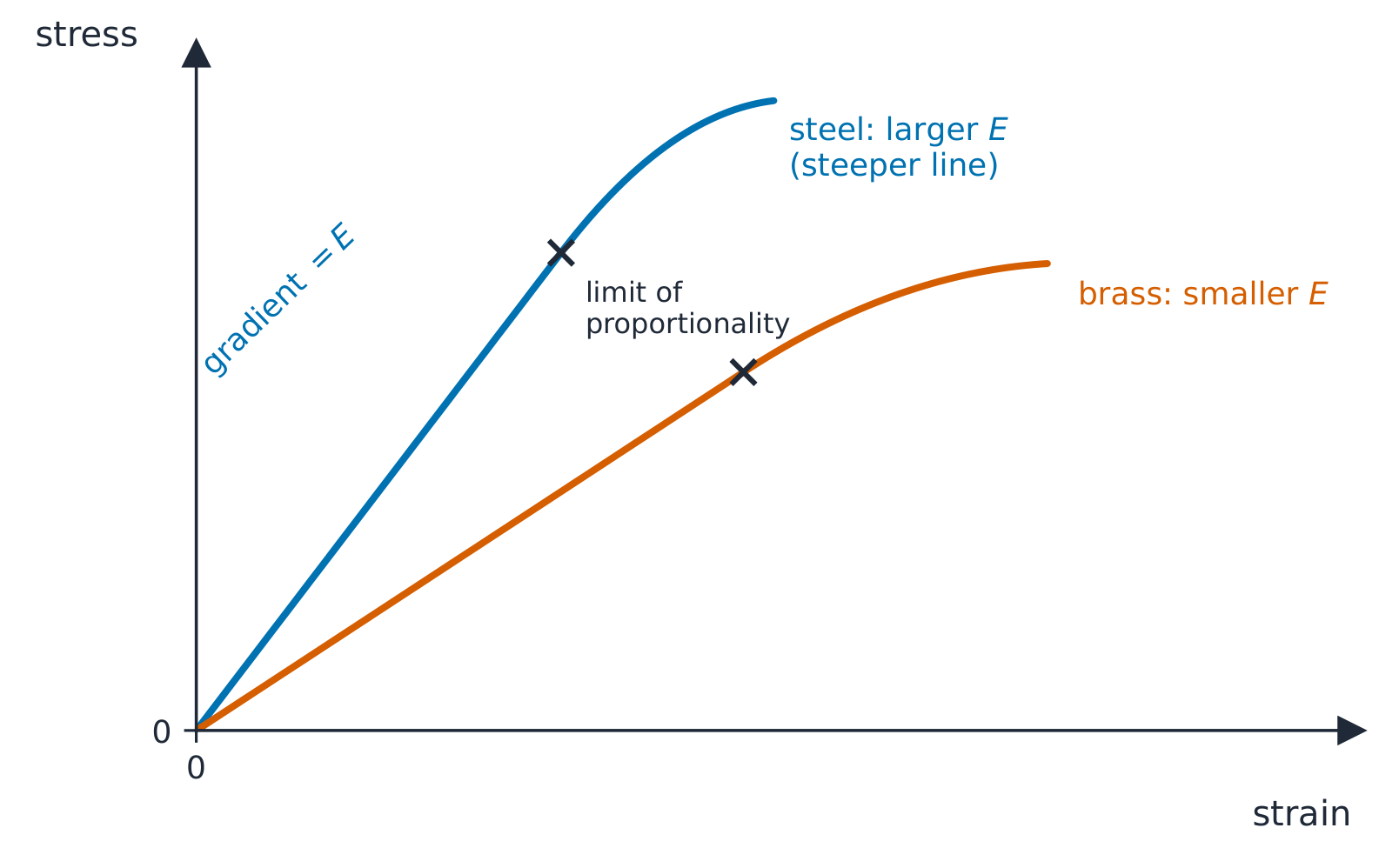
在应力-应变图上,直线部分的斜率是 $E$,所以画在同一坐标系里的两种材料中,更陡的线是更硬的材料,而杨氏模量加倍的金属丝画成一条过原点、斜率两倍的直线。在力-伸长量图上斜率是 $EA/L_{0}$,杨氏模量等于斜率乘以 $L_{0}/A$;只有应力-应变图的斜率才直接等于 $E$。
测量金属丝杨氏模量的实验
一个标准装置:
- 把一根又长又细的金属丝的一端夹在固定支架上。让金属丝越过桌边的一个滑轮(pulley),使它竖直下垂。
- 用米尺测量夹子与滑轮附近一个标记之间的原长 $L_{0}$。
- 用螺旋测微器(micrometer)在几处测量金属丝的直径(diameter)$d$ 并取平均。算出 $A = \pi d^{2}/4$。
- 一次挂一个砝码。记录负载 $F$ 和伸长量 $x$(标记相对固定刻度移动了多远)。
- 作 $F$ 对 $x$ 的图。在直线区域斜率是 $EA/L_{0}$,所以 $E = \text{gradient} \times L_{0}/A$。
为什么用又长又细的金属丝?为了使伸长量大到便于精确测量。为什么重复读数并在几处测 $d$?为了减小随机误差(random error)并检查金属丝是否均匀。
"描述一个实验"的答案靠这些得分:测量的量及其方法(用米尺测 $L_{0}$;用螺旋测微器在几处测 $d$;由砝码或测力计得到负载;由对着固定刻度读数的标记或游标刻度得到伸长量)、图像($F$ 对 $x$,斜率 $EA/L_{0}$;或应力对应变,斜率 $E$)以及注意事项:戴护目镜以防金属丝断裂,先加一个小负载拉直弯折处,卸载时也读数以检查金属丝保持了弹性。

词汇表
训练
| 英文 | 中文 | 拼音 |
|---|---|---|
| stress/stres/ | 应力 | yīng lì |
| strain/streɪn/ | 应变 | yìng biàn |
| Young modulus/jʌŋ ˈmɒdjʊləs/ | 杨氏模量 | yáng shì mó liàng |
| cross-sectional area/krɒs ˈsekʃənl ˈeərɪə/ | 横截面积 | héng jié miàn jī |
| diameter/daɪˈæmɪtə/ | 直径 | zhí jìng |
| pulley/ˈpʊli/ | 滑轮 | huá lún |
| micrometer/maɪˈkrɒmɪtə/ | 螺旋测微器 | luó xuán cè wēi qì |
| random error/ˈrændəm ˈerə/ | 随机误差 | suí jī wù chā |
6.2
弹性与塑性行为
大纲
- understand and use the terms elastic deformation, plastic deformation and elastic limit
- understand that the area under the force–extension graph represents the work done
- determine the elastic potential energy of a material deformed within its limit of proportionality from the area under the force–extension graph
- recall and use $E_p = \frac{1}{2}Fx = \frac{1}{2}kx^2$ for a material deformed within its limit of proportionality
来源:剑桥国际大纲
随着负载增大:
- 弹性且直(遵守胡克定律)——直到比例极限。去掉负载使物体回到它最初的长度。
- 弹性但弯曲——在比例极限和弹性极限(elastic limit)之间。伸长量对负载不再是直的,但卸载时物体仍回到它最初的长度。
- 塑性——过了弹性极限。卸载时,物体不回到它最初的长度;留下一个永久伸长。
胡克定律只在直的、弹性的区域内成立。
用文字表述:弹性形变指去掉负载后物体回到它原来的长度(或形状);塑性形变指它回不去,留下一个永久伸长;弹性极限是形变仍为弹性的最大负载(或伸长量);比例极限是过了之后伸长量不再与负载成正比的那一点。在图上,比例极限是图线不再是直线的地方。弹性极限在它稍后一点,单从加载线读不出来。所以在"哪个陈述一定正确"的题中,直线部分的末端就是比例极限,但后面某点是弹性极限还是断裂点,从加载线的形状无法判断。

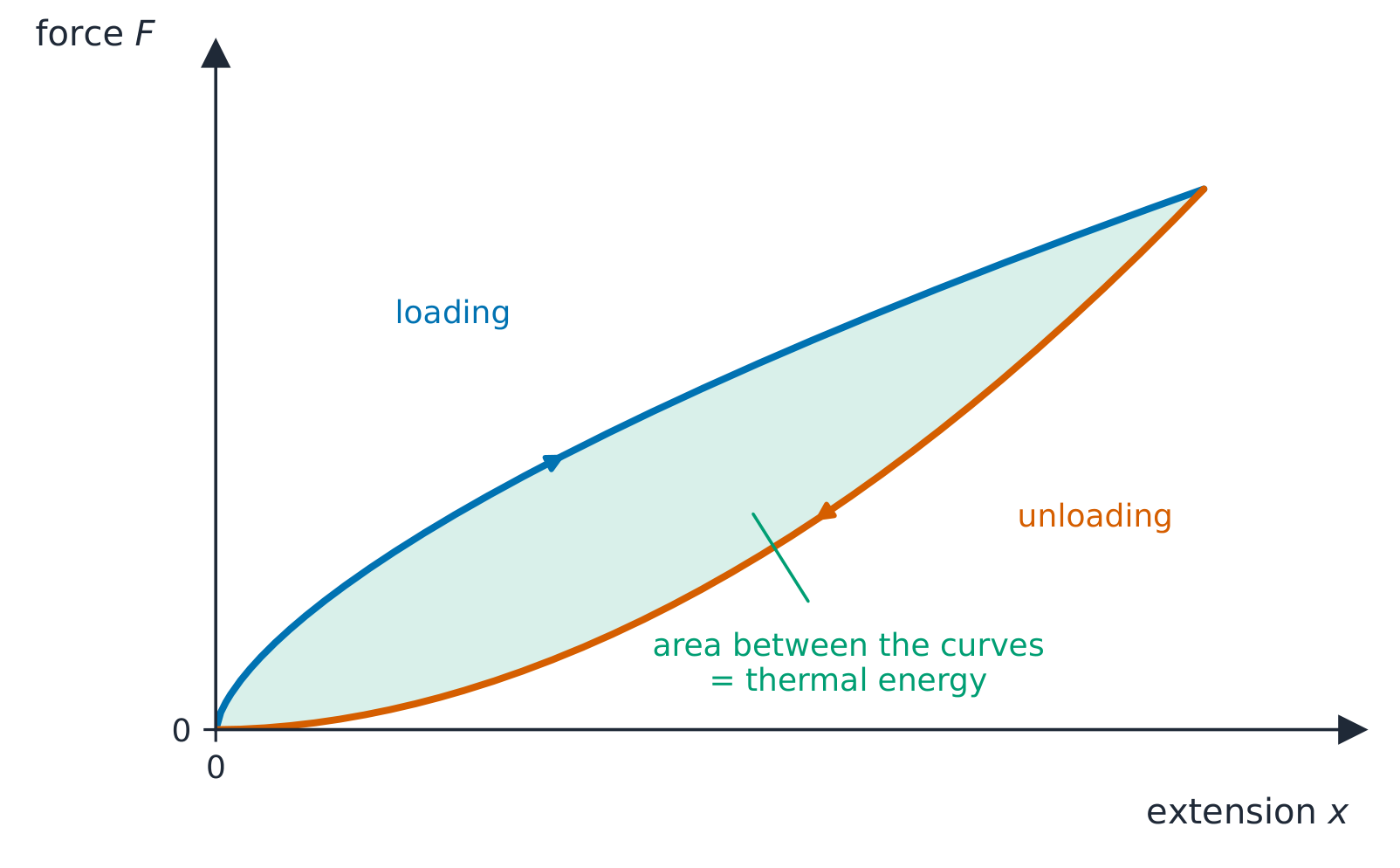
在一张被拉入塑性区然后卸载的材料的力-伸长量图上,加载线和卸载线是不同的。卸载线与最初的胡克线平行,但向右移动了(负载回到零时留下的永久伸长)。加载线和卸载线之间的面积是在材料中变成热能(thermal energy)的能量。
橡皮筋(rubber band)的加载曲线和卸载曲线也不同,但它会回到原来的长度:它的形变是弹性的。两条曲线之间的面积同样是以热能形式耗散的能量(弹性滞后(elastic hysteresis)),而卸载时回收的能量是下方曲线下的面积。两分的"解释为什么拉伸金属丝所做的功不等于去掉力时回收的能量"要答:金属丝被拉过了弹性极限,所以一部分形变是塑性的、留下了永久伸长,而所做的功有一部分变成了金属丝中的热能。
词汇表
训练
| 英文 | 中文 | 拼音 |
|---|---|---|
| elastic limit/ɪˈlæstɪk ˈlɪmɪt/ | 弹性极限 | tán xìng jí xiàn |
| thermal energy/ˈθɜːml ˈenədʒi/ | 热能 | rè néng |
| rubber band/ˈrʌbə bænd/ | 橡皮筋 | xiàng pí jīn |
| elastic hysteresis/ɪˈlæstɪk ˌhɪstəˈriːsɪs/ | 弹性滞后 | tán xìng zhì hòu |
6.2
拉伸材料中储存的能量
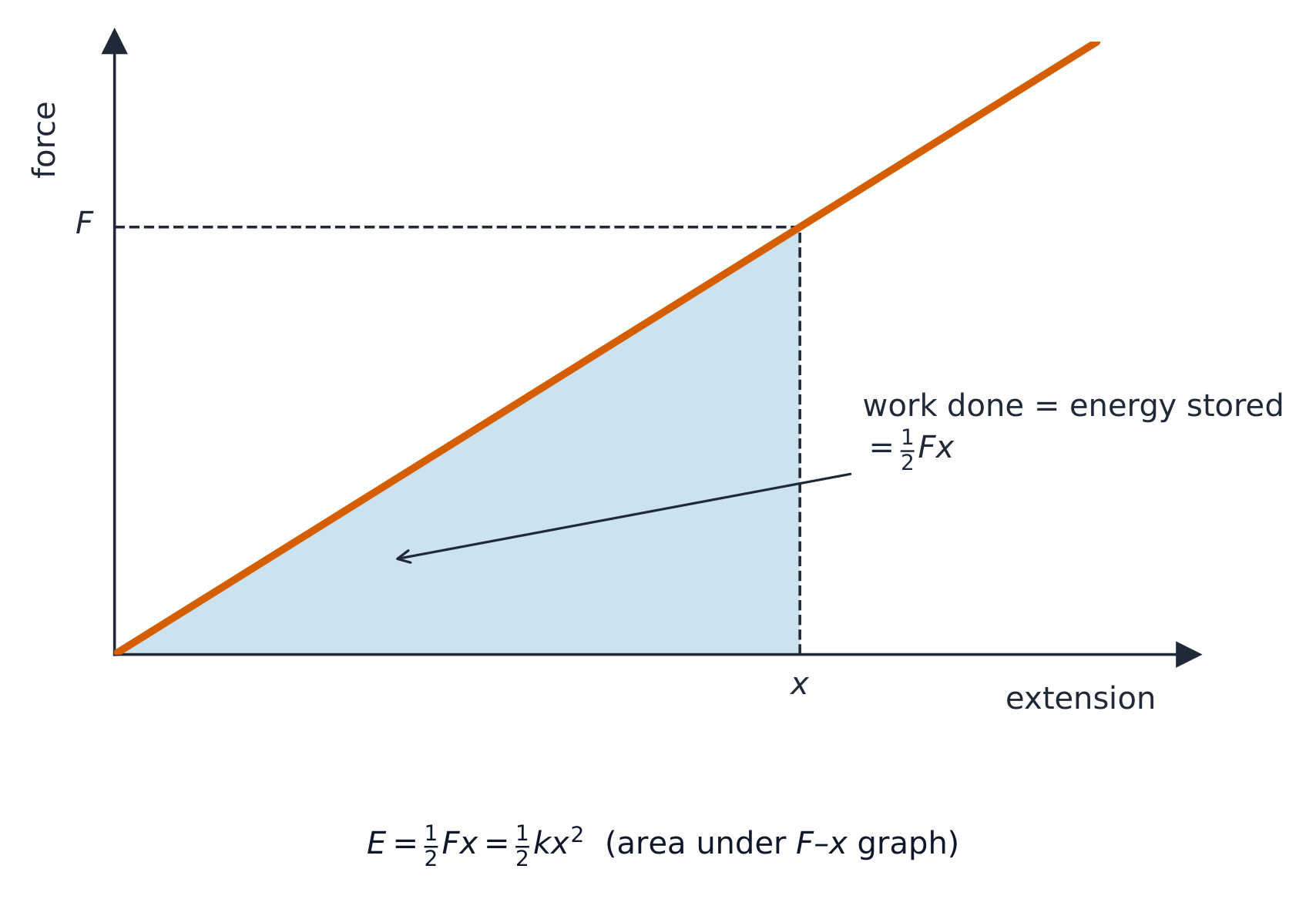
把一个材料从 $0$ 拉伸到伸长量 $x$、负载从 $0$ 增大到 $F$ 时所做的功,是力-伸长量图线下方的面积。
为什么是面积:所做的功是力乘以移动的距离,但这里力随材料的拉伸而增大,所以功是许多小伸长量上 $F\,\Delta x$ 的总和,即图线下方的面积。在比例极限内,力从 $0$ 均匀增大到 $F$,所以平均力是 $\tfrac{1}{2}F$,功是 $\tfrac{1}{2}Fx$。在力-伸长量图上,斜率是劲度系数。
遵守胡克定律的材料
当胡克定律成立时,$F$ 对 $x$ 的图是过原点的直线。它从 $0$ 到 $x$ 下方的面积是一个三角形:
$$E_{\text{P}} = \tfrac{1}{2} F x = \tfrac{1}{2} k x^{2}.$$
这是储存在弹簧或金属丝中(在其比例极限内拉伸)的弹性势能(elastic potential energy)。一个等价形式:
$$E_{\text{P}} = \frac{F^{2}}{2k}.$$
例题。 一根劲度系数为 $50\ \text{N m}^{-1}$ 的弹簧在其比例极限内被拉伸 $0.20\ \text{m}$。求储存的弹性势能。
$$E_{\text{P}} = \tfrac{1}{2} k x^{2} = \tfrac{1}{2} \times 50 \times 0.20^{2} = 1.0\ \text{J}.$$
例题。 一根劲度系数为 $2.0 \times 10^{4}\ \text{N m}^{-1}$ 的金属丝已经伸长了 $2.0\ \text{mm}$。求把它的伸长量增加到 $3.0\ \text{mm}$ 所做的功。
储存的能量从 $\tfrac{1}{2} k x_{1}^{2}$ 增加到 $\tfrac{1}{2} k x_{2}^{2}$:$W = \tfrac{1}{2} \times 2.0 \times 10^{4} \times \left[(3.0 \times 10^{-3})^{2} - (2.0 \times 10^{-3})^{2}\right] = 0.050\ \text{J}$。这是图线下方两个伸长量之间的梯形,而不是 $\tfrac{1}{2} k (x_{2} - x_{1})^{2}$。因为 $k$ 固定时 $E_{\text{P}} \propto x^{2}$,金属丝的伸长量加倍,储存的能量变为四倍($0.65\ \text{J}$ 变成 $2.6\ \text{J}$);由储存的能量可得伸长量 $x = \sqrt{2E_{\text{P}}/k}$:一根 $k = 400\ \text{N m}^{-1}$、储存 $0.32\ \text{J}$ 的弹簧被压缩了 $\sqrt{2 \times 0.32 / 400} = 0.040\ \text{m}$。对于首尾相接的两根金属丝,两者的张力相同,所以储存的总能量是 $\tfrac{1}{2}F x_{1} + \tfrac{1}{2}F x_{2}$,各用自己的伸长量。
不遵守胡克定律的材料
对于一张不是直线的图(一条被拉伸的橡皮筋,或过了比例极限的弹簧),用数网格方块或用梯形(trapezia)来求面积。同样的想法成立:力-伸长量图线下方的面积是对材料所做的功。要估算直到断裂点所做的功,数出整条曲线下方的方格数(不完整的方格算半个),再乘以一个方格代表的能量,即力的间隔乘以伸长量的间隔;说明面积是通过数方格得到的,就是"解释你的推理"的那一分。
比较储存的能量
一个常见的选择题情形:两个材料被相同的力拉伸,或被相同的伸长量拉伸。用 $E_{\text{P}} = \tfrac{1}{2} F x$:
- 相同的 $F$,较小的 $k$(不那么硬)→ 较大的 $x$ → 储存更多能量。
- 相同的 $x$,较大的 $k$(更硬)→ 较大的 $F$ → 储存更多能量。
$E_{\text{P}}$ 对伸长量或压缩量的示意图是一条过原点、越来越陡的曲线($E_{\text{P}} \propto x^{2}$),不是直线。在相同负载下,长度和面积都相同的两根金属丝中,杨氏模量较小的那根伸长更多,因而储存更多能量。
当一根被拉伸的弹簧被释放到一个质量上时,弹性势能变成动能(kinetic energy)(如果质量上升还有重力势能)。令 $\tfrac{1}{2} k x^{2}$ 等于 $\tfrac{1}{2} m v^{2}$(加上任何 $mgh$)来求速率或高度。
词汇表
训练
| 英文 | 中文 | 拼音 |
|---|---|---|
| elastic potential energy/ɪˈlæstɪk pəˈtenʃl ˈenədʒi/ | 弹性势能 | tán xìng shì néng |
| trapezia/trəˈpiːzɪə/ | 梯形 | tī xíng |
| kinetic energy/kɪˈnetɪk ˈenədʒi/ | 动能 | dòng néng |
6.2
考官认可的定义
定义题按固定的表述给分。把这些记准确,并且只写一个答案。
| 术语 | 定义 |
|---|---|
| 胡克定律(Hooke's law) | 只要不超过比例极限,伸长量与所施加的力成正比 |
| 劲度系数(spring constant) | 每单位伸长量的力 |
| 比例极限(limit of proportionality) | 过了之后伸长量不再与所施加的力成正比的那一点 |
| 弹性极限(elastic limit) | 去掉力后材料仍能回到原长的最大力(或伸长量) |
| 弹性形变(elastic deformation) | 去掉力后材料回到原来的长度(形状) |
| 塑性形变(plastic deformation) | 去掉力后材料回不到原来的长度;留下永久伸长 |
| 应力(stress) | 每单位横截面积上的力 |
| 应变(strain) | 每单位原长的伸长量 |
| 杨氏模量(Young modulus) | 应力与应变之比(在比例极限内) |
| 弹性势能(elastic potential energy) | 物体因被拉伸或压缩而储存的能量 |
6.2
考试技巧
- **胡克定律($F = kx$)**只在比例极限之前成立。
- 应力 $= F/A$,应变 $= x/L$,杨氏模量 $=$ 应力$/$应变(应力-应变图直线部分的斜率)——注意单位(Pa)。
- 储存的能量 $=$ 力-伸长量图线下方的面积 $=$ 弹性区域内的 $\frac{1}{2}Fx$。
- 区分弹性(恢复形状)和塑性(永久)形变。
常见错误
- 在 $A = \pi r^{2}$ 中把直径当作半径,或者把面积留在 $\text{mm}^{2}$。先把直径减半;$1\ \text{mm}^{2} = 10^{-6}\ \text{m}^{2}$。
- 把长度-力图上一直到坐标轴的整个面积读作所做的功。只有 $L_{0}$ 上方的三角形才是功。
- 把储存的能量当作与伸长量成正比。它随 $x^{2}$ 变化:伸长量加倍,能量四倍;两个伸长量之间所做的功是两个 $\tfrac{1}{2}kx^{2}$ 之差。
- 陈述胡克定律时漏掉条件。"只要不超过比例极限"是定律的一部分。
- 把比例极限(直线的末端)和弹性极限(弹性行为的末端,稍后一点)弄混。
- 说较粗的金属丝杨氏模量更大。模量属于材料;较粗的金属丝劲度系数更大。
本主题的互动课程
逐步学习,并即时检测练习。