- understand the term luminosity as the total power of radiation emitted by a star
- recall and use the inverse square law for radiant flux intensity $F$ in terms of the luminosity $L$ of the source $F = L / (4\pi d^2)$
- understand that an object of known luminosity is called a standard candle
- understand the use of standard candles to determine distances to galaxies
天文学与宇宙学
A-Level 物理 · 第 25 主题
 12:42
12:42
Luminosity & the Cosmos
That star is a hundred trillion kilometres away. You will never touch it. You will never visit it. And yet, from its faint light alone — just the light that…
英文讲解 · 内嵌中英文字幕
25.1
标准烛光

大纲
来源:剑桥国际大纲
一颗恒星的光度(luminosity)$L$ 是它发出的辐射的总功率(power)——每秒向各个方向辐射的能量(energy)。单位:瓦特(W)。
一分定义。 恒星的光度是恒星发出的辐射的总功率(或单位时间发出的总能量)。它只是恒星本身的性质;从地球上看起来多亮还取决于它有多远。被问到有些恒星看起来更亮的两个原因时,正好给出这两个:更大的光度,以及更小的距离(通量按 $1/d^{2}$ 下降)。
在距离 $d$ 处,这个功率已散布到一个面积为 $4\pi d^{2}$ 的球面上。距离 $d$ 处的辐射通量密度(radiant flux intensity)$F$(单位面积上的功率)是
$$F = \frac{L}{4\pi d^{2}}.$$
例题。 太阳的光度是 $L = 3.8 \times 10^{26}\ \text{W}$。求在距离 $d = 1.5 \times 10^{11}\ \text{m}$ 远的地球处的辐射通量密度。
$$F = \frac{L}{4\pi d^{2}} = \frac{3.8 \times 10^{26}}{4\pi (1.5 \times 10^{11})^{2}} \approx 1.4 \times 10^{3}\ \text{W m}^{-2}.$$
单位:$\text{W m}^{-2}$。这是通量的平方反比定律(inverse-square law):距离翻倍使通量变为四分之一。望远镜测量 $F$;如果 $L$ 已知,距离随之而来:
$$d = \sqrt{\frac{L}{4\pi F}}.$$

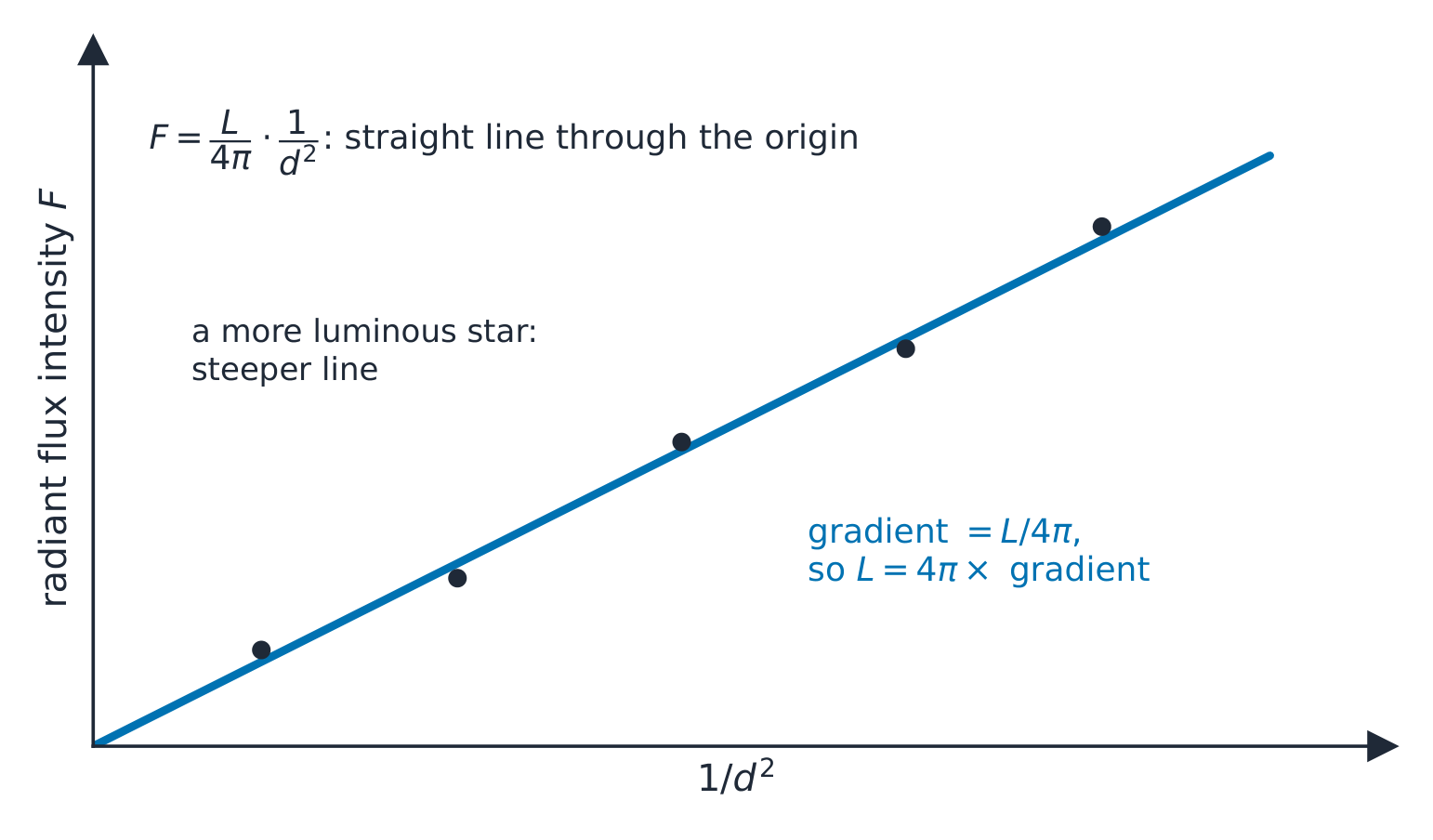
读图。 同一颗恒星的 $F$ 对 $1/d^{2}$ 的图是一条过原点、斜率为 $L/4\pi$ 的直线,所以 $L = 4\pi \times \text{斜率}$;光度更大的恒星给出更陡的线。所在星系正在退行的恒星仍服从平方反比定律,但我们收到的光是红移的,所以每个波长处的通量沿光谱移动,只对某一波段敏感的探测器看到的可能是不同的比例。
例题。 太阳的半径为 $6.96 \times 10^{8}\ \text{m}$,表面温度为 $5780\ \text{K}$。一个带有 $2.0\ \text{m}^{2}$ 太阳能板的空间探测器距太阳中心 $4.5 \times 10^{10}\ \text{m}$。求板正对太阳时落在板上的功率。
光度:$L = 4\pi\sigma r^{2}T^{4} = 4\pi(5.67 \times 10^{-8})(6.96 \times 10^{8})^{2}(5780)^{4} = 3.85 \times 10^{26}\ \text{W}$。探测器处的通量:$F = L/(4\pi d^{2}) = 3.85 \times 10^{26}/[4\pi(4.5 \times 10^{10})^{2}] = 1.5 \times 10^{4}\ \text{W m}^{-2}$,是地球处通量的十一倍。板上的功率:$P = FA = 1.5 \times 10^{4} \times 2.0 = 3.0 \times 10^{4}\ \text{W}$。通量是垂直于辐射的单位面积上的功率;倾斜的板接收 $FA\cos\theta$。
词汇表
训练
| 英文 | 中文 | 拼音 |
|---|---|---|
| luminosity/ˌluːmɪˈnɒsɪti/ | 光度 | guāng dù |
| power/ˈpaʊə/ | 功率 | gōng lǜ |
| energy/ˈenədʒi/ | 能量 | néng liàng |
| radiant flux intensity/ˈreɪdɪənt flʌks ɪnˈtensɪti/ | 辐射通量密度 | fú shè tōng liàng mì dù |
| inverse-square law/ɪnˈvɜːs skweə lɔː/ | 平方反比定律 | píng fāng fǎn bǐ dìng lǜ |
25.1
标准烛光
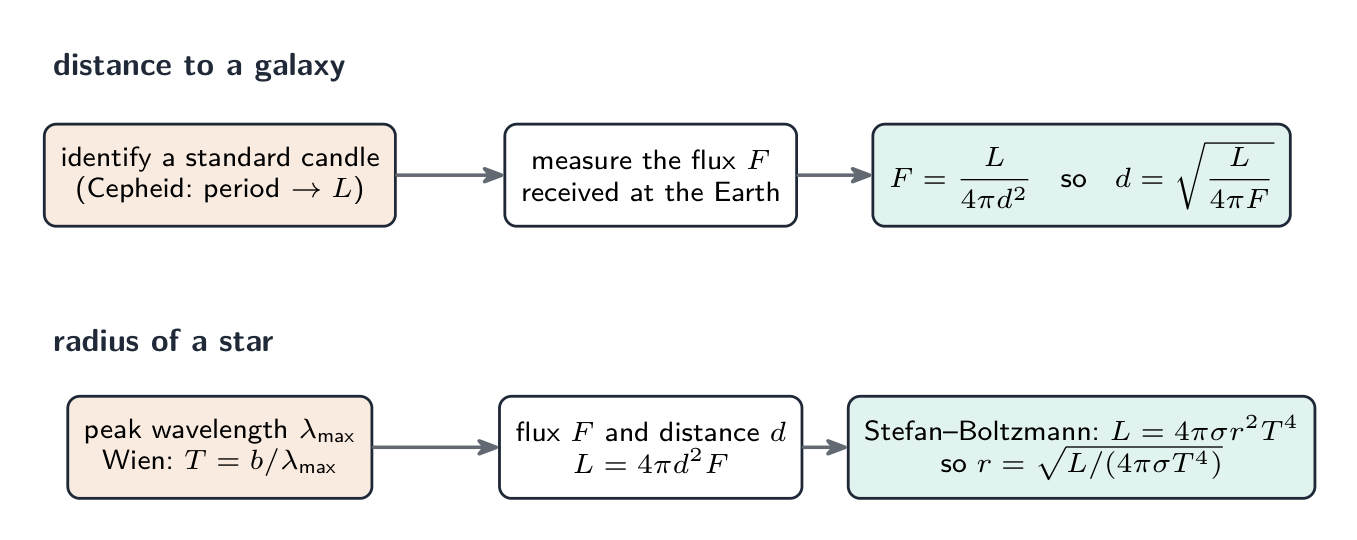
标准烛光(standard candle)是一个光度已知(由它的类型得知)的天体。一旦你在一个遥远的星系中找到一个并测量来自它的通量 $F$,你就能由 $d = \sqrt{L/(4\pi F)}$ 得到它的距离。
例子:
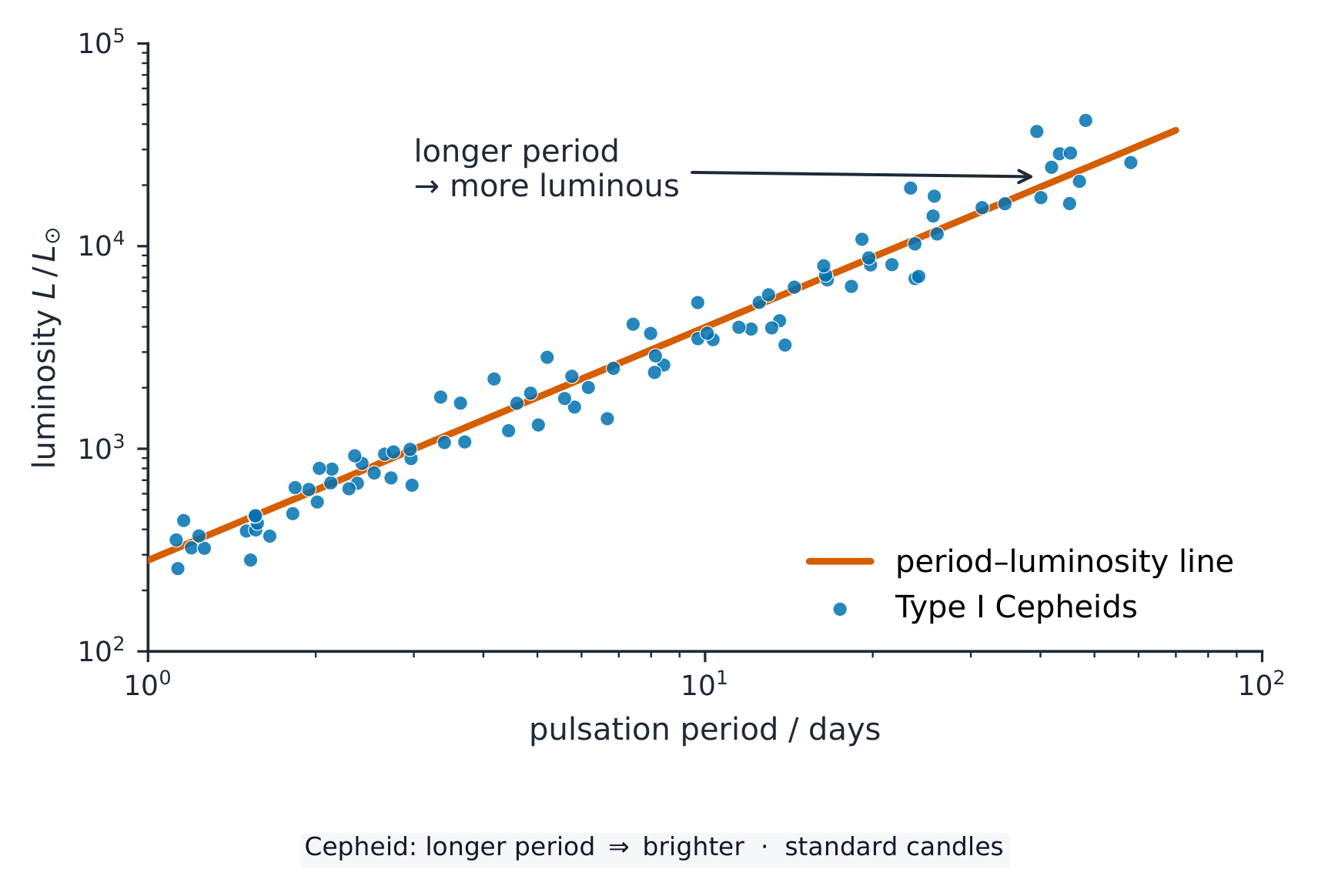
- 造父变星(Cepheid variables,脉动恒星)——脉动周期与光度紧密相关,所以周期给出 $L$。
- Ia 型超新星(Type Ia supernovae)——一个白矮星达到一个临界质量并爆炸,总有大约相同的峰值光度。
标准烛光在不事先知道距离的情况下给出 $L$,所以它能到达远超视差(parallax)的星系。
定义。 标准烛光是光度已知的天体(恒星或超新星)。 光度之所以已知,是因为它由一个在任何距离都能测量的性质确定:造父变星的脉动周期,或超新星的类型。
"解释如何用标准烛光确定星系的距离"(三分)。 (1) 识别星系中的一个标准烛光(造父变星,其周期给出光度;或 Ia 型超新星),从而知道它的光度 $L$。(2) 测量它的光到达地球时的辐射通量密度 $F$。(3) 由平方反比定律得到距离,$d = \sqrt{L/(4\pi F)}$。顺序很重要:光度来自烛光的类型,不是来自距离,距离正是要求的量。
例题。 一颗 Ia 型超新星峰值光度 $1.0 \times 10^{36}\ \text{W}$,观测到的峰值通量为 $2.0 \times 10^{-14}\ \text{W m}^{-2}$。它的星系有多远?
$d = \sqrt{L/(4\pi F)} = \sqrt{1.0 \times 10^{36}/(4\pi \times 2.0 \times 10^{-14})} = 6.3 \times 10^{24}\ \text{m}$,约 $670$ 百万光年(light years)($1\ \text{ly} = 9.5 \times 10^{15}\ \text{m}$)。光度约 $10^{30}\ \text{W}$ 的造父变星在那个距离看不见;超新星是远宇宙的烛光。

探索
Standard candle distance lab
brightness proportional to 1 / distance^2
Move distance and see why brightness falls quickly.
词汇表
训练
| 英文 | 中文 | 拼音 |
|---|---|---|
| standard candle/ˈstændəd ˈkændl/ | 标准烛光 | biāo zhǔn zhú guāng |
| Cepheid variables/ˈsefiɪd ˈveərɪəblz/ | 造父变星 | zào fù biàn xīng |
| Type Ia supernovae/taɪp wʌn ˈeɪ ˌsuːpəˈnəʊviː/ | 超新星 | chāo xīn xīng |
| parallax/ˈpærəlæks/ | 视差 | shì chā |
| light years/laɪt jɪəz/ | 光年 | guāng nián |
| supernovae/ˌsuːpəˈnəʊviː/ | 超新星 | chāo xīn xīng |
25.2
恒星半径
大纲
- recall and use Wien’s displacement law $\lambda_{\text{max}} \propto 1/T$ to estimate the peak surface temperature of a star
- use the Stefan–Boltzmann law $L = 4\pi\sigma r^2 T^4$
- use Wien’s displacement law and the Stefan–Boltzmann law to estimate the radius of a star
来源:剑桥国际大纲
维恩位移定律
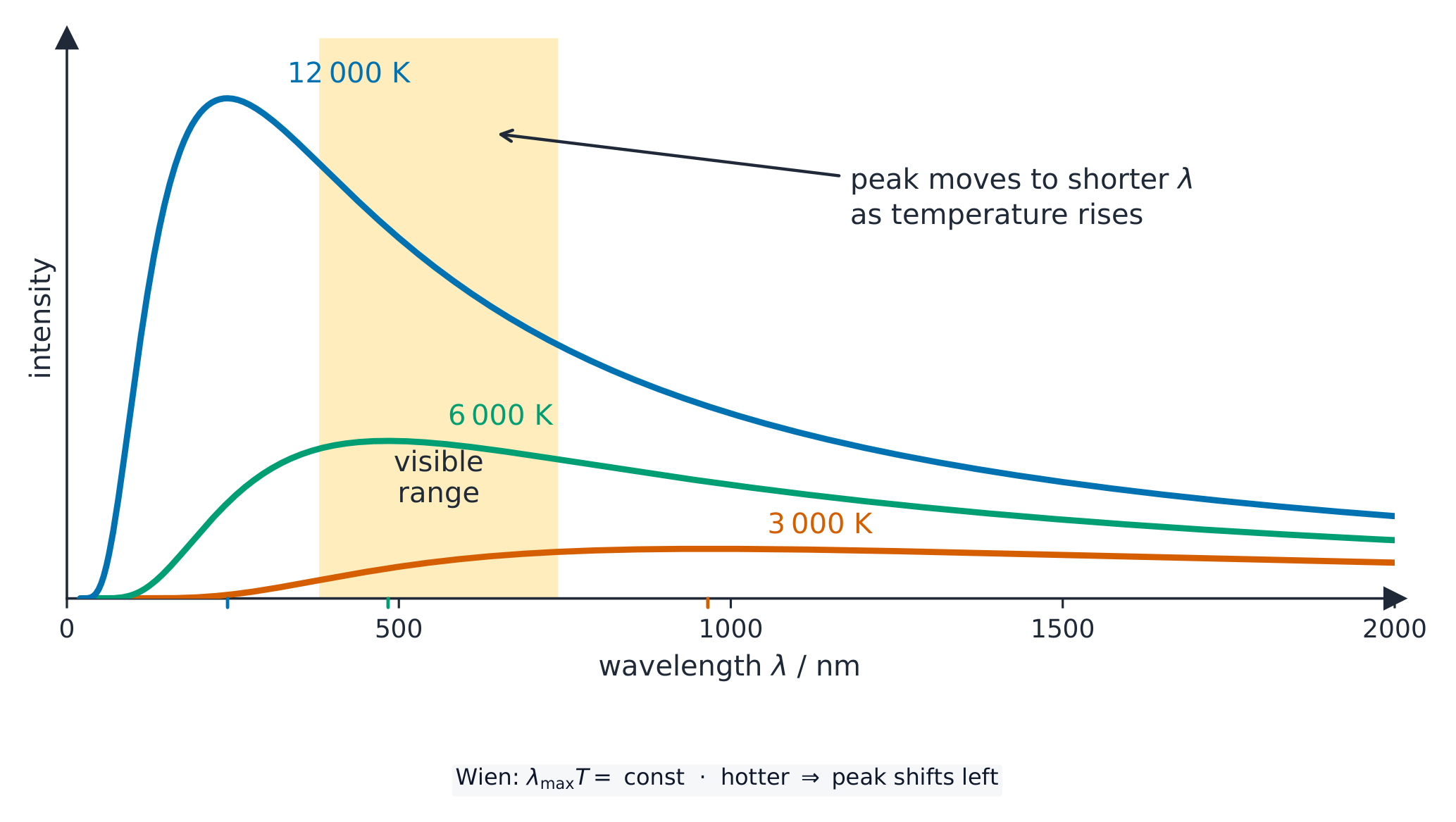
一个热的物体发出一个连续的(黑体(blackbody))谱,其峰值在一个由它的温度(temperature)决定的波长(wavelength)$\lambda_{\text{max}}$ 处。维恩位移定律(Wien's displacement law):
$$\lambda_{\text{max}} T = \text{constant}, \qquad b \approx 2.90 \times 10^{-3}\ \text{m K}.$$
例题。 一颗恒星的黑体谱在 $\lambda_{\text{max}} = 500\ \text{nm}$ 处达到峰值。求它的表面温度。($b = 2.90 \times 10^{-3}\ \text{m K}$。)
$$T = \frac{b}{\lambda_{\text{max}}} = \frac{2.90 \times 10^{-3}}{500 \times 10^{-9}} \approx 5800\ \text{K}.$$
更热的恒星在更短的波长处达到峰值:一颗冷的红星($\sim 3000\ \text{K}$)在红外达到峰值;太阳($\sim 5800\ \text{K}$)在 $500\ \text{nm}$ 附近;一颗热的蓝白星($\sim 20{,}000\ \text{K}$)在紫外。测量 $\lambda_{\text{max}}$ 给出表面温度。
"表述维恩位移定律"(两分)。 黑体辐射强度最大处的波长与它的热力学温度成反比:$\lambda_{\text{max}} \propto 1/T$,或 $\lambda_{\text{max}} T = \text{常量}$($2.90 \times 10^{-3}\ \text{m K}$)。要说"最大强度的波长",不只是"波长",温度必须以开尔文计。该定律描述的是连续黑体曲线的峰,不是谱线。
斯特藩-玻尔兹曼定律
一颗恒星,当作一个半径为 $r$、表面温度为 $T$ 的黑体球,有光度
$$L = 4\pi \sigma r^{2} T^{4},$$
其中 $\sigma = 5.67 \times 10^{-8}\ \text{W m}^{-2}\ \text{K}^{-4}$ 是斯特藩-玻尔兹曼常量(Stefan–Boltzmann constant,即斯特藩-玻尔兹曼定律(Stefan–Boltzmann law))。两个强的依赖关系:
- $L \propto r^{2}$——半径两倍,光度四倍(相同 $T$)。
- $L \propto T^{4}$——温度两倍,光度十六倍(相同 $r$)。
例题。 一颗恒星半径 $r = 7.0 \times 10^{8}\ \text{m}$、表面温度 $T = 5800\ \text{K}$。求它的光度。($\sigma = 5.67 \times 10^{-8}\ \text{W m}^{-2}\ \text{K}^{-4}$。)
$$L = 4\pi\sigma r^{2} T^{4} = 4\pi (5.67 \times 10^{-8})(7.0 \times 10^{8})^{2}(5800)^{4} \approx 3.9 \times 10^{26}\ \text{W}.$$
估算一颗恒星的半径
联立这两个定律:
- 测量 $\lambda_{\text{max}}$ → 由维恩定律得到 $T$。
- 求 $L$(例如由通量 $F$ 和距离 $d$:$L = 4\pi d^{2} F$)。
- 解斯特藩-玻尔兹曼定律求 $r$:$r = \sqrt{L/(4\pi \sigma T^{4})}$。
这就是天文学家如何估算他们看不到圆面的恒星的半径。
例题(太阳的半径)。 在距离 $1.50 \times 10^{11}\ \text{m}$ 处,地球接收的太阳光辐射通量密度为 $1370\ \text{W m}^{-2}$,太阳光谱在 $500\ \text{nm}$ 处达到峰值。估算太阳的半径。
光度:$L = 4\pi d^{2}F = 4\pi(1.50 \times 10^{11})^{2}(1370) = 3.87 \times 10^{26}\ \text{W}$。温度:$T = b/\lambda_{\text{max}} = 2.90 \times 10^{-3}/(500 \times 10^{-9}) = 5800\ \text{K}$。半径:$r = \sqrt{L/(4\pi\sigma T^{4})} = \sqrt{3.87 \times 10^{26}/[4\pi(5.67 \times 10^{-8})(5800)^{4}]} = 6.9 \times 10^{8}\ \text{m}$。三步,每步一个单行公式;把 $L$ 和 $T$ 的全部精度保留到最后,因为 $T$ 要取四次方。
例题。 遥远星系中的一颗恒星在地球处的辐射通量密度为 $2.52 \times 10^{-8}\ \text{W m}^{-2}$,距离 $4.16 \times 10^{17}\ \text{m}$,表面温度 $9500\ \text{K}$。求它的半径。
$L = 4\pi d^{2}F = 4\pi(4.16 \times 10^{17})^{2}(2.52 \times 10^{-8}) = 5.48 \times 10^{28}\ \text{W}$。于是 $r = \sqrt{5.48 \times 10^{28}/[4\pi(5.67 \times 10^{-8})(9500)^{4}]} = 3.1 \times 10^{9}\ \text{m}$,约为太阳半径的四倍。检查合理性:一颗光度是太阳 $140$ 倍、温度只有 $1.6$ 倍的恒星必定大得多,因为 $L \propto r^{2}T^{4}$。
为什么 $T^{4}$ 如此重要。 半径相同、温度分别为 $3000\ \text{K}$ 和 $6000\ \text{K}$ 的两颗恒星光度相差 $2^{4} = 16$ 倍;温度的小误差就是光度的大误差,这就是为什么峰值波长必须仔细读取,而且对退行的星系要做红移修正(见下)。
探索
A star's luminosity and radius
L ∝ r²
For a given surface temperature, a star's luminosity grows with the SQUARE of its radius (Stefan's law).
词汇表
训练
| 英文 | 中文 | 拼音 |
|---|---|---|
| blackbody/ˈblækbɒdi/ | 黑体 | hēi tǐ |
| wavelength/ˈweɪvleŋθ/ | 波长 | bō cháng |
| temperature/ˈtemprɪtʃə/ | 温度 | wēn dù |
| Wien's displacement law/viːnz dɪˈspleɪsmənt lɔː/ | 维恩位移定律 | wéi ēn wèi yí dìng lǜ |
| Stefan–Boltzmann constant/ˈstefən ˈbɒltsmən ˈkɒnstənt/ | 斯特藩-玻尔兹曼常量 | sī tè fān - bō ěr zī màn cháng liàng |
| Stefan–Boltzmann law/ˈstefən ˈbɒltsmən lɔː/ | 斯特藩-玻尔兹曼定律 | sī tè fān - bō ěr zī màn dìng lǜ |
25.3
哈勃定律与大爆炸理论

大纲
- understand that the lines in the emission and absorption spectra from distant objects show an increase in wavelength from their known values
- use $\Delta\lambda / \lambda \approx \Delta f / f \approx v / c$ for the redshift of electromagnetic radiation from a source moving relative to an observer
- explain why redshift leads to the idea that the Universe is expanding
- recall and use Hubble's law $v \approx H_0 d$ and explain how this leads to the Big Bang theory (candidates will only be required to use SI units)
来源:剑桥国际大纲
宇宙学红移
来自遥远星系的光的谱线(spectral lines)出现在比它们已知的实验室值更长的波长处——整个谱被拉向红端。这就是红移(redshift)。
把它读作一个多普勒频移,星系正在远离运动。对于 $v \ll c$:
$$\frac{\Delta \lambda}{\lambda} \approx \frac{v}{c},$$
其中 $\Delta\lambda = \lambda_{\text{observed}} - \lambda_{\text{emitted}}$,$v$ 是退行(recession)的速率。例子:在 $4.62 \times 10^{-7}\ \text{m}$ 发出但在 $4.91 \times 10^{-7}\ \text{m}$ 观察到的光给出 $\Delta\lambda = 0.29 \times 10^{-7}\ \text{m}$ 和
$$v \approx \frac{\Delta\lambda}{\lambda_{\text{em}}} c \approx 1.9 \times 10^{7}\ \text{m s}^{-1}.$$
为什么红移意味着一个膨胀的宇宙
几乎每一个遥远的星系都是红移的(少数近的因局部运动而蓝移(blueshifted))。所以星系平均而言在相互远离——不只是离开我们,而是彼此远离。宇宙在膨胀,星系之间的空间在拉伸。越遥远的星系红移越多。
"说明红移是什么意思。" 来自某个源的辐射(其谱线)的观测波长比发出的波长长,因为源正在远离观测者。 它是光的多普勒效应(Doppler effect):波长的相对变化等于频率的相对变化,并且当 $v \ll c$ 时等于比值 $v/c$。
例题。 实验室中测得 $656.3\ \text{nm}$ 的氢谱线在来自某星系的光中观测到在 $660.9\ \text{nm}$。求该星系的退行速率,并用 $H_{0} = 2.3 \times 10^{-18}\ \text{s}^{-1}$ 求它的距离。
$\Delta\lambda = 660.9 - 656.3 = 4.6\ \text{nm}$,所以 $v = c\,\Delta\lambda/\lambda = (3.00 \times 10^{8})(4.6/656.3) = 2.1 \times 10^{6}\ \text{m s}^{-1}$。距离:$d = v/H_{0} = 2.1 \times 10^{6}/2.3 \times 10^{-18} = 9.1 \times 10^{23}\ \text{m}$(约 $100$ 百万光年)。要除以发出的(实验室)波长,并在比值中保持纳米单位一致。
例题(反过来)。 北冕座中的一个星系以 $21\,400\ \text{km s}^{-1}$ 退行。它的 $656.3\ \text{nm}$ 氢谱线在什么波长处被观测到?
$\Delta\lambda = \lambda v/c = 656.3 \times (2.14 \times 10^{7}/3.00 \times 10^{8}) = 46.8\ \text{nm}$,所以谱线出现在 $703\ \text{nm}$,从红光几乎移进红外。每条谱线和整个连续光谱都被同一因子 $(1 + v/c) = 1.071$ 拉伸。
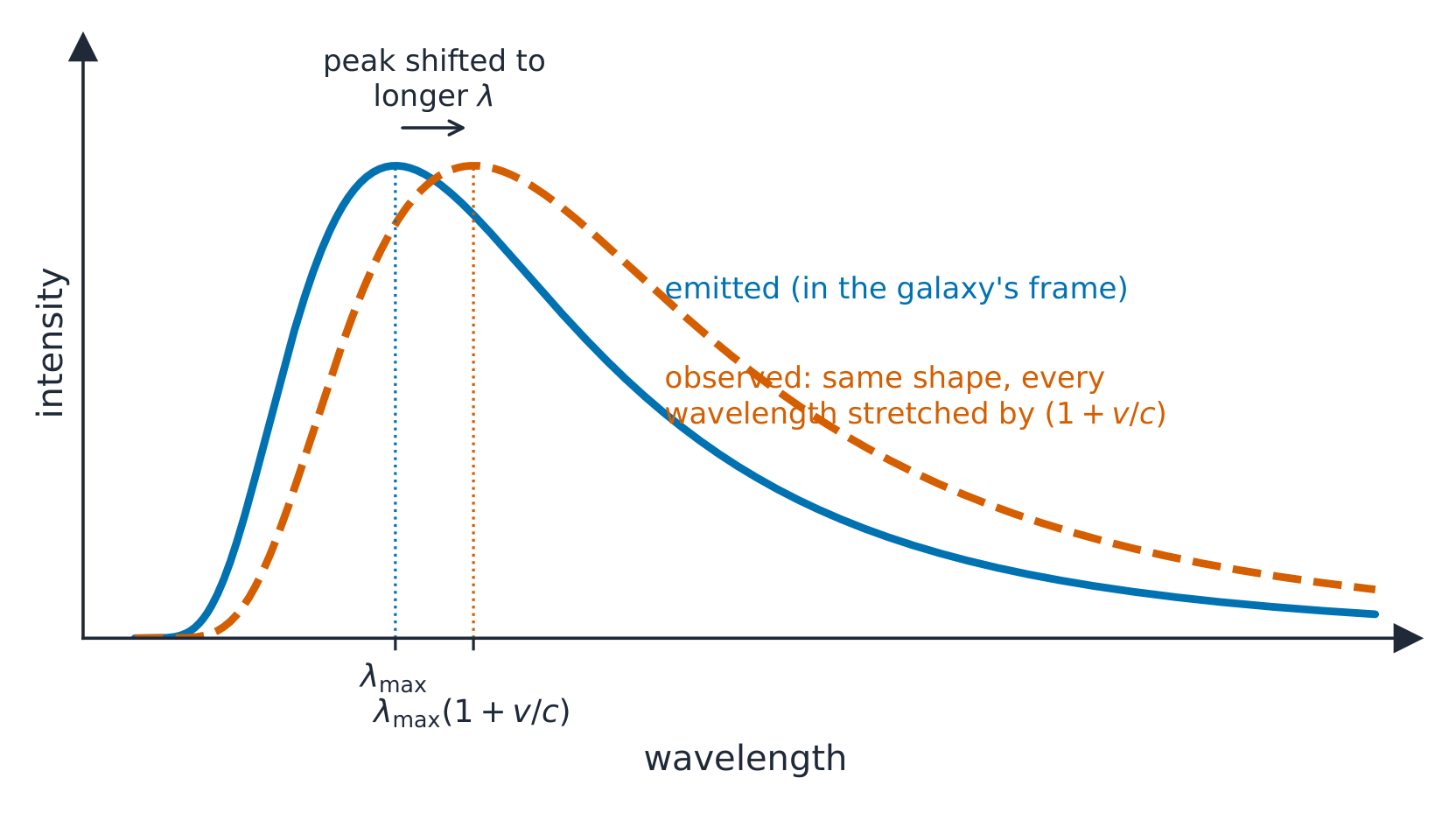
考试设下的陷阱。 若把退行星系光谱的峰值波长直接代入维恩定律,得到的温度偏低,因为观测到的 $\lambda_{\text{max}}$ 比发出的长。先修正峰值:$\lambda_{\text{emitted}} = \lambda_{\text{observed}}/(1 + v/c)$。被要求在与发出光谱相同的坐标上画观测光谱时,画同样的形状向长波方向平移,峰值也一起移。
"解释红移如何导致宇宙在膨胀的观点"(三分)。 (1) 来自(几乎)所有遥远星系的谱线都移向更长的波长,所以 (2) 由多普勒效应,这些星系正在远离我们,并且 (3) 星系越远,红移从而速率越大:如果所有星系之间的空间都在膨胀,从任何星系看都会看到这一现象,所以整个宇宙在膨胀,而不只是在远离地球。

哈勃定律
退行速率 $v$ 与距离 $d$ 之间的关系是哈勃定律(Hubble's law):
$$v \approx H_{0} \cdot d,$$
其中 $H_{0}$ 是哈勃常数(Hubble constant,$\approx 2.3 \times 10^{-18}\ \text{s}^{-1}$)。始终用 SI 单位。例子:一个以 $1.9 \times 10^{7}\ \text{m s}^{-1}$ 退行的星系在 $d = v/H_{0} \approx 8.3 \times 10^{24}\ \text{m}$ 处。
"表述哈勃定律"(两分)。 星系的退行速率与它到地球(观测者)的距离(正)成正比:$v = H_{0}d$,其中 $v$ 是退行速率,$d$ 是距离,$H_{0}$ 是哈勃常数。被要求时要说明每个符号。考试中 $H_{0}$ 的值以 SI 单位($\text{s}^{-1}$)给出,所以 $v$ 必须以 $\text{m s}^{-1}$ 计,$d$ 以米计,决不用千米每秒每百万秒差距。
例题。 遥远星系中的一颗恒星发出的辐射强度在 $4.62 \times 10^{-7}\ \text{m}$ 处达到峰值;地球接收到的光的峰值在 $4.91 \times 10^{-7}\ \text{m}$。求该恒星的表面温度、星系的退行速率及其距离($H_{0} = 2.3 \times 10^{-18}\ \text{s}^{-1}$)。
由发出的峰值求温度:$T = 2.90 \times 10^{-3}/4.62 \times 10^{-7} = 6300\ \text{K}$。速率:$v = c\,\Delta\lambda/\lambda = (3.00 \times 10^{8})(0.29/4.62) = 1.9 \times 10^{7}\ \text{m s}^{-1}$,约为 $c$ 的 $6\%$。距离:$d = v/H_{0} = 1.9 \times 10^{7}/2.3 \times 10^{-18} = 8.2 \times 10^{24}\ \text{m}$(约 $870$ 百万光年)。若用观测到的峰值求温度,会得到 $5900\ \text{K}$,偏低 $400\ \text{K}$。

从哈勃定律到大爆炸
哈勃定律意味着星系曾经在一起。把膨胀倒过来运行,所有距离在 $t = -1/H_{0}$ 时缩小到零——宇宙曾经是一个微小、极其致密、炽热的点。这就是大爆炸(Big Bang)。宇宙的年龄(对稳定膨胀)约为
$$T_{\text{age}} \approx \frac{1}{H_{0}} \approx 4.3 \times 10^{17}\ \text{s} \approx 14 \text{ billion years}.$$
膨胀、星系的红移、宇宙微波背景(cosmic microwave background),以及氢/氦的丰度是大爆炸的主要证据。
"解释哈勃定律如何导致大爆炸理论"(三分)。 (1) 星系以与距离成正比的速率退行,所以 (2) 若把时间倒推,每个星系,不论距离多远,都在同一时刻到达同一点,即 $t = d/v = 1/H_{0}$ 之前;(3) 所以宇宙必定起始于一个密度和温度极高的单一点,此后一直在膨胀。年龄估算:$1/H_{0} = 1/(2.3 \times 10^{-18}) = 4.3 \times 10^{17}\ \text{s}$,除以每年 $3.16 \times 10^{7}\ \text{s}$ 得 $1.4 \times 10^{10}$ 年。这假设膨胀速率没有改变;它是估算,不是测量。
距离阶梯
天文学家结合各种方法,每一种都由下一级校准:
- 视差(parallax)——用于近的恒星。
- 标准烛光(造父变星、Ia 型超新星)——用于星系。
- 哈勃定律($d = v/H_{0}$,$v$ 由红移得)——用于非常遥远的星系。

探索
Hubble's law
v = H₀·d
Recession speed is proportional to distance — the gradient is Hubble's constant.
词汇表
训练
| 英文 | 中文 | 拼音 |
|---|---|---|
| spectral lines/ˈspektrəl laɪnz/ | 谱线 | pǔ xiàn |
| redshift/ˈredʃɪft/ | 红移 | hóng yí |
| recession/rɪˈseʃn/ | 退行 | tuì xíng |
| blueshifted/ˈbluːʃɪftɪd/ | 蓝移 | lán yí |
| Doppler effect/ˈdɒplə ɪˈfekt/ | 多普勒效应 | duō pǔ lè xiào yìng |
| Hubble's law/ˈhʌblz lɔː/ | 哈勃定律 | hā bó dìng lǜ |
| Hubble constant/ˈhʌbl ˈkɒnstənt/ | 哈勃常数 | hā bó cháng shù |
| Big Bang/bɪɡ bæŋ/ | 大爆炸 | dà bào zhà |
| cosmic microwave background/ˈkɒzmɪk ˈmaɪkrəʊweɪv ˈbækɡraʊnd/ | 宇宙微波背景 | yǔ zhòu wēi bō bèi jǐng |
25.3
考官认可的定义
定义题按固定措辞评分。准确学会这些,只给一个答案。
| 术语 | 定义 |
|---|---|
| 光度 | 恒星发出的辐射的总功率 |
| 辐射通量密度 | 单位面积(垂直于辐射)接收的辐射功率,$F = L/(4\pi d^{2})$ |
| 标准烛光 | 光度已知的天体,通过测量接收到的通量可以求出距离 |
| 维恩位移定律 | 黑体最大强度处的波长与其热力学温度成反比,$\lambda_{\text{max}} T = \text{常量}$ |
| 斯特藩-玻尔兹曼定律 | 半径为 $r$ 的黑体的光度为 $L = 4\pi\sigma r^{2}T^{4}$ |
| 红移 | 来自远离观测者的源的辐射观测波长的增大 |
| 哈勃定律 | 星系的退行速率与它到观测者的距离成正比,$v = H_{0}d$ |
| 哈勃常数 | 哈勃定律中的比例常量,单位 $\text{s}^{-1}$;$1/H_{0}$ 估算宇宙的年龄 |
| 大爆炸理论 | 宇宙起始于一个密度和温度极高的单一点,此后一直在膨胀 |
25.3
考试技巧
- 两个配方:距离 = 烛光的 $L$、测得的 $F$、$d = \sqrt{L/(4\pi F)}$;半径 = 由 $\lambda_{\text{max}}$ 得 $T$、由 $F$ 和 $d$ 得 $L$、由 $L = 4\pi\sigma r^{2}T^{4}$ 得 $r$。每一步写成自己的公式。
- $F$ 是通量(每平方米),$L$ 是功率;$L = 4\pi d^{2}F$ 把两者联系起来,$4\pi$ 是两个定律的一部分。
- 维恩:$\lambda_{\text{max}}$ 以米计,$T$ 以开尔文计。斯特藩-玻尔兹曼:$r^{2}$ 和 $T^{4}$;$T$ 的 $10\%$ 误差是 $L$ 的 $46\%$ 误差。
- 红移:$\Delta\lambda/\lambda_{\text{emitted}} = v/c$;然后用 SI 单位求 $d = v/H_{0}$。用维恩定律之前先修正退行星系的峰值波长。
- 三个"解释"答案(标准烛光到距离、红移到膨胀、哈勃定律到大爆炸)逐点评分:各三句,按顺序。
- 宇宙的年龄是 $1/H_{0}$,约 $14$ 十亿年;要说明膨胀速率恒定的假设。
常见错误
- 把光度定义为亮度或单位面积功率;那是通量。
- 由距离求标准烛光的光度,这是循环论证;光度来自它的类型。
- 在维恩定律或斯特藩定律中用摄氏度,或忘记四次方。
- 把 $\Delta\lambda$ 除以观测波长而不是发出波长,或在一个比值里混用纳米和米。
- 把 $H_{0}$ 与以 $\text{km s}^{-1}$ 计的 $v$ 一起用;换成 $\text{m s}^{-1}$。
- 把红移后的峰值波长代入维恩定律,报出偏低的温度。
- 表述哈勃定律时没有"成正比",或不说明 $v$ 和 $d$ 是什么。
- 解释大爆炸时没有"所有星系在 $t = 1/H_{0}$ 之前聚在一起"的时间倒推论证。
本主题的互动课程
逐步学习,并即时检测练习。