Stellar radii
Introduced| English | Meaning |
|---|---|
| temperature/ˈtemprɪtʃə/ | A measure of how hot or cold something is. |
| Wien's displacement law/viːnz dɪˈspleɪsmənt lɔː/ | For a blackbody, the wavelength of peak emission per unit wavelength is inversely proportional to its absolute temperature. |
| Stefan-Boltzmann law/ˈstefən ˈbɒltsmən lɔː/ | Stefan-Boltzmann law |
| blackbody/ˈblækbɒdi/ | An ideal object that absorbs all incident electromagnetic radiation and emits the maximum thermal radiation possible at its temperature. |
| wavelength/ˈweɪvleŋθ/ | The distance between corresponding points on successive waves. |
| Stefan-Boltzmann constant/ˈstefən ˈbɒltsmən ˈkɒnstənt/ | Stefan-Boltzmann constant |
No telescope can see a star as a disc
- Every star except the Sun is a point in even the largest telescope. Its disc is far too small to resolve.
- Yet the radius of a star thousands of light years away is a routine calculation, and it is done from two things you can measure: its colour and its brightness.
- Colour gives the surface temperature. Brightness and distance give the total power. Those two together give the size.
- This lesson is Wien's displacement law 维恩位移定律 and the Stefan-Boltzmann law 斯特藩-玻尔兹曼定律, and the three-step chain that joins them.
Wien's displacement law
- A hot body radiates a continuous blackbody 黑体 spectrum whose peak sits at a wavelength 波长 set by its temperature 温度:
- The wavelength at which the intensity is a maximum is inversely proportional to the thermodynamic temperature. Say "wavelength of maximum intensity", not just "the wavelength".
- The temperature must be in kelvin, and the law describes the peak of the continuous curve, not the spectral lines.
- Hotter means bluer: a red star near $3000\ \text{K}$ peaks in the infrared, the Sun near $5800\ \text{K}$ peaks around $500\ \text{nm}$, and a blue-white star near $20000\ \text{K}$ peaks in the ultraviolet.
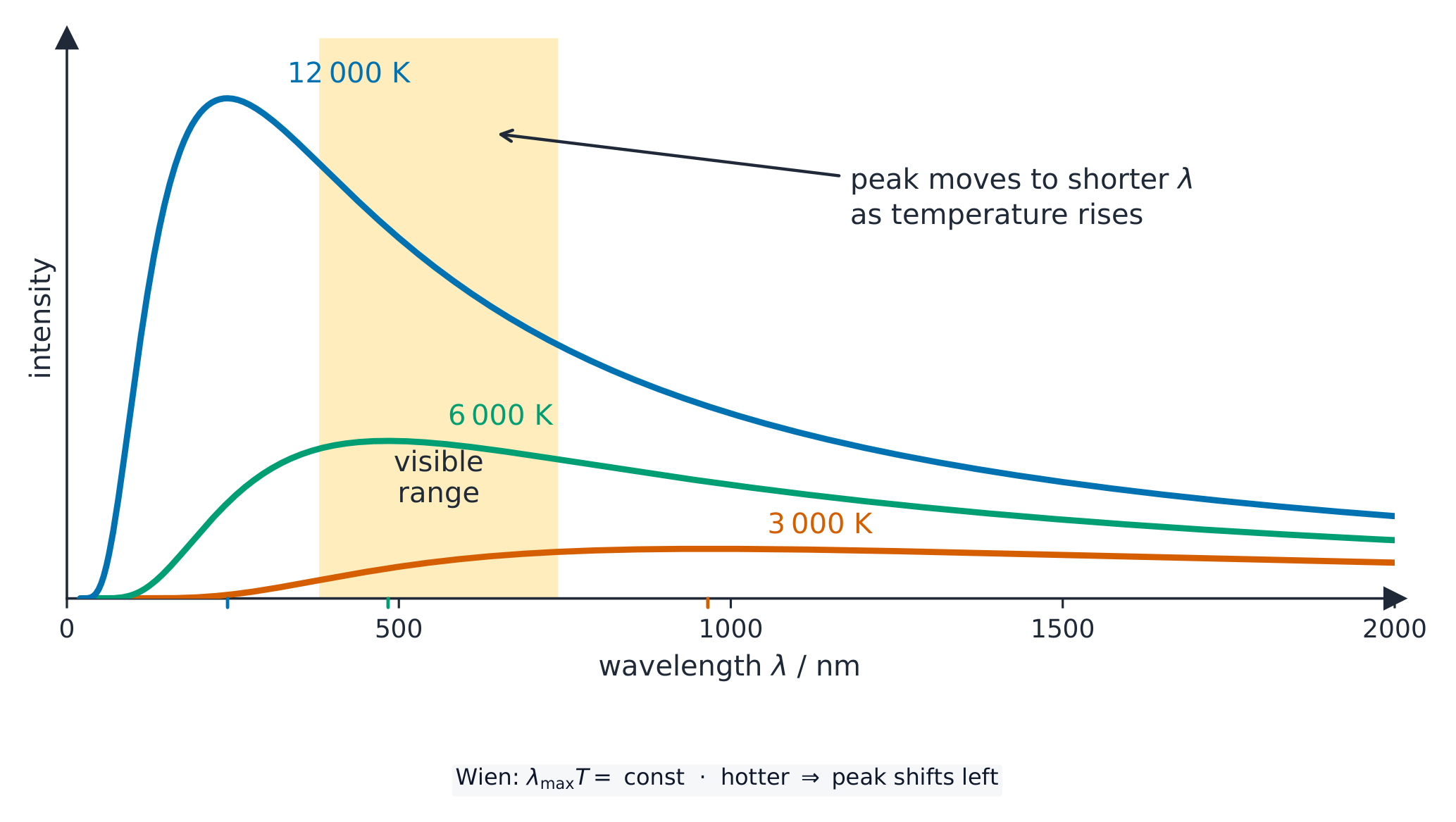
Hotter, taller, and further left
Hotter stars have their spectral peak (Wien's law) at a ____ wavelength.
Difficulty 1/5 · 100 coins + a small bonus on first completion today
$\lambda_{\max}T = b$, so a higher $T$ means a smaller $\lambda_{\max}$ — toward the blue.
Which belong in a statement of Wien's displacement law? Select all that apply.
Difficulty 2/5 · 140 coins + a small bonus on first completion today
It is about the peak of the continuous black-body curve, not the lines. Saying only the wavelength loses the mark; say the wavelength of maximum intensity.
Worked example: taking a star's temperature
- A star's spectrum peaks at $500\ \text{nm}$. Find its surface temperature.
- $T = \dfrac{b}{\lambda_{\text{max}}} = \dfrac{2.90\times10^{-3}}{500\times10^{-9}} = 5800\ \text{K}$.
- Convert nanometres to metres first. The constant is in metre kelvin, so a wavelength in nm gives a temperature out by $10^9$.
- This one measurement is the whole reason a star's colour is useful: colour is temperature.
A star's spectrum peaks at $\lambda_{\max} = 500\ \text{nm}$. What is its surface temperature? ($b = 2.9 \times 10^{-3}\ \text{m}\cdot\text{K}$)
Difficulty 2/5 · 140 coins + a small bonus on first completion today
$T = \dfrac{b}{\lambda_{\max}} = \dfrac{2.9 \times 10^{-3}}{500 \times 10^{-9}} \approx 5800\ \text{K}$ — about the Sun.
Match each star to where its spectrum peaks.
Difficulty 2/5 · 140 coins + a small bonus on first completion today
Hotter peaks shorter. This one measurement is why a star's colour is useful: colour is temperature.
The Stefan-Boltzmann law
- Treat the star as a blackbody sphere of radius $r$ at surface temperature $T$:
- $\sigma$ is the Stefan-Boltzmann constant 斯特藩-玻尔兹曼常量.
- Two dependences, and they are very different in strength. $L \propto r^2$: twice the radius, four times the luminosity. $L \propto T^4$: twice the temperature, sixteen times the luminosity.
- So a small error in temperature is a large error in luminosity, which is why the peak wavelength must be read carefully.
A star's luminosity and radius
L ∝ r²
For a given surface temperature, a star's luminosity grows with the SQUARE of its radius (Stefan's law).
The Stefan–Boltzmann law gives a star's luminosity as:
Difficulty 1/5 · 100 coins + a small bonus on first completion today
$L = 4\pi\sigma r^{2}T^{4}$ — strongly dependent on both radius and temperature.
Using $L = 4\pi\sigma r^2T^4$, which are true? Select all that apply.
Difficulty 2/5 · 140 coins + a small bonus on first completion today
L goes as r^2 and T^4. That fourth power is why the peak wavelength must be read carefully and corrected for redshift.
Worked example: the luminosity of a Sun-like star
- A star has radius $7.0\times10^{8}\ \text{m}$ and surface temperature $5800\ \text{K}$. Find its luminosity.
- $L = 4\pi\sigma r^2 T^4 = 4\pi(5.67\times10^{-8})(7.0\times10^{8})^2(5800)^4 = 3.9\times10^{26}\ \text{W}$.
- Square the radius and raise the temperature to the fourth power. On a calculator, do $T^4$ as its own step and check its magnitude: $(5800)^4 \approx 1.1\times10^{15}$.
If a star's temperature doubles (same radius), its luminosity multiplies by:
Difficulty 2/5 · 140 coins + a small bonus on first completion today
$L \propto T^{4}$, so doubling $T$ gives $2^{4} = 16$ times the luminosity.
Same luminosity, opposite stars
- Because $L$ depends on both $r$ and $T$, two completely different stars can have the same luminosity.
- A red giant is cool, so its $T^4$ is small, but it is enormous, and the $r^2$ makes up for it.
- A white dwarf is very hot but tiny: a huge $T^4$ against a minute $r^2$.
- Whenever an answer looks surprising, check it this way. A star $140$ times as luminous as the Sun but only $1.6$ times as hot must be considerably bigger, since $L \propto r^2T^4$.
Put the three steps for estimating a star's radius in order.
Difficulty 3/5 · 200 coins + a small bonus on first completion today
Each step is one line. Keep full precision of L and T until the end, because T is raised to the fourth power.
Estimating a radius, in three steps
- One. Measure $\lambda_{\text{max}}$ and get $T$ from Wien's law.
- Two. Get $L$, usually from the flux and distance: $L = 4\pi d^2 F$.
- Three. Solve the Stefan-Boltzmann law for the radius:
- Each step is one line. Keep the full precision of $L$ and $T$ until the end, because $T$ is raised to the fourth power and rounding it early is expensive.
Combining Wien's law and the Stefan–Boltzmann law lets us estimate a star's radius.
Difficulty 1/5 · 100 coins + a small bonus on first completion today
Wien gives $T$, the flux and distance give $L$, then $r = \sqrt{\dfrac{L}{4\pi\sigma T^{4}}}$.
Sunlight has flux 1370 W/m^2 at 1.50e11 m and the Sun's spectrum peaks at 500 nm. What is the Sun's radius, in units of 1e8 m?
Difficulty 2/5 · 140 coins + a small bonus on first completion today
L = 4 pi d^2 F = 3.87e26 W, T = 5800 K, then r = sqrt(L / (4 pi sigma T^4)) = 6.9e8 m against an accepted 6.96e8 m. Three one-line formulae, no telescope resolution needed.
Worked example: the radius of the Sun, from scratch
- Sunlight at the Earth has flux $1370\ \text{W/m}^2$ at $1.50\times10^{11}\ \text{m}$, and the Sun's spectrum peaks at $500\ \text{nm}$. Estimate the Sun's radius.
- Luminosity: $L = 4\pi d^2 F = 4\pi(1.50\times10^{11})^2(1370) = 3.87\times10^{26}\ \text{W}$.
- Temperature: $T = 2.90\times10^{-3}/(500\times10^{-9}) = 5800\ \text{K}$.
- Radius: $r = \sqrt{\dfrac{3.87\times10^{26}}{4\pi(5.67\times10^{-8})(5800)^4}} = 6.9\times10^{8}\ \text{m}$.
- The accepted value is $6.96\times10^{8}\ \text{m}$. Three one-line formulae, no telescope resolution required.
In $L = 4\pi\sigma r^2T^4$ and $F = L/(4\pi d^2)$, the lengths $r$ and $d$ mean the same thing.
Difficulty 1/5 · 100 coins + a small bonus on first completion today
r is the star's own radius; d is its distance from us. Swapping them is the commonest error in this topic, and the two differ by many orders of magnitude.
Marks that slip away
- Wien's law is about the wavelength of maximum intensity, and $T$ must be in kelvin.
- Convert $\lambda_{\text{max}}$ to metres; the constant $b$ is in metre kelvin.
- In $L = 4\pi\sigma r^2T^4$, $r$ is the star's radius; in $F = L/(4\pi d^2)$, $d$ is the distance to us. Two different lengths, and swapping them is the commonest error in this topic.
- Keep full precision until the last line, because $T$ is to the fourth power.
- For a receding galaxy, correct the observed peak before using Wien's law, or the temperature comes out too low.
You've got it
- Wien's displacement law: the wavelength of maximum intensity is inversely proportional to the thermodynamic temperature, $\lambda_{\text{max}}T = 2.90\times10^{-3}\ \text{m K}$
- Stefan-Boltzmann: $L = 4\pi\sigma r^2T^4$, so luminosity goes as the square of the radius and the fourth power of the temperature
- a radius comes in three steps: $\lambda_{\text{max}} \to T$, then $F$ and $d \to L$, then $r = \sqrt{L/(4\pi\sigma T^4)}$
- keep $r$ (the star) and $d$ (to us) apart, and hold full precision until the end because of the $T^4$