Hubble's law and the Big Bang
Introduced| English | Meaning |
|---|---|
| redshift/ˈredʃɪft/ | A shift of observed spectral features towards longer wavelengths. |
| Hubble's law/ˈhʌblz lɔː/ | For sufficiently nearby galaxies in the general cosmic expansion, recession speed is approximately proportional to distance. |
| Big Bang/bɪɡ bæŋ/ | The model in which the universe evolved from an early hot, dense state and has expanded and cooled over time. |
| Doppler effect/ˈdɒplə ɪˈfekt/ | A change in observed wave frequency caused by relative motion between a source and an observer. |
| recession/rɪˈseʃn/ | Motion away from an observer, as when a galaxy becomes more distant. |
| blueshifted/ˈbluːʃɪftɪd/ | Shifted towards shorter wavelengths compared with the emitted spectrum. |
| Hubble constant/ˈhʌbl ˈkɒnstənt/ | The present-day expansion rate of the universe, relating a distant galaxy's recession speed to its distance in the Hubble-Lemaitre law. |
| cosmic microwave background/ˈkɒzmɪk ˈmaɪkrəʊweɪv ˈbækɡraʊnd/ | Microwave radiation observed throughout space that is a remnant of the early hot universe. |
The fingerprint is right, but stretched
- Hydrogen in a laboratory always emits a line at $656.3\ \text{nm}$. In the light of a distant galaxy the same line arrives at $660.9\ \text{nm}$.
- The pattern of lines is unmistakably hydrogen. Every line has simply moved to a longer wavelength, by the same fraction.
- Something has stretched the light on its way here, and doing that arithmetic on galaxy after galaxy produced the largest conclusion in physics.
- This lesson is redshift 红移, Hubble's law 哈勃定律, and how they lead to the Big Bang 大爆炸.
Redshift
- The observed wavelength of the radiation from a source is longer than the wavelength emitted, because the source is moving away from the observer.
- It is the Doppler effect 多普勒效应 for light. For $v \ll c$:
- $\Delta\lambda = \lambda_{\text{observed}} - \lambda_{\text{emitted}}$, and $v$ is the speed of recession 退行.
- Divide by the emitted, laboratory wavelength, not the observed one. At small $v/c$ the difference is slight, but the mark scheme is specific.

The same pattern, slid to the right
Redshift means a galaxy's spectral lines are shifted to:
Difficulty 1/5 · 100 coins + a small bonus on first completion today
A receding source stretches the wavelengths — a redshift, with $\dfrac{\Delta\lambda}{\lambda} \approx \dfrac{v}{c}$.
In $\Delta\lambda/\lambda \approx v/c$, the $\lambda$ on the bottom is the observed wavelength.
Difficulty 1/5 · 100 coins + a small bonus on first completion today
It is the EMITTED, laboratory wavelength. At small v/c the difference is slight, but the mark scheme is specific about it.
Worked example: how fast, and how far
- A hydrogen line at $656.3\ \text{nm}$ in the laboratory is observed at $660.9\ \text{nm}$. Find the recession speed and, with $H_0 = 2.3\times10^{-18}\ \text{s}^{-1}$, the distance.
- $\Delta\lambda = 660.9 - 656.3 = 4.6\ \text{nm}$.
- $v = c\dfrac{\Delta\lambda}{\lambda} = (3.00\times10^{8})\dfrac{4.6}{656.3} = 2.1\times10^{6}\ \text{m/s}$.
- $d = \dfrac{v}{H_0} = \dfrac{2.1\times10^{6}}{2.3\times10^{-18}} = 9.1\times10^{23}\ \text{m}$, about $100$ million light years.
- The nanometres cancel inside the ratio, so there is no need to convert them, as long as both wavelengths are in the same unit.
A galaxy's lines show $\dfrac{\Delta\lambda}{\lambda} = 0.020$. What is its recession speed, as a fraction of $c$?
Difficulty 2/5 · 140 coins + a small bonus on first completion today
For $v \ll c$, $\dfrac{v}{c} = \dfrac{\Delta\lambda}{\lambda} = 0.020$.
Worked example: the other way round
- A galaxy recedes at $21400\ \text{km/s}$. At what wavelength is its $656.3\ \text{nm}$ hydrogen line seen?
- $\Delta\lambda = \lambda\dfrac{v}{c} = 656.3 \times \dfrac{2.14\times10^{7}}{3.00\times10^{8}} = 46.8\ \text{nm}$.
- So the line appears at $656.3 + 46.8 = 703\ \text{nm}$, moved out of the red and almost into the infrared.
- Every line and the continuous spectrum are stretched by the same factor $(1 + v/c) = 1.071$. Redshift moves the whole spectrum, not one line.
- Convert $\text{km/s}$ to $\text{m/s}$ first. A factor of $1000$ here is a very visible wrong answer.
A galaxy recedes at 21400 km/s. At what wavelength is its 656.3 nm hydrogen line observed, in nm?
Difficulty 2/5 · 140 coins + a small bonus on first completion today
delta lambda = lambda v/c = 46.8 nm, so the line appears at 703 nm. Convert km/s to m/s first; a factor of 1000 here is a very visible wrong answer.
Why this means the Universe is expanding
- The three-mark argument runs: (1) the spectral lines from almost all distant galaxies are shifted to longer wavelengths; (2) so by the Doppler effect those galaxies are moving away from us; (3) and the further away a galaxy is, the greater its redshift and so its speed.
- The third point is what makes it cosmological rather than local. That pattern is what an observer in any galaxy would see if the space between all galaxies were stretching.
- So the Universe as a whole is expanding, rather than everything fleeing from the Earth in particular.
- A few nearby galaxies are blueshifted 蓝移 by their own local motion, which is consistent: the expansion shows in the average over large distances.
Almost all distant galaxies are redshifted, which shows the Universe is expanding.
Difficulty 1/5 · 100 coins + a small bonus on first completion today
They are moving apart on average — the space between them is stretching.
Put the three-mark argument that the Universe is expanding in order.
Difficulty 3/5 · 200 coins + a small bonus on first completion today
The third point is what makes it cosmological. Without it you have only shown that things are moving away from the Earth in particular.
The trap with Wien's law
- If you feed the observed peak wavelength of a receding galaxy straight into Wien's law, the temperature comes out too low, because the observed peak is longer than the emitted one.
- Correct it first: $\lambda_{\text{emitted}} = \lambda_{\text{observed}}/(1 + v/c)$, then use Wien's law on the emitted peak.
- In the standard exam version, emitted $4.62\times10^{-7}\ \text{m}$ and observed $4.91\times10^{-7}\ \text{m}$ give $T = 6300\ \text{K}$ from the emitted peak. Using the observed one gives $5900\ \text{K}$: too low by $400\ \text{K}$.
- Asked to sketch the observed spectrum against the emitted one, draw the same shape shifted to longer wavelengths, peak included.
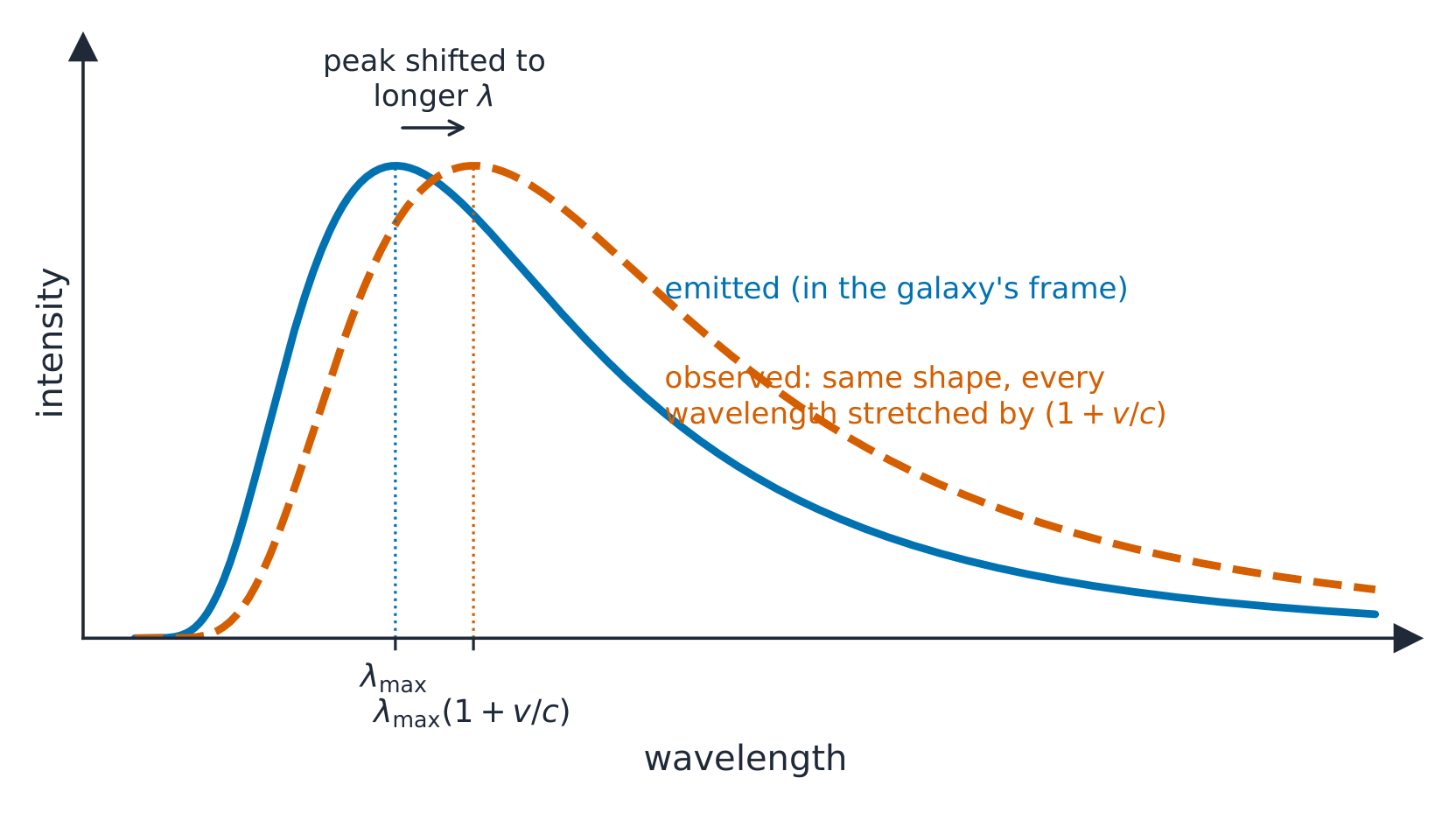
The whole curve slides, so the peak lies
Hubble's law
v = H₀·d
Recession speed is proportional to distance — the gradient is Hubble's constant.
Using the observed peak wavelength of a receding galaxy in Wien's law gives a temperature that is:
Difficulty 1/5 · 100 coins + a small bonus on first completion today
Correct the peak first with lambda_emitted = lambda_observed/(1 + v/c). In the standard version this is the difference between 6300 K and 5900 K.
Hubble's law
- The speed of recession of a galaxy is directly proportional to its distance from the observer:
- $v$ is the recession speed, $d$ the distance, and $H_0$ the Hubble constant 哈勃常数, about $2.3\times10^{-18}\ \text{s}^{-1}$.
- Identify every symbol when asked. The exam quotes $H_0$ in SI units, so $v$ must be in $\text{m/s}$ and $d$ in metres, never kilometres per second per megaparsec.
- On a graph of $v$ against $d$ the data lie on a straight line through the origin of gradient $H_0$.

Further means faster, in proportion
Hubble's law: recession speed $= H_0 \times$ ____.
Difficulty 1/5 · 100 coins + a small bonus on first completion today
$v = H_0 d$ — speed grows in proportion to distance.
Galaxy B is 3 times as far away as galaxy A. By Hubble's law, B recedes how many times as fast?
Difficulty 2/5 · 140 coins + a small bonus on first completion today
$v \propto d$, so 3 times the distance means 3 times the recession speed.
Which are required when using $v = H_0 d$ with $H_0$ in per second? Select all that apply.
Difficulty 2/5 · 140 coins + a small bonus on first completion today
The exam quotes H0 in SI units, so everything must be SI. Kilometres per second per megaparsec belongs to the astronomy literature, not to this paper.
From Hubble's law to the Big Bang
- If speed is proportional to distance, then running the expansion backwards brings every galaxy together at the same moment.
- All distances shrink to zero at $t = -1/H_0$: the Universe was once a tiny, enormously dense, hot point. That is the Big Bang.
- For steady expansion the age of the Universe is
- The main evidence, worth listing: the expansion itself, the redshift of galaxies, the cosmic microwave background 宇宙微波背景, and the observed hydrogen and helium abundances.
The approximate age of the Universe is:
Difficulty 1/5 · 100 coins + a small bonus on first completion today
Running the expansion back at a steady rate, all distances reach zero after a time $\dfrac{1}{H_0} \approx 14$ billion years.
Which are evidence for the Big Bang? Select all that apply.
Difficulty 2/5 · 140 coins + a small bonus on first completion today
Standard candles are a measuring tool, not evidence. 1/H0 is an ESTIMATE of the age assuming a steady rate of expansion, and the assumption should be stated.
Marks that slip away
- Divide $\Delta\lambda$ by the emitted wavelength, and put $v$ in $\text{m/s}$ and $d$ in metres for $H_0$ in $\text{s}^{-1}$.
- The expansion argument needs the third point: further galaxies recede faster. Without it you have only shown things are moving away from us.
- Correct a receding galaxy's peak wavelength before using Wien's law.
- Space itself is stretching. The galaxies are not flying through space away from a centre, and the Earth is not at one.
- $1/H_0$ is an estimate of the age assuming a steady rate of expansion. Say the assumption.
You've got it
- redshift is an observed wavelength longer than the emitted one, with $\Delta\lambda/\lambda \approx \Delta f/f \approx v/c$ for a receding source
- almost every distant galaxy is redshifted and the further ones more, which is what an observer in any galaxy would see if space were expanding
- Hubble's law is $v \approx H_0 d$ in SI units, a straight line through the origin of gradient $H_0$
- running the expansion backwards gives the Big Bang and an age of about $1/H_0 \approx 4.3\times10^{17}\ \text{s}$, supported also by the cosmic microwave background