Standard candles
Introduced| English | Meaning |
|---|---|
| luminosity/ˌluːmɪˈnɒsɪti/ | The total energy a star or other source emits as radiation per unit time. |
| inverse-square law/ɪnˈvɜːs skweə lɔː/ | A relationship in which a quantity is proportional to the reciprocal of the square of the distance from a source. |
| standard candle/ˈstændəd ˈkændl/ | An object whose luminosity is known from what type of object it is. |
| total power/ˈtəʊtl ˈpaʊə/ | total power |
| energy/ˈenədʒi/ | The capacity to do work or cause change. |
| radiant flux intensity/ˈreɪdɪənt flʌks ɪnˈtensɪti/ | Radiant power received or transmitted per unit area. |
| Cepheid variables/ˈsefiɪd ˈveərɪəblz/ | Pulsating stars whose brightness varies with a period related to their luminosity, allowing astronomers to estimate their distances. |
| Type Ia supernovae/taɪp wʌn ˈeɪ ˌsuːpəˈnəʊviː/ | Type Ia supernovae |
Two stars, equally bright, nothing alike
- Pick two stars out of the sky that look exactly as bright as each other. One may be a modest star nearby; the other a monster a hundred times further away.
- Brightness on its own tells you nothing. It is the product of two unknowns: how much light the star makes, and how far it has had to spread.
- Break that deadlock and you have measured the distance to another galaxy. The trick is to find an object whose output you already know.
- This lesson is luminosity 光度, the inverse-square law for flux, and the standard candle 标准烛光.
Luminosity
- The luminosity of a star is the total power 功率 of radiation emitted by the star, in watts. Equivalently, the total energy 能量 emitted per unit time.
- It is a property of the star alone. How bright it looks from Earth is not.
- Asked for two reasons one star appears brighter than another, give exactly these two: a greater luminosity, and a smaller distance.
- Anything else, including colour or size, only matters through those two.
The luminosity of a star is:
Difficulty 1/5 · 100 coins + a small bonus on first completion today
Luminosity $L$ is the energy radiated per second in all directions (watts).
Why might one star appear brighter than another? Select all that apply.
Difficulty 2/5 · 140 coins + a small bonus on first completion today
Colour and size only matter through the luminosity they produce. The two marked reasons are greater luminosity and smaller distance.
Flux and the inverse-square law
- At a distance $d$ that power has spread over a sphere of area $4\pi d^2$, so the radiant flux intensity 辐射通量密度 is
- Units: $\text{W/m}^2$. This is the inverse-square law 平方反比定律. Double the distance and the flux falls to a quarter.
- A telescope measures $F$. If $L$ is known too, the distance follows:

Same light, four times the area
Standard candle distance lab
brightness proportional to 1 / distance^2
Move distance and see why brightness falls quickly.
The flux received from a star falls as 1 over the distance ____.
Difficulty 1/5 · 100 coins + a small bonus on first completion today
$F = \dfrac{L}{4\pi d^{2}}$ — the inverse-square law.
Doubling the distance to a star reduces the radiant flux intensity to one half.
Difficulty 1/5 · 100 coins + a small bonus on first completion today
To one QUARTER. The power spreads over a sphere of area 4 pi d^2, so flux goes as 1/d^2. Using pi d^2 instead is out by a factor of four.
Worked example: sunlight at the Earth
- The Sun's luminosity is $3.8\times10^{26}\ \text{W}$ and the Earth is $1.5\times10^{11}\ \text{m}$ away. Find the radiant flux intensity here.
- $F = \dfrac{L}{4\pi d^2} = \dfrac{3.8\times10^{26}}{4\pi(1.5\times10^{11})^2} = 1.4\times10^{3}\ \text{W/m}^2$.
- That is the number behind every solar-panel calculation you will ever do.
- The $4\pi d^2$ is the area of a sphere, not a circle. Using $\pi d^2$ or $\pi r^2$ is the standard slip and it is out by a factor of four.
A star gives a flux of $100\ \dfrac{\text{W}}{\text{m}^2}$ at distance $d$. What is the flux at $3d$?
Difficulty 2/5 · 140 coins + a small bonus on first completion today
Inverse-square: $\dfrac{100}{3^{2}} = \dfrac{100}{9} \approx 11\ \dfrac{\text{W}}{\text{m}^2}$.
The graph that gives you $L$
- Plot $F$ against $1/d^2$ for one star and the inverse-square law becomes a straight line through the origin.
- Its gradient is $L/4\pi$, so $L = 4\pi \times \text{gradient}$.
- A more luminous star gives a steeper line. The origin matters: a line that misses it is not obeying an inverse-square law.
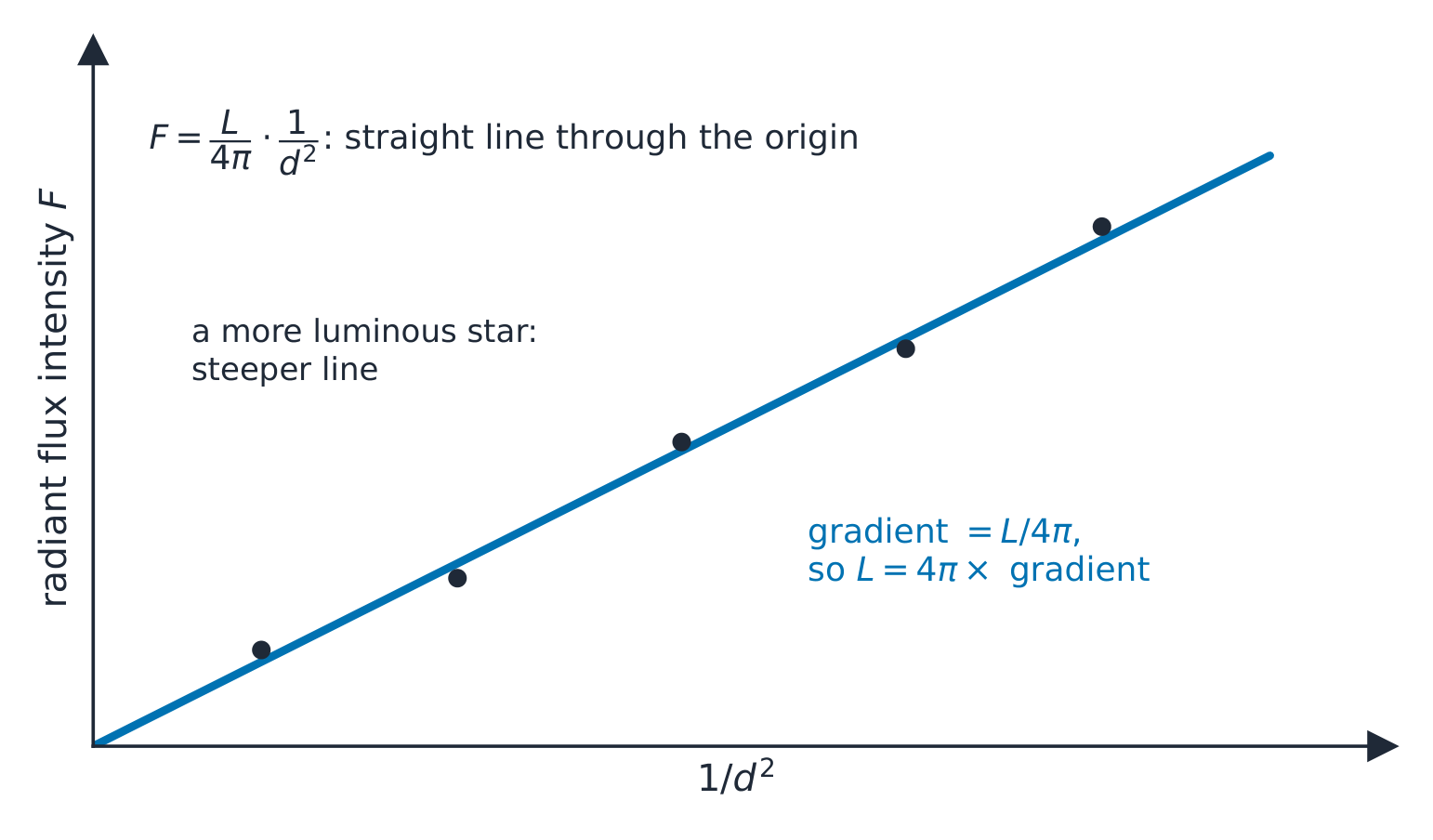
Straighten the curve and read off the luminosity
A graph of flux against $1/d^2$ is a straight line through the origin whose gradient equals the luminosity divided by ____.
Difficulty 1/5 · 100 coins + a small bonus on first completion today
F = (L/4pi)(1/d^2), so L = 4pi x gradient. A more luminous star gives a steeper line, and a line missing the origin is not obeying an inverse-square law.
Worked example: a solar panel on a probe
- The Sun has radius $6.96\times10^{8}\ \text{m}$ and surface temperature $5780\ \text{K}$. A probe $4.5\times10^{10}\ \text{m}$ from the Sun's centre carries a $2.0\ \text{m}^2$ panel facing the Sun. Find the power falling on it.
- Luminosity: $L = 4\pi\sigma r^2 T^4 = 4\pi(5.67\times10^{-8})(6.96\times10^{8})^2(5780)^4 = 3.85\times10^{26}\ \text{W}$.
- Flux there: $F = \dfrac{L}{4\pi d^2} = \dfrac{3.85\times10^{26}}{4\pi(4.5\times10^{10})^2} = 1.5\times10^{4}\ \text{W/m}^2$, eleven times the flux at the Earth.
- Power: $P = FA = 1.5\times10^{4}\times2.0 = 3.0\times10^{4}\ \text{W}$.
- Flux is power per unit area perpendicular to the radiation. A panel tilted at $\theta$ receives $FA\cos\theta$, which is why the question says "facing the Sun".
A probe 4.5e10 m from the Sun (L = 3.85e26 W) carries a 2.0 m^2 panel facing the Sun. What power falls on it, in kW?
Difficulty 2/5 · 140 coins + a small bonus on first completion today
F = L/(4 pi d^2) = 1.5e4 W/m^2, so P = FA = 3.0e4 W = 30 kW. A tilted panel receives FA cos(theta), which is why the question says the panel faces the Sun.
Standard candles
- A standard candle is an object whose luminosity is known from what type of object it is.
- Find one in a distant galaxy, measure the flux $F$ we receive from it, and the distance falls out of $d = \sqrt{L/(4\pi F)}$.
- This is the only way to reach galaxies far too distant for parallax. The whole distance ladder rests on it.
- The logic is worth stating cleanly in an answer: known $L$, measured $F$, therefore $d$.
A standard candle is an object whose ____ is known from its type.
Difficulty 1/5 · 100 coins + a small bonus on first completion today
Knowing $L$ (without first knowing distance) lets you get the distance from the measured flux.
Put the use of a standard candle in order.
Difficulty 3/5 · 200 coins + a small bonus on first completion today
Known L, measured F, therefore d. This is the only way to reach galaxies far too distant for parallax.
The two standard candles to name
- Cepheid variables 造父变星 are pulsating stars whose pulsation period is tightly linked to their luminosity. Time the pulsation and you know $L$.
- Type Ia supernovae 超新星 are white dwarfs that explode on reaching a critical mass, so they always have very nearly the same peak luminosity.
- Both are extremely bright, which is what lets them be seen in other galaxies at all.
- Name the mechanism, not just the object: "the period gives the luminosity", "they all explode at the same mass".
A Cepheid variable's pulsation period tells you its luminosity.
Difficulty 1/5 · 100 coins + a small bonus on first completion today
The period–luminosity relation makes Cepheids excellent standard candles.
Match each standard candle to why its luminosity is known.
Difficulty 2/5 · 140 coins + a small bonus on first completion today
Name the mechanism, not just the object. Both are extremely bright, which is what lets them be seen in other galaxies at all.
Marks that slip away
- The area in the inverse-square law is $4\pi d^2$, a sphere. Not $\pi d^2$.
- Luminosity is a property of the star; flux is what we receive. Questions swap the words deliberately.
- The two reasons one star looks brighter are greater luminosity and smaller distance. Nothing else.
- A standard candle needs a known luminosity. Saying it is "a very bright star" is not the point.
- Keep the distance in metres throughout, and remember flux is measured perpendicular to the radiation.
You've got it
- luminosity is the total power of radiation emitted by a star, a property of the star alone
- radiant flux intensity is $F = L/(4\pi d^2)$, so doubling the distance quarters the flux, and $F$ against $1/d^2$ is a straight line of gradient $L/4\pi$
- a standard candle has a known luminosity, so a measured flux gives the distance $d = \sqrt{L/(4\pi F)}$
- Cepheid variables give $L$ from their pulsation period, and Type Ia supernovae all peak at nearly the same luminosity