- define and use distance, displacement, speed, velocity and acceleration
- use graphical methods to represent distance, displacement, speed, velocity and acceleration
- determine displacement from the area under a velocity–time graph
- determine velocity using the gradient of a displacement–time graph
- determine acceleration using the gradient of a velocity–time graph
- derive, from the definitions of velocity and acceleration, equations that represent uniformly accelerated motion in a straight line
- solve problems using equations that represent uniformly accelerated motion in a straight line, including the motion of bodies falling in a uniform gravitational field without air resistance
- describe an experiment to determine the acceleration of free fall using a falling object
- describe and explain motion due to a uniform velocity in one direction and a uniform acceleration in a perpendicular direction
运动学
A-Level 物理 · 第 2 主题
 20:32
20:32
Kinematics
In 1971, an astronaut stood on the Moon and held out a hammer and a feather. On Earth, the feather would flutter down slowly, far behind the hammer. But the…
英文讲解 · 内嵌中英文字幕
2.1
运动方程

大纲
来源:剑桥国际大纲
这五个物理量几乎在每一道运动学(kinematics)题里都会出现。要记住准确的用词——考官是按精确表述给分的。
- 距离(distance)——走过的路径的总长度。是一个标量(scalar)。
- 位移(displacement)——从起点到终点的直线距离,带方向。是一个矢量(vector)。
- 速率(speed)——距离对时间的变化率。是标量。
- 速度(velocity)——位移对时间的变化率。是矢量。
- 加速度(acceleration)——速度对时间的变化率。是矢量。
速率和速度的单位是 $\text{m s}^{-1}$;加速度的单位是 $\text{m s}^{-2}$。
考官还会用到两个说法:匀加速(uniform acceleration)指恒定的加速度(速度-时间图上是一条直线);自由落体加速度(acceleration of free fall)$g$ 是物体在匀强重力场(uniform gravitational field)中、空气阻力可忽略(negligible,小到可以不计)时自由下落的加速度。
一个常见错误:减速度(deceleration)只是指方向与速度相反的加速度,它并不是一个单独的物理量。
速率有时以 $\text{km h}^{-1}$ 给出。先换算再计算:$85\ \text{km h}^{-1} = 85 \times 1000 / 3600 = 23.6\ \text{m s}^{-1}$。
探索
The velocity–time graph
v = u + at
On a speed–time graph the gradient is the acceleration and the area underneath is the distance travelled.
词汇表
训练
| 英文 | 中文 | 拼音 |
|---|---|---|
| projectile/prəˈdʒektaɪl/ | 抛体 | pāo tǐ |
| speed/spiːd/ | 速率 | sù lǜ |
| distance/ˈdɪstəns/ | 距离 | jù lí |
| kinematics/ˌkɪnɪˈmætɪks/ | 运动学 | yùn dòng xué |
| scalar/ˈskeɪlə/ | 标量 | biāo liàng |
| displacement/dɪˈspleɪsmənt/ | 位移 | wèi yí |
| vector/ˈvektə/ | 矢量 | shǐ liàng |
| velocity/vəˈlɒsɪti/ | 速度 | sù dù |
| acceleration/əkˌseləˈreɪʃn/ | 加速度 | jiā sù dù |
| uniform acceleration/ˈjuːnɪfɔːm əkˌseləˈreɪʃn/ | 匀加速 | yún jiā sù |
| acceleration of free fall/əkˌseləˈreɪʃn ɒv friː fɔːl/ | 自由落体加速度 | zì yóu luò tǐ jiā sù dù |
| free fall/friː fɔːl/ | 自由落体 | zì yóu luò tǐ |
| uniform gravitational field/ˈjuːnɪfɔːm ˌɡrævɪˈteɪʃənl fiːld/ | 匀强重力场 | yún qiáng zhòng lì chǎng |
| negligible/ˈneɡlɪdʒəbl/ | 可忽略的 | kě hū lüè de |
| deceleration/dɪˌseləˈreɪʃn/ | 减速度 | jiǎn sù dù |
2.1
运动图像

很多分数都来自读图或画运动图像——这就是大纲所说的图像法(graphical methods)。有两种图很重要。
位移-时间图
位移-时间图上某点的斜率(gradient,陡峭程度)给出该时刻的速度。
- 水平线 → 物体静止。
- 倾斜的直线 → 匀速(斜率 = 速度)。
- 曲线 → 速度在变化。在该点画一条切线(tangent),求它的斜率。
速度-时间图
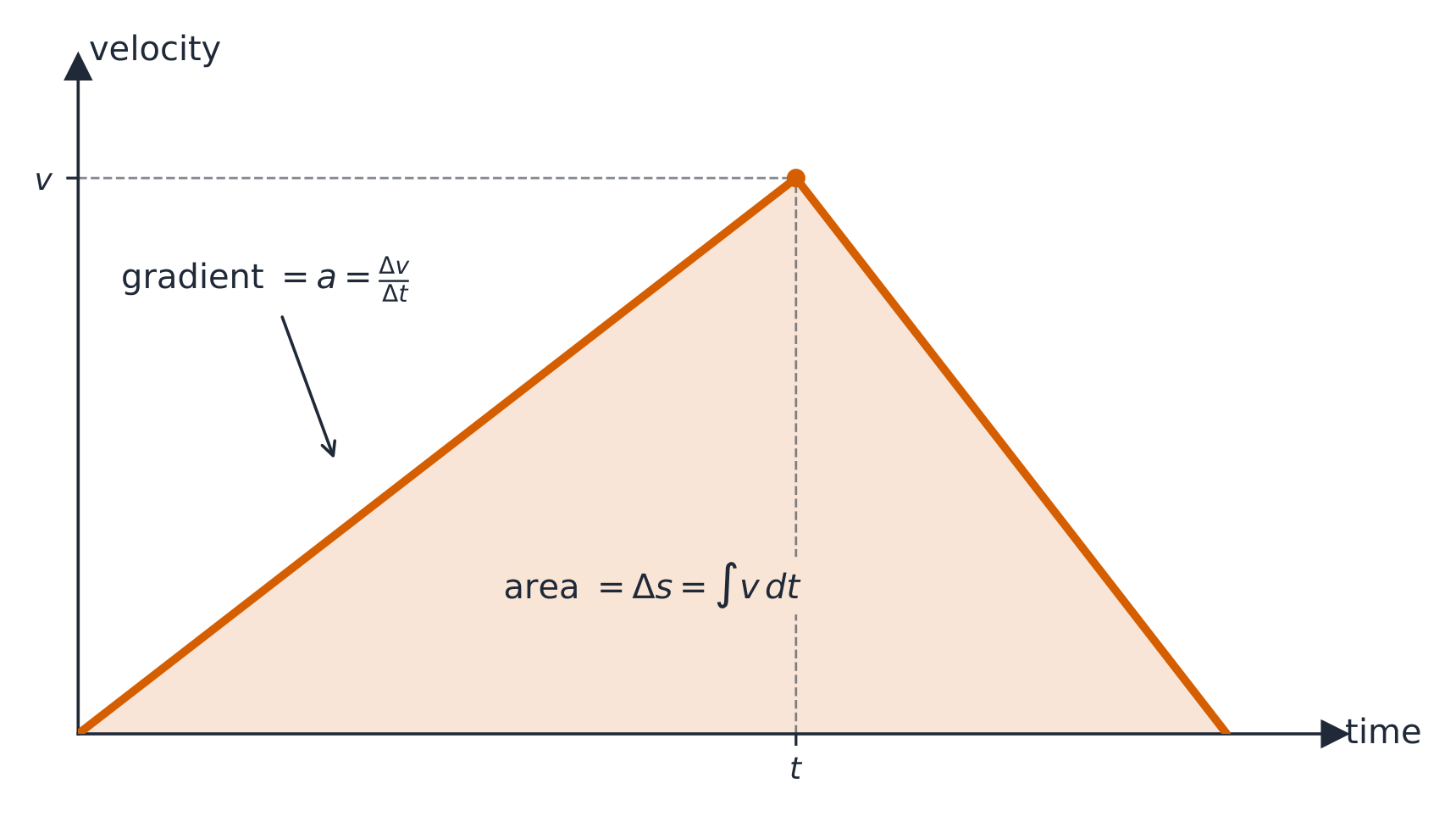
速度-时间图的斜率给出该时刻的加速度。
线与时间轴之间的面积(area)给出那段时间内的位移。
- 水平线 → 匀速(加速度为零)。
- 倾斜的直线 → 匀加速(加速度恒定)。
- 曲线 → 加速度在变化。
- 时间轴上方的面积是正位移;下方的面积是负的(物体向后运动)。
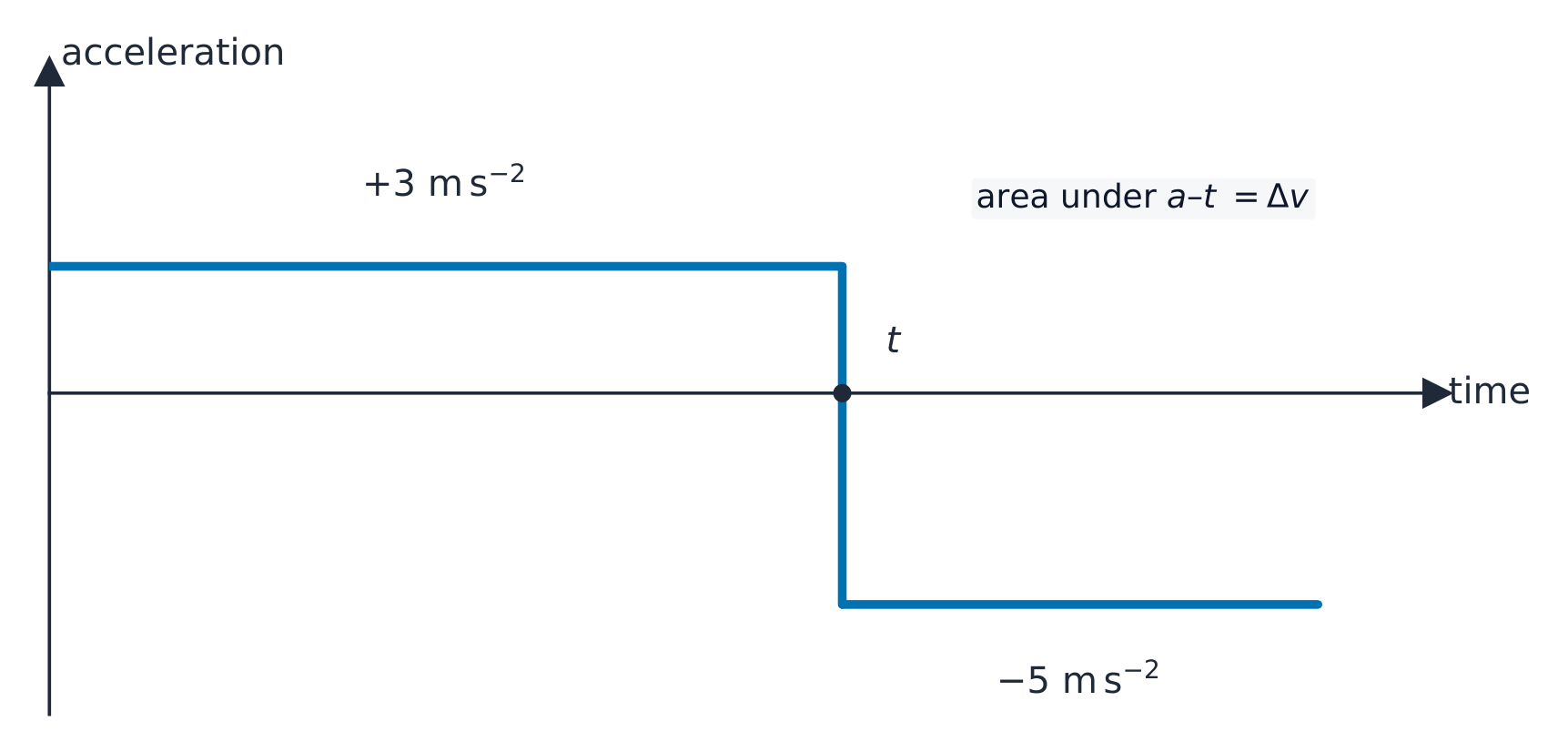
要求位移,就把面积分成若干三角形和矩形,或者数网格方块。三角形面积是 $\tfrac{1}{2} \times \text{base} \times \text{height}$;矩形面积是 $\text{base} \times \text{height}$。
例题。 图中给出一部电梯的速度。求每个阶段的加速度以及总路程。
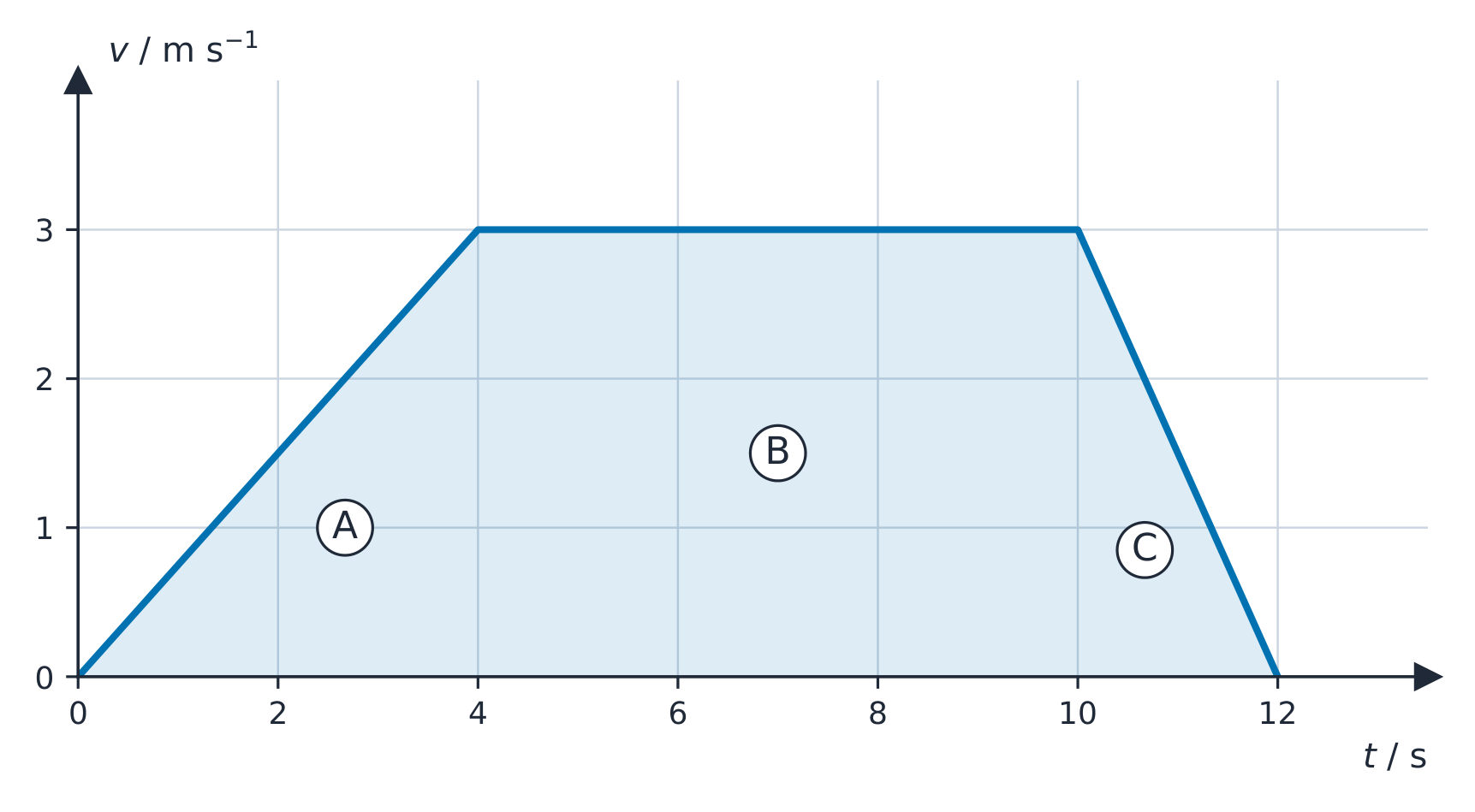
- 阶段 A:斜率 $= \dfrac{3.0 - 0}{4.0} = 0.75\ \text{m s}^{-2}$。
- 阶段 B:线是平的,所以加速度为零。
- 阶段 C:斜率 $= \dfrac{0 - 3.0}{2.0} = -1.5\ \text{m s}^{-2}$(减速度为 $1.5\ \text{m s}^{-2}$)。
- 路程:三角形 A $= \tfrac{1}{2} \times 4.0 \times 3.0 = 6.0\ \text{m}$,矩形 B $= 6.0 \times 3.0 = 18\ \text{m}$,三角形 C $= \tfrac{1}{2} \times 2.0 \times 3.0 = 3.0\ \text{m}$;总计 $27\ \text{m}$。
当图线是曲线时,面积仍然是位移:数出曲线下方的方格数(半格及以上算一格),再乘以一格代表的值。
探索
Reading a velocity–time graph
Change the start velocity u and the acceleration a. The gradient of the line is the acceleration; the area under it is the displacement.
词汇表
训练
| 英文 | 中文 | 拼音 |
|---|---|---|
| graphical methods/ˈɡræfɪkl ˈmeθədz/ | 图像法 | tú xiàng fǎ |
| gradient/ˈɡreɪdɪənt/ | 斜率 | xié lǜ |
| tangent/ˈtændʒənt/ | 切线 | qiè xiàn |
2.1
四个匀加速运动方程
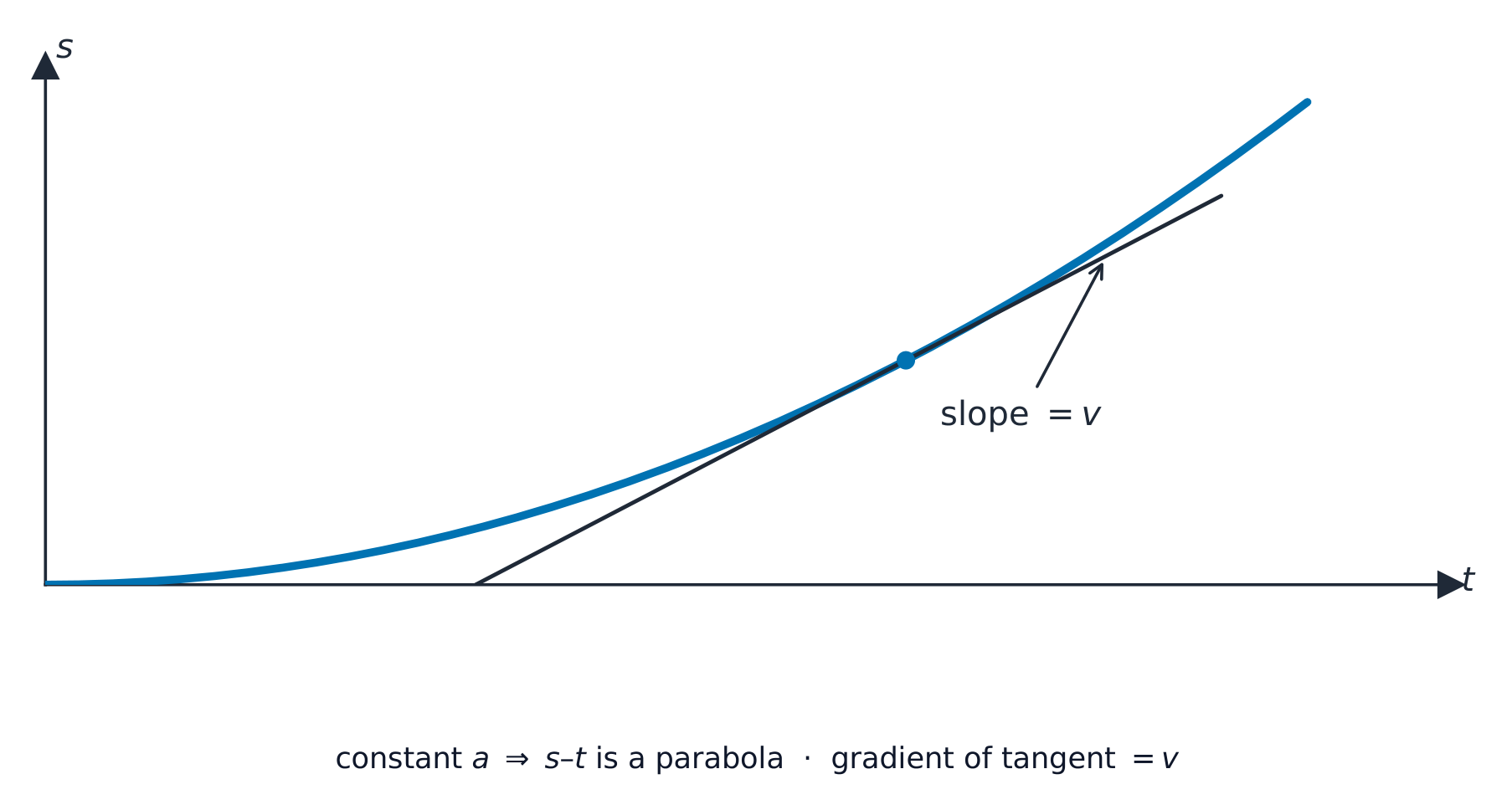
对于沿直线做匀加速的运动,我们用五个符号:初速度 $u$、末速度 $v$、加速度 $a$、位移 $s$ 和时间 $t$。四个方程把它们联系起来:
$$v = u + at$$
$$s = ut + \tfrac{1}{2} a t^{2}$$
$$s = \tfrac{1}{2}(u + v)t$$
$$v^{2} = u^{2} + 2as$$
每个方程用到五个符号中的四个。要选对方程:写下你已知的和你想求的,然后选恰好含这四个符号的那个方程。
例题。 一辆汽车在 $56\ \text{m}$ 的距离内从 $8\ \text{m s}^{-1}$ 匀加速到 $20\ \text{m s}^{-1}$。求它的加速度。
我们已知 $u$、$v$ 和 $s$,要求 $a$,所以用 $v^{2} = u^{2} + 2as$:
$$20^{2} = 8^{2} + 2a(56) \quad\Rightarrow\quad 336 = 112\,a \quad\Rightarrow\quad a = 3.0\ \text{m s}^{-2}.$$
SUVAT 方程从何而来
你应该能从速度和加速度的定义推出这些方程。想象这个运动的速度-时间图:一条从 $t = 0$ 时的 $u$ 到时刻 $t$ 的 $v$ 的直线。
- $v = u + at$:加速度是斜率,$a = (v - u)/t$,所以 $v = u + at$。
- $s = \tfrac{1}{2}(u + v) t$:位移是线下方的面积——一个梯形(trapezium),平行边为 $u$ 和 $v$,宽为 $t$,所以 $s = \tfrac{1}{2}(u + v)t$。
- $s = ut + \tfrac{1}{2}at^{2}$:把 $v = u + at$ 代入面积:$s = \tfrac{1}{2}(u + u + at)t = ut + \tfrac{1}{2}at^{2}$。
- $v^{2} = u^{2} + 2as$:由第一个方程 $t = (v - u)/a$;代入 $s = \tfrac{1}{2}(u + v)t$ 得 $2as = (v + u)(v - u) = v^{2} - u^{2}$。
"推导"题要的正是这些步骤,每一步都从一个定义或已经建立的方程出发,不带数字。
如果题目问"哪个方程只用速度-时间图的斜率就能求出?",答案是 $v = u + at$(斜率就是加速度)。
"证明"(show that)题。 当题目已经给出答案("证明高度是 3.2 km")时,分数在于方法。写出方程,把每个值连同单位代入,并把结果给到比题目引用的值多一位有效数字($3.24\ \text{km}$,四舍五入得 $3.2\ \text{km}$)。只是得到题目给的值本身证明不了什么。
选定一个正方向
一开始就选定一个正方向并保持不变。任何指向相反方向的量都要带负号。对于竖直上抛的球,若取"向上"为正:$u$ 为正,$a = -g$(重力(gravity)向下拉),而在最高点位移为正但速度为零。
词汇表
训练
| 英文 | 中文 | 拼音 |
|---|---|---|
| trapezium/trəˈpiːzɪəm/ | 梯形 | tī xíng |
| parabola/pəˈræbələ/ | 抛物线 | pāo wù xiàn |
| gravity/ˈɡrævɪti/ | 重力 | zhòng lì |
2.1
重力作用下的自由落体

当空气阻力(air resistance)可以忽略时,做自由落体(free fall)的物体有一个向下的恒定加速度 $g \approx 9.81\ \text{m s}^{-2}$。这个值对每一个质量都相同。
对于从静止释放、下落距离为 $h$ 的球:
$$h = \tfrac{1}{2}gt^{2}, \qquad v = gt, \qquad v^{2} = 2gh.$$
对于以速度 $u$ 竖直上抛的球:
- 最大高度:在 $v^{2} = u^{2} - 2gh$ 中令 $v = 0$,得 $h = u^{2}/(2g)$。
- 到达顶点的时间:在 $v = u - gt$ 中令 $v = 0$,得 $t = u/g$。
- 落回起始高度的总时间:$2u/g$(运动是对称的(symmetric))。
例题。 一个球以 $20\ \text{m s}^{-1}$ 竖直上抛。求它能达到的最大高度(取 $g = 9.81\ \text{m s}^{-2}$)。
在最高点 $v = 0$,所以由 $h = u^{2}/(2g)$:
$$h = \frac{20^{2}}{2 \times 9.81} = \frac{400}{19.62} \approx 20.4\ \text{m}.$$
当空气阻力不可忽略时
上面的方程假设唯一的力是重力。有空气阻力时,下落物体所受的合力小于它的重力,所以加速度小于 $g$;而且因为空气阻力随速率增大,物体越快,加速度就越小。在速度-时间图上线会弯曲,随着物体接近收尾速度(terminal velocity,主题 3),斜率趋向于零。对于抛体,空气阻力使射程变短、最大高度变低,路径不再是一条对称的抛物线(parabola):物体下落时比上升时更陡。"说明并解释"类的题目要先说力,再说它对加速度的影响,最后说对运动的影响。
测量 $g$ 的实验
一个常用方法:让物体从静止下落,然后测出它下落的距离 $h$ 和所用的时间 $t$。于是
$$g = \frac{2h}{t^{2}}.$$
对几个不同的高度重复实验,并作 $h$ 对 $t^{2}$ 的图。最佳直线的斜率是 $g/2$,所以 $g$ 是斜率的两倍。重复实验能减小随机误差(random error)。用电子计时器——借助光电门(light gates),或用球撞击的开关——可以消除反应时间(reaction-time)误差。
词汇表
训练
| 英文 | 中文 | 拼音 |
|---|---|---|
| air resistance/eə rɪˈzɪstəns/ | 空气阻力 | kōng qì zǔ lì |
| symmetric/sɪˈmetrɪk/ | 对称 | duì chèn |
| terminal velocity/ˈtɜːmɪnl vəˈlɒsɪti/ | 收尾速度 | shōu wěi sù dù |
| random error/ˈrændəm ˈerə/ | 随机误差 | suí jī wù chā |
| light gates/laɪt ɡeɪts/ | 光电门 | guāng diàn mén |
| light gate/laɪt ɡeɪt/ | 光电门 | guāng diàn mén |
| reaction-time/rɪˈækʃn taɪm/ | 反应时间 | fǎn yìng shí jiān |
2.1
二维运动

当一个物体在一个方向(比如水平(horizontal))上匀速运动,同时在与之垂直的方向(比如竖直(vertical),受重力作用)上加速时,这两个方向的运动互不影响。把每个方向单独处理,各用各的 SUVAT 方程。
水平抛出
一个以速度 $u_{\text{H}}$ 从高度 $h$ 水平抛出的物体,忽略空气阻力:
- 水平方向:匀速 $u_{\text{H}}$。经过时间 $t$ 后,水平距离为 $x = u_{\text{H}} t$。
- 竖直方向:从静止开始,以 $g$ 向下加速。经过时间 $t$ 后,已下落 $y = \tfrac{1}{2} g t^{2}$,竖直速度为 $v_{\text{V}} = g t$。
落地所需的时间只取决于高度 $h$,与 $u_{\text{H}}$ 无关。解 $h = \tfrac{1}{2} g t^{2}$ 求出 $t$;那么水平射程(range)就是 $u_{\text{H}} t$。
例题。 一个球从 $20\ \text{m}$ 高的悬崖顶以 $15\ \text{m s}^{-1}$ 水平抛出。求它落地所需的时间,以及落地点离崖底的距离(取 $g = 9.81\ \text{m s}^{-2}$)。
竖直方向的运动给出时间:由 $h = \tfrac{1}{2}g t^{2}$,
$$t = \sqrt{\frac{2h}{g}} = \sqrt{\frac{2 \times 20}{9.81}} \approx 2.0\ \text{s}.$$
再由水平方向的运动给出射程:$x = u_{\text{H}} t = 15 \times 2.0 \approx 30\ \text{m}.$
水平速度图是一条在 $u_{\text{H}}$ 处的水平线。竖直速度图是从原点出发、斜率为 $g$ 的直线。
比较两个物体。 如果物体 A 被释放、物体 B 在同一时刻从同一高度被水平抛出,两者同时落地:它们的竖直运动完全相同。如果 B 被抛出时带有向上的分量,它需要更长的时间,因为它必须先上升再回到起始高度,然后才下落同样的距离。它落地时的速率仍然由能量求得:无论抛出的方向如何,获得的动能都等于失去的势能,所以从同一高度以同一速率、以任何角度抛出的球,落地速率都相同(主题 5)。
有角度的抛体
一个以速度 $u$、与水平方向成 $\theta$ 角向上抛出的抛体(projectile):
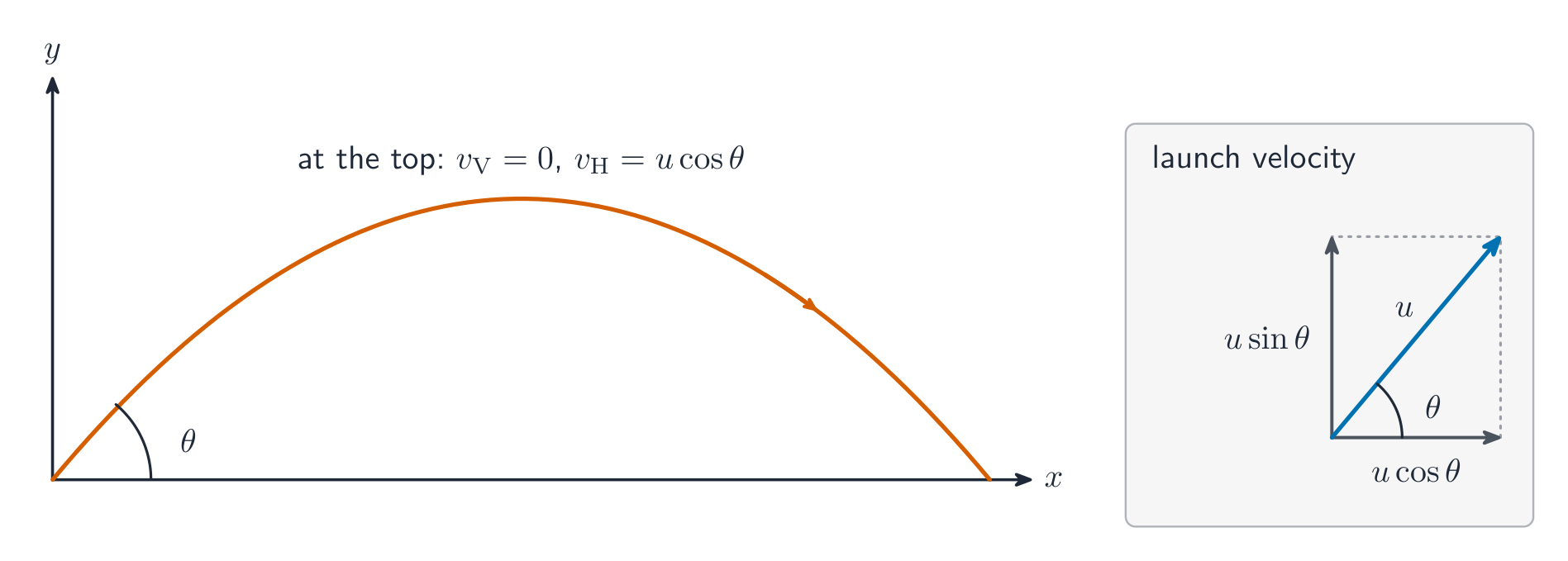
- 初速度的水平分量(component):$u_{\text{H}} = u \cos\theta$(在飞行过程中保持不变)。
- 初速度的竖直分量:$u_{\text{V}} = u \sin\theta$(逐渐变小,在顶点变为零,然后向下增大)。
在最高点,$v_{\text{V}} = 0$,但 $v_{\text{H}}$ 仍是 $u\cos\theta$。到达顶点的时间是 $t_{\text{up}} = u\sin\theta / g$;总飞行时间(回到起始高度)是 $2t_{\text{up}}$。
画速度图。 考官常要求你在同一坐标系里画出 $v_{\text{H}}$ 和 $v_{\text{V}}$ 随时间变化的草图,取向上为正。水平分量在整个飞行中是一条在 $u\cos\theta$ 处的水平线。竖直分量是一条斜率为 $-g$ 的直线:从 $+u\sin\theta$ 出发,在飞行顶点处穿过零,落回起始高度时到达 $-u\sin\theta$。给每条线加上标注,标出各线起止的时刻,并让穿零点正好落在 $t_{\text{up}}$。
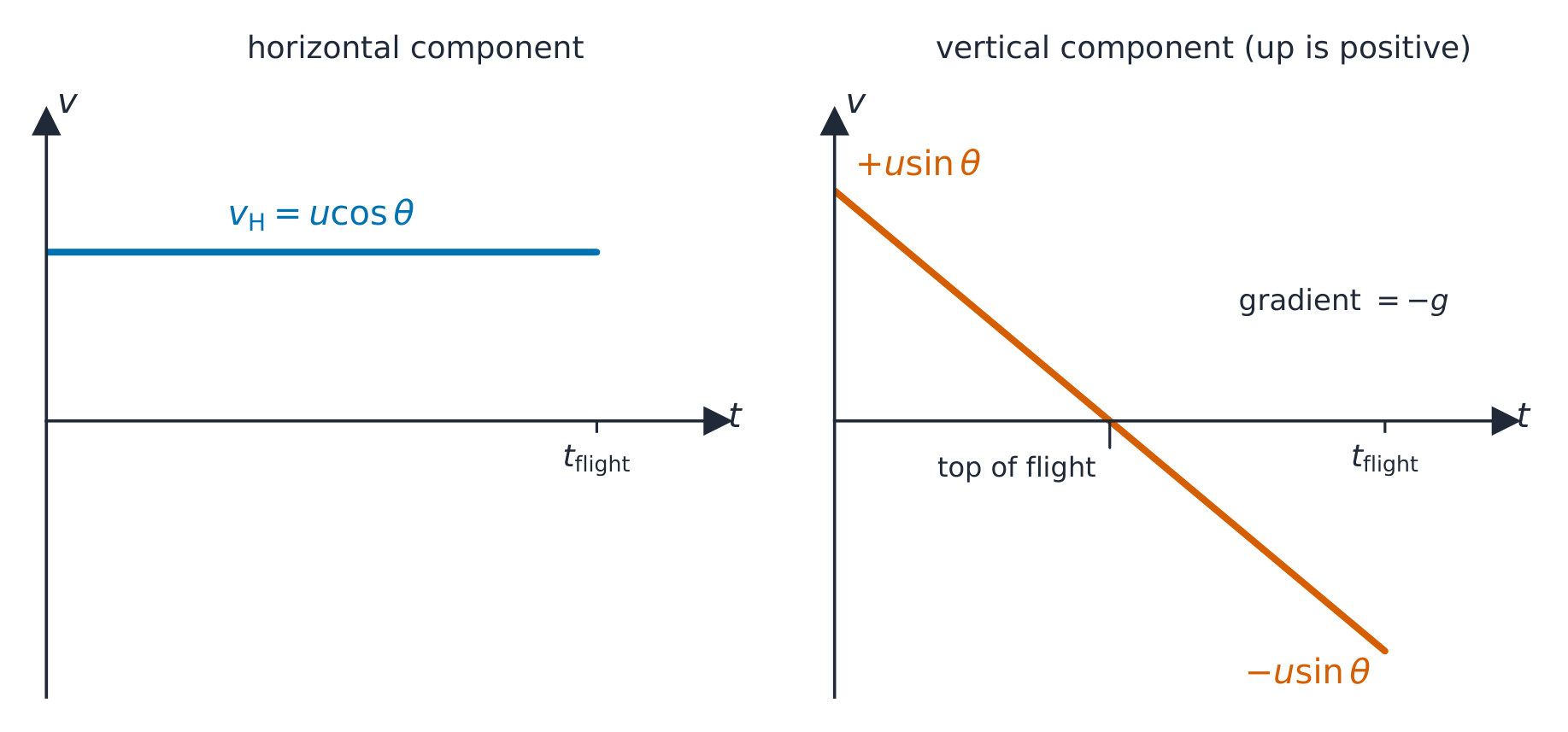
例题。 一个球以 $18\ \text{m s}^{-1}$、与水平方向成 $60°$ 离开地面。证明它在 $t = 1.6\ \text{s}$ 时达到最大高度。
$u_{\text{V}} = 18 \sin 60° = 15.6\ \text{m s}^{-1}$。在顶点 $v_{\text{V}} = 0$,所以由 $v = u + at$、$a = -9.81\ \text{m s}^{-2}$:$t = 15.6 / 9.81 = 1.59\ \text{s} \approx 1.6\ \text{s}$。

弹跳的球
当一个球弹跳时,它的速度-时间图是一组倾斜的直线段(恒定的 $g$),在每次弹跳处有一个突然的跳变(速度方向反转,若损失了一些能量(energy)则变小)。把各次弹跳的时间和距离加起来。
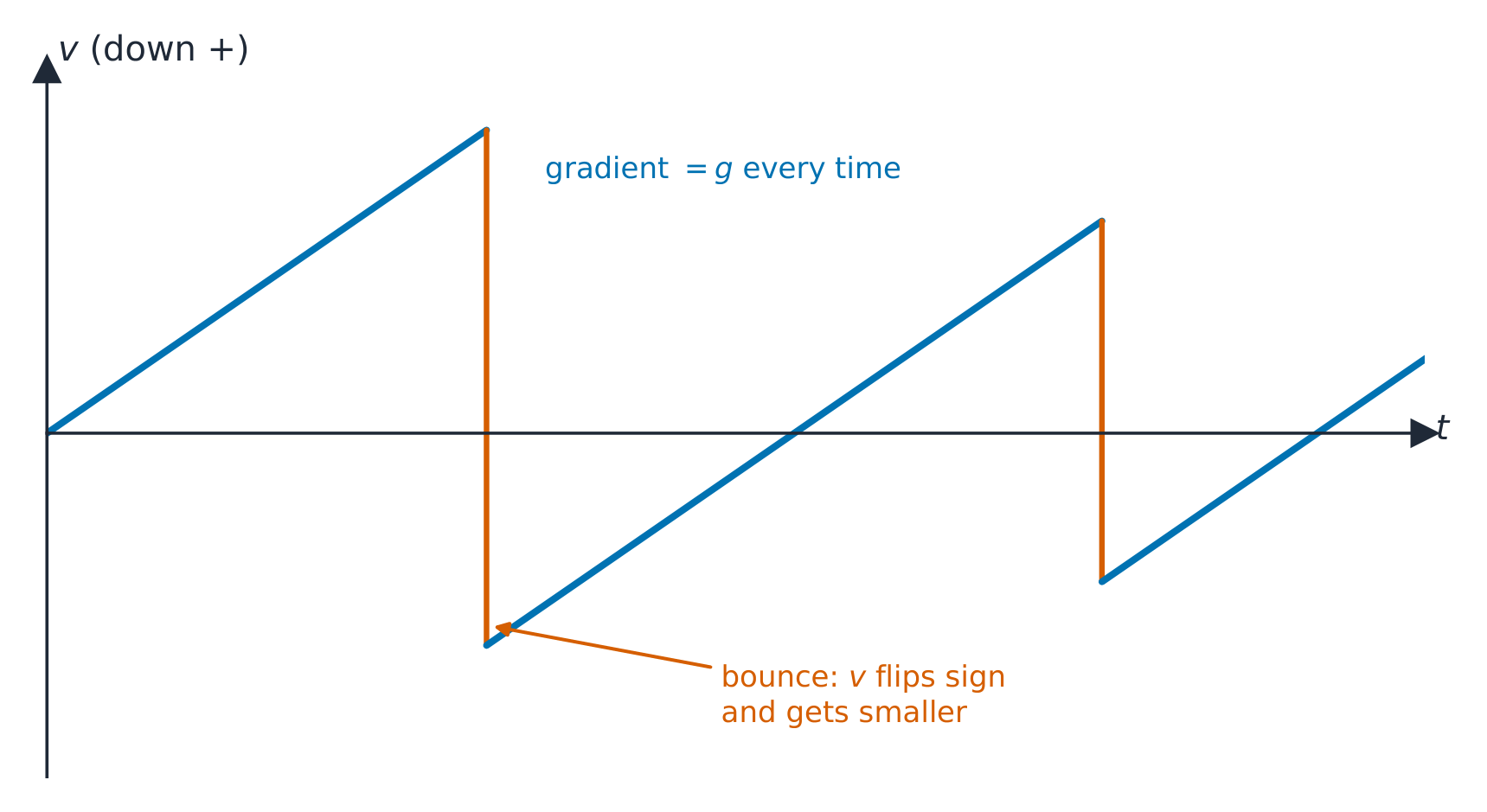
仔细读这样的图:每条斜线的斜率都是同一个 $g$;线穿过时间轴的地方就是球的最高点;每次弹起的高度来自该段飞行在轴上方(或下方)的三角形面积。
探索
Launch a projectile
Fire the ball, then change the angle and speed. The horizontal motion is steady while gravity pulls it down — together they trace a parabola. Find the angle for the longest range, and try the Moon.
词汇表
训练
| 英文 | 中文 | 拼音 |
|---|---|---|
| range/reɪndʒ/ | 射程 | shè chéng |
| horizontal/ˌhɒrɪˈzɒntl/ | 水平 | shuǐ píng |
| vertical/ˈvɜːtɪkl/ | 竖直 | shù zhí |
| component/kəmˈpəʊnənt/ | 分量 | fèn liàng |
| energy/ˈenədʒi/ | 能量 | néng liàng |
2.1
两物体相遇
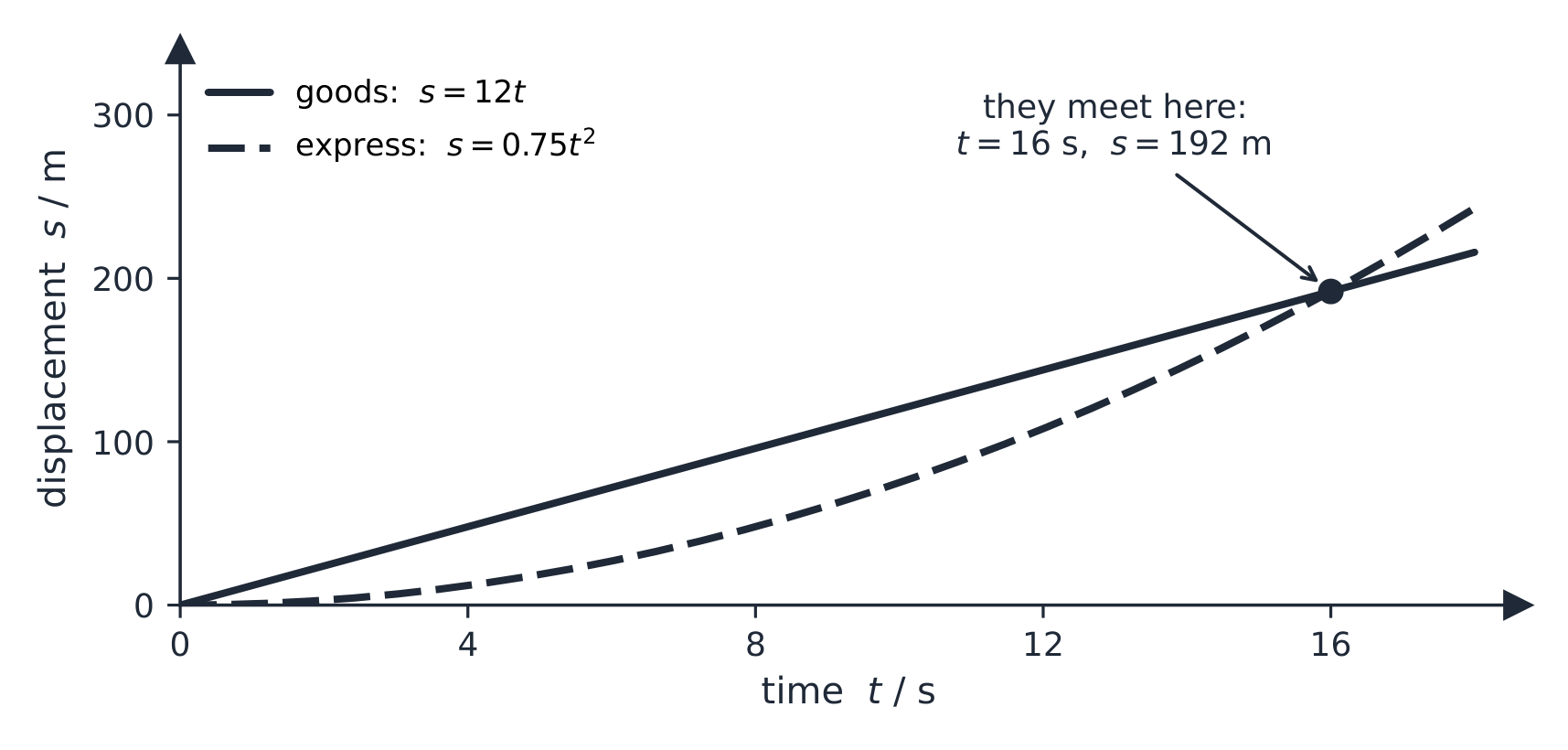
当两个物体沿同一条直线以不同方式运动时,分别给每个物体写一个位移方程。用相同的起始时间和相同的正方向。然后令两个位移相等(或令它们的差等于给定的间距)。
对于一列以恒定速度 $u_{\text{G}}$ 行驶的货运列车和一列从静止以加速度 $a$ 出发的特快列车,若两者都在 $t = 0$ 时经过同一点:
$$s_{\text{G}} = u_{\text{G}} t, \qquad s_{\text{E}} = \tfrac{1}{2} a t^{2}.$$
当 $s_{\text{G}} = s_{\text{E}}$ 时它们再次并排,得 $t = 2 u_{\text{G}} / a$。
2.1
解题技巧
- 画一张图,并标出正方向。
- 列出 SUVAT 符号及其已知与未知的值,包括正负号。
- 选择 SUVAT 方程,使它恰好含有你已知的四个符号加上你要求的那个。
- 对于抛体运动,拆成水平和竖直两个 SUVAT 问题,二者仅通过时间 $t$ 相联系。
- 始终检查答案的单位,以及数值大小是否合理。
2.1
考官认可的定义
定义题按固定的表述给分。把这些记准确,并且只写一个答案。
| 术语 | 定义 |
|---|---|
| 距离(distance) | 走过的路径的总长度(标量) |
| 位移(displacement) | 在指定方向上从起点到终点移动的距离(矢量) |
| 速率(speed) | 距离对时间的变化率 |
| 速度(velocity) | 位移对时间的变化率 |
| 加速度(acceleration) | 速度对时间的变化率 |
| 匀加速(uniform acceleration) | 大小和方向都恒定的加速度 |
| 自由落体加速度(acceleration of free fall) | 物体仅在重力作用下、空气阻力可忽略时自由下落的加速度 |
2.1
考试技巧
- 只对恒定加速度使用 SUVAT 方程;列出 $s, u, v, a, t$,选出缺少你未知量的那个方程。
- 选定一个方向为正,并保持正负号一致(通常 $g = -9.81\ \text{m s}^{-2}$)。
- 在速度-时间图上,斜率 $=$ 加速度,面积 $=$ 位移。
- 对于抛体,把水平(匀速)和竖直($a = g$)的运动分开处理,用相同的时间联系二者。
常见错误
- 在忽略空气阻力时,说较重的球先落地或落得更快。两者以相同的加速度下落,以相同的速率落地。
- 题目要面积时求了 $v$–$t$ 图的斜率,或者要斜率时求了面积。斜率是加速度;面积是位移。
- 给匀加速的物体在 $v$–$t$ 图上画出曲线。匀加速是一条直线;只有在弹跳处 $v$ 的符号才改变。
- 取"向上"为正却对竖直上抛的球用 $g = +9.81$。一旦向上为正,整个飞行过程中 $a = -9.81\ \text{m s}^{-2}$,下落时也是。
- 在加速度变化时(空气阻力、弯曲的图线)使用 SUVAT 方程。这时只有图像法可用。
本主题的互动课程
逐步学习,并即时检测练习。