Motion in two directions · 二维运动
| English | 中文 | Pinyin · 拼音 |
|---|---|---|
| vertical/ˈvɜːtɪkl/ | 竖直 | shù zhí |
| horizontal/ˌhɒrɪˈzɒntl/ | 水平 | shuǐ píng |
| parabola/pəˈræbələ/ | 抛物线 | pāo wù xiàn |
| range/reɪndʒ/ | 射程 | shè chéng |
| symmetric/sɪˈmetrɪk/ | 对称 | duì chèn |
| projectile/prəˈdʒektaɪl/ | 抛体 | pāo tǐ |
Drop one, throw one
- Drop a ball and throw another one sideways at the same instant.
- They hit the ground at the same time.
- The sideways motion does not change how fast it falls.
一个放下,一个扔出
- 同一瞬间,放下一个球,并把另一个球水平扔出去。
- 它们 同时 落地。
- 水平运动不改变它下落的快慢。
Two motions, side by side
- Horizontal 水平 and vertical 竖直 motion are independent.
- Treat each direction as its own SUVAT problem, linked only by the time $t$.
A high-speed train: its motion can be shown on a distance-time graph
两种运动,并排进行
- 水平运动和竖直运动是 互相独立的。
- 把每个方向当作各自独立的 SUVAT 问题,只通过 时间 $t$ 联系起来。

一列高速列车:它的运动可以画在距离–时间图上
Launch a projectile · 发射一个抛体
Fire the ball, then change the angle and speed. The horizontal motion is steady while gravity pulls it down — together they trace a parabola. Find the angle for the longest range, and try the Moon. · 发射球,然后改变角度和速度。水平运动是稳定的,而重力把它向下拉——它们一起描绘出一条抛物线。找出最长射程的角度,并试试月球。
A horizontal throw
- Horizontal: constant velocity $u_{\text{H}}$, so $x = u_{\text{H}}t$.
- Vertical: free fall from rest, so $y = \tfrac{1}{2}gt^{2}$.
- The time to land depends only on the height, not on $u_{\text{H}}$.
Displacement–time graph of a car on a test track
水平抛出
- 水平方向: 匀速 $u_{\text{H}}$,所以 $x = u_{\text{H}}t$。
- 竖直方向: 从静止自由落体,所以 $y = \tfrac{1}{2}gt^{2}$。
- 落地时间 只取决于高度,与 $u_{\text{H}}$ 无关。

一辆车在测试跑道上的位移–时间图
A ball thrown horizontally and a ball dropped from the same height hit the ground at the same time (no air resistance). · 一个水平抛出的球和一个从同一高度释放的球同时落地(无空气阻力)。
Yes — the vertical motion is the same free fall for both, and the horizontal speed does not change the fall time. · 是的——两者的竖直运动都是相同的自由落体,而水平速度不改变下落时间。
Launched at an angle
- Split the launch velocity: horizontal $u\cos\theta$ (stays constant), vertical $u\sin\theta$.
- The vertical part slows, stops at the top, then grows downward — tracing a parabola 抛物线.
以一定角度发射
- 把发射速度分解:水平 $u\cos\theta$(保持不变),竖直 $u\sin\theta$。
- 竖直部分先减速,在最高点停住,再向下增大——描出一条 抛物线(parabola)。

A projectile is launched at $20\ \dfrac{\text{m}}{\text{s}}$, $30^{\circ}$ above the horizontal. What is the vertical part of the launch velocity? · 一个抛体以 $20\ \dfrac{\text{m}}{\text{s}}$、水平线上方 $30^{\circ}$ 发射。发射速度的 竖直 分量是多少?
Vertical part $= u\sin\theta = 20 \times \sin 30^{\circ} = 20 \times 0.5 = 10\ \dfrac{\text{m}}{\text{s}}$. · 竖直分量 $= u\sin\theta = 20 \times \sin 30^{\circ} = 20 \times 0.5 = 10\ \dfrac{\text{m}}{\text{s}}$。
At the top and the range 射程
- At the highest point $v_{\text{V}} = 0$, but $v_{\text{H}} = u\cos\theta$ is unchanged.
- Time to the top $= \dfrac{u\sin\theta}{g}$; the flight is symmetric 对称, so total time is twice that.
Projectile 抛体 launched at angle $\theta$ — horizontal and vertical motions are independent
在最高点与射程
- 在最高点 $v_{\text{V}} = 0$,但 $v_{\text{H}} = u\cos\theta$ 不变。
- 到最高点的时间 $= \dfrac{u\sin\theta}{g}$;飞行是 对称的,所以总时间是它的两倍。
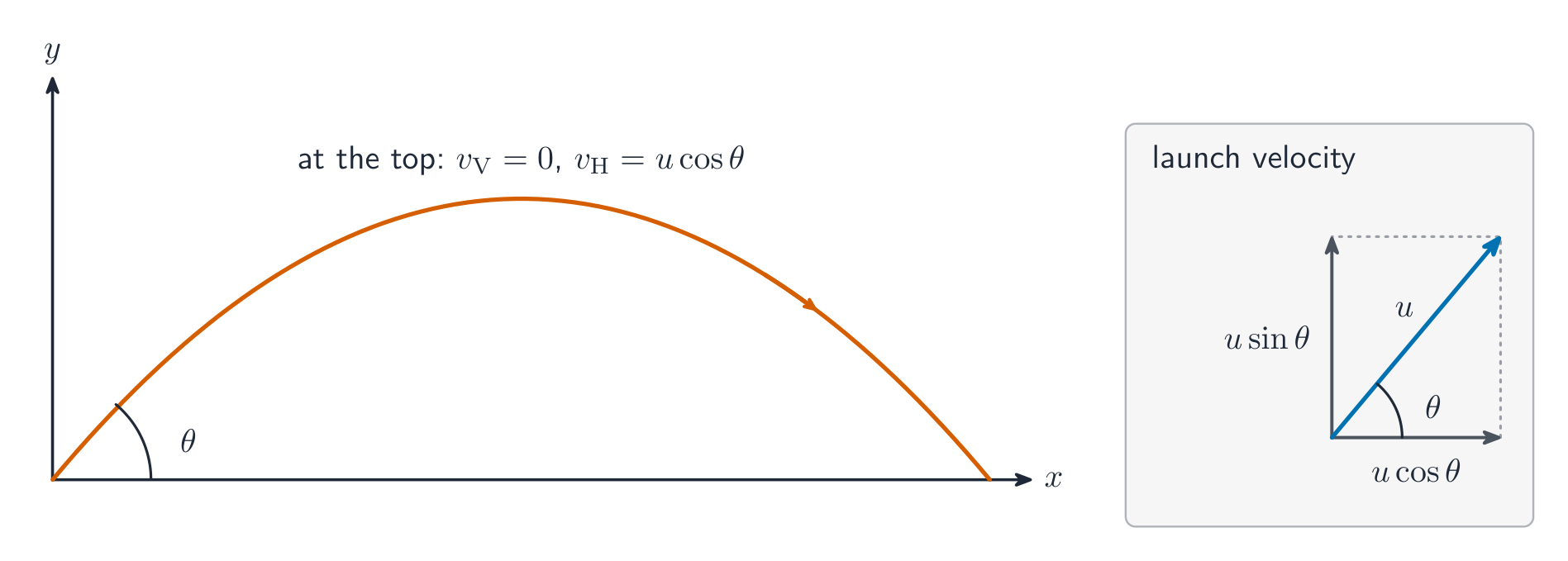
以角度 $\theta$ 发射的抛体——水平和竖直运动互相独立
Select all · 所有 the statements that are true for a projectile (ignore air). · 选出所有对抛体成立的说法(忽略空气)。
At the top only the vertical velocity is zero — the horizontal velocity $u\cos\theta$ carries on, so the ball keeps moving. Mass does not change free fall. · 在最高点只有竖直速度为零——水平速度 $u\cos\theta$ 继续保持,所以球还在运动。质量不改变自由落体。
That projectile has a vertical launch velocity of $10\ \dfrac{\text{m}}{\text{s}}$. How long does it take to reach the top? (Use $g = 9.81\ \dfrac{\text{m}}{\text{s}^2}$.) · 那个抛体的竖直发射速度是 $10\ \dfrac{\text{m}}{\text{s}}$。它到达最高点要多久?(取 $g = 9.81\ \dfrac{\text{m}}{\text{s}^2}$。)
Time to the top $= \dfrac{u\sin\theta}{g} = \dfrac{10}{9.81} \approx 1.0\ \text{s}$. · 到最高点的时间 $= \dfrac{u\sin\theta}{g} = \dfrac{10}{9.81} \approx 1.0\ \text{s}$。
A bouncing ball
- Between bounces the velocity–time graph is a straight sloping line (constant $g$).
- Each bounce is a sudden jump: the velocity flips direction (and shrinks if energy is lost).
弹跳的球
- 两次弹跳之间,速度–时间图是一条倾斜的直线(恒定 $g$)。
- 每次弹跳是一个 突然的跳变:速度方向翻转(若有能量损失则变小)。
On the velocity–time graph of a bouncing ball, each bounce appears as: · 在弹跳球的速度–时间图上,每次弹跳表现为:
At a bounce the velocity flips from downward to upward almost instantly — a sudden vertical jump on the graph (smaller if energy is lost). · 弹跳时速度几乎瞬间从向下翻转到向上——图上出现一个突然的竖直跳变(若有能量损失则更小)。
Two objects meeting
- Write a displacement equation for each, using the same start time and positive direction.
- They are level again when their displacements are equal — set $s_1 = s_2$ and solve.
两个物体相遇
- 为每个物体写一个位移方程,使用 相同的 起始时间和正方向。
- 当它们的 位移相等 时,它们再次并齐——令 $s_1 = s_2$ 求解。
Two objects moving along the same line are level again when their ____ are equal. · 沿同一直线运动的两个物体,当它们的 ____ 相等时再次并齐。
Set the two displacement equations equal ($s_1 = s_2$) and solve for the time. · 令两个位移方程相等($s_1 = s_2$)并解出时间。
Worked example: thrown off a cliff
- A ball is thrown horizontally at $15\ \text{m/s}$ from a cliff $20\ \text{m}$ high. Find the time to land and how far from the base it lands. Take $g = 9.81\ \text{m/s}^2$.
- Vertical, to get the time. The initial vertical velocity is zero, so $s = \tfrac{1}{2}gt^2$ gives $20 = \tfrac{1}{2}(9.81)t^2$ and $t = 2.02\ \text{s}$.
- Horizontal, to get the range. There is no horizontal acceleration, so $x = ut = 15 \times 2.02 = 30\ \text{m}$.
- The horizontal speed plays no part in finding the time. A ball dropped from the same cliff lands at exactly the same moment.
- Time is the only quantity the two motions share, and it is always the bridge between them.
例题:从悬崖上抛出
- 一个球以 $15\ \text{m/s}$ 从 $20\ \text{m}$ 高的悬崖上水平抛出。求落地时间和落点到崖底的距离。取 $g = 9.81\ \text{m/s}^2$。
- 竖直方向,用来求时间。初始竖直速度为零,所以 $s = \tfrac{1}{2}gt^2$ 给出 $20 = \tfrac{1}{2}(9.81)t^2$,$t = 2.02\ \text{s}$。
- 水平方向,用来求水平距离。水平方向没有加速度,所以 $x = ut = 15 \times 2.02 = 30\ \text{m}$。
- 水平速率在求时间时完全不起作用。从同一悬崖上让球自由落下,落地时刻分毫不差。
- 时间是两个方向唯一共有的量,它永远是连接两者的桥梁。
A ball is thrown horizontally at 15 m/s from a 20 m cliff. How long does it take to land, in seconds? (g = 9.81 m/s^2) · 一个球以 15 m/s 从 20 m 高的悬崖水平抛出。它落地要多少秒?(g = 9.81 m/s^2)
Vertical only: 20 = 0.5 x 9.81 x t^2, so t = 2.02 s. The 15 m/s plays no part; a dropped ball lands at the same moment. · 只看竖直方向:20 = 0.5 x 9.81 x t^2,所以 t = 2.02 s。那 15 m/s 不起作用;自由落下的球同时落地。
That same ball, thrown horizontally at 15 m/s and landing after 2.02 s, lands how far from the base of the cliff, in metres? · 同一个球以 15 m/s 水平抛出、2.02 s 后落地,落点距崖底多少米?
Horizontal has no acceleration, so x = ut = 15 x 2.02 = 30 m. Time is the bridge between the two directions. · 水平方向没有加速度,所以 x = ut = 15 x 2.02 = 30 m。时间是连接两个方向的桥梁。
Worked example: launched at an angle
- A ball leaves the ground at $18\ \text{m/s}$ at $60°$ to the horizontal. Show that it reaches its greatest height at $t = 1.6\ \text{s}$.
- Resolve first. Vertical: $u_y = 18\sin 60° = 15.6\ \text{m/s}$. Horizontal: $u_x = 18\cos 60° = 9.0\ \text{m/s}$.
- At the top the vertical velocity is zero, so $v = u + at$ gives $0 = 15.6 - 9.81t$ and $t = 1.59 \approx 1.6\ \text{s}$.
- The horizontal velocity is still $9.0\ \text{m/s}$ at the top. The speed there is $9.0\ \text{m/s}$, not zero.
- Total time of flight is twice this, $3.2\ \text{s}$, and the range is $u_x \times 3.2 = 29\ \text{m}$.
例题:斜向抛出
- 一个球以 $18\ \text{m/s}$、与水平成 $60°$ 角离开地面。证明它在 $t = 1.6\ \text{s}$ 达到最高点。
- **先分解。**竖直:$u_y = 18\sin 60° = 15.6\ \text{m/s}$。水平:$u_x = 18\cos 60° = 9.0\ \text{m/s}$。
- 最高点处竖直速度为零,所以 $v = u + at$ 给出 $0 = 15.6 - 9.81t$,$t = 1.59 \approx 1.6\ \text{s}$。
- 最高点处水平速度仍是 $9.0\ \text{m/s}$。那里的速率是 $9.0\ \text{m/s}$,不是零。
- 总飞行时间是这个的两倍,$3.2\ \text{s}$,水平射程是 $u_x \times 3.2 = 29\ \text{m}$。
Put the method for a projectile launched at an angle in order. · 把斜抛问题的做法按顺序排列。
Time is the only quantity the two directions share, which is why it is always found from the vertical motion first. · 时间是两个方向唯一共有的量,所以总是先由竖直运动求出它。
At the highest point of a projectile's flight, match each quantity to its value. · 在抛体飞行的最高点,把每个量与它的值配对。
The speed at the top is the horizontal component, not zero. And the acceleration never pauses, not even for an instant at the top. · 最高点的速率就是水平分量,不是零。而加速度从不停顿,连最高点那一瞬也不例外。
Marks that slip away
- Resolve before you start. Every projectile question is two one-dimensional problems sharing a value of $t$.
- The horizontal velocity is constant and takes no part in the time calculation.
- At the highest point the vertical velocity is zero, not the speed. The horizontal component is unchanged.
- A ball thrown horizontally and a ball dropped from the same height land at the same time.
- Keep the sign convention for the whole flight. With up positive, $a = -9.81\ \text{m/s}^2$ on the way down too.
容易丢掉的分
- **动手之前先分解。**每道抛体题都是共用同一个 $t$ 的两个一维问题。
- 水平速度是恒定的,在求时间时不起任何作用。
- 最高点处为零的是竖直速度,不是速率。水平分量丝毫未变。
- 水平抛出的球和从同一高度自由落下的球同时落地。
- 整段飞行保持同一符号约定。以向上为正时,下落途中的 $a$ 也是 $-9.81\ \text{m/s}^2$。
A ball thrown horizontally from a cliff lands later than a ball dropped from the same cliff at the same moment. · 从悬崖上水平抛出的球,比同一时刻从同一悬崖自由落下的球更晚落地。
They land together. The vertical motion is identical, and the horizontal velocity has no effect on it, which is the whole point of treating the two directions separately. · 它们同时落地。竖直运动完全相同,而水平速度对它没有影响,这正是把两个方向分开处理的全部要点。
You've got it
- horizontal and vertical motion are independent — share only the time $t$
- a horizontal throw lands in a time set only by its height
- resolve a launch: $u\cos\theta$ stays constant, $u\sin\theta$ behaves like a vertical throw
你掌握了
- 水平和竖直运动 互相独立——只共享时间 $t$
- 水平抛出的落地时间 只由高度决定
- 分解发射速度:$u\cos\theta$ 保持不变,$u\sin\theta$ 像竖直上抛一样运动