- explain and use the principle of superposition
- show an understanding of experiments that demonstrate stationary waves using microwaves, stretched strings and air columns (it will be assumed that end corrections are negligible; knowledge of the concept of end corrections is not required)
- explain the formation of a stationary wave using a graphical method, and identify nodes and antinodes
- understand how wavelength may be determined from the positions of nodes or antinodes of a stationary wave
叠加
A-Level 物理 · 第 8 主题
 19:48
19:48
Superposition
Put on a pair of noise-cancelling headphones, and the roar of a plane engine fades to silence. But here is the strange part: they do not block the sound — they…
英文讲解 · 内嵌中英文字幕
8.1
驻波

大纲
来源:剑桥国际大纲
当两个或更多的波(wave)在某点重叠时,那里的位移(displacement)是每个波单独产生的位移的矢量和(vector sum)。这就是叠加(superposition)原理。
波彼此穿过后原封不动地出来。叠加是本主题一切内容的基础。
两分的表述:当两个或更多的波在某一点相遇时,合位移是各个波位移之和。 相加的是位移,不是振幅或强度;而且只要同类的波重叠,该原理就适用;波不必相干,也不必振幅相等。
如果两个振幅(amplitude)为 $A_{1}$ 和 $A_{2}$ 的波相遇:
- 同相(in phase,波峰(crest)遇波峰):振幅是 $A_{1} + A_{2}$(相长干涉(constructive interference))。
- 恰好反相(波峰遇波谷(trough),相位差(phase difference)$\pi$):振幅是 $|A_{1} - A_{2}|$(相消干涉(destructive interference))。
- 任何其他相位差 $\phi$:振幅介于这两者之间。

对于强度(intensity),$I \propto A^{2}$。两个相等的波同相相遇给出强度 $(2A)^{2} = 4A^{2}$——是单个波强度的四倍。
因为 $I \propto A^{2}$,先用振幅算。强度为 $I$ 和 $4I$ 的两个波振幅为 $A$ 和 $2A$:同相叠加得振幅 $3A$、强度 $9I$,反相叠加得振幅 $A$、强度 $I$。所以强度不同的两个相干波永远不会完全相消:极小处的强度是 $(A_{2} - A_{1})^{2}$,不是零。振幅 $2A$ 的波与反向传播的振幅 $A/2$ 的波相遇,合成波在 $2.5A$ 和 $1.5A$ 之间变化,是一个没有真正波节的驻波图样。把同相相遇的两个相等的波之一振幅加倍,合振幅从 $2A$ 变为 $3A$,所以强度从 $4A^{2}$ 升到 $9A^{2}$:$2.25$ 倍。
探索
Adding two waves
Two waves overlap and add. Line them up for constructive interference, or oppose them for destructive — change the phase to see both.
词汇表
训练
| 英文 | 中文 | 拼音 |
|---|---|---|
| superposition/ˌsuːpəpəˈzɪʃn/ | 叠加 | dié jiā |
| wave/weɪv/ | 波 | bō |
| displacement/dɪˈspleɪsmənt/ | 位移 | wèi yí |
| vector sum/ˈvektə sʌm/ | 矢量和 | shǐ liàng hé |
| amplitude/ˈæmplɪtjuːd/ | 振幅 | zhèn fú |
| in phase/ɪn feɪz/ | 同相 | tóng xiāng |
| crest/krest/ | 波峰 | bō fēng |
| constructive interference/kənˈstrʌktɪv ˌɪntəˈfɪərəns/ | 相长干涉 | xiāng zhǎng gān shè |
| interference/ˌɪntəˈfɪərəns/ | 干涉 | gān shè |
| trough/trɒf/ | 波谷 | bō gǔ |
| phase difference/feɪz ˈdɪfrəns/ | 相位差 | xiàng wèi chā |
| destructive interference/dɪˈstrʌktɪv ˌɪntəˈfɪərəns/ | 相消干涉 | xiāng xiāo gān shè |
| intensity/ɪnˈtensɪti/ | 强度 | qiáng dù |
8.1
驻波
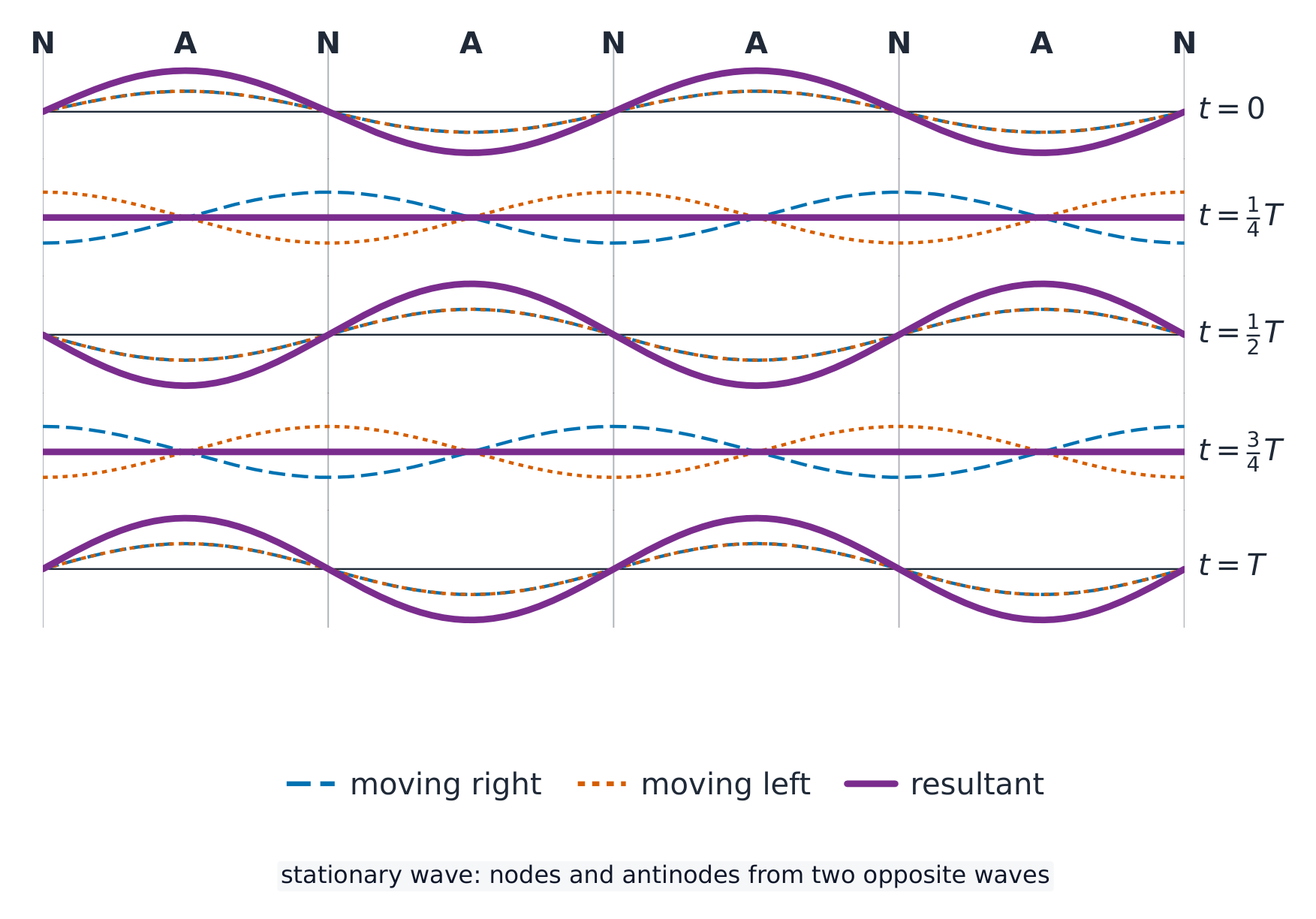
当两个相同的行波(progressive waves)沿相反方向传播并重叠时,它们形成一个驻波(stationary wave)。例子:一根弦上从固定端反射(reflected)的波与入射波重叠;气柱中从封闭端反射的声音;发射器与金属板之间的微波。
解释驻波是如何形成的(三到四分,对弦、空气柱和微波都会这样问):来自波源的波传到远端(墙、封闭端、金属板)并被反射;入射波和反射波有相同的频率、波长和速率,沿相反方向传播;它们在重叠处叠加;在始终同相相遇的点位移相加,得到最大振幅,即波腹;在始终反相相遇的点相消,即波节。对于"说出条件":同类的两个波,频率(和波长)相同、速率相同,沿同一直线反向传播;只有要求波节振幅为零时才需要振幅相等。微波实验里的金属板是为了把波沿原路反射回来。
波节和波腹
在一个驻波中:
- 波节(node)——一个始终位移为零的点(两个波总是相消)。相邻波节之间的距离是 $\lambda/2$。
- 波腹(antinode)——一个振幅最大的点(两个波总是相加)。相邻波腹之间的距离是 $\lambda/2$。
- 一个波节与相邻的波腹相隔 $\lambda/4$。
两个波节之间的粒子彼此同相振动,但振幅不同(在波腹处最大,在波节处为零)。波节两侧的粒子反相(antiphase,相位差 $\pi$)振动。
所以同一个环内(相邻波节之间)两点的相位差是 $0°$;相邻两个环上的两点相差 $180°$;隔着一整个环的两个环上的点又是 $0°$。每个点都在同一瞬间到达最大位移,也在同一瞬间经过零点。最大位移瞬间之后四分之一周期的弦画成沿平衡位置的一条直线;再过半个周期是第一张图的镜像。在一个周期内波腹处的粒子走过四个振幅,所以一个粒子在一个半周期内走了 $72\ \text{mm}$,振幅就是 $12\ \text{mm}$。

例题。 一根长 $0.80\ \text{m}$ 的弦两端固定,在基频模式下振动,其中波速是 $240\ \text{m s}^{-1}$。求基频。
一个环正好填满这根弦,所以 $\lambda = 2L = 1.60\ \text{m}$。于是
$$f = \frac{v}{\lambda} = \frac{240}{1.60} = 150\ \text{Hz}.$$
驻波与行波的区别:它不沿它的长度方向携带能量(energy),图样不沿长度移动,波节保持固定;而行波处处振幅相同并携带能量。
评分标准列出的三点区别:行波传递能量而驻波不传递;行波上每一点振幅相同,驻波的振幅从波节处的零变化到波腹处的最大;行波上相邻各点相位不同,驻波上两个波节之间的所有点都同相。
从波节间距测量波长
用一个振动器以频率 $f$ 驱动一根弦,直到出现一个驻波图样。测量两个相隔较远的波节之间的距离,再除以它们之间的半波长(wavelength)数。于是 $\lambda$ 已知,$v = f\lambda$ 给出波速。
对于一端封闭、另一端开口的管(共鸣管(resonance tube)),封闭端是位移波节,开口端是位移波腹。基频(fundamental)对应 $L = \lambda/4$;下一个共振在 $L = 3\lambda/4$;以此类推。对于两端开口的管,两端都是波腹;基频在 $L = \lambda/2$。
一般规则:封闭端是波节,开口端是波腹,两端固定的弦两端都是波节。所以闭管容纳奇数个四分之一波长($L = \lambda/4, 3\lambda/4, 5\lambda/4, \ldots$),而开管和固定的弦容纳整数个半波长($L = \lambda/2, \lambda, 3\lambda/2, \ldots$);两端开口、有 $n$ 个波节的管有 $n + 1$ 个波腹。频率由 $f = v/\lambda$ 得出:最低音为 $820\ \text{Hz}$ 的闭管有 $\lambda = 4L$;两端各有一扇反射门的 $13.2\ \text{m}$ 长走廊最低在 $f = v/2L = 330/26.4 = 12.5\ \text{Hz}$ 共振。
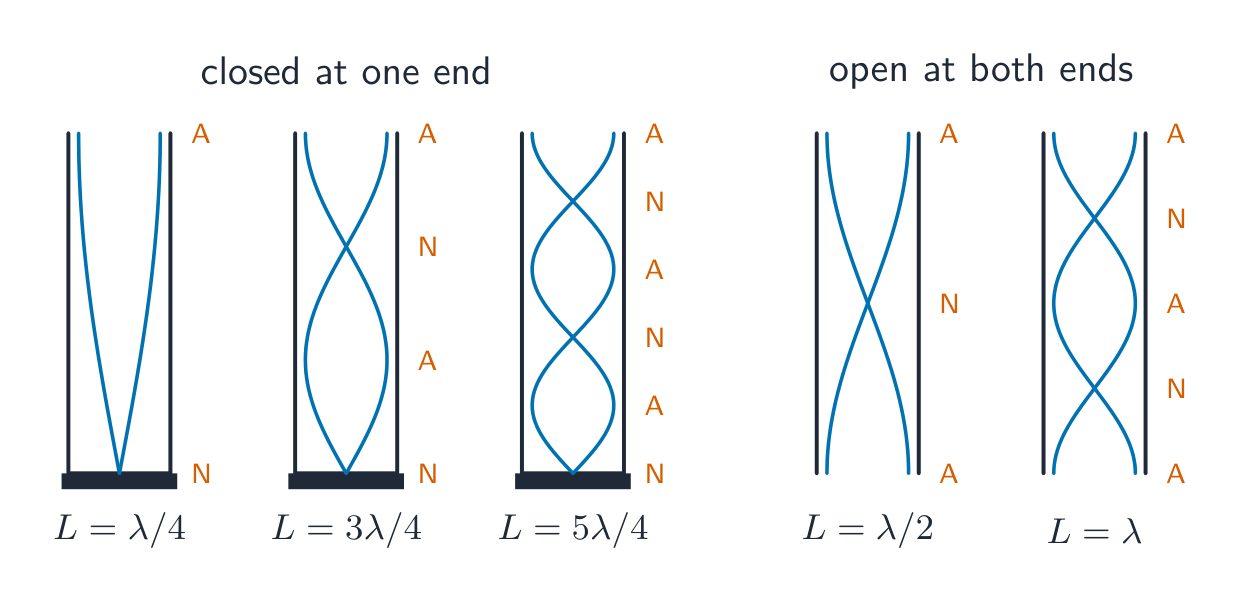
例题。 一根长 $0.51\ \text{m}$、另一端封闭的管,开口端的扬声器建立了一个有两个波节和两个波腹的驻波。求波长,并在 $v = 340\ \text{m s}^{-1}$ 时求频率。
两个波节、两个波腹是闭管的第二个模式,$L = 3\lambda/4$,所以 $\lambda = 4 \times 0.51 / 3 = 0.68\ \text{m}$,$f = 340 / 0.68 = 500\ \text{Hz}$。这根管能共振的最长波长是 $4L = 2.0\ \text{m}$。
教学大纲点名的实验都是从波节或波腹的间距量出 $\lambda$。在共鸣管实验中,把管从水中提起,同时扬声器或音叉在开口端发声;空气柱长为 $\lambda/4$ 时第一次共振,声音突然变响,长为 $3\lambda/4$ 时再次共振,所以两次之间管移动了 $\lambda/2$(学生不需要任何仪器就能察觉共振:声音变响)。在尘管里,细粉末聚成一堆堆,位于相隔 $\lambda/2$ 的位移波节处。用微波时,接收器沿发射器与金属反射板之间的直线移动,每隔 $\lambda/2$ 读到一个极小:从一个极小出发、在 $1.05\ \text{m}$ 内又经过六个极小的接收器走过了 $3\lambda$,所以 $\lambda = 0.35\ \text{m}$;对应的声学实验取 $v = 340\ \text{m s}^{-1}$,则 $f = 970\ \text{Hz}$。微波炉里的驻波在相隔 $\lambda/2$ 的波腹处把巧克力熔化,所以由斑点间距和炉子的频率($2.45\ \text{GHz}$)可用 $c = f\lambda$ 得到光速。

探索
Standing waves & harmonics
A string fixed at both ends only resonates at its harmonics. Drag n to see the nodes, antinodes and how the wavelength changes.
探索
Stationary waves
y = y₁ + y₂
Two waves superpose: where they reinforce you get antinodes, where they cancel, nodes.
词汇表
训练
| 英文 | 中文 | 拼音 |
|---|---|---|
| waves/weɪvz/ | 波 | bō |
| antiphase/ˌæntɪˈfeɪz/ | 反相 | fǎn xiāng |
| node/nəʊd/ | 波节 | bō jié |
| progressive waves/prəˈɡresɪv weɪvz/ | 行波 | xíng bō |
| progressive wave/prəˈɡresɪv weɪv/ | 行波 | xíng bō |
| stationary wave/ˈsteɪʃənəri weɪv/ | 驻波 | zhù bō |
| reflected/rɪˈflektɪd/ | 反射 | fǎn shè |
| wavelength/ˈweɪvleŋθ/ | 波长 | bō cháng |
| antinode/ˌæntɪˈnəʊd/ | 波腹 | bō fù |
| fundamental/ˌfʌndəˈmentl/ | 基频 | jī pín |
| energy/ˈenədʒi/ | 能量 | néng liàng |
| resonance tube/ˈrezənəns tjuːb/ | 共鸣管 | gòng míng guǎn |
8.2
衍射

大纲
- explain the meaning of the term diffraction
- show an understanding of experiments that demonstrate diffraction including the qualitative effect of the gap width relative to the wavelength of the wave; for example diffraction of water waves in a ripple tank
来源:剑桥国际大纲
衍射(diffraction)是波在穿过一个缝或绕过一个障碍物(obstacle)之后的散开。所有的波都会衍射——水、声音、光、微波。
两分的"说出衍射的含义":波穿过一个缝(孔)或绕过障碍物边缘时散开,进入其后方的区域。衍射改变波的传播方向,但不改变它的速率、频率或波长。
散开的程度取决于波长与缝宽之比:
- 缝远宽于 $\lambda$:散开很少;波几乎笔直穿过。
- 缝约与 $\lambda$ 同大小:散开很多;波扇形展开。
- 缝小于 $\lambda$:散开很强;缝几乎像一个点源。
用水波槽(ripple tank)中的水波来演示:直波遇到一个带缝的挡板,缝做得越窄,波弯曲得越多。同样的道理说明了为什么你能听见拐角处有人说话(语音的 $\lambda$ 接近 1 m,与缝的大小相近),却看不见他们(可见光的 $\lambda \sim 500\ \text{nm}$,远小于缝)。
要散开得最厉害,缝宽应约为一个波长。所以要增强给定的波的衍射,就把缝变窄;对给定的缝,就用更长的波长,即更低的频率。波长 $1.5\ \text{km}$ 的无线电波绕过山到达山后的天线;$1.5\ \text{cm}$ 的微波则不能。空气中 $0.44\ \text{kHz}$ 的声音 $\lambda = 330 / 440 = 0.75\ \text{m}$,所以约 $0.75\ \text{m}$ 的结构最能使它衍射;穿过 $0.80\ \text{m}$ 宽门口的声音中,低频散开得最多。把缝做成许多个波长宽,或提高频率,都会减弱散开。
探索
Waves adding and cancelling
Two overlapping waves add where they are in phase and cancel where out of phase — change the phase to see the result. This is what makes diffraction patterns.
词汇表
训练
| 英文 | 中文 | 拼音 |
|---|---|---|
| diffraction/dɪˈfrækʃn/ | 衍射 | yǎn shè |
| obstacle/ˈɒbstəkl/ | 障碍物 | zhàng ài wù |
| ripple tank/ˈrɪpl tæŋk/ | 水波槽 | shuǐ bō cáo |
8.3
干涉

大纲
- understand the terms interference and coherence
- show an understanding of experiments that demonstrate two-source interference using water waves in a ripple tank, sound, light and microwaves
- understand the conditions required if two-source interference fringes are to be observed
- recall and use $\lambda = ax / D$ for double-slit interference using light
来源:剑桥国际大纲
干涉(interference)是两个相干(coherent)波的叠加,给出一个稳定的、由高振幅区域(相长)和低振幅区域(相消)构成的图样。


相干性
当两个源发出的波有恒定的相位差(这也需要相同的频率)时,它们是相干的。两盏分开的灯不是相干的——它们的相位随机变化,所以任何图样都闪变得太快而看不见,你只能得到一个平均值。
一分的定义:相干波具有恒定的相位差,这要求频率相同。它们不必彼此同相:相差 $180°$ 发射的两个相干源给出的图样中心线是一个极小。两台独立的激光器,或一盏灯和一台激光器,即使频率恰好相同也不相干,所以不会形成稳定的图样。
要从一个源产生相干光,让它穿过双缝(double-slit)装置中的两个狭缝(slits)。两个缝都由同一个波前照亮,所以两束光保持固定的相位关系。
清晰图样的条件
要看到双源条纹,你需要:
- 两个相干源(恒定的相位差)。
- 大致相等的振幅(否则暗区不太暗)。
- 在你观察处波要重叠。
- 对于光(横波),相同的偏振(polarisation)面。
对光的实际做法:一个单缝(或一台激光器)使两个缝相干;缝很窄,所以每个缝都把光衍射到两束光重叠的区域;缝靠得很近而屏很远,这样条纹才宽到看得见。
路程差
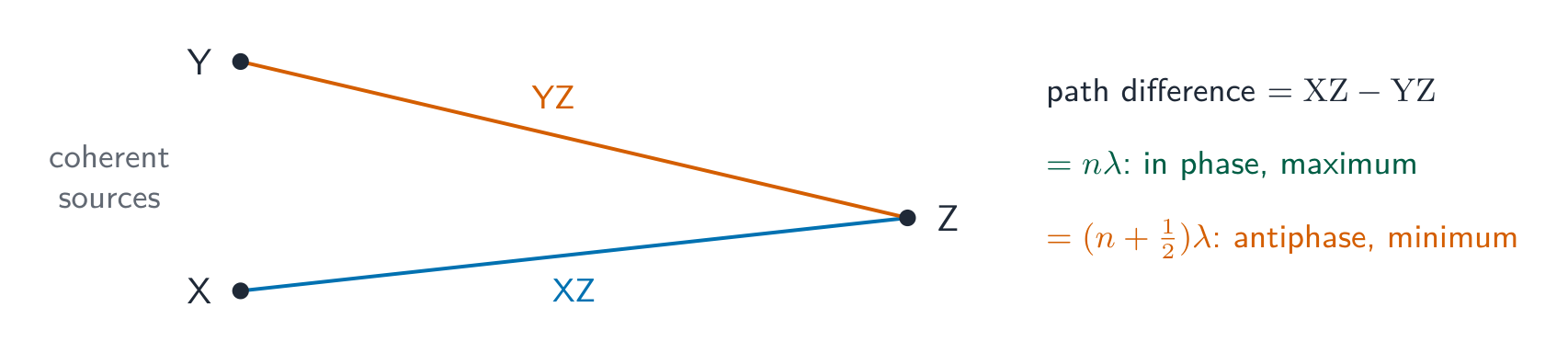
对于两个相干源,某点发生什么取决于到达那里的两个波之间的路程差(path difference)$\Delta x$:
- 相长:$\Delta x = n\lambda$(对整数 $n = 0, 1, 2, \ldots$)。
- 相消:$\Delta x = (n + \tfrac{1}{2})\lambda$。
路程差决定相位差:一个波长的路程是 $360°$。从两个同相波源出发、分别走了 $100\ \text{cm}$ 和 $80\ \text{cm}$、波长 $8.0\ \text{cm}$ 的波到达时路程差为 $2.5\lambda$,相位差 $180°$,因而相消;波长 $4\ \text{cm}$、路程相差 $6\ \text{cm}$($1.5\lambda$)的微波给出极小,只有两个振幅相等时强度才为零。把两个波源的频率同等降低会使波长变长,同样的路程差就是更少的波长数,该点便不再是极小。
双缝(杨氏)实验
对于相隔距离 $a$ 的两个缝,屏在距离 $D$ 处(假设 $D \gg a$),波长为 $\lambda$ 的光在屏上形成条纹。

条纹间距(fringe spacing)$x$(一条条纹(fringe)到下一条)是
$$\lambda = \frac{a x}{D}, \qquad x = \frac{\lambda D}{a}.$$
亮条纹(极大(maximum))在路程差是 $\lambda$ 整数倍处;暗条纹(极小(minimum))在它是 $(n + \tfrac{1}{2})\lambda$ 处。条纹是等间距的。
要使条纹间距更小:增大 $a$(缝分得更开)、减小 $D$(屏更近),或用更短的 $\lambda$(更蓝的光)。
解释明暗条纹图样是如何形成的(三分):光在每个缝处衍射;两束衍射光重叠并叠加;来自两缝的路程差为整数个波长处,波同相到达、相长干涉,形成亮条纹;路程差为奇数个半波长处,波反相到达、相消干涉,形成暗条纹。更亮的光源使亮条纹更亮,但不改变间距;换成蓝光使间距变小,所以要保持同样的间距就必须把两缝移近;把每个缝变窄会增强衍射,所以条纹出现在更宽的区域里,而间距不变。
例题。 在一个双缝实验中,缝相隔 $0.50\ \text{mm}$,由波长 $600\ \text{nm}$ 的光照射。屏在 $2.0\ \text{m}$ 外。求条纹间距。
$$x = \frac{\lambda D}{a} = \frac{(600 \times 10^{-9})(2.0)}{0.50 \times 10^{-3}} = 2.4 \times 10^{-3}\ \text{m} = 2.4\ \text{mm}.$$
例题。 波长 $680\ \text{nm}$ 的红光照在相隔 $0.16\ \text{mm}$ 的双缝上。第一条与第九条暗条纹中心之间的距离是 $3.2\ \text{cm}$。求到屏的距离 $D$。
八个条纹间距合计 $3.2\ \text{cm}$,所以 $x = 4.0\ \text{mm}$,$D = ax / \lambda = (0.16 \times 10^{-3})(4.0 \times 10^{-3}) / (680 \times 10^{-9}) = 0.94\ \text{m}$。在以图样为中心、宽 $5.0\ \text{cm}$ 的屏上,$x = 2.4\ \text{mm}$ 时中央条纹两侧各容纳十条亮条纹:共 $21$ 条。$x$ 对 $a$ 的图是随 $1/a$ 下降的曲线;$x$ 对 $\lambda$(或对 $D$)的图是过原点、斜率为 $D/a$(或 $\lambda/a$)的直线,由此可求 $a$。
探索
Interference
y = y₁ + y₂
In phase → constructive (bright/loud); antiphase → destructive (dark/quiet).
词汇表
训练
| 英文 | 中文 | 拼音 |
|---|---|---|
| coherent/kəʊˈhɪərənt/ | 相干 | xiāng gān |
| maximum/ˈmæksɪməm/ | 极大 | jí dà |
| minimum/ˈmɪnɪməm/ | 极小 | jí xiǎo |
| slit/slɪt/ | 狭缝 | xiá fèng |
| double-slit/ˈdʌbl slɪt/ | 双缝 | shuāng fèng |
| fringe/frɪndʒ/ | 条纹 | tiáo wén |
| polarisation/ˌpəʊləraɪˈzeɪʃn/ | 偏振 | piān zhèn |
| path difference/pæθ ˈdɪfrəns/ | 路程差 | lù chéng chā |
| fringe spacing/frɪndʒ ˈspeɪsɪŋ/ | 条纹间距 | tiáo wén jiān jù |
8.4
衍射光栅
大纲
- recall and use $d \sin \theta = n\lambda$
- describe the use of a diffraction grating to determine the wavelength of light (the structure and use of the spectrometer are not included)
来源:剑桥国际大纲
衍射光栅(diffraction grating)有许多等间距的缝——常常每毫米几百或几千条。每个缝是一个相干源。当满足下式时,在与光栅法线(normal)成 $\theta$ 角处看到一个极大:
$$d \sin\theta = n \lambda,$$
其中 $d$ 是缝间距(slit spacing,中心到中心),$n = 0, \pm 1, \pm 2, \ldots$ 是级次(order),$\lambda$ 是波长。
例题。 一个衍射光栅每毫米 $500$ 条线。波长 $600\ \text{nm}$ 的光垂直照在它上面。求一级($n = 1$)极大的角度。
缝间距是 $d = \dfrac{1}{500}\ \text{mm} = 2.0 \times 10^{-6}\ \text{m}$,所以
$$\sin\theta = \frac{n\lambda}{d} = \frac{600 \times 10^{-9}}{2.0 \times 10^{-6}} = 0.30 \quad\Rightarrow\quad \theta \approx 17°.$$
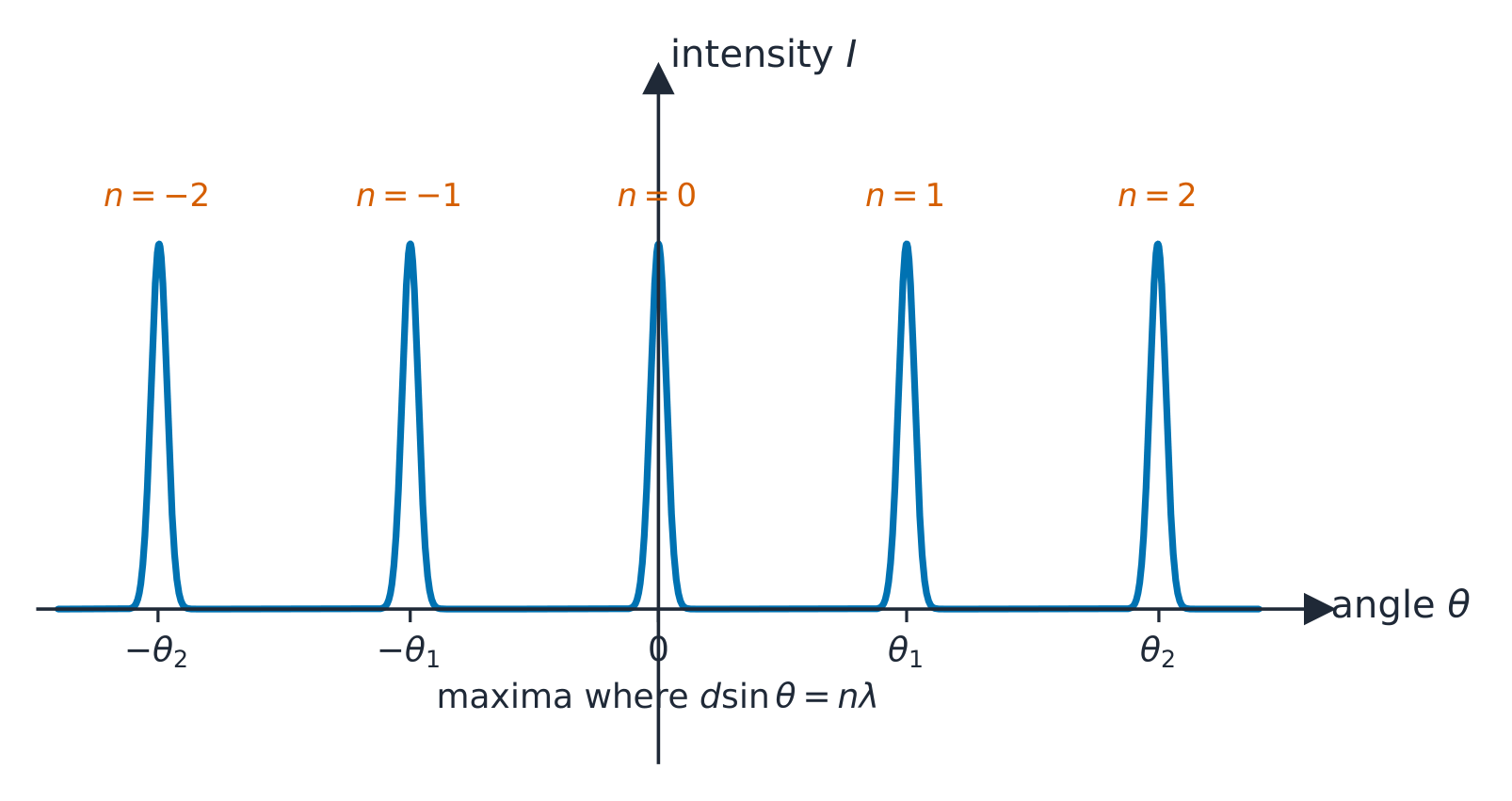
与双缝相比,光栅给出尖锐得多的极大,因为更多的缝叠加在一起——其他每个方向都被许多缝相消掉。
要描述光在光栅处的衍射:光在每个缝处散开(衍射),来自所有缝的波叠加;在相邻缝之间路程差为整数个波长的方向上它们全部同相,所以那里形成尖锐的极大,而其间几乎没有光。强度对角度的图是一组窄峰,位于 $\theta = 0$ 以及 $\pm\theta_{1}, \pm\theta_{2}, \ldots$ 处,其中 $\sin\theta_{n} = n\lambda/d$:在 $\sin\theta$ 上等间距,所以在 $\theta$ 上高级次略微更远。
例题。 波长 $680\ \text{nm}$ 的光垂直入射到每毫米 $450$ 条线的光栅上。求两个二级极大之间的夹角。
$d = 1/450\ \text{mm} = 2.22 \times 10^{-6}\ \text{m}$,所以 $\sin\theta_{2} = 2 \times 680 \times 10^{-9} / (2.22 \times 10^{-6}) = 0.612$,$\theta_{2} = 37.7°$;两束二级光相隔 $2\theta_{2} = 75°$。

从"每毫米线数"求缝间距
如果一个光栅每毫米 $N$ 条线,那么 $d = 1/N$ 毫米 $= 10^{-3}/N$ 米。对于每毫米 $450$ 条线,$d = 1/450\ \text{mm} \approx 2.22\ \mu\text{m}$。
最高级次
对于给定的光栅和波长,$\sin\theta = n\lambda/d$ 不能大于 $1$,所以看到的最高级次是
$$n_{\text{max}} = \left\lfloor \frac{d}{\lambda} \right\rfloor.$$
如果 $d/\lambda = 3.27$,则存在直到 $n = 3$ 的级次;$n = 4$ 需要 $\sin\theta > 1$,看不到。
所以宽屏上极大的总数是 $2n_{\text{max}} + 1$:对 $700\ \text{nm}$ 的光和每毫米 $400$ 条线,$d/\lambda = 3.57$,所以 $n_{\text{max}} = 3$,能看到七束光。更短的波长给出更多级次、更小的角度。用白光时,除零级外每一级都是一条光谱,紫色最靠近中心,红色最远,因为 $\theta$ 随 $\lambda$ 增大;零级仍是白色。当 $n_{1}\lambda_{1} = n_{2}\lambda_{2}$ 时,两种波长在同一角度给出极大:$400\ \text{nm}$ 的三级与 $600\ \text{nm}$ 的二级重合。
用光栅求 $\lambda$
把未知波长的平行光笔直射向光栅。测量一级极大离中心的角度 $\theta_{1}$。则 $\lambda = d \sin\theta_{1}$。对更高级次重复并取平均可减小误差。
测量两侧一级极大之间的夹角再取一半,这样可以抵消零点设置的误差;更高的级次角度更大,百分比不确定度更小;对几个级次作 $\sin\theta$ 对 $n$ 的图,得到过原点、斜率为 $\lambda/d$ 的直线,所以 $\lambda = Gd$(或已知波长时 $d = \lambda/G$)。两件事必须做对:$\theta$ 从光栅的法线量起,不是从它的表面;$d$ 是相邻线之间的距离,所以每毫米 $400$ 条线意味着 $d = 2.5\ \mu\text{m}$,绝不是 $400$。
探索
Why the grating gives sharp maxima
Two waves add when in phase and cancel when out of phase — change the phase and watch the resultant. A grating's many slits make the bright fringes razor-sharp.
词汇表
训练
| 英文 | 中文 | 拼音 |
|---|---|---|
| diffraction grating/dɪˈfrækʃn ˈɡreɪtɪŋ/ | 衍射光栅 | yǎn shè guāng shān |
| normal/ˈnɔːml/ | 法线 | fǎ xiàn |
| slit spacing/slɪt ˈspeɪsɪŋ/ | 缝间距 | fèng jiān jù |
| order/ˈɔːdə/ | 级次 | jí cì |
8.4
考官认可的定义
定义题按固定的表述给分。把这些记准确,并且只写一个答案。
| 术语 | 定义 |
|---|---|
| 叠加原理(principle of superposition) | 当两个或更多的波在某一点相遇时,合位移是各个波位移之和 |
| 驻波(stationary wave) | 两个频率和速率相同的行波反向传播并叠加时形成的图样,其波节和波腹不移动 |
| 波节(node) | 驻波上位移始终为零的点 |
| 波腹(antinode) | 驻波上振幅最大的点 |
| 衍射(diffraction) | 波穿过缝或绕过障碍物边缘时的散开 |
| 干涉(interference) | 来自相干源的波的叠加,给出稳定的极大和极小图样 |
| 相干性(coherence) | 波之间有恒定的相位差(因而频率相同) |
| 路程差(path difference) | 两个波从各自波源到某一点所走距离之差 |
| 条纹间距(fringe spacing) | 相邻两条亮(或暗)条纹中心之间的距离 |
| 极大的级次(order of a maximum) | $d\sin\theta = n\lambda$ 中的整数 $n$,即相邻缝之间路程差的波长数 |
词汇表
训练
| 英文 | 中文 | 拼音 |
|---|---|---|
| principle of superposition/ˈprɪnsɪpl ɒv ˌsuːpəpəˈzɪʃn/ | 叠加 | dié jiā |
8.4
考试技巧
- 双源干涉:路程差 $= n\lambda$ 时相长,$= (n + \tfrac{1}{2})\lambda$ 时相消;两个源必须相干。
- 双缝:$\lambda = ax/D$;衍射光栅:$d\sin\theta = n\lambda$——要熟悉每一个符号。
- 在驻波上标出波节和波腹;相邻波节相隔 $\lambda/2$;它储存能量但不传递能量。
- 一个驻波需要两个频率相同、沿相反方向传播的波。
常见错误
- 在叠加原理中把振幅或强度相加。相加的是位移;强度再由合振幅的平方得出。
- "相邻波节相隔一个波长。"是半个波长;波节到相邻波腹是四分之一。
- 在 $d\sin\theta = n\lambda$ 中把每毫米线数当作 $d$。要取倒数:$d = 10^{-3}/N$ 米。
- 从光栅表面量 $\theta$,或忘了两束一级光之间的夹角是 $2\theta_{1}$。
- 把相干写成"同相"。相干指相位差恒定;两个源可以永远错开。
- 说光源变亮时条纹间距会变,或说缝变窄会改变间距。亮度和缝宽改变的是对比度和可见条纹的数目,不是 $x = \lambda D/a$。
本主题的互动课程
逐步学习,并即时检测练习。