Superposition and stationary waves
Introduced| English | Meaning |
|---|---|
| superposition/ˌsuːpəpəˈzɪʃn/ | The principle that, in a linear system, the combined effect of independent contributions equals the sum of their separate effects. |
| constructive/kənˈstrʌktɪv/ | Describing interference in which overlapping wave displacements reinforce each other. |
| destructive/dɪˈstrʌktɪv/ | Describing interference in which overlapping wave displacements oppose and reduce each other. |
| in phase/ɪn feɪz/ | Describing oscillations that reach corresponding stages of their cycles at the same time. |
| stationary wave/ˈsteɪʃənəri weɪv/ | stationary wave |
| node/nəʊd/ | A point in a stationary wave where the displacement amplitude is zero. |
| antinode/ˌæntɪˈnəʊd/ | A position of maximum oscillation amplitude in a standing wave. |
| progressive wave/prəˈɡresɪv weɪv/ | A travelling disturbance that transfers energy from one place to another without net transport of the medium as a whole. |
Cancelling sound with sound
- Noise-cancelling headphones play a wave that cancels the noise around you.
- Two waves can add up — or wipe each other out.
- This adding-up of waves is the idea behind this whole topic.
The principle of superposition 叠加
- Where waves overlap, the displacement is the sum of the separate displacements.
- Afterwards the waves carry on, unchanged.
Stationary waves
y = y₁ + y₂
Two waves superpose: where they reinforce you get antinodes, where they cancel, nodes.
When two waves overlap at a point, the resultant displacement is:
Difficulty 1/5 · 100 coins + a small bonus on first completion today
That is the principle of superposition — displacements add (as vectors) at each point.
Match each term to the definition the examiner marks.
Difficulty 2/5 · 140 coins + a small bonus on first completion today
Displacements add. Amplitudes and intensities do not, which is why two equal waves can give zero at one point and four times the intensity at another.
Constructive 相长 and destructive 相消
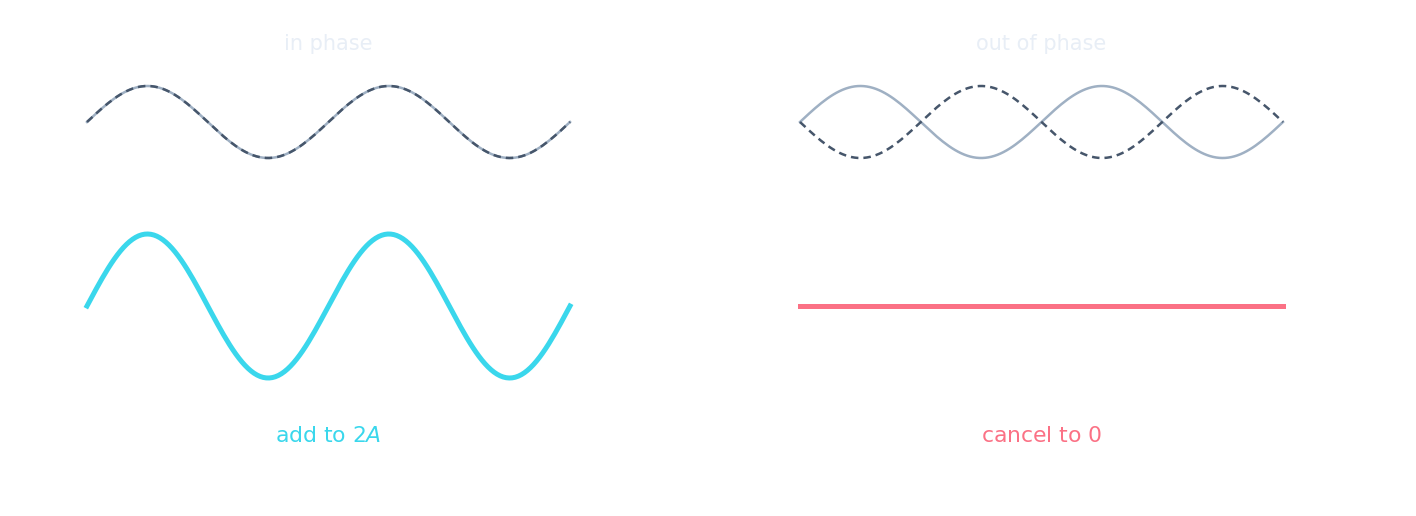
- In phase 同相 (crest meets crest) → amplitudes add → constructive.
- Out of phase (crest meets trough) → amplitudes cancel → destructive.
- Since $I \propto A^{2}$, two equal waves in phase give 4× the intensity of one.

Two waves arriving in phase add to give double the amplitude (constructive)
Standing waves & harmonics
A string fixed at both ends only resonates at its harmonics. Drag n to see the nodes, antinodes and how the wavelength changes.
Match what happens when the two waves meet.
Difficulty 2/5 · 140 coins + a small bonus on first completion today
In phase → a bigger wave; exactly out of phase → they cancel.
Two equal waves meeting in phase give four times the intensity of one wave alone.
Difficulty 1/5 · 100 coins + a small bonus on first completion today
The amplitude doubles to $2A$, and $I \propto A^{2}$, so $I \propto (2A)^{2} = 4A^{2}$.
Stationary waves 驻波
- Two identical waves travelling in opposite directions overlap to make a stationary wave.
- It happens when a wave reflects back on itself — on a string, or in an air column.
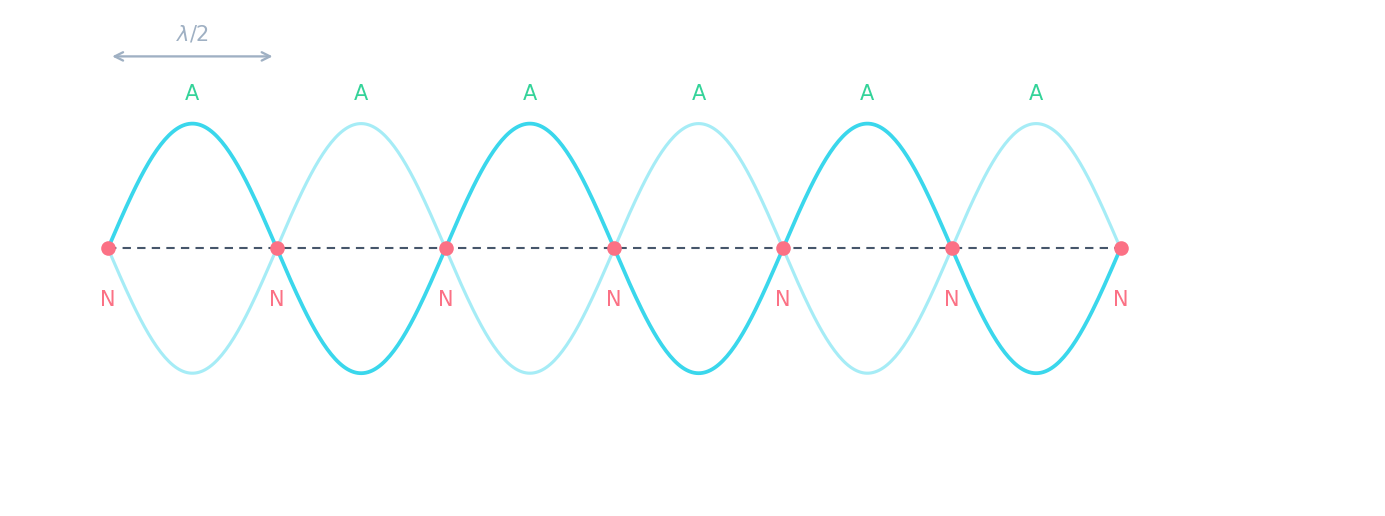
Nodes 波节 and antinodes 波腹
- A node never moves (the waves always cancel); an antinode has the biggest swing.
- Neighbouring nodes are $\dfrac{\lambda}{2}$ apart; a node and the next antinode are $\dfrac{\lambda}{4}$ apart.

Two waves arriving exactly out of phase cancel to zero (destructive)
A point on a stationary wave that is always at zero displacement is called a ____.
Difficulty 1/5 · 100 coins + a small bonus on first completion today
At a node the two waves always cancel. Halfway between nodes is an antinode (biggest swing).
Neighbouring nodes on a stationary wave are $0.30\ \text{m}$ apart. What is the wavelength?
Difficulty 2/5 · 140 coins + a small bonus on first completion today
Neighbouring nodes are $\dfrac{\lambda}{2}$ apart, so $\lambda = 2 \times 0.30 = 0.60\ \text{m}$.
What is needed to form a stationary wave? Select all that apply.
Difficulty 2/5 · 140 coins + a small bonus on first completion today
Equal amplitudes give the cleanest nodes, but the marked requirements are same frequency, same speed, opposite directions.
Stationary vs progressive
- A stationary wave does not carry energy along, and its pattern stays put.
- A progressive wave 行波 moves along and carries energy with it.
A stationary wave transfers energy along its length.
Difficulty 1/5 · 100 coins + a small bonus on first completion today
No — the pattern stays put and no energy travels along it. A progressive wave is the one that carries energy.
On a stationary wave, adjacent nodes are 0.30 m apart. What is the wavelength, in metres?
Difficulty 2/5 · 140 coins + a small bonus on first completion today
Adjacent nodes are HALF a wavelength apart, so the wavelength is 0.60 m. Taking the node spacing as a full wavelength halves every answer that follows.
Put the comparison of a stationary and a progressive wave in order, stationary first.
Difficulty 3/5 · 200 coins + a small bonus on first completion today
Those three contrasts are what a compare question is marked on, and the phase one is the one most often left out.
Pipes and strings
- A closed pipe end is a node; an open end is an antinode.
- Closed-pipe fundamental: $L = \dfrac{\lambda}{4}$. Open both ends: $L = \dfrac{\lambda}{2}$. Measure node spacing → $\lambda$, then $v = f\lambda$.
In a pipe closed at one end, the fundamental fits a length of:
Difficulty 1/5 · 100 coins + a small bonus on first completion today
A node at the closed end and an antinode at the open end is a quarter of a wave, so $L = \dfrac{\lambda}{4}$.
Marks that slip away
- The principle of superposition adds displacements, never amplitudes or intensities. The resultant intensity then follows from the resultant amplitude squared.
- Adjacent nodes are half a wavelength apart, and a node to the next antinode is a quarter.
- A stationary wave needs two progressive waves of the same frequency and speed travelling in opposite directions. State all of it.
- On a stationary wave the amplitude varies with position and every point between two nodes is in phase. On a progressive wave the amplitude is the same everywhere and the phase varies steadily.
- Nodes are points of permanently zero displacement, not points where the wave is momentarily flat.
You've got it
- superposition: overlapping displacements add (constructive) or cancel (destructive)
- a stationary wave has fixed nodes and antinodes, $\dfrac{\lambda}{2}$ apart
- it carries no energy along — unlike a progressive wave