- recall and use the circuit symbols shown in section 6 of this syllabus
- draw and interpret circuit diagrams containing the circuit symbols shown in section 6 of this syllabus
- define and use the electromotive force (e.m.f.) of a source as energy transferred per unit charge in driving charge around a complete circuit
- distinguish between e.m.f. and potential difference (p.d.) in terms of energy considerations
- understand the effects of the internal resistance of a source of e.m.f. on the terminal potential difference
直流电路
A-Level 物理 · 第 10 主题
 20:35
20:35
Practical Circuits
Here is an old battery, and a voltmeter says it is still full: nine volts. Yet connect it to a bulb, and the bulb barely glows. How can a full battery be so…
英文讲解 · 内嵌中英文字幕
10.1
实际电路

大纲
来源:剑桥国际大纲
电动势和电势差
一个电源的电动势(electromotive force,e.m.f.)$\varepsilon$ 是电源驱动电荷绕整个电路一周时给予每单位电荷的能量(energy)。单位:伏特。
一个元件两端的电势差(potential difference,p.d.)是每单位电荷经过那个元件时从电能变成其他形式的能量。
两者都以伏特为单位;它们在能量方向上不同:
- 电动势——电源注入电路的能量(电池中化学能 → 电能,发电机中机械能 → 电能)。
- 电势差——从电能形式中取走的能量(电阻中电能 → 热能,灯中 → 光,电动机中 → 动能)。
考官的措辞是固定的。电动势是"电源驱动电荷绕完整电路一周时每单位电荷转移的能量";电势差是"每单位电荷从电能转化为其他形式的能量"。两者都是每电荷的能量,所以伏特就是每库仑一焦耳($1\ \text{V} = 1\ \text{J C}^{-1}$)。关于电源总是成立的说法:电动势等于无电流时的端电压;它给电荷 $Q$ 的总能量是 $\varepsilon Q$。这个名字是个陷阱:电动"力"(electromotive force)不是力,也不以牛顿为单位。
例题。 一个电动势 $\varepsilon$、内阻 $r$ 的电池驱动电荷 $Q$ 绕一个端电压为 $V$ 的电路一周。比较电池转移的能量与电池外部耗散的能量。
电池总共转移 $\varepsilon Q$;外电路得到 $VQ$。只要有电流,$V = \varepsilon - Ir < \varepsilon$,所以 $VQ < \varepsilon Q$——差值 $(\varepsilon - V)Q = IrQ$ 是在电池内部变成热的能量。
在实验室里你常常在面包板(breadboard,一块带成排孔的板,不用焊接就能连接元件)上搭建电路,并用万用表(multimeter)测量电流和电势差。

内阻
一个真实电源有一些内阻(internal resistance)$r$——通常是电池(cell)中电解质(electrolyte)的电阻,或发电机中的线圈绕组。当电流 $I$ 流动时,一个 $Ir$ 的内部电势差在电源内部"损失"掉,所以外电路两端的端电压(terminal p.d.)是
$$V_{\text{terminal}} = \varepsilon - I r.$$
所以:
- 无电流(开路(open circuit),$I = 0$):端电压等于电动势。
- 较大电流:端电压下降。
- 短路(short circuit,$R_{\text{external}} \to 0$):$I = \varepsilon / r$,一个很大的电流,所有能量都在电源内部变成热。
要测量 $r$,改变外电阻并作 $V_{\text{terminal}}$ 对 $I$ 的图:这条线 $y$ 轴截距为 $\varepsilon$,斜率为 $-r$。
例题。 一个电动势 $1.5\ \text{V}$、内阻 $0.50\ \Omega$ 的电池接到一个 $2.5\ \Omega$ 的电阻上。求电流和端电压。
电动势驱动电流通过两个电阻:$I = \dfrac{\varepsilon}{R + r} = \dfrac{1.5}{2.5 + 0.50} = 0.50\ \text{A}$。于是
$$V_{\text{terminal}} = \varepsilon - Ir = 1.5 - 0.50 \times 0.50 = 1.25\ \text{V}.$$


给予外部负载的功率(power)是 $P_{\text{ext}} = (\varepsilon - Ir) I$;内部损失的功率是 $P_{\text{int}} = I^{2} r$;电源发出的总功率是 $\varepsilon I$。
电源的效率(efficiency)是 $\dfrac{P_{\text{ext}}}{\varepsilon I} = \dfrac{VI}{\varepsilon I} = \dfrac{V}{\varepsilon} = \dfrac{R}{R + r}$:负载电阻大,电源内部浪费的能量就少。
例题。 一个电动势 $2.0\ \text{V}$、内阻 $0.40\ \Omega$ 的电池驱动 $1.5\ \text{A}$ 的电流通过一根导线。证明端电压是 $1.4\ \text{V}$,并求电池向导线供电的百分比效率。
$V = \varepsilon - Ir = 2.0 - 1.5 \times 0.40 = 2.0 - 0.60 = 1.40\ \text{V}$。给导线的功率 $= VI = 1.4 \times 1.5 = 2.1\ \text{W}$;电池输出的总功率 $= \varepsilon I = 2.0 \times 1.5 = 3.0\ \text{W}$。效率 $= 2.1 / 3.0 = 0.70$,即 $70\%$。在"证明"题中,写出每一步和未四舍五入的值($1.40\ \text{V}$),再写题目给的值。
外电路改变时,沿着电流来论证。 闭合一个开关、并联接入第二个电阻,会降低外部总电阻,于是电池中的电流上升,内部"损失的电压"$Ir$ 上升,端电压 $\varepsilon - Ir$ 下降;原来那个电阻两端的电势差(就是端电压)因此下降,它的电流也下降——尽管电池的电流上升了。这条链——电阻 → 电池中的电流 → $Ir$ → 端电压——是本专题几乎所有"说明并解释影响"题的标准答案。
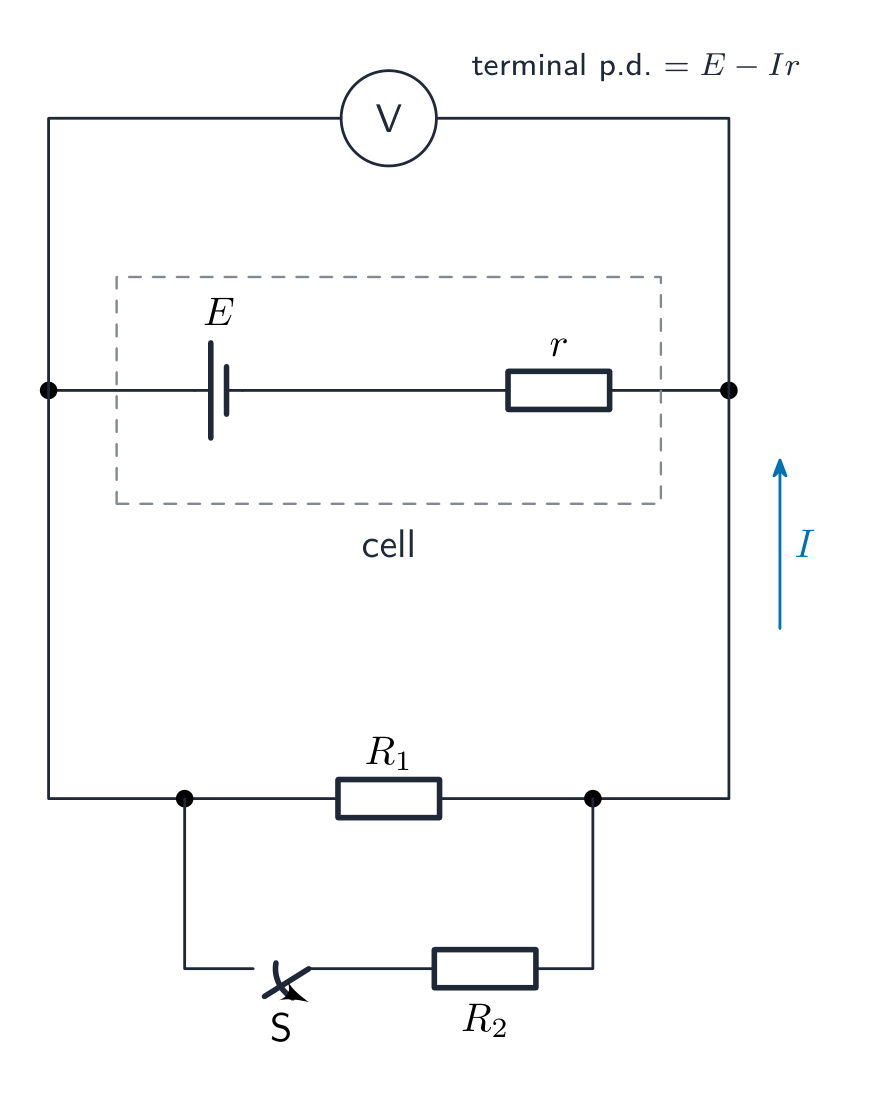
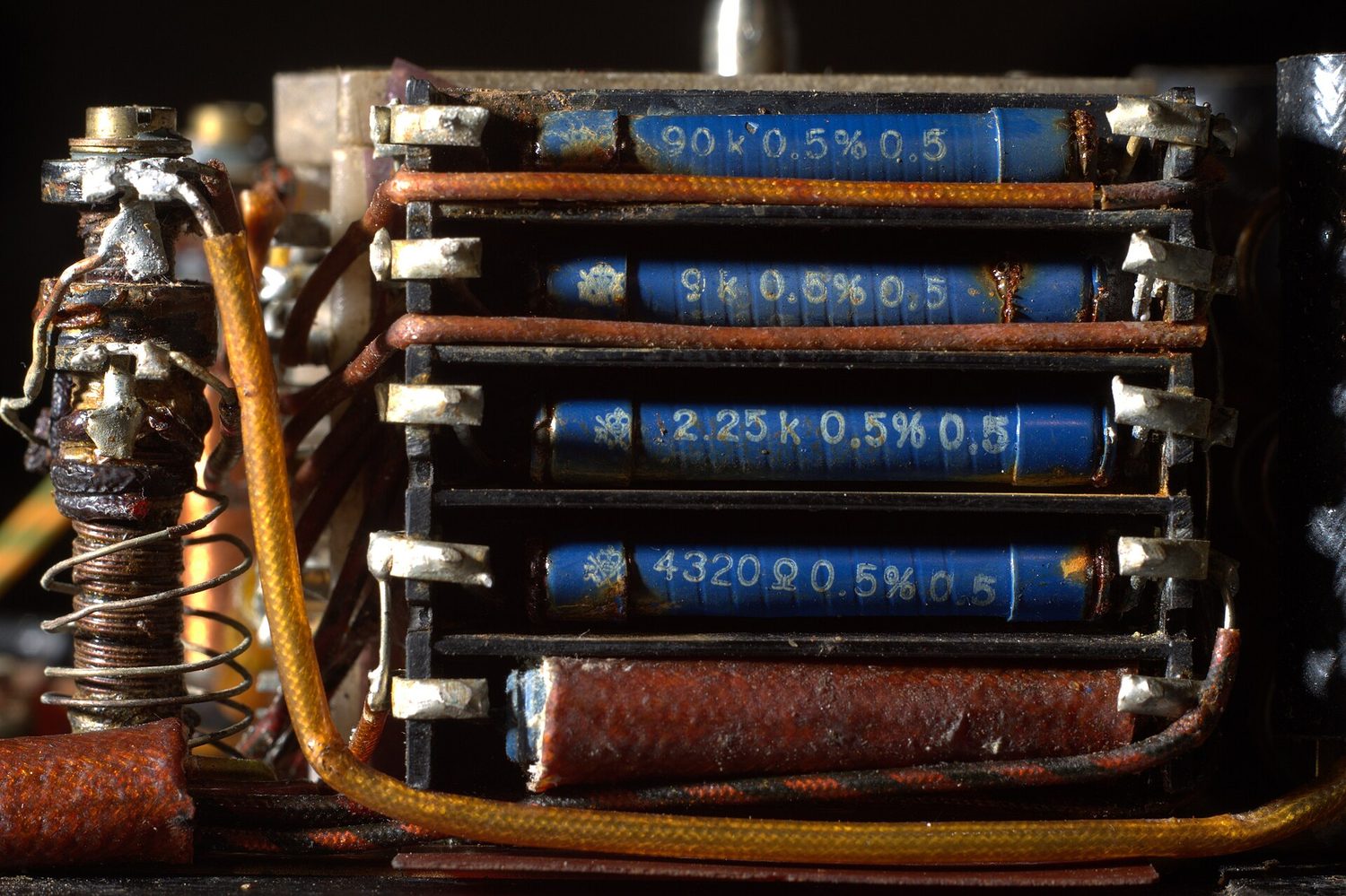
电池的连接。 串联时,电动势相加,内阻也相加:三个电动势 $\varepsilon$、内阻 $r$ 的电池给出 $3\varepsilon$ 和 $3r$。一个接反的电池会减去它的电动势(十个 $1.5\ \text{V}$ 的电池中有一个接反,给出 $8 \times 1.5 = 12\ \text{V}$)。相同的电池并联给出相同的电动势 $\varepsilon$ 和更小的内阻 $r/N$,所以能提供更大的电流。
电路符号
你必须认识并画出大纲中的标准符号:电池、电池组、开关、电阻、可变电阻、电流表(ammeter)、电压表(voltmeter)、灯、二极管(diode,以及 LED 发光二极管)、电容器(capacitor)、电感、热敏电阻、光敏电阻、保险丝(fuse)、接地、接点。理想电流表有零电阻(resistance),串联(series)接入。理想电压表有无穷大的电阻,并联(parallel)接入。

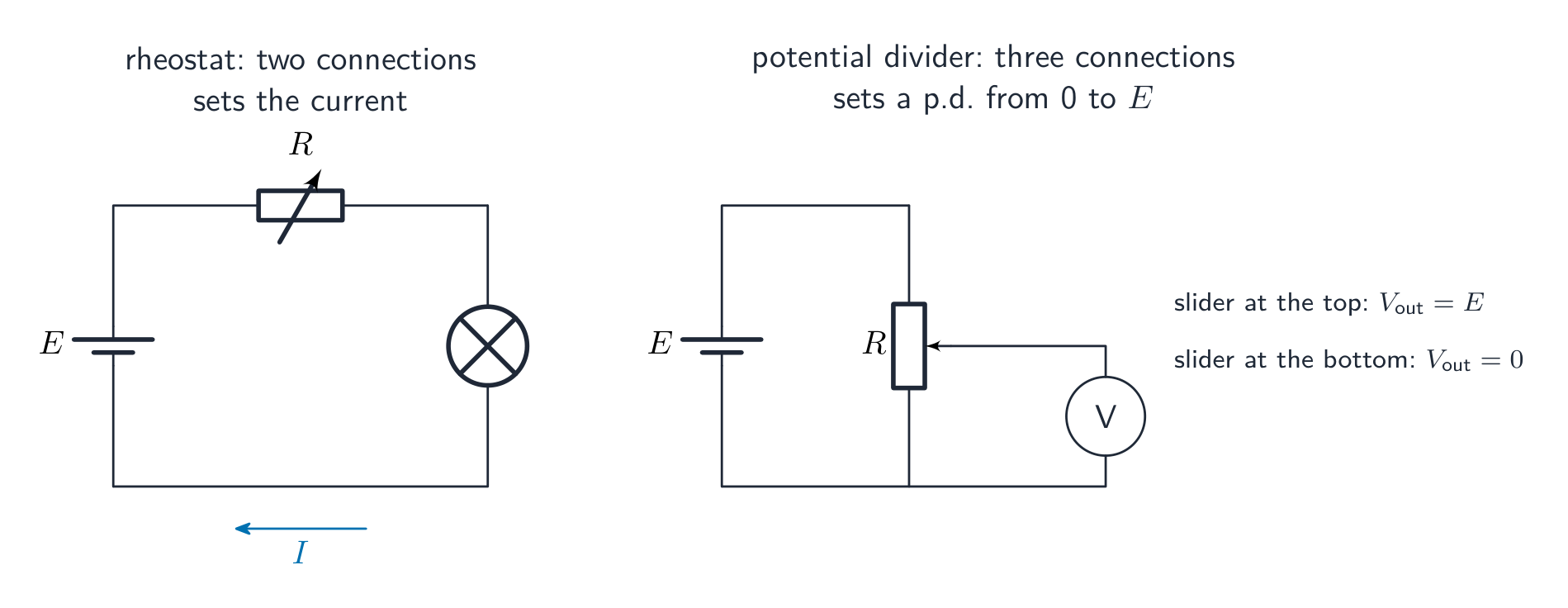
画电路图。 丢分在符号上,不在物理上。用直尺画直线并使用标准符号;电流表与被测电流的元件串联,电压表与被测电势差的元件并联(跨接);有内阻的电池画成一个理想电池与一个电阻 $r$ 串联;可变电阻有两种用法,见下图。"补全电路图"题通常正是要这套测量布置:电源、电流表和可变电阻在一个串联回路里,电压表跨接在被测元件上。
探索
Internal resistance
V = ε − I·r
Terminal p.d. falls with current: it starts at the e.m.f. ε and drops by I·r.
词汇表
训练
| 英文 | 中文 | 拼音 |
|---|---|---|
| electromotive force/ɪˌlektrəʊˈməʊtɪv fɔːs/ | 电动势 | diàn dòng shì |
| energy/ˈenədʒi/ | 能量 | néng liàng |
| potential difference/pəˈtenʃl ˈdɪfrəns/ | 电势差 | diàn shì chā |
| breadboard/ˈbredbɔːd/ | 面包板 | miàn bāo bǎn |
| multimeter/ˌmʌltɪˈmiːtə/ | 万用表 | wàn yòng biǎo |
| internal resistance/ɪnˈtɜːnl rɪˈzɪstəns/ | 内阻 | nèi zǔ |
| electrolyte/ɪˈlektrəlaɪt/ | 电解质 | diàn jiě zhì |
| cell/sel/ | 电池 | diàn chí |
| terminal p.d./ˈtɜːmɪnl ˌpiː ˈdiː/ | 端电压 | duān diàn yā |
| open circuit/ˈəʊpən ˈsɜːkɪt/ | 开路 | kāi lù |
| short circuit/ʃɔːt ˈsɜːkɪt/ | 短路 | duǎn lù |
| power/ˈpaʊə/ | 功率 | gōng lǜ |
| efficiency/ɪˈfɪʃənsi/ | 效率 | xiào lǜ |
| ammeter/ˈæmiːtə/ | 电流表 | diàn liú biǎo |
| voltmeter/ˈvəʊltmiːtə/ | 电压表 | diàn yā biǎo |
| LED/ˌel iː ˈdiː/ | 发光二极管 | fā guāng èr jí guǎn |
| capacitor/kəˈpæsɪtə/ | 电容器 | diàn róng qì |
| fuse/fjuːz/ | 保险丝 | bǎo xiǎn sī |
| resistance/rɪˈzɪstəns/ | 电阻 | diàn zǔ |
| series/ˈsɪəriːz/ | 串联 | chuàn lián |
| parallel/ˈpærəlel/ | 并联 | bìng lián |
| rheostat/ˈriːəstæt/ | 变阻器 | biàn zǔ qì |
10.2
基尔霍夫定律

大纲
- recall Kirchhoff's first law and understand that it is a consequence of conservation of charge
- recall Kirchhoff's second law and understand that it is a consequence of conservation of energy
- derive, using Kirchhoff's laws, a formula for the combined resistance of two or more resistors in series
- use the formula for the combined resistance of two or more resistors in series
- derive, using Kirchhoff's laws, a formula for the combined resistance of two or more resistors in parallel
- use the formula for the combined resistance of two or more resistors in parallel
- use Kirchhoff's laws to solve simple circuit problems
来源:剑桥国际大纲
第一定律(节点规则)
在任何节点(junction)处,流入的总电流等于流出的总电流。这来自电荷守恒(conservation of charge)——在稳定电路中电荷不能在一点积累,所以每秒流入的电荷等于每秒流出的电荷。
对于一个有三根导线的节点:如果电流 2 和 3 流出、电流 1 流入,则 $I_{1} = I_{2} + I_{3}$。
考官的两种问法:"陈述该定律"(一分:流入节点的电流之和等于流出节点的电流之和)和"陈述它背后的守恒定律"(电荷)。不要把第一定律答成"能量"或把第二定律答成"电荷"——这个配对几乎每份 Paper 1 都考。
第二定律(回路规则)
绕任何闭合回路(closed loop)一周,总电动势等于那个回路中各元件两端电势差之和。这来自能量守恒(conservation of energy):当一单位电荷绕回路一周时,它从电源获得的能量等于它交给各元件的能量。
选一个绕回路的方向。当回路方向从电源的 − 走向 + 时,电动势取正;当回路方向是通过电阻的常规电流方向时,电势差取正。
用符号表示,绕任何闭合回路 $\sum \varepsilon = \sum IR$。从 $+$ 走到 $-$ 经过的电源算作负的电动势(它正在被充电,或者与另一个电源相抗),逆着电流方向经过的电阻算作负的电势差。
例题。 两个电池在同一回路中,电动势相抗:$12.0\ \text{V}$、内阻 $1.0\ \Omega$,以及 $8.0\ \text{V}$、内阻 $0.50\ \Omega$。求电流。
绕回路一周,净电动势是 $12.0 - 8.0 = 4.0\ \text{V}$,总电阻是 $1.0 + 0.50 = 1.5\ \Omega$(内阻串联),所以 $I = 4.0 / 1.5 = 2.7\ \text{A}$。电流沿较大电动势驱动的方向流动。
合成电阻
串联的电阻。 用基尔霍夫定律推导: 电阻之间没有节点,所以由第一定律,相同的电流 $I$ 通过每一个。由第二定律,回路中的电动势等于各电势差之和:
$$\varepsilon = I R_{1} + I R_{2} + \ldots = I (R_{1} + R_{2} + \ldots),$$
所以 $R_{\text{series}} = R_{1} + R_{2} + \ldots$。

并联的电阻。 推导: 由第二定律,每个电阻都与电源各自构成一个回路,所以每个两端都有相同的电势差 $V$。由第一定律,进入节点的电流等于各支路电流之和:
$$I = \frac{V}{R_{1}} + \frac{V}{R_{2}} + \ldots = V \left(\frac{1}{R_{1}} + \frac{1}{R_{2}} + \ldots\right),$$
所以 $\dfrac{1}{R_{\text{parallel}}} = \dfrac{1}{R_{1}} + \dfrac{1}{R_{2}} + \ldots$。

两个相等的电阻 $R$ 并联给出 $R/2$;$N$ 个相等的给出 $R/N$。一个并联组合总是小于它的任何一个电阻;一个串联组合总是更大。
例题。 一个 $4.0\ \Omega$ 的电阻和一个 $12\ \Omega$ 的电阻并联。求它们的合成电阻。
$$\frac{1}{R} = \frac{1}{4.0} + \frac{1}{12} = \frac{3}{12} + \frac{1}{12} = \frac{4}{12} = \frac{1}{3} \quad\Rightarrow\quad R = 3.0\ \Omega.$$
电阻网络与功率
一步一步化简混合网络:把每条串联链换成它的和,把每对并联换成 $\dfrac{R_{1}R_{2}}{R_{1} + R_{2}}$("积除以和"的形式,只对两个电阻成立),重新画图,重复直到只剩一个电阻。两条规则不用任何计算就能判断哪个电阻耗散的功率最大:通过相同电流的元件,较大电阻耗散更多($P = I^{2}R$);两端相同电势差的元件,较小电阻耗散更多($P = V^{2}/R$)。在串并联混合中,通过全部电流的那一个电阻通常耗散最多,因为并联支路只分到一部分电流。
例题。 三个阻值均为 $R$ 的电阻,其中两个串联,这一对再与第三个并联。两端之间的总电阻是 $8.0\ \Omega$。求 $R$。
串联的一对是 $2R$;与 $R$ 并联:$R_{\text{T}} = \dfrac{2R \times R}{2R + R} = \dfrac{2R}{3}$。所以 $\dfrac{2R}{3} = 8.0$,得 $R = 12\ \Omega$。检验:单独那个电阻 $R$ 通过的电流是那一对的两倍(相同电势差,一半电阻),所以它耗散的功率最大。
解一个电路
- 用一个符号和一个选定的方向标记每个电流。
- 在每个节点处用基尔霍夫第一定律(Kirchhoff's first law)把电流联系起来。
- 绕每个回路用基尔霍夫第二定律(Kirchhoff's second law)得到关于电势差的方程。
- 对每个电阻用 $V = IR$。
- 把这些方程联立求解。
对于对称的电阻网络,用对称性找出电流相等的支路——电流最多的支路给出最多的功率($P = I^{2}R$)。
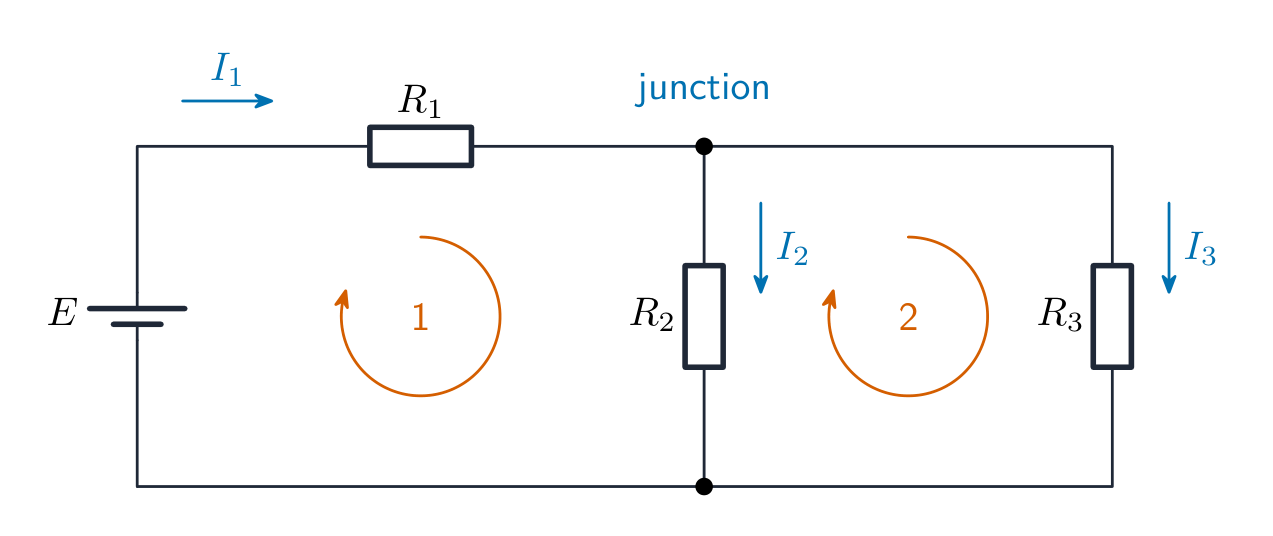
例题。 上图电路中 $\varepsilon = 12\ \text{V}$(内阻可忽略),$R_{1} = 2.0\ \Omega$,$R_{2} = 6.0\ \Omega$,$R_{3} = 3.0\ \Omega$。求三个电流。
基尔霍夫方法。 节点:$I_{1} = I_{2} + I_{3}$。回路 1(经过 $\varepsilon$、$R_{1}$、$R_{2}$):$12 = 2.0 I_{1} + 6.0 I_{2}$。回路 2(经过 $R_{2}$ 和 $R_{3}$,没有电源):$0 = 6.0 I_{2} - 3.0 I_{3}$,所以 $I_{3} = 2 I_{2}$。于是 $I_{1} = 3 I_{2}$,$12 = 6.0 I_{2} + 6.0 I_{2}$,得 $I_{2} = 1.0\ \text{A}$,$I_{3} = 2.0\ \text{A}$,$I_{1} = 3.0\ \text{A}$。
化简检验。 $6.0\ \Omega$ 与 $3.0\ \Omega$ 并联得 $2.0\ \Omega$;加上 $R_{1}$ 总共 $4.0\ \Omega$,所以 $I_{1} = 12 / 4.0 = 3.0\ \text{A}$,并联对两端的电势差是 $3.0 \times 2.0 = 6.0\ \text{V}$,得 $I_{2} = 6.0/6.0 = 1.0\ \text{A}$,$I_{3} = 6.0/3.0 = 2.0\ \text{A}$。两种方法必须一致;电流算出负值只是说明你猜的方向反了。
探索
Series & parallel circuits
Switch between series and parallel and add bulbs. In series they share the voltage and one break kills them all; in parallel each gets the full voltage and a break only loses its branch.
词汇表
训练
| 英文 | 中文 | 拼音 |
|---|---|---|
| junction/ˈdʒʌŋkʃn/ | 节点 | jié diǎn |
| conservation of charge/ˌkɒnsəˈveɪʃn ɒv tʃɑːdʒ/ | 电荷守恒 | diàn hè shǒu héng |
| closed loop/kləʊzd luːp/ | 回路 | huí lù |
| conservation of energy/ˌkɒnsəˈveɪʃn ɒv ˈenədʒi/ | 能量守恒 | néng liàng shǒu héng |
| Kirchhoff's first law/ˈkɜːkhɒfs fɜːst lɔː/ | 基尔霍夫第一定律 | jī ěr huò fū dì yí dìng lǜ |
| Kirchhoff's second law/ˈkɜːkhɒfs ˈsekənd lɔː/ | 基尔霍夫第二定律 | jī ěr huò fū dì èr dìng lǜ |
| loop/luːp/ | 回路 | huí lù |
10.3
分压器

大纲
- understand the principle of a potential divider circuit
- recall and use the principle of the potentiometer as a means of comparing potential differences
- understand the use of a galvanometer in null methods
- explain the use of thermistors and light-dependent resistors in potential dividers to provide a potential difference that is dependent on temperature and light intensity
来源:剑桥国际大纲
分压器(potential divider)是跨接在一个电源上的两个(或更多)串联电阻。每个电阻两端的电势差与它的电阻成正比:
$$V_{1} = V_{\text{in}} \cdot \frac{R_{1}}{R_{1} + R_{2}}, \qquad V_{2} = V_{\text{in}} \cdot \frac{R_{2}}{R_{1} + R_{2}}.$$
通过选择电阻值,输出(在 $R_{1}$ 和 $R_{2}$ 之间引出)可以设为 $0$ 到 $V_{\text{in}}$ 之间的任何电压(voltage)。一个用上全部三个接线端的电位差计(potentiometer,匀电阻轨道上的一个滑片)给出一个平滑可变的分压器;同一个元件只接两端时是变阻器(rheostat),只改变电流。
例题。 一个 $6.0\ \text{V}$ 的电源跨接在一个 $2.0\ \text{k}\Omega$ 的电阻与一个 $4.0\ \text{k}\Omega$ 的电阻串联上。求在 $4.0\ \text{k}\Omega$ 电阻两端引出的输出电压。
$$V_{2} = V_{\text{in}} \cdot \frac{R_{2}}{R_{1} + R_{2}} = 6.0 \times \frac{4.0}{2.0 + 4.0} = 4.0\ \text{V}.$$
标准答案里常用的先算电流的路线给出同样的结果:$I = V_{\text{in}} / (R_{1} + R_{2}) = 6.0 / 6000 = 1.0\ \text{mA}$,然后 $V_{2} = I R_{2} = 1.0 \times 10^{-3} \times 4000 = 4.0\ \text{V}$。两个值得记住的推论:较大的电阻分到较大的电势差;比例公式只在输出不取电流时成立——与 $R_{2}$ 并联的负载(或低电阻的电压表)会降低 $R_{2}$ 的有效电阻,从而降低 $V_{2}$。
传感器电路
把一个固定电阻换成一个电阻随物理量变化的传感器(sensor):
- 热敏电阻(thermistor,NTC):$R$ 随温度上升而下降。在分压器中,输出电压沿一个固定方向随温度变化。
- 光敏电阻(light-dependent resistor,LDR):$R$ 随光强(light intensity)上升而下降,给出一个随亮度变化的输出。
把输出接到一个晶体管(transistor)基极或一个比较器(comparator),当温度或光越过一个阈值(threshold)时接通或断开一个负载。

输出往哪个方向变? 输出可以取自传感器两端,也可以取自固定电阻两端,两种选择的响应方向相反。按下面的顺序沿着电流论证,你就有了完整的三分答案:
- 光变亮(或温度上升),所以 LDR(或热敏电阻)的电阻下降;
- 串联电路的总电阻下降,所以电流上升($I = \varepsilon / R_{\text{total}}$);
- 固定电阻两端的电势差 $= IR$ 上升,所以传感器两端的电势差 $= \varepsilon - IR$ 下降。
所以取自固定电阻的输出随光或温度上升;取自传感器的输出下降。如果电源有内阻,再加一环:更大的电流也使 $Ir$ 增大,所以端电压略微下降。
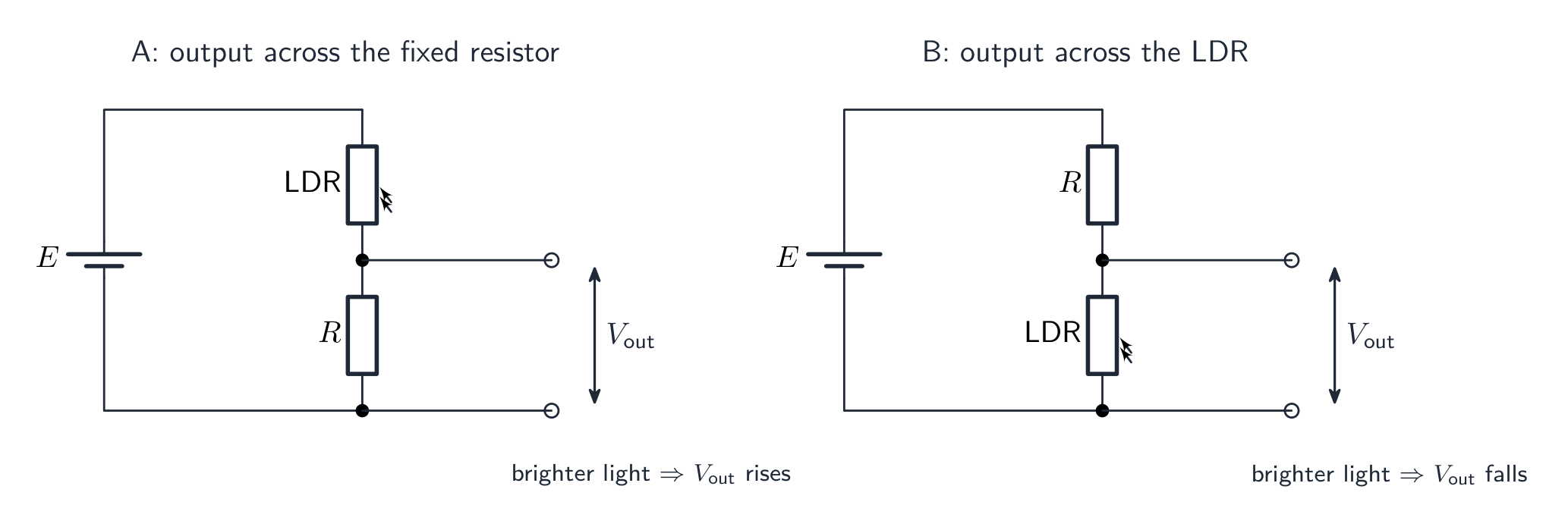
例题。 一个电动势 $9.0\ \text{V}$、内阻可忽略的电池与一个 LDR 和一个 $1200\ \Omega$ 的电阻串联。在光照下 LDR 的电阻为 $1800\ \Omega$。计算 LDR 两端的电势差,并说明和解释光强减小时它如何变化。
$V_{\text{LDR}} = 9.0 \times \dfrac{1800}{1800 + 1200} = 5.4\ \text{V}$。光变少 → LDR 的电阻增大 → 总电阻增大、电流减小 → $1200\ \Omega$ 电阻两端的电势差($IR$)减小 → LDR 两端的电势差($9.0 - IR$)增大。
例题。 一个热敏电阻与一个 $5800\ \Omega$ 的电阻串联接在 $6.0\ \text{V}$ 电源上,电阻两端的电势差为 $2.9\ \text{V}$。求热敏电阻的阻值。
电流 $= 2.9 / 5800 = 5.0 \times 10^{-4}\ \text{A}$。热敏电阻分到剩下的 $6.0 - 2.9 = 3.1\ \text{V}$,所以 $R = 3.1 / (5.0 \times 10^{-4}) = 6200\ \Omega$(或按比例,$R = 5800 \times 3.1/2.9$)。
电位差计与零点法
电位差计(potentiometer)是一根长度为 $L_{0}$ 的匀电阻线,带一个滑动触点(滑动触头(jockey))。单位长度的电阻均匀,所以从一端到滑动触头的电势差与长度成正比:
$$V_{x} = V_{\text{full}} \cdot \frac{x}{L_{0}}.$$
要比较两个电动势(一个未知电池对一个标准电池),把每个依次通过一个检流计(galvanometer)与滑动触头相连。滑动触头,直到检流计读数为零(一个零点(null)——被测电池中没有电流流过,因为电位差计在那里的电压恰好抵消电池的电动势)。平衡长度(balance length)——平衡时从导线一端到滑动触头的长度——与被测电动势成正比,所以两个长度之比等于电动势之比:
$$\frac{\varepsilon_{1}}{\varepsilon_{2}} = \frac{l_{1}}{l_{2}}.$$
这是一个零点法(null method):你找到平衡(零电流),而不是测量一个电流的值。它的优点是在平衡时未知电池不给出电流,所以它的内阻不影响结果。

为什么零点法比电压表好。 平衡时被测电池不输出电流,所以其内部没有 $Ir$ 压降:平衡点测的是电动势,而不是端电压。电压表总要取一些电流,所以它的读数略小于电动势。
读平衡点。 导线单位长度的电势差由驱动电池(driver cell)和导线的电阻决定。任何使被平衡的电势差变大的因素都会把平衡点沿导线推得更远;任何使单位长度电势差变大的因素(电动势更大的驱动电池,或分到驱动电池更大份额电势差的导线)都会使平衡长度变短。换成一根长度相同但直径更大的导线,会降低它的电阻($R = \rho L / A$):如果驱动电池内阻可忽略且没有别的串联元件,导线两端仍是全部电动势,平衡长度不动;如果驱动电池有内阻或有串联电阻,导线分到的电动势份额下降,每米电势差下降,平衡长度变长。要说明你处于哪种情况。
例题。 一根长 $2.0\ \text{m}$ 的电位差计导线 XY 两端电势差为 $1.50\ \text{V}$。一个电动势 $E$ 的电池在滑动触头距 X $1.6\ \text{m}$ 处平衡。求 $E$,并说明若把驱动电池换成电动势更大的电池,平衡长度会怎样变化。
$E = 1.50 \times \dfrac{1.6}{2.0} = 1.2\ \text{V}$。更大的驱动电动势给出更大的每米电势差,所以同样的 $1.2\ \text{V}$ 在更短的长度处达到:滑动触头必须向 X 移动。
探索
Sharing voltage in series
In a series loop the same current flows everywhere and the cell's voltage splits across the components — that split is how a potential divider works.
词汇表
训练
| 英文 | 中文 | 拼音 |
|---|---|---|
| potential divider/pəˈtenʃl dɪˈvaɪdə/ | 分压器 | fēn yā qì |
| voltage/ˈvəʊltɪdʒ/ | 电压 | diàn yā |
| potentiometer/pəˌtentɪˈɒmɪtə/ | 电位差计 | diàn wèi chā jì |
| sensor/ˈsensə/ | 传感器 | chuán gǎn qì |
| thermistor/ˈθɜːmɪstə/ | 热敏电阻 | rè mǐn diàn zǔ |
| light-dependent resistor/laɪt dɪˈpendənt rɪˈzɪstə/ | 光敏电阻 | guāng mǐn diàn zǔ |
| light intensity/laɪt ɪnˈtensɪti/ | 光强 | guāng qiáng |
| transistor/trænˈzɪstə/ | 晶体管 | jīng tǐ guǎn |
| comparator/kəmˈpæreɪtə/ | 比较器 | bǐ jiào qì |
| threshold/ˈθreʃəʊld/ | 阈值 | yù zhí |
| jockey/ˈdʒɒki/ | 滑动触头 | huá dòng chù tóu |
| galvanometer/ˌɡælvəˈnɒmɪtə/ | 检流计 | jiǎn liú jì |
| balance length/ˈbæləns leŋθ/ | 平衡长度 | píng héng cháng dù |
| null method/nʌl ˈmeθəd/ | 零点法 | líng diǎn fǎ |
| driver cell/ˈdraɪvə sel/ | 驱动电池 | qū dòng diàn chí |
10.3
考官认可的定义
定义题按固定措辞给分。把这些记准,并且只给一个答案。
| 术语 | 定义 |
|---|---|
| 电动势(e.m.f.) | 电源驱动电荷绕完整电路一周时,每单位电荷转移的能量 |
| 电势差(p.d.) | 每单位电荷从电能转化为其他形式能量的能量 |
| 内阻 | 电动势源内部对电流的阻碍,当有电流时在电源内部产生电势差 $Ir$ |
| 端电压 | 电源两端子之间的电势差,等于电动势 $- Ir$ |
| 基尔霍夫第一定律 | 流入一个节点的电流之和等于流出该节点的电流之和(电荷守恒) |
| 基尔霍夫第二定律 | 绕一个闭合回路的电动势之和等于该回路中电势差之和(能量守恒) |
| 分压器 | 跨接在电源上的两个或更多串联电阻,在其中一个电阻两端给出电源电势差的一部分 |
| 电位差计 | 带滑动触点的匀电阻线,通过找到检流计读数为零的长度来比较电势差 |
| 零点法 | 调节电路直到仪表读数为零的测量方法,这样被测元件不输出电流 |
| 平衡长度 | 检流计读数为零时,电位差计导线一端到滑动触点之间的长度 |
10.3
考试技巧
- 应用基尔霍夫定律:流入节点的电流 $=$ 流出的电流(电荷守恒);绕回路 $\sum \text{e.m.f.} = \sum \text{p.d.}$(能量守恒)。当题目说"用基尔霍夫定律"时,写出你用的是哪条定律。
- 合成电阻:串联 $R = R_1 + R_2$;并联 $1/R = 1/R_1 + 1/R_2$。并联组合总是小于其中最小的电阻。
- 分压器按电阻之比分配电压;较大的电阻分到较大的电势差。
- 把内阻算进去:$\text{e.m.f.} = I(R + r)$——"损失的电压"是 $Ir$。电路改变时,按 电阻 → 电池中的电流 → $Ir$ → 端电压 来论证。
- "内阻可忽略"意味着无论电流多大,端电压就是电动势。动笔前先找这句话。
- 把电源的 $V$–$I$ 图读作 $V = \varepsilon - Ir$:截距 $\varepsilon$,斜率 $-r$,$V = 0$ 时的电流是最大(短路)电流 $\varepsilon / r$。
- Paper 5 里,先把电路关系整理成 $y = mx + c$ 再作图:电动势 $\varepsilon$、内阻 $r$ 的电池向 $n$ 个相同的并联电阻 $R$ 供电时,$\varepsilon = I\left(\dfrac{R}{n} + r\right)$,所以 $\dfrac{1}{I} = \dfrac{R}{\varepsilon} \cdot \dfrac{1}{n} + \dfrac{r}{\varepsilon}$——$1/I$ 对 $1/n$ 的图斜率为 $R/\varepsilon$,截距为 $r/\varepsilon$。
常见错误
- 只用电动势和外电阻写 $V = IR$,忘了 $r$。用 $\varepsilon = I(R + r)$。
- 说电动势是"推动电荷的力"。它是每单位电荷的能量;伏特是每库仑一焦耳。
- 把定律和守恒定律配错。第一定律——电荷;第二定律——能量。
- 对三个并联电阻用"积除以和"。它只对两个成立;否则把倒数相加。
- 用"电阻变了所以电压变了"解释传感器电路。得分点在这条链:电阻 → 总电阻 → 电流 → 固定电阻两端的 $IR$ → 其余落在传感器上。
- 说平衡时电位差计"不从驱动电池取电流"。它不从被测电池取电流;驱动电池始终提供导线电流。
- 在"证明"题最后一行之前就四舍五入——先写 $1.40\ \text{V}$,再说它是 $1.4\ \text{V}$。
本主题的互动课程
逐步学习,并即时检测练习。