Practical circuits and internal resistance
Introduced| English | Meaning |
|---|---|
| internal resistance/ɪnˈtɜːnl rɪˈzɪstəns/ | The effective resistance within a source of electrical energy that causes its terminal voltage to change when current flows. |
| terminal potential difference/ˈtɜːmɪnl pəˈtenʃl ˈdɪfrəns/ | terminal potential difference |
| lost volts/lɒst vəʊlts/ | lost volts |
| short circuit/ʃɔːt ˈsɜːkɪt/ | An unintended low-resistance path that bypasses part of a circuit and can carry a large current. |
| parallel/ˈpærəlel/ | An electrical arrangement in which components are connected across the same two points and have the same potential difference. |
| ammeters/ˈæmiːtəz/ | An instrument connected in series to measure electric current. |
| voltmeters/ˈvəʊltmiːtəz/ | An instrument connected across two points to measure their potential difference. |
| series/ˈsɪəriːz/ | An arrangement in which components lie along a single electrical path. |
Why the headlights dim
- Start a car and the headlights dim for a moment.
- The starter motor draws a huge current, and the battery's own voltage sags.
- Every real source has some internal resistance 内阻.
e.m.f. and p.d.
- e.m.f. $\varepsilon$ — energy each coulomb is given by the source.
- p.d. — energy each coulomb gives up to a component. Both in volts.

A real circuit built on a breadboard, being measured with a multimeter
Internal resistance
V = ε − I·r
Terminal p.d. falls with current: it starts at the e.m.f. ε and drops by I·r.
The e.m.f. is the energy given to each unit of charge by the ____.
Difficulty 1/5 · 100 coins + a small bonus on first completion today
The source (battery, cell, generator) supplies energy to the charge; a component takes it back out (the p.d.).
Internal resistance
- A real source has internal resistance $r$, so some energy is lost inside it.
- The terminal potential difference 端电压 (terminal p.d.) delivered outside is $V = \varepsilon - Ir$.
- The $Ir$ is called the lost volts 内阻压降 — energy per coulomb turned to heat inside the source.
A cell of e.m.f. $12\ \text{V}$ and internal resistance $0.50\ \Omega$ drives a current of $2.0\ \text{A}$. What is the terminal p.d.?
Difficulty 2/5 · 140 coins + a small bonus on first completion today
$V = \varepsilon - Ir = 12 - 2.0 \times 0.50 = 11\ \text{V}$.
What happens as current changes
- No current ($I = 0$): terminal p.d. equals the e.m.f.
- More current: the terminal p.d. drops (that $Ir$ loss grows).
- Short circuit 短路 ($R_{\text{ext}} \to 0$): $I = \dfrac{\varepsilon}{r}$ — a large current.
A cell of e.m.f. $6.0\ \text{V}$ and internal resistance $0.50\ \Omega$ is short-circuited. What current flows?
Difficulty 2/5 · 140 coins + a small bonus on first completion today
With $R_{\text{ext}} \to 0$, $I = \dfrac{\varepsilon}{r} = \dfrac{6.0}{0.50} = 12\ \text{A}$.
Worked example: a battery and two lamps
A battery of e.m.f. $6.0\ \text{V}$ and internal resistance $0.80\ \Omega$ drives a current of $1.5\ \text{A}$ through two lamps X and Y in parallel. X has resistance $4.0\ \Omega$.
- Terminal p.d.: $V = \varepsilon - Ir = 6.0 - 1.5 \times 0.80 = 4.8\ \text{V}$.
- Current in X: the parallel lamps share the terminal p.d., so $I_{\text{X}} = \dfrac{4.8}{4.0} = 1.2\ \text{A}$.
- Current in Y: Kirchhoff's first law at the junction: $I_{\text{Y}} = 1.5 - 1.2 = 0.30\ \text{A}$.
- Power in Y: $P = VI = 4.8 \times 0.30 = 1.4\ \text{W}$.
- Check: $1.2\ \text{V}$ is lost inside the battery, so only $4.8\ \text{V}$ of the $6.0\ \text{V}$ reaches the lamps. Both lamps see the same p.d. because they are in parallel.
A battery of e.m.f. $9.0\ \text{V}$ and internal resistance $1.0\ \Omega$ delivers $2.0\ \text{A}$ to two resistors in parallel. One of them, of resistance $10\ \Omega$, takes part of the current. What current, in A, flows in the other resistor?
Difficulty 2/5 · 140 coins + a small bonus on first completion today
Terminal p.d. $= 9.0 - 2.0 \times 1.0 = 7.0\ \text{V}$; the $10\ \Omega$ resistor takes $\dfrac{7.0}{10} = 0.70\ \text{A}$; the other takes $2.0 - 0.70 = 1.3\ \text{A}$.
Measuring the internal resistance
- Vary the external resistor and plot terminal p.d. $V$ against current $I$.
- The line's intercept is $\varepsilon$ and its gradient is $-r$.
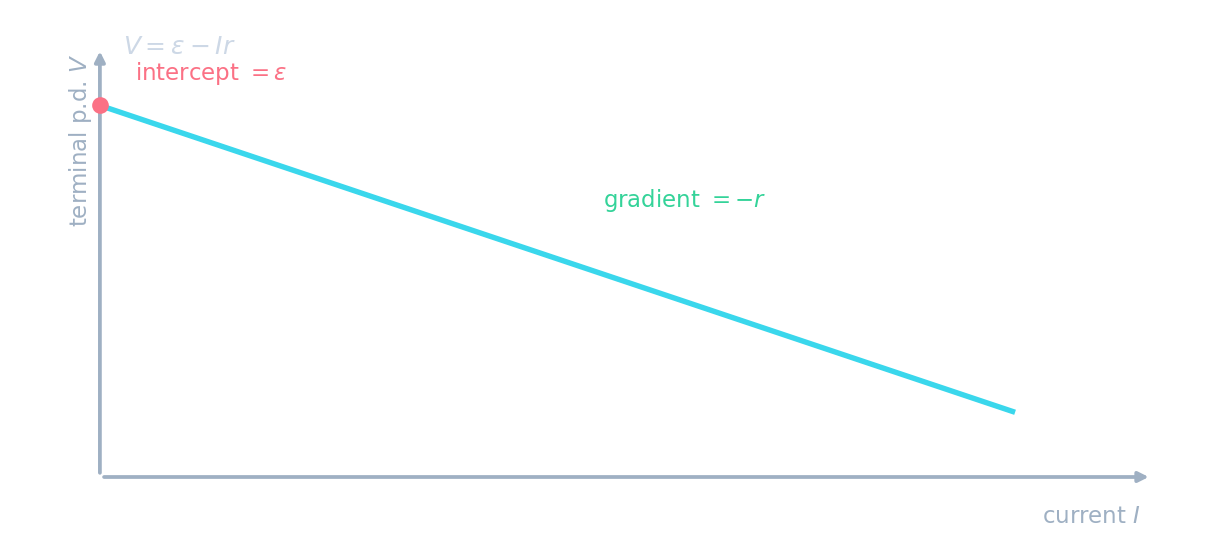
On a terminal-p.d.-against-current graph, match each feature.
Difficulty 2/5 · 140 coins + a small bonus on first completion today
From $V = \varepsilon - Ir$: at $I = 0$, $V = \varepsilon$ (intercept); the slope is $-r$.
Worked example: reading the graph
A $V$–$I$ graph for a cell is a straight line from $(0,\ 1.5\ \text{V})$ to $(3.0\ \text{A},\ 0)$. The external resistor is then made smaller.
- e.m.f.: the intercept, $\varepsilon = 1.5\ \text{V}$.
- Internal resistance: gradient $= \dfrac{0 - 1.5}{3.0 - 0} = -0.50\ \dfrac{\text{V}}{\text{A}}$, so $r = 0.50\ \Omega$.
- Short-circuit current: where the line meets the $I$ axis, $\dfrac{\varepsilon}{r} = 3.0\ \text{A}$.
- Smaller external resistor: the current increases, so the lost volts $Ir$ increase and the terminal p.d. falls — you move down the line to the right.
- Check: the gradient is negative but a resistance is positive; write $r = 0.50\ \Omega$, not $-0.50\ \Omega$.
The external resistance connected to a real cell is decreased. What happens to the terminal p.d., and why?
Difficulty 1/5 · 100 coins + a small bonus on first completion today
Smaller external resistance → larger current → larger lost volts $Ir$ → smaller terminal p.d. $\varepsilon - Ir$. The e.m.f. is fixed, but the terminal p.d. is not.
The e.m.f. is not "the voltage of the battery" read by any voltmeter. A voltmeter across the terminals reads the terminal p.d., which equals $\varepsilon$ only when no current flows — an ideal voltmeter alone across the cell. Once a load is connected the reading drops by $Ir$. And the gradient of the $V$–$I$ line is $-r$: quote the resistance as a positive number.
When does a voltmeter across a cell's terminals read the e.m.f.? Select all that apply.
Difficulty 2/5 · 140 coins + a small bonus on first completion today
The reading is $\varepsilon - Ir$. It equals $\varepsilon$ if $r = 0$ or if $I = 0$. With a lamp connected, current flows and the reading drops; on a short circuit it falls to zero.
Ammeters 电流表, voltmeters 电压表 and the diagram
- An ideal ammeter has zero resistance and goes in series 串联.
- An ideal voltmeter has infinite resistance and goes in parallel 并联.
- When asked to draw the circuit, use the standard symbols and show the internal resistance as a resistor next to the cell.

The standard circuit symbols you need to recognise and draw
An ideal ammeter has:
Difficulty 1/5 · 100 coins + a small bonus on first completion today
An ammeter goes in series and should add no resistance, so an ideal one has zero resistance.
An ideal voltmeter has infinite resistance and is connected in parallel.
Difficulty 1/5 · 100 coins + a small bonus on first completion today
Yes — in parallel, with infinite resistance so it draws no current from the component it measures.
You've got it
- terminal p.d. $V = \varepsilon - Ir$ (drops as current rises); $Ir$ is the lost volts
- a $V$–$I$ graph gives $\varepsilon$ (intercept) and $-r$ (gradient); short-circuit current $= \dfrac{\varepsilon}{r}$
- ideal ammeter: 0 Ω in series; ideal voltmeter: ∞ Ω in parallel — it reads $\varepsilon$ only with no current