Kirchhoff's laws
Introduced| English | Meaning |
|---|---|
| Kirchhoff's laws/ˈkɜːkhɒfs lɔːz/ | Kirchhoff's laws |
| junctions/ˈdʒʌŋkʃnz/ | A point in an electrical circuit where branches meet and current can split or combine. |
| conservation of charge/ˌkɒnsəˈveɪʃn ɒv tʃɑːdʒ/ | The principle that total electric charge remains constant in an isolated system. |
| conservation of energy/ˌkɒnsəˈveɪʃn ɒv ˈenədʒi/ | The principle that energy cannot be created or destroyed, only transferred or transformed. |
| series/ˈsɪəriːz/ | An arrangement in which components lie along a single electrical path. |
| parallel/ˈpærəlel/ | An electrical arrangement in which components are connected across the same two points and have the same potential difference. |
Two rules for any circuit
- A tangle of wires can look impossible to solve.
- But just two rules — Kirchhoff's laws 基尔霍夫定律 — crack any of them.
- Each is really a conservation law in disguise.
First law: junctions 节点
- At any junction, current in = current out.
- It comes from conservation of charge 电荷守恒 — charge cannot pile up at a point.
Series & parallel circuits
Switch between series and parallel and add bulbs. In series they share the voltage and one break kills them all; in parallel each gets the full voltage and a break only loses its branch.
$5.0\ \text{A}$ flows into a junction and splits into two branches; one carries $2.0\ \text{A}$. What does the other carry?
Difficulty 2/5 · 140 coins + a small bonus on first completion today
Current in = current out: $5.0 = 2.0 + I$, so $I = 3.0\ \text{A}$.
Second law: loops
- Around any closed loop, total e.m.f. = total p.d. across the components.
- It comes from conservation of energy 能量守恒 — each coulomb gives back what it gained.
- Go round the loop in one direction: an e.m.f. counts positive if you pass through the source from $-$ to $+$; a p.d. $IR$ counts positive if you go with the current.
Match each Kirchhoff law to the conservation law behind it.
Difficulty 2/5 · 140 coins + a small bonus on first completion today
Charge cannot build up at a junction; energy a charge gains from sources equals what it gives to components round a loop.
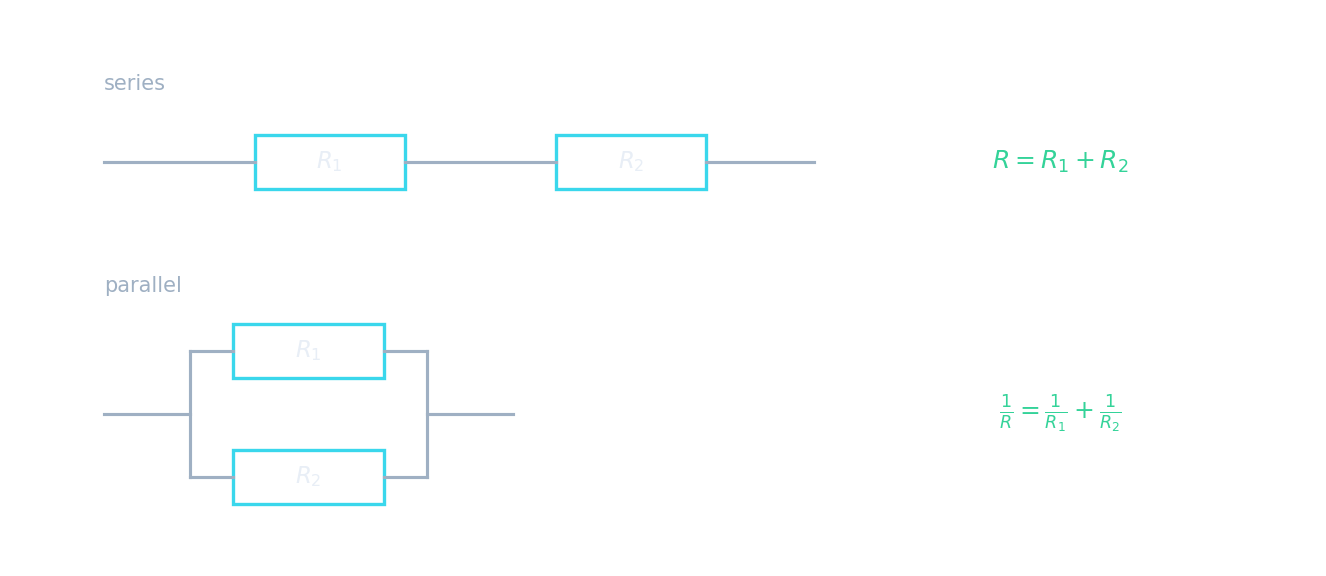
Resistors in series 串联
- Same current through each; the p.d.s add.
- $R_{\text{series}} = R_1 + R_2 + \ldots$ — always larger than each one.

Two resistors in series and their single equivalent resistor
A $3.0\ \Omega$ and a $6.0\ \Omega$ resistor are in series. What is the total resistance?
Difficulty 2/5 · 140 coins + a small bonus on first completion today
$R = R_1 + R_2 = 3.0 + 6.0 = 9.0\ \Omega$.
Resistors in parallel 并联
- Same p.d. across each; the currents add.
- $\dfrac{1}{R_{\text{parallel}}} = \dfrac{1}{R_1} + \dfrac{1}{R_2} + \ldots$ — always smaller than the smallest one.

Two resistors in parallel and their single equivalent resistor
A $3.0\ \Omega$ and a $6.0\ \Omega$ resistor are in parallel. What is the total resistance?
Difficulty 2/5 · 140 coins + a small bonus on first completion today
$\dfrac{1}{R} = \dfrac{1}{3.0} + \dfrac{1}{6.0} = \dfrac{1}{2.0}$, so $R = 2.0\ \Omega$ — smaller than either.
A parallel combination is always smaller than the smallest resistor in it.
Difficulty 1/5 · 100 coins + a small bonus on first completion today
Yes — adding a parallel path gives the current another route, lowering the overall resistance.
Worked example: a cell with a parallel pair
A cell of e.m.f. $6.0\ \text{V}$ and internal resistance $1.0\ \Omega$ is connected to a $4.0\ \Omega$ and a $6.0\ \Omega$ resistor in parallel. Find the current in the cell, the terminal p.d., and the current in each resistor.
- Parallel pair: $\dfrac{1}{R} = \dfrac{1}{4.0} + \dfrac{1}{6.0} = \dfrac{5}{12}$, so $R = 2.4\ \Omega$.
- Whole circuit: $R_{\text{total}} = 2.4 + 1.0 = 3.4\ \Omega$, so $I = \dfrac{6.0}{3.4} = 1.8\ \text{A}$ (second law: $\varepsilon = I(R + r)$).
- Terminal p.d.: $V = 6.0 - 1.8 \times 1.0 = 4.2\ \text{V}$ — the p.d. across both resistors.
- Branch currents: $\dfrac{4.2}{4.0} = 1.1\ \text{A}$ and $\dfrac{4.2}{6.0} = 0.70\ \text{A}$.
- Check (first law): $1.1 + 0.70 = 1.8\ \text{A}$, the current in the cell. The smaller resistor takes the larger share.
A cell of e.m.f. $12\ \text{V}$ and internal resistance $2.0\ \Omega$ is connected to two $8.0\ \Omega$ resistors in parallel. What is the terminal p.d., in V?
Difficulty 2/5 · 140 coins + a small bonus on first completion today
Two equal $8.0\ \Omega$ resistors in parallel give $4.0\ \Omega$. $I = \dfrac{12}{4.0 + 2.0} = 2.0\ \text{A}$, so $V = 12 - 2.0 \times 2.0 = 8.0\ \text{V}$.
Explaining a change with the laws
- A thermistor in parallel with a resistor R, across a real cell. Temperature rises — why does the current in R fall?
- Chain it: thermistor resistance ↓ → total circuit resistance ↓ → current in the cell ↑ → lost volts $Ir$ ↑ → terminal p.d. ↓ → current in R $= \dfrac{V}{R}$ ↓.
- Every arrow is a mark. The current in the cell goes up while the current in R goes down — both at once.
A thermistor is in parallel with a resistor R across a real cell, and the temperature rises. Put the chain of reasoning in order.
Difficulty 3/5 · 200 coins + a small bonus on first completion today
Less resistance → more cell current → more lost volts → less terminal p.d. → less current in R. Note the cell current rises while the current in R falls.
Solving a circuit
- Label every current with a direction.
- Apply the junction rule and the loop rule, plus $V = IR$, then solve together.
Two equal resistors $R$ in parallel give a combined resistance of:
Difficulty 1/5 · 100 coins + a small bonus on first completion today
$\dfrac{1}{R_{\text{tot}}} = \dfrac{1}{R} + \dfrac{1}{R} = \dfrac{2}{R}$, so $R_{\text{tot}} = \tfrac{1}{2}R$.
The parallel formula gives $\dfrac{1}{R}$ — invert at the end, or you will quote $0.42\ \Omega$ for a $2.4\ \Omega$ pair. Two equal resistors in parallel give exactly half. Adding any resistor in parallel always lowers the total. And all branches in parallel have the same p.d., so you never add p.d.s across parallel branches.
Components connected in parallel always have the same ____ across them.
Difficulty 1/5 · 100 coins + a small bonus on first completion today
Parallel branches share the same two junctions, so the p.d. across each is identical; the currents are what differ.
You've got it
- first law (junctions): current in = current out — conservation of charge
- second law (loops): total e.m.f. = total p.d. — conservation of energy; $\varepsilon = I(R + r)$
- series: $R = R_1 + R_2$; parallel: $\dfrac{1}{R} = \dfrac{1}{R_1} + \dfrac{1}{R_2}$ (then invert); a change anywhere alters the cell current and the terminal p.d.