这份讲义涵盖主题 3:纯数学(Pure Mathematics)3。子主题 3.1–3.6 建立在纯数学 2 的代数、对数、三角学、微分、积分和数值方法之上,所以这份讲义解释纯数学 3 中新的东西,然后涵盖三个大的新领域:向量、微分方程和复数。
纯数学3
A-Level 数学 · 第 3 主题
 13:36
13:36
Pure Mathematics 3
For centuries, mathematicians hit a wall: what is the square root of minus one? No ordinary number, squared, gives a negative. They called it impossible, and…
英文讲解 · 内嵌中英文字幕
3.1
代数
大纲
| Candidates should be able to: | Notes and examples |
|---|---|
| • understand the meaning of $|x|$, sketch the graph of $y = |ax + b|$ and use relations such as $|a| = |b| \iff a^2 = b^2$ and $|x - a| < b \iff a - b < x < a + b$ when solving equations and inequalities | Graphs of $y = |\text{f}(x)|$ and $y = \text{f}(|x|)$ for non-linear functions $\text{f}$ are not included. e.g. $|3x - 2| = |2x + 7|$, $2x + 5 < |x + 1|$. |
| • divide a polynomial, of degree not exceeding 4, by a linear or quadratic polynomial, and identify the quotient and remainder (which may be zero) | |
| • use the factor theorem and the remainder theorem | e.g. to find factors and remainders, solve polynomial equations or evaluate unknown coefficients. Including factors of the form $(ax + b)$ in which the coefficient of $x$ is not unity, and including calculation of remainders. |
| • recall an appropriate form for expressing rational functions in partial fractions, and carry out the decomposition, in cases where the denominator is no more complicated than – $(ax + b)(cx + d)(ex + f)$ – $(ax + b)(cx + d)^2$ – $(ax + b)(cx^2 + d)$ | Excluding cases where the degree of the numerator exceeds that of the denominator |
| • use the expansion of $(1 + x)^n$, where $n$ is a rational number and $|x| < 1$. | Finding the general term in an expansion is not included. Adapting the standard series to expand e.g. $(2 - \frac{1}{2}x)^{-1}$ is included, and determining the set of values of $x$ for which the expansion is valid in such cases is also included. |
来源:剑桥国际大纲
两个新工具加入纯数学 2 的代数。
Partial fractions
一个分母被因式分解的单一分数能被拆成一个更简单分数的和。这叫把它写成部分分式(partial fractions),它使一个有理函数(rational function,多项式的一个分数)容易积分或展开。把形式匹配到分母:
先检查分子的次数低于分母。如果不是("头重"),就先做多项式除法:除法给出一个商(quotient)加上一个余数(remainder)除以原来的分母,然后只拆那个剩下的真分数。
一个分母被因式分解的分数拆成一个更简单分数的和。
$$\frac{1}{(ax+b)(cx+d)} = \frac{A}{ax+b} + \frac{B}{cx+d}, \qquad \frac{1}{(ax+b)(cx+d)^2} = \frac{A}{ax+b} + \frac{B}{cx+d} + \frac{C}{(cx+d)^2}.$$
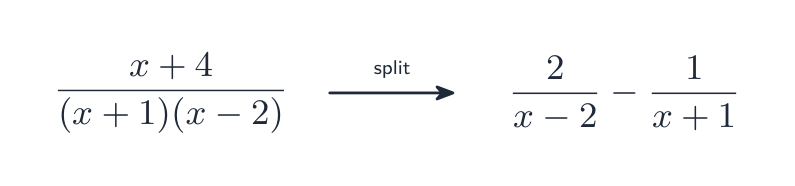
例题。 把 $\dfrac{x+4}{(x+1)(x-2)}$ 表示成部分分式。
写 $\dfrac{x+4}{(x+1)(x-2)} = \dfrac{A}{x+1} + \dfrac{B}{x-2}$,所以 $x + 4 = A(x-2) + B(x+1)$。 令 $x = 2$:$6 = 3B$,所以 $B = 2$。令 $x = -1$:$3 = -3A$,所以 $A = -1$。因此
$$\frac{x+4}{(x+1)(x-2)} = \frac{2}{x-2} - \frac{1}{x+1}.$$
The binomial expansion for a rational power
当幂是一个分数或是负的时,二项展开式(binomial expansion)也有效,只要 $|x| < 1$:
$$(1 + x)^n = 1 + nx + \frac{n(n-1)}{2!}x^2 + \frac{n(n-1)(n-2)}{3!}x^3 + \cdots$$
例如对 $|x| < 1$ 有 $(1 + x)^{1/2} = 1 + \tfrac12 x - \tfrac18 x^2 + \cdots$。
探索
Reciprocal curves
y = a/(x − b) + c
Partial fractions split a hard fraction into simple reciprocal pieces — each with a vertical and a horizontal asymptote.
词汇表
训练
| 英文 | 中文 | 拼音 |
|---|---|---|
| Pure Mathematics/pjʊə ˌmæθɪˈmætɪks/ | 纯数学 | chún shù xué |
| partial fractions/ˈpɑːʃl ˈfrækʃnz/ | 部分分式 | bù fèn fēn shì |
| rational function/ˈræʃənl ˈfʌŋkʃn/ | 有理函数 | yǒu lǐ hán shù |
| quotient/ˈkwəʊʃənt/ | 商 | shāng |
| remainder/rɪˈmeɪndə/ | 余数 | yú shù |
| binomial expansion/baɪˈnəʊmɪəl ekˈspænʃn/ | 二项展开式 | èr xiàng zhǎn kāi shì |
3.2 3.3 3.6
对数函数与指数函数
大纲
| Candidates should be able to: | Notes and examples |
|---|---|
| understand the relationship between logarithms and indices, and use the laws of logarithms (excluding change of base) | |
| understand the definition and properties of $e^x$ and $\ln x$, including their relationship as inverse functions and their graphs | Including knowledge of the graph of $y = e^{kx}$ for both positive and negative values of $k$. |
| use logarithms to solve equations and inequalities in which the unknown appears in indices | e.g. $2^x < 5$, $3 \times 2^{3x-1} < 5$, $3^{x+1} = 4^{2x-1}$. |
| use logarithms to transform a given relationship to linear form, and hence determine unknown constants by considering the gradient and/or intercept. | e.g. $y = kx^n$ gives $\ln y = \ln k + n \ln x$ which is linear in $\ln x$ and $\ln y$. $y = k(a^x)$ gives $\ln y = \ln k + x \ln a$ which is linear in $x$ and $\ln y$. |
| Candidates should be able to: | Notes and examples |
|---|---|
| understand the relationship of the secant, cosecant and cotangent functions to cosine, sine and tangent, and use properties and graphs of all six trigonometric functions for angles of any magnitude | |
| use trigonometrical identities for the simplification and exact evaluation of expressions, and in the course of solving equations, and select an identity or identities appropriate to the context, showing familiarity in particular with the use of: – $\sec^2 \theta \equiv 1 + \tan^2 \theta$ and $\cosec^2 \theta \equiv 1 + \cot^2 \theta$ – the expansions of $\sin(A \pm B)$, $\cos(A \pm B)$ and $\tan(A \pm B)$ – the formulae for $\sin 2A$, $\cos 2A$ and $\tan 2A$ – the expression of $a \sin \theta + b \cos \theta$ in the forms $R \sin(\theta \pm \alpha)$ and $R \cos(\theta \pm \alpha)$. | e.g. simplifying $\cos(x - 30^\circ) - 3 \sin(x - 60^\circ)$. e.g. solving $\tan \theta + \cot \theta = 4$, $2 \sec^2 \theta - \tan \theta = 5$, $3 \cos \theta + 2 \sin \theta = 1$. |
| Candidates should be able to: | Notes and examples |
|---|---|
| • locate approximately a root of an equation, by means of graphical considerations and/or searching for a sign change | e.g. finding a pair of consecutive integers between which a root lies. |
| • understand the idea of, and use the notation for, a sequence of approximations which converges to a root of an equation | |
| • understand how a given simple iterative formula of the form $x_{n+1} = \text{F}(x_n)$ relates to the equation being solved, and use a given iteration, or an iteration based on a given rearrangement of an equation, to determine a root to a prescribed degree of accuracy. | Knowledge of the condition for convergence is not included, but an understanding that an iteration may fail to converge is expected. |
来源:剑桥国际大纲
子主题 3.2、3.3 和 3.6 是你在纯数学 2 中遇到的同样技能:带 $e^x$ 和 $\ln x$ 的对数定律;恒等式 $\sec^2\theta \equiv 1 + \tan^2\theta$ 和 $\csc^2\theta \equiv 1 + \cot^2\theta$、复合角和二倍角公式,以及 $a\sin\theta + b\cos\theta$ 的 $R$ 形式;以及通过一个变号(sign change)和一个迭代公式(iterative formula)$x_{n+1} = F(x_n)$ 数值地解一个方程。完全像之前一样用它们。
那三个新的三角函数是熟悉的三个的倒数(reciprocals):正割(secant)$\sec\theta = \dfrac{1}{\cos\theta}$、余割(cosecant)$\csc\theta = \dfrac{1}{\sin\theta}$,和余切(cotangent)$\cot\theta = \dfrac{1}{\tan\theta} = \dfrac{\cos\theta}{\sin\theta}$。(记忆法:对上第三个字母 —— sec 配 cosine。)上面那两个毕达哥拉斯恒等式,正是把 $\sin^2\theta + \cos^2\theta \equiv 1$ 除以 $\cos^2\theta$ 或 $\sin^2\theta$ 得来的。对一个数值方法,当相继的值越来越接近时,迭代 $x_{n+1}=F(x_n)$ 就收敛(converges)到根。
探索
The unit circle
(cos θ, sin θ)
The R-formula rewrites a sin θ + b cos θ as one wave — and it all lives on this circle.
词汇表
训练
| 英文 | 中文 | 拼音 |
|---|---|---|
| sign change/saɪn tʃeɪndʒ/ | 变号 | biàn hào |
| iterative formula/ˈɪtərətɪv ˈfɔːmjʊlə/ | 迭代公式 | dié dài gōng shì |
| reciprocals/rɪˈsɪprəklz/ | 倒数 | dào shǔ |
| secant/ˈsiːkənt/ | 正割 | zhèng gē |
| cosecant/ˈkəʊsekənt/ | 余割 | yú gē |
| cotangent/ˈkəʊtændʒənt/ | 余切 | yú qiē |
| converges/kənˈvɜːdʒɪz/ | 收敛 | shōu liǎn |
3.4
微分
大纲
| Candidates should be able to: | Notes and examples |
|---|---|
| use the derivatives of $e^x$, $\ln x$, $\sin x$, $\cos x$, $\tan x$, $\tan^{-1} x$, together with constant multiples, sums, differences and composites | Derivatives of $\sin^{-1} x$ and $\cos^{-1} x$ are not required. |
| differentiate products and quotients | e.g. $\frac{2x - 4}{3x + 2}$, $x^2 \ln x$, $x e^{1-x^2}$. |
| find and use the first derivative of a function which is defined parametrically or implicitly. | e.g. $x = t - e^{2t}$, $y = t + e^{2t}$. e.g. $x^2 + y^2 = xy + 7$. Including use in problems involving tangents and normals. |
来源:剑桥国际大纲
方法是纯数学 2 的那些(乘积、商和链式法则,带参数和隐式曲线)。加了一个导数——反正切(inverse tangent):
$$\frac{d}{dx}\tan^{-1} x = \frac{1}{1 + x^2}.$$
例题。 微分 $y = \tan^{-1}(3x)$。
用链式法则和上面的结果:$\dfrac{dy}{dx} = \dfrac{1}{1 + (3x)^2} \times 3 = \dfrac{3}{1 + 9x^2}.$
探索
The gradient at a point
gradient = dy/dx
Implicit or not, the derivative is still the slope of the tangent — slide the point to see it.
词汇表
训练
| 英文 | 中文 | 拼音 |
|---|---|---|
| inverse tangent/ɪnˈvɜːs ˈtændʒənt/ | 反正切 | fǎn zhèng qiè |
3.5
积分
大纲
| Candidates should be able to: | Notes and examples |
|---|---|
| extend the idea of 'reverse differentiation' to include the integration of $e^{ax + b}$, $\frac{1}{ax + b}$, $\sin(ax + b)$, $\cos(ax + b)$, $\sec^2(ax + b)$ and $\frac{1}{x^2 + a^2}$ | Including examples such as $\frac{1}{2 + 3x^2}$. |
| use trigonometrical relationships in carrying out integration | e.g. use of double-angle formulae to integrate $\sin^2 x$ or $\cos^2(2x)$. |
| integrate rational functions by means of decomposition into partial fractions | Restricted to types of partial fractions as specified in topic 3.1 above. |
| recognise an integrand of the form $\frac{k f'(x)}{f(x)}$, and integrate such functions | e.g. integration of $\frac{x}{x^2 + 1}$, $\tan x$. |
| recognise when an integrand can usefully be regarded as a product, and use integration by parts | e.g. integration of $x \sin 2x$, $x^2 e^{-x}$, $\ln x$, $x \tan^{-1} x$. |
| use a given substitution to simplify and evaluate either a definite or an indefinite integral. | e.g. to integrate $\sin^2 2x \cos x$ using the substitution $u = \sin x$. |
来源:剑桥国际大纲
纯数学 3 增加几个强大的方法。
- 一个新的标准积分:$\displaystyle\int \frac{1}{x^2 + a^2}\,dx = \frac{1}{a}\tan^{-1}\frac{x}{a} + C$。
- 部分分式:先拆一个有理函数,然后把每一片作为一个对数积分。
- 模式 $\dfrac{k\,f'(x)}{f(x)}$:这积分成 $k\ln|f(x)| + C$。例如 $\displaystyle\int \frac{2x}{x^2 + 1}\,dx = \ln(x^2 + 1) + C$。
- 分部积分(integration by parts),用于一个乘积:$\displaystyle\int u\,\frac{dv}{dx}\,dx = uv - \int v\,\frac{du}{dx}\,dx$。
- 换元积分(integration by substitution):一个给定的变量替换把一个难的积分变成一个容易的。
例题。 求 $\displaystyle\int x\cos x\,dx$。
用分部积分,$u = x$、$\dfrac{dv}{dx} = \cos x$,所以 $\dfrac{du}{dx} = 1$ 且 $v = \sin x$:
$$\int x\cos x\,dx = x\sin x - \int \sin x\,dx = x\sin x + \cos x + C.$$
探索
The area under the curve
area = ∫ f(x) dx
Every integration method just measures this area — drag the limits to total it.
词汇表
训练
| 英文 | 中文 | 拼音 |
|---|---|---|
| Integration by parts/ˌɪntɪˈɡreɪʃn baɪ pɑːts/ | 分部积分 | fēn bù jī fēn |
| Integration by substitution/ˌɪntɪˈɡreɪʃn baɪ ˌsʌbstɪˈtjuːʃn/ | 换元积分 | huàn yuán jī fēn |
3.7
向量

大纲
| Candidates should be able to: | Notes and examples |
|---|---|
| • use standard notations for vectors, i.e. $\begin{pmatrix} x \\ y \end{pmatrix}$, $x\mathbf{i} + y\mathbf{j}$, $\begin{pmatrix} x \\ y \\ z \end{pmatrix}$, $x\mathbf{i} + y\mathbf{j} + z\mathbf{k}$, $\overrightarrow{AB}$, $\mathbf{a}$ | |
| • carry out addition and subtraction of vectors and multiplication of a vector by a scalar, and interpret these operations in geometrical terms | e.g. ‘$OABC$ is a parallelogram’ is equivalent to $\overrightarrow{OB} = \overrightarrow{OA} + \overrightarrow{OC}$. The general form of the ratio theorem is not included, but understanding that the midpoint of $AB$ has position vector $\frac{1}{2}(\overrightarrow{OA} + \overrightarrow{OB})$ is expected. |
| • calculate the magnitude of a vector, and use unit vectors, displacement vectors and position vectors | In 2 or 3 dimensions. |
| • understand the significance of all the symbols used when the equation of a straight line is expressed in the form $\mathbf{r} = \mathbf{a} + t\mathbf{b}$, and find the equation of a line, given sufficient information | e.g. finding the equation of a line given the position vector of a point on the line and a direction vector, or the position vectors of two points on the line. |
| • determine whether two lines are parallel, intersect or are skew, and find the point of intersection of two lines when it exists | Calculation of the shortest distance between two skew lines is not required. Finding the equation of the common perpendicular to two skew lines is also not required. |
| • use formulae to calculate the scalar product of two vectors, and use scalar products in problems involving lines and points. | e.g. finding the angle between two lines, and finding the foot of the perpendicular from a point to a line; questions may involve 3D objects such as cuboids, tetrahedra (pyramids), etc. Knowledge of the vector product is not required. |
来源:剑桥国际大纲
一个向量(vector)既有大小又有方向。把它写成一个列,或写成 $x\mathbf{i} + y\mathbf{j} + z\mathbf{k}$,或写成 $\overrightarrow{AB}$。
- $\mathbf{v} = x\mathbf{i} + y\mathbf{j} + z\mathbf{k}$ 的模长(magnitude,长度)是 $|\mathbf{v}| = \sqrt{x^2 + y^2 + z^2}$。
- 一个单位向量(unit vector)有模长 $1$;把一个向量除以它的模长以构成一个。
- 一个位置向量(position vector)给出一个点从原点的位置;一个位移向量(displacement vector)$\overrightarrow{AB} = \mathbf{b} - \mathbf{a}$ 从一个点到另一个。乘以一个标量(scalar,一个普通的数)伸缩一个向量。
Lines and the scalar product
通过点 $\mathbf{a}$、沿方向 $\mathbf{b}$ 的一条直线有向量方程 $\mathbf{r} = \mathbf{a} + t\mathbf{b}$。两条直线可能平行(parallel)、可能在一个点相交(intersect),或可能是异面直线(skew lines,不平行且从不相遇)。

$\mathbf{a}$ 和 $\mathbf{b}$ 的数量积(scalar product,点积)是
$$\mathbf{a}\cdot\mathbf{b} = a_1 b_1 + a_2 b_2 + a_3 b_3 = |\mathbf{a}|\,|\mathbf{b}|\cos\theta,$$
其中 $\theta$ 是它们之间的角。所以 $\mathbf{a}\cdot\mathbf{b} = 0$ 意味着这两个向量垂直。

例题。 求 $\mathbf{a} = \mathbf{i} + 2\mathbf{j} + 2\mathbf{k}$ 和 $\mathbf{b} = 2\mathbf{i} + 2\mathbf{j} + \mathbf{k}$ 之间的角。
$$\mathbf{a}\cdot\mathbf{b} = (1)(2) + (2)(2) + (2)(1) = 8, \qquad |\mathbf{a}| = |\mathbf{b}| = 3.$$
所以 $\cos\theta = \dfrac{8}{3\times 3} = \dfrac{8}{9}$,给出 $\theta = 27.3^\circ$。
探索
Adding vectors and the dot product
Drag the two vectors. See the resultant (tip-to-tail) and the dot product, which is zero when they are perpendicular.
词汇表
训练
| 英文 | 中文 | 拼音 |
|---|---|---|
| vector/ˈvektə/ | 向量 | xiàng liàng |
| magnitude/ˈmæɡnɪtjuːd/ | 模长 | mó zhǎng |
| unit vector/ˈjuːnɪt ˈvektə/ | 单位向量 | dān wèi xiàng liàng |
| position vector/pəˈzɪʃn ˈvektə/ | 位置向量 | wèi zhì xiàng liàng |
| displacement vector/dɪˈspleɪsmənt ˈvektə/ | 位移向量 | wèi yí xiàng liàng |
| scalar/ˈskeɪlə/ | 标量 | biāo liàng |
| parallel/ˈpærəlel/ | 平行 | píng xíng |
| intersect/ˌɪntəˈsekt/ | 相交 | xiāng jiāo |
| skew lines/skjuː laɪnz/ | 异面直线 | yì miàn zhí xiàn |
| scalar product/ˈskeɪlə ˈprɒdʌkt/ | 数量积 | shù liàng jī |
3.8
微分方程

大纲
| Candidates should be able to: | Notes and examples |
|---|---|
| formulate a simple statement involving a rate of change as a differential equation | The introduction and evaluation of a constant of proportionality, where necessary, is included. |
| find by integration a general form of solution for a first order differential equation in which the variables are separable | Including any of the integration techniques from topic 3.5 above. |
| use an initial condition to find a particular solution | |
| interpret the solution of a differential equation in the context of a problem being modelled by the equation. | Where a differential equation is used to model a 'real-life' situation, no specialised knowledge of the context will be required. |
来源:剑桥国际大纲
一个微分方程(differential equation)把一个量与它的变化率联系起来。要解一个变量可分离变量(separable)的一阶方程,把所有 $y$ 项放在一边、所有 $x$ 项放在另一边,然后积分两边。这给出通解(general solution),它含一个常数。一个初始条件(initial condition,一个已知的值)确定这个常数并给出特解(particular solution)。
例题。 解 $\dfrac{dy}{dx} = xy$,给定当 $x = 0$ 时 $y = 1$。
分离变量并积分:
$$\int \frac{1}{y}\,dy = \int x\,dx \;\Rightarrow\; \ln y = \tfrac12 x^2 + c \;\Rightarrow\; y = A e^{x^2/2}.$$
用 $x = 0$ 处 $y = 1$ 给出 $A = 1$,所以 $y = e^{x^2/2}$。
探索
A slope field
Each little line shows the gradient $\frac{dy}{dx}$ there. A solution curve follows the arrows — change the starting point to see a different one.
词汇表
训练
| 英文 | 中文 | 拼音 |
|---|---|---|
| differential equation/ˌdɪfəˈrenʃl ɪˈkweɪʒn/ | 微分方程 | wēi fēn fāng chéng |
| separable/ˈsepərəbl/ | 可分离变量 | kě fēn lí biàn liàng |
| general solution/ˈdʒenərəl səˈluːʃn/ | 通解 | tōng jiě |
| initial condition/ɪˈnɪʃl kənˈdɪʃn/ | 初始条件 | chū shǐ tiáo jiàn |
| particular solution/pəˈtɪkjʊlə səˈluːʃn/ | 特解 | tè jiě |
3.9
复数

大纲
| Candidates should be able to: | Notes and examples |
|---|---|
| understand the idea of a complex number, recall the meaning of the terms real part, imaginary part, modulus, argument, conjugate, and use the fact that two complex numbers are equal if and only if both real and imaginary parts are equal | Notations $\text{Re } z$, $\text{Im } z$, $|z|$, $\arg z$, $z^*$ should be known. The argument of a complex number will usually refer to an angle $\theta$ such that $-\pi < \theta \leqslant \pi$, but in some cases the interval $0 \leqslant \theta < 2\pi$ may be more convenient. Answers may use either interval unless the question specifies otherwise. |
| carry out operations of addition, subtraction, multiplication and division of two complex numbers expressed in Cartesian form $x + \text{i}y$ | For calculations involving multiplication or division, full details of the working should be shown. |
| use the result that, for a polynomial equation with real coefficients, any non-real roots occur in conjugate pairs | e.g. in solving a cubic or quartic equation where one complex root is given. |
| represent complex numbers geometrically by means of an Argand diagram | |
| carry out operations of multiplication and division of two complex numbers expressed in polar form $r(\cos \theta + \text{i}\sin \theta) \equiv r\text{e}^{\text{i}\theta}$ | Including the results $|z_1 z_2| = |z_1||z_2|$ and $\arg(z_1 z_2) = \arg(z_1) + \arg(z_2)$, and corresponding results for division. |
| find the two square roots of a complex number | e.g. the square roots of $5 + 12\text{i}$ in exact Cartesian form. Full details of the working should be shown. |
| understand in simple terms the geometrical effects of conjugating a complex number and of adding, subtracting, multiplying and dividing two complex numbers | |
| illustrate simple equations and inequalities involving complex numbers by means of loci in an Argand diagram | e.g. $|z - a| < k$, $|z - a| = |z - b|$, $\arg(z - a) = \alpha$. |
来源:剑桥国际大纲
一个复数(complex number)有形式 $z = x + iy$,其中 $i^2 = -1$。这里 $x$ 是实部(real part)而 $y$ 是虚部(imaginary part)。这个 $x + iy$ 是直角坐标形式(Cartesian form)。两个复数相等只当它们的实部匹配且它们的虚部匹配时。
- $z = x + iy$ 的共轭(conjugate)是 $z^* = x - iy$。对一个有实系数的多项式,任何非实根成共轭对出现。
- 模(modulus)是 $|z| = \sqrt{x^2 + y^2}$(它到原点的距离),而辐角(argument)是这个点构成的角,从正实轴测量。
- 你可以把 $z$ 作为一个点画在一个阿干图(Argand diagram,复平面)上。
- 极坐标形式(polar form)是 $z = r(\cos\theta + i\sin\theta) = re^{i\theta}$,其中 $r = |z|$ 而 $\theta$ 是辐角。相乘把模相乘并把辐角相加。
- 满足一个 $z$ 上的条件的点的轨迹被画在阿干图上——例如 $|z - a| = r$ 是一个圆、$|z - a| = |z - b|$ 是一条垂直平分线,而 $\arg(z - a) = \theta$ 是一条半线。一个复数的平方根来自解 $w^2 = z$。

要相除,把上和下都乘以下面的共轭。
例题。 把 $\dfrac{3 + i}{1 - i}$ 写成 $x + iy$ 的形式。
$$\frac{3 + i}{1 - i} = \frac{(3 + i)(1 + i)}{(1 - i)(1 + i)} = \frac{3 + 3i + i + i^2}{1 + 1} = \frac{2 + 4i}{2} = 1 + 2i.$$
一个 $z$ 中的方程或不等式描述阿干图上的一个轨迹(locus,一条路径或区域)。例如 $|z - a| = r$ 是一个以 $a$ 为圆心、半径 $r$ 的圆。

探索
The Argand diagram
Drag the point. A complex number $a + bi$ is a point on the plane; its modulus is the distance from the origin and its argument is the angle.
词汇表
训练
| 英文 | 中文 | 拼音 |
|---|---|---|
| complex number/ˈkɒmpleks ˈnʌmbə/ | 复数 | fù shù |
| real part/rɪəl pɑːt/ | 实部 | shí bù |
| imaginary part/ɪˈmædʒɪnəri pɑːt/ | 虚部 | xū bù |
| Cartesian form/kɑːˈtiːzɪən fɔːm/ | 直角坐标形式 | zhí jiǎo zuò biāo xíng shì |
| conjugate/ˈkɒndʒuːɡeɪt/ | 共轭 | gòng è |
| modulus/ˈmɒdjʊləs/ | 模 | mó |
| argument/ˈɑːɡjuːmənt/ | 辐角 | fú jiǎo |
| Argand diagram/ˈɑːɡænd ˈdaɪəɡræm/ | 阿干图 | ā gàn tú |
| polar form/ˈpəʊlə fɔːm/ | 极坐标形式 | jí zuò biāo xíng shì |
| locus/ˈləʊkəs/ | 轨迹 | guǐ jì |
3.9
考试技巧
- 在积分或展开之前把一个有理函数拆成部分分式。
- 从被积函数的形式选择正确的积分技巧(换元、分部,或部分分式)。
- 用数量(点)积求向量之间的角并测试垂直性;把一条直线写成 $\mathbf{r} = \mathbf{a} + t\mathbf{b}$。
- 以被要求的形式(直角坐标或模-辐角)给出复数并在一个阿干图上显示它们。
本主题的互动课程
逐步学习,并即时检测练习。