Complex numbers
Introduced| English | Meaning |
|---|---|
| complex number/ˈkɒmpleks ˈnʌmbə/ | A number expressible as a real part plus an imaginary part, using i with i squared equal to minus one. |
| real part/rɪəl pɑːt/ | The real-number component a of a complex number written as a plus bi. |
| imaginary part/ɪˈmædʒɪnəri pɑːt/ | The real coefficient of i in a complex number written as a plus bi. |
| conjugate/ˈkɒndʒuːɡeɪt/ | A paired expression obtained by changing a sign, such as reversing the sign of a complex number's imaginary part. |
| modulus/ˈmɒdjʊləs/ | The non-negative magnitude of a number; for a real number, its distance from zero. |
| argument/ˈɑːɡjuːmənt/ | An angle describing the direction of a nonzero complex number from the positive real axis in the complex plane. |
| Argand diagram/ˈɑːɡænd ˈdaɪəɡræm/ | A coordinate diagram representing a complex number by its real part horizontally and imaginary part vertically. |
| polar form/ˈpəʊlə fɔːm/ | A representation of a complex number using its modulus and an argument rather than its real and imaginary components. |
| discriminant/dɪˈskrɪmɪnənt/ | The value b squared minus 4ac, which determines the nature of a quadratic equation's roots. |
The number that doesn't exist
- What is $\sqrt{-1}$? For centuries, mathematicians said it doesn't exist. Then they discovered that pretending it does — calling it $i$ — unlocks solutions to equations that otherwise have none.
- Complex numbers 复数 extend the number line into a plane, and they're essential for electrical engineering, quantum mechanics, and signal processing.
Complex numbers
- A complex number is $z = x + iy$, where $i^2 = -1$ — $x$ is the real part 实部, $y$ the imaginary part 虚部.
- The conjugate 共轭 $z^* = x - iy$. Real-coefficient polynomials have non-real roots in conjugate pairs.
- The modulus 绝对值 $|z| = \sqrt{x^2 + y^2}$; the argument 辐角 is the angle from the positive real axis.
Worked example. $z = 3 + 4i$. Modulus $= \sqrt{9 + 16} = 5$. Conjugate $= 3 - 4i$.
$i^2 = -1$, not $1$. When multiplying complex numbers, remember that $i^2 = -1$. For example, $(2+i)(3+i) = 6 + 2i + 3i + i^2 = 6 + 5i - 1 = 5 + 5i$.

Self-similar patterns like Romanesco arise from iterating in the complex plane
The Argand diagram
z = x + yi
Plot a complex number as a point: its distance from O is the modulus, its angle is the argument.
What is the modulus of the complex number 3 + 4i?
Difficulty 2/5 · 140 coins + a small bonus on first completion today
|z| = √(3² + 4²) = √(9 + 16) = √25 = 5.
The conjugate of z = 5 + 2i is:
Difficulty 1/5 · 100 coins + a small bonus on first completion today
The conjugate flips the sign of the imaginary part: z* = 5 − 2i.
What is the value of i²?
Difficulty 2/5 · 140 coins + a small bonus on first completion today
By definition of the imaginary unit, i² = −1.
(2 + i)(3 + i) = a + bi. What is a (the real part)?
Difficulty 2/5 · 140 coins + a small bonus on first completion today
(2+i)(3+i) = 6 + 2i + 3i + i² = 6 + 5i − 1 = 5 + 5i. Real part = 5.
Argand diagram 阿干图 and polar form 极坐标形式
- Plot $z$ as a point on an Argand diagram (real axis horizontal, imaginary axis vertical).
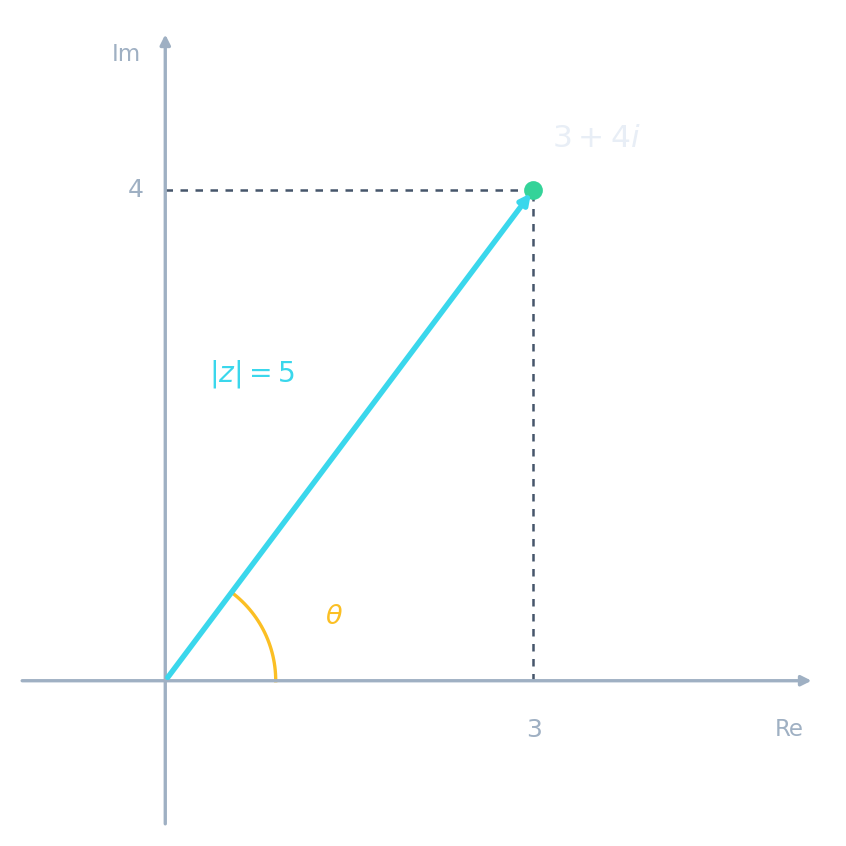
On an Argand diagram, the modulus |z| is the distance from the origin and the argument is the angle θ.
- Polar form: $z = r(\cos\theta + i\sin\theta) = re^{i\theta}$ — multiplying multiplies moduli and adds arguments.
Division using the conjugate
- To divide, multiply top and bottom by the conjugate of the bottom.
- Example: $\dfrac{3+i}{1-i} = \dfrac{(3+i)(1+i)}{(1-i)(1+i)} = \dfrac{3+3i+i+i^2}{1+1} = \dfrac{2+4i}{2} = 1 + 2i$.
(3+i)/(1−i) = a + bi. What is b (the imaginary part)?
Difficulty 2/5 · 140 coins + a small bonus on first completion today
Multiply by (1+i)/(1+i): (3+i)(1+i)/2 = (3+3i+i−1)/2 = (2+4i)/2 = 1+2i. Imaginary part = 2.
Solving equations with complex roots
- A quadratic with negative discriminant 判别式 has complex roots: $x^2 + 4 = 0 \Rightarrow x = \pm 2i$.
- Real-coefficient polynomials always have non-real roots in conjugate pairs: if $a + bi$ is a root, so is $a - bi$.
allow_no_figure: Complex number arithmetic and the Argand diagram are algebraic/geometric concepts that are effectively conveyed through notation and worked examples.
- Besides Cartesian and polar forms, find square roots of a complex number and sketch loci (e.g. $|z-a|=r$).
If a polynomial with real coefficients has root 2 + 3i, it must also have root 2 − 3i.
Difficulty 1/5 · 100 coins + a small bonus on first completion today
Real-coefficient polynomials always have non-real roots in conjugate pairs.
You've got it
- $z = x + iy$, $i^2 = -1$; conjugate $z^* = x - iy$; modulus $|z| = \sqrt{x^2+y^2}$
- plot on the Argand diagram; polar form $z = re^{i\theta}$
- divide by multiplying top and bottom by the bottom's conjugate
Write from a modulus of 17
- z = 8 plus 15 i.
- Find the modulus and the conjugate.
For z = 8 plus 15 i, what are the modulus and the conjugate?
64 plus 225 is 289, and 17 squared is 289.
What is the modulus?
Difficulty 1/5 · 100 coins + a small bonus on first completion today
The square root of 289 is 17.