Vectors
Introduced| English | Meaning |
|---|---|
| vector/ˈvektə/ | A quantity represented by both magnitude and direction, or by an ordered set of components. |
| magnitude/ˈmæɡnɪtjuːd/ | The size or numerical value of a quantity. |
| unit vector/ˈjuːnɪt ˈvektə/ | A vector whose magnitude is one. |
| parallel/ˈpærəlel/ | Describing lines in the same plane that never meet, however far extended. |
| intersect/ˌɪntəˈsekt/ | To share at least one common point. |
| skew/skjuː/ | Describing lines in three-dimensional space that are neither parallel nor intersecting and do not lie in one plane. |
| perpendicular/ˌpɜːpənˈdɪkjʊlə/ | Meeting at a right angle of 90 degrees. |
| scalar product/ˈskeɪlə ˈprɒdʌkt/ | The sum of the products of corresponding vector components, equal to the product of their magnitudes and the cosine of their angle. |
Navigating in 3D
- GPS satellites track your position in three dimensions. Aircraft navigate using heading, pitch, and roll.
- Vectors 向量 are the mathematics of direction and magnitude 模长 in space — essential for physics, engineering, and computer graphics.
Vectors in 3D
- A vector has size and direction: $\mathbf{v} = x\mathbf{i} + y\mathbf{j} + z\mathbf{k}$.
- Magnitude $|\mathbf{v}| = \sqrt{x^2 + y^2 + z^2}$; a unit vector 单位向量 has magnitude 1.
Worked example. $\mathbf{v} = 3\mathbf{i} + 4\mathbf{j}$. Magnitude $= \sqrt{9 + 16} = 5$. Unit vector $= \dfrac{1}{5}(3\mathbf{i} + 4\mathbf{j})$.

Forces like wind and water are vectors, with size and direction
What is the magnitude of the vector i + 2j + 2k?
Difficulty 2/5 · 140 coins + a small bonus on first completion today
|v| = √(1² + 2² + 2²) = √(1+4+4) = √9 = 3.
Vector equations of lines
- A line through point $\mathbf{a}$ in direction $\mathbf{b}$: $\mathbf{r} = \mathbf{a} + t\mathbf{b}$.
- Lines may be parallel 平行 (same direction), intersect 相交 (share a point), or be skew 异面 (neither).
Skew lines don't intersect and aren't parallel. In 3D, two lines can miss each other entirely — they're not in the same plane. This is impossible in 2D.
The scalar product
a · b = |a||b|cos θ
The dot product measures how much two vectors point the same way — it's zero when they're perpendicular.
The vector equation of a line through point a in direction b is:
Difficulty 1/5 · 100 coins + a small bonus on first completion today
r = a + tb, where t is a scalar parameter.
In 3D, two lines that don't intersect must be parallel.
Difficulty 1/5 · 100 coins + a small bonus on first completion today
In 3D, lines can be skew — neither parallel nor intersecting. This is impossible in 2D.
The scalar (dot) product
- So $\mathbf{a}\cdot\mathbf{b} = 0$ means the vectors are perpendicular 垂直.
- Use it to find the angle between two vectors: $\cos\theta = \dfrac{\mathbf{a}\cdot\mathbf{b}}{|\mathbf{a}||\mathbf{b}|}$.
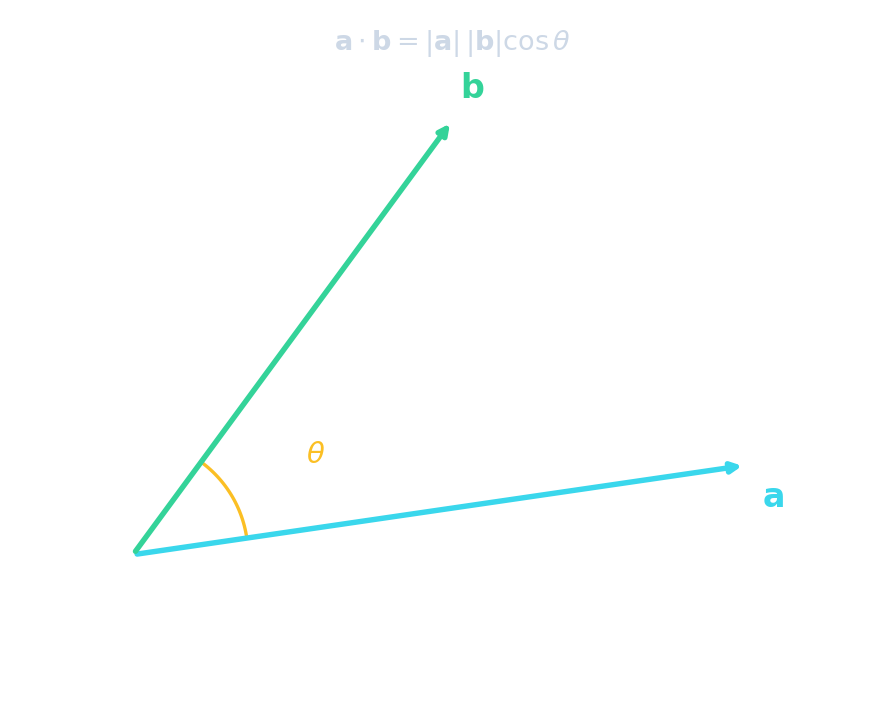
The scalar product 数量积 gives the angle: a·b = |a||b|cos θ, so cos θ = (a·b)/(|a||b|).
Find the scalar product (i + 2j + 2k)·(2i + 2j + k).
Difficulty 2/5 · 140 coins + a small bonus on first completion today
(1)(2) + (2)(2) + (2)(1) = 2 + 4 + 2 = 8.
If a·b = 0, the two vectors are perpendicular.
Difficulty 1/5 · 100 coins + a small bonus on first completion today
cos θ = 0 gives θ = 90°, so a zero dot product means the vectors are perpendicular.
If a·b = 6, |a| = 3, |b| = 4, what is cos θ?
Difficulty 2/5 · 140 coins + a small bonus on first completion today
cos θ = (a·b)/(|a||b|) = 6/(3×4) = 6/12 = 0.5.
Worked example — angle between vectors
- $\mathbf{a} = \mathbf{i} + 2\mathbf{j} + 2\mathbf{k}$, $\mathbf{b} = 2\mathbf{i} + \mathbf{j} - 2\mathbf{k}$.
- $\mathbf{a}\cdot\mathbf{b} = 2 + 2 - 4 = 0$. So $\mathbf{a}$ and $\mathbf{b}$ are perpendicular ($\theta = 90^{\circ}$).
allow_no_figure: Vectors are inherently 3D and difficult to represent clearly in a 2D static diagram — the algebraic notation and worked examples convey the concepts effectively.
- Use position vectors and displacement vectors, and unit vectors; the ratio theorem divides a line in a given ratio.
You've got it
- magnitude $|\mathbf{v}| = \sqrt{x^2+y^2+z^2}$; line: $\mathbf{r} = \mathbf{a} + t\mathbf{b}$
- scalar product $\mathbf{a}\cdot\mathbf{b} = a_1b_1 + a_2b_2 + a_3b_3 = |\mathbf a||\mathbf b|\cos\theta$
- $\mathbf{a}\cdot\mathbf{b} = 0$ → perpendicular
Write from a magnitude of 13
- The vector is 5 i plus 12 j.
- Find its magnitude.
Find the magnitude of 5 i plus 12 j.
5 squared plus 12 squared is 169, which is 13 squared.
What is the magnitude?
Difficulty 1/5 · 100 coins + a small bonus on first completion today
The square root of 169 is 13.