这份讲义涵盖主题 2:纯数学(Pure Mathematics)2。它增加绝对值和多项式代数、对数(logarithms)和指数函数(exponential function)、更多的三角学,以及微分和积分的新方式。
纯数学2
A-Level 数学 · 第 2 主题
 12:32
12:32
Pure Mathematics 2
In two thousand eleven, an earthquake off Japan measured nine on the Richter scale. A smaller quake might measure six. Only three points apart — yet the first…
英文讲解 · 内嵌中英文字幕
2.1
代数
大纲
| Candidates should be able to: | Notes and examples |
|---|---|
| understand the meaning of $|x|$, sketch the graph of $y = |ax + b|$ and use relations such as $|a| = |b| \iff a^2 = b^2$ and $|x - a| < b \iff a - b < x < a + b$ when solving equations and inequalities | Graphs of $y = |f(x)|$ and $y = f(|x|)$ for non-linear functions $f$ are not included. e.g. $|3x - 2| = |2x + 7|$, $2x + 5 < |x + 1|$ |
| divide a polynomial, of degree not exceeding 4, by a linear or quadratic polynomial, and identify the quotient and remainder (which may be zero) | |
| use the factor theorem and the remainder theorem. | e.g. to find factors and remainders, solve polynomial equations or evaluate unknown coefficients. Including factors of the form $(ax + b)$ in which the coefficient of $x$ is not unity, and including calculation of remainders. |
来源:剑桥国际大纲
The modulus
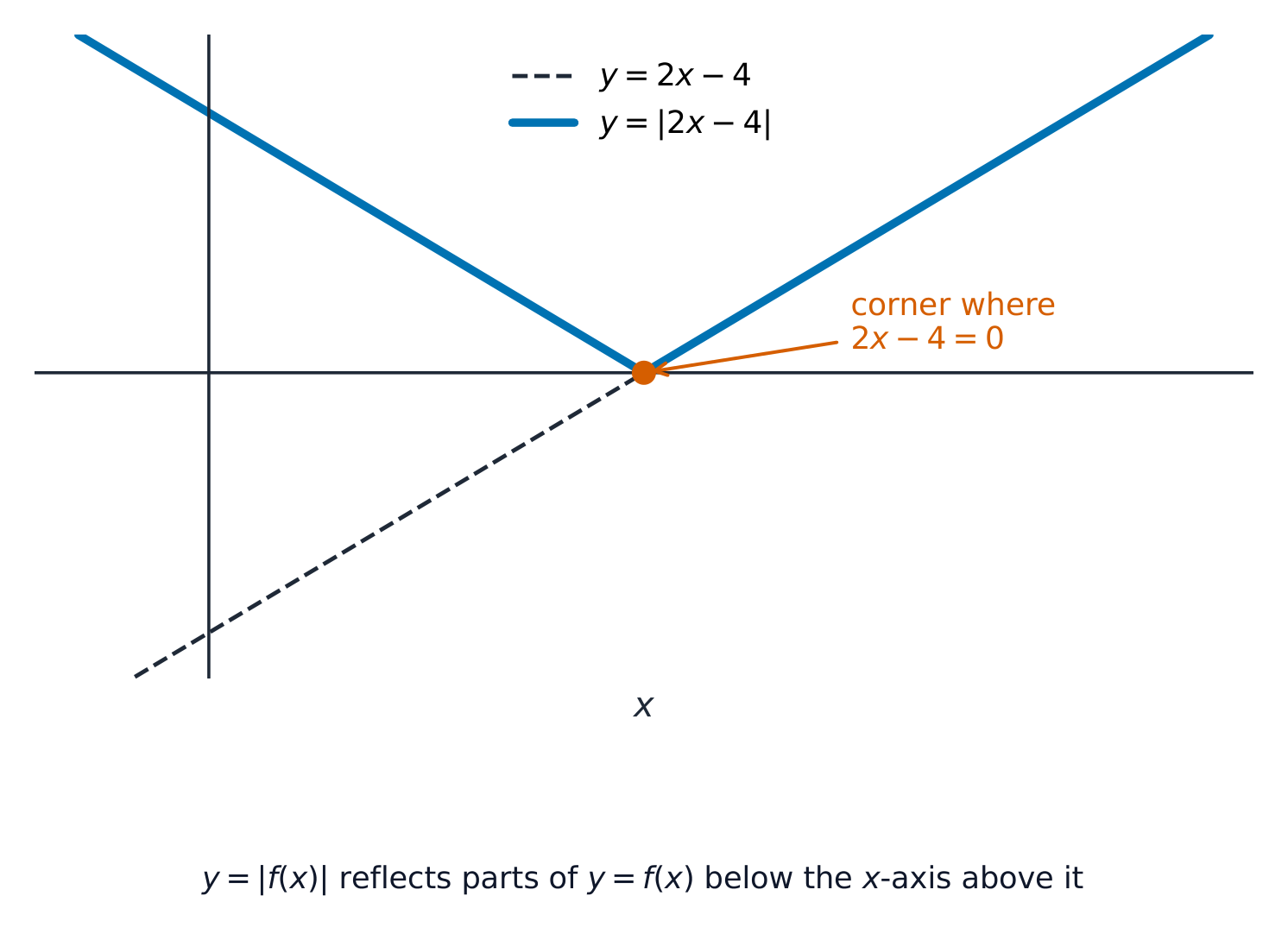
绝对值(modulus)$|x|$ 是去掉符号的一个数的大小,所以 $|x| \geqslant 0$ 总是成立。$y = |ax + b|$ 的图形是一个从 $x$ 轴弹起的"V"形。解方程和不等式的两个有用规则是
$$|a| = |b| \;\Leftrightarrow\; a^2 = b^2, \qquad |x - a| < b \;\Leftrightarrow\; a - b < x < a + b.$$
例题。 解 $|3x + 8| < 9$。
用第二个规则,把不等式写成 $-9 < 3x + 8 < 9$:
$$-9 < 3x + 8 < 9 \;\Rightarrow\; -17 < 3x < 1 \;\Rightarrow\; -\tfrac{17}{3} < x < \tfrac13.$$
Polynomial division and the factor and remainder theorems
一个多项式(polynomial)是 $x$ 的幂的一个和,如 $2x^4 + 3x^2 - 5$。它的次数(degree)是最高的幂。当你用一个多项式除另一个时,你得到一个商(quotient)和一个余数(remainder)。
- 余数定理(remainder theorem):$p(x)$ 被 $(x - a)$ 除时的余数是 $p(a)$。
- 因式定理(factor theorem):$(x - a)$ 是 $p(x)$ 的一个因式恰好当 $p(a) = 0$ 时。
例题。 多项式 $p(x) = 2x^4 + kx^3 + kx^2 + 17x + 18$ 有因式 $(x + 2)$。求 $k$。
由因式定理 $p(-2) = 0$:
$$2(16) + k(-8) + k(4) + 17(-2) + 18 = 0 \;\Rightarrow\; 16 - 4k = 0 \;\Rightarrow\; k = 4.$$
探索
The modulus function
y = a|x − b| + c
The modulus makes a V-shape. Move its vertex with b and c; change how steep the arms are with a.
词汇表
训练
| 英文 | 中文 | 拼音 |
|---|---|---|
| modulus/ˈmɒdjʊləs/ | 绝对值 | jué duì zhí |
| polynomial/ˌpɒlɪˈnəʊmɪəl/ | 多项式 | duō xiàng shì |
| degree/dɪˈɡriː/ | 次数 | cì shù |
| quotient/ˈkwəʊʃənt/ | 商 | shāng |
| remainder/rɪˈmeɪndə/ | 余数 | yú shù |
| remainder theorem/rɪˈmeɪndə ˈθɪərəm/ | 余数定理 | yú shù dìng lǐ |
| factor theorem/ˈfæktə ˈθɪərəm/ | 因式定理 | yīn shì dìng lǐ |
2.2
对数函数与指数函数

大纲
| Candidates should be able to: | Notes and examples |
|---|---|
| understand the relationship between logarithms and indices, and use the laws of logarithms (excluding change of base) | |
| understand the definition and properties of $e^x$ and $\ln x$, including their relationship as inverse functions and their graphs | Including knowledge of the graph of $y = e^{kx}$ for both positive and negative values of $k$. |
| use logarithms to solve equations and inequalities in which the unknown appears in indices | e.g. $2^x < 5$, $3 \times 2^{3x-1} < 5$, $3^{x+1} = 4^{2x-1}$ |
| use logarithms to transform a given relationship to linear form, and hence determine unknown constants by considering the gradient and/or intercept. | e.g. $y = kx^n$ gives $\ln y = \ln k + n \ln x$ which is linear in $\ln x$ and $\ln y$ $y = k(a^x)$ gives $\ln y = \ln k + x \ln a$ which is linear in $x$ and $\ln y$. |
来源:剑桥国际大纲

一个对数回答问题"什么幂?"。若 $a^x = y$ 则 $x = \log_a y$。对数和指数(indices,幂)是逆的思想。对数定律(laws of logarithms)是
$$\log(mn) = \log m + \log n, \qquad \log\!\frac{m}{n} = \log m - \log n, \qquad \log(m^k) = k\log m.$$
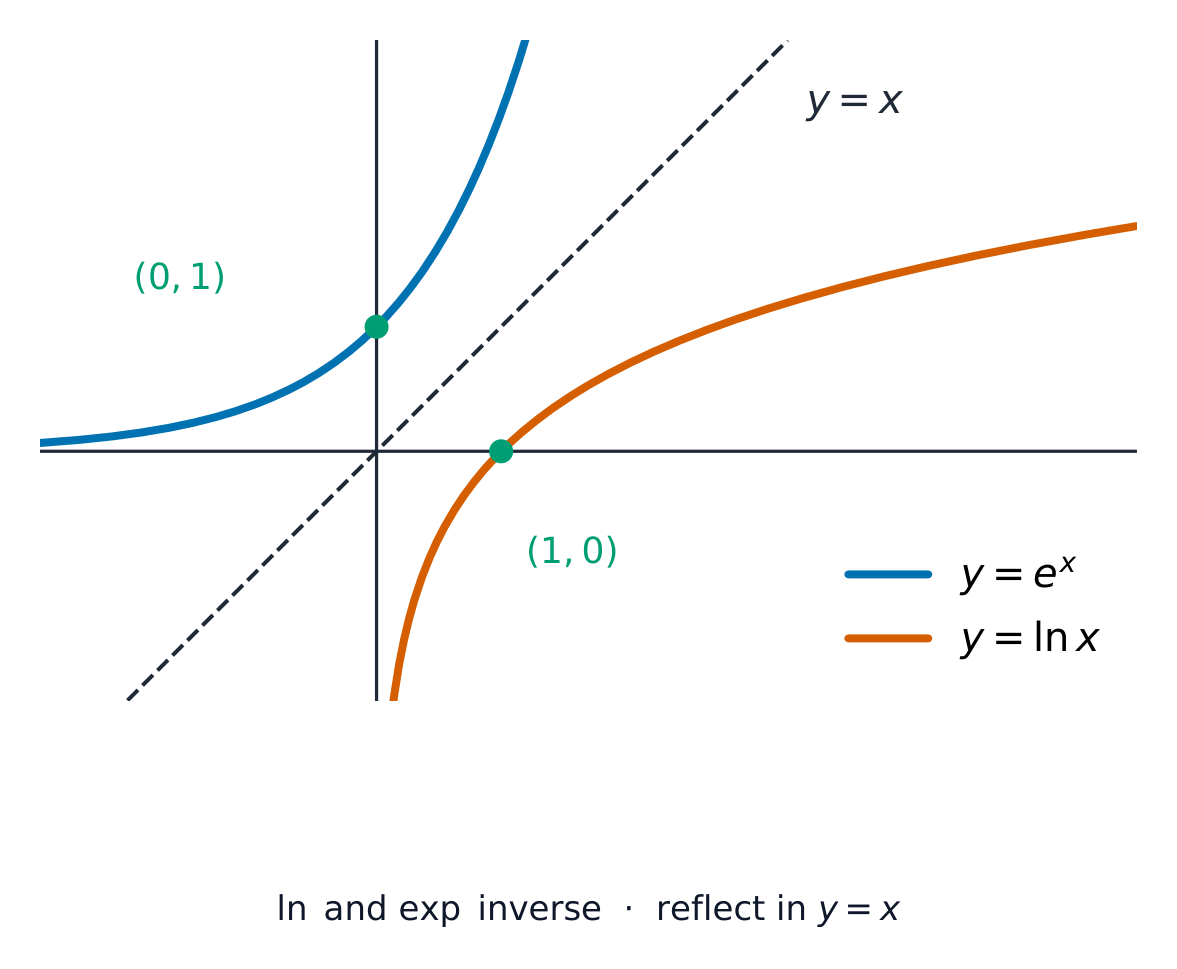
指数函数 $e^x$ 和自然对数(natural logarithm)$\ln x$ 是反函数,所以 $\ln(e^x) = x$ 且 $e^{\ln x} = x$。当未知量在幂中时,取两边的对数。
例题。 解 $4^x < 0.05$。
$$4^x < 0.05 \;\Rightarrow\; x\ln 4 < \ln 0.05 \;\Rightarrow\; x < \frac{\ln 0.05}{\ln 4} = -2.16 \ (\text{3 s.f.}).$$
线性形式(linear form):一个像 $y = Ax^n$ 的关系若你取对数就变成一条直线:$\ln y = \ln A + n\ln x$。把 $\ln y$ 对 $\ln x$ 作图给出一条斜率 $n$、截距 $\ln A$ 的直线,所以你能找到未知的常数。
探索
Exponential growth
y = a·bˣ
Change the base b: when b > 1 the curve grows, when 0 < b < 1 it decays — and it always passes through (0, a).
词汇表
训练
| 英文 | 中文 | 拼音 |
|---|---|---|
| Pure Mathematics/pjʊə ˌmæθɪˈmætɪks/ | 纯数学 | chún shù xué |
| logarithms/ˈlɒɡərɪθəmz/ | 对数 | duì shù |
| exponential function/ˌekspəˈnenʃl ˈfʌŋkʃn/ | 指数函数 | zhǐ shù hán shù |
| indices/ˈɪndɪsiːz/ | 指数 | zhǐ shù |
| laws of logarithms/lɔːz ɒv ˈlɒɡərɪθəmz/ | 对数定律 | duì shù dìng lǜ |
| natural logarithm/ˈnætʃərəl ˈlɒɡərɪθəm/ | 自然对数 | zì rán duì shù |
| linear form/ˈlɪnɪə fɔːm/ | 线性形式 | xiàn xìng xíng shì |
2.3
三角学

大纲
| Candidates should be able to: | Notes and examples |
|---|---|
| understand the relationship of the secant, cosecant and cotangent functions to cosine, sine and tangent, and use properties and graphs of all six trigonometric functions for angles of any magnitude | |
| use trigonometrical identities for the simplification and exact evaluation of expressions, and in the course of solving equations, and select an identity or identities appropriate to the context, showing familiarity in particular with the use of: – $\sec^2 \theta \equiv 1 + \tan^2 \theta$ and $\csc^2 \theta \equiv 1 + \cot^2 \theta$ – the expansions of $\sin(A \pm B)$, $\cos(A \pm B)$ and $\tan(A \pm B)$ – the formulae for $\sin 2A$, $\cos 2A$ and $\tan 2A$ – the expression of $a \sin \theta + b \cos \theta$ in the forms $R \sin(\theta \pm \alpha)$ and $R \cos(\theta \pm \alpha)$. | e.g. simplifying $\cos(x - 30^\circ) - 3 \sin(x - 60^\circ)$. e.g. solving $\tan \theta + \cot \theta = 4$, $2 \sec^2 \theta - \tan \theta = 5$, $3 \cos \theta + 2 \sin \theta = 1$. |
来源:剑桥国际大纲
有另外三个函数,每个是你知道的一个的倒数:正割(secant)$\sec\theta = \dfrac{1}{\cos\theta}$、余割(cosecant)$\csc\theta = \dfrac{1}{\sin\theta}$,和余切(cotangent)$\cot\theta = \dfrac{1}{\tan\theta}$。
你必须知道这些三角恒等式(trigonometric identities)并为每个问题选择正确的那个:
$$\sec^2\theta \equiv 1 + \tan^2\theta, \qquad \csc^2\theta \equiv 1 + \cot^2\theta.$$
你也用 $\sin(A \pm B)$、$\cos(A \pm B)$、$\tan(A \pm B)$ 的复合角(compound angle)公式、二倍角(double angle)公式
$$\sin 2A = 2\sin A\cos A, \quad \cos 2A = 2\cos^2 A - 1, \quad \tan 2A = \frac{2\tan A}{1 - \tan^2 A},$$
以及辅助角公式(R-formula)$a\sin\theta + b\cos\theta = R\sin(\theta + \alpha)$,其中 $R = \sqrt{a^2 + b^2}$ 且 $\tan\alpha = \dfrac{b}{a}$。
例题。 解 $2\tan^2\theta + 3\sec\theta = 18$,对 $-180^\circ < \theta < 180^\circ$。
把 $\tan^2\theta$ 换成 $\sec^2\theta - 1$ 以得到一个函数:
$$2(\sec^2\theta - 1) + 3\sec\theta = 18 \;\Rightarrow\; 2\sec^2\theta + 3\sec\theta - 20 = 0 \;\Rightarrow\; (2\sec\theta - 5)(\sec\theta + 4) = 0.$$
所以 $\sec\theta = \tfrac52$ 或 $\sec\theta = -4$,给出 $\cos\theta = \tfrac25$ 或 $\cos\theta = -\tfrac14$。解是 $\theta = \pm 66.4^\circ$ 和 $\theta = \pm 104.5^\circ$。
探索
The unit circle
Drag the angle to see how $\sin$, $\cos$ and $\tan$ relate — the key to solving trig equations.
词汇表
训练
| 英文 | 中文 | 拼音 |
|---|---|---|
| secant/ˈsiːkənt/ | 正割 | zhèng gē |
| cosecant/ˈkəʊsekənt/ | 余割 | yú gē |
| cotangent/ˈkəʊtændʒənt/ | 余切 | yú qiē |
| trigonometric identities/ˌtrɪɡənəʊˈmetrɪk aɪˈdentɪtiz/ | 三角恒等式 | sān jiǎo héng děng shì |
| compound angle/ˈkɒmpaʊnd ˈæŋɡl/ | 复合角 | fù hé jiǎo |
| double angle/ˈdʌbl ˈæŋɡl/ | 二倍角 | èr bèi jiǎo |
| R-formula/ɑː ˈfɔːmjʊlə/ | 辅助角公式 | fǔ zhù jiǎo gōng shì |
2.4
微分
大纲
| Candidates should be able to: | Notes and examples |
|---|---|
| use the derivatives of $e^x$, $\ln x$, $\sin x$, $\cos x$, $\tan x$, together with constant multiples, sums, differences and composites | |
| differentiate products and quotients | e.g. $\frac{2x - 4}{3x + 2}$, $x^2 \ln x$, $x e^{1 - x^2}$. |
| find and use the first derivative of a function which is defined parametrically or implicitly. | e.g. $x = t - e^{2t}$, $y = t + e^{2t}$. e.g. $x^2 + y^2 = xy + 7$. Including use in problems involving tangents and normals. |
来源:剑桥国际大纲
学习这些标准导数:
$$\frac{d}{dx}e^x = e^x, \quad \frac{d}{dx}\ln x = \frac{1}{x}, \quad \frac{d}{dx}\sin x = \cos x, \quad \frac{d}{dx}\cos x = -\sin x, \quad \frac{d}{dx}\tan x = \sec^2 x.$$
对于两个函数的一个乘积或一个商,用:
- 乘积法则(product rule):$(uv)' = u'v + uv'$;
- 商法则(quotient rule):$\left(\dfrac{u}{v}\right)' = \dfrac{u'v - uv'}{v^2}$。
当一条曲线由参数方程(parametric equations)$x = x(t)$、$y = y(t)$ 给出时,斜率是 $\dfrac{dy}{dx} = \dfrac{dy/dt}{dx/dt}$。当 $y$ 被隐式(implicitly,没有变成主语)定义时,对每一项关于 $x$ 微分,对 $y$ 项用链式法则,然后解出 $\dfrac{dy}{dx}$。
例题。 给定 $y = 6x\cos(x^2 + 1)$,求 $\dfrac{dy}{dx}$。
用乘积法则,$u = 6x$、$v = \cos(x^2 + 1)$(以及对 $v$ 用链式法则):
$$\frac{dy}{dx} = 6\cos(x^2 + 1) + 6x\cdot\big(-2x\sin(x^2 + 1)\big) = 6\cos(x^2 + 1) - 12x^2\sin(x^2 + 1).$$
探索
Tangent and gradient
y = ax³ + bx² + cx + d
Move the point: the tangent line is the derivative at that x. Where the curve turns, the gradient is zero.
词汇表
训练
| 英文 | 中文 | 拼音 |
|---|---|---|
| product rule/ˈprɒdʌkt ruːl/ | 乘积法则 | chéng jī fǎ zé |
| quotient rule/ˈkwəʊʃənt ruːl/ | 商法则 | shāng fǎ zé |
| parametric equations/ˌpærəˈmetrɪk ɪˈkweɪʒnz/ | 参数方程 | cān shù fāng chéng |
| implicitly/ɪmˈplɪsɪtli/ | 隐式 | yǐn shì |
2.5
积分
大纲
| Candidates should be able to: | Notes and examples |
|---|---|
| • extend the idea of ‘reverse differentiation’ to include the integration of $e^{ax + b}$, $\frac{1}{ax + b}$, $\sin(ax + b)$, $\cos(ax + b)$ and $\sec^2(ax + b)$ | Knowledge of the general method of integration by substitution is not required. |
| • use trigonometrical relationships in carrying out integration | e.g. use of double-angle formulae to integrate $\sin^2 x$ or $\cos^2(2x)$. |
| • understand and use the trapezium rule to estimate the value of a definite integral. | Including use of sketch graphs in simple cases to determine whether the trapezium rule gives an over-estimate or an under-estimate. |
来源:剑桥国际大纲
积分是逆微分——逆转每个新的导数;更难的积分可能需要换元积分(integration by substitution,在纯数学 3 中展开)。对于一个线性的内部函数 $(ax + b)$:
$$\int e^{ax+b}\,dx = \frac{1}{a}e^{ax+b} + C, \qquad \int \frac{1}{ax+b}\,dx = \frac{1}{a}\ln|ax + b| + C,$$
$$\int \sin(ax+b)\,dx = -\frac{1}{a}\cos(ax+b) + C, \qquad \int \cos(ax+b)\,dx = \frac{1}{a}\sin(ax+b) + C, \qquad \int \sec^2(ax+b)\,dx = \frac{1}{a}\tan(ax+b) + C.$$
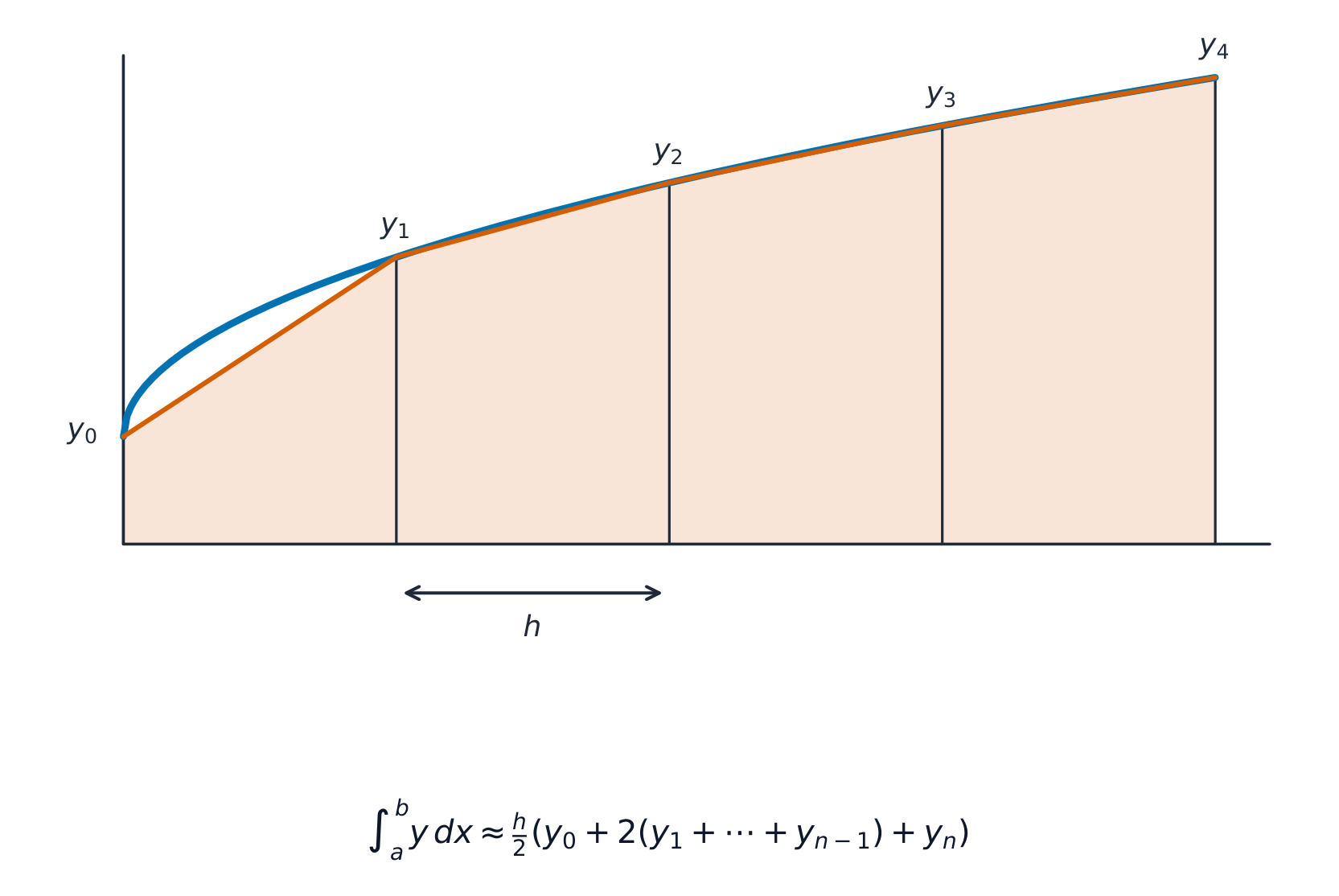
要积分 $\sin$ 或 $\cos$ 的一个幂,先用一个恒等式去掉这个幂。当你不能精确积分时,梯形法则(trapezium rule)估计一个定积分:
$$\int_a^b y\,dx \approx \tfrac{h}{2}\big[y_0 + y_n + 2(y_1 + y_2 + \cdots + y_{n-1})\big].$$
例题。 求 $\displaystyle\int 6\sin^2 x\,dx$。
用 $\sin^2 x = \tfrac12(1 - \cos 2x)$:
$$\int 6\sin^2 x\,dx = \int (3 - 3\cos 2x)\,dx = 3x - \tfrac32\sin 2x + C.$$
探索
The area under the curve
area = ∫ f(x) dx
The integral still measures area — drag a and b to total the strip under the curve.
词汇表
训练
| 英文 | 中文 | 拼音 |
|---|---|---|
| trapezium rule/trəˈpiːzɪəm ruːl/ | 梯形法则 | tī xíng fǎ zé |
| integration by substitution/ˌɪntɪˈɡreɪʃn baɪ ˌsʌbstɪˈtjuːʃn/ | 换元积分 | huàn yuán jī fēn |
2.6
方程的数值解
大纲
| Candidates should be able to: | Notes and examples |
|---|---|
| • locate approximately a root of an equation, by means of graphical considerations and/or searching for a sign change | e.g. finding a pair of consecutive integers between which a root lies. |
| • understand the idea of, and use the notation for, a sequence of approximations which converges to a root of an equation | |
| • understand how a given simple iterative formula of the form $x_{n + 1} = \text{F}(x_n)$ relates to the equation being solved, and use a given iteration, or an iteration based on a given rearrangement of an equation, to determine a root to a prescribed degree of accuracy. | Knowledge of the condition for convergence is not included, but an understanding that an iteration may fail to converge is expected. |
来源:剑桥国际大纲
许多方程不能精确地解。两个思想帮助你找到一个根(root,一个解)。
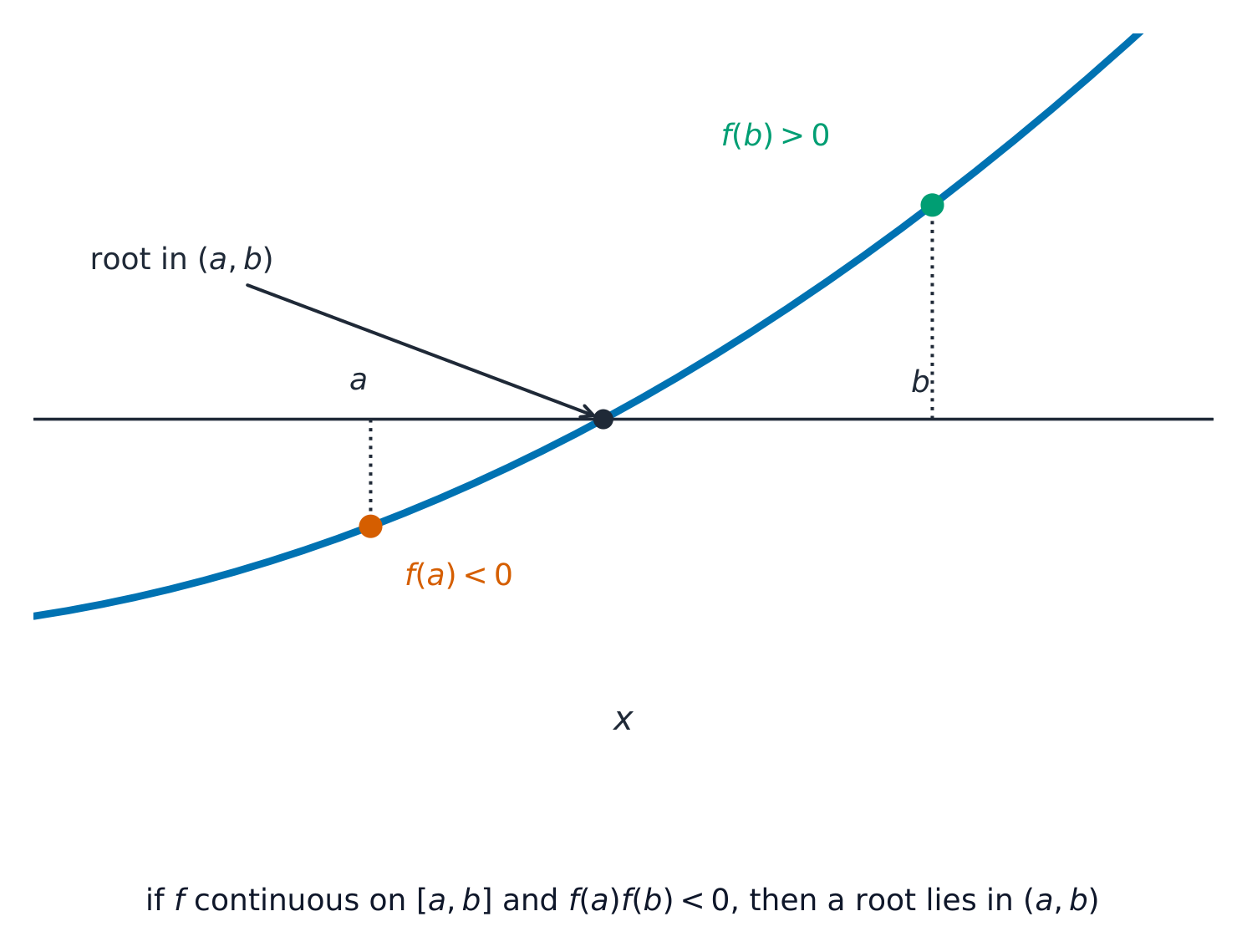
- 变号(sign change):若 $f(a)$ 和 $f(b)$ 有相反的符号(而图形在它们之间没有断裂),一个根位于 $a$ 和 $b$ 之间。
- 迭代(iteration):把方程重排成 $x = F(x)$ 的形式,然后用迭代公式(iterative formula)$x_{n+1} = F(x_n)$。从一个初始猜测 $x_0$ 开始并重复。若这些值是收敛的,它们稳定下来并收敛(converge)到一个根。继续下去直到答案稳定到所要求的精度。
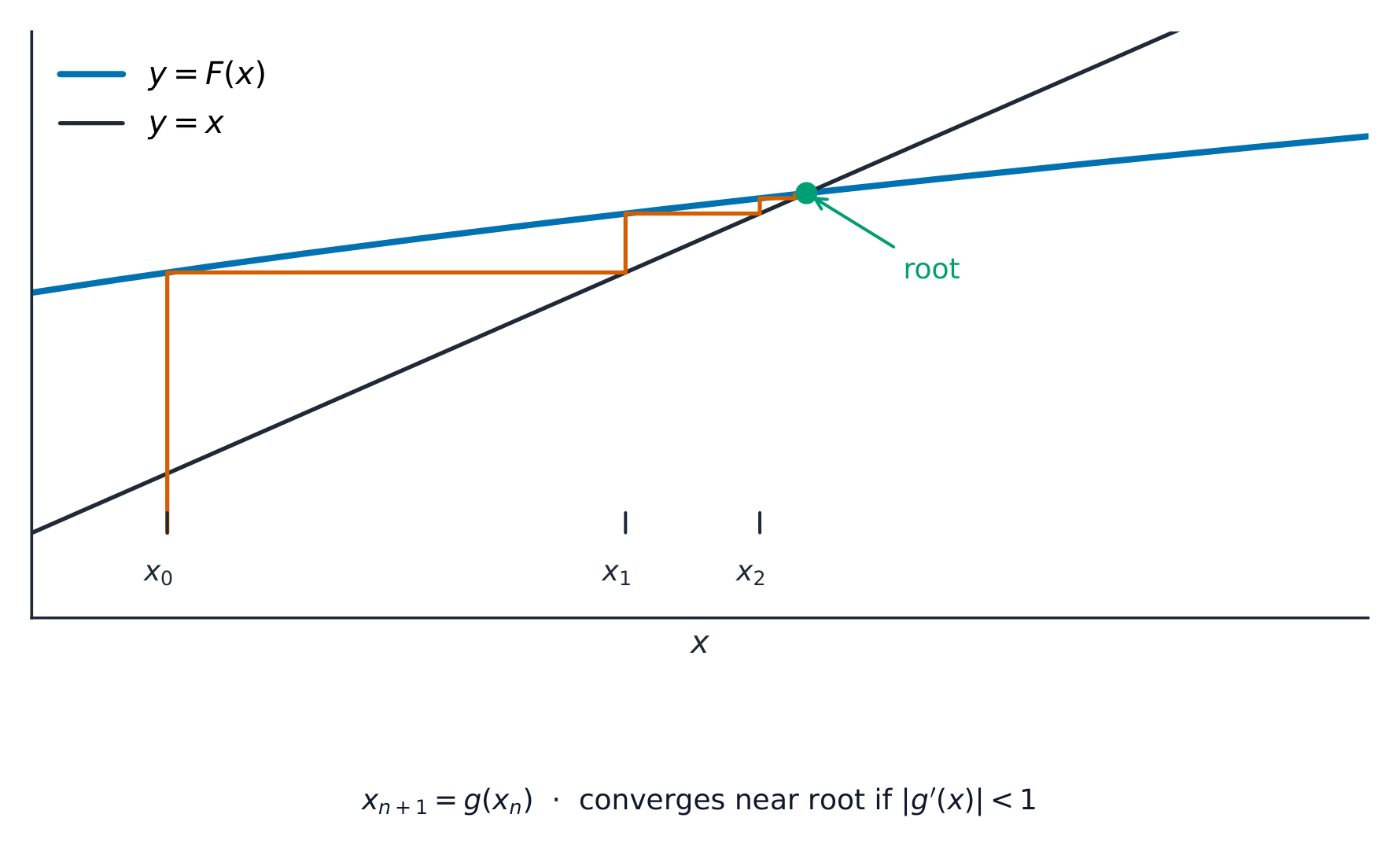
例题。 一个方程的一个根 $\beta$ 满足 $x = \sqrt[3]{-2x - 4.5}$,而 $-1.4 < \beta < -1.0$。用迭代 $x_{n+1} = \sqrt[3]{-2x_n - 4.5}$,$x_0 = -1.2$。
$$x_1 = \sqrt[3]{-2(-1.2) - 4.5} = \sqrt[3]{-2.1} = -1.281, \qquad x_2 = \sqrt[3]{-2(-1.281) - 4.5} = -1.247, \quad \ldots$$
这些值稳定在 $-1.26$ 附近,所以 $\beta = -1.26$(3 s.f.)。
探索
Where is the root?
y = ax³ + bx² + cx + d
A root is where the curve crosses zero. A sign change in f(x) traps a root between two x-values.
词汇表
训练
| 英文 | 中文 | 拼音 |
|---|---|---|
| root/ruːt/ | 根 | gēn |
| sign change/saɪn tʃeɪndʒ/ | 变号 | biàn hào |
| iteration/ˌɪtəˈreɪʃn/ | 迭代 | dié dài |
| iterative formula/ˈɪtərətɪv ˈfɔːmjʊlə/ | 迭代公式 | dié dài gōng shì |
| converge/kənˈvɜːdʒ/ | 收敛 | shōu liǎn |
2.6
考试技巧
- 用对数定律解方程;记住 $\ln$ 和 $e^x$ 是反函数。
- 对于数值方法,显示一个变号以定位一个根、清晰地布置迭代,并给出答案到陈述的精度。
- 学习链式、乘积和商法则并识别函数需要哪一个。
- 通过考虑正和负两种情况解绝对值方程 $|f(x)| = g(x)$,并作草图检查。
本主题的互动课程
逐步学习,并即时检测练习。