Logarithmic and exponential functions
Introduced| English | Meaning |
|---|---|
| logarithm/ˈlɒɡərɪθəm/ | The exponent to which a specified base must be raised to produce a given positive number. |
| laws of logarithms/lɔːz ɒv ˈlɒɡərɪθəmz/ | Rules for rewriting logarithms of products, quotients and powers, subject to valid bases and positive arguments. |
| natural logarithm/ˈnætʃərəl ˈlɒɡərɪθəm/ | The logarithm to base e, the inverse of the exponential function with base e. |
| linear form/ˈlɪnɪə fɔːm/ | An arrangement of a relationship as a straight-line equation in chosen original or transformed variables. |
The number that grows forever
- A bank account doubles every 10 years. After 100 years, it's grown by a factor of $2^{10} = 1024$.
- But what if you want to know: "After how many years will it be worth exactly 500 times the original?" That's a question only logarithms 对数 can answer.
What is a logarithm?
- A logarithm answers "what power?": if $a^x = y$ then $x = \log_a y$.
- Example: $2^x = 32 \Rightarrow x = \log_2 32 = 5$.
Worked example. Solve $3^x = 81$. Since $81 = 3^4$, we get $x = \log_3 81 = 4$.

Earthquake strength is measured on the logarithmic Richter scale
Exponential growth
y = a·bˣ
Change the base b: when b > 1 the curve grows, when 0 < b < 1 it decays — and it always passes through (0, a).
Evaluate log₂(8).
Difficulty 2/5 · 140 coins + a small bonus on first completion today
2³ = 8, so log₂(8) = 3.
Solve 2ˣ = 8 for x.
Difficulty 2/5 · 140 coins + a small bonus on first completion today
2³ = 8, so x = 3 (or x = log₂8 = 3).
The laws of logarithms 对数定律
- The laws of logarithms:
- $\log(mn) = \log m + \log n$,
- $\log\dfrac{m}{n} = \log m - \log n$,
- $\log(m^k) = k\log m$.
Logs don't distribute over addition. $\log(a + b) \neq \log a + \log b$. The laws only apply to products, quotients, and powers — not sums.

Populations can grow exponentially when resources are plentiful
Which is a correct law of logarithms?
Difficulty 1/5 · 100 coins + a small bonus on first completion today
log(mn) = log m + log n; and log(m^k) = k log m.
log(a + b) = log a + log b.
Difficulty 1/5 · 100 coins + a small bonus on first completion today
Logarithms do not distribute over addition. log(a + b) ≠ log a + log b.
e and ln
- $e^x$ and the natural logarithm 自然对数 $\ln x$ are inverses: $\ln(e^x) = x$ and $e^{\ln x} = x$.
- When the unknown is in the power, take logs of both sides.
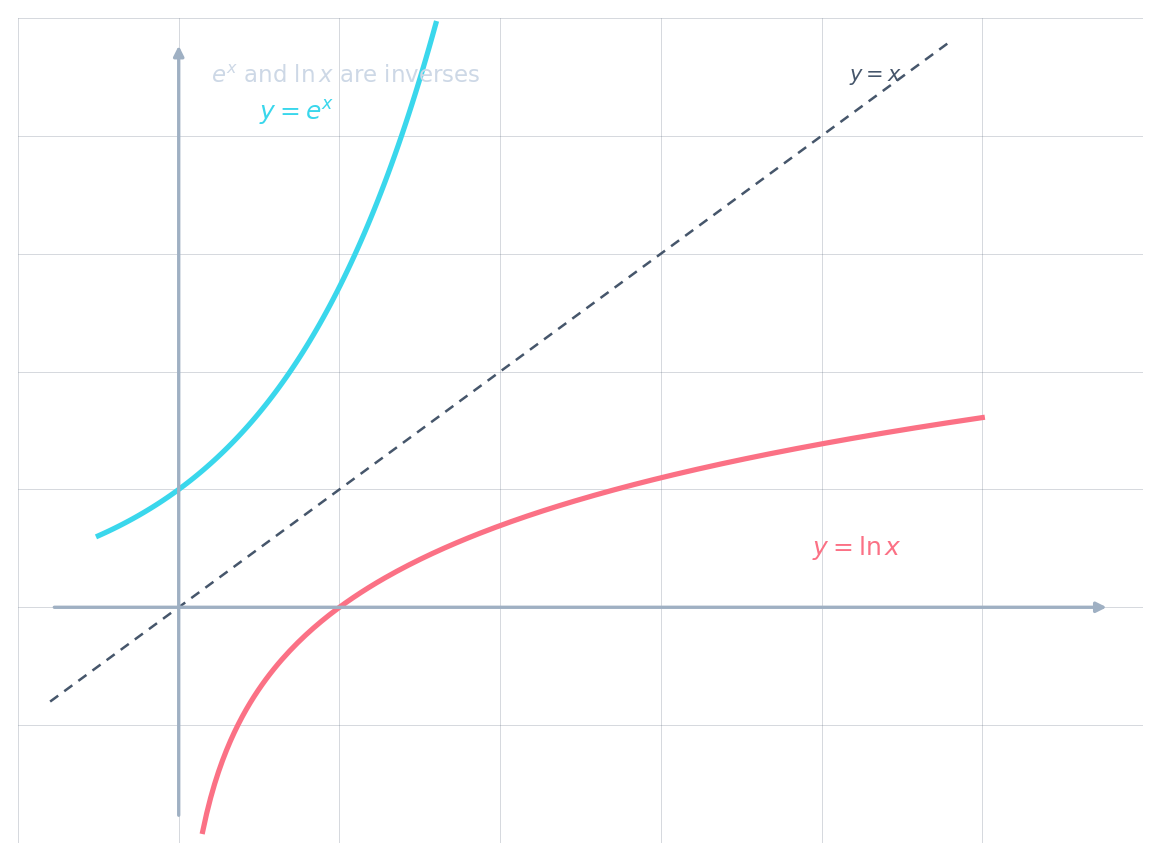
$e^x$ and $\ln x$ are inverse functions: their graphs are reflections in the line $y = x$.
What is ln(e⁵)?
Difficulty 2/5 · 140 coins + a small bonus on first completion today
ln and e are inverses, so ln(e⁵) = 5.
Linear form 线性形式 and modelling
- Linear form: $y = Ax^n$ becomes $\ln y = \ln A + n\ln x$ — a line with gradient $n$, intercept $\ln A$.
- This lets you find the power law from experimental data by plotting $\ln y$ vs $\ln x$.
- Logarithms and indices (powers) are reverse operations.
If y = 5x³, then ln y = ln 5 + n ln x. What is n?
Difficulty 2/5 · 140 coins + a small bonus on first completion today
ln(5x³) = ln 5 + 3 ln x, so n = 3 (the power becomes the gradient).
You've got it
- a log answers "what power?"; laws: $\log mn = \log m + \log n$, $\log m^k = k\log m$
- $e^x$ and $\ln x$ are inverses; take logs when the unknown is a power
- linear form: plot $\ln y$ vs $\ln x$ → gradient $n$, intercept $\ln A$