Differentiation (Pure 2)
Introduced| English | Meaning |
|---|---|
| standard derivatives/ˈstændəd dɪˈrɪvətɪvz/ | standard derivatives |
| quotient rule/ˈkwəʊʃənt ruːl/ | The differentiation rule for a ratio: the denominator times the numerator's derivative minus the numerator times the denominator's derivative, divided by the denominator squared. |
| product rule/ˈprɒdʌkt ruːl/ | The differentiation rule for two multiplied functions: the first times the derivative of the second plus the second times the derivative of the first. |
| parametric/ˌpærəˈmetrɪk/ | parametric |
| implicit/ɪmˈplɪsɪt/ | implicit |
The derivative that never changes
- The function $e^x$ is unique: its derivative is itself. No other function has this property.
- This makes $e^x$ the foundation of growth models, radioactive decay, and compound interest.
Standard derivatives 标准导数
Worked example. $y = e^{3x}$. By the chain rule: $\dfrac{dy}{dx} = 3e^{3x}$.
The gradient at a point
gradient = dy/dx
Slide the point — the tangent slope is the derivative, even for these new standard functions.
The derivative of ln x is 1/x. What is its value at x = 4?
Difficulty 2/5 · 140 coins + a small bonus on first completion today
d/dx(ln x) = 1/x = 1/4 = 0.25.
The derivative of eˣ is eˣ. What is its value at x = 0?
Difficulty 2/5 · 140 coins + a small bonus on first completion today
d/dx(eˣ) = eˣ, and e⁰ = 1.
If y = e^(3x), then dy/dx = 3e^(3x). What is dy/dx at x = 0?
Difficulty 2/5 · 140 coins + a small bonus on first completion today
At x = 0: dy/dx = 3e⁰ = 3 × 1 = 3.
Product and quotient rules 商法则
- Product rule 乘积法则: $(uv)' = u'v + uv'$.
- Quotient rule: $\left(\dfrac{u}{v}\right)' = \dfrac{u'v - uv'}{v^2}$.
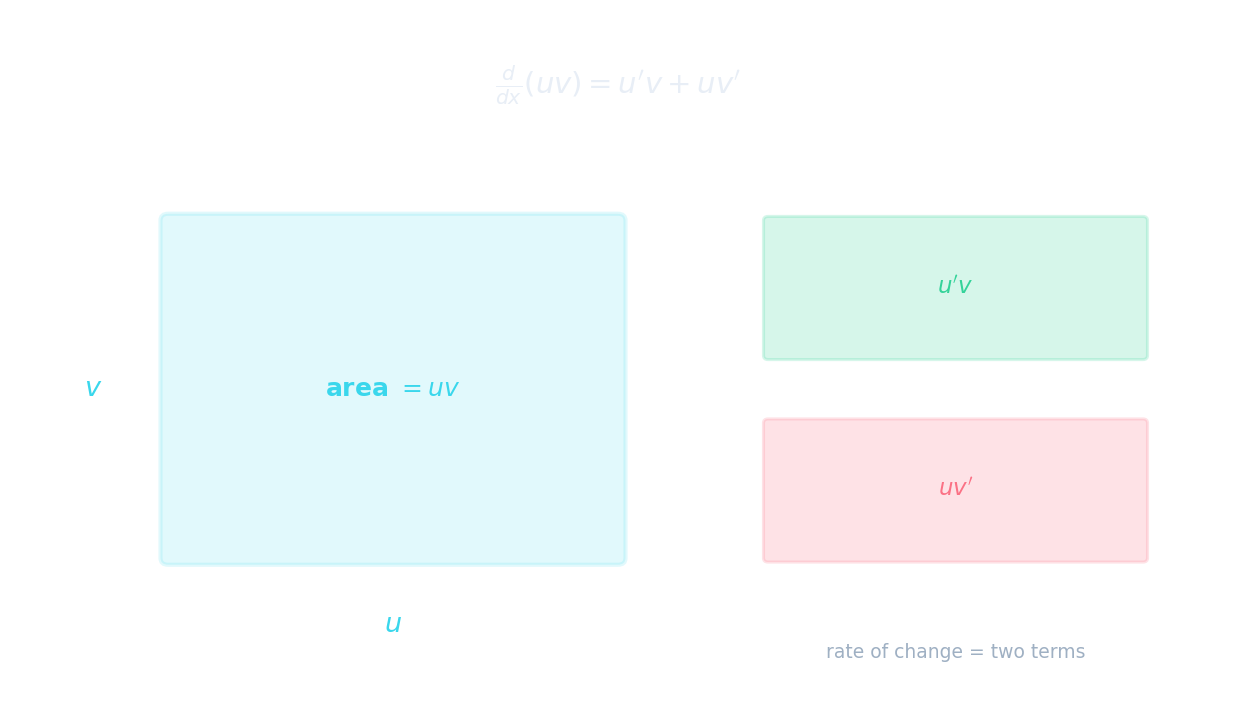
The product rule: when both $u$ and $v$ change, the total rate of change has two terms — one for each function changing while the other stays fixed.
Don't forget the product rule. The derivative of $uv$ is NOT $u'v'$. You must use $(uv)' = u'v + uv'$. This is one of the most common mistakes in differentiation.
The product rule says (uv)′ equals:
Difficulty 1/5 · 100 coins + a small bonus on first completion today
The product rule: (uv)′ = u′v + uv′.
The quotient rule for (u/v)′ is (u′v + uv′)/v².
Difficulty 1/5 · 100 coins + a small bonus on first completion today
The quotient rule is (u′v − uv′)/v² (minus, not plus in the numerator).
Parametric 参数的 and implicit 隐式的 differentiation
- Parametric: $\dfrac{dy}{dx} = \dfrac{dy/dt}{dx/dt}$.
- Implicit: differentiate every term in $x$, chain-rule the $y$ terms, then solve for $\dfrac{dy}{dx}$.
If x = t² and y = t³, then dy/dx = (dy/dt)/(dx/dt) = 3t²/2t = 3t/2. At t = 4, dy/dx = ?
Difficulty 2/5 · 140 coins + a small bonus on first completion today
At t = 4: dy/dx = 3(4)/2 = 6.
Worked example — product rule
- $y = x^2 \sin x$. Let $u = x^2$, $v = \sin x$.
- $u' = 2x$, $v' = \cos x$.
- $\dfrac{dy}{dx} = 2x\sin x + x^2\cos x$.
You've got it
- learn: $\dfrac{d}{dx}e^x = e^x$, $\dfrac{d}{dx}\ln x = \dfrac{1}{x}$, $\dfrac{d}{dx}\sin x = \cos x$, $\dfrac{d}{dx}\cos x = -\sin x$
- product rule $(uv)' = u'v + uv'$; quotient rule $\dfrac{u'v - uv'}{v^2}$
- parametric: $\dfrac{dy}{dx} = \dfrac{dy/dt}{dx/dt}$; implicit: chain-rule the $y$ terms