| Candidates should be able to: | Notes and guidance |
|---|---|
| Show understanding of the need for input, output, primary memory and secondary (including removable) storage | |
| Show understanding of embedded systems | Including: benefits and drawbacks of embedded systems |
| Describe the principal operations of hardware devices | Including: Laser printer, 3D printer, microphone, speakers, magnetic hard disk, solid state (flash) memory, optical disc reader/writer, touchscreen, virtual reality headset |
| Show understanding of the use of buffers | |
| Explain the differences between Random Access Memory (RAM) and Read Only Memory (ROM) | Including their use in a range of devices and systems |
| Explain the differences between Static RAM (SRAM) and Dynamic RAM (DRAM) | Including the use of SRAM and DRAM in a range of devices and systems and the reasons for using one instead of the other depending on the device and its use |
| Explain the difference between Programmable ROM (PROM), Erasable Programmable ROM (EPROM) and Electrically Erasable Programmable ROM (EEPROM) | |
| Show an understanding of monitoring and control systems | Including: • difference between monitoring and control • use of sensors (including temperature, pressure, infra-red, sound) and actuators • importance of feedback |
硬件
A-Level 计算机科学 · 第 3 主题
 22:38
22:38
Computers & Components
Open up any computer — past the case, past the chips, all the way down to the silicon — and you find switches. Not thousands. Billions. And each one does…
英文讲解 · 内嵌中英文字幕
3.1
计算机及其部件

大纲
来源:剑桥国际大纲
一台通用计算机有四个构件:
- 输入设备(input devices)——把数据输入(键盘、鼠标、麦克风、扫描仪、传感器)。
- 输出设备(output devices)——把结果输出(显示器、扬声器、打印机、执行器)。
- 主存储器(primary memory)——处理器(processor,CPU)直接访问的快速存储器(RAM 和 ROM)。容纳运行中的程序及其数据。
- 辅助存储器(secondary storage)——较慢、较大,在不用时保存程序和数据(硬盘、SSD、光盘、U 盘)。
大纲要求说明为什么需要每一种。需要输入设备,是因为计算机只能处理已经输入的数据和指令。需要输出设备,是为了把结果以人能使用的形式呈现出来。需要主存储器,是因为处理器只能执行和使用它能直接寻址的存储器中的指令和数据,而且必须能快速取到。需要辅助存储器,是因为主存储器是易失的且容量小:程序和数据必须在断电后仍然保存,存放在一个更大、更便宜的存储器里;而可移动存储器让数据能在计算机之间转移或作为备份保存。


探索
Tap the blocks of a computer system
Explore the four blocks plus the CPU. Data flows input → processing → output, while primary memory holds the running program and secondary storage keeps it for later.
探索
Network route lab
Follow data from a device through network hardware and protocols.
词汇表
训练
| 英文 | 中文 | 拼音 |
|---|---|---|
| input devices/ˈɪnpʊt dɪˈvaɪsɪz/ | 输入设备 | shū rù shè bèi |
| output devices/ˈaʊtpʊt dɪˈvaɪsɪz/ | 输出设备 | shū chū shè bèi |
| primary memory/ˈpraɪməri ˈmeməri/ | 主存储器 | zhǔ cún chǔ qì |
| processor/ˈprəʊsesə/ | 处理器 | chǔ lǐ qì |
| RAM/ræm/ | 随机存取存储器 | suí jī cún qǔ cún chǔ qì |
| secondary storage/ˈsekəndəri ˈstɔːrɪdʒ/ | 辅助存储器 | fǔ zhù cún chǔ qì |
3.1
嵌入式系统
一个嵌入式系统(embedded system)是一台内置于另一个设备中、做一个固定工作的计算机(洗衣机、微波炉、汽车发动机单元、恒温器)。
- 好处:为一个任务优化,所以体积小、功耗低、批量制造便宜;可靠,因为它运行一个固定的程序,出错的机会少;启动快,不需要用户设置;通过简单的界面易于使用。
- 缺点:限于它的一个任务,所以不能升级去做更多事;难以更新(它的固件(firmware)可能需要特殊工具,或者根本无法更改);难以排查故障,失效时通常要整台设备更换;如果它接入网络,可能成为安全弱点,因为它的软件很少打补丁。
"描述缺点"类的题目要求把每个缺点写成完整的一点:限制是什么,以及它对用户意味着什么,例如"固件无法更新,所以后来发现的安全漏洞无法修补"。
词汇表
训练
| 英文 | 中文 | 拼音 |
|---|---|---|
| embedded system/emˈbedɪd ˈsɪstəm/ | 嵌入式系统 | qiàn rù shì xì tǒng |
| firmware/ˈfɜːmweə/ | 固件 | gù jiàn |
3.1
主要硬件设备

激光打印机
一台激光打印机(laser printer)把页面图像扫描到一个带电的感光感光鼓(drum)上。墨粉(toner)黏附到带电区域,转移到纸上,并被一个定影器熔上去。快速、清晰、大批量。
它的工作原理,按评分标准列出的步骤:
- 页面的数据被送到打印机的缓冲区。
- 感光鼓被均匀地充上静电。
- 激光经旋转的反射镜把页面图像扫描到鼓上,照到的地方电荷被消除,于是鼓上留下的电荷与图像一致。
- 墨粉(带电的粉末)只被吸附到鼓上带电的部分。
- 纸被充上相反的电荷并压过鼓面,墨粉就转移到纸上。
- 定影器(fuser,一对加热的辊)把墨粉熔进纸里。然后鼓被放电并清洁,准备打印下一页。
3D 打印机
一台 3D 打印机(3D printer)逐层构建一个物体:FDM 通过一个喷嘴熔化塑料丝;立体光刻用一个 UV 激光固化液态树脂。用于原型和定制医疗部件。

它的工作原理:
- 在 CAD 软件中设计(或扫描)物体的模型。
- 切片软件把模型分成很薄的水平层,并为每一层生成指令。
- 打印机一次构建一层:FDM 打印机熔化塑料丝(filament),通过移动的喷嘴把它铺下;树脂打印机用激光或紫外光固化液态树脂;粉末打印机用激光熔合粉末。
- 每一层与下面的一层结合,平台(或喷嘴)移动一层的厚度。
- 最后一层完成后,去掉支撑材料。用途包括原型、假肢等定制医疗部件,以及按需打印的备件。
麦克风和扬声器
一个麦克风(microphone)把声音变成一个电信号(一个膜片振动,改变电容器(capacitor)的电荷或线圈位置);信号被一个模数转换器(analogue-to-digital converter,ADC)数字化。一个扬声器做相反的——一个变化的信号驱动一个磁场中的线圈,移动一个纸盆来发声。


麦克风的工作原理:声波使膜片(diaphragm)振动;在动圈式麦克风中,连在膜片上的线圈在磁场中运动,于是线圈中感应出变化的电流;在电容式麦克风中,膜片是电容器的一个极板,它运动时电容随之改变;变化的模拟信号随后由 ADC 采样并存为数字数据。扬声器把这条链反过来:数模转换器(digital-to-analogue converter,DAC)产生变化的电流,线圈中的电流产生变化的磁场并与永磁体相互作用,线圈和纸盆前后运动,纸盆的运动在空气中产生压力波。
磁性硬盘(HDD)
一个硬盘(hard disk)把数据存储在涂有磁性材料的旋转盘片上。每个盘片有分成扇区(sectors)的磁道(tracks)。一个读写头(read/write head)浮在其上方,磁化微小区域(写)或感应它们(读)。每吉字节便宜,但比 SSD 慢,并有运动部件。


它的工作原理:盘片高速旋转(每分钟几千转);每个盘面分成同心的磁道,每条磁道分成扇区;磁头臂(actuator arms)上的读写头横越盘片移动到正确的磁道;写入时,磁头把一个微小区域磁化成两种极性之一,代表 0 或 1;读取时,它在该区域从下方经过时检测其极性。等待磁头臂到达磁道、等待扇区转过来的延迟,正是硬盘比 SSD 慢的原因。
固态(闪存)存储器
一个固态硬盘(solid-state drive)把数据作为电荷存储在晶体管(transistors)中,没有运动部件。随机访问比 HDD 快、更耐用、功耗更低,但每吉字节更贵;每个单元在许多次写入后会磨损。

它的工作原理:每个单元是一个浮栅晶体管(floating-gate transistor);困在浮栅上的电荷代表一位,断电后仍保留;一个控制器芯片把每个地址映射到一个单元,并把写入分散到各个单元上,因为一个单元只能承受有限次数的写入。
| 磁性硬盘 | 固态硬盘 | |
|---|---|---|
| 运动部件 | 盘片和磁头 | 无 |
| 速度 | 较慢:寻道和旋转延迟 | 随机访问快得多 |
| 每吉字节成本 | 较低 | 较高 |
| 坚固程度 | 受撞击会损坏;有噪音;耗电更多 | 抗震;无声;耗电更少 |
| 寿命 | 可反复重写多次;机械磨损 | 每个单元的写入次数有限 |
"为什么服务器用硬盘而不用 SSD"类的题目要的是左边一列:超大容量下每吉字节更便宜、在不断重写下寿命长,以及数据更容易恢复。
光盘
一个激光检测来自一个光盘(optical disc,CD、DVD、蓝光)上微小凹坑的反射。驱动器是一个光盘读写器:写入用一个更强的激光来改变表面的反射率。

它的工作原理:光盘上有一条长长的螺旋磁道,由凹坑(pits)和平台(lands,凹坑之间的平坦区域)组成;光盘旋转,激光聚焦在磁道上;从平台反射的光与在凹坑边缘反射的光不同,光传感器把每一次变化读作 1、没有变化读作 0。写入时用更强的激光改变染料层或合金层的反射率。蓝光用波长更短的蓝色激光,所以它的凹坑更小、更密,这就是它比 DVD 容量更大的原因。
触摸屏
一个触摸屏(touchscreen)感应接触。电阻式(resistive):两个导电层被压在一起;能与任何东西一起工作但不太准确。电容式(capacitive):一根手指扰乱一个电荷场;准确、多点触控,用于手机。

它的工作原理:电阻屏有两个由隔离点分开的薄导电层;按压把上层压到下层上,在该点接通电路,控制器读取电压来求出坐标。电容屏有一层镀有透明导体的玻璃,它带有电荷;手指触碰时会引走一个微小的电流,四个角上分别测量这个电流,控制器根据差异算出触碰位置。电容屏对轻触和多指同时触碰都有反应,但对戴手套的手指或普通触笔没有反应。
虚拟现实头显
一个虚拟现实(virtual reality,VR)头显有两个小显示屏(每只眼一个)和跟踪头部运动的运动传感器(加速度计(accelerometer)、陀螺仪(gyroscope)),这样当你环顾四周时场景就移动。

它的工作原理:每只眼睛透过一个透镜看自己的显示屏,两幅图像略有差别,所以大脑看到了深度;传感器(加速度计、陀螺仪,有时还有摄像头)报告头部的位置和朝向;计算机每秒多次从这个视点重新渲染场景,所以转头就转动了视野;耳机给出与方向相符的声音。用于游戏、飞行或手术模拟等训练,以及在建造之前查看设计。
词汇表
训练
| 英文 | 中文 | 拼音 |
|---|---|---|
| microphone/ˈmaɪkrəfəʊn/ | 麦克风 | mài kè fēng |
| actuator/ˈæktʃuːeɪtə/ | 执行器 | zhí xíng qì |
| hard disk/hɑːd dɪsk/ | 硬盘 | yìng pán |
| optical disc/ˈɒptɪkl dɪsk/ | 光盘 | guāng pán |
| laser printer/ˈleɪzə ˈprɪntə/ | 激光打印机 | jī guāng dǎ yìn jī |
| drum/drʌm/ | 感光鼓 | gǎn guāng gǔ |
| toner/ˈtəʊnə/ | 墨粉 | mò fěn |
| fuser/ˈfjuːsə/ | 定影器 | dìng yǐng qì |
| 3D printer/ˌθriː ˈdiː ˈprɪntə/ | 3D打印机 | 3D dǎ yìn jī |
| filament/ˈfɪləmənt/ | 塑料丝 | sù liào sī |
| diaphragm/ˈdaɪəfræm/ | 膜片 | mó piàn |
| capacitor/kəˈpæsɪtə/ | 电容器 | diàn róng qì |
| analogue-to-digital converter/ˈænəlɒɡ tə ˈdɪdʒɪtl kənˈvɜːtə/ | 模数转换器 | mó shù zhuǎn huàn qì |
| digital-to-analogue converter/ˈdɪdʒɪtl tʊ ˈænəlɒɡ kənˈvɜːtə/ | 数模转换器 | shù mó zhuǎn huàn qì |
| tracks/træks/ | 磁道 | cí dào |
| sectors/ˈsektəz/ | 扇区 | shàn qū |
| read/write head/riːd raɪt hed/ | 读写头 | dú xiě tóu |
| actuator arms/ˈæktʃuːeɪtə ɑːmz/ | 磁头臂 | cí tóu bì |
| solid-state drive/ˈsɒlɪd steɪt draɪv/ | 固态硬盘 | gù tài yìng pán |
| transistors/trænˈzɪstəz/ | 晶体管 | jīng tǐ guǎn |
| floating-gate transistor/ˈfləʊtɪŋ ɡeɪt trænˈzɪstə/ | 浮栅晶体管 | fú zhà jīng tǐ guǎn |
| pits/pɪts/ | 凹坑 | āo kēng |
| lands/lændz/ | 平台 | píng tái |
| touchscreen/ˈtʌtʃskriːn/ | 触摸屏 | chù mō píng |
| resistive/rɪˈzɪstɪv/ | 电阻式 | diàn zǔ shì |
| capacitive/kəˈpæsɪtɪv/ | 电容式 | diàn róng shì |
| virtual reality/ˈvɜːtʃuːəl rɪˈælɪti/ | 虚拟现实 | xū nǐ xiàn shí |
| accelerometer/əkˌseləˈrɒmɪtə/ | 加速度计 | jiā sù dù jì |
| gyroscope/ˈdʒaɪrəskəʊp/ | 陀螺仪 | tuó luó yí |
3.1
缓冲区
一个缓冲(buffer)是在数据于不同速度的设备之间移动时暂时容纳数据的存储器。例子:CPU 快速地把一个文档写入一个打印机缓冲区,然后就能自由地做其他工作,而打印机以它自己的速度从缓冲区打印。缓冲区阻止快设备等待慢设备(也用于流式传输、键盘和磁盘访问)。
"说明为什么 3D 打印机需要缓冲区":计算机发送打印数据的速度远快于打印机构建各层的速度,所以数据保存在缓冲区中,直到打印机准备好接收,处理器则被释放去做其他工作。当缓冲区快空时,打印机发出一个中断(interrupt)来请求更多数据(主题 4)。视频流的原理相同:缓冲区先于播放填满,这样网络速度短暂下降时画面不会停住。
词汇表
训练
| 英文 | 中文 | 拼音 |
|---|---|---|
| buffer/ˈbʌfə/ | 缓冲 | huǎn chōng |
| interrupt/ˈɪntərʌpt/ | 中断 | zhōng duàn |
3.1
RAM 与 ROM

- RAM(随机存取存储器,Random Access Memory)——易失性(volatile,断电丢失数据)。容纳操作系统、运行中的程序及其数据;不断地读和写。
- ROM(只读存储器,Read-Only Memory)——非易失性(non-volatile,断电保持数据)。通常写一次;容纳启动时所需的固件(BIOS / 引导加载程序)。
ROM 启动系统;然后 RAM 容纳活动的工作。
| RAM | ROM | |
|---|---|---|
| 易失? | 是:断电后内容丢失 | 否:断电后内容保留 |
| 可读写? | 不断地读和写 | 正常使用时只读 |
| 存放 | 操作系统、运行中的程序及其数据 | 启动计算机的固件和引导程序 |
| 容量 | 大,通常可以扩充 | 小且固定 |
| 典型用途 | 计算机或手机的主存储器 | PC 的启动代码;洗衣机等嵌入式系统的整个程序 |
更多的 RAM 让计算机能同时容纳更多的程序和数据,所以在内存和磁盘之间交换得更少、运行更快;这就是"解释为什么 RAM 更多的计算机性能更好"的答案。

探索
Device and storage lab
Classify computing examples by what job they do in a system.
词汇表
训练
| 英文 | 中文 | 拼音 |
|---|---|---|
| ROM/rɒm/ | 只读存储器 | zhī dú cún chǔ qì |
| volatile/ˈvɒlətaɪl/ | 易失性 | yì shī xìng |
| non-volatile/nɒn ˈvɒlətaɪl/ | 非易失性 | fēi yì shī xìng |
3.1
SRAM 与 DRAM
- SRAM(静态 RAM,Static RAM)把每一位存储在一个由几个晶体管构成的触发器(flip-flop)中。快,但昂贵且不密集。用于 CPU 高速缓存(cache)。
- DRAM(动态 RAM,Dynamic RAM)把每一位作为电荷存储在一个微小的电容器上。更便宜、更密集但更慢,并且必须每秒刷新(refreshed,重写)数千次。用于主存储器。
小的快速存储器(高速缓存)用 SRAM;大的主存储器用 DRAM。
| SRAM | DRAM | |
|---|---|---|
| 每一位存储在 | 由几个晶体管构成的触发器中 | 一个电容器和一个晶体管中 |
| 需要刷新? | 否 | 是,每秒数千次 |
| 速度 | 更快 | 更慢 |
| 密度和成本 | 每片位数更少,更贵 | 每片位数更多,更便宜 |
| 功耗 | 空闲时功耗更低 | 更高,因为要刷新 |
| 用于 | 处理器高速缓存 | 主存储器,包括嵌入式系统中的 |
"解释为什么嵌入式系统使用 DRAM":它需要在小空间里以低成本获得大量存储器,而对速度的要求不高,所以更便宜、更密集的 DRAM 是正确的选择;SRAM 留给最讲究速度的小容量高速缓存。
词汇表
训练
| 英文 | 中文 | 拼音 |
|---|---|---|
| SRAM/ˈesræm/ | 静态 | jìng tài |
| DRAM/ˈdiːræm/ | 动态 | dòng tài |
| flip-flop/flɪp flɒp/ | 触发器 | chù fā qì |
| cache/kæʃ/ | 高速缓存 | gāo sù huǎn cún |
| refreshed/rɪˈfreʃt/ | 刷新 | shuā xīn |
3.1
PROM、EPROM 与 EEPROM
制造后你能编程的 ROM 变体:
- PROM(可编程 ROM)——写一次(由一个编程器烧断熔丝);不能改变。
- EPROM(可擦可编程 ROM)——通过一个窗口用强 UV 光擦除,然后重写(一次整个芯片)。
- EEPROM(电可擦可编程 ROM)——电气地擦除和重写,一次一个字节,在电路中。闪存是一个为块擦除优化的衍生物。
| PROM | EPROM | EEPROM | |
|---|---|---|---|
| 写入 | 一次,由用户用编程器写入 | 多次 | 多次 |
| 擦除方式 | 不能擦除 | 通过石英窗口用紫外光 | 用电信号 |
| 擦除范围 | 无 | 一次整个芯片 | 一次一个字节或一块 |
| 重新编程时要从电路中取下? | 不适用 | 是 | 否 |
"给出 EPROM 和 EEPROM 的两个区别"要的是这个表中的两行,每一行都要对两种类型分别说明。
3.1
监测与控制系统

两者都读传感器;区别在于它们接下来做什么。
- 监控(monitoring)——收集并报告数据但不采取行动(一个记录读数的气象站)。
- 控制系统(control system)——用传感器数据通过执行器来决定并行动,通常在一个反馈回路中(一个开关锅炉的恒温器)。
三分的"描述区别"答案:监控系统只测量、记录或显示读数,最多发出警告;控制系统把每个读数与一个预设值(preset value)比较,如果超出范围,就向改变物理过程的执行器发送信号;这个变化随后被再次测量,所以控制系统包含反馈,而监控系统没有。一个给定的系统属于哪一种,就用这个判据来定:测量车辆高度并点亮警告牌的桥梁系统是监控,因为它做的事没有改变车辆;放下栏杆的系统则是控制。
例题。 描述一个自动系统如何在有人处于 2 米以内时开门、无人时关门。
一个红外或超声波传感器测量门前物体的距离;模拟读数由 ADC 转换为数字并送到处理器;处理器把距离与预设的 2 米比较;若小于 2 米,处理器向执行器(电机)发送信号开门;传感器持续测量,当收不到低于 2 米的读数时,处理器向电机发信号关门。每次动作之后的反复测量就是反馈,它阻止门在错误的时候开关。
传感器和执行器
一个传感器(sensor)把一个物理量变成一个信号:温度(一个热敏电阻(thermistor)或热电偶)、压力(应变片)、红外、声音。模拟信号需要先经过一个 ADC。一个执行器(actuator)做相反的——把一个信号变成一个动作(一个电机、阀门、加热器、蜂鸣器)。


反馈
在一个控制系统中,执行器改变环境,传感器随即重新测量它——一个反馈(feedback)回路。没有反馈,系统不能自我纠正或知道何时停止(一个没有温度反馈的恒温器会永远加热)。
探索
The control feedback loop
Tap round the loop a thermostat or autopilot repeats. A control system doesn't just read the world — it acts, then re-measures, correcting itself again and again.
词汇表
训练
| 英文 | 中文 | 拼音 |
|---|---|---|
| sensor/ˈsensə/ | 传感器 | chuán gǎn qì |
| monitoring/ˈmɒnɪtərɪŋ/ | 监控 | jiān kòng |
| control system/kənˈtrəʊl ˈsɪstəm/ | 控制系统 | kòng zhì xì tǒng |
| feedback/ˈfiːdbæk/ | 反馈 | fǎn kuì |
| preset value/ˈpriːset ˈvæljuː/ | 预设值 | yù shè zhí |
| thermistor/ˈθɜːmɪstə/ | 热敏电阻 | rè mǐn diàn zǔ |
3.2
逻辑门与逻辑电路

大纲
| Candidates should be able to: | Notes and guidance |
|---|---|
| Use the following logic gate symbols: [NOT, AND, OR, NAND, NOR, XOR] | |
| Understand and define the functions of: NOT, AND, OR, NAND, NOR and XOR (EOR) gates | All gates except the NOT gate will have two inputs only. |
| Construct the truth table for each of the logic gates above | |
| Construct a logic circuit | From: • a problem statement • a logic expression • a truth table |
| Construct a truth table | From: • a problem statement • a logic circuit • a logic expression |
| Construct a logic expression | From: • a problem statement • a logic circuit • a truth table |
来源:剑桥国际大纲
一个逻辑门(logic gate)是一个做一个布尔(Boolean)运算的小电路。输入和输出是 0(假、低)或 1(真、高)。要知道每个门的符号、功能和真值表(truth table)。
NOT(反相器)
| A | NOT A |
|---|---|
| 0 | 1 |
| 1 | 0 |
AND —— 仅当所有输入都为 1 时输出 1
| A | B | A AND B |
|---|---|---|
| 0 | 0 | 0 |
| 0 | 1 | 0 |
| 1 | 0 | 0 |
| 1 | 1 | 1 |
OR —— 若至少一个输入为 1 则输出 1
| A | B | A OR B |
|---|---|---|
| 0 | 0 | 0 |
| 0 | 1 | 1 |
| 1 | 0 | 1 |
| 1 | 1 | 1 |
NAND(NOT AND)—— 仅当所有输入都为 1 时输出 0
| A | B | A NAND B |
|---|---|---|
| 0 | 0 | 1 |
| 0 | 1 | 1 |
| 1 | 0 | 1 |
| 1 | 1 | 0 |
NOR(NOT OR)—— 仅当所有输入都为 0 时输出 1
| A | B | A NOR B |
|---|---|---|
| 0 | 0 | 1 |
| 0 | 1 | 0 |
| 1 | 0 | 0 |
| 1 | 1 | 0 |
XOR(异或,也叫 EOR)—— 若输入不同则输出 1
| A | B | A XOR B |
|---|---|---|
| 0 | 0 | 0 |
| 0 | 1 | 1 |
| 1 | 0 | 1 |
| 1 | 1 | 0 |
探索
Logic gates
Switch the inputs and pick a gate. Each gate has its own rule — the building blocks of every digital circuit.
词汇表
训练
| 英文 | 中文 | 拼音 |
|---|---|---|
| logic gate/ˈlɒdʒɪk ɡeɪt/ | 逻辑门 | luó jí mén |
| Boolean/ˈbuːlɪən/ | 布尔 | bù ěr |
| truth table/truːθ ˈteɪbl/ | 真值表 | zhēn zhí biǎo |
3.2
逻辑电路

一个逻辑电路(logic circuit)是一个执行一个布尔表达式的门网络。你应当能够在一个问题陈述、一个逻辑表达式、一个真值表和一个电路图之间转换。
试卷用文字写表达式,X = (A AND NOT B) OR (B AND C),也接受代数形式 $X = A\overline{B} + BC$,其中点(或省略)表示 AND,加号表示 OR,上划线表示 NOT。题目用哪种,你就用哪种。
从表达式到电路
每个运算符画一个门并把它们连起来。对于 $X = (A \text{ AND } B) \text{ OR } (\text{NOT } C)$:$C$ 上一个 NOT 门、$A$ 和 $B$ 上一个 AND 门,然后两个结果上一个 OR 门。
从电路到表达式
从输入向前推进,标注每个门的输出,直到你到达最终输出。
例题。 写出下面电路的表达式,然后补全它的真值表。
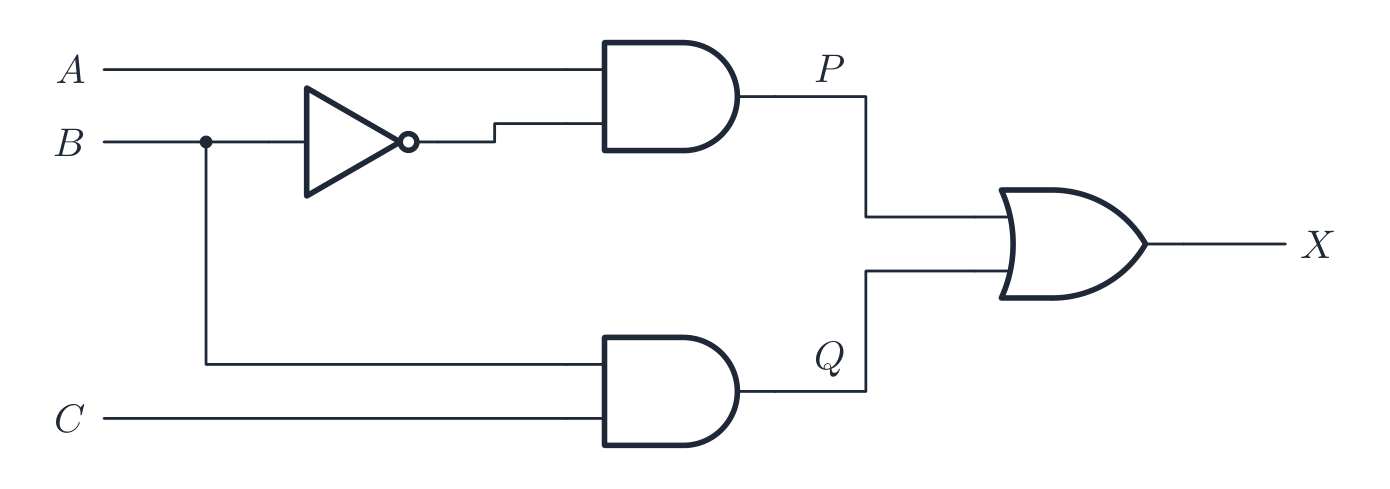
标注各门的输出:$P = A \text{ AND NOT } B$,$Q = B \text{ AND } C$,所以 $X = P \text{ OR } Q = (A \text{ AND NOT } B) \text{ OR } (B \text{ AND } C)$。然后给真值表每个中间输出加一列,这样每一行都能一个门一个门地检查:
| A | B | C | NOT B | P | Q | X |
|---|---|---|---|---|---|---|
| 0 | 0 | 0 | 1 | 0 | 0 | 0 |
| 0 | 0 | 1 | 1 | 0 | 0 | 0 |
| 0 | 1 | 0 | 0 | 0 | 0 | 0 |
| 0 | 1 | 1 | 0 | 0 | 1 | 1 |
| 1 | 0 | 0 | 1 | 1 | 0 | 1 |
| 1 | 0 | 1 | 1 | 1 | 0 | 1 |
| 1 | 1 | 0 | 0 | 0 | 0 | 0 |
| 1 | 1 | 1 | 0 | 0 | 1 | 1 |
由表达式画电路是同一条路反着走:从最内层的括号开始,每个运算符画一个门,任何带 NOT 的输入在它的导线上画一个 NOT 门,输入放在左边、唯一的输出放在右边,并给输出标上字母。每条线都必须终止于某个门的输入或最终输出;一条哪里都不去的线会丢分。
从电路到真值表
对于 $n$ 个输入有 $2^{n}$ 行。列出每个输入组合;对每一个,算出内部的门再算出输出。
从真值表到表达式(积之和)
对每个输出为 1 的行,写一个输入的 AND(对那一行中为 0 的任何输入取 NOT);把这些 OR 在一起。例子:一个只在 $(A=0,B=1)$ 和 $(A=1,B=0)$ 输出 1 的表给出 $\overline{A}B + A\overline{B}$,即 $A \text{ XOR } B$。
从一个问题陈述
先把英语变成一个布尔表达式:"A and B" → A AND B;"A or B or both" → A OR B;"exactly one of A and B" → A XOR B;"neither A nor B" → A NOR B;"not both" → A NAND B。
例题。 某机器的警报 $X$ 在防护罩打开($A=1$)并且电机运转($B=1$)或温度过高($C=1$)时鸣响。写出布尔表达式,并给出 $X=1$ 的各行。把英文一句一句地转成逻辑:"B 或 C"是 $B + C$,"A 并且这个"是 $X = A\cdot(B + C)$。至于各行,$X=1$ 需要 $A=1$ 并且 $B$、$C$ 中至少有一个为 1 - 所以是 $(A,B,C) = (1,0,1)$、$(1,1,0)$ 和 $(1,1,1)$,八行中的三行。注意 $A=0$ 时无论 $B$ 和 $C$ 怎样都不会报警。在与 A 相与之前要给 OR 加括号:$X = A\cdot B + C$ 完全是另一个电路,它会在防护罩关着时也因高温而报警。
探索
Half adder
Wire XOR and AND to the same two inputs: XOR gives the sum bit, AND gives the carry. Click A and B.
探索
Logic circuits
gates combine into circuits
Each gate has a fixed rule; chaining them builds every circuit — start with one gate.
词汇表
训练
| 英文 | 中文 | 拼音 |
|---|---|---|
| logic circuit/ˈlɒdʒɪk ˈsɜːkɪt/ | 逻辑电路 | luó jí diàn lù |
3.2
考官认可的定义
定义题按固定的表述给分。把这些记准确,并且只写一个答案。
| 术语 | 定义 |
|---|---|
| 嵌入式系统(embedded system) | 内置于更大设备中、具有专门功能的计算机系统 |
| 缓冲区(buffer) | 在不同速度的设备之间传输数据时暂时存放数据的一块存储区 |
| RAM | 可读可写的易失性存储器,存放正在使用的程序和数据 |
| ROM | 正常使用中内容不能更改的非易失性存储器,存放启动指令 |
| SRAM | 用触发器存储每一位、不需要刷新的静态 RAM |
| DRAM | 用电容器上的电荷存储每一位、必须不断刷新的动态 RAM |
| 监控系统(monitoring system) | 用传感器测量并报告一个物理过程而不改变它的系统 |
| 控制系统(control system) | 根据传感器读数决定并通过执行器执行改变物理过程的动作的系统 |
| 传感器(sensor) | 测量一个物理量并把它转换成计算机信号的装置 |
| 执行器(actuator) | 把来自计算机的信号转换成物理动作的装置 |
| 反馈(feedback) | 控制系统的输出被测量并作为输入送回,使系统能自我纠正 |
| 逻辑门(logic gate) | 对一个或多个二进制输入执行布尔运算、给出一个二进制输出的电子电路 |
| 真值表(truth table) | 列出逻辑电路的每一种输入组合及其对应输出的表 |
3.2
考试技巧
- 区分 **RAM(易失性、读/写)**和 ROM(非易失性、容纳引导程序);SRAM(高速缓存、更快)和 DRAM(主存储器、需要刷新)。
- 对于一个逻辑电路,逐门构建布尔表达式,然后一个覆盖每个输入组合的真值表。
- 学每个门(AND、OR、NOT、NAND、NOR、XOR)的符号、表达式和真值表。
- 解释一个缓冲(一个桥接两个不同速度的临时存储)以及一个中断的作用。
常见错误
- 说出设备的名称而不是描述它的工作过程。"它使用激光"得不到分;各个步骤(给鼓充电、激光消除电荷、吸附墨粉、转移、定影)才得分。
- 说监控系统"控制"了什么。如果没有任何东西改变物理过程,那就是监控;加上执行器和反馈,它才成为控制。
- 写 RAM"永久存储文件"或 ROM"存储用户的数据"。RAM 是易失的工作存储器;ROM 存放固定的启动指令。
- 真值表少于 $2^{n}$ 行,或者各行顺序随意。从 000 数到 111 按二进制计数,就不会漏掉组合。
- 为了保险从一个门的输出画两条线,或者留下一条哪里都不去的导线。只画表达式需要的那些连接。
本主题的互动课程
逐步学习,并即时检测练习。