| Candidates should be able to: | Notes and guidance |
|---|---|
| Show understanding of the limitations of using a file-based approach for the storage and retrieval of data | |
| Describe the features of a relational database that address the limitations of a file-based approach | |
| Show understanding of and use the terminology associated with a relational database model | Including entity, table, record, field, tuple, attribute, primary key, candidate key, secondary key, foreign key, relationship (one-to-many, one-to-one, many-to-many), referential integrity, indexing |
| Use an entity-relationship (E-R) diagram to document a database design | |
| Show understanding of the normalisation process | First Normal Form (1NF), Second Normal Form (2NF) and Third Normal Form (3NF) |
| Explain why a given set of database tables are, or are not, in 3NF | |
| Produce a normalised database design for a description of a database, a given set of data, or a given set of tables |
数据库
A-Level 计算机科学 · 第 8 主题
 17:18
17:18
Databases & the Relational Model
Before databases, each program kept its own flat files — one file per program. Picture a shop. The sales program, the billing program, and the shipping program…
英文讲解 · 内嵌中英文字幕
8.1
数据库概念

大纲
来源:剑桥国际大纲
在数据库之前,程序把数据存储在平面文件(flat files)中——通常每个程序一个文件。这对小数据没问题,但在规模上会崩溃。
局限
- 数据冗余(data redundancy)——相同的数据(一个客户的地址)保存在几个文件中,每个程序一个,既浪费存储,每个副本又都要更新。
- 数据不一致(data inconsistency)——一个副本更新了而另一个没有,文件之间互相矛盾,没人知道哪个是对的。
- 数据依赖(data dependence)——每个程序都是针对其文件的确切布局写的;改一个字段的长度或加一个字段,每个读该文件的程序都要重写。
- 无法共享访问——一个程序使用文件时文件被锁定,用户不能同时处理数据。
- 完整性(integrity)薄弱——没有集中规则阻止无效值或指向不存在客户的链接;安全薄弱——访问按文件而不是按字段控制;跨文件的查询每次都要一个新程序。

一个关系数据库(relational database)通过把数据存储在由一个所有程序都使用的软件(DBMS)管理的表中来修复这些。

为什么关系数据库更好——三分答案。 每项数据只在一个表中存储一次,表之间用键连接,所以没有冗余、没有不一致;数据与程序独立,程序向 DBMS 索取需要的数据,结构改变时不受影响;DBMS 集中执行完整性规则,按用户和按字段控制访问,允许多用户同时使用,并且无需编写新程序就能回答任何查询。
例题。 一家维修店用基于文件的方法存储顾客、设备和维修工作,每个程序一个文件。给出这造成的三个问题,并描述关系数据库如何消除它们。
顾客的姓名和电话既存在维修文件里又存在发票文件里(冗余);顾客换号码时,一个文件更新了而另一个没有(不一致);店里想要一份新报表——每位技师的维修数——就得写一个新程序去读文件(无法即席查询)。在关系数据库中,顾客只在 CUSTOMER 表中存储一次,REPAIR 表用 CustomerID 引用它,所以改动只做一次、处处可见;报表只是一条 SQL 查询。
词汇表
训练
| 英文 | 中文 | 拼音 |
|---|---|---|
| flat files/flæt faɪlz/ | 平面文件 | píng miàn wén jiàn |
| data redundancy/ˈdeɪtə rɪˈdʌndənsi/ | 数据冗余 | shù jù rǒng yú |
| data inconsistency/ˈdeɪtə ˌɪnkənˈsɪstənsi/ | 数据不一致 | shù jù bù yī zhì |
| integrity/ɪnˈteɡrɪti/ | 完整性 | wán zhěng xìng |
| relational database/rɪˈleɪʃənl ˈdeɪtəbeɪs/ | 关系数据库 | guān xì shù jù kù |
| DBMS/ˌdiː biː em ˈes/ | 数据库管理系统 | shù jù kù guǎn lǐ xì tǒng |
| SQL/ˌes kjuː ˈel/ | 结构化查询语言 | jié gòu huà chá xún yǔ yán |
8.1
关系模型 —— 术语
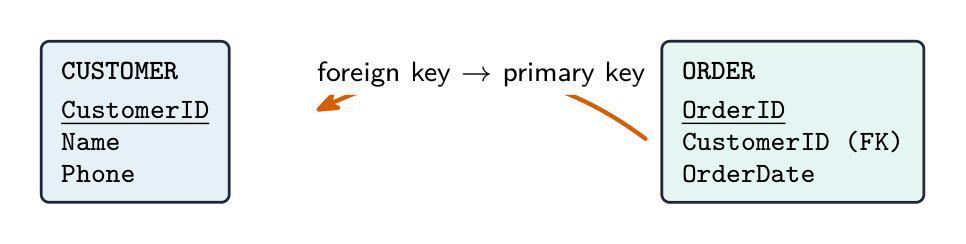
- 表(table,关系)——行和列的一个网格;每种实体(entity)一个表(例如
CUSTOMER)。 - 记录(record,行,也叫元组(tuple))——一行;实体的一个实例。
- 字段(field,列,也叫属性(attribute))——一列;关于每条记录的一条信息。
- 主键(primary key)——唯一标识每条记录的一个字段(或多个字段);从不为空或重复。
- 外键(foreign key)——一个值匹配另一个表主键的字段,把两者链接起来。
- 复合键(composite key)——由两个或更多字段一起构成的一个主键。
- 候选键(candidate key)——任何可以是主键的字段。
- 次键(secondary key)——一个为快速搜索而建立索引的非主字段。
- 索引(indexing)——在一个字段上建立一个索引,使查找和连接运行得更快。
- 参照完整性(referential integrity)——每个外键值必须匹配一个现有的主键(没有孤立记录)。
一个表用简写书写,主键加下划线、外键标注:
CUSTOMER(CustomerID, Name, Phone)
ORDER(OrderID, CustomerID, OrderDate)   -- CustomerID is FK → CUSTOMER
例题。 说明关系数据库模型中实体、主键和参照完整性的含义,并补全元组和属性的术语 ↔ 描述表。
实体是被存储数据的对象——一个人、物体或事件——它成为一个表。主键是唯一标识表中每条记录的属性(或属性组合)。参照完整性指每个外键值必须匹配它所引用的表中某个主键的值,这样一条记录就不能引用一条不存在的记录。元组是表的一行(一条记录);属性是一列(一个字段)。记住这些配对:表/关系,记录/元组,字段/属性。
探索
Read a relational table with SELECT
A relational table is just rows (records) and columns (fields). WHERE keeps the rows that match a condition; SELECT then keeps only the columns you asked for.
词汇表
训练
| 英文 | 中文 | 拼音 |
|---|---|---|
| field/fiːld/ | 字段 | zì duàn |
| table/ˈteɪbl/ | 表 | biǎo |
| entity/ˈentɪti/ | 实体 | shí tǐ |
| record/ˈrekɔːd/ | 记录 | jì lù |
| tuple/ˈtuːpl/ | 元组 | yuán zǔ |
| attribute/ˈætrɪbjuːt/ | 属性 | shǔ xìng |
| primary key/ˈpraɪməri kiː/ | 主键 | zhǔ jiàn |
| foreign key/ˈfɒrən kiː/ | 外键 | wài jiàn |
| composite key/ˈkɒmpəzɪt kiː/ | 复合键 | fù hé jiàn |
| candidate key/ˈkændɪdeɪt kiː/ | 候选键 | hòu xuǎn jiàn |
| secondary key/ˈsekəndəri kiː/ | 次键 | cì jiàn |
| indexing/ˈɪndeksɪŋ/ | 索引 | suǒ yǐn |
| referential integrity/ˌrefəˈrenʃl ɪnˈteɡrɪti/ | 参照完整性 | cān zhào wán zhěng xìng |
8.1
实体-关系(E-R)图

一个实体关系图(entity-relationship diagram)显示结构:每个实体是一个矩形,每个关系是一条线,在每端标注基数(cardinality):
- 一对一(1:1)。
- 一对多(one-to-many,1:M)——每个客户有许多订单;每个订单有一个客户。
- 多对多(many-to-many,M:N)——学生选许多课程,而课程有许多学生。

一个多对多关系不能直接存储。把它拆成两个一对多关系,通过一个容纳两个外键的连接表(link table):
ENROLMENT(StudentID, CourseID, EnrolmentDate)

为给定的一组表画 E-R 图。 每个表成为一个实体。凡是一个表持有指向另一个表的外键,就存在一个关系;它从持有外键的表(多的一端)连到以该键为主键的表(一的一端)。一个有两个外键、没有其他身份的表通常是解决多对多关系的连接表。给每条线标上关系类型。
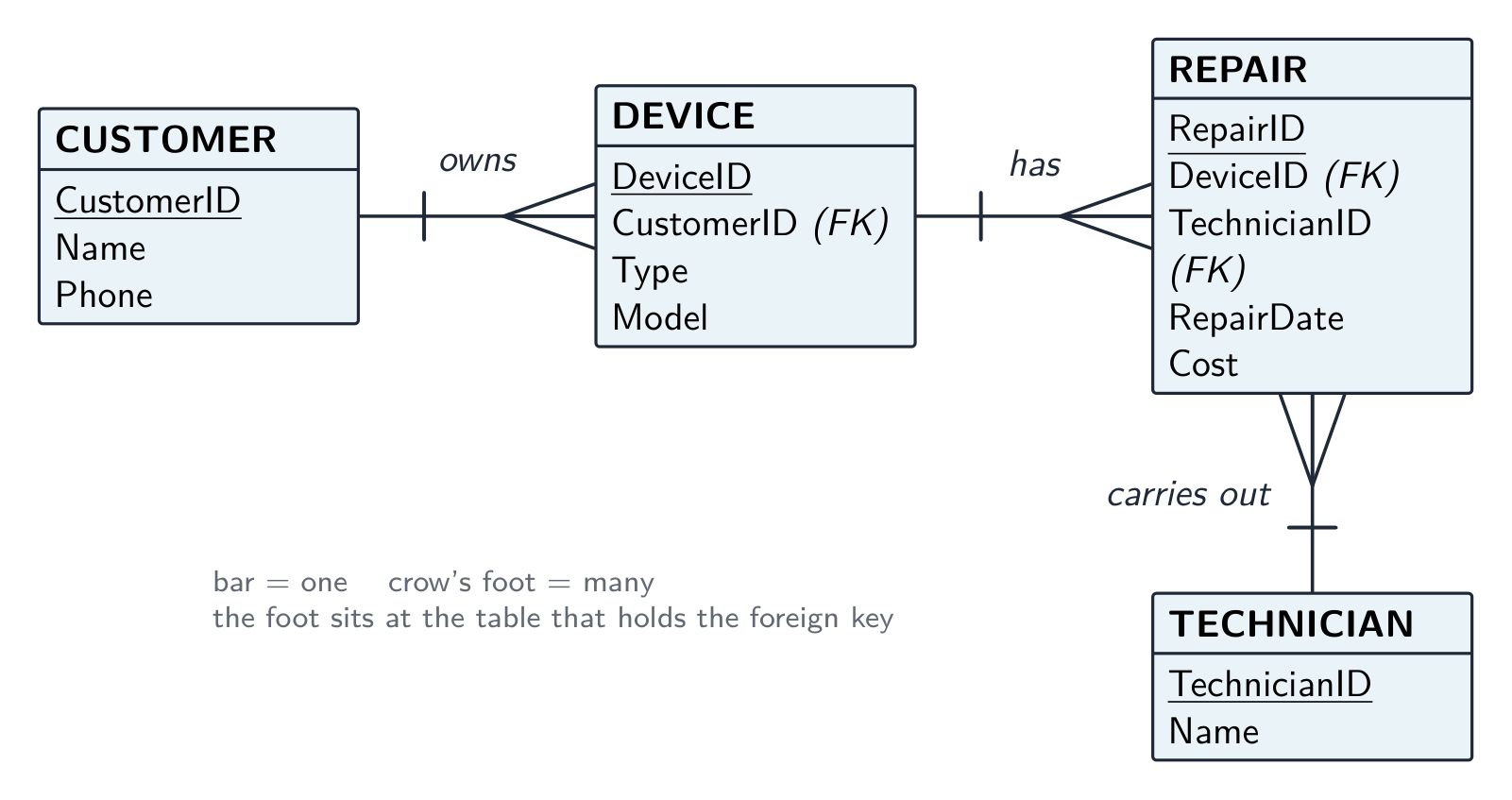
例题。 一家维修店有表 CUSTOMER(CustomerID, Name, Phone)、DEVICE(DeviceID, CustomerID, Type, Model)、TECHNICIAN(TechnicianID, Name) 和 REPAIR(RepairID, DeviceID, TechnicianID, RepairDate, Cost)。指出各关系及其类型。
DEVICE 持有 CustomerID,所以 CUSTOMER–DEVICE 是一对多(一个顾客,许多设备)。REPAIR 持有 DeviceID,所以 DEVICE–REPAIR 是一对多;它还持有 TechnicianID,所以 TECHNICIAN–REPAIR 是一对多。没有直接的 CUSTOMER–REPAIR 线:联系经由 DEVICE。三条线,三个鸦爪,都在 REPAIR 或 DEVICE 那一端。
词汇表
训练
| 英文 | 中文 | 拼音 |
|---|---|---|
| entity-relationship diagram/ˈentɪti rɪˈleɪʃənʃɪp ˈdaɪəɡræm/ | 实体关系图 | shí tǐ guān xì tú |
| cardinality/ˌkɑːdɪˈnælɪti/ | 基数 | jī shù |
| one-to-many/wʌn tə ˈmeni/ | 一对多 | yī duì duō |
| link table/lɪŋk ˈteɪbl/ | 连接表 | lián jiē biǎo |
8.1
规范化

规范化(normalisation)组织表以减少冗余和不一致,按顺序经过各范式(normal forms)。
- 第一范式(1NF)——每个字段容纳一个单一(原子(atomic))值,没有重复组,并有一个主键。
- 第二范式(2NF)——处于 1NF,并且每个非键字段依赖于整个主键(只对一个复合键有意义)。
- 第三范式(3NF)——处于 2NF,并且每个非键字段只依赖于主键,而不依赖于另一个非键字段(没有传递依赖(transitive dependency))。
一个 3NF 设计把每个事实存储一次,所以插入/更新/删除异常消失。权衡是更多的表和更多的连接。以 3NF 为目标。
要产生一个 3NF 设计:找出实体及其属性;为每个选择一个主键;拆分重复/非原子字段(1NF);拆分依赖于一个复合键一部分的字段(2NF);拆分传递地依赖于键的字段(3NF);为关系添加外键。
例题。 表 ORDER(OrderID, CustomerID, CustomerName, ProductID, Quantity) 的复合主键是 (OrderID, ProductID)。把它规范化到 3NF。逐个用主键去检验每个非键字段。Quantity 同时依赖 OrderID 和 ProductID,这没问题。但 CustomerID 只依赖 OrderID - 也就是复合主键的一部分。这是部分依赖,所以该表不满足 2NF。把它拆成 ORDER_LINE(OrderID, ProductID, Quantity) 和 ORDER(OrderID, CustomerID, CustomerName)。再检验 3NF:在新的 ORDER 表中,CustomerName 依赖于 CustomerID,而后者不是主键 - 这是传递依赖。再拆一次:ORDER(OrderID, CustomerID) 和 CUSTOMER(CustomerID, CustomerName)。要点出破坏每种范式的那种依赖(部分依赖破坏 2NF,传递依赖破坏 3NF);写"它有重复数据"只是在描述症状,得不到分。
对任何表都要问的三个问题。 每个单元格是否都是单一值、没有重复组? 不是,就不在 1NF。如果键是复合的,每个非键字段是否都依赖于整个键? 若某字段只依赖于它的一部分,就存在部分依赖(partial dependency),表不在 2NF。每个非键字段是否只依赖于键? 若某字段依赖于另一个非键字段,就存在传递依赖,表不在 3NF。"解释为什么该表不在 3NF"的答案要说出依赖的名称和涉及的字段。
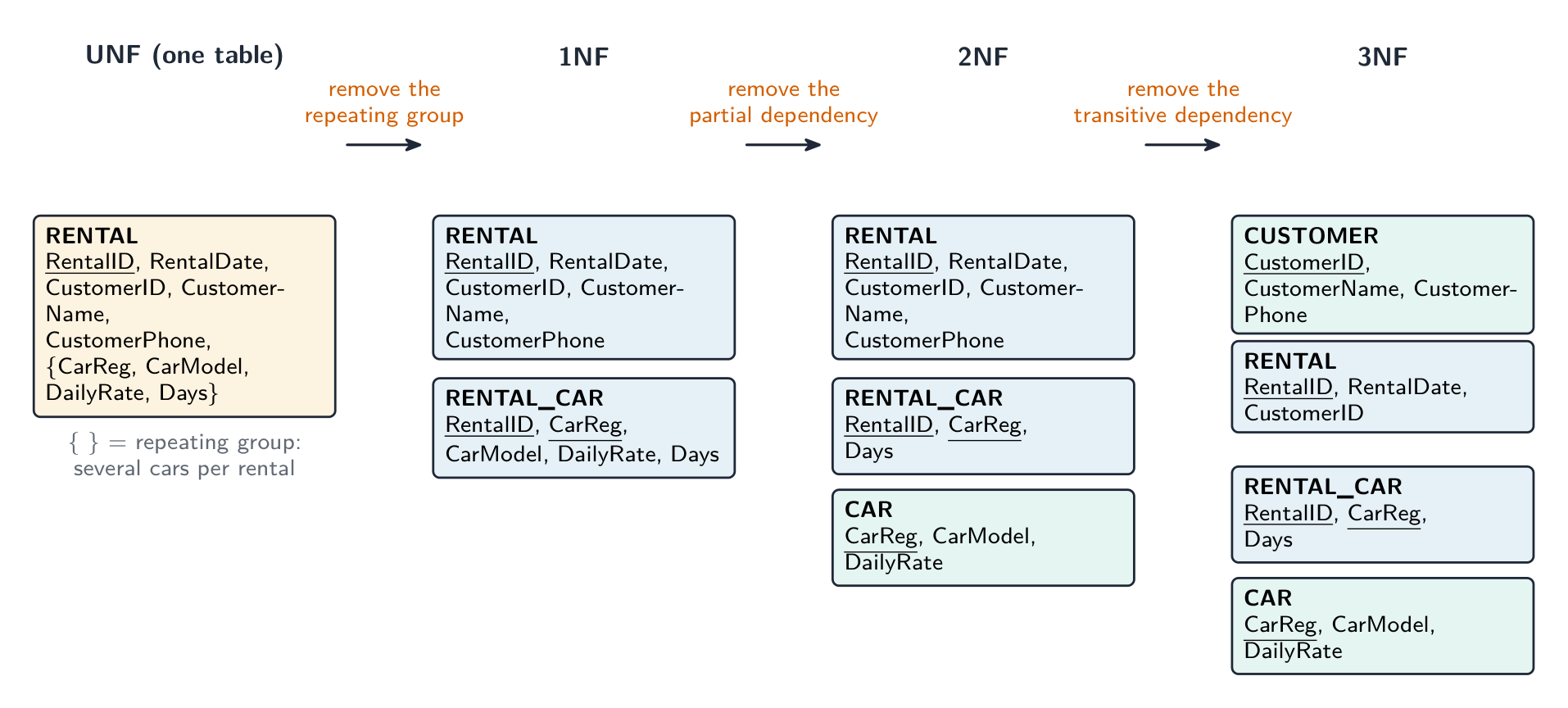
例题。 一家租车店把每次租车记录为 RENTAL(RentalID, RentalDate, CustomerID, CustomerName, CustomerPhone, CarReg, CarModel, DailyRate, Days),一次租车可以包含几辆车。解释为什么该表未规范化,并给出 3NF 设计。
不在 1NF: 汽车字段 CarReg, CarModel, DailyRate, Days 构成一个重复组——一次租车有几辆车。把它们移到 RENTAL_CAR(RentalID, CarReg, CarModel, DailyRate, Days),复合键为 (RentalID, CarReg)。不在 2NF: 在 RENTAL_CAR 中,CarModel 和 DailyRate 只依赖于 CarReg——部分依赖。把它们移到 CAR(CarReg, CarModel, DailyRate),留下 RENTAL_CAR(RentalID, CarReg, Days)。不在 3NF: 在 RENTAL 中,CustomerName 和 CustomerPhone 依赖于非键字段 CustomerID——传递依赖。把它们移到 CUSTOMER(CustomerID, CustomerName, CustomerPhone),留下 RENTAL(RentalID, RentalDate, CustomerID)。3NF 设计是四个表——CUSTOMER、RENTAL、RENTAL_CAR、CAR——以 CustomerID、RentalID 和 CarReg 为外键;给每个主键加下划线。
词汇表
训练
| 英文 | 中文 | 拼音 |
|---|---|---|
| normalisation/ˌnɔːməlaɪˈzeɪʃn/ | 规范化 | guī fàn huà |
| normal forms/ˈnɔːml fɔːmz/ | 范式 | fàn shì |
| atomic/əˈtɒmɪk/ | 原子 | yuán zi |
| transitive dependency/ˈtrænsɪtɪv dɪˈpendənsi/ | 传递依赖 | chuán dì yī lài |
| partial dependency/ˈpɑːʃl dɪˈpendənsi/ | 部分依赖 | bù fèn yī lài |
8.2
数据库管理系统(DBMS)

大纲
| Candidates should be able to: | Notes and guidance |
|---|---|
| Show understanding of the features provided by a Database Management System (DBMS) that address the issues of a file based approach | Including: • data management, including maintaining a data dictionary • data modelling • logical schema • data integrity • data security, including backup procedures and the use of access rights to individuals / groups of users |
| Show understanding of how software tools found within a DBMS are used in practice | Including the use and purpose of: • developer interface • query processor |
来源:剑桥国际大纲
一个 DBMS(数据库管理系统)集中管理数据库。修复基于文件的局限的特性:
- 数据字典(data dictionary)——对每个表、字段、类型和键的描述;程序查询它而不是硬编码结构。
- 冗余/一致性控制——每个事实存储一次。
- 并发访问(concurrent access)控制——锁和事务让许多用户一次工作。
- 备份(backup)和恢复;安全和每用户权限。
- 完整性规则——键、唯一和范围约束,集中强制执行。
- 事务(transactions)——一组全部成功或全部失败的操作。
- 视图(views)——向每个用户显示"他们的"那一片数据的虚拟表。
- 数据管理(data management)和数据建模(data modelling)——控制数据如何存储,并把它的结构定义为一个逻辑模式(logical schema,逻辑设计,独立于物理存储)。
- 数据完整性(data integrity)和数据安全(data security)——集中强制正确性并控制访问。
- 一个查询处理器(query processor)运行查询;一个开发者接口(developer interface)给出构建应用程序的工具和 API。
它的工具包括一个数据字典编辑器、一个查询构建器、一个表单构建器、一个报表生成器、用户管理,以及一个 SQL 编辑器。
数据字典里有什么("给出三项"的题目):表的名称;每个表中字段的名称;每个字段的数据类型和长度;主键、外键以及表之间的关系;验证规则;索引;以及谁可以访问每个表。它是元数据——关于数据的数据——DBMS 用它检查每条查询和每次改动。
DBMS 如何保证数据安全("描述两种方法"的题目):身份验证(authentication)——任何访问之前先输入用户名和密码,或用生物特征;访问权限——每个用户或用户组只被允许读、写或删除某些表或字段,常通过视图实现;对存储的数据和传给它的数据加密,使复制出去的文件无法读取;定期备份,使数据在丢失后可以恢复;还有一份记录谁改了什么的事务日志。
两个软件工具。 开发者接口是程序员用来构建数据库及其上应用程序的工具:创建表、设置键和验证、编写查询和 SQL、设计表单和报表,而不必知道数据在物理上如何存储。查询处理器接受一条查询(来自程序的 SQL,或在接口中构建的查询),对照数据字典检查它,找出最高效的执行方式,取出数据并返回结果。
逻辑模式。 DBMS 把逻辑设计(存在哪些表和字段、它们如何关联)与物理存储(文件、索引、磁盘块)分开。程序面对的是逻辑模式,所以物理存储可以重新组织而一个程序都不用改——这正是基于文件的方法所缺少的数据独立性。
探索
Database service lab
Watch how a DBMS turns a query into safe shared data access.
探索
Database service lab
Watch how a DBMS turns a query into safe shared data access.
词汇表
训练
| 英文 | 中文 | 拼音 |
|---|---|---|
| query/ˈkwɪərɪ/ | 查询 | chá xún |
| data dictionary/ˈdeɪtə ˈdɪkʃənəri/ | 数据字典 | shù jù zì diǎn |
| concurrent access/kənˈkʌrənt ˈækses/ | 并发访问 | bìng fā fǎng wèn |
| transactions/trænˈsækʃnz/ | 事务 | shì wù |
| backup/ˈbækʌp/ | 备份 | bèi fèn |
| views/vjuːz/ | 视图 | shì tú |
| data management/ˈdeɪtə ˈmænɪdʒmənt/ | 数据管理 | shù jù guǎn lǐ |
| data modelling/ˈdeɪtə ˈmɒdəlɪŋ/ | 数据建模 | shù jù jiàn mó |
| logical schema/ˈlɒdʒɪkl ˈskiːmə/ | 逻辑模式 | luó jí mó shì |
| data integrity/ˈdeɪtə ɪnˈteɡrɪti/ | 数据完整性 | shù jù wán zhěng xìng |
| data security/ˈdeɪtə sɪˈkjʊərɪti/ | 数据安全 | shù jù ān quán |
| query processor/ˈkwɪərɪ ˈprəʊsesə/ | 查询处理器 | chá xún chǔ lǐ qì |
| developer interface/dɪˈveləpə ˈɪntəfeɪs/ | 开发者接口 | kāi fā zhě jiē kǒu |
| authentication/ɔːˌθentɪˈkeɪʃn/ | 身份验证 | shēn fèn yàn zhèng |
8.3
数据定义语言(DDL)与数据操纵语言(DML)
大纲
| Candidates should be able to: | Notes and guidance |
|---|---|
| Show understanding that the DBMS carries out all creation/modification of the database structure using its Data Definition Language (DDL) | |
| Show understanding that the DBMS carries out all queries and maintenance of data using its DML | |
| Show understanding that the industry standard for both DDL and DML is Structured Query Language (SQL) | Understand a given SQL statement |
| Understand given SQL (DDL) statements and be able to write simple SQL (DDL) statements using a sub-set of statements | Create a database (CREATE DATABASE) Create a table definition (CREATE TABLE), including the creation of attributes with appropriate data types: • CHARACTER • VARCHAR(n) • BOOLEAN • INTEGER • REAL • DATE • TIME change a table definition (ALTER TABLE) add a primary key to a table (PRIMARY KEY (field)) add a foreign key to a table (FOREIGN KEY (field) REFERENCES Table (Field)) |
| Write an SQL script to query or modify data (DML) which are stored in (at most two) database tables | Queries including SELECT... FROM, WHERE, ORDER BY, GROUP BY, INNER JOIN, SUM, COUNT, AVG |
| Data maintenance including INSERT INTO, DELETE FROM, UPDATE |
来源:剑桥国际大纲
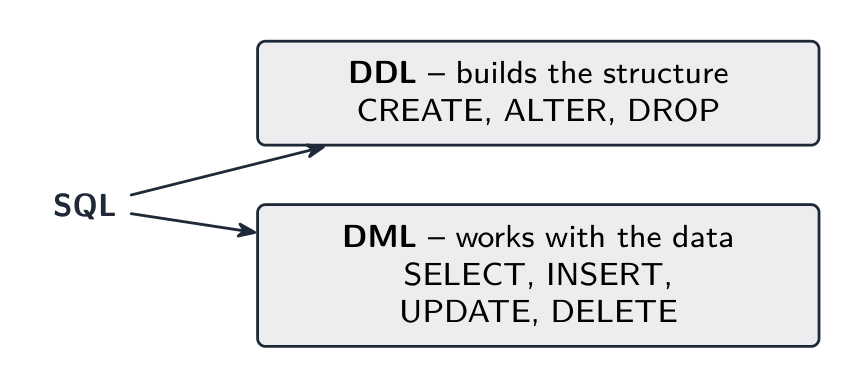
SQL(结构化查询语言,Structured Query Language)有两半:
- 数据定义语言(Data Definition Language,DDL)——创建或改变结构(表、键、约束)。
- 数据操纵语言(Data Manipulation Language,DML)——处理数据(插入、更新、删除、查询(query))。
DDL 基础
CREATE TABLE CUSTOMER (
  CustomerID INTEGER PRIMARY KEY,
  Name VARCHAR(50) NOT NULL,
  Phone VARCHAR(20)
);
添加一个外键:
CREATE TABLE ORDER (
  OrderID INTEGER PRIMARY KEY,
  CustomerID INTEGER,
  OrderDate DATE,
  FOREIGN KEY (CustomerID) REFERENCES CUSTOMER(CustomerID)
);
修改和删除:
ALTER TABLE CUSTOMER ADD Email VARCHAR(100);
DROP TABLE CUSTOMER;
常见类型:INTEGER、REAL、VARCHAR(n)、CHAR(n)(也叫 CHARACTER(n))、DATE、TIME、BOOLEAN、DECIMAL(p, s)。
DML 基础
用 SELECT 查询:

SELECT Name, Phone
FROM CUSTOMER
WHERE City = 'London'
ORDER BY Name ASC;
SELECT 列出字段,FROM 命名表,WHERE 过滤行,ORDER BY 排序。
一个连接(join)用一个外键关系组合两个表:
SELECT C.Name, O.OrderDate
FROM CUSTOMER C INNER JOIN ORDER O
  ON C.CustomerID = O.CustomerID
WHERE O.OrderDate >= '2024-01-01';
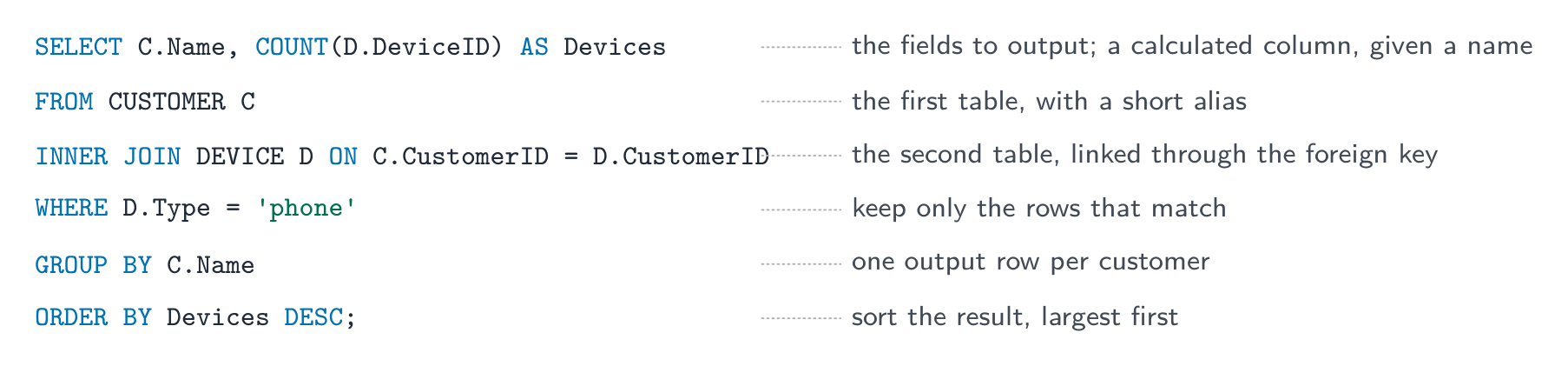
聚合函数(aggregate functions,COUNT、SUM、AVG、MIN、MAX)常与 GROUP BY 一起用:
SELECT CustomerID, COUNT(*) AS NumOrders
FROM ORDER
GROUP BY CustomerID;
插入、更新、删除:
INSERT INTO CUSTOMER (CustomerID, Name, Phone)
VALUES (101, 'Ada Lovelace', '020-1234-5678');

UPDATE CUSTOMER SET Phone = '020-9999-0000' WHERE CustomerID = 101;

DELETE FROM CUSTOMER WHERE CustomerID = 101;
总是在 UPDATE 和 DELETE 上加一个 WHERE 子句,否则改变会命中每一行。
考试 SQL 的提示
- 使用题目中确切的表名和字段名。
- 用单引号引起字符串(
'Smith');不要引起数字。 - 比较:
=、<、>、<=、>=、<>。 LIKE 'A%'匹配任何以 A 开头的(%= 任何字符串,_= 一个字符);IN (1,2,3);BETWEEN 10 AND 20。- 用
AND/OR/NOT组合条件,并以一个分号结束每条语句。
考试要的 DDL 模式。 每条 CREATE TABLE 给每个字段命名并写出类型,标出主键,并声明每个外键及其引用的表;复合键单独占一行声明:
CREATE TABLE RENTAL_CAR (
  RentalID INTEGER,
  CarReg VARCHAR(8),
  Days INTEGER,
  PRIMARY KEY (RentalID, CarReg),
  FOREIGN KEY (RentalID) REFERENCES RENTAL(RentalID),
  FOREIGN KEY (CarReg) REFERENCES CAR(CarReg)
);
例题。 用 CUSTOMER(CustomerID, Name, Phone) 和 DEVICE(DeviceID, CustomerID, Type, Model),写 SQL 脚本:(a) 按姓名字母顺序列出每个拥有类型为 'tablet' 的设备的顾客的姓名和电话;(b) 统计每种类型的设备数;(c) 记录顾客 17 现在的电话号码是 '0771 234 5678';(d) 添加一台新设备,ID 305,类型 'laptop'、型号 'X1',属于顾客 17。
(a)
SELECT CUSTOMER.Name, CUSTOMER.Phone
FROM CUSTOMER INNER JOIN DEVICE
  ON CUSTOMER.CustomerID = DEVICE.CustomerID
WHERE DEVICE.Type = 'tablet'
ORDER BY CUSTOMER.Name ASC;
(b)
SELECT Type, COUNT(DeviceID) AS NumberOfDevices
FROM DEVICE
GROUP BY Type;
(c) UPDATE CUSTOMER SET Phone = '0771 234 5678' WHERE CustomerID = 17;
(d) INSERT INTO DEVICE (DeviceID, CustomerID, Type, Model) VALUES (305, 17, 'laptop', 'X1');
分数按子句给——字段、表、连接条件、WHERE、ORDER BY——所以一个子句错了的脚本仍能得到其余的分。涉及两个表时一律写 表.字段。
例题。 解释这段脚本做什么:SELECT T.Name, SUM(R.Cost) AS Total FROM TECHNICIAN T INNER JOIN REPAIR R ON T.TechnicianID = R.TechnicianID GROUP BY T.Name;
它输出每位技师的姓名以及该技师所做维修的总费用,每位技师一行:两个表通过 TechnicianID 连接,行按姓名分组,每组的费用相加。被问脚本做什么时,描述结果,而不是语法。
探索
Stitch two tables with INNER JOIN
A join matches rows where the foreign key equals the primary key — here Orders.CustomerID = Customer.CustomerID — and combines each matching pair into one wider row.
探索
SELECT … WHERE
Step through a query: WHERE keeps the rows that match, then SELECT picks the columns you asked for.
词汇表
训练
| 英文 | 中文 | 拼音 |
|---|---|---|
| join/dʒɔɪn/ | 连接 | lián jiē |
| Data Definition Language/ˈdeɪtə ˌdefɪˈnɪʃn ˈlæŋɡwɪdʒ/ | 数据定义语言 | shù jù dìng yì yǔ yán |
| Data Manipulation Language/ˈdeɪtə məˌnɪpjʊˈleɪʃn ˈlæŋɡwɪdʒ/ | 数据操纵语言 | shù jù cāo zòng yǔ yán |
| aggregate functions/ˈæɡrɪɡeɪt ˈfʌŋkʃnz/ | 聚合函数 | jù hé hán shù |
8.3
考官认可的定义
定义题按固定措辞给分。把这些记准,并且只给一个答案。
| 术语 | 定义 |
|---|---|
| 实体 | 被存储数据的对象——人、物体或事件——在关系数据库中成为一个表 |
| 属性 | 实体的一项数据(表中的一列) |
| 元组 | 表中的一行:一个实体的一个实例 |
| 主键 | 唯一标识表中每条记录的一个属性或属性组合 |
| 外键 | 一个表中的属性,其值与另一个表中的主键匹配,用来把两个表连接起来 |
| 候选键 | 任何可以选作主键的属性(或组合) |
| 次键 | 为快速搜索或排序而建立索引的非主键属性 |
| 复合键 | 由两个或更多属性一起构成的主键 |
| 参照完整性 | 每个外键值必须与被引用表中已有的主键值匹配 |
| 第一范式 | 每个属性都是原子值、没有重复组、有主键的表 |
| 第二范式 | 处于 1NF,且每个非键属性都依赖于整个主键(没有部分依赖) |
| 第三范式 | 处于 2NF,且非键属性之间没有依赖(没有传递依赖) |
| 数据字典 | DBMS 保存的关于数据库结构的元数据:表、字段、类型、键、关系、验证 |
| DDL / DML | 用来定义或修改数据库结构的语言 / 用来查询和维护数据库中数据的语言 |
8.3
考试技巧
- 精确地定义术语:实体、属性、主键、外键,以及关系类型(1:1、1:多、多:多)。
- 在每个范式给出一个理由:1NF(没有重复组)、2NF(没有部分依赖)、3NF(没有非键依赖)——并说出涉及的字段。
- 解释一个 DBMS 提供什么(数据独立性、安全、完整性、并发访问、数据字典、开发者接口、查询处理器)。
- 区分 DDL(定义结构)和 DML(查询和改变数据),并按子句写 SQL:
SELECT、FROM、INNER JOIN … ON、WHERE、GROUP BY、ORDER BY。 - 从表画 E-R 图时,先找出每个外键:每个外键就是一个一对多关系,"多"在持有它的表那一端。
常见错误
- 直接画多对多关系。它必须通过一个持有两个外键的连接表拆成两个一对多关系。
- 用"数据重复了"解释一个表不在 3NF。要说出依赖(部分或传递)以及涉及的字段。
- 在 SQL 中用双引号引字符串,或给数字加引号。字符串用
'单引号',数字不加引号。 INNER JOIN后漏掉ON条件。没有它两个表就没有连接起来。- 在
SELECT里把一个普通字段与COUNT或SUM放在一起却没有GROUP BY。 UPDATE或DELETE没有WHERE。这会改变或删除表中的每一行。
本主题的互动课程
逐步学习,并即时检测练习。