- describe qualitatively (and indicate the periodicity in) the variations in atomic radius, ionic radius, melting point and electrical conductivity of the elements
- explain the variation in melting point and electrical conductivity in terms of the structure and bonding of the elements
元素周期表:化学周期性
A-Level 化学 · 第 9 主题
 8:43
8:43
The Periodic Table: chemical periodicity
Sodium and argon sit in the same row of the Periodic Table, with only six elements between them. Drop sodium into cold water and it melts into a shining ball…
英文讲解 · 内嵌中英文字幕
9.1
第三周期元素物理性质的周期性

大纲
来源:剑桥国际大纲
周期性(periodicity)意味着当你沿周期表的每个周期(period)横过时,性质以一个规则的模式重复。第 3 周期(Na 到 Ar)是标准例子。

| 性质 | 沿第 3 周期的趋势 |
|---|---|
| 原子半径(atomic radius) | 变小(更多的核电荷把同一壳层拉进来) |
| 离子半径(ionic radius) | 正离子小;从 $\text{P}^{3-}$ 起负离子更大 |
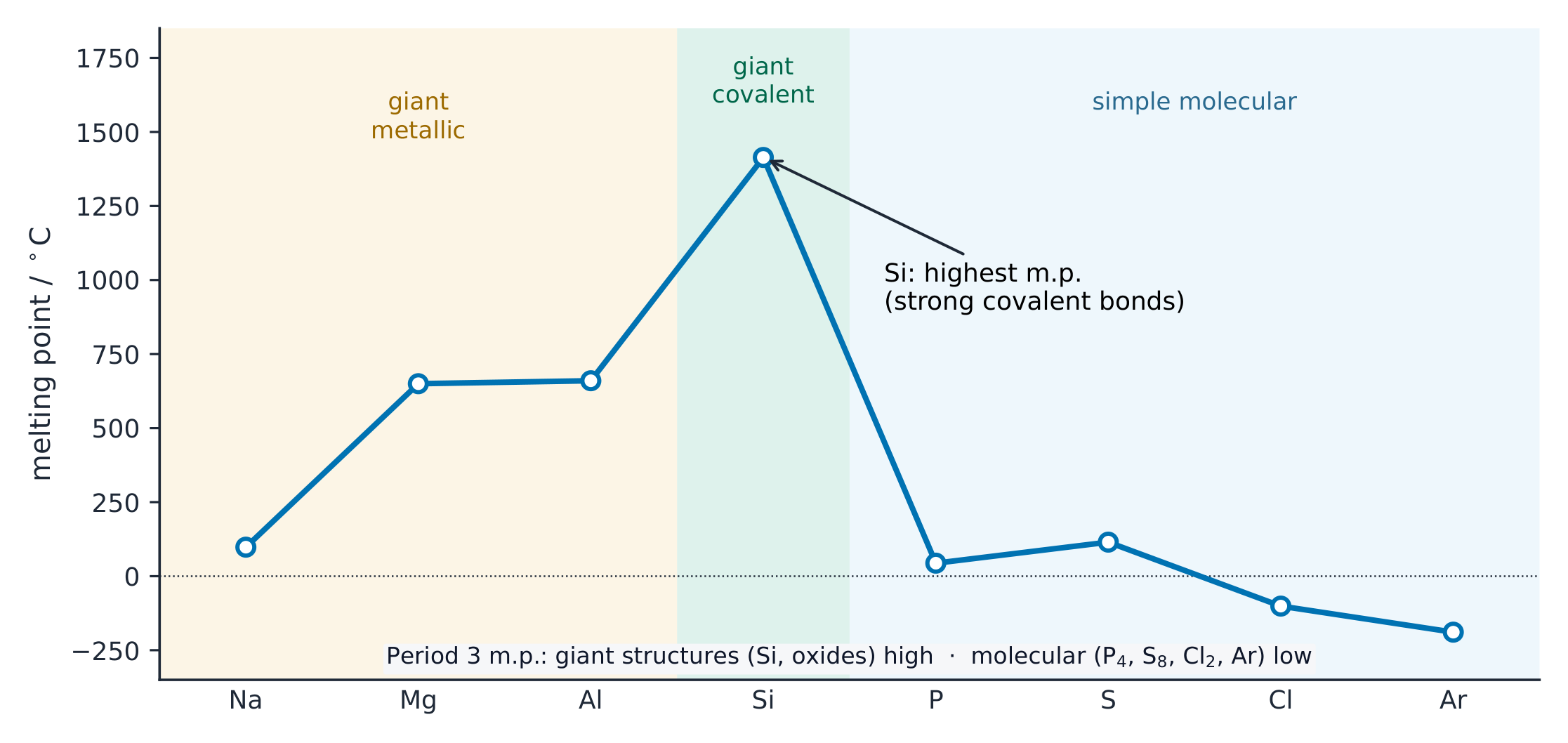
| 熔点(melting point) | 升到硅处的一个峰,然后急剧下降 |
| 导电性(electrical conductivity) | Na、Mg、Al 高;从 Si 起几乎为零 |
熔点和导电性由结构和键得出:
- Na、Mg、Al 是金属晶体(giant metallic)。熔点上升(Na → Al),因为每个原子给出更多的离域电子且离子变小,所以键更强。它们导电好。
- Si 是原子晶体(giant molecular,巨型共价)。它有最高的熔点,因为必须断裂强共价键。它几乎不导电。
- P、S、Cl、Ar 是分子晶体(simple molecular,或单个原子)。它们的熔点低,因为唯一被破坏的是分子之间弱的范德华力(van der Waals' forces)—— 每个分子内部的强共价键根本没有被断开。它们不导电。
解释这一骤降时要点名范德华力:这就是得分点,而写"共价键很弱"正是丢分的错误。熔化 $\text{S}_8$ 是把一个个完整的分子彼此拉开;它一根 $\text{S–S}$ 键都没有碰到。它们熔点的高低仍取决于分子本身:$\text{S}_8$ 的熔点高于 $\text{P}_4$,因为它更大、电子更多,因而范德华力更强;而 $\text{Ar}$(单个原子)是其中最低的。
探索
Trends across Period 3
Switch between atomic radius, ionisation energy and melting point, and step across Period 3 to see each periodic trend.
词汇表
训练
| 英文 | 中文 | 拼音 |
|---|---|---|
| periodicity/ˌpɪərɪˌɒˈdɪsɪti/ | 周期性 | zhōu qī xìng |
| period/ˈpɪərɪəd/ | 周期 | zhōu qī |
| atomic radius/əˈtɒmɪk ˈreɪdɪəs/ | 原子半径 | yuán zi bàn jìng |
| ionic radius/aɪˈɒnɪk ˈreɪdɪəs/ | 离子半径 | lí zi bàn jìng |
| melting point/ˈmeltɪŋ pɔɪnt/ | 熔点 | róng diǎn |
| electrical conductivity/ɪˈlektrɪkl kɒndəkˈtɪvɪti/ | 导电性 | dǎo diàn xìng |
| giant metallic/ˈdʒaɪənt məˈtælɪk/ | 金属晶体 | jīn shǔ jīng tǐ |
| giant molecular/ˈdʒaɪənt məˈlekjʊlə/ | 原子晶体 | yuán zi jīng tǐ |
| simple molecular/ˈsɪmpl məˈlekjʊlə/ | 分子晶体 | fēn zǐ jīng tǐ |
| van der Waals' forces/ˈvændɜː wɑːlz ˈfɔːsɪz/ | 范德华力 | fàn dé huá lì |
9.2
第三周期元素化学性质的周期性

大纲
- describe, and write equations for, the reactions of the elements with oxygen (to give $\text{Na}_2\text{O}$, $\text{MgO}$, $\text{Al}_2\text{O}_3$, $\text{P}_4\text{O}_{10}$, $\text{SO}_2$), chlorine (to give $\text{NaCl}$, $\text{MgCl}_2$, $\text{AlCl}_3$, $\text{SiCl}_4$, $\text{PCl}_5$) and water ($\text{Na}$ and $\text{Mg}$ only)
- state and explain the variation in the oxidation number of the oxides ($\text{Na}_2\text{O}$, $\text{MgO}$, $\text{Al}_2\text{O}_3$, $\text{P}_4\text{O}_{10}$, $\text{SO}_2$ and $\text{SO}_3$ only) and chlorides ($\text{NaCl}$, $\text{MgCl}_2$, $\text{AlCl}_3$, $\text{SiCl}_4$, $\text{PCl}_5$ only) in terms of their outer shell (valence shell) electrons
- describe, and write equations for, the reactions, if any, of the oxides $\text{Na}_2\text{O}$, $\text{MgO}$, $\text{Al}_2\text{O}_3$, $\text{SiO}_2$, $\text{P}_4\text{O}_{10}$, $\text{SO}_2$ and $\text{SO}_3$ with water including the likely pHs of the solutions obtained
- describe, explain, and write equations for, the acid/base behaviour of the oxides $\text{Na}_2\text{O}$, $\text{MgO}$, $\text{Al}_2\text{O}_3$, $\text{P}_4\text{O}_{10}$, $\text{SO}_2$ and $\text{SO}_3$ and the hydroxides $\text{NaOH}$, $\text{Mg(OH)}_2$ and $\text{Al(OH)}_3$ including, where relevant, amphoteric behaviour in reactions with acids and bases (sodium hydroxide only)
- describe, explain, and write equations for, the reactions of the chlorides $\text{NaCl}$, $\text{MgCl}_2$, $\text{AlCl}_3$, $\text{SiCl}_4$, $\text{PCl}_5$ with water including the likely pHs of the solutions obtained
- explain the variations and trends in 9.2.2, 9.2.3, 9.2.4 and 9.2.5 in terms of bonding and electronegativity
- suggest the types of chemical bonding present in the chlorides and oxides from observations of their chemical and physical properties
来源:剑桥国际大纲
与氧、氯和水的反应
与氧:
$$4\text{Na} + \text{O}_2 \rightarrow 2\text{Na}_2\text{O} \qquad 2\text{Mg} + \text{O}_2 \rightarrow 2\text{MgO} \qquad 4\text{Al} + 3\text{O}_2 \rightarrow 2\text{Al}_2\text{O}_3$$
$$\text{P}_4 + 5\text{O}_2 \rightarrow \text{P}_4\text{O}_{10} \qquad \text{S} + \text{O}_2 \rightarrow \text{SO}_2$$
与氯:
$$2\text{Na} + \text{Cl}_2 \rightarrow 2\text{NaCl} \qquad \text{Mg} + \text{Cl}_2 \rightarrow \text{MgCl}_2 \qquad 2\text{Al} + 3\text{Cl}_2 \rightarrow 2\text{AlCl}_3$$
$$\text{Si} + 2\text{Cl}_2 \rightarrow \text{SiCl}_4 \qquad 2\text{P} + 5\text{Cl}_2 \rightarrow 2\text{PCl}_5$$
与水(只有 Na 和 Mg 反应):
$$2\text{Na} + 2\text{H}_2\text{O} \rightarrow 2\text{NaOH} + \text{H}_2 \qquad \text{Mg} + 2\text{H}_2\text{O} \rightarrow \text{Mg(OH)}_2 + \text{H}_2$$
钠反应快;镁与冷水只非常缓慢地反应。
氧化物和氯化物的氧化数
第 3 周期元素在它的氧化物或氯化物中的氧化数(oxidation number)沿周期上升,因为它等于原子在成键中所用的外壳层(价层(valence shell))电子(electrons)的数目:
| 氧化物 | $\text{Na}_2\text{O}$ | $\text{MgO}$ | $\text{Al}_2\text{O}_3$ | $\text{P}_4\text{O}_{10}$ | $\text{SO}_2$ / $\text{SO}_3$ |
|---|---|---|---|---|---|
| 氧化数 | $+1$ | $+2$ | $+3$ | $+5$ | $+4$ / $+6$ |
氯化物 $\text{NaCl}$、$\text{MgCl}_2$、$\text{AlCl}_3$、$\text{SiCl}_4$、$\text{PCl}_5$ 以同样的方式显示 $+1$ 到 $+5$ 的氧化数。
氧化物与水,以及酸碱行为
沿周期,氧化物(oxides)从碱性变为酸性:
| 氧化物 | 与水 | 酸碱性质 | 近似 pH |
|---|---|---|---|
| $\text{Na}_2\text{O}$ | $\text{Na}_2\text{O} + \text{H}_2\text{O} \rightarrow 2\text{NaOH}$ | 碱性 | 13–14 |
| $\text{MgO}$ | $\text{MgO} + \text{H}_2\text{O} \rightarrow \text{Mg(OH)}_2$ | 碱性 | 9–10 |
| $\text{Al}_2\text{O}_3$ | 不溶 | 两性(amphoteric) | 7 |
| $\text{SiO}_2$ | 不溶 | 弱酸性 | 7 |
| $\text{P}_4\text{O}_{10}$ | $\text{P}_4\text{O}_{10} + 6\text{H}_2\text{O} \rightarrow 4\text{H}_3\text{PO}_4$ | 酸性 | 1–2 |
| $\text{SO}_3$ | $\text{SO}_3 + \text{H}_2\text{O} \rightarrow \text{H}_2\text{SO}_4$ | 强酸性 | 0–1 |
金属氧化物(左)是碱性的;非金属氧化物(右)是酸性的。$\text{Al}_2\text{O}_3$ 和它的氢氧化物(hydroxide)$\text{Al(OH)}_3$ 是两性的——它们与酸和碱都反应:
$$\text{Al}_2\text{O}_3 + 6\text{HCl} \rightarrow 2\text{AlCl}_3 + 3\text{H}_2\text{O}$$
$$\text{Al}_2\text{O}_3 + 2\text{NaOH} + 3\text{H}_2\text{O} \rightarrow 2\text{NaAl(OH)}_4$$

氯化物与水
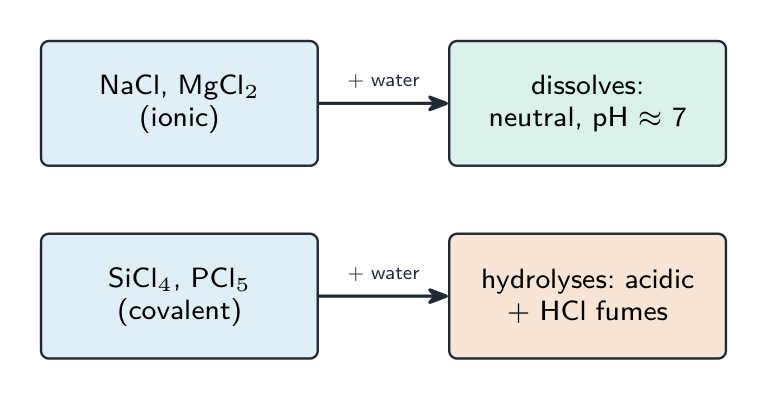
- $\text{NaCl}$ 和 $\text{MgCl}_2$ 是离子的。它们只是溶解,给出接近中性的溶液。
- $\text{SiCl}_4$ 和 $\text{PCl}_5$ 是共价的。它们发生水解(hydrolysis,与水反应)生成酸性溶液和 $\text{HCl}$ 的烟雾:
$$\text{SiCl}_4 + 2\text{H}_2\text{O} \rightarrow \text{SiO}_2 + 4\text{HCl} \qquad \text{PCl}_5 + 4\text{H}_2\text{O} \rightarrow \text{H}_3\text{PO}_4 + 5\text{HCl}$$
解释这些趋势
这些趋势由键和电负性(electronegativity)的变化得出。在左边,元素是电负性低的金属,所以它们的氧化物和氯化物是离子的、碱性的(或中性的)。在右边,元素是电负性高的非金属,所以它们的氧化物和氯化物是共价的、酸性的。你可以用一个氯化物或氧化物的性质(熔点、导电性、对水的影响)来推测它的键是离子的还是共价的。
例题。 预测把 $\text{Na}_2\text{O}$、$\text{Al}_2\text{O}_3$ 和 $\text{SO}_3$ 分别加入水中时的 pH。酸碱性随第 3 周期从金属到非金属的变化而变化。$\text{Na}_2\text{O}$ 是离子型且显碱性:它溶解生成 $\text{NaOH}$,所以 pH 约为 13。$\text{SO}_3$ 是共价型且显酸性:它反应生成 $\text{H}_2\text{SO}_4$,所以 pH 约为 1。$\text{Al}_2\text{O}_3$ 正处在转变处 - 它是两性的,而且在水中基本不溶,所以 pH 保持在约 7。陷阱就在最后这个:两性不等于中性,它的意思是这种氧化物既与酸反应又与碱反应 - 只是它不与水反应而已。
探索
Period 3 reaction lab
Classify Period 3 reactions by what they reveal about bonding and acidity.
探索
Oxide and chloride hydrolysis route
Follow how Period 3 oxides and chlorides change pH in water.
词汇表
训练
| 英文 | 中文 | 拼音 |
|---|---|---|
| oxidation number/ˌɒksɪˈdeɪʃn ˈnʌmbə/ | 氧化数 | yǎng huà shù |
| valence shell/ˈveɪləns ʃel/ | 价层 | jià céng |
| electron/ɪˈlektrɒn/ | 电子 | diàn zi |
| oxide/ˈɒksaɪd/ | 氧化物 | yǎng huà wù |
| amphoteric/ˌæmfəʊˈterɪk/ | 两性 | liǎng xìng |
| hydroxide/haɪˈdrɒksaɪd/ | 氢氧化物 | qīng yǎng huà wù |
| hydrolysis/haɪˈdrɒləsɪs/ | 水解 | shuǐ jiě |
| electronegativity/ɪˌlektrəʊŋɡəˈtɪvɪti/ | 电负性 | diàn fù xìng |
9.3
其他元素的化学周期性
大纲
- predict the characteristic properties of an element in a given group by using knowledge of chemical periodicity
- deduce the nature, possible position in the Periodic Table and identity of unknown elements from given information about physical and chemical properties
来源:剑桥国际大纲
同样的想法对任何族都行得通。如果你知道沿族向下和沿周期横过的模式,你就能:
- 从一个元素的位置预测它的性质(例如,一个第 1 族元素将是一个形成 $+1$ 离子的活泼金属)。
- 从一个未知元素的物理和化学性质推出它可能的位置和身份。
探索
Periodic trends
Step across Period 3 to see a property rise or fall, then repeat in the next period — that recurring pattern is periodicity.
9.3
考试技巧
- 总是把趋势与它的原因配对:原子半径沿第 3 周期下降(核电荷上升,屏蔽相近)。
- 用结构解释熔点模式:金属晶体(Na→Al)、巨型共价(Si,最高),然后分子晶体($\text{P}_4$、$\text{S}_8$、$\text{Cl}_2$)和单原子(Ar)。
- 氧化物沿周期从碱性 → 两性($\text{Al}_2\text{O}_3$) → 酸性;与离子到共价的键联系起来。
- 对于氧化物/氯化物与水的反应,给出产物和产生的 pH。
本主题的互动课程
逐步学习,并即时检测练习。