| English | 释义 | 拼音 |
|---|---|---|
| oxide/ˈɒksaɪd/ | 氧化物 | yǎng huà wù |
| chloride/ˈklɔːraɪd/ | 氯化物 | lǜ huà wù |
| oxidation number/ˌɒksɪˈdeɪʃn ˈnʌmbə/ | 氧化数 | yǎng huà shù |
Period 3 meets water and oxygen
- The Period 3 elements react with oxygen, chlorine and (some) water.
- The products are oxides 氧化物 and chlorides 氯化物.
- The element's oxidation number 氧化数 rises across the period.
Period 3 reaction lab
Classify Period 3 reactions by what they reveal about bonding and acidity.
Sodium reacts vigorously with water to form sodium hydroxide and ______.
难度 1/5 · 今日首次完成可获 100 金币及少量额外奖励
2Na + 2H₂O → 2NaOH + H₂.
With oxygen and chlorine
- With oxygen: e.g. $2\text{Mg} + \text{O}_2 \rightarrow 2\text{MgO}$, $\text{S} + \text{O}_2 \rightarrow \text{SO}_2$.
- With chlorine: e.g. $2\text{Na} + \text{Cl}_2 \rightarrow 2\text{NaCl}$, $2\text{Al} + 3\text{Cl}_2 \rightarrow 2\text{AlCl}_3$.
The reaction of sodium with chlorine gives:
难度 1/5 · 今日首次完成可获 100 金币及少量额外奖励
Sodium burns in chlorine to form sodium chloride: 2Na + Cl₂ → 2NaCl.
With water
- Only Na and Mg react: $2\text{Na} + 2\text{H}_2\text{O} \rightarrow 2\text{NaOH} + \text{H}_2$.
- Sodium reacts fast; magnesium reacts only very slowly with cold water.
Which Period 3 elements react with water?
难度 1/5 · 今日首次完成可获 100 金币及少量额外奖励
Only Na and Mg react with water; sodium reacts fast, magnesium only very slowly with cold water.
Match each Period 3 reaction to its result.
难度 2/5 · 今日首次完成可获 140 金币及少量额外奖励
Each item links the term to its correct meaning.
Oxidation numbers
- The element's oxidation number in its oxide/chloride rises across the period.
- It equals the number of outer-shell electrons used in bonding.
| Oxide | $\text{Na}_2\text{O}$ | $\text{MgO}$ | $\text{Al}_2\text{O}_3$ | $\text{P}_4\text{O}_{10}$ | $\text{SO}_3$ |
|---|---|---|---|---|---|
| ox. number | +1 | +2 | +3 | +5 | +6 |
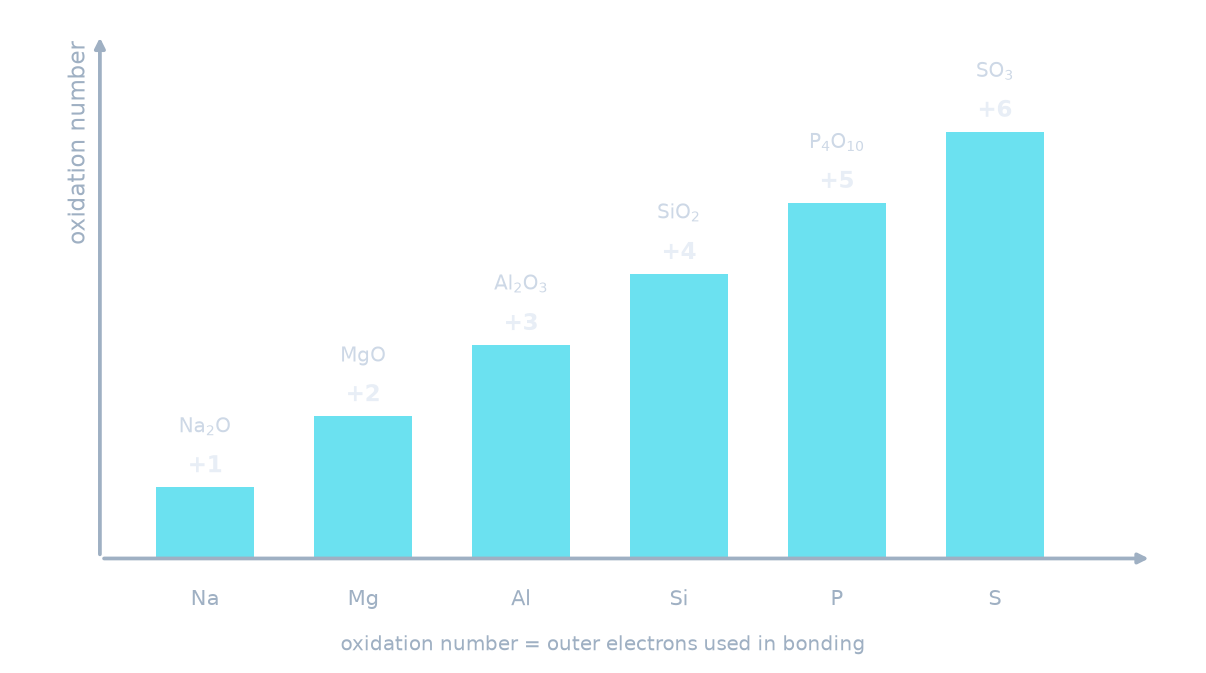
The oxidation number of the Period 3 element in its oxide rises across the period because it equals:
难度 1/5 · 今日首次完成可获 100 金币及少量额外奖励
Going across, each element uses more valence electrons, so its oxidation number rises (+1 for Na up to +6 for S in SO₃).
In Al₂O₃, the oxidation number of aluminium is:
难度 1/5 · 今日首次完成可获 100 金币及少量额外奖励
Na₂O is +1, MgO +2, Al₂O₃ +3 — the oxidation number rises across the period.
Worked example: equations and oxidation numbers
Write equations for aluminium burning in oxygen and phosphorus burning in excess oxygen. Give the oxidation number of the Period 3 element in each product, and link it to the outer electrons.
- $4\text{Al} + 3\text{O}_2 \rightarrow 2\text{Al}_2\text{O}_3$: Al is +3, matching its 3 outer electrons. $\text{P}_4 + 5\text{O}_2 \rightarrow \text{P}_4\text{O}_{10}$: P is +5, matching its 5 outer electrons.
- Check P: in $\text{P}_4\text{O}_{10}$, oxygen is −2, so $4x + 10(-2) = 0$ and $x = +5$. Across the period, more outer electrons can be used in bonding, so the maximum oxidation number rises.
What is the oxidation number of sulfur in SO₃?
难度 2/5 · 今日首次完成可获 140 金币及少量额外奖励
x + 3(−2) = 0, so x = +6.
Magnesium reacts with steam. What are the products?
难度 1/5 · 今日首次完成可获 100 金币及少量额外奖励
Mg + H₂O(g) → MgO + H₂.
You've got it
- elements react with oxygen and chlorine to form oxides and chlorides
- with water, only Na (fast) and Mg (slow) react
- the element's oxidation number rises across the period (= outer electrons used)